Large-scale Reordering Model for Statistical Machine Translation
using Dual Multinomial Logistic Regression
Abdullah Alrajehaband Mahesan Niranjanb
aComputer Research Institute, King Abdulaziz City for Science and Technology (KACST)
Riyadh, Saudi Arabia, [email protected]
bSchool of Electronics and Computer Science, University of Southampton
Southampton, United Kingdom,{asar1a10, mn}@ecs.soton.ac.uk
Abstract
Phrase reordering is a challenge for statis-tical machine translation systems. Posing phrase movements as a prediction prob-lem using contextual features modeled by maximum entropy-based classifier is su-perior to the commonly used lexicalized reordering model. However, Training this discriminative model using large-scale parallel corpus might be computationally expensive. In this paper, we explore recent advancements in solving large-scale clas-sification problems. Using the dual prob-lem to multinomial logistic regression, we managed to shrink the training data while iterating and produce significant saving in computation and memory while preserv-ing the accuracy.
1 Introduction
Phrase reordering is a common problem when translating between two grammatically different languages. Analogous to speech recognition tems, statistical machine translation (SMT) sys-tems relied on language models to produce more fluent output. While early work penalized phrase movements without considering reorderings aris-ing from vastly differaris-ing grammatical structures across language pairs like Arabic-English (Koehn, 2004a), many researchers considered lexicalized reordering models that attempted to learn orienta-tion based on the training corpus (Tillmann, 2004; Kumar and Byrne, 2005; Koehn et al., 2005).
Building on this, some researchers have bor-rowed powerful ideas from the machine learning literature, to pose the phrase movement problem as a prediction problem using contextual input fea-tures whose importance is modeled as weights of a linear classifier trained by entropic criteria. The approach (so called maximum entropy classifier
or simply MaxEnt) is a popular choice (Zens and Ney, 2006; Xiong et al., 2006; Nguyen et al., 2009; Xiang et al., 2011). Max-margin structure classifiers were also proposed (Ni et al., 2011). Alternatively, Cherry (2013) proposed recently us-ing sparse features optimize the translation quality with the decoder instead of training a classifier in-dependently.
While large-scale parallel corpus is advanta-geous for improving such reordering model, this improvement comes at a price of computational complexity. This issue is particularly pronounced when discriminative models are considered such as maximum entropy-based model due to the re-quired iterative learning.
Advancements in solving large-scale classifica-tion problems have been shown to be effective such as dual coordinate descent method for linear support vector machines (Hsieh et al., 2008). Sim-ilarly, Yu et al. (2011) proposed a two-level dual coordinate descent method for maximum entropy classifier.
In this work we explore the dual problem to multinomial logistic regression for building large-scale reordering model (section 3). One of the main advantages of solving the dual problem is providing a mechanism to shrink the training data which is a serious issue in building such large-scale system. We present empirical results com-paring between the primal and the dual problems (section 4). Our approach is shown to be fast and memory-efficient.
2 Baseline System
In statistical machine translation, the most likely translation ebest of an input sentence f can be
found by maximizing the probability p(e|f), as follows:
ebest= arg maxe p(e|f). (1)
A log-linear combination of different models (features) is used for direct modeling of the poste-rior probabilityp(e|f)(Papineni et al., 1998; Och and Ney, 2002):
ebest= arg maxe
n
X
i=1
λihi(f,e) (2)
where the feature hi(f,e) is a score function over sentence pairs. The translation model and the language model are the main features in any sys-tem although additional featuresh(.)can be inte-grated easily (such as word penalty). State-of-the-art systems usually have around ten features.
The language model, which ensures fluent translation, plays an important role in reordering; however, it has a bias towards short translations (Koehn, 2010). Therefore, a need for developing a specific model for the reordering problem.
2.1 Lexicalized Reordering Model
Adding a lexicalized reordering model consis-tently improved the translation quality for sev-eral language pairs (Koehn et al., 2005). Re-ordering modeling involves formulating phrase movements as a classification problem where each phrase position considered as a class (Tillmann, 2004). Some researchers classified phrase move-ments into three categories (monotone, swap, and discontinuous) but the classes can be extended to any arbitrary number (Koehn and Monz, 2005). In general, the distribution of phrase orientation is:
p(ok|f¯i,¯ei) =Z1 h( ¯fi,e¯i, ok). (3)
This lexicalized reordering model is estimated by relative frequency where each phrase pair (f¯i,¯ei) with such an orientation (ok) is counted and then normalized to yield the probability as fol-lows:
p(ok|f¯i,e¯i) = Pcount( ¯fi,¯ei, ok)
ocount( ¯fi,¯ei, o). (4)
The orientation of a current phrase pair is de-fined with respect to the previous target phrase. Galley and Manning (2008) extended the model to tackle long-distance reorderings. Their hierarchi-cal model enables phrase movements that are more complex than swaps between adjacent phrases.
3 Multinomial Logistic Regression
Multinomial logistic regression (MLR), also known as maximum entropy classifier (Zens and Ney, 2006), is a probabilistic model for the multi-class problem. The multi-class probability is given by:
p(ok|f¯i,e¯i) = exp(w >
kφ( ¯fi,e¯i))
P
k0exp(wk>0φ( ¯fi,¯ei)), (5)
where φ( ¯fi,e¯i)is the feature vector of the i-th phrase pair. An equivalent notation tow>
kφ( ¯fi,e¯i) is w>f(φ( ¯f
i,e¯i), ok) where w is a long vector composed of all classes parameters (i.e. w> = [w>
1 . . .w>K] ) and f(., .) is a joint feature vec-tor decomposed via the orthogonal feature rep-resentation (Rousu et al., 2006). This repre-sentation simply means there is no crosstalk be-tween two different feature vectors. For example,
f(φ( ¯fi,¯ei), o1)>= [φ( ¯fi,¯ei)>0. . .0].
The model’s parameters can be estimated by minimizing the following regularized negative log-likelihoodP(w)as follows (Bishop, 2006):
min w
1 2σ2
K
X
k=1
kwkk2− N
X
i=1
K
X
k=1
˜
piklogp(ok|f¯i,e¯i) (6) Hereσ is a penalty parameter andp˜is the em-pirical distribution where p˜ik equals zero for all
ok6=oi.
Solving the primal optimization problem (6) us-ing the gradient:
∂P(w)
∂wk =
wk
σ2−
N
X
i=1
˜
pik−p(ok|f¯i,e¯i)φ( ¯fi,¯ei), (7) do not constitute a closed-form solution. In our experiments, we used stochastic gradient decent method (i.e. online learning) to estimatewwhich is shown to be fast and effictive for large-scale problems (Bottou, 2010). The method approxi-mates (7) by a gradient at a single randomly picked phrase pair. The update rule is:
w0
k=wk−ηi∇kPi(w), (8)
3.1 The Dual Problem
Lebanon and Lafferty (2002) derived an equiva-lent dual problem to (6). Introducing Lagrange multipliersα, the dual becomes
min w
1 2σ2
K
X
k=1
kwk(α)k2+ N
X
i=1
K
X
k=1
αiklogαik,
s.t. XK
k=1
αik= 1 and αik≥0,∀i,k, (9)
where
wk(α) =σ2
N
X
i=1
(˜pik−αik)φ( ¯fi,¯ei) (10)
As mentioned in the introduction, Yu et al. (2011) proposed a two-level dual coordinate de-scent method to minimize D(α) in (9) but it has some numerical difficulties. Collins et al. (2008) proposed simple exponentiated gradient (EG) al-gorithm for Conditional Random Feild (CRF). The algorithm is applicable to our problem, a special case of CRF. The rule update is:
α0ik = Pαikexp(−ηi∇ikD(α))
k0αik0exp(−ηi∇ik0D(α)) (11)
where
∇ikD(α)≡ ∂∂αD(α)
ik = 1 + logαik +wy(α)>φ( ¯fi,e¯i)−wk(α)>φ( ¯fi,e¯i)
.
(12) Herey represents the true class (i.e. oy = oi). To improve the convergence, ηi is adaptively ad-justed for each example. If the objective function (9) did not decrease,ηiis halved for number of tri-als (Collins et al., 2008). Calculating the function difference below is the main cost in EG algorithm,
D(α0)− D(α) =XK
k=1
α0
iklogα0ik−αiklogαik
−XK
k=1
(α0
ik−αik)wk(α)>φ( ¯fi,e¯i)
+σ22kφ( ¯fi,¯ei)k2 K
X
k=1
(α0
ik−αik)2. (13)
Clearly, the cost is affordable becausewk(α)is maintained throughout the algorithm as follows:
wk(α0) =wk(α)−σ2(α0ik−αik)φ( ¯fi,¯ei) (14) Following Yu et al. (2011), we initializeαik as follows:
αik=
(1−) ifok=oi;
K−1 else. (15)
whereis a small positive value. This is because the objective function (9) is not well defined at
αik = 0due to the logarithm appearance.
Finally, the optimal dual variables are achieved when the following condition is satisfied for all ex-amples (Yu et al., 2011):
max
k ∇ikD(α) = mink ∇ikD(α) (16) This condition is the key to accelerate EG al-gorithm. Unlike the primal problem (6), the dual variables αik are associated with each example (i.e. phrase pair) therefore a training example can be disregarded once its optimal dual variables ob-tained. More data shrinking can be achieved by tolerating a small difference between the two val-ues in (16). Algorithm 1 presents the overall pro-cedure (shrinking step is from line 6 to 9).
Algorithm 1 Shrinking stochastic exponentiated
gradient method for training the dual problem
Require: training setS={φ( ¯fi,e¯i), oi}Ni=1
1: Givenαand the correspondingw(α)
2: repeat
3: Randomly pickifromS 4: Claculate∇ikD(α)∀kby (12)
5: vi = maxk∇ikD(α)−mink∇ikD(α) 6: ifvi ≤then
7: RemoveifromS
8: Continue from line 3
9: end if
10: η= 0.5
11: fort= 1tomaxTrial do 12: Calculateα0ik ∀kby (11) 13: ifD(α0)− D(α)≤0then 14: Updateαandw(α)by (14)
15: Break
16: end if
17: η = 0.5η
18: end for
4 Experiments
We used MultiUN which is a large-scale parallel corpus extracted from the United Nations website (Eisele and Chen, 2010). We have used Arabic and English portion of MultiUN where the English side is about 300 million words.
We simplify the problem by classifying phrase movements into three categories (monotone, swap, discontinuous). To train the reordering models, we used GIZA++ to produce word align-ments (Och and Ney, 2000). Then, we used the extracttool that comes with the Moses toolkit (Koehn et al., 2007) in order to extract phrase pairs along with their orientation classes.
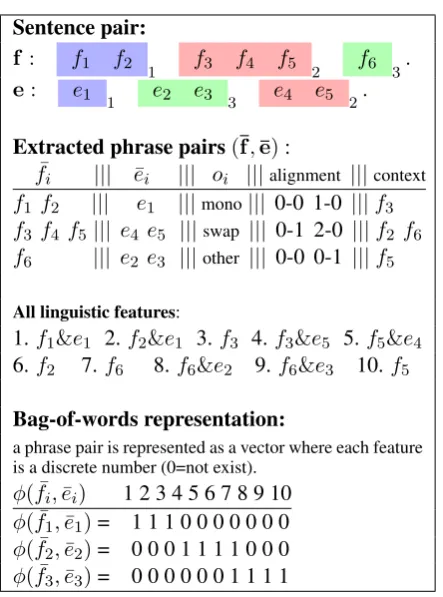
As shown in Table 1, each extracted phrase pair is represented by linguistic features as follows:
• Aligned source and target words in a phrase pair. Each word alignment is a feature.
• Words within a window around the source phrase to capture the context. We choose ad-jacent words of the phrase boundary.
The extracted phrase pairs after filtering are 47,227,789. The features that occur more than 10 times are 670,154.
Sentence pair:
f : f1 f2 1 f3 f4 f5 2 f6 3. e: e1 1 e2 e3 3 e4 e5 2.
Extracted phrase pairs(¯f,¯e): ¯
fi ||| e¯i ||| oi |||alignment |||context
f1 f2 ||| e1 |||mono||| 0-0 1-0 |||f3 f3 f4 f5||| e4 e5 |||swap ||| 0-1 2-0 |||f2 f6 f6 ||| e2 e3 |||other ||| 0-0 0-1 |||f5
All linguistic features:
1.f1&e1 2.f2&e1 3.f3 4.f3&e5 5.f5&e4
6.f2 7.f6 8. f6&e2 9.f6&e3 10.f5
Bag-of-words representation:
a phrase pair is represented as a vector where each feature is a discrete number (0=not exist).
φ( ¯fi,e¯i) 1 2 3 4 5 6 7 8 9 10
φ( ¯f1,e¯1)= 1 1 1 0 0 0 0 0 0 0 φ( ¯f2,e¯2)= 0 0 0 1 1 1 1 0 0 0 φ( ¯f3,e¯3)= 0 0 0 0 0 0 1 1 1 1
Table 1: A generic example of the process of phrase pair extraction and representation.
4.1 Classification
We trained our reordering models by both primal and dual classifiers for 100 iterations. For the dual MLR, different shrinking levels have been tried by varying the parameter () in Algorithm 1. Table 2 reports the training time and classification error rate of these models.
Training the dual MLR with moderate shrinking level (i.e.= 0.1) is almost four times faster than training the primal one. Choosing larger value for () leads to faster training but might harm the per-formance as shown below.
[image:4.595.312.522.256.324.2]Classifier Training Time Error Rate Primal MLR 1 hour 9 mins 17.81% Dual MLR:0.1 18 minutes 17.95% Dual MLR:1.0 13 minutes 21.13% Dual MLR:0.01 22 minutes 17.89%
[image:4.595.72.294.421.720.2]Table 2: Performance of the primal and dual MLR based on held-out data.
Figure 1 shows the percentage of active set dur-ing traindur-ing dual MLR with various shrinkdur-ing lev-els. Interestingly, the dual MLR could disregard more than99% of the data after a couple of iter-ations. For very large corpus, the data might not fit in memory and training primal MLR will take long time due to severe disk-swapping. In this sit-uation, using dual MLR is very beneficial.
2 4 6 8 10 12 14 16 18 20 0
10 20 30 40 50 60 70 80 90 100
Training iteration
Percentage of active phrase pairs
ǫ= 0 .1 ǫ= 1
[image:4.595.301.523.516.691.2].0 ǫ= 0.01
4.2 Translation
We used the Moses toolkit (Koehn et al., 2007) with its default settings to build three phrase-based translation systems. They differ in how their re-ordering models were estimated. The language model is a 5-gram with interpolation and Kneser-Ney smoothing (Kneser and Kneser-Ney, 1995). We tuned the system by using MERT technique (Och, 2003). As commonly used in statistical machine trans-lation, we evaluated the translation performance by BLEU score (Papineni et al., 2002). The test sets are NIST MT06 and MT08 where the En-glish sides are 35,481 words (1056 sentences) and 116,840 words (3252 sentences), respectively. Ta-ble 3 shows the BLEU scores for the translation systems. We also computed statistical significance for the models using the paired bootstrap resam-plingmethod (Koehn, 2004b).
Translation System MT06 MT08
Baseline + Lexical. model 30.86 34.22
Baseline + Primal MLR 31.37* 34.85*
Baseline + Dual MLR:0.1 31.36* 34.87* Table 3: BLEU scores for Arabic-English transla-tion systems with different reordering models (*: better than the lexicalized model with at least 95% statistical significance).
5 Conclusion
In training such system with large data sizes and big dimensionality, computational complexity be-come a serious issue. In SMT, maximum entropy-based reordering model is often introduced as a better alternative to the commonly used lexical-ized one. However, training this discriminative model using large-scale corpus might be compu-tationally expensive due to the iterative learning.
In this paper, we propose training the model using the dual MLR with shrinking method. It is almost four times faster than the primal MLR (also know as MaxEnt) and much more memory-efficient. For very large corpus, the data might not fit in memory and training primal MLR will take long time due to severe disk-swapping. In this sit-uation, using dual MLR is very beneficial. The proposed method is also useful for many classi-fication problems in natural language processing that require large-scale data.
References
Christopher M. Bishop. 2006. Pattern Recognition and Machine Learning (Information Science and Statistics). Springer-Verlag New York, Inc., Secau-cus, NJ, USA.
L´eon Bottou. 2010. Large-scale machine learning with stochastic gradient descent. In Yves Lecheval-lier and Gilbert Saporta, editors, Proceedings of the 19th International Conference on Computa-tional Statistics (COMPSTAT’2010), pages 177– 187, Paris, France, August. Springer.
Colin Cherry. 2013. Improved reordering for phrase-based translation using sparse features. In Proceed-ings of the 2013 Conference of the North American Chapter of the Association for Computational Lin-guistics: Human Language Technologies, pages 22– 31, Atlanta, Georgia, June. Association for Compu-tational Linguistics.
Michael Collins, Amir Globerson, Terry Koo, Xavier Carreras, and Peter L. Bartlett. 2008. Exponen-tiated gradient algorithms for conditional random fields and max-margin markov networks. Journal of Machine Learning Research, 9:1775–1822, June.
Andreas Eisele and Yu Chen. 2010. Multiun:
A multilingual corpus from united nation docu-ments. In Daniel Tapias, Mike Rosner, Ste-lios Piperidis, Jan Odjik, Joseph Mariani, Bente Maegaard, Khalid Choukri, and Nicoletta Calzo-lari (Conference Chair), editors,Proceedings of the Seventh conference on International Language Re-sources and Evaluation, pages 2868–2872. Euro-pean Language Resources Association (ELRA), 5. Michel Galley and Christopher D. Manning. 2008. A
simple and effective hierarchical phrase reordering model. In Proceedings of the 2008 Conference on Empirical Methods in Natural Language Process-ing, pages 848–856, Hawaii, October. Association for Computational Linguistics.
Cho-Jui Hsieh, Kai-Wei Chang, Chih-Jen Lin, S. Sathiya Keerthi, and S. Sundararajan. 2008. A dual coordinate descent method for large-scale lin-ear svm. In Proceedings of the 25th International Conference on Machine Learning, ICML ’08, pages 408–415.
Reinhard Kneser and Hermann Ney. 1995. Improved backing-off for m-gram language modeling. IEEE International Conference on Acoustics, Speech and Signal Processing, pages 181–184.
Philipp Koehn and Christof Monz. 2005. Shared task: Statistical machine translation between euro-pean languages. InProceedings of ACL Workshop on Building and Using Parallel Texts, pages 119– 124. Association for Computational Linguistics. Philipp Koehn, Amittai Axelrod, Alexandra Birch
for the 2005 IWSLT speech translation evaluation. In Proceedings of International Workshop on Spo-ken Language Translation, Pittsburgh, PA.
Philipp Koehn, Hieu Hoang, Alexandra Birch, Chris Callison-Burch, Marcello Federico, Nicola Bertoldi, Brooke Cowan, Wade Shen, Christine Moran, Richard Zens, Christopher J. Dyer, Ondˇrej Bojar, Alexandra Constantin, and Evan Herbst. 2007. Moses: Open source toolkit for statistical machine translation. InProceedings of the ACL 2007 Demo and Poster Sessions, pages 177–180.
Philipp Koehn. 2004a. Pharaoh: a beam search de-coder for phrase-based statistical machine transla-tion models. InProceedings of 6th Conference of the Association for Machine Translation in the Ameri-cas (AMTA), pages 115—124, Washington DC. Philipp Koehn. 2004b. Statistical significance tests for
machine translation evaluation. In Dekang Lin and Dekai Wu, editors, Proceedings of EMNLP 2004, pages 388–395, Barcelona, Spain, July. Association for Computational Linguistics.
Philipp Koehn. 2010.Statistical Machine Translation. Cambridge University Press.
Shankar Kumar and William Byrne. 2005.
Lo-cal phrase reordering models for statistiLo-cal machine translation. In Proceedings of Human Language Technology Conference and Conference on Empiri-cal Methods in Natural Language Processing, pages 161–168, Vancouver, British Columbia, Canada, October. Association for Computational Linguistics. Guy Lebanon and John D. Lafferty. 2002. Boosting and maximum likelihood for exponential models. In T.G. Dietterich, S. Becker, and Z. Ghahramani, ed-itors, Advances in Neural Information Processing Systems 14, pages 447–454. MIT Press.
Vinh Van Nguyen, Akira Shimazu, Minh Le Nguyen, and Thai Phuong Nguyen. 2009. Improving a lex-icalized hierarchical reordering model using maxi-mum entropy. In Proceedings of the Twelfth Ma-chine Translation Summit (MT Summit XII). Inter-national Association for Machine Translation. Yizhao Ni, Craig Saunders, Sandor Szedmak, and
Ma-hesan Niranjan. 2011. Exploitation of machine learning techniques in modelling phrase movements for machine translation. Journal of Machine Learn-ing Research, 12:1–30, February.
Franz Josef Och and Hermann Ney. 2000. Improved statistical alignment models. InProceedings of the 38th Annual Meeting of the Association of Compu-tational Linguistics (ACL).
Franz Josef Och and Hermann Ney. 2002. Discrimina-tive training and maximum entropy models for sta-tistical machine translation. In Proceedings of the 40th Annual Meeting of the Association for Compu-tational Linguistics (ACL).
Franz Josef Och. 2003. Minimum error rate training in statistical machine translation. InProceedings of the 41st Annual Meeting on Association for Computa-tional Linguistics - Volume 1, ACL ’03, pages 160– 167, Stroudsburg, PA, USA. Association for Com-putational Linguistics.
Kishore Papineni, Salim Roukos, and Todd Ward. 1998. Maximum likelihood and discriminative training of direct translation models. InProceedings of ICASSP, pages 189–192.
Kishore Papineni, Salim Roukos, Todd Ward, and Wei-Jing Zhu. 2002. Bleu: a method for automatic eval-uation of machine translation. InProceedings of the 40th Annual Meeting on Association for Computa-tional Linguistics, pages 311–318, Stroudsburg, PA, USA. Association for Computational Linguistics. Juho Rousu, Craig Saunders, Sandor Szedmak, and
John Shawe-Taylor. 2006. Kernel-based learning of hierarchical multilabel classification models. Jour-nal of Machine Learning Research, pages 1601– 1626.
Christoph Tillmann. 2004. A unigram orientation model for statistical machine translation. In Pro-ceedings of HLT-NAACL: Short Papers, pages 101– 104.
Bing Xiang, Niyu Ge, and Abraham Ittycheriah. 2011. Improving reordering for statistical machine transla-tion with smoothed priors and syntactic features. In Proceedings of SSST-5, Fifth Workshop on Syntax, Semantics and Structure in Statistical Translation, pages 61–69, Portland, Oregon, USA. Association for Computational Linguistics.
Deyi Xiong, Qun Liu, and Shouxun Lin. 2006. Max-imum entropy based phrase reordering model for statistical machine translation. In Proceedings of the 21st International Conference on Computational Linguistics and 44th Annual Meeting of the ACL, pages 521–528, Sydney, July. Association for Com-putational Linguistics.
Hsiang-Fu Yu, Fang-Lan Huang, and Chih-Jen Lin. 2011. Dual coordinate descent methods for logistic regression and maximum entropy models. Machine Learning, 85(1-2):41–75, October.