STEADY FLOWS IN PIPES OF RECTANGULAR CROSS
MEDIUM WITH MAGNETIC FIELD
Department of Applied Sciences, Ideal Institute of Technology, Ghaziabad (U.P), India
ARTICLE INFO ABSTRACT
In this paper we have investigated the steady porous medium with magnetic field.
Copyright © 2015 Dr. Anand Swrup Sharma. This is an open access article distributed under the Creative Commons Att unrestricted use, distribution, and reproduction in any medium, provided the original work is properly cited.
INTRODUCTION
We have investigated the steady flow in pipes of rectangular cross several researchers i.e. Givler and Altobelli
model. Goel and Agarwal (1998) shears flow instability of visco some solutions of the boundary-layer equations in hydrodynamics.
Gopinath (1994) steady streaming due to small amplitude superposed oscillations of a sphere in a viscous fluid. Bernard (1995) Vorticity Transport Analysis of turbule
study of double-diffusive natural convection in a porous cavity using the Darcy Reynolds number solutions of Navier-stokes equations using incremen
region boundary element method for incompressible viscous fluid flows.
Grosan, Revnic, Pop and Ingham (2009) rectangular cavity filled with a porous medium
flow computations. Gupta (1991) high accuracy solutions of incompressible Navier Boundary layer receptivity to free-stream sound on parabolic bodies.
Haji-Sheikh and Vafai (2004) analysis of flow and heat transfer in porous media imbedded inside various paper we have investigated the velocity, flux and vortex line.
FORMULATION OF THE PROBLEM
Let z-axis be taken the direction of flow along the axis of the pipe. Then u = 0, v = 0 for steady and incompressible fluid the velocity component is independent of z.
*Corresponding author: Dr. Anand Swrup Sharma
Department of Applied Sciences, Ideal Institute of Technology, Ghaziabad (U.P), India
ISSN: 0975-833X
Vol.
Article History:
Received 28th December, 2014 Received in revised form 15th December, 2014 Accepted 27th January, 2015 Published online 26th February,2015
Key words: Steady flow,
Rectangular cross section, Incompressible fluid,
porous medium and Magnetic field.
RESEARCH ARTICLE
STEADY FLOWS IN PIPES OF RECTANGULAR CROSS-SECTION THROUGH POROUS
MEDIUM WITH MAGNETIC FIELD
*Dr. Anand Swrup Sharma
of Applied Sciences, Ideal Institute of Technology, Ghaziabad (U.P), India
ABSTRACT
In this paper we have investigated the steady flow in pipes of rectangular cross porous medium with magnetic field. We have investigated the velocity, flux and vortex line.
is an open access article distributed under the Creative Commons Att use, distribution, and reproduction in any medium, provided the original work is properly cited.
steady flow in pipes of rectangular cross-section through porous medium.
Altobelli (1994) a determination of the effective viscosity for the Brinkman shears flow instability of visco- elastic fluid in a porous medium.
layer equations in hydrodynamics.
steady streaming due to small amplitude superposed oscillations of a sphere in a viscous fluid. Vorticity Transport Analysis of turbulent flows. Journal of Fluids Engng. Goyeau
diffusive natural convection in a porous cavity using the Darcy-Brinkman formulation. stokes equations using incremental unknowns. Grigoriev
region boundary element method for incompressible viscous fluid flows.
(2009) Magnetic field and internal heat generation effects on the free convection in a ity filled with a porous medium. Gupta and Manohar (1979) Boundary approximations and accuracy in viscous
high accuracy solutions of incompressible Navier-stokes equations.
stream sound on parabolic bodies. Haddon and Riley (1985) on flows with closed streamlines. analysis of flow and heat transfer in porous media imbedded inside various
velocity, flux and vortex line.
axis be taken the direction of flow along the axis of the pipe. Then u = 0, v = 0 for steady and incompressible fluid the
*Corresponding author: Dr. Anand Swrup Sharma,
Department of Applied Sciences, Ideal Institute of Technology, Ghaziabad (U.P), India.
International Journal of Current Research Vol. 7, Issue, 02, pp.12418-12424, February, 2015
INTERNATIONAL
SECTION THROUGH POROUS
of Applied Sciences, Ideal Institute of Technology, Ghaziabad (U.P), India
flow in pipes of rectangular cross-section through We have investigated the velocity, flux and vortex line.
is an open access article distributed under the Creative Commons Attribution License, which permits
section through porous medium. Attempts have been made by a determination of the effective viscosity for the Brinkman-Forchheimer flow elastic fluid in a porous medium. Goldstein (1930) concerning
steady streaming due to small amplitude superposed oscillations of a sphere in a viscous fluid. Gorski and Goyeau and Gobin (1996) Numerical Brinkman formulation. Goyon (1996)
high-Grigoriev and Dargush (1999) a
poly-Magnetic field and internal heat generation effects on the free convection in a Boundary approximations and accuracy in viscous stokes equations. Haddad and Corke (1998)
on flows with closed streamlines. analysis of flow and heat transfer in porous media imbedded inside various-shaped ducts. In this
axis be taken the direction of flow along the axis of the pipe. Then u = 0, v = 0 for steady and incompressible fluid the
The equation of continuity.
u
v
w
0 ...(1)
x
y
z
0,
0 ,
w
0
,
...(2)
But u
v
w
w x y
z
i.e. w is independent of z
The Navier-Stokes equations of motion in the absence of body forces.
= 0 ...(3)
P
x
= 0...(4)
P
y
2 2 2 0 2 21
0...(5)
B
P
w
w
w
z
x
y
K
It is clear from (3) and (4) P is independent of x and y i.e. p is the Function of z
SOLUTION OF THE PROBLEM p = p (z)
p
dp
Constant
P
z
dz
2 2 2 2 2
2 2 2
0
2 2 2 2
1
,
...(6)
B
w
w
dp
w
w
P
let
B
B w
B w
K
x
y
dz
x
y
2 2 2
' 2 2 2'
.
n nwhere
n& ' are related by
n n'
n0
h x h y n
P
D
D
B
w
C F
a e
h
h
h
h
B
2
2 ' 2
2 2 2 2 2
1
'
1
1
and . .
w (x, y) =
Where
'
n n n nn n
h x h y
P
P
P I
a e
P
h
h
B
D
D
B
B
B
Case-1
w x y
( , )
0
at a b w x y
( , ) ( , )
0
at a
( ,
b
)
2 2 1 1 ' '
0
0
n n n n a an n n n
h h b
P
h h bP
a e
and
a
e
B
B
2 2 ' ' 1 1na n
...( ) &
na n
...( )
n n
n n
h h b h h b
P
P
a
e
a
a
e
b
B
B
Figur-1y- axis
x- axis
z
A
B
C
D
(-a , b)
(-a , -b) (a , -b)
(a , b)
(0, 0)
o =x
a
x
=
-a
2
'
2
1 1
0
P
a B B a B
n n n n
n n
P
on solving h
h
B
e
a
a
e
e
B
2
1 2 2 2
1 1
( , )
P
a B x B a B B a B
n n
n n
P
P
P
w x y
e
e
e
a
a
e
e
B
B
B
Case -2
w x y
( , )
0
at
(
a b
, ) & (
a
,
b
)
2 2 2 2 2
( )
( , )
P
a B
x B
P
P
B x a
P
w x y
e
e
e
B
B
B
B
Case - 3
( )
3 2 2 2 2
( , )
0 at (
, ) & ( , )
( , )
P
b B y B
P
P
B y b
P
w x y
a b
a b
w x y
e e
e
B
B
B
B
Case - 4
w x y
( , )
0 at (
a
,
b
) & ( ,
a
b
)
w x y
4( , )
P
2e
B y b( )P
2B
B
2
( , )
P
1 2
a B2
b B... (7)
w x y
e
Cosh x B
e
Cosh y B
B
In particular case: In the case of square i.e .a = b
2
( , )
P
1 2
a B... (8)
w x y
e
Cosh x B Cosh y B
B
Flux Q of the fluid over an area of rectangular cross-section:
2
( , )
1 2
a B2
b Ba b a b
x a y b a b
P
Q
w x y dx dy
e
Cosh x B
e Cosh y B dx dy
B
2 0 2
2 2 1
1 2 a B 2 b B 1 2 a B 2 b B
a b a
a a
P P
e Cosh x B e Cosh y B dy dx e Cosh x B b e Sinh b B dx
B B B
2 0 2
0
4 2 4 2 2
1 2 a B b B a B b B
a a
P P a
b e Cosh x B e Sinh b B dx b x e Sinh x B e Sinh b B
B B B B B
2
4
P
2
a B2
a
b Bb a
e
Sinh a B
e
Sinhb B
B
B
B
2
4
2
... (9)
a B b B
P
Q
ab
b e
Sinh a B
a e
Sinh b B
B
B
2
2
4
4
... (10)
a BP
a
Q
a
e
Sinh a B
B
B
The equation of vortex line:
x
y
z
dx
dy
dz
here
x,
y&
z are vorticity components
2
1 2
2
a B b B
P
where q
ui vj
wk
e
Cosh x B
e
Cosh y B k
B
2
2
2
b B b Bx
w
v
P
P
B e
Sinh y B
e
Sinh y B
y
z
B
B
2
2
2
a Ba B
0
y
u
w
P
B e
Sinh x B
P
e
Sinh x B
z
z
x
B
B
0
2
b B2
a B0
dx
dy
dz
dz
z
B
P
P
e
Sinh y B
e
Sinh x B
B
B
1
a B b B
a B b B
dx
dy
e
Sinh x B dx
e
Sinh y B dy
C
e
Sinh x B
e
Sinh y B
1
1
1
1
or
b B a B
a B b B
e
Cosh x B
e
Cosh y B
C
e
Cosh x B
e
Cosh y B
C B
A
B
B
Vortex lines:e
a BCosh x B
e
bBCosh y B
A
&
Z = B ... (11)
Clearly the flow is Rotational in pipe.
I
n particular case: In the case of square a = b
&
Z = B ... (12)
a B
e
Cosh x B
Cosh y B
A
Tables for velocity: Case- 1
2 2
0 0
1
1
1
1
1
,
.5,
1,
4
2
2
B
B
Let P
a
b
B
K
K
Table 1 (for velocity)
x y
,
(.1, .1)
(.2, .3)
(.3, .4)
(.4, .5)
(.5, .6)
(.6, .7)
(.7, .8)
1
1
2
K
,
w x y
-11.21
-11.297
-11.396
-11.529
-11.696
-11.897
-12.133
2
0 1
2 B
,
w x y
-11.21
-11.297
-11.396
-11.529
-11.696
-11.897
-12.133
2 0
1
1
2
B
K
,
w x y
-7.133
-7.245
-7.367
-7.532
-7.739
-7.99
-8.286
C
ase-
22 2 2
0 0 0
1
1
1
1
1
5
,
.5,
1,
1
4
2
2
B
B
B
Let P
a
b
Let
and
B
K
K
K
T
a
ble-
2 (for velocity)
x y
,
(.1, .1)
(.2, .3)
(.3, .4)
(.4, .5)
(.5, .6)
(.6, .7)
(.7, .8)
1
1
2
K
,
w x y
-11.21
-11.297
-11.396
-11.529
-11.696
-11.897
-12.133
2
0
1
B
,
w x y
-4.964
-5.114
-5.28
-5.504
-5.788
-6.134
-6.547
2 0
1 5
2 B K
,
w x y
-4.525
-4.695
-4.882
-5.135
-5.458
-5.854
-6.328
C
ase –
32 2 2
0 0 0
1
1
1
1
1
5
,
.5,
1,
1
4
2
2
B
B
B
Let P
a
b
Let
and
B
K
K
K
T
able-
3 (for velocity)
x y
,
(.1, .1)
(.2, .3)
(.3, .4)
(.4, .5)
(.5, .6)
(.6, .7)
(.7, .8)
2
0
1
2
B
,
w x y
-4.964
-5.114
-5.28
-5.504
-5.788
-6.134
-6.547
1
1
K
,
w x y
-11.21
-11.297
-11.396
-11.529
-11.696
-11.897
-12.133
2 0
1
5
2
B
K
,
[image:5.595.36.547.52.761.2]CONCLUSION AND DISCUSSION
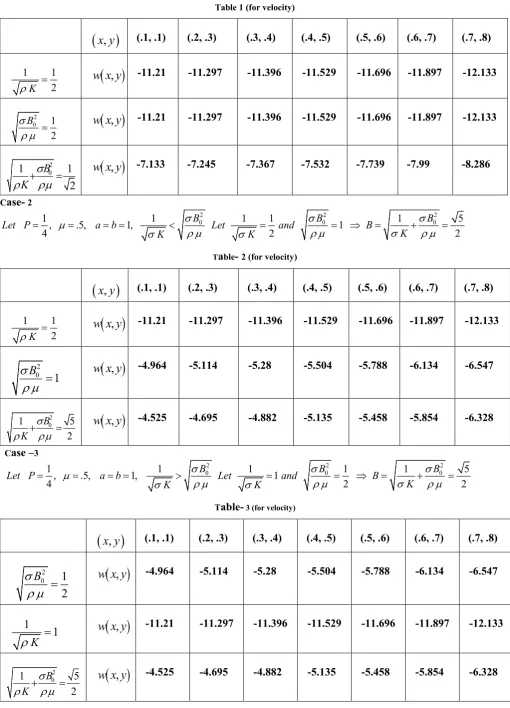
In this paper we have investigated the velocity by the Table-1 of equations (7) between velocities and point
x y
,
it is clear that paths of velocity are approximately parallel increases uniformly with negative sign in porous medium, magnetic field and porous medium with magnetic field in the interval
.1,.1
x y
,
.7 ,.8
but the value of velocity in porous medium and magneticfield at
2 0
1
1
2
B
K
is greater than the corresponding value of velocity in porous medium with magnetic field at2 0
1
1
2
B
K
in the interval
.1,.1
x y
,
.7 ,.8
.Again by the Table-2 of equations (7) between velocities and point
x y
,
it is clear that paths of velocity are approximately parallel increases uniformly with negative sign in porous medium, magnetic field and porous medium with magnetic field in theinterval
.1,.1
x y
,
.7 ,.8
but the value of velocity in porous medium at1
1
2
K
is greater (negatively) thencorresponding value of velocity in magnetic field at
2 0
1
B
and also is greater than the corresponding value of velocity inporous medium with magnetic field at
2 0
1
5
2
B
K
respectively.Again by the Table-3 of equations (7) between velocities and point
x y
,
it is clear that paths of velocity are approximately parallel increases uniformly with negative sign in porous medium, magnetic field and porous medium with magnetic field in theinterval
.1,.1
x y
,
.7 ,.8
but the value of velocity in magnetic field at2
0
1
2
B
is greater (negatively) thencorresponding value of velocity in porous medium at
1
1
K
and also is greater than the corresponding value of velocity inporous medium with magnetic field at
2 0
1
5
2
B
K
respectively. We have investigated the vortex lines and thevolumetric flow of elliptic and circle given by the equations (8), (9), (10), (11) and (12) respectively.
REFERENCES
Givler R. C. and Altobelli S.A., 1994. A determination of the effective viscosity for the Brinkman-Forchheimer flow model.J. Fluid Mechanics; Vol. 258, pp 355–370.
Goel, A. K. and Agarwal, S.C., 1998. Shears flow instability of visco- elastic fluid in a porous medium. Indian J. Pure Appl. Math., Vol. 29, (9). pp 969-981.
Goldstein, S., 1930. Concerning some solutions of the boundary-layer equations in hydrodynamics. Proc. Camb. Phil. Soc., Vol. 26, pp 1-30.
Gopinath, A., 1994. Steady streaming due to small amplitude superposed oscillations of a sphere in a viscous fluid. G. J.Mech. Applied Math., Vol. 81, pp. 3.
Gorski, J. J. and Bernard, P. S. 1995. Vorticity Transport Analysis of turbulent flows. Journal of Fluids Engng. J. of Fluids Engng., Vol. 117, No. 3, pp 410-416.
Goyeau, J. P. and Gobin, D., 1996. Numerical study of double-diffusive natural convection in a porous cavity using the Darcy-Brinkman formulation. Int. J. of Heat and Mass Transfer, vol. 39, no. 7, pp 1363–1378.
Goyon, O., 1996. High-Reynolds number solutions of Navier-stokes equations using incremental unknowns. Computer methods in applied mechanics and engineering; Vol. 130, pp 319-335.
Grigoriev, M. M. and Dargush, G. F., 1999. A poly-region boundary element method for incompressible viscous fluid flows. Int. J. Numer. Meth. Engg., Vol. 46, pp 1127–1158.
Grosan, T. and Revnic, C., Pop, I. and Ingham, D. B., 2009. Magnetic field and internal heat generation effects on the free convection in a rectangular cavity filled with a porous medium. Int. J. of Heat and Mass Transfer, vol. 52, no. 5-6, pp 1525– 1533.
Gupta, M. M. and Manohar, R. P., 1979. Boundary approximations and accuracy in viscous flow computations. J. Comp. Physics; Vol. 31, pp 265–288.
Gupta, M. M., 1991. High accuracy solutions of incompressible Navier-stokes equations. J. Comp. Physics; Vol. 93, pp 343–359. Haddad, O. M. and Corke, T. C., 1998. Boundary layer receptivity to free-stream sound on parabolic bodies. J. Fluid Mechanics
Vol. 368, pp 1-26.
Haddon, E. W. and Riley, N., 1985. On flows with closed streamlines. J. Eng. Math., Vol. 19 pp 233-246.
Haji-Sheikh, A. and Vafai, K., 2004. Analysis of flow and heat transfer in porous media imbedded inside various-shaped ducts.
Int. J. of Heat and Mass Transfer, Vol. 47, pp 1889-1905.