Theoretical Model for Detecting Sensitive Data Items of
Users in Data Publication
Charles R. Haruna
University of Electronic Science and Technology of China No. 2006 , Xiyuan Ave, West Hi-Tech Zone
611731, Chengdu, China
MengShu Hou
University of Electronic Science and Technology of China No. 2006 , Xiyuan Ave, West Hi-Tech Zone
611731, Chengdu, China
Barbie Eghan-Yartel
University of Cape CoastCape Coast, Ghana
ABSTRACT
Developments in current information technology are leading to the increased capture and storage of information about people and their activities. This raises serious concerns about the which data items are sensitive and how to detect these sensitive data items. Data pri-vacy has become a very important concern in data publication in this modern era. The protection of data privacy depends on exactly what needs to be kept secret, thus, sensitive data. Protecting data privacy is a complicated task that takes into consideration what needs to be kept confidential. However, current privacy modeling techniques assume sensitive data items.
This paper considers the detection of sensitive data items in data publication for research purposes. We attempt to theo-retically formalize a model for detecting sensitive data us-ing a directed graph. We identify transitions that have a lot of sensitive data items published to them; critical transitions. Furthermore, the state that is most risky to the user to tra-verse in the graph, termed the ”Risky State” was ascertained.
General Terms
Data Privacy
Keywords
Sensitive Data items, Data Publication, User Transition
1. INTRODUCTION
Data owners over the years have had problems publishing their data items (examples are medical records, personal photos, telephone numbers, salary) to access services from different states (examples are hospitals, companies, banks). Extraordinary amounts of data on individuals are being collected in this age by the trusted third party. When a data owner seeks a service from a state, their data items are published. The data are published for reasons such as offering ser-vices to the user, research purposes and legal cases. Unfortunately, once the data items are published, the owners can no longer count on the third party to publish data items that will not compromise their privacy. The issue of users protecting their privacy is a very
vital concern that troubles them the most. A technique to detect sensitive data is needed to control the rate at which third parties publish data items to states that will weaken the data user’s privacy. Individuals have different reasons for accessing a service. Publish-ing certain data items to some states will put the privacy of the data owner at risk. For example, Bob intends to give out his informa-tion to both the hospital and a manufacturing industry for medical care and employment respectively. In most cases, the information released to a medical facility via the trusted third party, for Bob to receive a better care, is different from the one released to the in-dustry for employment. The same information on past medical his-tory cannot be released to the manufacturing industry for employ-ment. Some features of the same information released for medical care will not be published to secure an employment. How does the trusted third party be made aware of the data items to be published to different states without compromising the privacy of the user? To the best of knowledge, there are no existing techniques that de-tect sensitive items of users, they all assume some data items are sensitive. Most of the techniques in previous works talked about usingk-anonymity and improvements ofk-anonymity techniques to protect the user’s privacy [1]. [7][8] presented models for pro-tecting user’s data privacy based on the adversary’s external knowl-edge. However, their methods of protecting the privacy of the indi-vidual’s detected sensitive data items were determined only based on assumptions and sanitized techniques.
The goal and contributions of this research is to propose a technique to detect sensitive data and protect the owners in data publishing industry. We used a directed graph depicting the relationships of the user’s data publication to explain this work. Furthermore, in the graph Critical transitions and Risky State were identified.
2. PROBLEM FORMULATION
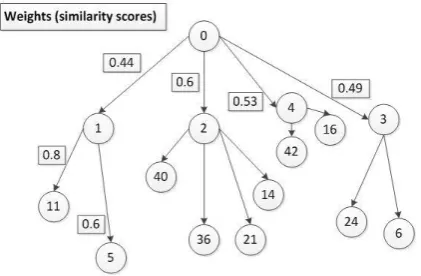
Fig. 1. A subgraph showing a data user’s transitions.
2.1 Formal Definitions
Let the set of records be R =(r1,r2, . . . ,rn). A data owner,U, has
a set of data itemsD={d1, d2, . . . , dn}, where each itemdiR
represents information to be published to different set of states,S=
{s1, s2, . . . , sn}. But among these data items are sensitive ones
that when published will compromise the user’s privacy. Examples of a data publisher’s states can be staying at home, going to the office, going to the bar or restaurant, to the shopping mall, to the transport yard, home of a friend or a relative, a holiday resort, to the sports complex or to the hospital. We call each trajectory by the user between states, a transition.
A graph G= (V, E) consists of a set of vertices (nodes)
V ={v1, v2, . . . , vn}representing the set of records/states. A set
of edgesE⊆V ×V ,i.e. the edge set is a subset of ordered pairs of distinct nodes representing the user’s transition from a state to another. An edgee(j, k)⊆E is called directed if(j, k)⊆E. A statek is said to be accessible from statejwritten asj→k, if the system started in statejand has a non-zero probability of transitioning into statek. If there is a directed edgej→k, statej is said to be an ancestor of statek, andkthe descendant ofj. Each edgeegin setE, is associated with a non-negative weight,w(eg).
A similarity based technique [17][18][19] is used on a pair of vertices to calculate a similarity value as the weight of the edges. In this work the similarity-based technique used is the Euclidean distance,DE, defined [20] as:
DE −→
ta,
− → tb = m X t=1
|wt,a−wt,b|2 !1/2
(1)
Fig. 1, shows a subgraph with weights of user’s transitions to states accessing different types of services .
2.1.1 Detection of Sensitive Data Items. A userUsends numer-ous requests for their data items to be published to different states for services. Some data items published on the transitions to the states may lessen or compromise the user’s privacy depicting these data items as sensitive information relative to the transition being published on. Randomly assigned weights of publishing a data item in a database isw(di)and ranges [0,1].
The pseudocode for detecting sensitive data items is shown in Al-gorithm1. It inputs a directed graphG= (V, E)and data items
difrom the dataset. Similarity values are then calculated for each
transition as weights of the graphw(Sj→ Sk). Random weights
Algorithm 1Detecting Sensitive Data Items Require: A directed graphG= (V, E), data itemsdi. Ensure: sensitive data itemsdion a transition(Sj→Sk).
1: generatew(Sj→Sk)by using Euclidean distance similarity score. 2: generaterandomw(di).
3: calculateset ofvalue(di,(Sj→Sk))=w(Sj→Sk)×w(di) 4: selectdistinctvalue(di,(Sj→Sk)).
5: ordervalue(di,(Sj→Sk))desc. 6: selecttop 20%value(di,(Sj→Sk)). 7: setSD←select randomvalue(di,(Sj→Sk)). 8: whiledi≤dn
9: select(Sj→Sk)to determine sensitive data items on. 10: selectdi.
11: ifvalue(di,(Sj→Sk))>=SD. 12: savedion(Sj→Sk)as sensitive data item. 13: elseincreasediby 1.
14: end if 15: end while
16: returndion(Sj→Sk)as sensitive data item.
w(di) are assigned to the data items. Lines 3 computes the set
of values of data items on a transition,value(di,(Sj → Sk))as
w(Sj→Sk)×w(di). The set ofvalue(di,(Sj→Sk))is sorted
in a descending order from largest to smallest. The set of top twenty (20)%from the sortedvalue(di,(Sj → Sk))is selected. To set
the threshold value, the algorithm randomly selects a value from the set containing the top twenty (20)%value(di,(Sj → Sk)).
Finally, it comparesvalue(di,(Sj→Sk))with the set value,SD.
Ifvalue(di,(Sj→Sk))>=SD, the data itemsdiare returned as
sensitive data on the relative transition(Sj→Sk). Otherwise,diis
not sensitive and when published on(Sj→Sk)to access services
will not compromise privacy of the user.
2.1.2 Critical Transition of a user. In data publication, the criti-cal path of a user from a start node to its descendant nodes is de-fined as the transition with possibly the most sensitive data items detected on. Thus, sensitive data items on each transition are de-tected, then the transition with the highest number of sensitive data items is identified as the critical transition.
2.1.3 Risky State. From the graph a ”Risky State” of the user’s transitions shall be identified. The ”Risky State” is assumed to be the most dangerous state and the weak link of the graph because a lot of sensitive data items are published to it, thus it is vulnerable to attacks by adversaries and hence, will compromise the privacy of the user.
2.1.4 Complexity Analysis. Our algorithm can detect a user?s sensitive data items only with a certain level of confidence. Con-fidence is a number between 0 and 1 that denotes the probability that an item is detected as sensitive. In this work, it could be as-sumed that capturing confidence is a property. Together with the accuracy (efficiency), the algorithm determines an item?s sensitiv-ity with respect to privacy ? that is, how detectable a data item is captured with a particular level of confidence and at a given level of accuracy. For the data items, the higher their sensitivity, the more detectable they are. Assume a data itemdi, has an accuracy that
Table 1. Setting of Threshold Values.
Experiments SD
Experiment 1 0.19
Experiment 2 0.07
Experiment 3 0.05
Experiment 4 0.14
reduction in uncertainty (entropy) after the data item?s detection confidence for a given accuracy is known:
sensitivity(di) =− n X 1 log1 n − "
(−plogp)−
n−1 X
1 1−p n−1log
1−p n−1
# (2)
3. EXPERIMENTS AND DISCUSSIONS
According to research, there are no suitable methods for identifying sensitive data items on transitions that this work can be compared with.
The experiments setup was as follows:
Data used were from a Directed Gnutella P2P network from Au-gust 6, 2002 and constructed a directed graph with 8717 nodes and 31525 edges representing states where a user can access a service and the transitions respectively. We also used 2 datasets from the UCI machine learning; Adult Data Set and Census Income Data Set with 16281 and 32561 records respectively. We pruned the num-ber of records in the datasets to match the numnum-ber of nodes in the directed graph. The attributes (data items) from the datasets were
D={age, workclass, fnlwgt, education, education-num, marital-status, occupation, relationship, race, sex, capital-gain, capital-loss, hours-per-week, native-country}. The binary attribute salary class (salary above or below 50,000) was not retained. The graphs were scaled using natural log scale (base e logarithmic scale).
3.1 Sensitive Data Items
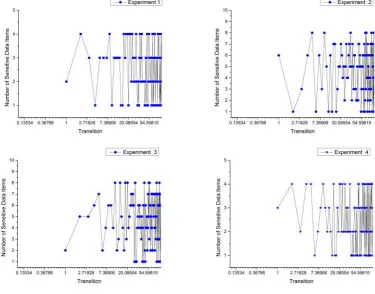
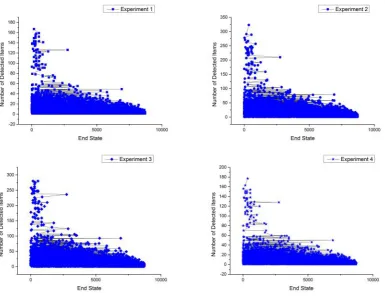
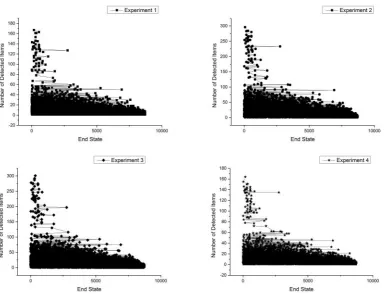
In this work, to analyze the efficiency, four (4) experiments were performed and sensitive data items on each transition were iden-tified. Table??shows the threshold (SD) values returned in each of the experiments. Experiments 1 and 4 returned hugeSDvalues compared to experiments 2 and 3. Figs. 2 and 3 show the number of sensitive data items detected on the user’s transitions. The tran-sitionsSj→Skwere represented with numbers on the horizontal
axis. In experiments 2 and 3 on both data sets, a lot of sensitive data items were detected on numerous transitions as compared to exper-iments 1 and 4 on both datasets. This implies that the lower the threshold valueSD, the more sensitive data items will be detected on many transitions.
3.2 Critical Transitions
The critical transition of each start state to its reachable states were determined. Sensitive data items on all transitions were detected. Table??shows the sets of sensitive data items detected on some few selected transitions using Census Income Data set. For ex-ample, in identifying critical transition, transitionsS17 → S938,
S17 → S1608, S17 → S2786 and S17 → S3597 had no
sen-sitive data items detected on them in all four experiments, but
S17→ S4038had sensitive data items detected on, only in
exper-iment 3. It implies that in experexper-iments 1, 2 and 4, there were no critical transitions identified but in experiment 3, the critical transi-tion wasS17→S4038.
3.3 Risky State
The number of sensitive data items published to each state from all of its ancestors, were accumulated and the state with the highest number identified as the ”Risky State”.
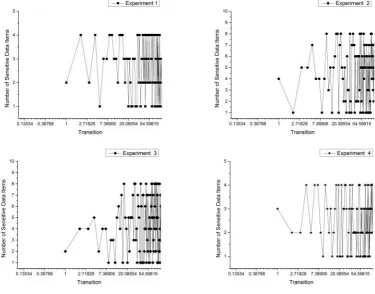
Figs. 4 and 5 show graphs of accumulated sensitive data items pub-lished to states. Table??shows Risky states identified in all ex-periments under both data sets. On both datasets, the graphs are heavy-tailed at the lower bottom. Using Adult data set,S176,S356,
S176andS356were identified as Risky states in experiments 1, 2, 3
and 4 respectively. Using Census Income data set,S176,S67,S356
andS176were also identified as Risky states in experiments 1, 2, 3
and 4 respectively. In experiments 2 and 3 using both data sets, a lot of sensitive data items were detected as compared to experiments 1 and 4. We can thus conclude that the lower the threshold valueSD, the more sensitive data items will be detected on a transition to be identified as risky.
[image:3.595.322.547.310.489.2]3.4 Occurrences of Data Items as Sensitive
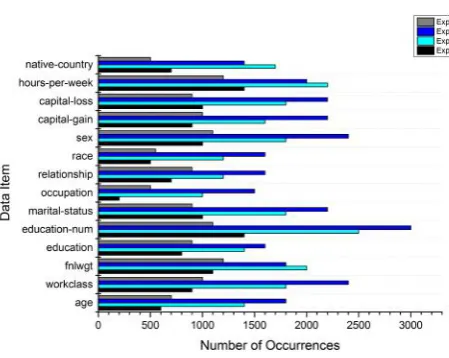
Fig. 6. Number of occurrences of data items as sensitive: adult data set.
Figs. 6 and 7 show the number of occurrences of data items as sen-sitive using adult data set and census income data set respectively. Showed in both figures, experiments 2 and 3 had data items de-tected as sensitive on transitions the highest. Experiments 1 and 4 have the lowest occurrences of data items as sensitive. This implies that the lowerSDvalue, the higher the number of data items being detected as sensitive on both data sets and vice versa.
3.5 Efficiency of the technique
Efficiency of the algorithm are measured in terms of the running time or speed of detecting sensitive data items and identifying risky states.
Fig. 2. Number of sensitive data items on transitions using Adult data set.
Table 2. Sets of sensitive data items on selected transitions using Census Income data set.
Transition Sensitive Data Items
Experiment 1 Experiment 2 Experiment 3 Experiment 4
S17→S938 {None} {None} {None} {None}
S17→S1608 {None} {None} {None} {None}
S17→S2786 {None} {None} {None} {None}
S17→S3597 {None} {None} {None} {None}
S17→S4038 {None} {None} {age, workclass, fnlwgt} {None}
S1111→S4067 {occupation, relationship} {relationship, capital-gain} {age, workclass, capital-gain} {workclass, fnlwgt} S7421→S7949 {None} {marital-status, occupation,
relationship}
{age, marital-status, occupa-tion, relationship}
{None}
threshold values in 1 and 4 are higher than in 2 and 3. Therefore, the higher the threshold values, the faster the proposed algorithm in this work executes.
4. RELATED WORK
From intensive research done, there are no works that provide a model to detect sensitive information, that when released will com-promise the user’s privacy. In most of the works, ascertaining sen-sitive information was based on assumption and these sets of sensi-tive data satisfied all of the user’s transitions in all possible states. Therefore, some works on data privacy that made assumptions of sensitive items are briefly discussed.
Sweeney et al. [1] proposed a formal model calledk-anonymity and a set of accompanying policies for protecting the user’s data during data publishing. Pei, Jian, et al. [3] suggested a model to
[image:4.595.54.566.411.517.2]-Fig. 3. Number of sensitive data items on transitions using Census Income data set.
Table 3. Risky States and number of detected data items.
Experiment Adult Data Items Census Income Data Items
Risky State Detected Items Risky State Detected Items
1 176 167 176 167
2 356 323 67 296
3 176 280 356 301
4 356 177 176 164
anonymity notably Samarati?s algorithm and Sweeney?s Datafly, which both adhere to full domain generalisation, require a trade off between computing time and information loss. Thus they pro-posed an improved greedy heuristic for enforcingk-anonymity with full domain generalisation. Iyengar [14] addressed the importance of preserving the anonymity of the individuals or entities during the data dissemination process. Gkoulalas-Divanis et al [15] pre-sented a survey on algorithms that have been proposed for pub-lishing structured patient data, which protect the disseminated data against several privacy threats, while the data remained useful for subsequent analysis tasks.
In works [2][7][8], the authors presented models for defining data privacy based on the adversary’s external knowledge. These privacy frameworks allow data owners to safeguard their data against at-tackers called realistic adversaries when publishing their data. Ka-pur et al. [9] based their work on modeling as the basis of data man-agement of uncertainty, stating that the uncertainty of the data in k-anonymity is caused by generalization. Jiang et al. [5] described a theoretical model for privacy control in context aware-systems, which has the ability to infer revealing information from loosely
related personal data has even more troubling implications for in-dividual privacy.
5. CONCLUSION
[image:5.595.60.553.412.474.2]Fig. 4. Risky state using Adult data set.
Fig. 7. Number of occurrences of data items as sensitive: census income data set.
Acknowledgment
We thank Anthony Padua Bangdome for providing insightful com-ments that helped improve the paper. We are most grateful.
6. REFERENCES
[1] Sweeney, Latanya. ”k-anonymity: A model for protecting pri-vacy.” International Journal of Uncertainty, Fuzziness and Knowledge-Based Systems 10.05 (2002): 557-570.
[2] Machanavajjhala, Ashwin, Johannes Gehrke, and Michaela Gtz. ”Data publishing against realistic adversaries.” Proceed-ings of the VLDB Endowment2.1 (2009): 790-801.
[3] Pei, J., Tao, Y., Li, J. and Xiao, X., 2009, March. Privacy pre-serving publishing on multiple quasi-identifiers. In Data Engi-neering, 2009. ICDE’09. IEEE 25th International Conference on (pp. 1132-1135). IEEE.
[4] Wu, Jiawei, and Guohua Liu. ”Modeling the Uncertain Data in the K-anonymity Privacy Protection Model.” Computational Intelligence and Security (CIS), 2011 Seventh International Conference on. IEEE, 2011.
[5] Jiang, Xiaodong, and James Landay. ”Modeling privacy con-trol in context-aware systems.” Pervasive Computing, IEEE 1.3 (2002): 59-63.
[6] Agrawal, Rakesh, Ramakrishnan Srikant, and Dilys Thomas. ”Privacy preserving OLAP.” Proceedings of the 2005 ACM SIGMOD international conference on Management of data. ACM, 2005.
[image:6.595.73.297.411.584.2]Fig. 5. Risky state using Census Income data set.
Fig. 8. Efficiency: Detecting data items as sensitive and Identifying risky state.
[8] Martin, D.J., Kifer, D., Machanavajjhala, A., Gehrke, J. and Halpern, J.Y., 2007, April. Worst-case background knowledge for privacy-preserving data publishing. In Data Engineering, 2007. ICDE 2007. IEEE 23rd International Conference on (pp. 126-135). IEEE.
[9] Kapur, Eshan, Parveen Kumar, and Sahil Gupta. ”Proposal of a two way sorting algorithm and performance comparison with
existing algorithms.” International Journal of Computer Sci-ence, Engineering and Applications (IJCSEA) Vol 2 (2012). [10] Shokri, R., Theodorakopoulos, G., Le Boudec, J.Y. and
Hubaux, J.P., 2011, May. Quantifying location privacy. In Se-curity and privacy (sp), 2011 ieee symposium on (pp. 247-262). IEEE.
dif-ferential privacy under temporal correlations.” Proceedings of the 22nd ACM SIGSAC Conference on Computer and Com-munications Security. ACM, 2015.
[12] Bhat, T.P., Karthik, C. and Chandrasekaran, K., 2015. A Privacy Preserved Data Mining Approach Based on k-Partite Graph Theory. Procedia Computer Science, 54, pp.422-430. [13] Navarro-Arribas, G., Torra, V., Erola, A. and Castell-Roca,
J., 2012. User k-anonymity for privacy preserving data mining of query logs. Information Processing & Management, 48(3), pp.476-487.
[14] Iyengar, V.S., 2002, July. Transforming data to satisfy privacy constraints. In Proceedings of the eighth ACM SIGKDD inter-national conference on Knowledge discovery and data mining (pp. 279-288). ACM.
[15] Gkoulalas-Divanis, A., Loukides, G. and Sun, J., 2014. Pub-lishing data from electronic health records while preserving privacy: a survey of algorithms. Journal of biomedical infor-matics, 50, pp.4-19.
[16] Babu, K.S., Reddy, N., Kumar, N., Elliot, M. and Jena, S.K., 2013. Achieving k-anonymity Using Improved Greedy Heuris-tics for Very Large Relational Databases. Transactions on Data Privacy, 6(1), pp.1-17.
[17] R. J. Bayardo, Y. Ma, and R. Srikant. Scaling up all pairs sim-ilarity search. In WWW, pages 131?140, 2007.
[18] S. Chaudhuri, V. Ganti, and R. Kaushik. A primitive operator for similarity joins in data cleaning. In ICDE, page 5, 2006. [19] Xiao, C., Wang, W., Lin, X., Yu, J.X. and Wang, G., 2011.
Efficient similarity joins for near-duplicate detection. ACM Transactions on Database Systems (TODS), 36(3), p.15. [20] Huang, A., 2008, April. Similarity measures for text