Comparative Study of Reactive Routing Protocols in MANET: A Review
Shipra Tripathi
1, Dr. Brajesh Kumar Singh
21
M.Tech Student, Computer Science &Engineering, R.B.S. Engineering Technical Campus, Agra, India
2
Professor, Dept. of Computer Science &Engineering,
R.B.S. Engineering Technical Campus, Agra, India
---***---Abstract - Mobile ad hoc network (MANET) is an independent structure of mobile nodes connected through the wireless links. MANET is infrastructure less ad-hoc network that can be establishing easily anywhere. MANETs are mostly employed in battles fields, disaster management etc. Due to its dynamic nature routing are important for data transferring. Routing protocol in ad-hoc network performs a crucial role. Routing is responsible for forwarding the data packets along the efficient metrics in the network. There are many routing protocols available for use in Ad hoc networks. The choice of routing protocols depends upon various situations like when energy is not a constraint in that situation selection of proactive routing protocols is best choice. In networking (wired and wireless), routing has been one of the important function we need to concentrate. Routing is the process in which, we will be sending the packets or messages from the source to the destination.
Key Words: MANET, DSR, AODV, PDT, RREQ etc.
1. INTRODUCTION
Advancement in the field of internet due to wireless networking technologies advances to numerous new applications. Mobile ad-hoc network (MANET) is one of the most interesting areas for research and improvement of wireless network. As the prominence of mobile device and wireless networks essentially become greater over the past years, wireless ad-hoc networks has now turned out to be a standout amongst the most dynamic and energetic field of communication and networks. A mobile ad hoc network is a collection of mobile devices such as laptops, Mobile phones, sensors, etc. that communicate with each other through the wireless links and work together with each other in a distributed manner in order to provide the important network functionality in the absence of a fixed infrastructure. MANET is a self-organizing network and forms an unknown topology. This type of network operated as a stand-alone network or with one or multiple points of attachment to cellular networks or the internet. In MANET, each node acts both as a router and as a host & even the topology of network may also change rapidly.
2. ROUTING PROTOCOLS
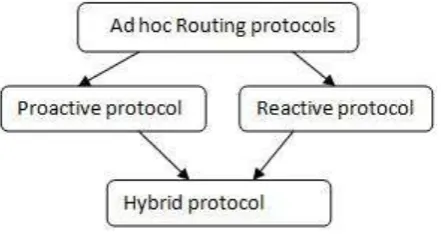
In MANET, there are different types of routing protocols each of them is applied according to the network circumstances. Figure 1 shows the basic classification of the routing protocols in
[image:1.595.189.410.564.681.2]MANETs.
Fig-1: Classification of routing protocols
Proactive Protocols
the network. As such, these protocols are also referred as table-driven. Examples of proactive protocols include Dynamic Destination Sequenced Distance-Vector Routing Protocol (DSDV), Optimized Link State Routing Protocol (OLSR) and Wireless Routing Protocol (WRP).
Reactive Protocols
The reactive protocol is also known as on-demand routing protocols and it is based on Query-Reply topology in which they do not attempt to continuously maintain the up-to-date topology of the network. When a route is needed, a procedure is called to find a route to the destination node. The major goal of on demand protocols is to minimize the network traffic overhead. Examples of reactive protocols include the Dynamic Source Routing Protocol (DSR), Ad Hoc On-Demand Distance Vector Routing Protocol (AODV), and Temporally-Ordered Routing Algorithm (TORA).
Hybrid Protocol
Hybrid protocol is introduced to overcome the shortcomings of both proactive and reactive routing protocols. Hybrid routing protocol is the combination of both proactive and reactive protocol. It utilizes the route discovery mechanism of reactive protocol and the table maintenance mechanism of proactive protocol in order to avoid latency and overhead problems in the network. Hybrid protocol is useful for large networks where large numbers of nodes are available. In this large network is divided into set of zones. Example of hybrid protocol is Zone routing protocol (ZRP).
3. Dynamic Source Routing (DSR):
The Dynamic Source Routing (DSR) protocol is an on-demand routing protocol dependent on source routing. In the source routing procedure, a sender decides the definite sequence of nodes through which to spread a packet. The list of intermediate nodes for routing is explicitly contained in the packet’s header. In DSR, every node in the network needs to keep up a route cachewhere it reserved source routes that it has learned. When a host needs to send a packet to some other host, it first checks its route cache for a route to the destination. If route is found in the route cache, the sender utilizes this route to propagate the packet. Otherwise the source node starts the route discovery process. DSR performs its work in two phases: Route discovery and Route maintenance.
3.1 Route Discovery
For route discovery, the source node broadcast a route requestpacket that can be received by all nodes within its wireless transmission range. The route request contains the address of the destination host [1], the source’s address, a route recordfield and a unique identification number. If the route discovery is completed the sender receives a route reply packet containing a list of network nodes through which it should propagate the packets. During the route discovery process, the route record field is used to accumulate the sequence of hops already taken. First of all the sender initiates the route record as a list with a single element containing itself. The following node appends itself to the list and so on. Each route request uniquely identified by request_id. The request_id is a simple counter which is increased whenever a new route request packet is being sent by the source node. Thus, every route request packet can be uniquely identified through its source’s address and request_id. By this we can make sure that no loops will occur during the broadcasting of the packets.
When any nodes receives a route request packet then, process it in the below described order:
1. If the pair ( source address, request_id ) is found in the list of recent route requests, the packet is discarded.
2. If the host’s address is already mentioned in the request’s route record, the packet is also discarded.
3. If the destination address in the route request matches the host’s address, the route record field contains the route by which the request reached this host from the source node. A route reply packet is sent back to the source node containing a copy of this route.
4. Otherwise, add this present host’s address to the route record field of the route request packet and re-broadcast the packet.
Sending back route replies can be accomplished by two different ways: DSR may use symmetric links, but it is not required to. In the case of symmetric links, the node generating the route reply just uses the reverse route of the route record. When using unidirectional (asymmetric) links, the node needs to initiate its own route discovery process and piggyback the route reply on the new route request.
3.2 Route Maintenance
Route maintenance can be accomplished by two processes:
Hop-by-hop acknowledgement at the data link layer
End-to-end acknowledgements
Hop-by-hop acknowledgement at the data link layer permits an early detection and retransmission of lost or corrupt packets. If the data link layer detect a transmission error (for example, because the maximum number of retransmissions is exceeded), a route errorpacket is being sent back to the sender.
The route error packet contains two information:
The address of the node find the error and
The host’s address which it was trying to send the packet to.
Whenever a node receives a route error packet, the hop in error is removed from the route cache and all routes which contain this hop must be truncated by then.
End-to-end acknowledgement might be utilized, if wireless transmission between two hosts does not work similarly well in the both directions. As long as a route exists by which the two end hosts are able to communicate, route maintenance is possible. There may be various routes in both directions. In this case, replies or acknowledgements on the application or transport layer may be used to indicate the status of the route from one host to the other. However, with end-to-end acknowledgement it is not possible to find out the hop which has been in error.
4. Ad hoc on demand distance vector (AODV):
AODV is the reactive routing protocol for finding the best path to deliver the packet, when needed. It is designed for use in ad-hoc mobile networks. It uses traditional routing tables, one entry per destination, and sequence numbers to determine whether routing information is up to-date and to prevent routing loops. An important feature of AODV is the maintenance of time-based states in each node. In case of a route broken, the neighbors can be notified to source. Source node start the route discovery process which is based on query and reply cycles, and route information is stored in all intermediate nodes along the route in the form of route table entries.
4.1 Route Discovery
Route Discovery is the main procedure of AODV protocol. As shown in fig 2, if a source node needs a route to destination, it
broadcasts a route request(RREQ) message. Every node maintains a broadcast idwhen it taken together with the originator’s
IP address then they extraordinarily recognizes a RREQ. Each time a sender issues a RREQ, it increments its broadcast id and sequence number by one. The sender buffers this RREQ until its neighbors send it to the back this time called path discovery
time(PDT) after this time sender can reprocess it again. The sender then waits for net traversal time (NETT) for a route reply
(RREP) message. If the sender does not receive RREP within this time then the sender will rebroadcast another RREQ up to RREQ TRIES times. The holding up time (NETT) is multiplied with each additional attempt. When a node receives a RREQ message that has not seen before, it sets up a reverse route back to the node from where the RREQ come. This reverse route has
a lifetime value which is called active route timeout(ART). The reverse route entry is stored along with the requested
Fig- 2: Example of a AODV Routing Protocol
4.2 Route Maintenance
The job of route maintenance is to give input to the sender on the off chance that a switch or connection has gone down, to enable the course to be changed or re-found. A course can quit working when any of the versatile hubs has moved. If a source node moves, then it should rediscover a new route. If an intermediate node moves, it must inform all its neighbors that needed this hop. This message is forwarded to all the other nodes in the network and the old route is deleted. Then the source node
must rediscover a new route. One proposed way for a node to keep track of its neighbors by using HELLOmessages. These are
periodically sent to detect link failures. Upon receiving notification for a broken link, the source node can start the rediscovery
process. If there is a link breakage, a route error(RERR) message can be broadcast on the network. Any host that receives the
RERR message invalidates the route and rebroadcasts the error messages with the unreachable destination information to all
nodes in the network.
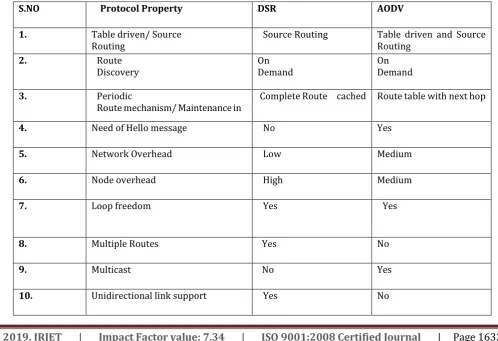
5. Comparison of DSR and AODV:
S.NO Protocol Property DSR AODV
1. Table driven/ Source
Routing Source Routing Table driven and Source Routing
2. Route
Discovery
On
Demand On Demand
3. Periodic
Route mechanism/ Maintenance in Complete Route cached Route table with next hop
4. Need of Hello message No Yes
5. Network Overhead Low Medium
6. Node overhead High Medium
7. Loop freedom Yes Yes
8. Multiple Routes Yes No
[image:4.595.45.544.463.804.2]11. Packet size Non Uniform Uniform
12. Network Size Up to 200 nodes Highly Dynamic
6. CONCLUSIONS
Dynamic Source Routing (DSR)
The key distinguishing feature of DSR is the use of source routing. It is a reactive protocol i.e. it doesn’t use periodic advertisements. It computes the routes when necessary and then maintains them. Source routing is a routing technique in which the sender of a packet determines the complete sequence of nodes through which the packet has to pass, the sender explicitly lists this route in the packet’s header, identifying each forwarding “hop” by the address of the next node to which to transmit the packet on its way to the destination host.
Adhoc demand Distance Vector Routing (AODV)
AODV is a basically a blend of both DSR and DSDV. It acquires the basic on-demand mechanism of Route Discovery and Route Maintenance from DSR, and the use of hop-by-hop routing, sequence numbers, and periodic guides from DSDV. It uses destination sequence numbers to ensure loop freedom at all times and by avoiding the Bellman-Ford ”count-to -infinity” problem offers quick convergence when the ad hoc network topology changes.
REFERENCES
[1] D. B. Johnson and D. A. Maltz, “Dynamic source routing in ad hoc wireless networks,” in Mobile Computing, T. Imielinski
and H. Korth, Eds. Kluwer Academic Publishers, 1996, vol. 353, ch. 5, pp. 153–181.
[2] Basu Dev Shivahare1 ,Charu Wahi2 , Shalini Shivhare3” Comparison Of Proactive And Reactive Routing Protocols In Mobile
Adhoc Network Using Routing Protocol Property” International Journal of Emerging Technology and Advanced Engineering, ISSN 2250-2459, Volume 2, Issue 3, March 2012.
[3] C. Perkins, E. Belding-Royer, and S. Das, "Ad hoc on demand distance vector (AODV) routing "RFC 3561, July ,2003.
[4] Charles E. Perkins and Elizabeth M.” Ad hoc On Demand Distance Vector Routing”
[5] Sunil Taneja and Ashwani Kush” A Survey of Routing Protocols in Mobile Ad Hoc Networks” International Journal of