© 2019, IRJET | Impact Factor value: 7.34 | ISO 9001:2008 Certified Journal | Page 1331
Detection and Classification of Skin Diseases using Different Color
Phase Models
A.V.Ubale
1, P.L. Paikrao
21
Goverment college of Engineering, Amravati, India
---***---Abstract -
Now a days, skin diseases are mostly found in animals, humans and plants. A skin disease is a particular kind of illness caused by bacteria or an infection. These diseases like Psoriasis, Melanoma, Papillomus, Mycosis, Warts etc. have various dangerous effects on the skin and keep on spreading over time. It becomes important to identify these diseases at their initial stage to control it from spreading. These diseases are identified by using many technologies such as image processing, data mining, k nearest neighbor (KNN) etc. Recently, image processing has played a major role in this area of research and has widely used for the detection of skin diseases. Techniques like filtering, segmentation, feature extraction, image pre-processing and edge detection etc. are part of image processing and are used to identify the part affected by disease, the form of affected area, its affected area color etc. This thesis presents a various skin disease detection and classification systems using image processing techniques in recent times. A comprehensive study of a number of skin disease diagnosis systems are done in this thesis, with different methodologies and their performances.Key Words: skin diseases; skin infections; image
processing; lesions; histograms etc.
1. INTRODUCTION AND LITERATURE REVIEW
The biggest organ of the body is human skin. Its weight lies between six and nine pounds and surface area is about two square yards. Inner part of body is separated by skin from the outer environment. It provides protection against fungal infection, bacteria, allergy, viruses and controls temperature of body. Situations that frustrate, change texture of the skin, or damage the skin can produce symptoms like swelling, burning, redness and itching. Allergies, irritants, genetic structure, and particular diseases and immune system related problems can produce dermatitis, hives, and other skin problems. Many of the skin diseases, such as acne, alopecia, ringworm, eczema also affect your look. Skin can also produce many types of cancers. Image processing is used to detect these diseases by using various methods like segmentation, filtering, feature extraction etc. To get an improved image or to get meaningful information from an image, it is necessary to convert an image into digital form and then perform functions onto that image. It is a part of signal processing. The input is an image and it may be a video, a photograph and output is also another image having same characteristics as input image.
Here is a survey on image processing Techniques:
In Nikos Petrellis [1] is proposed a method in which quantitative analysis is done. Three step process is done in which first step is image enhancement, second process image segmentation, feature extraction is a third step and then forth step is classification of skin diseases.
1. In this method they used MATLAB software for Image enhancement.
2. They used a advanced algorithms for the image segmentation.
3. By using co-occurrence matrix, features can be extracted for the classification.
4. Supervised Vector Machine(SVM), Neural Network(NN) are used for the classification and also they some deterministic method related to k- Nearest Neighbours or Decision trees is adopted for classification of images.
H. Mirzaalian, T. K. Lee and G. Hamarneh [2] proposed the matching process, for facilitate special normalization they used human back template (atlas).
On 56 pairs of dermatological images they applied point-matching algorithms and by using this spatially normalized coordinates, accuracy of PSL matching get improved.
R. Yasir, A. Rahman, and N. Ahmed [3] proposed method by which they detect various skin diseases by using computers vision techniques. for feature extraction, they used many image processing algorithms and for testing and training purposes they used feed forward artificial neural network. This method carried out into two phases one for feature extraction and another for identification of diseases By this method, they detect 9 types of diseases with 90 percent accuracy.
P. S. Ambad, A. S. Shirsat [4] proposed a method which used multiple skin disease for diagnosis for analysis.. They classified this images using two level classifiers for improve the result. Basically AdaBoost classifier gives better result which correlate the images with respect to the parameters.
© 2019, IRJET | Impact Factor value: 7.34 | ISO 9001:2008 Certified Journal | Page 1332
classification of different skin diseases with a 75 percent accuracy.
Alaa Haddad, Shihab A. Hameed [6] used MSIM algorithm for image analysis and skin diseases detection. This MSIM algorithm gives 82.5 percent accuracy,
Mugdha S Manerkar, Shashwata Harsh, Juhi Saxena, Simanta P Sarma, Dr.U. Snekhalatha, Dr. M. Anburaja [7] used C-Means Algorithm and Watershed Algorithm individually for image segmentation and multi SVM classifier is used for different diseases with 96 to 98 percent accuracy.
Jainesh Rathod, Vishal Wazhmode, Aniruddh Sodha, Praseniit Bhavathankar [8] used Convolutional Neural Network (CNN) for feature extraction and softmax classifier is used for classification and obtain the diagnosis report. Convolutional Neural Network gives 90 percent accuracy.
2. METHODOLOGY
[image:2.595.48.274.374.463.2]The block diagram for the proposed methodology is shown In Figure 1.
Figure -1: Block diagram of proposed methodology
2.1 Input Image
The input images for this project are the digital images of various skin diseases.
2.2Preprocessing
This process consists of the following:
Image Resizing
Contrast Enhancement
RGB to HSV and Lab conversion.
2.3Feature Extraction
Features can be extracted using two color phase models
HSV color phase model LAB color phase model
2.3.1 HSV color phase model
In color image processing, there are various models one of which is the hue, saturation, value (HSV) model. Using this model, an object with a certain color can be detected and to reduce the influence of light intensity from the outside.
They are calculated by using the standard (R, G, B) to (H, S, I) conversions.
Hue is calculated using
H = (Color2 - Color3 + (Color1 - Color3 - 1)*256)….... (1)
Intensity is calculated using:
I = ………… (2)
Saturation is calculated using
S = ………….(3)
2.3.2 Lab color phase model
Any digital image can be converted from its original color space into the LAB color space, which arranges similar colors to be near and uniformly distributed in the so called color planes. Suppose we have a dataset of N digital RGB images of the same dimension p×q = m pixels. The RGB images are converted into the Lab format which result in real values for the parameters L, a and b of each pixel. These parameters are mapped to the 0 to 255 integer range, so that the Lab images could be manipulated and displayed in the same way as RGB images.
The same applies if we construct a global histogram with a or b values. The decision to split L in x intervals, a in y intervals and b in z intervals should be based on the nature of the application. For instance, if the number of images in the dataset is small, then one can use larger values for x, y and z, but if the number of images is large or very 180 large, then one must choose lower values for x, y and z, to obtain a color feature vector faster to compute, smaller and that can be more conveniently used in image comparisons.
2.4 Classification
A classification task usually involves with training and testing data which consist of some data instances. Each instance in the training set contains one target values and several attributes.
© 2019, IRJET | Impact Factor value: 7.34 | ISO 9001:2008 Certified Journal | Page 1333
2.4.1 KNN Classifier
A step in KNN classification involves identification as which are intimately connected to the known classes. This is called feature selection or feature extraction. Feature selection and KNN classification together have a use even when prediction of unknown samples is not necessary. Algorithm for k nearest neighbor classification:
For feature vector using above features, Contrast,
Color moment, mean.
Pass these features to KNN classifier.
Determine Euclidean distance d
d = ………(4)
3. RESULTS
3.1 Detection of skin diseases
[image:3.595.316.553.107.251.2]Input Image
Figure -2: Input Image
Processing image:
Figure- 3: Processing Image
RGB Histogram:
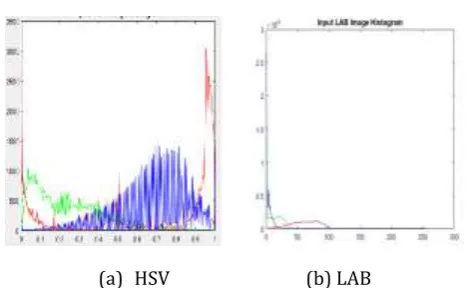
(a) HSV (b) LAB Figure 4: RGB Histogram (a) HSV, (b) LAB
HSV Image:
Figure- 5: HSV image
[image:3.595.45.561.131.775.2]LAB Image:
Figure -6: LAB image
Output Image:
[image:3.595.87.238.567.712.2]© 2019, IRJET | Impact Factor value: 7.34 | ISO 9001:2008 Certified Journal | Page 1334
[image:4.595.37.288.126.426.2]3.2 Classification of skin diseases
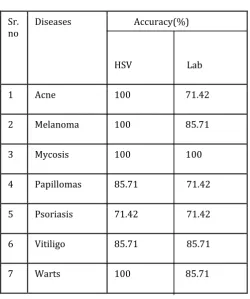
Table -1: Results
Sr.
no Diseases Accuracy(%)
HSV Lab
1 Acne 100 71.42
2 Melanoma 100 85.71
3 Mycosis 100 100
4 Papillomas 85.71 71.42
5 Psoriasis 71.42 71.42
6 Vitiligo 85.71 85.71
7 Warts 100 85.71
4. CONCLUSION
The proposed project work has designed an color phase models for detection and classifying different skin diseases using KK Classifier. This work can be applied in the field of health informatics for automatic diagnosis of different skin Diseases. It also helps dermatologists to give better treatment to the patients by proper diagnosis of the several disease conditions. The system proposed in this project can be used to provide a efficient solution and low cost for detection and classification of skin diseases. The KNN classification can serve as an effective tool in identifying and classifying skin diseases. This method gives 91.80 % accuracy for HSV Color Phase Model and 81.60 % accuracy for Lab Color Phase Model. So HSV color phase model is more efficient and appropriate and gives more accuracy than Lab Color Phase model.
REFERENCES
[1] Nikos Petrellis, “Using Color Signatures for the Classification of Skin Disorders”, 7th International Conference on Modern Circuits and Systems Technologies (MOCAST),2018.
[2] H. Mirzaalian, T. K. Lee and G. Hamarneh, “Spatial
Normalization of Human Back Images for
Dermatological Studies" , IEEE J. of Biomedical andHealth Informatics, Vol. 18, No. 4, July,2014.
[3] R. Yasir, A. Rahman, and N. Ahmed, “Dermatological
Disease Detection using Image Processing and Artificial Neural Network", Proc. of the 8th International
Conference on Electrical and Computer Engineering 20-22 December, 2014, Dhaka, Bangladesh.
[4] Alaa Haddad, Shihab A. Hameed, “Image Analysis Model
for Skin Disease Detection: Framework”7th International Conference on Computer and Communication Engineering (ICCCE),2018.
[5] P. S. Ambad, A. S. Shirsat, “A Image analysis System to
Detect Skin Diseases", OSR Journal of VLSI and Signal Processing (IOSR-JVSP), Vol. 6, No. 5, Ver. I, pp. 17-25, Sep.-Oct. 2016, pp. 17-25.
[6] P. B. Manoorkar Prof. D. K. Kamat Dr. P. M. Patil,
“Analysis and Classification of Human Skin Diseases” International Conference on Automatic Control and
Dynamic Optimization Techniques
(ICACDOT)International Institute of Information Technology (I²IT), Pune,2016.
[7] Mugdha S Manerkar ; U. Snekhalatha ; Shashwata
Harsh ; Juhi. Saxena ; Simanta P Sarma ; M Anburajan “Automated skin disease segmentation and classification using multi-class SVM classifier”, 3rd International Conference on Electrical, Electronics, Engineering Trends, Communication, Optimization and Sciences (EEECOS 2016).
[8] Jainesh Rathod ,Vishal Wazhmode , Aniruddh Sodha ,
Praseniit Bhavathankar, Diagnosis of skin diseases using Convolutional Neural Networks" Second International Conference on Electronics, Communication and Aerospace Technology (ICECA),2018.
[9] Md. Nazrul Islam ; Jaime Gallardo-Alvarado ; Masyitah
Abu ; Nurfazlyna Aneem Salman ;Sahanah Pandu Rengan; Sakina Said “Skin disease recognition using texture analysis” 2017 IEEE 8th Control and System Graduate Research Colloquium (ICSGRC).
[10]Archana Ajith, Vrinda Goel, Priyanka Vazirani, M. Mani
Roja, “Digital dermatology: skin disease detection model using image processing", International Conference on Intelligent Computing and Control Systems (ICICCS),2017.
[11]Zulfikar Zulfikar, Zulhelmi Zulhelmi, “Statistical
© 2019, IRJET | Impact Factor value: 7.34 | ISO 9001:2008 Certified Journal | Page 1335
[12]Asha Gnana Priya, H, J. Anitha, Jacinth Poonima.J,
“Identification of Melanoma in Dermoscopy Images Using Image Processing Algorithms", International Conference on Control, Power, Communication and Computing Technologies (ICCPCCT), 2018.
[13]Hangning Zhou, Fengying Xie, Zhiguo Jiang, Jie Liu ,Shiqi
Wang , Chenyu Zhu, “Multi classification of skin diseases for dermoscopy images using deep learning", IEEE International Conference on Imaging Systems and Techniques (IST),2017.
[14]S. Chatterjee, D. Dey , S. Munshi, “Development of a