RESEARCH ARTICLE
MICROAGGREGATE STABILITY AND SESQUIOXIDES CONTENT OF DEGRADED ULTISOL UNDER
DIFFERENT SOIL AND CROP MANAGEMENT PRACTICES IN NSUKKA, SOUTHEASTERN NIGERIA
*Azuka, C. V., Obi, M. E. and Igwe, C. A.
Department of Soil Science, University of Nigeria, Nsukka
ARTICLE INFO ABSTRACT
Evaluating microaggregate stability and sesquioxides content of degraded Ultisol is important for sustainable management and productivity of the soils and our agroecosystem. A research was conducted in the runoff plots at the University of Nigeria Nsukka Teaching and Research Farm, in 2010 and 2011 to evaluate changes in microaggregate stability, and sesquioxides contents of Nkpologu sandy loam soil under different cover and soil management practices. The management practices were bare fallow (BF), grass fallow (GF), legume (CE), groundnut (GN), sorghum (SM), and cassava (CA) cultivation. Soil samples for analysis were taken at 0-20 cm depth at the end of each cropping season and five-month interval. There were significant effect (p<0.05) of soil and cover management on the sesquioxides (Fe2O3and Al2O3) and the organic matter (O.M.) contents. Fe2O3 recorded the lowest value (5.88%) under the BF while the highest value (10.18%) was recorded under SM. However, the lowest value (0.265%) of Al2O3was recorded under GN, and the highest value (0.345%) was recorded under CA. Although, the soil and cover management practices did not have significant effect (p<0.05) on the microggregate stability indices; water dispersible silt (WDSi) and clay (WDC), clay flocculation index (CFI), dispersion ratio (DR), aggregated silt and clay (ASC), and clay dispersion index (CDI) measured, there were traces of variability (CV 16-31%) in the microaggregate stability indices under the different soil and cover management practices. The most varied index was WDSi (CV 30.8%) while the least varied index was DR (CV 16%).Both Fe2O3and O.M. had significant high positive correlation with DR (0.6658; 0.7615) and CDI (0.6068; 0.5360), but significant high negative correlation with ASC (-0.7675; -0.6918) and CFI (0.6068; -0.5360) respectively. However, while Fe2O3had significant high positive correlation with WDC, O.M. content had a poor positive correlation with WDC. On the other hand, Al2O3had poor correlation with all the microaggregate stability indices studied. The sesquioxides and O.M. had similar but opposite correlation coefficients with CDI and CFI respectively. It was clear that O.M. and Fe2O3played major role in the microaggregation of the soil studied. A continuous vegetative cover management practices and adequate crop residue management were recommended for this soil, due to its fragile nature to minimize further structural degradation and further leaching of the basic cations in the soil which affects the sesquioxides and O.M. contents.
Copyright © 2014 Azuka et al. This is an open access article distributed under the Creative Commons Attribution License, which permits unrestricted use, distribution, and reproduction in any medium, provided the original work is properly cited.
INTRODUCTION
Evaluating microaggregate stability and sesquioxides content of degraded Ultisol is important for sustainable management and productivity of the soils and our agroecosystem. Soil structural stability affects the productivity and sustainability of agricultural systems, and natural environments through soil erosion, and consequently loss of soils and nutrients. Soil aggregate structure and aggregate stability are important factors that contribute to sustainable soil quality and soil erosion potential (Barthes and Roose, 2002; Shepherd et al., 2002; Bronick and Lal 2005). Soil aggregate/structural stability may be defined as a measure of the ability of the soil structural units to resist change or the extent to which they remain intact
*Corresponding author: Azuka, C. V.,
Department of Soil Science, University of Nigeria, Nsukka.
when mechanically stressed by environmental factors (Encyclopedia of Soil Science, 2008) mainly climate and soil characteristics. Microaggregate stability indices serve as sensitive indicators of soil degradation (Boix-fayos, 2001), and are very important in the processes of infiltration, sealing and crust formation, runoff and soil erosion (Levy and Miller, 1997). It has been widely reported that the major microaggregating agents in tropical soils are Fe and Al oxides (Alekseeva et al., 2009; Yan et al., 2008; Igwe, 2005; Igwe et al., 2009). Numerous studies have shown that soil properties can change under various land use (Oguike and Mbagwu 2009) or management techniques.Land use according to Mbagwu and Auerswald (1999) influence structural stability more than other intrinsic soil properties. Some authors adjudged microaggregates to be more stable and less affected by management than macroaggregates (Edwards and Bremner, 1967; Tisdall and Oades, 1982). However, the fact that
ISSN: 0975-833X
International Journal of Current Research Vol. 6, Issue, 03, pp.5576-5581, March, 2014
INTERNATIONAL JOURNAL OF CURRENT RESEARCH
Article History:
Received 19thDecember, 2013
Received in revised form 24thJanuary, 2014
Accepted 10thFebruary, 2014
Published online 25thMarch, 2014
Key words:
Microaggregatestability, Sesquioxides,
microaggregates are more stable and less affected by management than macroaggregates may hold true due to the sensitivity of the later to organic matter content (Sung et al., 2012; Tisdall and Oades, 1982) but not absolute in all cases. An assessment of microaggregate stability under different land use types in some Nigerian tropical soil revealed the strong dependence of soil microaggregation on land use (Opara, 2009; Obi, 1982). This suggests that agents of stabilization of microaggregates in tropical soils are sensitive to land use. While numerous studies may have reported the effect of land use and organic matter on microaggregation, little is known about the effect of crops and soil management practices on sesquioxides contents and microaggregate stability. Growing concerns regarding adverse effects of intensive crop management on soil quality have kindled an interest in identifying cropping systems that maintain desirable soil quality and productivity. The search for the most appropriate combination of crop and or soil management practices suitable for different ecological zones in Nigeria should be intensified especially on fragile Ultisols of southeastern Nigeria. Despite the fragile nature of this soil, indiscriminate deforestation, inappropriate land use and non-sustainable soil management options are common features of agriculture in the region. Better soil management and conservation option for sustainable agricultural production is imperative for restoration of these badly degraded soils. Investigating how different soil and crop management practices affect the microaggregate stabilityand sesquioxides contents of degraded ultisols will give insight on appropriate soil management practices in the region. Thus, the objective of this study is to evaluate the influence of different soil and crop management practices on microaggregate stabilityand sesquioxides contents of a degraded Ultisols and the sensitivity of different microaggregate stability indices to sesquioxides and organic matter contents.
MATERIALS AND METHODS
Site description
The study was carried out at the University of Nigeria Nsukka Teaching and Research Farm located between latitude 06o52ʹN and longitude 07o 24’ E on runoff plots established in 1973. The area is characterized by a humid tropical climate with wet and dry season (Obi, 1982). The rainfall is bimodally distributed with annual total of about 1750mm. The average annual rainfall is estimated to be 800 mm. The mean annual temperature is 27o C with minimum and maximum of 21o C and 31o C respectively (UNN meteorological station). The runoff plots, each 20 x 3 m, were located on a 5% slope with mean elevation of 400m above sea level. The study was established to monitor microaggregate stability and sesquioxide contents of degraded Ultisol under different soil/crop management practices. The soil is an Ultisol (Acrisol, FAO; sol ferrallitique, French system) belonging to the Nkpologu series. It is deep, porous, and red to brownish red and derived from sandy deposit of false bedded sand stones, classified as Typic Paleustult (Nwadialo, 1989).
Field methods/ crop establishment
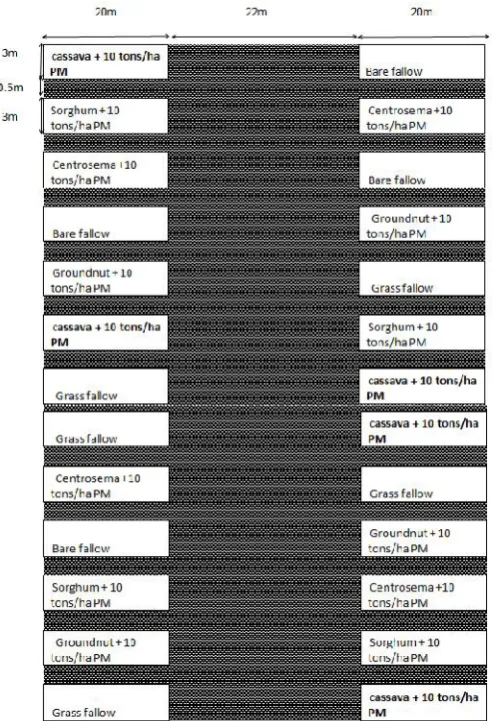
The experimental layout was a completely randomized design (CRD) and the treatments imposed were replicated four times
[image:2.595.312.559.272.633.2](Fig 1). Cassava, groundnuts, sorghum and centrosema were used as test crops. The test crops were grown with 10 tons/ha poultry droppings during crop establishment in 2010, while the bare fallow and grass fallow remained untilled with no amendment. Groundnut seeds were sown at a rate of two seeds per hole and at a planting distance of 45 cm by 30 cm. Sorghum seeds were sown at the rate of four seeds per hole at a planting distance of 70 cm by 30 cm and later reduced to two. Cassava cuttings of length 25 cm was planted 15 cm deep into the soil at a rate of one cutting per hole and at a planting distance of 1 m by 1 m. The Centrosema seeds were established by broadcasting the seeds on the soil surface after tillage and fresh supplies were made in areas where germination failed to occur. Groundnut and sorghum were harvested at five and six months after planting respectively and replanted in 2011 without amendments. Cassava was harvested at twelve months after planting while centrosema was not harvested.
Fig. 1. Field or experimental layout of the runoff plots at the study location
PM= Poultry Manure
Measurement of soil physical properties
Laboratory Methods
The particle size distribution of the < 2 mm size fraction of calgon-dispersed soil samples was determined by the hydrometer method described by Gee and Or (2002).Organic carbon was determined on the air dried, 2mm sieved samples at 0-20cm from each location according to the Nelson and Summer (1982) method. The organic matter content was obtained by multiplying values of organic carbon by a factor of 1.724.Dithionite-citrate-bicarbonate Fe and Al were determined by the extraction method of Mehra and Jackson (1960). Water dispersible clay (WDC) and silt (WDSi) was determined by dispersing soils in distilled water only and determining the particle size by the hydrometer method described by Gee and Or (2002). The indices of microaggregate stability were calculated using the relationships stated below:
Dispersion ratio (DR) = [% silt + clay (H2O)] / [% silt + clay (calgon)]
Aggregated silt and clay (ASC) = [% silt + clay (calgon)] - [% silt + clay (H2O)]
Clay flocculation index (CFI) = [% clay (calgon) - % clay (H2O) / % clay (calgon)] X 100
Clay dispersion index (CDI) = [% clay (H2O) / % clay dispersed)] x100
Statistical Analysis
The analysis of variance (ANOVA) for a completely randomized design (CRD) was carried out using a Genstat Discovery Edition version 5.0 (GENSTAT, 2003) on windows 7 to compare the influence of soil and crop management system on the measured soil properties. The mean difference of the effects of different crop growth on microaggregate stability
were separated using the Fischer’s least significant difference
(F-LSD0.05) as described by Obi (2002). Correlation between microaggregate stability indices, organic matter content, and sesquioxides was done to ascertain their contribution to microaggregate stability.
RESULTS AND DISCUSSION
Microaggregate Stability Indices
The water dispersible clay (WDC), water dispersible silt (WDSi) and dispersion ratio (DR) are used as estimates of the rate of dispersibility of the soils. The results show that the soils were moderately stable and moderately dispersive (Table 1). This was confirmed by the report of Igwe et al., (2009) that soils with low WDC, WDSi and low to moderate DR were stable and less erodible. The results also show moderate to high values of ASC and CFI which imply greater stability, and moderate values of DR and CDI indicate moderate stability. The moderate dispersion of the soils was reflected on the relatively high microaggregate stability indices such as CFI (Table 1). The results showed non-significant effect of the various cover management practices on indices of stability such as DR, ASC, WDSi, CDI, WDC and CFI. Oguike and Mbagwu (2009) found significant effect of land use types on these properties. However, the non-significant effect observed
in this study could be because these indices to some extent are determined/controlled by the intrinsic properties of soil such as texture especially clay and silt content which rarely change especially within short-term period. This can be further buttressed by the fact that treatment effects on water dispersible clay (WDC) and silt (WDSi) remained non-significant throughout this study. There was no appreciable difference or variability in the structural indices due to cover management as seen from the CV (13.4%). Moreso, all the indices of microaggregate stability were not significantly affected (P<0.05) by the interaction of sampling period and cover management practices. This implies that these properties are intrinsic and are therefore, dependent mostly on the nature of the soil rather than the management practices. However, the results show that breakdown of macroaggregates was less under various cover management practices compared to the BF without protection. Thus, most cases of low stability observed in these soils can be linked to a combination of anthropogenic factors such as deforestation and land use, the nature of the soil and the high rainfall regime with high intensity. Mbagwu and Bazzoffi (1998) reported that the sandy nature of most tropical soil parent material, and decreased clay contents militate against their stability. Again, most tropical soils have long weathering history as is often evident in their low silt content (Igwe, 2011), and this also contributes to frustrating aggregation processes in the soils. This is true for the soils as shown from their textures which were mainly sandy loam with low silt content (Azuka and Obi, 2012). Igwe (2011) reported that most soils occurring in areas with heavy rainfall, even when not originally sandy, have been so intensively washed by runoff and leaching that their texture tends toward coarseness. Mbagwu and Bazzoffi (1998) also reported that the resistance of soil aggregates to raindrop impact decreases with a decrease in clay content of the soil. The result also shows that sampling period was significant (P<0.05) on ASC, CFI, and DR. This implies that the factor which influences these microaggregate stability indices changes with time, leading to changes in microaggregate stability of the soils with time. This may further influence the rate of formation of macroaggregates from microaggregates.
Sesquioxides (Iron and Aluminium oxide) contents
Correlation of sesquioxides and organic matter with the microaggregate stability indices
The correlation of sesquioxides and organic matter contents with the microaggreagate stability indices was done to evaluate their contribution or relationship to microaggregate stability. The results showed that the sesquioxides and organic matter contents had significant effect/contribution to macroaggregate stability (Table 3) of the degraded Ultisol. Both Fe2O3 and organic matter had significant high positive correlation with DR (0.6658; 0.7615) and CDI (0.6068; 0.5360), but significant high negative correlation with ASC (-0.7675; -0.6918) and CFI (0.6068; -0.5360) respectively. However, while Fe2O3 had significant high positive correlation with WDC, O.M. content
[image:4.595.51.546.81.171.2]has a poor positive correlation with WDC. On the other hand, Al2O3had poor correlation with all the microaggregate stability indices studied (Table 3) especially with WDC (0.0574). This could be attributed to its low concentration in the soil studied (Table 1), and mainly caused by the extensive leaching of the basic cations in the soil typical of highly weathered or degraded soils. The results also showed that Fe2O3, Al2O3and organic matter had a similar but opposite correlation coefficients with CDI and CFI respectively. For instance, Al2O3has a correlation coefficient value of 0.1098 with CDI and a value of -0.1098 with CFI (Table 3). The above result show that O.M. content and most importantly the Fe2O3oxide content contributed significantly to the microaggregate stability and otherwise of the degraded Ultisol while the Al2O3had little management practices in Nsukka, Southeastern Nigeria
Table 1. `Main effect of cover management on some selected soil properties
MS O.M (g/kg) WDSi WDC ASC CDI CFI DR Fe2O3(%) Al2O3(%)
Bare fallow 9.9 5.28 6.32 14.73 34.7 65.3 0.44 5.88 0.322
Centrosema 13.5 5.28 6.32 12.9 39.7 60.3 0.48 7.56 0.301
Groundnut 13 5.11 6.65 12.23 40.2 59.8 0.5 9.36 0.265
Sorghum 13.8 4.45 6.99 13.23 43.1 56.9 0.47 10.18 0.285
Cassava 11.8 3.95 6.99 12.9 45.5 54.5 0.46 7.77 0.345
Grass fallow 11.9 4.28 6.65 13.57 40.8 59.2 0.45 7.79 0.272
CV% 15 30.8 19.8 20.1 23.4 16 16.1 16.5 22.1
LSD0.05 0.15 NS NS NS NS NS NS 1.103 0.055
[image:4.595.69.529.220.448.2]MS= management system, O.M. = organic matter, WDC= water dispersible clay, ASC= aggregated silt and clay, CDI= clay dispersion index, CFI= clay flocculation index, DR= dispersion ratio, Fe2O3= Iron oxide, Al2O3= Aluminium oxide, LSD0.05= least significant difference at 5% probability level, NS= not significant
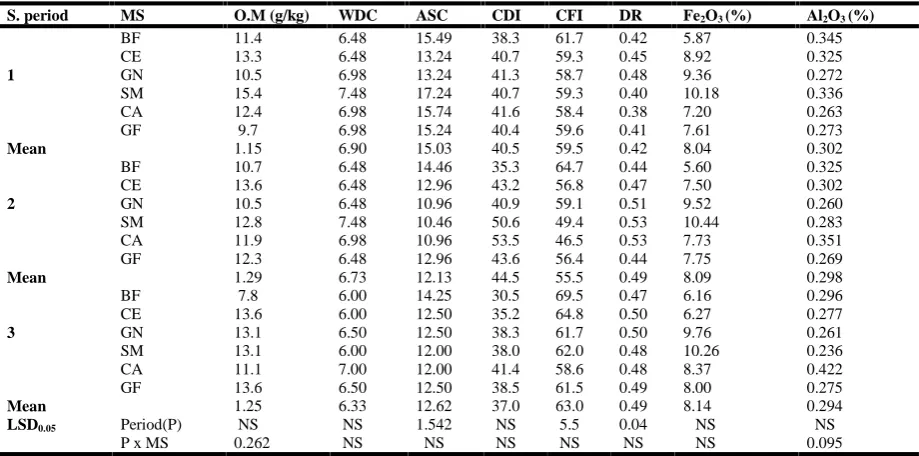
Table 2. Effects of sampling period and cover management on some selected soil properties studied
S. period MS O.M (g/kg) WDC ASC CDI CFI DR Fe2O3(%) Al2O3(%)
BF 11.4 6.48 15.49 38.3 61.7 0.42 5.87 0.345
CE 13.3 6.48 13.24 40.7 59.3 0.45 8.92 0.325
1 GN 10.5 6.98 13.24 41.3 58.7 0.48 9.36 0.272
SM 15.4 7.48 17.24 40.7 59.3 0.40 10.18 0.336
CA 12.4 6.98 15.74 41.6 58.4 0.38 7.20 0.263
GF 9.7 6.98 15.24 40.4 59.6 0.41 7.61 0.273
Mean 1.15 6.90 15.03 40.5 59.5 0.42 8.04 0.302
BF 10.7 6.48 14.46 35.3 64.7 0.44 5.60 0.325
CE 13.6 6.48 12.96 43.2 56.8 0.47 7.50 0.302
2 GN 10.5 6.48 10.96 40.9 59.1 0.51 9.52 0.260
SM 12.8 7.48 10.46 50.6 49.4 0.53 10.44 0.283
CA 11.9 6.98 10.96 53.5 46.5 0.53 7.73 0.351
GF 12.3 6.48 12.96 43.6 56.4 0.44 7.75 0.269
Mean 1.29 6.73 12.13 44.5 55.5 0.49 8.09 0.298
BF 7.8 6.00 14.25 30.5 69.5 0.47 6.16 0.296
CE 13.6 6.00 12.50 35.2 64.8 0.50 6.27 0.277
3 GN 13.1 6.50 12.50 38.3 61.7 0.50 9.76 0.261
SM 13.1 6.00 12.00 38.0 62.0 0.48 10.26 0.236
CA 11.1 7.00 12.00 41.4 58.6 0.48 8.37 0.422
GF 13.6 6.50 12.50 38.5 61.5 0.49 8.00 0.275
Mean 1.25 6.33 12.62 37.0 63.0 0.49 8.14 0.294
LSD0.05 Period(P) NS NS 1.542 NS 5.5 0.04 NS NS
P x MS 0.262 NS NS NS NS NS NS 0.095
S= sampling, MS= management system, O.M. = organic matter, WDC= water dispersible clay, ASC= aggregated silt and clay, CDI= clay dispersion index, CFI= clay flocculation index, DR= dispersion ratio, Fe2O3= Iron oxide, Al2O3= Aluminium oxide, LSD0.05= least significant difference at 5% probability level, NS= not significant
Table 3. Correlation of sesquioxides and O.M. with microaggregate stability indices
CDI 0.1098
CFI -0.1098 -1.0000
DR -0.4888 0.2658 -0.2658
Fe2O3(%) -0.5656 0.6068 -0.6068 0.6658
O.M. (g/kg) -0.4961 0.5360 -0.5360 0.7615 0.8283
WDC 0.0574 0.8739 -0.8739 0.1009 0.6675 0.3413
WDSi -0.2159 -0.8172 0.8172 0.2766 -0.2842 -0.0591 -0.8433
ASC 0.3352 -0.6319 0.6319 -0.8887 -0.6918 -0.7675 -0.3936
[image:4.595.42.555.493.581.2]or no contribution. The result from this study confirm the report of Oades (1990) that the concentration of Fe and Al oxides had to be considerably high (10%) before they could exert any aggregating effect on soils. Where the concentration is low (< 10%), humic acids appeared to dominate the charge on oxide surfaces. Oades (1984) reported that in soils with high amounts of Fe and Al oxides, the contribution of organic matter to aggregate stability is diminished. This further explains why Al2O3had poor correlation with microaggregate stability indices, while O.M.reported to be low and significantly (P < 0.05) influenced by different cover management for the soil (Azuka and Obi, 2012) and Fe2O3had better correlation with the microaggregate stability indices studied.
Conclusion
Soil microaggregates were stabilized under vegetative cover management practices. The lack of vegetative cover in the bare fallow plot had serious negative impacts on the sesquioxides contents of the soils, and to lesser extent soil microaggregate stability indices. The organic matter content and the Fe2O3 played significant roles to the microaggregate stability of the degraded Ultisol while the Al2O3had little or no contribution. Although, the soil and cover management practices had no significant effect on the microaggregate stability indices, they helped to protect the soil, and lessen the rate of its breakdown. Thus, a continuous vegetative cover management practices and adequate crop residue management are recommended for this soil, due to its fragile nature to minimize further structural degradation and further leaching of the basic cations in the soil. Proper management is necessary to position these soil resources for improved and sustainable agricultural productivity without compromising environmental quality. Incorporation of high quality and quantity of organic materials during tillage operations and use of manure are encouraged.
REFERENCES
Alekseeva, T.V., Sokolowska, Z., Hajnos, M., Alekseev, A.O., Kalinin, P.I. 2009. Water stability of aggregates in subtropical and tropical soils (Georgia and China) and its relationships with the mineralogy and chemical properties. Eurasian Soil Science 2009; 42 415-425.
Azuka, C.V. and Obi, M.E. 2012. Structural stability and hydraulic conductivity of Nkpologu sandy loam soil under different land covers in Southeastern Nigeria. Agro-science: Vol. 11, No. 1, 1-9. DOI:http://dx.doi.org/10.4314/as. v11i1.1
Barthe` S, B. and Roose, E. 2002. Aggregate stability as an indicator of soil susceptibility to runoff and erosion; validation at several levels. Catena, 47, 133–149.
Beare, M. H., and R. R. Bruce, 1993. A comparison of methods for measuring water stable aggregates: Implications for determining environmental effects on soil structure. Geoderma 56:87- 104.
Boix-fayos, C., Calvo- Cases, A., Imerson, A. C. and Soriano-Soto, M. D. 2001. Influence of soil properties on the aggregation of some Mediterranean soils and the use of aggregate size and stability as land degradation indicators. Catena 44: 47–67
Bronick, C.J. and Lal, R. 2005. Soil structure and management: a review. Geoderma, 124, 3–22.
Encyclopedia of Soil Science, ESS 2008. Aggregate stability to drying and wetting. In Chesworth C (Ed). Encyclopedia of Soil Science, Springer; pp. 28-33.
Gee G.W., and Or D. 2002. Particle size analysis. In: Dane JH, Topp GC (eds) Methods of soil analysis. Part 4. Physical Methods Soil Science Society America Book Series N0. 5 ASA and SSSA, Madison, WI; 255-293.
GENSTAT 2003. GENSTAT 5.0 Release 4.23 DE, Discovery Edition 1, Lawes Agricultural Trust Rothamsted experimental station press, UK.
Igwe C.A. 2003. Erodibility of soils of the upper rainforest zone, southeastern Nigeria. Land Degradation and Development; 14 323-334.
Igwe, C.A. 2004. Soil Properties Influencing Stability of Structure of B-horizons of Ultisols in Semiarid Nsukka, Eastern Nigeria. Arid Land Research and Management. 18:185-195
Igwe, C.A. 2011. Tropical soils, physical properties. In J Glinski, J Horabik, J Lipiec (Eds.), Encyclopedia of Agrophysics (1st ed.), Springer; 934-937.
Igwe, C.A., Akamigbo, F.O.R., Mbagwu, J.S.C. 1999b. Application of SLEMSA and USLE erosion models for potential erosion hazard mapping in southeastern Nigeria. International Agrophysics; 13: 41-48.
Igwe, C.A., Zarei, M., Stahr, K. 2009. Colloidal stability in some tropical soils of southeastern Nigeria as affected by iron and aluminium oxides. Catena; 77: 232-237.
Levy, G. J. and Miller, V. P. 1997. Aggregate stabilities of some southeastern U. S. soils. Soil Sci. Soc. Am. J., 67, 1176–1182.
Matter Content of Soils of Coastal Plain Sand under Different Land Use Types. World Journal of Agricultural Sciences 5 (1): 63-69.
Mbagwu JSC, Bazzoffi P. Soil characteristics related to resistance of breakdown of dry soil aggregates by water-drops. Soil and Tillage Research 1998; 45 133-145.
Mbagwu, J.S.C. and Bazzoffi, P. 1998. Soil characteristics related to resistance of breakdown of dry soil aggregates by water-drops. Soil and Tillage Research 1998; 45 133-145. Mbagwu, J.S.C. and K. Auerswald. 1999. Relationship of
percolation stability of soil aggregates to land use, selected properties, structural indices and simulated rainfall erosion. Mehra, O.P., and Jackson, M.L. 1960. Iron oxide removal from
soils and clays by a dithionite-citrate system buffered with sodium bicarbonate. Clay mineral 7, 317–327
Nelson, D.W. and I.E. Sommers 1982. Total carbon and organic matter. In: methods of soil analysis part II, page, A.L. (Ed). chemical and microbiological properties. Am. Soc. Agron. Madison, WI., pp 359-586.
Nwadialo, B.E. 1989. Soil landscape relationship in the Udi-Nsukka plateau. Catena 16:111-120.
Obi, M.E. 1982. Runoff and soil loss from an Oxisol in southeastern Nigeria under various management practices. Agricultural Water Management 1982; 5 193-203.
Oguike P.C. and J.S.C. Mbagwu. 2009.Variations in Some Physical Properties and Organic
Soil Tillage Res., 50: 197-206.
Sung, C.T.B. 2012. Aggregate stability of tropical soils in relation to their organic matter constituent and other soil properties. Pertanika Journal of Tropical Agricultural Science 2012; 35 135-148.
Tisdall, J.M. and Oades, J.M. 1982. Organic matter and water-stable aggregates in soils. J. Soil Sci., 33:141-163.
Williams, N. D. and. Petticrew, E. L. 2009. Aggregate stability in organically and conventionallyfarmed soils Soil Use and Management, September 2009, 25, 284–292
Yan, F., Shi, Z., Li, Z., Cai, C. 2008. Estimating interrill soil erosion from aggregate stability of Ultisols in subtropical China. Soil and Tillage Research; 100 34-41.