1 Type: Original Article
1
Exploring a New Model of End-of-Life Care for Older People that Operates in the 2
Space Between the Life World and the Healthcare System: A Qualitative Case Study 3
Abstract 4
Background: Innovative service models to facilitate end-of-life care for older people may be 5
required to enable and bolster networks of care. The aim of this study was to understand how 6
and why a new charitably funded service model of end-of-life care impacts upon the lives of 7
older people. 8
Methods. A multiple exploratory qualitative case study research strategy. Cases were three 9
sites providing a new end of life service model for older people. The services were provided in 10
community settings, primarily providing support in peoples own homes. Study participants 11
included the older people receiving the end-of-life care service, their informal carers, staff 12
providing care within the service and other stakeholders. Data collection included individual 13
interviews with older people and informal carers at two time points, focus group interviews 14
with staff and local stakeholders, non-participant observation of meetings, and a final cross-15
case deliberative panel discussion workshop. Framework analysis facilitated analysis within 16
and across cases. 17
Results: Twenty-three service users and five informal carers participated in individual 18
interviews across the cases. Two focus groups were held with an additional 12 participants, 19
and 19 people attended the deliberative panel workshop. Important elements contributing to 20
the experience and impacts of the service included organisation, where services felt they were 21
‘outsiders’; the focus of the services and their flexible approach; and the impacts particularly 22
in enriching relationships and improving mental health. 23
Conclusion: These end-of-life care service models operated in a space between the healthcare 24
system and the person’s life world. This meant there could be ambiguity around their services, 25
where they occupied a liminal, but important, space. These services are potentially important 26
to older people, but should not be overly constrained or they may lose the very flexibility that 27
enables them to have impact. 28
29
Keywords: Health Services, Health Services for the Aged, Frail Elderly, Palliative Care, Aged, 30
Qualitative Research 31
2 1
Key Messages: 2
1. Implications for policy makers 3
4
• Flexible service models that are provided without formal, statutory health and social 5
care funding may offer particular and specific benefits to older people towards the end 6
of their lives. 7
• Service models provided outside of usual care provision should be enabled to be 8
flexible, responsive and risk taking to facilitate a different sort of impact on older 9
people. 10
• Articulating the roles a new service model may provide is important, but there should 11
be the facility for this to change in response to actual patient need. 12
• Supportive end-of-life care service models operating in a community or voluntary 13
provided space are likely to have an impact on enriching relationships and improving 14
mental health. 15
16
2. Implications for public 17
Older people who live at home towards the end of their lives may have care and support needs 18
that are not met by traditional health and social care services such as nurses, doctors or social 19
care services. We found that a new, charitably provided, service model focused on responsive 20
identification of care needs, service referral and befriending operated in an important space 21
between formal care services and the support of friends and family. They appeared to help 22
people to feel safe and secure, re-connect them with their communities, and enable 23
improvements in people’s mental health. Service providers could consider how they may 24
replicate such care models within their own contexts. 25
26
Introduction 27
‘Building a workforce that can meet this population’s needs will require more 28
than training … it will require a radical redesign of the health system that is 29
centered on the communities where patients live’1 30
3
At the Health Affairs summit in 2018, the need to redesign healthcare for those with serious 1
illness was clearly set out1. Many palliative care services are found mostly in hospitals, and 2
hospice care may only be offered to those imminently dying 2-4. There is a need to develop 3
palliative care service models to meet the needs of those, often older people, living in the 4
community who are frail and with co-morbid conditions, and who are likely to be towards the 5
end of their lives5. In the context of this study we use the term ‘approaching the end of life’, 6
meaning likely to die within the next 12 months. This includes people with advanced, 7
progressive, incurable conditions, general frailty, and coexisting conditions that mean they are 8
expected to die within 12 months6. 9
An important element of care provision towards the end of life may be based within and from 10
the community, provided via social networks and using people’s social capital7,8. Social 11
relationships and networks can buffer distress or crisis situations, prevent family carer burn out, 12
and demonstrate the importance of social contexts9,10. However, existing networks can be small 13
and fragile, community engagement reduced by existing caregiving responsibilities, and with 14
formal care services providing little practical support9. Older people may have smaller social 15
networks, and family carers themselves may be older. Compared to other caregivers, end-of-16
life caregivers provide nearly twice as many hours of care per week and, report more care-17
related challenges11. Social isolation of itself also has a major influence on health, comparable 18
with well-established risk factors for mortality12. For older people in particular, innovative 19
solutions and service models may be required that enable and bolster networks of care. 20
Service models to facilitate access to healthcare for frail older people include care coordination, 21
case management, care navigation, and integrated care, with variable effects on outcomes such 22
as satisfaction, health status, healthcare utilisation or place of death13-19. What these 23
interventions share is their mediation by health or social care professionals working within 24
formal care networks, often with a relatively narrow focus. It may be that service models that 25
sit outside these formal care networks could offer a flexible, innovative, community focused 26
solutions to improving access to care for those who may not usually access palliative or hospice 27
care services, meet needs and enable improved quality of life. 28
In this paper research is presented exploring the impact of a new service model of care towards 29
the last years of life for older people. A UK charity focused on older people (Age UK) set up 30
three pilot services facilitating care to older people thought to be in their last 12-18 months of 31
life. Sitting outside the formal health care system, the service model involved a number of 32
4
primarily through working alongside general(family) practitioners and publicity to local health 1
and social care providers. Second, training staff (not necessarily with a health or social care 2
background) to enable conversations with older people and facilitate integrated support to 3
achieve personal goals. Third, mobilising volunteers to provide support where required. Such 4
services were provided alongside any existing care. The aim of this research was to understand 5
how and why this new charitably provided community model of end-of-life care influences the 6
experiences of older people. 7
8
Methods 9
Research design: We conducted a multiple exploratory longitudinal qualitative case study 10
research strategy20,21. As the services were new, a longitudinal design enabled tracking both 11
service development over time (6 months), and any changing impacts from those using the 12
service. The case was defined as a location providing the new model of care and those involved 13
with commissioning, referring to, delivering and receiving the service. North-West Liverpool 14
East Research Ethics Committee granted approval on 2nd February 2018: 17/NW/0705. Data 15
were collected in 2018. 16
Case selection and setting
17
Three locations piloted the new service model, and these formed the three cases for the 18
research. Each served a different geographical area. Brief information on the geographical area 19
each served is given in Table 1 to contextualise the cases for the reader. 20
[image:4.595.74.524.535.773.2]21
Table 1 Contextual information on the three locations piloting the new service model 22
Site Description of location
Ethnicity of
locationa
Older person populationa
Mortality rate by age group.b
Place of death 2016 all agesb
Referral sources for new service model 1 Market
town Pop 20-30,000.
White 97.9%
60- 64: 7.4% 65 -74: 11% 75- 84: 6.6%
85- 89:1.7%
0-64 years: 11.5% 65-75 years: 18.7%
Hospital: 50.4% Care home: 23%
Home: 20.9%
5
≥90: 0.9% 75-84 Years: 28.2%
85 years+: 41.6%
2 Suburban, part of large urban (pop 320, 000) area
White 97%
60-64: 6.8% 65-74:9.8% 75- 84:6.7% 85- 89:1.7%
≥90: 0.9%
0-64 years: 15.2% 65-75 years: 16.1% 75-84 Years: 29.3% 85 years+: 39.3%
Hospital:50% Care
home:20.8% Home: 23.8%
2 Family Practices (General Practitioner surgeries)
3 Mid-size town. Pop.200-300,000
White 84.5%
60-64: 5.5% 65-74: 7.0% 75-84: 4.4% 85-89: 1.3%
≥90: 0.7%
0-64 years: 17.6% 65-75 years: 17.6% 75-84 Years: 25% 85 years+: 39.8%
Hospital:51.5% Care
home:18.8% Home:21.7%
Varied number of referral routes
aCensusData. bData from Public Health England: End of Life Care Profiles 1
2
Participants
3
Participants included older people receiving care from the new service model, their family 4
carers, service providers and other stakeholders including general practitioners, community 5
nurses, and Age UK charity staff. A broad definition of ‘family carer’ was used, including 6
those related through committed heterosexual or same sex partnerships, birth or adoption and 7
others who have strong emotional and social bonds with the service user. They are lay, unpaid, 8
6
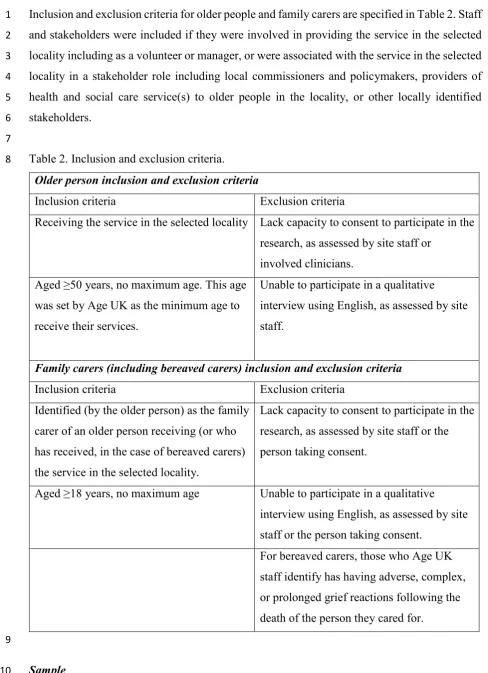
Inclusion and exclusion criteria for older people and family carers are specified in Table 2. Staff 1
and stakeholders were included if they were involved in providing the service in the selected 2
locality including as a volunteer or manager, or were associated with the service in the selected 3
locality in a stakeholder role including local commissioners and policymakers, providers of 4
health and social care service(s) to older people in the locality, or other locally identified 5
stakeholders. 6
[image:6.595.43.532.65.739.2]7
Table 2. Inclusion and exclusion criteria. 8
Older person inclusion and exclusion criteria
Inclusion criteria Exclusion criteria
Receiving the service in the selected locality Lack capacity to consent to participate in the research, as assessed by site staff or
involved clinicians.
Aged ≥50 years, no maximum age. This age
was set by Age UK as the minimum age to receive their services.
Unable to participate in a qualitative interview using English, as assessed by site staff.
Family carers (including bereaved carers) inclusion and exclusion criteria
Inclusion criteria Exclusion criteria
Identified (by the older person) as the family carer of an older person receiving (or who has received, in the case of bereaved carers) the service in the selected locality.
Lack capacity to consent to participate in the research, as assessed by site staff or the person taking consent.
Aged ≥18 years, no maximum age Unable to participate in a qualitative interview using English, as assessed by site staff or the person taking consent.
For bereaved carers, those who Age UK staff identify has having adverse, complex, or prolonged grief reactions following the death of the person they cared for.
9
Sample
7
A convenience sample of older people referred to, and receiving care from, the service in each 1
location was obtained, and if available, their family carer. A sample size of up to 10 older 2
people and 5 family carers was anticipated per case. All those providing direct care as part of 3
the new service model, and a purposive sample of stakeholders to include a range of people 4
from different professional backgrounds with an interest in the service, were invited to 5
participate. 6
Recruitment
7
Those providing the service distributed recruitment packs (invitation letter, participant 8
information sheet, reply slip). Older people who indicated interest were contacted to arrange a 9
face-to-face visit, where written consent was obtained. Older people were asked to pass a 10
recruitment pack to a family carer of their choice. Staff and stakeholder participants received 11
information about the study either directly from the research team, or via the service managers. 12
13
Data collection
14
Six forms of data collection were used: 15
1. Individual interviews: Older people and/or their family carers were interviewed to 16
explore their experience of receiving the service. Initial interviews were face to face, 17
with follow up telephone interviews offered approximately 3-4 months later. 18
Demographic data were collected at the first interview. All interviews were conducted 19
by SD or CW, digitally audio-recorded and transcribed. 20
2. One-off focus group interviews in each case study site with staff and stakeholders to 21
explore views on the service. These were conducted by CW or SD and digitally audio-22
recorded and transcribed, and details only of the roles of participants collected. 23
3. Non-participant observation of a service or other relevant meeting within each case 24
study site were conducted by SD and facilitated an understanding of service processes. 25
4. Non-patient specific documentary materials such as service brochures were collected 26
from each case-study site to understand how the service was conceptualised and 27
publicised, referral and other service processes. 28
5. Service provision data: Anonymised aggregated data were provided by the sites 29
summarising demographic information on all referrals received. 30
6. Deliberative panel discussion workshop: A cross-case deliberative panel was held with 31
staff key workers and stakeholders, together with selected professional and lay experts. 32
8
discussions. The panel was facilitated by CW, NP and SP. The purpose of the 1
deliberative panel workshop was to discuss the emerging findings of the case studies, to 2
facilitate interpretation and identify key themes. 3
Data analysis
4
Framework analysis, used in previous palliative care case studies and which facilitates 5
integration of different forms of data, was used to facilitate within and cross case pattern 6
matching21-23. The approach involves a systematic five-stage process of familiarisation, 7
identifying a thematic framework, indexing, charting, and mapping and interpretation. An a 8
priori thematic framework22 was informed by four theoretical propositions developed from an 9
initial scoping review of qualitative literature examining outcomes of services for older people 10
with similar features: 11
i) Enriching relationships: Relationships engendered feelings of being more cared for, 12
respected, loved, and secure. 13
ii) Greater autonomy and perceived control: People felt more empowered, understood, 14
consulted. 15
iii) Knowing more: More involved and informed. The intervention promoted a greater 16
level of engagement and knowledge in the patient about their condition. 17
iv) Improved mental health: People felt less anxious or stressed. They could also be 18
more confident, more independent and more assertive. 19
This framework iteratively developed throughout the analysis. Analysis was primarily 20
conducted by SD (health services researcher), with cross checking and agreement of coding 21
with CW (researcher with palliative care nursing background), and discussion with NP and SP 22
(researchers with nursing and psychology backgrounds) to debate areas of disagreement. Cross 23
case pattern matching follows to identify thematic factors associated with challenges and 24
successes in influencing the experience of older people whilst taking account of context. All 25
qualitative analyses were managed using NVivo™ software. 26
Results 27
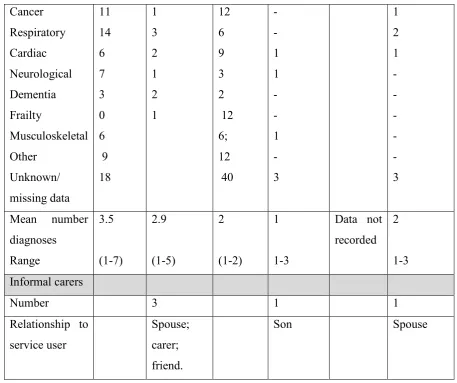
Twenty-three service users and five informal carers participated across the cases, their 28
demographic information, and that of all referrals received are found in Table 3. 29
Table 3. Demographic information on all referrals to the services from inception to end of data 30
9
Site 1 Site 2 Site 3
Service users Referred to service Study participants (n=10) Referred to service Study participan ts (n=6) Referred to service Study participant s (n=7) Number referred
Time period for referral receipt
74
14 months
NA 102
14 months
NA 23
8 months NA Mean age Range 81 (52-100) 82 (67-97) 86 (44-97) 89 (82-93) 80 (56 to 93)
80 (67-86) Male Female Missing data 30 44 2 8 36 65 1 4 2 6 17 1 6 Married Divorced Widowed Not disclosed Data not recorded 2 1 7 Data not recorded 1 - 4 1 Data not recorded 1 2 2 2 Live Alone
10 Cancer
Respiratory Cardiac Neurological Dementia Frailty
Musculoskeletal Other
Unknown/ missing data
11 14 6 7 3 0 6 9 18
1 3 2 1 2 1
12 6 9 3 2 12 6; 12 40
- - 1 1 - - 1 - 3
1 2 1 - - - - - 3
Mean number diagnoses
Range
3.5
(1-7)
2.9
(1-5)
2
(1-2)
1
1-3
Data not recorded
2
1-3 Informal carers
Number 3 1 1
Relationship to service user
Spouse; carer; friend.
Son Spouse
1
In site 1 follow up interviews were conducted with four service users and one informal carer 2
and in site 2 with two service users but were not possible in site 3 due to deterioration or death 3
of participants. Initial interviews lasted a mean of 26.3 minutes (range 8.4 – 45.3). The two 4
focus groups lasted 56.3 and 71.1 minutes. The focus group in site 1 had 7 participants (3 5
provider staff, 4 external stakeholders), and in site 3 had 5 participants, all provider staff. A 6
full day deliberative panel workshop included a number of different discursive elements across 7
[image:10.595.68.526.68.451.2]the day. Participants for the deliberative panel are summarised in Table 4. 8
Table 4. Participants in the deliberative panel 9
Participants in Deliberative Panel Number Staff from service funders headquarters n=5 End-of-life care service site staff Site 3 =2
11
Site 1 n= 2
NHS representatives Site 2 n=1
Site 1 n=2
PPI representative n=1
Researchers n=3
Total 19
1
The cross-case analysis is presented here, as the three overarching themes identified from the 2
analysis. First, organisational identity, exploring how and why the services conceptualised and 3
organised themselves, and how they fitted with existing service provision structures. Second, 4
flexible provision, how and why services were provided, their focus, and the type of care 5
offered. Third, the impact and experience of the service, how people experienced the services, 6
and what the impacts of the service were for users. 7
Service organisational identity 8
These services were often perceived as ‘outsider’ services, although this was not clear-cut: 9
I think we are insiders, in that we are a community service, so we are 10
maybe within the community voluntary sectors providing a community 11
service, but I suppose outsiders in terms of we are not health professionals. 12
(Deliberative panel - staff) 13
Being ‘outsiders’, compared to health and social care staff, could be perceived as an advantage: 14
Speaker 1: the plus about us is, we are outsiders…we have a staffing that 15
is more fluid (…) and that fluidity is what is noticed very much by statutory 16
services isn’t it. 17
Speaker 2: The flexibility we bring is exactly the opposite of an institutional 18
approach and, of course, our workers will do whatever. (Site 3 Focus group 19
- staff) 20
The service staff also often regarded themselves as outsiders, and whilst this could be a source 21
of frustration in gaining credence with and access to health care providers (such as being able 22
12
recognised that this enabled them to take risks, that would not be allowed by public service 1
professionals because of bureaucratic processes: 2
We go, ‘oh come on’, and we just get it done…, risks work, they work very 3
much in favour of the clients, (…) we will do those things that can’t be done 4
under that red tape. (Deliberative panel - staff) 5
You walk into someone’s house and you know, they’ve got no food because 6
they haven’t got a fridge, and you know, you’re the only person that’s going 7
to see them for the next week, as an organisation we’ll go and get them a 8
fridge, and we’ll carry the fridge into their house and we’ll plug the fridge 9
in. But, you know, I think of the millions of risks attached to … (Deliberative 10
panel – staff) 11
‘Risk taking’ was almost universally perceived to be of benefit to clients. Typical risks were 12
unlikely to pose direct harm, but which, as in the examples above, circumvented ‘red tape’ to 13
meet expressed needs directly and rapidly in the way that a friend or neighbour might do. 14
The predicament of being an outsider was that it could be hard to establish credibility and form 15
a clear identity for the service. This could make it more difficult to gain a sympathetic audience 16
with potential referrers, particularly when the purpose of more flexibly provided services may 17
not be clear to them. The services struggled initially to gain referrals, and recognised that their 18
planned associations just with general practices needed to be widened. 19
Flexible provision
20
The case study sites differed in the structure of their approach, within the overall initially 21
proposed service model. For example, site one had a more structured approach, restricting 22
their role to a narrower range of predefined tasks such as future care planning and assistance 23
with benefit applications. Whereas, in site three, more flexibility and autonomy could be seen 24
in how they interpreted their role and what to do with service users, for example in providing 25
more direct befriending services and a ‘listening ear’. In site two their service had developed 26
away from a fixed approach toward becoming more flexible in their response to need: 27
I think we started off with quite fixed criteria and within a very short time 28
we realised it’s not going to work, and you do have to become more flexible, 29
13
saying about advance care planning and power of attorney…you thought 1
you would be really focusing on those. (Deliberative Panel staff member) 2
Flexibility however, resulted in challenges expressing their service identity or purpose, despite 3
the benefits of responsiveness or addressing unanticipated needs: 4
I think the holistic thing is important in this role, because if that…I’ve got 5
one client that I’ve done, I think, seven different things for him and that 6
varies from maximising his income, referral to occupational therapy, 7
getting him some rehabilitation at home, getting him out and socialising. 8
(Deliberative panel - staff) 9
Lacking a clear, defined, identity and purpose was confusing both to referrers, 10
affecting referral streams, and to service users initially who could be confused about 11
the referral and its purpose. 12
Service impacts and experiences
13
Enriching relationships 14
The relational aspects of care, and human contact, appear important. Service users expressed 15
satisfaction at being party to a new relationship, in some case likening it to a friendship, 16
providing much needed company and contact with the outside world. The relationship in and 17
of itself could be experienced as a profound impact of the intervention: 18
Interviewer: What would you say have been the biggest benefits you’ve felt 19
from the service? 20
Service User: Just knowing them. Such satisfaction of knowing these 21
people. (Interview S1P4) 22
23
The depth of the relationship could differ, but it was common for service users to emphasise 24
their appreciation for the relationship, irrespective of how formal or ‘loose’ the relationship 25
was: 26
It’s important for the likes of me to have that lovely regular but loose 27
14
understanding. A lot of understanding and to help where necessary, yeah? 1
(Interview S2P6) 2
Service staff felt that it could take time to build up relationships to enable in-depth discussions, 3
but that this was not always possible when someone had a limited prognosis: 4
Basically because of capacity, that the time it takes to do that kind of 5
work and the relationship…the time it takes to build up the relationship 6
to have that kind of conversation about end of life, really. (Site 1 Focus 7
Group - staff) 8
Despite this, service user’s trust for the service staff could reach a level where they felt that 9
they could act like a confidante for them, facilitating frank conversations that the service user 10
might feel uncomfortable having with friends or family: 11
I didn’t know who to turn to, or anything, but now I’ve got someone I can 12
turn to that I know I can… you know, you don’t mind confiding in. 13
(Interview S2P4) 14
Such relationships could affect people’s state of mind: 15
The most important thing is knowing that there’s somebody there who you 16
can contact if you’re unsure of any difficulties, and if they can’t give you 17
the answer, they know somebody who can….. And I think that’s very 18
important that you know that there’s somebody out there, you know, who 19
can. (Interview S1P7) 20
21
Improved mental health 22
Service users appeared to derive psychological benefits from their relationships with the 23
service staff: 24
If you’d come before she started coming, you would have noticed a 25
difference in me, you know. I just didn’t want to talk to people and, you 26
know. It’s only a few visits, but it’s so much. (Interview – S3P2) 27
15
Very aware that, obviously, I’ve problems and worries and things, so she 1
put my mind at rest about a lot of those so I didn’t feel at all intimidated by 2
her coming in to talk to me or asking me questions. (Interview S1P3) 3
Keeping me chirpy and not going down that pit of anxiety, she’s there. She’s 4
there. Yeah. (….) It’s an extra, it’s an extra part of being comfortable with 5
who I am and what I can do and what I can’t do. (Interview S2P6) 6
Service users also mentioned greater feelings of safety and security: 7
It takes pressure off you because you feel… I know this sounds daft, 8
somebody my age, but you feel safer somehow and that’s a big thing. 9
(Interview – S1P7) 10
In more vivid terms, this service user described the feelings of protection and security he felt: 11
I’m not standing on the end of a cliff feeling like I’m going to fall, you know 12
what I mean? And they come and help, it’s like having a barrier and they 13
put a blanket round you and cuddle you. (Interview S1P9) 14
Financial impacts 15
Service staff frequently supported service users to apply for financial benefits, making up a 16
considerable shortfall in the service user’s finances: 17
It [new financial benefit] will make a big difference to me, yeah, (…) That’ll 18
pay the carers, but then I’ve got to live on my savings. (Interview S3P5) 19
20
Being part of the outside world 21
For some individuals the company of the service staff or volunteers could constitute a rare 22
instance of social contact, and where they could be enabled to leave their homes and be part of 23
a world they had lost: 24
I’m so used to not being out for so long, you know, that it’s a treat for me 25
to sit here and think, you know. Well, when she asks me another time, you 26
16
have a look at the new café,’ It doesn’t take much to please me if I go out. 1
(Interview S3P2) 2
Discussion 3
Summary of main findings 4
The services occupied a distinct space in their local care landscape in providing a different, but 5
needed, form of care to older people towards the end of their lives. They identified challenges 6
articulating and defining the form of provision, and this resulted in subtle differences in service 7
scope, form of provision, and the degree of responsiveness and flexibility. Services were 8
perceived to be ‘outside’ the norm of service provision, but this enabled them to take more 9
risks, responding to need in ways not possible for traditional service providers. Service users 10
reflected this ambiguity, with some lack of clarity about the purpose of the service. However, 11
where a relationship developed, this was described as having a needed impact on feelings of 12
having a friend, on being part of, or re-engaging with, a community, and having someone to 13
turn to. There were impacts described on mental health issues such as general worries, anxiety 14
and depression, with people feeling safer and more secure. 15
16
What this adds to knowledge 17
These services operate in a space that can be understood with reference to Habermas’s 18
description of system and lifeworld24,25. Habermas argues that as social complexity increases, 19
our economic and political systems become disconnected from the personal or family lifeworld. 20
These services could be seen as operating in a space between the (healthcare) system and the 21
(personal) lifeworld, where there could be discomfort or conflict if they bring the attitudes, 22
values and needs of the patient’s lifeworld into a rule-bound and risk averse healthcare system. 23
Occupying these spaces can be experienced as ambiguous, where the social expectations that 24
may be between, say a nurse and a patient, are suspended, making this a ‘liminal’ or ‘threshold’ 25
space. Service users appeared to recognise these services occupied a different form of space, 26
with different expectations than of formal care services. 27
These concepts of system and lifeworld have been used to explore issues such as hospice 28
provision, community nursing and public involvement, where there is also perceived to be a 29
space, or shift in lifeworld26-28. The concept of liminality can both conceptualise the ‘betwixt 30
17
certain lifeworld 29,30, and the flexible services that can operate between system and 1
lifeworlds31. Liminality expresses how they existed in the interstices between categories of 2
insider/outsider, inhabiting characteristics of being an outsider such as being risk-taking, 3
flexible, and exerting affective labour, while, simultaneously, exhibiting characteristics of 4
insider status such as being paid workers for a well-known charity, gaining access to service 5
users through family practitioners, and having a degree of expertise in their field. There was a 6
degree of agency and choice at work in how each service choose to work with liminality and 7
interpret the identity of their service, pushing their working practices towards structure or 8
flexibility, insider or outsider, and risk takers or risk averse services. 9
Engendering a feeling of safety, security and being cared for was also important to the 10
experience of receiving the service. Feeling safe is emerging as a core concept in many 11
healthcare decision making processes, including decision making about going to emergency 12
departments32 or being in hospital33. There is evidence that home nursing services can enable 13
a feeling of safety34, and that if neighbors are trusted, that engenders a feeling of safety that 14
improves self-reported health35. Feeling safe and secure appears to protect against frailty36. 15
Whilst we report that older people reported benefit from the relationship itself, rather than a 16
specific impact of the relationship, there is strong evidence that social relationships, loneliness 17
and social isolation affect mortality risk 12,37. Whilst the ‘lifeworld’ places importance on 18
people and relationships, it is likely that this impact on health and wellbeing could influence 19
use of healthcare ‘systems’. 20
Strengths and limitations of the research 21
The case study approach enabled a multi-perspective understanding of how and why these new 22
service models had an impact on service user experience. However, we captured little of the 23
family carer view on these services and their impact, and it may be that family carers have 24
different opinions on services and their impact. Information about the study was given to 25
service users by the services, due to requirements of our research approvals. They may have 26
selected potential participants in unknown ways that introduces bias, for example those who 27
may have expressed positive opinions of services received. We do not know how many were 28
given information packs but chose not to participate. Our sample was primarily White British, 29
which reflects the users of these services, and typical users of many end of life care services38. 30
Access to palliative care services for minority ethnic populations remains challenging39, and 31
18
it appears these services may not be the answer to addressing this inequitable access. It was 1
challenging to capture repeated interviews, primarily due to health deterioration or death, and 2
the planned longitudinal understanding is not present in this analysis. Only two of our initial 3
four theoretical propositions were fully supported by the data; those of enriching relationships 4
and improved mental health. Our initial scoping review drew from a number of studies on 5
advance care planning, given this was planned to be a focus of the intervention studied. 6
However, such planning conversations were not a key part of the service model in some 7
locations, and it may be this is why propositions on autonomy and knowledge were not 8
supported by these data. 9
Recommendations for policy, practice and future research 10
Policymakers and practitioners should consider facilitating or initiating such services as they 11
appear to have value. Account needs to be taken of ways of enabling sufficient time to allow 12
flexibility and reasonable risk taking that appear vital to success, even if referrals and service 13
usage increases. Evaluation should be integral, taking account of how contexts shape such 14
services, and consideration should be given to attributional and/or longitudinal designs to 15
strengthen the evidence base and enable appraisal of service outcomes such as on quality of 16
life. 17
Conclusions and Implications 18
Flexible, responsive, person-centred services, operating in the liminal space between the 19
person’s life world and formal health and care systems, appear to have benefit for older people 20
thought to be towards the end of their lives. The benefit is likely to be in aspects such as 21
developing relationships, feeling connected and safe, and wellbeing. These benefits may have 22
an impact on mental health, mortality and service use. 23
24
References 25
1. Bylander J. Community-Focused Health Care For The Seriously Ill. Health Affairs. 26
2019;38(3):344-346. doi:10.1377/hlthaff.2019.00111 27
2. Meier DE, Back AL, Berman A, Block SD, Corrigan JM, Morrison RS. A National Strategy 28
For Palliative Care. Health Affairs. 2017;36(7):1265-1273. doi:10.1377/hlthaff.2017.0164 29
3. Penders YW, Gilissen J, Moreels S, Deliens L, Block LVd. Palliative care service use by older 30
people: Time trends from a mortality follow-back study between 2005 and 2014. Palliative 31
Medicine.0(0):0269216317720833. doi:doi:10.1177/0269216317720833 32
4. Walshe C, Todd C, Caress A, Chew-Graham C. Patterns of access to community palliative care 33
19
5. Aldridge M, Bradley EH. Epidemiology And Patterns Of Care At The End Of Life: Rising 1
Complexity, Shifts In Care Patterns And Sites Of Death. Health Affairs. 2017;36(7):1175-1183. 2
doi:10.1377/hlthaff.2017.0182 3
6. Council. GM. Treatment and care towards the end of life: good practice in decision making. 4
London: General Medical Council 2010. 5
7. Abel J, Walter T, Carey LB, et al. Circles of care: should community development redefine the 6
practice of palliative care? BMJ Supportive & Palliative Care. 2013;3(4):383-388. 7
8. Sallnow L, Richardson H, Murray SA, Kellehear A. The impact of a new public health approach 8
to end-of-life care: A systematic review. Palliative Medicine. 2016;30(3):200-211. 9
doi:10.1177/0269216315599869 10
9. Lewis J, DiGiacomo M, Currow D, Davidson P. Social capital in a lower socioeconomic 11
palliative care population: a qualitative investigation of individual, community and civic 12
networks and relations. BMC Palliative Care. 2014;13(1):30. 13
10. Lewis JM, DiGiacomo M, Currow D, Davidson P. A social capital framework for palliative 14
care: supporting health and well-being for people with life-limiting illness and their carers 15
through social relations and networks. J Pain Symptom Manag. 2013;45(1):92-103. 16
11. Ornstein KAK, A.S; Bollens-Lund, E; Wolff, J.L;. A National Profile Of End-Of-Life 17
Caregiving In The United States. Health Affairs. 2017;36(7):1184-1192. 18
doi:10.1377/hlthaff.2017.0134 19
12. Holt-Lunstad J, Smith TB, Layton JB. Social Relationships and Mortality Risk: A Meta-20
analytic Review. PLoS Med. 2010;7(7):e1000316. doi:10.1371/journal.pmed.1000316 21
13. Di Pollina L, Guessous I, Petoud V, et al. Integrated care at home reduces unnecessary 22
hospitalizations of community-dwelling frail older adults: a prospective controlled trial. BMC 23
Geriatr. 2017;17(1):53. doi:10.1186/s12877-017-0449-9 24
14. Eklund K, Wilhelmson K. Outcomes of coordinated and integrated interventions targeting frail 25
elderly people: a systematic review of randomised controlled trials. Health Soc Care 26
Community. 2009;17(5):447-458. doi:10.1111/j.1365-2524.2009.00844.x 27
15. Randall S, Daly G, Thunhurst C, Mills N, Guest DA, Barker A. Case management of 28
individuals with long-term conditions by community matrons: report of qualitative findings of 29
a mixed method evaluation. Prim Health Care Res Dev. 2014;15(1):26-37. 30
doi:10.1017/s1463423612000667 31
16. Yu DS. Effects of a Health and Social Collaborative Case Management Model on Health 32
Outcomes of Family Caregivers of Frail Older Adults: Preliminary Data from a Pilot 33
Randomized Controlled Trial. J Am Geriatr Soc. 2016;64(10):2144-2148. 34
doi:10.1111/jgs.14259 35
17. Oeseburg B, Wynia K, Middel B, Reijneveld SA. Effects of case management for frail older 36
people or those with chronic illness: a systematic review. Nurs Res. 2009;58(3):201-210. 37
doi:10.1097/NNR.0b013e3181a30941 38
18. Hallberg IR, Kristensson J. Preventive home care of frail older people: a review of recent case 39
management studies. J Clin Nurs. 2004;13(6b):112-120. 40
19. You EC, Dunt D, Doyle C, Hsueh A. Effects of case management in community aged care on 41
client and carer outcomes: a systematic review of randomized trials and comparative 42
observational studies. BMC Health Serv Res. 2012;12:395. doi:10.1186/1472-6963-12-395 43
20. Yin RK. Case study research. Design and Method. Third ed. Thousand Oaks: Sage; 2003. 44
21. Walshe C. The evaluation of complex interventions in palliative care: An exploration of the 45
potential of case study research strategies. Palliative Medicine. 2011;25(8):774-781. 46
22. Ritchie J, Spencer L. Qualitative data analysis for applied policy research. In: Bryman A, 47
Burgess RG, eds. Analysing qualitative data. London: Routeledge; 1994. 48
23. Walshe CE, Caress AL, Chew-Graham C, Todd CJ. Case studies: a research strategy 49
appropriate for palliative care? Palliative Medicine. 2004;18:677-684. 50
24. Habermas J. The Theory of Communicative Action, Volume One: Reason and the 51
Rationalization of Society (Cambridge: Polity). 1984. 52
25. Habermas J. The theory of communicative action, Volume 2: Lifeworld and system: A critique 53
20
26. Maguire K, Britten N. 'You're there because you are unprofessional': patient and public 1
involvement as liminal knowledge spaces. Sociol Health Illn. 2018;40(3):463-477. 2
doi:10.1111/1467-9566.12655 3
27. West E, Onwuteaka-Philipsen B, Philipsen H, Higginson IJ, Pasman HRW. "Keep All Thee 4
'Til the End": Reclaiming the Lifeworld for Patients in the Hospice Setting. Omega (Westport). 5
2017:30222817697040. doi:10.1177/0030222817697040 6
28. Pearce C, Phillips C, Hall S, et al. Contributions from the lifeworld: quality, caring and the 7
general practice nurse. Qual Prim Care. 2009;17(1):5-13. 8
29. MacArtney JI, Broom A, Kirby E, Good P, Wootton J. The Liminal and the Parallax:Living 9
and Dying at the End of Life. 2017;27(5):623-633. doi:10.1177/1049732315618938 10
30. Blows E, Bird L, Seymour J, Cox K. Liminality as a framework for understanding the 11
experience of cancer survivorship: a literature review. 2012;68(10):2155-2164. 12
doi:10.1111/j.1365-2648.2012.05995.x 13
31. Vanderstichelen S, Cohen J, Van Wesemael Y, Deliens L, Chambaere K. The liminal space 14
palliative care volunteers occupy and their roles within it: a qualitative study. BMJ Support 15
Palliat Care. 2018. doi:10.1136/bmjspcare-2018-001632 16
32. Henson LA, Higginson IJ, Daveson BA, et al. 'I'll be in a safe place': a qualitative study of the 17
decisions taken by people with advanced cancer to seek emergency department care. BMJ 18
Open. 2016;6(11):e012134. doi:10.1136/bmjopen-2016-012134 19
33. Robinson J, Gott M, Frey R, Gardiner C, Ingleton C. Predictors of patient-related benefit, 20
burden and feeling safe in relation to hospital admissions in palliative care: A cross-sectional 21
survey. Palliat Med. 2018;32(1):167-171. doi:10.1177/0269216317731991 22
34. Leine M, Wahl AK, Borge CR, Hustavenes M, Bondevik H. Feeling safe and motivated to 23
achieve better health: Experiences with a partnership-based nursing practice programme for in-24
home patients with chronic obstructive pulmonary disease. J Clin Nurs. 2017;26(17-18):2755-25
2764. doi:10.1111/jocn.13794 26
35. Cain CL, Wallace SP, Ponce NA. Helpfulness, Trust, and Safety of Neighborhoods: Social 27
Capital, Household Income, and Self-Reported Health of Older Adults. Gerontologist. 28
2018;58(1):4-14. doi:10.1093/geront/gnx145 29
36. Cramm JM, Nieboer AP. Relationships between frailty, neighborhood security, social cohesion 30
and sense of belonging among community-dwelling older people. Geriatr Gerontol Int. 31
2013;13(3):759-763. doi:10.1111/j.1447-0594.2012.00967.x 32
37. Holt-Lunstad J, Smith TB, Baker M, Harris T, Stephenson D. Loneliness and social isolation 33
as risk factors for mortality: a meta-analytic review. Perspect Psychol Sci. 2015;10(2):227-237. 34
doi:10.1177/1745691614568352 35
38. Walshe C, Chew-Graham C, Todd C, Caress A. What influences referrals within community 36
palliative care services? A qualitative case study. Social Science & Medicine. 2008;67(1):137-37
146. 38
39. Gunaratnam Y. Ethnicity, older people and palliative care. London 2006 2006. 39
40
Appendix 1:
41
Exploring a New Model of End-of-Life Care for Older People that Operates in the Space 42
Between the Life World and the Healthcare System: A Qualitative Case Study 43
Data collection topic guides and schedules 44
21
A topic guide rather than a fixed schedule guided but not constrained the interviews, ensuring 1
that interviews were driven by participant issues. Interviews were conversational to aid 2
developing rapport to explore complex and potentially emotional issues. The topic guide 3
evolved as categories are discovered through the interviews and analysis. Interviews were 4
terminated at participant request or if the interviewer is concerned about the participant. 5
Interview topics: 6
a) Summarising experiences as patient/carer to set agenda, level of disclosure and 7
terminology. 8
b) Probing events i.e. could you tell me a bit more about what happened then? How 9
do you feel about that? Did you get support from anyone at this time? What do you 10
think you learned from this experience? 11
c) Exploring the experience of the Age UK Later Life service, what was helpful, what 12
could be improved? Understanding perceptions of how the service works with any 13
other care providers. 14
d) Understanding what they consider to be important in later life, why, and whether 15
the Age UK service has enabled this. 16
17
2) Focus groups 18
For stakeholder participants a focus group was held towards the end of the data collection 19
period within each site, facilitated by two research team members. 20
The purpose was to explore stakeholder views on the Age UK Later Life service, how people 21
experience it, and its perceived impact. The topics of the focus group were primarily 22
determined by participants and their interactions. Topics introduced to the group for discussion 23
included exploring processes of the service provision (patient identification, referral, service 24
receipt, interaction with other services), perceptions of impact and service outcomes. 25
3) Deliberative Panel Discussion Workshop 26
The purpose of the deliberative panel discussion workshop was to draw upon the emerging 27
findings of the case studies, to discuss the implications for implementation of similar Age UK 28
or other services, including identifying facilitators and barriers to change, in different socio-29
political, cultural and economic environments. The deliberative workshop drew upon 30
22
‘roundtable’ discussions. Three discussions were held, in two groups, across the day. These 1
sequentially focused on stimulus data and discussion on the following topics: 2
a. What is the service for? Who might benefit? 3
b. Concepts and challenges of the service 4