Steffen Gr ¨unew¨alder
Department of Mathematics and Statistics, Lancaster University.
Abstract
We study plug-in estimators of conditional ex-pectations and probabilities, and we provide a systematic analysis of their rates of convergence. The plug-in approach is particularly useful in this setting since it introduces a natural link to VC- and empirical process theory. We make use of this link to derive rates of convergence that hold uniformly over large classes of functions and sets, and under various conditions. For in-stance, we demonstrate that elementary condi-tional probabilities are estimated by these plug-in estimators with a rate ofn˛ 1=2if one conditions with a VC-class of sets and where˛ 2 Œ0; 1=2/ controls a lower bound on the size of sets we can estimate givenn samples. We gain similar results for Kolmogorov’s conditional expectation and probability which generalize the elementary forms of conditioning. Due to their simplicity, plug-in estimators can be evaluated in linear time and there is no up-front cost for inference.
1
Introduction
Conditional distributions and conditional expectations are of importance in all areas of machine learning and statis-tics. We consider a simple and natural approach to esti-mate conditional distributions based on the plug-in prin-ciple. This allows us to leverage results from VC- and empirical process theory in order to control estimation er-rors uniformly over large families of sets and functions. Before giving a more detailed account of the estimators and their properties we go through some concrete exam-ples in which conditional distributions play a major role. Many applications of conditional distributions make use of the Markov property, and essentially any method that uses this property relies on estimates of conditional dis-tributions. For instance, hidden Markov models use the
Proceedings of the 21st International Conference on Artificial Intelligence and Statistics (AISTATS) 2018, Lanzarote, Spain. PMLR: Volume 84. Copyright 2018 by the author(s).
Baum-Welch algorithm to infer conditional distributions and, more generally, graphical models rely heavily on con-ditioning (Baum and Petrie, 1966; Rabiner, 1989; Bishop, 2006). Similarly, many reinforcement learning algorithms are developed for Markov decision processes (MDPs) and balance between optimization and the estimation of condi-tional pay-offs (Sutton and Barto, 1998; Szepesv´ari, 2010). Recently, causal inference has become increasingly popu-lar, which is yet another branch of machine learning that relies heavily on conditioning (Sch¨olkopf, Janzing, Peters, Sgouritsa, Zhang, and Mooij, 2012).
In the case that conditioning happens only with respect to finitely many events, elementary tools suffice to prove con-sistency of estimators and to derive rates of convergence. However, in practice, the number of events we condition on is typically very large or even infinite. For example, the number of states in an MDP is usually exceptionally large and approximation techniques are used in practice. Neural networks have proven useful in this context (Silver et al., 2016). Providing guarantees on estimates of conditional expectations is, in this case, a non-trivial challenge and falls within the area of non-parametric statistics. Classical tools in non-parametric statistics to address such challenges are VC- and empirical process theory. Before showing how these tools can be applied in our context we first provide an overview of the forms of conditioning we can deal with.
In machine learning we encounter conditional distributions in various forms. For instance, graphical models make use of conditional probabilities P .AjB/ of an eventA given a second event B. Closely related to this is the condi-tional probability of a random variableY attaining a value y and given that a second random variable X equals x when both X and Y can attain only finitely many val-ues. Formally, we are working with P .Y D yjX D x/ andy andx are elements of the finite range spaces ofY and X respectively, which we will denote in the follow-ing by Y and X. Similarly, E.YjB/, the average value of the random variable Y over the set B, plays a role in various applications, often in the form of E.YjX D x/ or E.f .Y /jX D x/. For example, in classical reinforce-ment learning we use the conditional expectation operator E.f .Y /jX D x/ D Pn
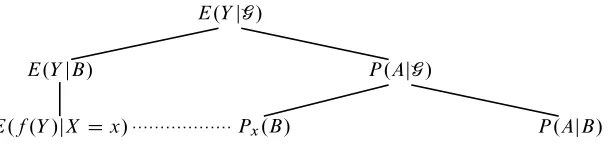
of a policy. One can define conditional expectations also on continuous spaces if there exist densitiesp.x; y/on the joint spaceXY. In modern probability theory such con-ditional probabilities and expectations are treated as spe-cial cases of Kolmogorov’s conditional expectation. Com-ing from these more elementary forms of conditionCom-ing Kol-mogorov’s approach can appear counter-intuitive at the out-set. Kolmogorov’s conditional expectation takes a random variableY and a set of events grouped inG and returns a random variableE.YjG/that is measurable with respect to the events inGand which equalsY when compared across any event contained inG. Intuitively, these properties say that information of the eventsG allows us to determine the value E.YjG/andE.YjG/corresponds to a suitable av-erage value of Y. The approach appears sometimes un-familiar since one often thinks of a conditional expectation E.YjX Dx/as a fixed value and not as a random variable. This difference occurs since forE.YjX D x/we already assume that a particular event occured, i.e. the event that the random variableX attains valuex. If we do not make this assumption thenE.YjX /is a random variable that de-pends on the values thatX attains. Furthermore, the move to a family of eventsG allows one to consider the average value ofY across a variety of events and not just for the eventX Dx. In Kolmogorov’s approachG is a-algebra which guarantees, in particular, that if we can calculate the average value forX D x1; X D x2; : : :then we can also calculate the average value for any union of these events, i.e. we could ask what is the average probability of Y if X 1 etc. Kolmogorov’s approach is also used to de-fine conditional probabilities. The way these are dede-fined is based on the simple observation thatP .A/ D E.A/, whereAdenotes the characteristic function of the event A, i.e. A.x/attains value1ifx 2Aand0otherwise. In particular, conditional probabilitiesP .AjG/are defined as E.AjG/and one can regain the more elementary forms of conditional probabilities by suitable choices ofG. Here, our aim is not to derive estimators for the most general form of conditioning but to understand how one can control es-timation errors not only uniformly over a set of elementary events, but also over combinations of these events. That is, we control estimation errors for at most countable unions and intersections, as well as complements, of these elemen-tary events. Figure 1 provides an overview of the different forms of conditioning and we fill in missing details about these in the preliminaries.
The problem of estimating a probability measure P uni-formly over large classes of sets is well understood when the empirical measurePnis used as the estimator.Pn con-verges uniformly over a family of sets to the measureP if is a VC-class (recall that is a VC-class if there ex-ists a setx1; : : : ; xnand a labelingb1; : : : ; bn2 f0; 1gsuch that for everyA2there is anifor whichbi 6DA.xi/). In fact, in this case the rate of convergence is known; in-deed, supA2jPn.A/ P .A/jconverges to zero at a rate of
n 1=2, and the error decreases uniformly over. We make use of this approach to derive plug-in estimators of condi-tional probabilitiesP .AjB/whereA2 1; B 2 2. The plug-in principle suggests to replace the unknown probabil-ity measurePwith the empirical measurePnto gain the es-timatorPn.AjB/. Suitable restrictions on1and2 anal-ogous to the VC-class approach above allow us to derive n 1=2rates for this estimator. A difficulty that arises here is that the setsBwe condition on can have small probabil-ities and infB22P .B/can be zero. We develop a simple
technique which decreases the rate of convergence but cir-cumvents this problem and allows us to work with infinite sets2for which infB22P .B/D 0. A similar approach
allows us to derive estimators for conditional expectations E.fjB/and to control their estimation error. We need re-strictions on the function class F over which the guaran-tees should hold. We extend standard results which say that a rate ofn 1=2uniformly overF can be achieved when es-timating expectationsE.f / ifF is a VC-subgraph class (the family of subgraphs ff.x; t / W x 2 X; t f .x/g W f 2 Fg is a VC-class), or more generally, a Donsker class (Dudley, 2014). Examples of such classes are suf-ficiently constrained neural networks (Shalev-Shwartz and Ben-David, 2014)[Sec. 20.4], and unit balls in a reproduc-ing kernel Hilbert space (RKHS, (Aronszajn, 1950)) if the kernel function is continuous and the input space is com-pact. We extend these results to Kolmogorov’s conditional expectation and probability.
This extension is straightforward when the involved fam-ilies are finite, but is non-trivial when they are infinite. This is because, for instance, the fact that is a VC-class does not necessarily imply that the smallest-algebra that contains is a VC-class. In fact, ./ is a VC-class if, and only if, it is generated by finitely many sets. The implication of this is that conditional expectations and probabilities given a -algebra G consisting of infinitely many sets need to be approximated by conditional expec-tations and probabilities over finite -algebras Gn where either S
n2NGn D G or one can increasingly well rep-resent elements in G by elements inGn. A further diffi-culty one faces is that it is often easy to construct families
G1 G2 : : :such that for eachA 2 G there exists an n and aB 2 Gnwhich approximatesAwell in the sense that P .AB/ < . However, this convergence is typi-cally not uniform. In natural settings one has, for instance, supA2GinfB2GnP .AB/ D 1=2despite this
approxima-tion property of the families Gn; see Section 2.3 for de-tails. The problematic sets get increasingly irregular asn increases and one way to resolve this problem is to work with functions f that posses certain smoothness proper-ties, such as Lipschitz-continuity. This allows for efficient estimation of conditional expectations in the sense that one attains inequalities of the type
E.YjG/
P .AjG/
P .AjB/ Px.B/
E.YjB/
[image:3.612.170.474.73.147.2]E.f .Y /jX Dx/
Figure 1: An overview of various forms of conditioning and their interrelation.
wheref is anL-Lipschitz function anddnis some mea-sure of size of the elements in Gn which decreases to 0 in n. Such inequalities can then be combined with guarantees for estimators of E.fjGn/to gain bounds on kE.fjG/ En.fjGn/kˇ1.P / where we useEn. jGn/to
denote the estimator of the conditional expectation. We ex-plore this line of thought in Section 3.2. In particular, we use this approach to derive plug-in estimators forE.fjG/ andP .AjG/, and we control their estimation error over in-finite families of events G and simultaneously over large function classesF. In general, we focus on rates of conver-gence and we do not study finite sample guarantees. That being said, finite sample guarantees are amenable to the ap-proach, e.g. by using data-driven Rademacher complexities as can be found in Gin´e and Nickl (2016)[Sec 3.5].
Comparison. There exists a variety of approaches to esti-mate conditional distributions and expectations. Of partic-ular importance are the following two. 1. In the elementary setting whereXandY attain only finitely many values and one has observations.X1; Y1/; : : : ; .Xn; Yn/it is common to estimateE.YjX D x/byPn
iD1YifXi D xg=jfi W Xi D xgj, where X1; : : : ; Xn are i.i.d. according toP. From the central limit theorem it follows that these estima-tors converge with a rate ofn 1=2. Our estimators are the natural generalization of such estimators to not necessarily finite valued random variables. 2. Estimators of condi-tional expectations of the form E.fjX D x/ are popular in the kernel literature and have been pioneered by Song et al. (2009). f lies here in an RKHS andE.fjX D x/ is approximated through a function gin a second RKHS. It is known that under favorable conditions the kernel es-timator converges with a rate of log.n/=nto an approxi-mation of E.fjX D x/ – this corresponds to a rate of log1=2.n/n 1=2 in our setting. An important condition is here thatf is an element of the unit ball of a finite dimen-sional RKHS (Gr¨unew¨alder et al., 2012). This approach is somewhat different from ours in that it controls the com-plexity of the conditional expectation estimator by repre-senting it through an RKHS function that is constrained in its norm. Our techniques do not extend straightforwardly to this approach and we cannot use them to derive rates of convergence for the approximation. On the other hand, our approach does not rely on a particular function space like an RKHS or on assumptions on the dimension of the involved function spaces.
Contribution. Our main contributions are given below:
1. To the best of our knowledge plug-in estimators for conditional expectations and probabilities have not been systematically studied before. This comment ap-plies, in particular, to the estimators we introduce in Equations (2,3) and (5-7).
2. Similarly, works that exploit VC-theory to study such conditional expectations and probabilities are lacking. The plug-in principle allows for a very efficient use of VC-theory and demonstrating this relation is, in our opinion, a significant contribution of our paper.
3. We use VC-theory to establish rates of convergence for the plug-in estimators, i.e. Prop. 3.1 to Prop. 3.4 provide rates of convergence for the estimators under various conditions and these propositions are novel.
4. Another contribution worth pointing out is the study of the interplay between-algebras and VC-classes. This is crucial for an understanding of rates of conver-gence of the plug-in estimators.
1.1 Preliminaries
We start by adding details about how conditional expec-tations and probabilities are defined (see (Dudley, 2002) for more details). To define Kolmogorov’s conditional ex-pectation formally consider a probability space.;A; P / and a -subalgebra G A. A conditional expecta-tion E.YjG/ is a random variable that is G-measurable and which agrees with Y over any element B 2 G, i.e.
R
BE.YjG/ dP D
R
expectation or a distribution that acts on Y, e.g. ifY at-tains values inRthen the conditional distribution should be a distribution onR. For simplicity letY D Rand letB
be the Borel-algebra. If there existsPYjG.B; !/such that PYjG.B; !/ WD P .Y 1ŒBjG/almost surely,PYjG.B; !/ is a probability measure on the space.R;B/for almost all !andPYjG.B;/isG-measurable then we callPYjGa con-ditional distribution. We also use the notation Px in the product space case if for each x 2 X, Px is a probabil-ity measure on the Borel sets BY of Y, x 7! Px.B/is BX-measurable andP .AB/ D RBPx.A/d.x/for all A2BY; B 2BX.DPX 1is the marginal measure on
X. The conditional expectation wrt. f WY !Rcan then be written asE.f .Y /jX 2B/DR
B
R
f .y/Px.y/ d.x/. We will useE.fjX 2B/to denote such estimators if it is obvious thatf is a function ofY only.
Empirical Processes. In this paper we assume that we have been given a sequence S1; S2; : : : of i.i.d. random variables attaining values in some sample spaceS Rd, where we equipSwith the Borel-algebraBS. In the
sim-plest case we are interested in estimating the probability lawP of these random variables. One way to estimatePis to use the empirical measurePn D n 1Pn
iD1ıSi, where
ıSi denotes the measure that has point mass at Si. The
empirical measurePnis a random probability measure on
BS. One can also viewPnas a stochastic process indexed
by the sets inBS, i.e. a stochastic process that mapsA7!
PnA; A2BS. The empirical processnWDn1=2.Pn P /
is a centered and normalized version of this stochastic pro-cess. The empirical process can be indexed by subsets of
BSor by sets of functions, where we use then the
nota-tionPf WDR
f dP. To avoid some technical difficulties it is useful to assume that the underlying probability space on which the Si live is the product.S;BS; P /NC and to
identify the Si with the projections onto the i’th coordi-nate (Dudley, 2014)[Ex. on p. 234]. Furthermore, the pro-cessnis in general not measurable and one needs to use outer probabilities when studying its convergence behav-ior (Dudley, 2014)[Ch. 3]. For us these technicalities play only a minor role, i.e. we will have to consider rates of con-vergence inOP instead of the more familiarOP-notation. A sequence of random variablesY1; Y2; : : :lies inOP.an/ for a sequence of positive real numbers a1; a2; : : :if, and only if, for every > 0there exists anM > 0andN 2N
such that Pr.jYn=anj > M / for alln N. Pr denotes an outer measure. The most important result for us is that if a class of functions is a Donsker class then kPn PkF 2 OP.n 1=2/, where we use here the supre-mum normknkF D supf2F jn.f /j. This follows from the definition of Donsker classes (Dudley, 2014)[p. 137], Remark 3.7.27 in (Gin´e and Nickl, 2016) and the Portman-teau theorem (Dudley, 2014)[Thm. 3.27]. The result ex-tends to families of sets by consideringCWD fAWA2
g, IfCis a Donsker class thenkPn Pk 2O
P.n 1=2/, whereknk DsupA2jn.C /j.
2
Families of Sets and Functions
We collect in this section results about families of sets and functions that allow us to control estimation errors formly. VC-theory is one of the main tools to derive uni-form rates of convergence. In particular,C D fC W C 2
gwith being a VC-class, and VC-subclasses of func-tions are Donsker classes if a measurability assumption is fulfilled (Dudley, 2014)[p. 258] and one attains a rate of convergence of n 1=2 uniformly over any Donsker-class. Note that we will use the notation C throughout for the characteristic functions of sets in. Our running example in this paper is the following set
fAWADŒx;xCh1X;x2X; h2Œ0;1Œg [ f;g; (1)
where we consider both X D Rd andX D Œ0; 1d. The family of sets defined in eq. 1 is the family of hyper-cubes,his the length of the sides of the hypercube andx specifies its location. Such families of sets are natural when trying to estimate a probability measureP and resembles the density estimation approach where a kernel is used to average the values of the density ofP. This family of sets has finite VC-dimension and one can estimateP uniformly over with a rate ofn 1=2.
Lemma 2.1 (Proof on p.10). C is a universal Donsker class ifXisRdorŒ0; 1d.
The term universal refers here to the property that C is a Donsker class for any probability measure P, i.e. P does not need to posses any particular property like having a density function. Variations of this family can be con-sidered, however, the family cannot be chosen much large since, for example, the family of all convex closed subsets of a bounded open set in Rd; d 3, is not a universal Donsker class (Dudley, 2014)[Thm 11.3].
2.1 Products and Intersections
Intersections between sets and products between functions and characteristic functions of sets play a major role for conditioning. In particular, for elementary conditional probabilitiesP .AjB/ D P .A\B/=P .B/,A 2 1; B 2
2, it is beneficial if the chracteristic functions of the sets in 1 u 2 WD fA\B W A 2 1; B 2 2g form a Donsker class. Similarly, for the general conditional prob-abilityP .AjG/,A2 , we gain fast rates of convergence if the characteristic functions of sets inuGare a Donsker class. Closely related is the importance of the product for conditional expectations E.fjG/; f 2 F. We gain fast rates if F fA W A 2 Ggis a Donsker class. VC the-ory is here useful: if1and2 are VC-classes then so is
1u2Dudley (2014)[Thm 4.34]. Similarly, the product
12D fABWA21; B22gis a VC-class if both
2.2 Growing Families
Donsker classes are restricted in complexity and size. It is often useful to increase the size of the involved function class or family of sets with the number of samples at the cost of a slower rate of convergence. One way to achieve this is to use nested function classesF1 F2 : : : :In particular, if F1 is a Donsker class such that cF1 F1 for allc 2 Œ0; 1and1 2 : : :is a non-decreasing sequence inŒ0;1/then by lettingFn WD fcf W 0 c n; f 2F1gwe gain a sequence of nested function classes. The rate of convergence is then slowed down tonn 1=2, but the guarantees are uniform over Fn. A typical case is where F1 is a unit ball in some function space and we increase the ball size withnto exhaust the function space successively. This approach is closely related to Vapnik’s
structural risk minimization (SRM).
Nested families of sets 1 2: : : : can also be used. Standard bounds for VC-classes (Devroye et al., 1996)[chp. 12] show that for VC-classesfngn1with VC-dimension vnone has for anyn1and allı 2.0; 1/that
Prsup A2n
p
njPn.A/ P .A/j
p
8log.16=ı/C8vnlog.n/1
ı:
The argument allows us to derive a rate of up to
p
log.n/n 1=2which is aplog.n/factor slower than the correct rate if one uses, for instance, a single VC-class
D 1 D 2 D : : :. Beside this minor reduction in rate the observation allows for a useful control of nested VC-classes. Given someı > 0; q2 .0; 1/, we can choose the classesn, for example, with VC-dimensionvn D nq and with outer probability of at least1 ıwe have for any n1that
sup A2n
p
njPn.A/ P .A/j
p
8log.16=ı/C8nqlog.n/ 1:
Particularly, this implies thatkPn Pkn lies in the order
classOP.plog.n/n.q 1/=2/.
2.3 Extension to ./
If is a VC-class then we can estimate P .A/well uni-formly over. This does not guarantee us, however, that we estimate P .S
n1An/ or P .
T
n1An/ well for arbi-trary sequencesfAngn1in and it prevents us from ap-proximating and estimating probabilities of more compli-cated sets. Furthermore, it introduces difficulties when try-ing to estimate general conditional probabilities P .AjG/ and expectations E.AjG/. The smallest family of sets which is closed under countable unions, intersections and complements and which contains is ./, the smallest -algebra that contains. There are a few ways by which one can extend guarantees to ./from. In interesting
cases the rate of convergence ofPntoP is, however, sig-nificantly slower when measured over all of ./. This dif-ficulty is already indicated by the dimension: the VC-dimension increases significantly when one moves from
to ./. For example, a partition of Œ0; 1 consisting of n intervals of equal length has VC-dimension one whilst the smallest-algebra that contains this partition has VC-dimensionn. A simple way to extend the guarantees that hold uniformly over to ./makes use of some weak assumption about the probability measure P and the size of the sets in. This approach is based on the following lemma.
Lemma 2.2 (Proof on p. 11). Let.;A; P /be a prob-ability space and A a disjoint family of sets such that for each A 2 there exists fAngn2N in with
nA D S
n2NAn and ; 2 . For any measure Q for which there exists a constant c > 0 such that for all A 2 , jQ.A/ P .A/j cP .A/, we have that
supA2 ./jQ.A/ P .A/j=P .A/c.
We can make use of this lemma by letting Q be the empirical measure Pn. Now, if we impose a density assumption, say the density of P is lower bounded by b > 0, and if we assume the sets A to have at least a volume of d then jPn.A/ P .A/j c implies that jPn.A/ P .A/j P .A/c=.bd /and the lemma tells us that supA2 ./jPn.A/ P .A/j c=.bd /. So the guarantees that we have for elements in transfer to guarantees for elements in ./by scaling the upper bound by1=.bd /.
Whenis of infinite cardinality then we face a further dif-ficulty since ./cannot be a VC-class in this case, even ifis a VC-class. This is a consequence of the following lemma.
Lemma 2.3(Proof on p. 10). LetXbe any set andG be a
-algebra of subsets ofX. G is a VC-class if, and only if, G is a finite family of sets.
This means that we need to approximate large-algebrasG
in a suitable way, for instance, through a sequence of finite -subalgebrasG1 G2 : : :ofG such that any element inG can eventually be approximated by elements in some
Gn. In particular, for eachA 2 G and > 0we want to have an elementB2S
nGnsuch thatP .AB/ < .
We demonstrate this approach on a simple example. We use in this example the Borel-algebra on thed-dimensional hypercube. We approximate this large-algebra with fam-iliesn D f;g [ fŒx;xC2 n1/ W xi 2 f0; 2 n; : : : ; 1 2 ng; i dg with union D S
B1 B2 B3 B4
Figure 2: The figure shows a dyadic partition of the unit interval consisting of the setB1; : : : ; B4. The shaded area is a measurable setAwhich cannot be approximated well by this dyadic partition, i.e. if Bis any union of the sets B1; : : : ; B4thenP .AB/D1=2.
or use Lemma 2.2 together with the observation that is a VC-class. The former approach tells us that if given n-samples we use the class .n/, wherefngn1is a
non-decreasing sequence, then the rate of convergence is not slower thanplog.n/2d n=2n 1=2without any assumption
onP. Alternatively, imposing an assumption on the den-sity, using Lemma 2.2 together with the fact thatis a VC-class, we gain a rate of convergence that is upper bounded by2d nn 1=2, i.e. a rate of convergence that is inferior by
a factor2 in the exponent to the SRM like approach. We summarize this result in the following corollary. A simple proof of the approximation property of the families .n/ is contained in the appendix for the reader’s convenience.
Corollary 2.1 (Proof on p. 11). Let .Œ0; 1d;A; P / be a probability space such that P has a density p that is lower bounded by b > 0. Let fngn1 be a
non-decreasing sequence in NC such that limn!1n D 1
then kn.A/k .n/ 2 OP.
p
log.n/2d n=2/. Further-more, for any Borel setAand > 0there exists ann2N
andB2 .n/such thatP .AB/.
We can increasenonly logarithmically since we have an exponential increase in the number of intervals, e.g. n 1=.2d /lognresults in a rate of convergence ofn 1=4.
We did not quantify the approximation error. This is, in fact, not straight forward: consider the case where d D 1 for simplicity and observe that for any nthere exists a Borel setAn such that infB2 .n/P .AnB/ D 1=2(An
can actually be chosen as an element of .nC1/). Figure 2 visualizes such a setAn. Let us consider now one particular n02 Nand the corresponding setAn0. This particular set
has the property that infB2 .n/P .An0B/ D1=2for all
nn0and infB2 .n/P .An0B/D0for alln > n0.
There exists another interesting approach to curtail the in-crease in model complexity when passing from to ./ which uses the symmetric convex hull of a VC-class. Let
be a VC-class thenC is a VC-subgraph class and the symmetric convex hull of C, which we will denote with scoC D fP
in˛iAi WAi 2;
P
inj˛ij 1; n2Ng, is a Donsker class if certain measurability assumptions are fulfilled (Gin´e and Nickl, 2016)[Thm.3.7.34]. The sym-metric convex hull of a VC class can be used in the follow-ing way: for finitely many disjoint elementsA1; : : : ; An2
the function m 1.S
imAi/ D m 1
P
imAi 2 scoC andm 1.S
imAi/can be estimated with a rate of n 1=2 if is a VC-class. In fact, theAi do not even need to be disjoint for this to hold. Using the nested func-tion class approach we can work withnscoC, wherenis a non-decreasing sequence. This approach results in a rate of convergence ofnn 1=2and we can estimate unions of arbitrarymelements in for anymn. Intuitively this approach is based on how difficult it is to represent the ele-ments we want to estimate. Sets that can be represented by the union of few sets ofcan be estimated well while sets that need large numbers of such sets to be represented have weak guarantees. Due to space constraints we will focus in the following only on the earlier discussed approach which uses growing families of-algebras.
3
Conditioning
We introduce estimators for conditional expectations and probabilities and we provide rates of convergence for these. We start with elementary forms of conditioning and define corresponding plug-in estimators. We then extend these to gain estimators of Kolmogorov’s conditional expectation and probabilities, and we provide estimators of conditional expectations given a random variableX.
3.1 Elementary
The simplest form of a conditional expectation is the aver-age of a random variable Y W S ! Rover a measurable setB2BSwhich has positive measureP .B/ > 0, that is
E .Y jB/D R
BY dP
ı
P .B/; whereY 2ˇ1.P /. Given i.i.d. samplesS1; : : : ; Snthe plug-in estimate of this con-ditional expectation is
En.YjB/WD
Z
B Y dPn
Pn.B/; (2)
withPn.B/D 1 n
n
X
iD1 ıSi.B/;
and
Z
B
Y dPnD 1 n
n
X
iD1
Y .Si/ıSi.B/
if Pn.B/ > 0 and En.Y jB/ WD 0 otherwise. Simi-larly, Pn.AjB/ WD Pn.A \B/=Pn.B/ if Pn.B/ > 0 andPn.BjA/ D 0otherwise is the plug-in estimator for the elementary conditional probability. To emphasize that Y can be any measurable function acting on S we re-place in the following Y by f W S ! R. The plug-in estimators converge uniformly over Donsker classes to E.fjB/ andP .AjB/ under various assumptions on the sets Bwe condition with. In particular, with the notation
Proposition 3.1(Proof on p. 12). If BSis a finite set withinfB2P .B/ > 0,F is a subset ofˇ1.P /uniformly
bounded in supremum norm andFis aP Donsker class
then
sup f2F
sup B2
jEn.f jB/ E .f jB/j DOP.n 1=2/:
Furthermore, if0B
S, is such thatC0 is aP-Donsker
class then
sup A20
sup B2
jPn.AjB/ P .AjB/j DOP.n 1=2/:
Here,F can be the unit ball of an RKHS with continuous kernel acting on a compact set or a neural-network, suitably restricted in its complexity and0can be any VC-class (up to measurability assumptions). The restriction that is fi-nite can be weakened if we are willing to accept a slower rate of convergence. The following holds if the measureP has a density wrt. Lebesgue measure.
Proposition 3.2(Proof on p. 13). If BS,C andF
areP-Donsker classes,F is a subset ofˇ1.P /uniformly bounded in supremum norm andP has a density which is lower bounded by a constantb > 0then withnWD fC W C 2; .C /n ˛gand˛2Œ0; 1=2/
sup f2F
sup B2n
jEn.f jB/ E .fjB/j 2OP.n˛ 1=2/:
Furthermore, if0 BSis such thatC0 is aP-Donsker class then
sup A20
sup B2n
jPn.AjB/ P .AjB/j 2OP.n˛ 1=2/:
If is the set of cubes in Œ0; 1d then.C / D hd for a cubeC with edge lengthh. Hence, givennsamples we can evaluate conditional expectations and probabilities over cubes withhn ˛=d.
3.2 Kolmogorov’s Conditional Expectation and Probability
The previous results generalize straightforwardly to -algebras ./if is finite, because ./has then finite VC-dimension. Such results are of interest if one wants to be able to combine events in in various ways. For example, in a graphical model we have a set of events A1; : : : ; Anand we aim to infer dependencies between the Aibut also between combinations likeA1\A2\A3. This approach can also be used to control estimation errors of Kolmogorov’s conditional expectation and probability. Let
G be a-algebra consisting of finitely many sets then there exists a unique finite partition PG G of S such that each B 2 G can be written as a finite union of elements
of the partition and the -algebra generated by the parti-tion equalsG (see Lemma B.1 in the Supplementary Ma-terial). Using this partition we define estimatorsEn.fjG/ andPn.AjG/by
En.fjG/WD X B2PG
En.fjB/B and (3)
Pn.AjG/WD X B2PG
Pn.AjB/B:
An important property of conditional expectationsE.fjG/ is that they are G-measurable. Observe that the estima-tors En.fjG/and Pn.AjG/have the same property, i.e. they are also G-measurable. The following result shows that these estimators are sensible and estimateE.fjG/and P .AjG/uniformly with a rate of n 1=2 if G consists of finitely many elements only.
Proposition 3.3 (Proof on p. 14). If G BS is a -algebra consisting of finitely many sets, F is a subset of ˇ1.P / uniformly bounded in supremum norm, FG is a P Donsker class then
sup f2F
kEn.f jG/ E .f jG/kˇ1.P /2OP.n 1=2/:
Furthermore, if BS, is such thatCG is aP-Donsker
class then
sup A2
kPn.AjG/ P .AjG//kˇ1.P /2OP.n 1=2/:
Using Proposition 3.2 these results can be extended to in-finite collections of sets. We demonstrate this on the se-quencefngn1introduced in Section 2.3. We used there a non-decreasing sequencefngn1to balance the rate of convergence against the size of the family of sets we con-dition with. We use in the following the notationGn WD
.n/and we assume that the function classF fulfills
sup f2F
sup B2Gn
jn.f B/j 2OP.plogn2d n=2/: (4)
Recall thatndenotes the empirical process. This assump-tion is effectively saying that Corollary 2.1 also holds for
F fC WC 2Gng. This assumption can be verified for
concrete function classes in a similar way as in Cor. 2.1.
Proposition 3.4(Proof on p. 14). Let.Œ0; 1d;B; P /be a
probability space such thatP has a densitypthat is lower bounded by b > 0and letfngn1 be a non-decreasing
sequence inNCsuch that
n2o
1
3dlog.2/log
n p
log.n/
:
IfF is a subset ofˇ1.P /uniformly bounded in supremum norm which fulfills Equation 4, then
sup f2F
kEn f ˇ ˇGn
E f ˇ ˇGn
k1
Furthermore, if BS, is such thatCfulfills Equation 4
sup A2
kPn AˇˇGn
P AˇˇGn
k1
2OP.plog.n/2.3=2/d nn 1=2/:
Like in Corollary 2.1ncan increase only logarithmically since the-algebras grow exponentially in size. Also ob-serve that we keptF fixed. We could let this family grow withnat a further expense of the rate of convergence.
The last proposition gives us only bounds for the differ-ence betweenEn.fjGn/andE.fjGn/. We would
obvi-ously prefer to replace the latter term withE.fjG/, where
G D .S
nGn/is in this example the Borel-algebra. This brings us back to the discussion centered around Figure 2 and the difficulties of approximating arbitrary sets in
G. This problem can be alleviated if the functions in F
are Lipschitz continuous with common constant L. We demonstrate this for d D1: observe that Gn G for all n, and that the conditional expectation can be written as
E.fjGn/D 2n X
iD1 1 P .Ii/
Z
Ii
f dPIi;
where Ii D Œai; bi/ denotes the i’th Dyadic interval of length 2 n. Now, using these observations and Jensen’s inequality for conditional expectations gives us
kE.fjG/ E.fjGn/kˇ1.P /
kf E.fjGn/kˇ1.P /
DP2n
iD1
Rbi
ai jf Rbi
ai f dP =P .Ii/jdP
2 nLP2n
iD1P .Ii/D2 nL:
Therefore the approximation error between E.fjG/ and E.fjGn/ decreases as 1=n if we allow for a
logarith-mic increase of n and the dominant term in the bound on supf2F kEn.fjGn/ E.fjG/kˇ1.P /is the error term bounded in Proposition 3.4.
3.3 Conditioning with respect to a Random Variable
As discussed in the preliminaries there are multiple ways to condition a random variable Y by a second random variable X. Here, we are discussing plug-in estima-tors for the case where the sample space S WD X Y
and X and Y are the projections onto the components, i.e. X.x; y/ D x and Y .x; y/ D y. First, we pro-vide an estimator for the conditional probability measure PYjG.A; !/ WD P .Y 1ŒAjG/.!/,A 2 BY, ! 2 S and G D .X /. The plug-in estimator based on i.i.d. random variablesS1; : : : Snattaining values inS, using the partition
PX .X /implied by Lemma B.1 and assuming thatX attains only finitely many values, is
PYnjG.A; !/WD X B2PX
Pn.XAjB/B.!/ (5)
where we moved n, which indicates that we are dealing with an estimator, into the superscript on the left side. The rate of convergence of this estimator can be studied in the same way as in the previous section.
Conditional expectations of the form E.fjX 2 B/ WD
R
B
R
f .y/Px.y/d.x/,f WY !R, can also be estimated if we use sets B 2 BX that have non-zero measure. The
plug-in estimator is
En.fjX2B/D n
X
iD1
f .Yi/ıXi.B/ .
Pn.B/; (6)
if Pn.B/ > 0 andEn.fjX 2 B/ D 0 otherwise. This resembles the estimator in eq. (2). Generalizing this to finite-subalgebrasSof .X /we gain
En.fjS/D X B2PS
En.fjX 2B/B: (7)
Observe, that it is in general not possible to evaluate En.fjX D x/directly since the set B D fX D xghas probability0ifX is not a discrete random variable. How-ever, it is possible to shrink the setsBwith increasing sam-ple size. For instance, we can use the hypercubes defined in Equation 1 together with Proposition 3.2 to successively refine the estimate with respect to X and to approximate the sets fX D xgwell for largen. Similarly, we can use non-decreasing families of-subalgebrasS1 S2 : : : to reproduce the result of Proposition 3.4 in the context of conditioning with respect to random variables.
4
Discussion
This paper presents a plug-in approach to the estimation of conditional expectations and probabilities and demon-strates how one can derive rates of convergence for these estimators in various settings. It is unclear if these rates are minimax optimal or if the approaches can be improved to gain faster rates of convergence. In particular, under stronger density assumptions we expect that Nadaraya-Watson style estimators can prove superior. While we fo-cused here only on rates it would be useful to complement these with finite sample guarantees. Another open prob-lem is the extension of our techniques to the case where the conditional expectation is approximated by a function (Song et al., 2009; Gr¨unew¨alder et al., 2012). Furthermore, it would be interesting to see how these estimators perform in real-world problems. The application of conditional ex-pectations and probabilities to real-world problems is not always straightforward since one often has no i.i.d. data available but samples from a dependent process (e.g. in reinforcement learning).
Acknowledgement
References
N. Aronszajn. Theory of reproducing kernels.Transactions of the American Mathematical Society, 68(3):337–404, 1950.
L.E. Baum and T. Petrie. Statistical inference for prob-abilistic functions of finite state markov chains. Ann. Math. Statist., 37(6):1554–1563, 12 1966.
C. M. Bishop.Pattern Recognition and Machine Learning. Springer-Verlag New York, Inc., 2006.
L. Devroye, L. Gy¨orfi, and G. Lugosi. A Probabilistic The-ory of Pattern Recognition. Springer, 1996.
R.M. Dudley. Real Analysis and Probability. Cambridge University Press, 2002.
R.M. Dudley. Uniform Central Limit Theorems. Cam-bridge University Press, 2nd edition, 2014.
D.H. Fremlin. Measure Theory - Vol. 4: Topological Mea-sure Spaces. Torres Fremlin, 2003.
E. Gin´e and R. Nickl. Mathematical Foundations of Infinite-dimensional Statistical Models. Cambridge Uni-versity Press, 2016.
S. Gr¨unew¨alder, G. Lever, L. Baldassarre, S. Patterson, A. Gretton, and M. Pontil. Conditional mean embed-dings as regressors. InInternational Conference on Ma-chine Learning, 2012.
L. R. Rabiner. A tutorial on hidden markov models and selected applications in speech recognition. In Proceed-ings of the IEEE, pages 257–286, 1989.
B. Sch¨olkopf, D. Janzing, J. Peters, E. Sgouritsa, K. Zhang, and J. Mooij. On causal and anticausal learning. In In-ternational Conference on Machine Learning, 2012.
C. Scott and R.D. Nowak. Minimax-optimal classification with dyadic decision trees. IEEE Transactions on Infor-mation Theory, 2006.
S. Shalev-Shwartz and S. Ben-David. Understanding Ma-chine Learning: From Theory to Algorithms. Cambridge University Press, 2014.
D. Silver, A. Huang, C. J. Maddison, A. Guez, L. Sifre, G. van den Driessche, J. Schrittwieser, I. Antonoglou, V. Panneershelvam, M. Lanctot, S. Dieleman, D. Grewe, J. Nham, N. Kalchbrenner, I. Sutskever, T. Lillicrap, M. Leach, K. Kavukcuoglu, T. Graepel, and D. Hassabis. Mastering the game of go with deep neural networks and tree search. Nature, 529(7587):484–489, 01 2016.
L. Song, J. Huang, A.J. Smola, and K. Fukumizu. Hilbert space embeddings of conditional distributions with ap-plications to dynamical systems. InInternational Con-ference on Machine Learning, 2009.
R. S. Sutton and A.G. Barto. Introduction to Reinforce-ment Learning. MIT Press, Cambridge, MA, USA, 1st edition, 1998.