Controlled Creation of a Singular Spinor Vortex
by Circumventing the Dirac Belt Trick
L. S. Weiss,1,∗ M. O. Borgh,2 A. Blinova,3, 1 T. Ollikainen,4, 1 M. M¨ott¨onen,4, 5 J. Ruostekoski,6 and D. S. Hall1,†
1Department of Physics and Astronomy, Amherst College,
Amherst, Massachusetts 01002–5000, USA 2Faculty of Science, University of East Anglia,
Norwich, NR4 7TJ, United Kingdom
3Department of Physics, University of Massachusetts,
Amherst, Massachusetts 01003, USA 4QCD Labs, QTF Centre of Excellence,
Department of Applied Physics, Aalto University, P.O. Box 13500, FI–00076 Aalto, Finland 5VTT Technical Research Centre of Finland Ltd,
P.O. Box 1000, FI-02044 VTT, Finland 6Department of Physics, Lancaster University,
Lancaster, LA1 4YB, United Kingdom
Abstract
Persistent topological defects and textures are particularly dramatic consequences of
superflu-idity. Among the most fascinating examples are the singular vortices arising from the rotational
symmetry group SO(3), with surprising topological properties illustrated by Dirac’s famous belt
trick. Despite considerable interest, controlled preparation and detailed study of vortex lines with
complex internal structure in fully three-dimensional spinor systems remains an outstanding
ex-perimental challenge. Here, we propose and implement a reproducible and controllable method for
creating and detecting a singular SO(3) line vortex from the decay of a non-singular spin texture
in a ferromagnetic spin-1 Bose–Einstein condensate. Our experiment explicitly demonstrates the
SO(3) character and the unique spinor properties of the defect. Although the vortex is singular, its
core fills with atoms in the topologically distinct polar magnetic phase. The resulting stable,
co-herent topological interface has analogues in systems ranging from condensed matter to cosmology
and string theory.
∗ Johns Hopkins University Applied Physics Laboratory, 11100 Johns Hopkins Road, Laurel, MD 20723,
USA
Introduction
Quantized vortices are topological defects with universal properties that span seemingly disparate areas of science, such as high-energy physics, superconductivity, liquid crystals, and superfluids1. Superfluids with internal degrees of freedom such as liquid3He (Ref. 2) and dilute-gas spinor Bose–Einstein condensates3,4 (BECs) may exist in diverse stable phases, characterised by different broken symmetries of the full interaction Hamiltonian. Distinct states within a given phase of matter transform into one another in several ways, such as through rotations of spin and condensate phase. As a result, a rich phenomenology emerges consisting of topological defects and textures that resemble those predicted to exist in quantum field theories and cosmology1.
In ordinary scalar superfluids, such as superfluid liquid 4He and dilute Bose–Einstein condensates with frozen internal degrees of freedom, quantized vortices are characterised by the winding of the phase of the macroscopic wave function about any closed loop encircling the vortex line5,6. The whole spectrum of phase values converges to the singular vortex line, at which the superfluid density vanishes.
In contrast, spin-1 condensates are described by a three-component spinor, which admits both polar (P) and ferromagnetic (FM) ground-state magnetic phases. For atoms in the FM phase, the magnitude of the spin assumes its maximum value of one3,4, and all of the different physical states are related to each other by spatial rotations of the spinor. The distinguishable states of the system are fully represented by the orientation of a local, orthonormal vector triad defined by the orientation of the atomic spin and rotations about it, corresponding to the elements of the group SO(3) of three-dimensional (3D) spatial rotations. Mathematical analysis7 of this symmetry group indicates that vorticity must be carried either by coreless, non-singular spin textures, or by quantized, singular vortices.
attributed to Dirac as his eponymous belt trick, a demonstration in which two 2π twists of a belt in the same direction may return it to its original configuration8; but the concept also makes an appearance in diverse artistic contexts such as the Balinese candle dance. The significance of the belt trick to our work is that vortices with an odd number of 2π rotations of the vector triad are all equivalent to one another but not to the defect-free state.
In light of their peculiar properties, which have no correspondence in scalar quantum fluids, singular SO(3) vortices have attracted considerable attention in several different con-texts. They have previously been described and indirectly detected in the superfluid liquid 3He-A phase2,9,10, where their direct visualisation is challenging. In spin-1 BECs, they have been studied theoretically as the unique class of singular vortices in the FM phase11–14. Of particular significance is the fact that, although the superfluid density in the FM phase must vanish along the line where the triad orientation is ill-defined, the singular vortex can lower its energy by developing a superfluid core consisting of atoms in the spinless P phase that are excited out of the FM ground-state manifold12,14,15. This phenomenon has been observed experimentally in the spontaneous vorticity of randomly appearing singular SO(3) defects in quasi-two-dimensional (2D) condensates during a rapid non-equilibrium phase transition16, where the filled vortex cores were detected indirectly by their lack of longitudinal magnetisa-tion. More recently, atomic condensates subjected to momentum-dependent artificial gauge potentials were shown to support filled-core vortices17closely related to those studied in our work. Related but topologically different half-quantum vortices have also been observed in the P phase in a quasi-2D BEC18. Despite these efforts, the controlled creation of singular SO(3) vortices remains an experimental challenge.
3He at the boundary between coexisting A andB phases20,21, early-universe cosmology and
superstring theory as domain walls22and branes23, and solid-state physics supporting exotic superconductivity24. Finally, we explicitly demonstrate the SO(3) character of the vortices by enacting a change of basis, which appears experimentally as a spatial separation of phase singularities in the three spinor components. Our work directly addresses the challenges of controlled creation and simple parameter tuning of a fully 3D, singular SO(3) vortex, marking the path for a detailed study and direct imaging of the underlying topological phenomena.
Results
Theoretical background. The macroscopic wave function of a spin-1 BEC can be written in terms of the atomic density n and the three-component spinor ζ as Ψ(r, t) = p
n(r, t)ζ(r, t). In the FM phase, we have3
ζFM = e −iγ √ 2 √
2e−iαcos2 β 2 sinβ √
2eiαsin2 β2 , (1)
which can be obtained by applying a 3D spin rotation U(α, β, γ) to the representative FM spinor (1,0,0)T. Any FM spinor is thus fully specified by the three Euler anglesα,β, andγ, corresponding to the group of rotations in three dimensions, SO(3). As a consequence, any FM state can be represented by the orientation of a vector triad defined by the condensate spin vector hFiˆ (F ≡ |hFi|ˆ = 1) and an orthogonal vector ˆd (Methods).
that trace between them an odd number of times. Mathematically, the vortex charges form the two-element group Z2.
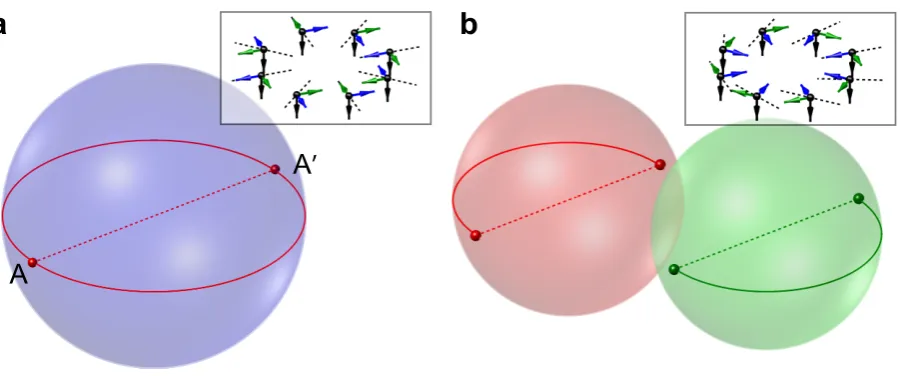
Since an even number of connections between identified points always corresponds to a loop contractible to a point, the vortices in the first (even) class can be continuously deformed into the defect-free state, and those in the second (odd) class can be continuously deformed to a singly quantized singular vortex. The essence of Dirac’s belt trick is that a 4π winding, with a path in parameter space that goes about the sphere once, is equivalent to the defect-free state.
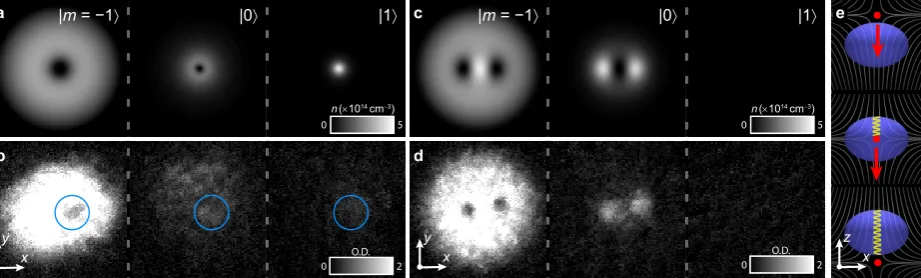
SO(3) vortex creation. Our primary result is a controlled creation method of a pair of singular SO(3) spinor vortices with non-trivial rotational topology from a non-singular texture. In the initial non-singular vortex — also known as a coreless vortex, baby skyrmion, or Anderson–Toulouse–Chechetkin/Mermin–Ho2 vortex in superfluid liquid helium — the circulation is not quantized and the spin forms a fountain-like profile that adjusts to the angular momentum of the superfluid. This characteristic fountain texture has been exper-imentally observed in BECs25–27. If the non-singular spin texture is not constrained, e.g., energetically, it can continuously deform to a vortex-free state. We find, however, that a very sharp bending of the vortex spin profile, corresponding to a strong but incomplete lon-gitudinal magnetisation, induces an instability wherein the non-singular spin texture decays by splitting into a pair of singly quantized vortices14, as shown in Fig. 3a–d (see also Sup-plementary Note 1). Once separated, the resulting singly quantized vortices can no longer unwind on their own, thus circumventing the Dirac belt trick along the lines of Fig. 2. The decay paths of the non-singular vortex therefore include not only its unwinding by local spin rotations or departure from the condensate at its boundary25, but also its splitting into a pair of singly quantized SO(3) vortices that will, in turn, also ultimately leave the conden-sate. Numerically, a bending with magnetisation M . −0.3 that is explicitly conserved is sufficient to guarantee the splitting, as shown in Figs. 3 and 4.
occur due to conservation of the maximised longitudinal magnetisation. The critical feature of our experiment is that the decay dynamics begin with an imprinted non-singular spin texture. The incomplete magnetisation ensures active spin degrees of freedom, and a spinor description is required. The relevant algebra of the line-vortex charges in our splitting process in SO(3) thus obeys the cyclic group Z2 with only the elements 0 and 1. Both evenly quantized and non-singular vortices are represented by the trivial element and their splitting corresponds to the group operation 0 = 1 + 1, with no counterpart in a scalar BEC. We use time-varying magnetic fields (Fig. 3e) to initiate the creation process experimen-tally with a condensate initially prepared in |m= 1i, where |mi denotes the mth spinor component. Such techniques32,33 have been used to prepare, e.g., non-singular25,27,34 and multiply quantized vortices29, as well as monopoles35, skyrmions36, and knots37.
Controlled creation of singular vortices in scalar BECs38,39 and continuous textures in spinor systems26have also been achieved using phase imprinting methods. In our experiment the atoms experience an applied magnetic field described by
B=Bb(t)ˆz+bq(xˆx+yˆy−2zˆz). (2)
where bq is the strength of the quadrupole contribution and Bb(t) is a time-dependent bias field that shifts the location of the point at which the magnetic field vanishes (the field zero) to z0 =Bb/(2bq) on the z-axis. We initially choose Bb such that the field zero is slightly above the condensate (see Methods) and the magnetic field is approximately uniform (Fig. 3e).
a single SO(3) vortex (Fig. 5). The main dissipative sources, as in scalar BECs6,40, are a non-vanishing thermal cloud and potential collisions with high-temperature atoms.
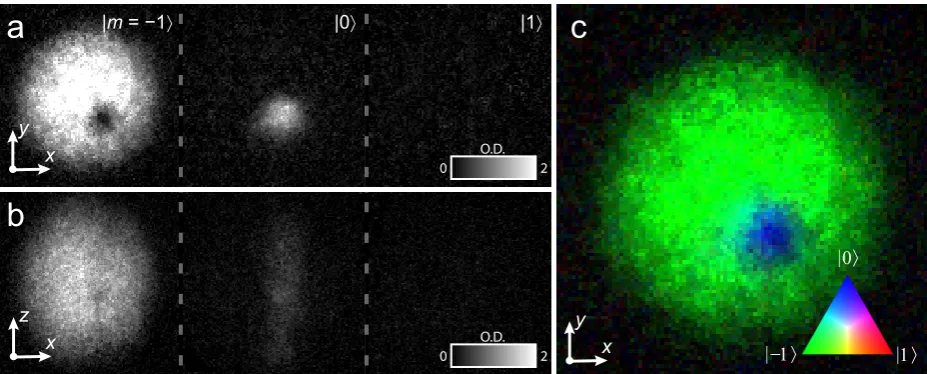
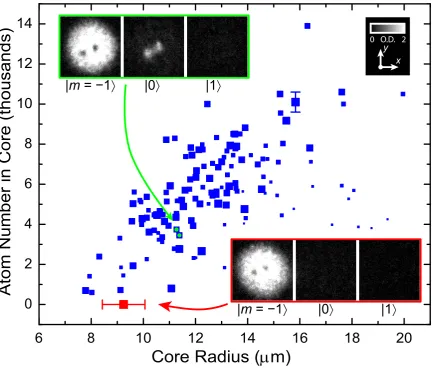
Vortex core filling and interface. For comparison, we also produce vortices with empty cores by reducing the ramp rate such that the spins rotate nearly adiabatically, leaving the system with unobservable populations in|0iand |1i. The size of the filled vortex core is typically much larger than that of an empty core, as shown in Fig. 6. We have numerically verified that for our experimental parameters the superfluid vortex core expands at a rate similar to that of the whole condensate after the release from the trap. In the experiment, the size of the filled vortex core is a further manifestation of the topology of the spinor where the spinor interactions break the |hFi|ˆ = 1 spin condition of the FM phase. In the ground state, the size of a filled vortex core is determined by a spin healing length12,15 arising only from the spin–spin interactions, which is much larger than the density healing length that limits the size of an empty core. Thus, as the condensate evolves, dissipation causes the filled vortex cores to inflate as |0i atoms accumulate there. We observe no corresponding growth of empty vortex cores, as also shown in Fig. 6.
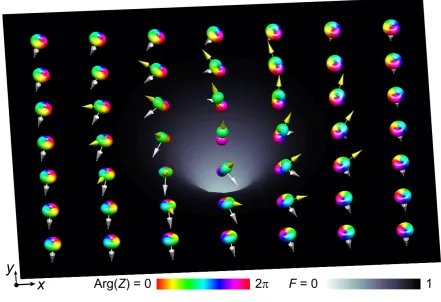
Whereas the SO(3) order parameter of the FM phase may be represented by the orienta-tion of an orthonormal vector triad, the P order parameter is characterised by an unoriented nematic axis ˆd together with the condensate phase (Supplementary Note 2). The filling of the vortex core thus results in an interface between regions where the superfluid order pa-rameter breaks different symmetries. In our system the interface appears in the internal structure of the defect itself and is observed directly in the experiment as a smooth transi-tion between the FM vortex state in the surrounding superfluid and the P phase at the vortex core (Fig. 5). A numerical simulation of this transition allows us to portray the condensate spinor graphically in terms of a spherical-harmonic expansion,Z (see Fig. 1). The deforma-tion ofZ illustrates the continuous topological interface that connects the SO(3) symmetric order parameter of the FM phase to the nematic order parameter of the P phase. Note that in the pure FM phase, the triad order parameter corresponds exactly to the orientation and argument of Z.
as an interpolating filled-core vortex solution as in Ref. 14,
ζ = 1 2 √
2e−iφ cos2 β
2D+−sin 2 β
2D−
sinβ(D++D−) √
2eiφ sin2 β2D+−cos2 β2D− , (3)
where D± = √
1±F represents the interpolation between the FM and P phases for F varying from 1 to 0, respectively. The azimuthal angle around the vortex line is represented by φ, and β is the polar angle. The spin vector is hFiˆ = F(sinβρˆ+ cosβˆz), and the unit vector orthogonal to it isdˆ=−cosβρˆ+ sinβˆz, where ρˆis the radial unit vector relative to the vortex line. For F = 1, equation (3) reduces to the singular FM vortex, and for F = 0, the spinor represents the non-circulating P phase that occupies the vortex core.
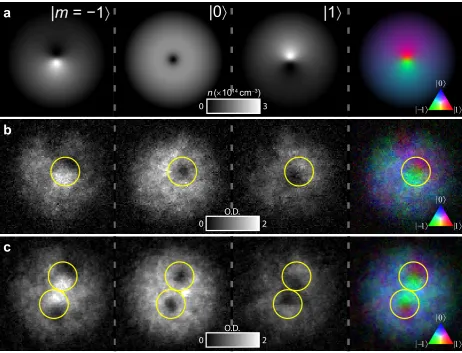
Spinor analysis. Next, we explicitly demonstrate the SO(3) nature of the vortex. The representation of the vortex wave function as a three-component spinor depends on the choice of the spinor basis, and the order parameter symmetry dictates how the representation transforms under a change of basis. Experimentally it is more convenient to change the orientation of the spin with respect to a fixed quantization axis by applying a radio-frequency (RF)π/2 pulse, which rotates the spin according to the unitary transformationU(0, π/2, γ0) where the arbitrary angle γ0 does not affect the outcome. The resulting density profiles are notably more complicated, as shown in Fig. 7. To understand these results theoretically, we assume cylindrical symmetry and neglect any small population in|1i, leading to a qualitative model for the vortex
ζ = 0 p
1−g(ρ) eiφpg(ρ)
, (4)
where g(ρ) = ρ2/(ρ2 +r2
broken the axial symmetry of the original state. This translation of the vortices after the basis transformation is a manifestation of the SO(3) symmetry of the order parameter, and indicates the presence of a line singularity about which the spin vector rotates (disgyration). After the π/2 rotation, one can still identify the locations of the vortices by the density minima of the atoms in the |0i component.
The matter wave in |±1i may also be interpreted as an interference between the over-lapping spinor components before the spin-tip pulse. In all cases, the experimental density profiles of Fig. 7 agree well with the theoretical prediction obtained by applying a π/2 spin rotation to equation (4).
Discussion
Our results advance the experimental and theoretical investigations of defects containing topological interfaces. Similar techniques can be used to generate half-quantum vortices, as well as vortices with coherent interfaces involving the many diverse magnetic phases observed in spin-2 spinor condensates41–44. The filled vortex cores themselves may be used as tracers to examine the longitudinal dynamics of the vortex lines45, which are otherwise difficult to discern. A further exciting extension would be to study the corresponding system in rotation where the nucleation and stability of vortices should dramatically depend on the precise value of the conserved magnetisation14 — determining whether non-singular or singular vortices will prevail.
Methods
The magnetic field zero is initially placed approximately 35 µm above the condensate with an initial gradient strengthbq= 4.3(4) G cm−1 and initial bias fieldBb≈30 mG. The bias field is then reduced to ∼ −50 mG at the rate dBb/dt, and then to −0.38 G over the following 10 ms. The atoms are then held in the trap for a time Tevolve. An optional 8 µs, 0.266 MHz RF π/2 spin-tip pulse is applied immediately afterwards. At the conclusion of the experiment the quadrupole field and the optical trap are extinguished. A brief exposure to a magnetic field gradient of 70 G cm−1 during the 23 ms expansion separates the spinor components horizontally, after which they are imaged absorptively along the y- and z-axes in a 0.1 G field aligned with the z-axis. Atom loss during the experiment, both during the ramp and during the subsequent evolution time, reduces the total number of atoms to approximately 2×10⁵ at the time of imaging.
Reducing the bias field at the rate −0.25 G s−1 results in a doubly-quantized vortex in |−1i and essentially no atoms in the other spinor components. The experiments with filled cores were conducted at higher ramp rates, between −4 G s−1 and −6 G s−1. Ramp rates exceeding−10 G s−1 result in larger non-singular vortices that occupy all three spinor components. These are not observed to evolve into singular SO(3) vortices.
Numerical model. We use experimental parameters for the Gross-Pitaevskii Hamilto-nian density of the spin-1 BEC
H=h0+ c0
2n 2+ c2
2n
2|hFi|ˆ 2−pnhB·Fiˆ +qnh(B·Fˆ)2i, (5)
where h0 = ~
2
2Ma |∇Ψ|
2
+V(r)n includes the harmonic trapping potential V(r). Here ~ is the reduced Planck constant and Ma is the atomic mass. The spin is defined as the expectation value hFiˆ = P
αβζ †
αFˆαβζβ, where Fˆ is a vector of dimensionless spin-1 Pauli matrices. The condensate spin vector corresponding to equation (1) is given by hFiˆ = cosαsinβxˆ+sinαsinβˆy+cosβˆz. The FM order parameter can be defined by the orientation of two orthogonal vectors hFiˆ and dˆ = (−sinαcosγ −cosαsinγcosβ)ˆx+ (cosαcosγ − sinαsinγcosβ)ˆy+ sinγsinβˆz. The last two terms of equation (5) describe the linear and quadratic Zeeman shift of strengths p and q, respectively. The two interaction terms of strengths c0 and c2 arise from s-wave scattering of the atoms.
In s-wave scattering the only spin-flip processes are 2|m = 0i |m= +1i+|m=−1i. The longitudinal magnetisation
M = 1 N
Z
where Fz is the z component of the condensate spin, is therefore approximately conserved on time scales for which s-wave scattering dominates. This condition is broken when the Gross–Pitaevskii equations are made dissipative, e.g., by imaginary-time evolution. We em-ploy an algorithm to strictly restore the conservation of magnetization14 throughout energy relaxation in pure imaginary time evolution and in evolution dynamics following imprint-ing, in which case we set time to include a small imaginary component t → (1− iη)t, where η∼10−2. All numerical simulations are carried out using a split-step algorithm on a minimum of 128×128×128-point grid.
Data Availability
All relevant datasets generated during and/or analysed during the current study are avail-able from the corresponding author upon request. The source data underlying Figs. 1 and 3– 7 are provided as a Source Data file in the Zenodo repository (doi:19.5281/zenodo.3404017) (Ref. 46).
References
1 Volovik, G. E. The Universe in a Helium Droplet (Oxford University Press, 2003).
2 Vollhardt, D. & W¨olfle, P. The Superfluid Phases of Helium 3 (Taylor & Francis Ltd, London,
UK, 1990).
3 Kawaguchi, Y. & Ueda, M. Spinor Bose–Einstein condensates.Phys. Rep.520, 253–382 (2012). 4 Stamper-Kurn, D. M. & Ueda, M. Spinor Bose gases: Symmetries, magnetism, and quantum
dynamics. Rev. Mod. Phys.85, 1191–1244 (2013).
5 Donnelly, R. J. Quantized Vortices in Helium II (Cambridge University Press, Cambridge,
1991).
6 Fetter, A. L. Rotating trapped Bose–Einstein condensates.Rev. Mod. Phys.81, 647–691 (2009).
7 Mermin, N. D. The topological theory of defects in ordered media.Rev. Mod. Phys.51, 591–648
(1979).
8 Staley, M. Understanding quaternions and the Dirac belt trick. Eur. J. Phys. 31, 467–478
(2010).
9 Simola, J. T., Skrbek, L., Nummila, K. K. & Korhonen, J. S. Two different vortex states in
10 Parts, ¨U.et al. Phase diagram of vortices in superfluid3He–A. Phys. Rev. Lett.75, 3320–3323
(1995).
11 Isoshima, T. & Machida, K. Axisymmetric vortices in spinor Bose–Einstein condensates under
rotation. Phys. Rev. A66, 023602 (2002).
12 Lovegrove, J., Borgh, M. O. & Ruostekoski, J. Energetically stable singular vortex cores in an
atomic spin-1 Bose–Einstein condensate. Phys. Rev. A 86, 013613 (2012).
13 Kobayashi, S., Kawaguchi, Y., Nitta, M. & Ueda, M. Topological classification of vortex-core
structures of spin-1 Bose–Einstein condensates. Phys. Rev. A 86, 023612 (2012).
14 Lovegrove, J., Borgh, M. O. & Ruostekoski, J. Stability and internal structure of vortices
in spin-1 Bose–Einstein condensates with conserved magnetization. Phys. Rev. A93, 033633
(2016).
15 Ruostekoski, J. & Anglin, J. R. Monopole core instability and Alice rings in spinor Bose–
Einstein condensates. Phys. Rev. Lett.91, 190402 (2003).
16 Sadler, L. E., Higbie, J. M., Leslie, S. R., Vengalattore, M. & Stamper-Kurn, D. M. Spontaneous
symmetry breaking in a quenched ferromagnetic spinor Bose–Einstein condensate.Nature 443,
312–315 (2006).
17 Chen, P.-K.et al.Rotating atomic quantum gases with light-induced azimuthal gauge potentials
and the observation of the Hess–Fairbank effect. Phys. Rev. Lett.121, 250401 (2018).
18 Seo, S. W., Kang, S., Kwon, W. J. & Shin, Y.-i. Half-quantum vortices in an antiferromagnetic
spinor Bose–Einstein condensate. Phys. Rev. Lett. 115, 015301 (2015).
19 Borgh, M. O. & Ruostekoski, J. Topological interface engineering and defect crossing in ultracold
atomic gases. Phys. Rev. Lett.109, 015302 (2012).
20 Finne, A. P.et al. Dynamics of vortices and interfaces in superfluid 3He. Rep. Prog. Phys.69,
3157–3230 (2006).
21 Bradley, D. I. et al. Relic topological defects from brane annihilation simulated in superfluid 3He. Nat. Phys.4, 46–49 (2008).
22 Kibble, T. W. B. Topology of cosmic domains and strings.J. Phys. A Math. Gen.9, 1387–1398
(1976).
23 Sarangi, S. & Tye, S.-H. H. Cosmic string production towards the end of brane inflation. Phys.
Lett. B 536, 185–192 (2002).
at the LaAlO3/SrTiO3 interface. Nat. Phys.7, 767–771 (2011).
25 Leanhardt, A. E., Shin, Y., Kielpinski, D., Pritchard, D. E. & Ketterle, W. Coreless vortex
formation in a spinor Bose–Einstein condensate. Phys. Rev. Lett. 90, 140403 (2003).
26 Leslie, L. S., Hansen, A., Wright, K. C., Deutsch, B. M. & Bigelow, N. P. Creation and detection
of skyrmions in a Bose–Einstein condensate. Phys. Rev. Lett.103, 250401 (2009).
27 Choi, J.-y., Kwon, W. J. & Shin, Y.-i. Observation of topologically stable 2D skyrmions in an
antiferromagnetic spinor Bose–Einstein condensate. Phys. Rev. Lett. 108, 035301 (2012).
28 Leanhardt, A. E. et al. Imprinting vortices in a Bose–Einstein condensate using topological
phases. Phys. Rev. Lett.89, 190403 (2002).
29 Shin, Y.et al.Dynamical instability of a doubly quantized vortex in a Bose–Einstein condensate.
Phys. Rev. Lett.93, 160406 (2004).
30 Huhtam¨aki, J. A. M., M¨ott¨onen, M., Isoshima, T., Pietil¨a, V. & Virtanen, S. M. M. Splitting
times of doubly quantized vortices in dilute Bose–Einstein condensates. Phys. Rev. Lett. 97,
110406 (2006).
31 Isoshima, T. et al. Spontaneous splitting of a quadruply charged vortex. Phys. Rev. Lett. 99,
200403 (2007).
32 Nakahara, M., Isoshima, T., Machida, K., Ogawa, S.-i. & Ohmi, T. A simple method to create
a vortex in Bose–Einstein condensate of alkali atoms. Physica B 284–288, 17–18 (2000).
33 Pietil¨a, V. & M¨ott¨onen, M. Creation of Dirac monopoles in spinor Bose–Einstein condensates.
Phys. Rev. Lett.103, 030401 (2009).
34 Choi, J.-y.et al. Imprinting skyrmion spin textures in Bose–Einstein condensates.New J. Phys.
14, 053013 (2012).
35 Ray, M. W., Ruokokoski, E., Kandel, S., M¨ott¨onen, M. & Hall, D. S. Observation of Dirac
monopoles in a synthetic magnetic field. Nature 505, 657–660 (2014).
36 Lee, W. et al. Synthetic electromagnetic knot in a three-dimensional skyrmion. Sci. Adv. 4,
eaao3820 (2018).
37 Hall, D. S.et al. Tying quantum knots. Nat. Phys. 12, 478–483 (2016).
38 Matthews, M. R.et al. Vortices in a Bose–Einstein condensate. Phys. Rev. Lett.83, 2498–2501
(1999).
39 Andersen, M. F.et al. Quantized rotation of atoms from photons with orbital angular
40 Rosenbusch, P., Bretin, V. & Dalibard, J. Dynamics of a single vortex line in a Bose–Einstein
condensate. Phys. Rev. Lett.89, 200403 (2002).
41 Semenoff, G. W. & Zhou, F. Discrete symmetries and 1/3–quantum vortices in condensates of
F = 2 cold atoms. Phys. Rev. Lett.98, 100401 (2007).
42 Kobayashi, M., Kawaguchi, Y., Nitta, M. & Ueda, M. Collision dynamics and rung formation
of non-Abelian vortices. Phys. Rev. Lett. 103, 115301 (2009).
43 Mawson, T., Ruben, G. & Simula, T. Route to non-Abelian quantum turbulence in spinor
Bose–Einstein condensates. Phys. Rev. A91, 063630 (2015).
44 Borgh, M. O. & Ruostekoski, J. Core structure and non-Abelian reconnection of defects in a
biaxial nematic spin-2 Bose–Einstein condensate. Phys. Rev. Lett.117, 275302 (2016).
45 Fonda, E., Meichle, D. P., Ouellette, N. T., Hormoz, S. & Lathrop, D. P. Direct observation of
Kelvin waves excited by quantized vortex reconnection. Proc. Natl Acad. Sci.111, 4707–4710
(2014).
46 Weiss, L. S. et al. Controlled creation of a singular spinor vortex by circumventing the Dirac
belt trick. Zenodo digital repository. doi:10.5281/zenodo.340417 (2019).
Acknowledgements
We acknowledge funding by the National Science Foundation (Grant Nos. PHY–1519174 and PHY–1806318), by the Emil Aaltonen Foundation, by the Kaupallisten ja teknillisten tieteiden tukis¨a¨ati¨o (KAUTE) foundation through its Researchers Abroad program, by the Academy of Finland through the Centre of Excellence Programme (grant no. 312300) and ERC Consolidator Grant QUESS (no. 681311), and by the EPSRC.
Author contributions
Additional information
Competing Interests: The Authors declare no competing interests.
Correspondence and requests for materials should be addressed to D.S.H.
F
= 0
1
x
y
[image:17.595.84.526.87.389.2]Arg(
Z
) = 0
2
π
Figure 1 | Numerical simulation of a singly-quantized singular SO(3) vortex. The
symmetry of the local spinor order parameter is illustrated by a graphical representation of the
surface of |Z(θ, φ)|2, with the colour indicating Arg(Z), where Z(θ, φ) = P+1
m=−1Y1,m(θ, φ)ζm
corresponds to an expansion of the spinor in terms of spherical harmonics Y1,m(θ, φ), such that
(θ, φ) define the local spinor orientation. Outside the vortex core the order parameter reaches the
SO(3) symmetric ferromagnetic phase. Inside the core it continuously connects with the nematic
order parameter of the polar phase at the vortex line singularity, forming a coherent topological
interface. The interpolation of the order parameter across the interface is readily apparent in the
vanishing magnitude of the spin vector hFˆi (silver arrows and background surface) at the vortex
line where the polar phase is determined by the dˆ vector (gold arrows) and the phase of the
A
A
’
[image:18.595.83.534.71.259.2]a
b
Figure 2 | Contractible and non-contractible loops in SO(3). (a) Points inside and on
the surface of the sphere represent elements of SO(3), with diametrically opposite points (e.g., A
and A0) on the surface corresponding to the same element. The contractible loop on the surface
of the sphere corresponds to a vortex with 4π winding that is continuously deformable into the
vortex-free state. Such deformation amounts to enacting the Dirac belt trick. (b) The decay of
the non-singular vortex into two separated singular line defects is represented by the emergence of
two loops in distinct copies of the SO(3) sphere. Each loop is closed by virtue of the identification
of A and A0 and cannot be contracted to a point on its own. The insets show the orientation of
the ferromagnetic order parameter in real space corresponding to the points on the contractible
(a) and non-contractible (b) loops, respectively. Each orthonormal triad is specified in terms of its
spin direction (black arrows) and two other mutually orthonormal vectors (green and blue), with
a
|m = −1〉 |0〉 |1〉
a
b d
x y
c
x y
e
x z
|m = −1〉 |0〉 |1〉
0 5
n(×1014 cm−3)
0 2
O.D.
0 O.D. 2
0 5
[image:19.595.77.538.72.211.2]n(×1014 cm−3)
Figure 3 |Controlled singular SO(3) vortex creation from a non-singular vortex. (a)
Spinor component densities of an analytically constructed non-singular vortex state immediately
after imprinting (see also Supplementary Note 1) in a cross-section through the condensate. (b)
Corresponding experimental absorption images withTevolve ≈0 ms for dBb/dt=−5 G s−1. The
density minimum of the m=−1 component marks the non-singular vortex centre, and the other
two components are non-zero in this region (blue circles). The creation process subjects the three
spinor components to sustained differential forces, distorting the condensate and inducing non-zero
densities in them= 0 andm= 1 components distant from the vortex centre. The densities of the
experimental images are expressed in terms of dimensionless optical depth (O.D.), and the field of
view of each image is 219µm×219µm. (c) Locally stable state after numerically simulated energy
relaxation of the non-singular vortex of b, shown as component densities in a cross-section through
the cloud. As a consequence of the SO(3) order parameter symmetry and conserved magnetisation,
the non-singular vortex is unstable towards splitting into a pair of singly quantized singular vortices,
visible as density dips in the m=−1 component. Peaks in the m= 0 component at the positions
of the vortices show the formation of vortex cores filled with atoms in the polar phase. (d) Asb,
but forTevolve= 150 ms and corresponding toc. (e) Schematic of the imprinting process, showing
the condensate (blue), magnetic field lines (gray), nodal line/axis of coreless vortex (yellow), and
location of the magnetic field zero (red dot) at three sequential instants in time. The non-singular
vortex is created by incompletely adiabatic spin rotations as the location of the field zero passes
through the condensate in the direction of the red arrow. Source data are provided as a Source
F
= 0
1
a
d
x
y
x y
x y
x
y
c
b
|−1〉 |1〉 [image:20.595.70.538.72.379.2]|0〉
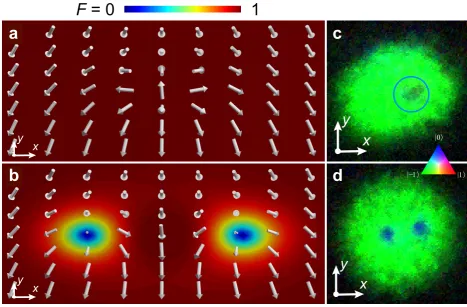
Figure 4 | Theoretical spin textures and corresponding experimental data. (a) The
characteristic fountain-like spin texture of the initial non-singular vortex, with spin magnitude one
everywhere. (b) The spin texture of the relaxed vortex state. The background colour indicates
spin magnitude, showing the filled vortex cores. (c,d) Experimentally obtained composite colour
images of the corresponding structures using the data of Fig. 3, where the colours indicate the
spinor components. In the absence of atoms in them= 1 spinor component, pure blue represents
the P phase and pure green represents the ferromagnetic phase. The field of view of c, d is
|m = −1〉 |0〉 |1〉
|1〉 1〉
|−
|0〉
x y
x y x
z
b
a
c
0 2
O.D.
0 2
[image:21.595.74.538.70.257.2]O.D.
Figure 5 |A singly-quantized, singular SO(3) vortex in three dimensions. (a,b)
Experi-mental absorption images of the atomic density in each spinor component from the top,a, and side,
b, expressed in terms of dimensionless optical depth (O.D.), for the SO(3) vortex configuration
after one of the two vortices has exited the system. Them=−1 component displays a vortex line,
the core of which is filled withm= 0 atoms. The system has evolved for 1000 ms after imprinting.
(c) Composite false colour image of the condensate density as viewed from the top. The field of
6
8
10
12
14
16
18
20
0
2
4
6
8
10
12
14
Atom Number in Core (thousands)
Core Radius (
µ
m)
|
m
= −1
〉
|0
〉
|1
〉
|
m
= −1
〉
|0
〉
|1
〉
0 O.D. 2
[image:22.595.84.518.82.453.2]x y
Figure 6 | Effect of the core atoms on the size of the core. The post-expansion size of
the vortex cores in them=−1 component with unfilled (red) or filled (blue) cores. The core size
depends in part on the number of|0iatoms within the core, which grows as |0i atoms accumulate
there. Each blue point represents a single vortex measurement. As even empty vortex cores near
the condensate boundary are enlarged, we indicate the radial position of a vortex by the size of the
point, with smaller points corresponding to larger radii. A typical uncertainty in the atom number
within the core is given as a vertical error bar for a single point. The red point and error bar
illustrate the mean and standard deviation of a representative sample of unfilled vortex cores from
more than 25 condensates, produced with a low-speed (|dBb/dt|<1 G s−1) ramp of the magnetic
bias field. The insets show typical experimental atomic density profiles from absorption imaging,
expressed in terms of dimensionless optical depth (O.D.), of the three spinor components for the
case of filled (upper left, and points marked with green circles) and empty (lower right) cores. The
a
b
|1〉 1〉
|− |0〉
c
|
m
= −1
〉
|0
〉
|1
〉
0 2
O.D.
0 2
O.D.
0 3
n(×1014 cm−3)
|1〉 1〉
|− |0〉
|1〉 1〉
[image:23.595.73.536.70.423.2]|− |0〉
Figure 7|Signature of SO(3) character. (a) Spinor component densities after applying aπ/2
spin-tip pulse to the analytically constructed singly quantized vortex, equation (4), corresponding
to a change of spinor basis. The vortex core is at the density minimum of the |0i component.
(b,c) Experimental absorption images of the atomic density, expressed in terms of dimensionless
optical depth (O.D.), in each spinor component after applying aπ/2 spin rotation for condensates
containing one and two vortices, respectively. The vortex cores are identified by the density minima
in them= 0 component, and yellow circles are drawn around the corresponding locations in each
spinor component and in the colour composite image. The false-colour composite images show
alternating regions of m=±1 components in the vicinity of the vortex core. The field of view of
Controlled Creation of a Singular Spinor Vortex
by Circumventing the Dirac Belt Trick
Supplementary Notes
Supplementary Note 1| Theoretical details of the SO(3) vortex creation process. A non-singular vortex with longitudinal magnetisation M can be written as
ζ = 1 2
1 +M f(ρ) √
2eiφp1−[M f(ρ)]2 e2iφ[1−M f(ρ)]
, (1)
where φ is the azimuthal angle around the vortex line. The condensate spin is hFiˆ = p
1−[M f(ρ)]2ρˆ + M f(ρ)ˆz and the profile function f(ρ) = cos(β)/M satisfies 1
N R
d3r n(r)f(ρ) = 1. The analytically constructed spinor wave function for the non-singular vortex used in Figs. 3a and 4a was obtained from supplementary equation (1) and embedded into the ground-state density profile of the condensate.
In these expressionsβ(ρ) is the second Euler angle appearing in equation (1), which in this case increases monotonically from zero on the vortex line to π at the boundary to define a fountain-like spin texture. For strongly negativeM, corresponding toβ(ρ) increasing rapidly, a large proportion of the condensate resides in the |−1i component. The two extremes of magnetisation correspond to constant f(ρ): For M = 1, f(ρ) = 1, to give the vortex-free stateζ = (1,0,0)T. ForM =−1, on the other hand, we obtain the doubly-quantized vortex ζ = (0,0, e2iφ)T with its associated instability towards splitting. The two limits can be continuously connected through a family of functionsf(ρ), allowing the vortex to unwind1. Note, however, that conservation of longitudinal magnetisation suppresses the redistribution of the atom populations between the spinor components during the free evolution of the condensate.
vortices persist for a significant period of imaginary-time evolution, but do eventually leave the condensate over a significantly longer period of relaxation. The local stability is also reflected in the long lifetime of the vortices created in our experiment.
The observed splitting of the coreless vortex represents a particular case of the instability also found in supplementary Ref. 2. In imprinting of a non-singular vortex, its magnetisation is a controllable parameter determined by the rate of change of the imprinting magnetic field. Our idealised model thus indicates that singular SO(3) vortices can be created by imprinting a non-singular vortex with sufficiently strong longitudinal magnetisation and allowing it to split.
Supplementary Note 2 | Magnetic Phases. The spin-1 Bose-Einstein condensate ex-hibits both polar (P) and ferromagnetic (FM) phases3. In a 87Rb condensate, c
2 < 0 in equation (5), and hence the FM phase, which maximises |hFi|ˆ , forms the ground state in a uniform system at zero magnetic field. The P phase, with |hFi|ˆ = 0, appears in the cores of the singular vortices and exhibits different symmetry properties. The P order parameter, and hence also the spinorζP in the P phase, are specified by a nematic axisdˆ together with a condensate scalar phase τ, with the property that ζP(ˆd, τ) =ζP(−d, τˆ +π). The P phase thus exhibits uniaxial nematic order, characterised by the continuous symmetry under spin rotations about the local, unoriented axis defined byˆd. The order parameter space is there-fore [S2×U(1)]/
Z2, where the factorisation by Z2 arises from the aforementioned nematic symmetry, which also allows the P phase to support half-quantum vortices4.
Supplementary References
1 Ho, T.-L. Spinor Bose condensates in optical traps. Phys. Rev. Lett.81, 742–745 (1998). 2 Lovegrove, J., Borgh, M. O. & Ruostekoski, J. Stability and internal structure of vortices
in spin-1 Bose–Einstein condensates with conserved magnetization. Phys. Rev. A93, 033633
(2016).
3 Kawaguchi, Y. & Ueda, M. Spinor Bose–Einstein condensates.Phys. Rep.520, 253–382 (2012). 4 Seo, S. W., Kang, S., Kwon, W. J. & Shin, Y.-i. Half-quantum vortices in an antiferromagnetic