doi:10.4236/jmp.2011.212186 Published Online December 2011 (http://www.SciRP.org/journal/jmp)
Well Behaved Parametric Class of Exact Solutions of
Einstein-Maxwell Field Equations in General Relativity
Neeraj Pant1, B. C. Tewari2, Pratibha Fuloria3
1Department of Mathematics, National Defence Academy Khadakwasla, Pune, India 2Department of Mathematics, Kumaun University, S.S.J. Campus, Almora, India
3Department of Physics Kumaun University, S.S.J. Campus, Almora, India E-mail:{neeraj.pant, p.fuloria}@yahoo.com
Received September 15, 2011; revised October 27, 2011; accepted November 22, 2011
Abstract
We present a new well behaved class of exact solutions of Einstein-Maxwell field equations. This solution describes charge fluid balls with positively finite central pressure, positively finite central density; their ratio is less than one and causality condition is obeyed at the centre. The gravitational red shift is positive throughout positive within the ball. Outmarch of pressure, density, pressure-density ratio, the adiabatic speed of sound and gravitational red shift is monotonically decreasing, however, the electric intensity is monotoni-cally increasing in nature. The solution gives us wide range of parameter K (0.72 ≤K≤ 2.41) for which the solution is well behaved hence, suitable for modeling of super dense star. For this solution the mass of a star is maximized with all degree of suitability and by assuming the surface density ρb = 2 × 10¹⁴ g/cm3.
Corre-sponding to K = 0.72 with X = 0.15, the resulting well behaved model has the mass M = 1.94 MΘ with radius
rb 15.2 km and for K = 2.41 with X = 0.15, the resulting well behaved model has the mass M = 2.26 MΘ
with radius rb 14.65 km.
Keywords:Charge Fluid, Reissner-Nordstrom, General Relativity, Exact Solution
1. Introduction
Ever since the formulation of Einstein-Maxwell field equations, the relativists have been proposing different models of immense gravity astrophysical objects by con-sidering the distinct nature of matter or radiation (en-ergy-momentum tensor) present in them. Such models successfully explain the characteristics of massive ob-jects like quasar, neutron star, pulsar, quark star, black- hole or other super-dense object. These stars are speci-fied in terms of their masses as white dwarfs (Mass < 1.44 solar mass), Quark star (2 solar mass - 3 solar mass) and Neutron star (1.35 solar mass - 2.1 solar mass).
It is well known that the Reissener-Nordstrom solution for the external field of a ball of charged mass has two distinct singularities at finite radial positions other than at the centre. Thus the solution describes a bridge (worm hole) between two asymptotically flat spaces and an electric flux flowing across the bridge. Graves and Bill [1] pointed out that the region of minimum radius or the throat of worm hole pulsates periodically between these two surfaces due to Maxwell pressure of the electric field.
Consequently, unlike Schwarzschild’s exterior solution of chargeless matter,in Reissener-Nordstrom solution has no surface which can catastrophically hit the geometric singularity at r = 0.All these aspects show that the pres- ence of some charge in a spherical material distribution provides an additional resistance against the gravita- tional contraction by mean of electric repulsion and hence ,the catastrophic collapse of the entire mass to a point singularity can be avoided.
The above result has been supported by a physically reasonable charge spherical model of Bonnor [2], that a dust distribution of arbitrarily large mass and small ra-dius can remain in equilibrium against the pull of gravity by a repulsive force produced by a small amount of charge. Thus it is desirable to study the implications of Einstein-Maxwell field equations with reference to the general relativistic prediction of gravitational collapse. For this purpose charged fluid ball models are required. The external field of such ball is to be matched with Reissener-Nordstrom solution.
have been using exact solutions with finite central pa-rameters of Einstein field equations, as seed solutions. There are two type of exact solutions of this category.
Type 1. If the solutions are well behaved (Delgaty- Lake [3], Pant [4]). These solutions their self completely describe interior of the Neutron star or analogous super dense astrophysical objects with chargeless matter. Del- gaty-Lake [3] studied most of the exact solutions so far obtained and pointed out that only nine solutions are regular and well behaved. Out of which only six of them are well behaved in curvature coordinates and rest three solutions are in isotropic coordinates. In previous papers (Pant et al. [5], Pant [4], we obtained a new well behaved solution in isotropic coordinates and two new well be-haved solutions in curvature coordinates respectively.
Type 2. If the solutions are not well behaved but with finite central parameters, such solutions are taken as seed solutions of astrophysical objects with charge matter since at centre the charge distribution is zero.
For well behaved nature of the solution in curvature coordinates, the following conditions should be satisfied (augmentation of (Delgaty-Lake [3] and Pant [4]) condi-tions).
1) The solution should be free from physical and geo-metrical singularities i.e. finite and positive values of central pressure , central density and non zero positive values of e and e i.e. p00 an 00. For well behaved solution in curvature coordinates, it should have
0
r , i.e. the tangent-3space at the centre in flat
but converse is not true.
e 1
2) The solution should have positive and monotoni-cally decreasing expressions for pressure and density (pand) with the increase of r. The solution should have positive value of ratio of pressure-density and less than 1 (weak energy condition) and less than 1/3 (strong energy condition) throughout within the star.
3) The solution should have positive and monotoni- cally decreasing expression for fluid parameter p2
c
with the increase of r, i.e.
2 0
p r
c
0 and 2 0
0 r p
c
and p2 c
is negative valued function for r0.
d d d d 1
d d
d log
1 1
d e
e
p p
p P
og
matter 1. Thus we have, d
0 2 dp p
c
,
decreases with the increase of r.
4) The solution should have positive and monotoni- cally decreasing expression for velocity of sound d
d p with the increase of r and causality condition should be obeyed at the centre i.e. 2d 1
d p c .
5) The red shift Z should be positive, finite and mono-tonically decreasing in nature with the increase of r.
6) Electric intensity E is positive and monotonically increasing from centre to boundary and at the centre the Electric intensity is zero.
Under these well behaved conditions, one has to as-sume the gravitational potential and electric field in-tensity in such a way that the field equation can be inte-grated and solution should be well behaved. Keeping in view of this aspect ,several authors obtained the para-metric class of exact solutions Pant et al. [6,7], Gupta and Maury [8,9], Pant [10], M. J. Pant and Tewari [11] etc. These coupled solutions are well behaved with some positive values of charge parameter K and completely describe interior of thesuper-dense astrophysical object with charge matter. Further, The mass of the such mod-eled super dense object can be maximized by assuming surface density is ρb = 2 × 10¹⁴ g/cm3. In the present pa-per we have obtained yet another new parametric class of well behaved exact solutions of Einstein –Maxwell field equations, which is compatible within the range of Quark star and neutron star .
2. Einstein-Maxwell Equation for Charged
Fluid Distribution
Let us consider a spherical symmetric metric in curvature coordinates
2 2 2 2 2 2
ds e d r r d sin d e d t2 (1) where the functions
r and satisfy the Ein-stein-Maxwell equations
v r
2
4 4
8π 1 8π
2
1 1
4π 4
i i i i i
j j j j j
im i mn
jm j mn
GT R R G c p v v p
c c
F F F F
(2)
where denote energy density, fluid pressure, velocity vector and skew-symmetric electromagnetic
, , ,i ij
p v F
22 4
1 e 8π
e
v p
r r c
obtain the fluid parameters and Our task is to explore the solutions of Equation (9) and p from Equation (7) and Equation (8).
4
G q
r (3)
2 2
4
8π
e
2 4 4 2
v v v v G q
p
r c r
4 (4)
3. New Class of Solutions
22 2
1 e 8π
e G q
r r c
In order to solve the differential Equation (9), In this paper we consider the electric intensity E of the
follow-ing form 4
r
(5)
where, prime (/)denotes the differentiation with respect to r and q(r) represents the total charge contained within
the sphere of radius r.
2
2 1
1 3
2 1
1 3 1
2 c q
E K
x x
c x x (10) Now let us set
where K is a positive constant. The electric intensity is so assumed that the model is physically significant and well behaved i.e. E remains regular and positive throughout the sphere. In addition, E vanishes at the centre of the star.
2 2 1 1 ve B c r (6) which is the same as that of the metric obtained by Adler [12].
Putting (6) into (3) - (5) , we have In view of Equation (10) differential Equation (9) yields the following solution
21
2 4
1 1
4 π
1
Z c q 1 8
Z G
p
x x x c c
(7)
3 2
3 3
(1 )
e 1
3 1 3 1 3
2
K x x Ax
Z
x x
(11a)
21
2 2
1
1 2d 1 8π
d
Z Z c q G
x x x c c
(8)
where A is an arbitrary constant of integration.
and Z satisfying the equation
21 v
e B x (11b)
2 1
1 2
d 1
1
d 1 3 1 3
x c q
Z x
Z
x x x x x x
(9) the following expressions for pressure and energy den-Using (11a), (11b) into Equations (7) and (8), we get sity
where 2 1 , e
x c r Z.
2
4 2
1 3 3
19 15 2 1 1 5
1 8π 4
6 1 3 1 1 3 1
2
x x x A x
G K
p
c c x x x x (12)
3 2
5
2 5
1 3 3
1 73 92 37 6 3 5
1 8π
6 1 3 1 3
x x x x A x
G K
c c x x (13)
4. Properties of the New Class of Solutions
For p0 and0 must be positive and 0 0
1 p
, we The central values of pressure and density are given by have
0 4 1
1 8π 4
3
Gp K A
c c (14) K3 4 A 1 K3, and K0, A0 (16)
0 2 1 1 8π
3 G
K A
c c (15) Differentiating (12) and (13) w. r. t. x, we get;
3 2 2
4 5 2
1 3 3
63 123 65 13 1 5
1 8π d 4
2
d 6 1 3 1 1 3 1
x x x x
G p K
A
c c x 5 2
x
x x x
4 3 2
2 8
1 3 3
1241 2602 1914 602 73 1
1 8π d . 1
d 6 1 3
(1 3 )
x x x x x
G K A
c c x 0 8
x x (18)
4 1 0 4 1 01 8π d 13 2 4
d 6
1 8π d
0 d x x
G p K A
c c x
G p
ve
c c x
(19)
The expression of right hand side of (19) is negative, thus the pressure p is maximum at the centre and mono-tonically decreasing.
2
1 0
1 8π d 73 10
d 6 x
G K A
c c x (20)
2
1 0
1 8π d
0 d x G
c c x (21)
The expression of right hand side of (20) is negative, the density is maximum at the centre and monotoni-cally decreasing.
and hence the velocity of sound v is given by the fol-lowing expression
2 d d d
d d
d
p p p
v x x
3 2 2
5 2 5
3 3
2
4 3 2
8 8
3 3
63 123 65 13 1 5 4
2
6 1 3 1 1 3 1
1 d
d 1241 2602 1914 602 73 1
10
6 1 3 1 3
x x x x
K A
x
x x x
p
c x x x x x
K A x x 2 (22) 2 0
1 d 13 12 24 1
d r 73 60
p K A
K A
c
, for all values of K
and A satisfied by(16).
The expression for gravitational red-shift(z) is given by
11 1 x z B
(23)
The central value of gravitational red shift to be non zero positive finite, we have
1 B0 (24) Differentiating equation (24) w.r.t. x, we get,
0
d 1
0
d x
z
x B
(25)
The expression of right hand side of (25) is negative, thus the gravitational red-shift is maximum at the centre
and monotonically decreasing.
Differentiating Equation (10) w.r.t. x, we get,
2 2 2 3 11 6 7
d
d 2 1 3
x x
E K
x c x
(26)
21 0
d
ve
d x 2
E K
x c
(27)The expression of right hand side of (27) is positive, thus the electric intensity is minimum at the centre and monotonically increasing for all values of K > 0. Also at the centre it is zero.
5. Boundary Conditions
The solutions so obtained are to be matched over the boundary with Reissner-Nordstrom metric.;
1
2 2
2 2 2 2 2 2
2 2 2 2
2 2
d 1 d d sin d 1
b b b b
GM e GM e d 2
s r r t
c r r c r r
(28)
which requires the continuity of across the boundary .
, and
e e q
b
r r
2 ( ) 2 2 1 b r b b GM e e
c r r
b 0p r (32) The condition (30) can be utilized to compute the val-ues of arbitrary constants A as follows:
On setting r rb
2 1b ,
x Xc r ( being the radius of the charged sphere) b
r
Pressure at p(r rb)0 gives
2 2 2 3
1 19 15 2 1 3
4
6 1 5 1 5
X X X X
K A
X X (33)
The expression for mass can be written as
2
2 2 1 3 2 3 6 1 7 2
b
r
GM X K
X X X A
X c
(34) In view of (29) and (30) we get,
3
2 3 2 3
2 1 1
3 1 3 1 3
1 X
KX A X
X X
B
X
Centre red shift is given by 1/ 2
0 1
z B (35)
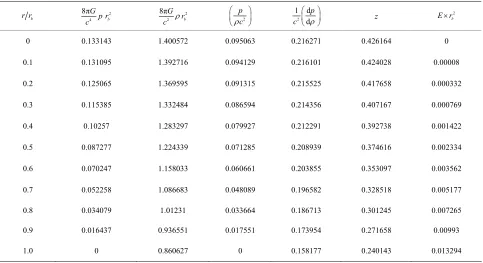
In view of and TableI and Table-II We observe that pressure, density, pressure-density ratio, square of adia- batic sound speed and gravitational red shift decrease monotonically with the increase of radial coordinate
however, the charge distribution is increasing in nature.
6. Discussion
In view of and Tables 1 and 2, it has been observed , p2,
c
,
dp z
d
that all the physical parameters (p,
and E) are positive at the centre and within the limit of realistic equation of state and well behaved conditions for all values of K satisfying the inequalities 0.72 ≤K≤ 2.41. However, corresponding to any value of K < 0.72, there exist no value of X for which the nature of adia- batic sound speed is monotonically decreasing from centre to pressure free interface and for K > 2.41 , the pressure is negative some where within the ball for all values of X. It has been observed that under well be- haved conditions this class of solutions gives us the mass of super dense object within the range of quark star and neutron star.
We now present here two models of super dense star based on the particular solution discussed above by as-suming surface density; ρb = 2 × 10¹⁴ g/cm3. Corre-sponding to K = 0.72 with X = 0.15, the resulting well behaved model has the mass M = 1.94 MΘ.with radius rb
15.2 km and for K = 2.41 with X = 0.15, the resulting well behaved model has the mass M = 2.26 MΘwith
[image:5.595.57.540.461.724.2]ra-dius rb 14.65 km.
Table 1. The march of pressure, density, pressure-density ratio, square of adiabatic sound speed, gravitational red shift and electric field intensity within the ball corresponding to K = 0.72 with X = 0.15.
b
r r 2
4 8π
b Gp r c
2 2 8π
b
G r
c 2
p c
2
1 d d
p
c
z
2
b E r
0 0.133143 1.400572 0.095063 0.216271 0.426164 0
0.1 0.131095 1.392716 0.094129 0.216101 0.424028 0.00008
0.2 0.125065 1.369595 0.091315 0.215525 0.417658 0.000332
0.3 0.115385 1.332484 0.086594 0.214356 0.407167 0.000769
0.4 0.10257 1.283297 0.079927 0.212291 0.392738 0.001422
0.5 0.087277 1.224339 0.071285 0.208939 0.374616 0.002334
0.6 0.070247 1.158033 0.060661 0.203855 0.353097 0.003562
0.7 0.052258 1.086683 0.048089 0.196582 0.328518 0.005177
0.8 0.034079 1.01231 0.033664 0.186713 0.301245 0.007265
0.9 0.016437 0.936551 0.017551 0.173954 0.271658 0.00993
Table 2. The march of pressure, density, pressure-density ratio, square of adiabatic sound speed, gravitational red shift and electric field intensity within the ball corresponding to K = 2.41 with X = 0.15.
b
r r 2
4 8π
b Gp r c
2 2 8π
b
G r
c 2
p c
2
1 d d
p
c
z
2
b E r
0 0.068295 1.595114 0.042815 0.102667 0.444341 0
0.1 0.066626 1.584203 0.042057 0.101874 0.442177 0.000273
0.2 0.061773 1.552015 0.039802 0.099459 0.435726 0.001111
0.3 0.054182 1.500104 0.036119 0.095324 0.425102 0.002573
0.4 0.044551 1.430801 0.031137 0.089335 0.410489 0.004759
0.5 0.033775 1.346889 0.025076 0.081351 0.392136 0.007813
0.6 0.02288 1.251268 0.018286 0.071278 0.370342 0.011924
0.7 0.012961 1.146656 0.011304 0.059104 0.34545 0.017328
0.8 0.005127 1.035372 0.004952 0.044947 0.317829 0.024317
0.9 0.000462 0.919216 0.000502 0.02907 0.287865 0.033237
1.0 0 0.79943 0 0.011874 0.255948 0.044497
7. Acknowledgements
1) First author (NP) acknowledges his gratitude to Lt. Gen. Jatinder Singh AVSM, SM, Comdt, NDA for his motivation and encouragement.
2) First author (NP) also acknowledges his gratitude to Prof A. N. Srivastava HOD Mathematics NDA for his invaluable suggestions.
8. References
[1] J. C. Graves and D. R. Brill, “Oscillatory Character of Reissner Nordstorm Metric for an Ideal Charged Worm-hole,” Physical Review, Vol. 120, No. 4, 1960, pp. 1507- 1513. doi:10.1103/PhysRev.120.1507
[2] W. B. Bonnor, “The Equilibrium of Charged Sphere,”
Monthly Notices of the Royal Astronomical Society, Vol. 137, No. 3, 1965, pp. 239-251.
[3] M. S. R. Delgaty and K. Lake, “Physical Acceptability of Isolated, Static, Spherically Symmetric, Perfect Fluid So- lutions of Einstein’s Equations,” Computer Physics Com- munications, Vol. 115, No. 2-3, 1998, pp. 395-399.
doi:10.1016/S0010-4655(98)00130-1
[4] N. Pant, “Some new Exact Solutions with Finite Central Parameters and Uniform Radial Motion of Sound,” As- trophysics and Space Science,Vol. 331, No. 2, 2011, pp. 633-644.
[5] N. Pant, et al., “New Class of Regular and Well Behaved
doi:10.1007/s10509-010-0383-1
[6] N. Pant, et al., “Well Behaved Class of Charge Analogue of Heintzmann’s Relativistic Exact Solution,” Astrophys- ics and Space Science, Vol. 332, No. 2, 2011, pp. 473- 479. doi:10.1007/s10509-010-0509-5
[7] N. Pant, et al., “Variety of Well Behaved Parametric Classes of Relativistic Charged Fluid Spheres in General Relativity,” Astrophysics and Space Science, Vol. 333, No. 1, 2011, pp. 161-168.
doi:10.1007/s10509-011-0607-z
[8] S. K. Maurya and Y. K. Gupta, “A Family of Well Be-haved Charge Analogue of a Well BeBe-haved Neutral Solu- tion in Genetral Relativity,” Astrophysics and Space Sci- ence, Vol. 332, No. 2, 2011, pp. 481-490.
doi:10.1007/s10509-010-0541-5
[9] Y. K. Gupta and S. K. Maurya, “A Class of Regular and Well Behaved Relativistic Super Dense Star Models,”
Astrophysics and Space Science, Vol. 334, No. 1, 2011, pp. 155-162. doi:10.1007/s10509-010-0503-y
[10] N. Pant, “Well Behaved Parametric Class of Relativistic in Charged Fluid Ball General Relativity,” Astrophysics and Space Science, Vol. 332, No. 2, 2011, pp. 403-408.
doi:10.1007/s10509-010-0521-9
[11] M. J. Pant and B. C. Tewari, “Well Behaved Class of Charge Analogue of Adler’s Relativistic Exact Solution,”
Journal of Modern Physics, Vol. 2, No. 6, 2011, pp. 481- 487. doi:10.4236/jmp.2011.26058