ISSN Online: 2165-3860 ISSN Print: 2165-3852
DOI: 10.4236/ojfd.2019.91004 Mar. 6, 2019 63 Open Journal of Fluid Dynamics
Improvement of the Microalgae Harvest by the
“Foaming-Scumming” Function of an Airlift
Column
Djimako Bongo
1*, Nekoulnag Clarice
2, Jean-Mari Mbailao Mbaiguinam
2,
Alexis Mouangue Naminina
1, Jean-Yves Champagne
3, Salif Gaye
41National Institute of Science and Technology of Abeché, Abeché, Chad
2Faculty of Exact and Applied Sciences, University of N’Djamena, N’Djamena, Chad 3Laboratory of Fluid Mechanics and Acoustics INSA-Lyon, Lyon, France
4LME Materials and Energetics Laboratory, University Institute of Technology, Thiès, Senegal
Abstract
The aim of this research work is to valorize the microalgae grown-up in an Airlift column. The system of fluid circulation and mass transfer is based on the principle of interaction between gas bubbles and a liquid. Thus, this study focuses on the phenomenon of the determination of the vacuum rate, the size and the speed of the bubbles including the optimization of microalgae devel-opment within the culture process. In addition, this study tries to understand the close relationship between these phenomena, its environment and the microalgae cell. These studies were conducted on the operation of an Airlift column in aquaculture, mainly in freshwater [1]. However, other researchers
[2] are interested in studying saline water. In conclusion, a series of experi-ments were carried out in order to evaluate the profitability of the Microflota-tion technique, as a method of separaMicroflota-tion and concentraMicroflota-tion in microalgae. These results are very interesting since they reveal that the efficiency of the column, for the foaming-skimming function, is greater by working with less significant air injections, which lead to a reduction in energy cost.
Keywords
Vacuum Column, Microalgae, Vacuum Rate, Bubble Size, Bubble Speed
1. Introduction
In order to separate the particles with water, one of the most used processes is the flotation process. The principle of flotation is based on the adhesion of hy-How to cite this paper: Bongo, D., Clarice,
N., Mbaiguinam, J.-M.M., Naminina, A.M., Champagne, J.-Y. and Gaye, S. (2019) Im-provement of the Microalgae Harvest by the “Foaming-Scumming” Function of an Airlift Column. Open Journal of Fluid Dynamics, 9, 63-71.
https://doi.org/10.4236/ojfd.2019.91004
Received: January 25, 2019 Accepted: March 3, 2019 Published: March 6, 2019
Copyright © 2019 by author(s) and Scientific Research Publishing Inc. This work is licensed under the Creative Commons Attribution International License (CC BY 4.0).
DOI: 10.4236/ojfd.2019.91004 64 Open Journal of Fluid Dynamics drophobic particles to air bubbles injected into the water. The foam, or scum, thus formed is then recovered, mainly by mechanic method. Hydrophilic par-ticles do not bind to bubbles but tend to remain in suspension [3]. This tech-nique is applied in many fields, including analytical chemistry, odor elimination, plastic separation and recycling, microalgae and microorganism harvesting, fruit juice clarification, etc. Due to the nature of the process, the bubble-particle inte-raction is fundamental. The effectiveness of the flotation will depend mainly on the ability of the bubbles to fix the particles contained in the water, and to transport them to a desired place.
The studied vacuum column allows a flotation, and recovers suspended par-ticles that will be in the form of scum. This foam is recovered at the top of the column, using as previously stated, the double cone. The column will remove water microalgae. These microalgae have a size of the order of 2 to 30 microns. Obviously, it will also be able to eliminate larger particles, such as parasite eggs (about 50 μm in size). Thus, the column is interesting in terms of biosecurity, in that it eliminates any form of parasitism in farms [4].
2. Description of the Vacuum Column
Principle
An airlift depression column, or simply airlift, involves a two-phase flow, in other words a phenomenon of transport and exchange between the liquid phase and the gaseous phase (the gas bubbles) [5]. Minimally, it can be modeled as a column in which a partition has been introduced to channel the flow of the liq-uid and gaseous phases. The injection of gas is done in one of the compartments. It makes it possible to modify the apparent density and the expansion of the two-phase fluid, causing the circulation of the initially immobile liquid phase. An airlift is schematically divided into four compartments as shown in Figure 1. Compartment 1: aerated part where the fluids move in an upward
move-ment;
Compartment 2: change of circulation direction over the first compartment, the liquid goes down to compartment 3 while most of the gas escapes through the top of the column;
Compartment 3: generally, non-aerated part where the liquid phase moves in a downward movement. The gas bubbles caused by the movement of the liq-uid and found in this compartment disturb its circulation by attempting to go up the column and create a phenomenon called “against airlift”;
Compartment 4: change of the liquid movement direction returning to the first compartment where it is evacuated to an external system.
Compartments 1 and 3 are the place of the functionalities expected from the airlift. The compartments 2 and 4 are considered as simple collectors and dis-tributors of fluid which generates the load losses.
DOI: 10.4236/ojfd.2019.91004 65 Open Journal of Fluid Dynamics choice of these criteria imposes the flow regime as well as the intensity of the de-sired functionalities of the system. Figure 2 shows the apparatus of airlift.
3. Materials and Protocol Used
3.1. Materials
The following materials are used in this research study:
An analytical balance of the Balco brand with a precision of ±0.01 mg, A centrifuge, Sigma brand with a working instruction around 5000 rpm, An oven, Labover brand with a working instruction at 75˚C,
A salinometer, Fisher brand, for the control of salinity and water temperature, with a precision of ±0.1‰ and ±0.1˚C respectively.
3.2. Protocol Used
First, it will be necessary to identify a microalgae culture adapted to the needs of the experiment. We then take samples of the initial culture, a triplicate was taken. Then, system is started for one hour and all the parameters are set as following:
The salinity of the water (0, 20 or 40‰); Particle size (2 - 10 or 50 - 150 μm);
The microalgae concentration (0.35, 0.45 or 0.80 g/L); The air flow (20, 40 or 60 L/min);
The type of injector (open tube, fine or microporous diffuser); The volume of shellfish harvested (1, 10, 40 or 100 L).
After one hour of experimentation, the system is stopped and we take a sam-ple of the Ecumat recovered with triplicate. These samsam-ples will be studied in the laboratory to determine the concentration of microalgae. Finally, we renew the experiment by varying one parameter at a time. The collect of the samples enable to calculate the concentration of microalgae. The concentration in g/L will be specified. Doing this in triplicate allows to obtain an average more reliable value. The Concentration effect, which is the ratio of the average concentration of the recovered moussate to the initial average concentration, is also calculated.
The template is used to format your paper and style the text. All margins, column widths, line spaces, and text fonts are prescribed; please do not alter them. You may note peculiarities. For example, the head margin in this template measures proportionately more than is customary. This measurement and others are deliberate, using specifications that anticipate your paper as one part of the entire journals, and not as an independent document. Please do not revise any of the current designations (Figure 3).
4. Results
4.1. Effect of Air Flow on the Concentrator Effect
DOI: 10.4236/ojfd.2019.91004 66 Open Journal of Fluid Dynamics
[image:4.595.266.483.506.693.2]Figure 1. Schematic of airlift.
Figure 2. Airlift depression column.
(a) Water at the star (b) Ecumat obtained (c) Water at the end
Figure 3. (a) Samples of water at the start and (b) at the end of the experiment and (c) the extracted foam.
liquid-air
separatorcompressor
w
at
er
lev
DOI: 10.4236/ojfd.2019.91004 67 Open Journal of Fluid Dynamics
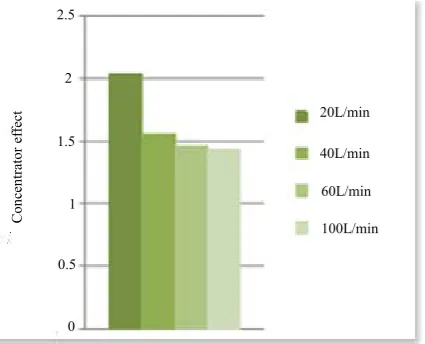
Figure 4. Value of the concentrator effect according to the flow of air injected.
Volumes of injected water [6] because the turbulence increases with the in-crease of the air flow. However, strong turbulence dein-creases the foam extraction efficiency. This result is interesting because it can be noted that the concentrator effect is maximum for a low energy cost.
Influence of diffuser on the size of the bubbles
Figure 5 presents the concentrator effect based on bubble size. As expected,
the recovery is most effective when bubble size decreases (Figure 4).
From Figure 4, it has been observed that the separation efficiency is
maxi-mum for little. Indeed, small bubbles facilitate the fixation of a wide range of particles. This finding has been demonstrated in many studies [7] [8] [9].
4.2. Effect of Salinity on the Concentrator Effect
The increase in salinity improves the extraction efficiency of microalgae [10]. The cause of this improvement is the same as in the previous case as the salinity of the water prevents the coalescence of the air bubbles and therefore makes it possible to keep a very small bubble size [11] which, like as we have seen, im-proves the extraction efficiency of microalgae.
4.3. Effect of Particle Size on the Concentrator Effect
Figure 6 presents the effect of particle size on the concentrator effect. The size of
the particles to be treated is important in the efficiency of the system. Indeed, a small particle size induces a better concentrating effect than with larger particles.
The results obtained are much improved because the concentrator effect value calculated with small particles is almost twice as large as with larger particles.
However, large particles tend to bias concentration results. Thus, the initial concentration would be lower than what was measured. The value of the con-centrator effect is therefore biased.
4.4. Effect of Starting Concentration
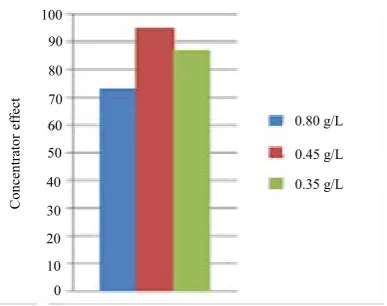
The starting concentration influences the microalgae concentration of the
Ecu-C
onc
ent
ra
tor
ef
fect
0.5 1 1.5 2 2.5
0
20L/min
60L/min 40L/min
DOI: 10.4236/ojfd.2019.91004 68 Open Journal of Fluid Dynamics mat recovered (Figure 7). Concentrations obtained at the starting concentra-tions are almost proportional.
However, the concentrator effect differs somewhat but with not a clear trend given.
[image:6.595.251.496.177.331.2]The initial concentration therefore does not play a determining role in the ex-traction efficiency of microalgae.
[image:6.595.272.473.363.497.2]Figure 5. Concentrator effect value based on bubble size.
Figure 6. Concentrator effect value according to particle size.
Figure 7. Concentration of the recovered foam as a function of the starting concentration.
Opened conduit
[image:6.595.278.472.541.694.2]DOI: 10.4236/ojfd.2019.91004 69 Open Journal of Fluid Dynamics
4.5. Effect of Volume of Recovered Foam
The amount of foam collected per hour of operation of the column necessarily acts on the capacity of the column to concentrate the microalgae. The lower the volume recovered, the more concentrated it will be.
4.6. Economic Analysis
The results obtained previously made it possible to determine the parameters for an optimal operation of the column, [12] for the foaming-skimming function.
The parameters are as follows: Air flow: 10 l/min,
Injector system: microbubble diffuser, Salinity: 50‰,
Microalgae concentration: 0.80 g/L, Microalgae size: 2 - 10 μm
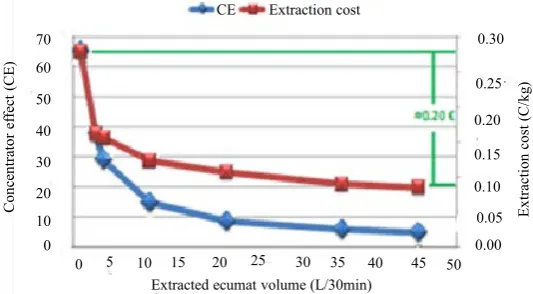
From this, it is proposed to calculate the extraction cost per kg of microalgae harvested as a function of the volume extracted per hour (Figure 8).
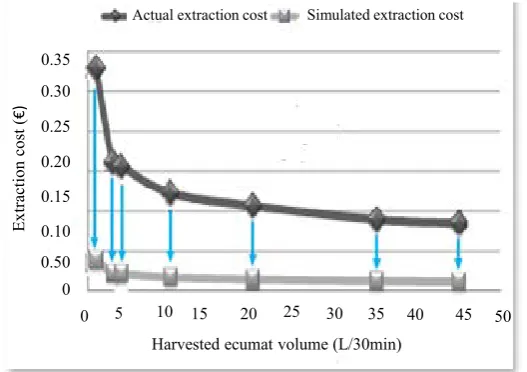
In terms of efficiency, it is best to extract little volumes of foam, concentrated in microalgae. In terms of cost, it is the opposite, it is better to harvest large vo-lumes. However, this study did not consider the costs associated with the treat-ment of foams such as the cost of the centrifuge (which is energetically very ex-pensive), the cost of transportation and the cost of human labor. For these costs, the lower the volume extracted and concentrated, the lower the costs (Figure 9). These will have to be taken into account to determine the overall extraction cost.
The costs can be reduced by equipping the system with a suitable equipment, such as a dry pump that plays the dual role vacuum pump and compressor.
Contrary to the actual micro-flotation systems, the vacuum column has sever-al advantages:
Eliminate the breakdowns occurring in mechanical filters, and thus extend the life of the system,
[image:7.595.239.506.557.704.2]Eliminate the proliferation of bacteria as is the case in biological filters, Eliminate the microorganisms of a wide range of size from the foam.
Figure 8. Concentrator effect and extraction cost based on extracted volume.
C onc ent ra tor ef fect (C E) Extraction cost
Extracted ecumat volume (L/30min)
Ex tra ctio n co st ( C /k g) 0 50 20 10 50 40 30 60 0.00 70 0.20 0.15 0.10 0.05 0 0.30 0.25 25 20 15 10
5 30 35 40 45
DOI: 10.4236/ojfd.2019.91004 70 Open Journal of Fluid Dynamics
Figure 9. Comparison of extraction costs with or without adapted equipment.
5. Conclusions
Microalgae are now a research area to be explored due to their varied biochemi-cal characteristics. Among of the thousands of species microalgae that exist, only a few hundred are conserved and studied by scientists and some ten are pro-duced in industrial quantities. The fight against the greenhouse effect attracts the world to these microorganisms capable of consuming carbon dioxide present in the atmosphere. The production of biomass containing fatty acids is used for the production of biofuel, hydrogen biology and of molecules with high added value. The airlift is a very innovative system that allows, in a simple, ecological, eco-nomical way with a low energy cost, to combine the different functions: pump-ing, mass transfer and foaming-scumming. However, the industrialization of such a CO2 capture process requires the implementation of a performance con-trol strategy allowing optimal efficiency: the implementation of a strategy for es-timating the cell concentration and the development of robust control laws to maximize CO2 consumption by microalgae.
Conflicts of Interest
The authors declare no conflicts of interest regarding the publication of this pa-per.
References
[1] Awari, G.K., Ardhapurkar, P.M., Wakde, D.G. and Bhuyar, L.B. (2004) Performance Analysis of Airlift Pump Design. Proceedings of the Institution of Mechanical En-gineers, Part C: Journal of Mechanical Engineering Science, 218, 1155-1161. https://doi.org/10.1243/0954406042369099
[2] Falkowski, P.G. and Raven, J.A. (2007) Aquatic Photosynthesis. 2nd Edition, Prin-ceton University Press, PrinPrin-ceton.
[3] Nguyen, A.V. (2007) Flotation. Encyclopedia of Separation Science, 1-27. https://doi.org/10.1016/B0-12-226770-2/00071-5
0
0 5 10 15 20 25 30 35 40 45
Ex
tra
ctio
n
co
st
(
€)
0.10 0.50
Actual extraction cost
0.25 0.20 0.15 0.30 0.35
50
Simulated extraction cost
DOI: 10.4236/ojfd.2019.91004 71 Open Journal of Fluid Dynamics [4] Jacquety, J. (2007) Etude d’un système innovant et multifonctionnel de traitement
de l’eau en circuit recirculé. Rapport de fin d’études DESTA, Intechmer/Cnam. DESTA/2007/07.
[5] Parker, N.C. and Suttle, M.A. (1987) Design of Airlift Pumps for Water Circulation and Aeration in Aquaculture. Aquacultural Engineering, 6, 97-110.
https://doi.org/10.1016/0144-8609(87)90008-2
[6] Rubin, A.J., Cassell, E.A., Henderson, O., Johnson, J.D., Lamb, J.C. (1966) Micro-flotation: New Low Gas Flow Rate Foam Separation Technique for Bacteria and Al-gae. Biotechnology and Bioengineering, 8, 135-150.
[7] Cassell, E.A., Kaufman, K.M. and Matijević, E. (1975) The Effects of Bubble Size on Microflotation. Water Research, 9, 1017-1024.
https://doi.org/10.1016/0043-1354(75)90095-0
[8] Jameson, G.J. (1999) Hydrophobicity and Floc Density in Induced-Air Flotation for Water Treatment. Colloids and Surfaces (A): Physicochemical and Engineering As-pects, 151, 269-281. https://doi.org/10.1016/S0927-7757(98)00503-2
[9] Liu, S., Wang, Q., Ma, H., Huang, P., Li, J. and Kikuchi, T. (2010) Effect of Mi-cro-Bubbles on Coagulation Flotation Process of Dyeing Wastewater. Separation and Purification Technology, 71, 337-346.
https://doi.org/10.1016/j.seppur.2009.12.021
[10] Moran, D. (2010) Carbon Dioxide Degassing in Fresh and Saline Water. I: Degass-ing Performance of a Cascade Column. Aquacultural Engineering, 43, 29-36. https://doi.org/10.1016/j.aquaeng.2010.05.001
[11] Martín, M., Montes, F.J. and Galán, M.A. (2009) Mass Transfer from Oscillating Bubbles in Bubble Column Reactors. Chemical Engineering Journal, 151, 79-88. https://doi.org/10.1016/j.cej.2009.01.046