TANNERY EFFLUENT EFFECTS ON VERTEBRATES: LESSONS FROM EXPERIMENTAL ANIMALS
1
Joyce Moreira de Souza,
1Abraão Tiago Batista Guimarães,
2
Caio César Oliveira Pereira,
3Ivandilson Pessoa Pinto de Menezes
1
Doctors Hospital & Medical Centre,
3
Pakistan Institute of Medical Scienc
4Maryam Memorial Hospital,
6
Dept of Physiology, Altibri Medical College,
Liaquat College of Medicine & dentistry,
Orthopedic Surgeon, Orthopedic Surgeon, Consultant Orthopedic, Consultant Orthopedic, Manager Medical
Research, Sr. Director Medical, Regulatory &
ARTICLE INFO ABSTRACT
The bovine leather processing (tanning industries) stands out as a potentially toxic waste
emission of untreated effluents into the environment may cause serious harm to human health and to the environment. Th
effect ofeffluent exposure on vertebrates by emphasizingthe identification of the so far observed effect types.The main experimental designs were adopte
investigations and the proposition of future research in this field. A systematic literature review was performed through the search for scientific articles in databases such as LILACS
SciELO, Google Scholar and PubMed. The search comprised studies published from March 1981 to July 2016. Thirty-four (34)articles were analyzed, 58.8% of them assessed the effects of tannery effluents on fish; 2.9%,on amphibians;
and their effects on vertebrates were mostly conducted in India and Brazil. With regard to the scientific fields covered by these previous studies,
prevalenceof genotoxic, histological, mutagenic, immunological, biochemical and behavioral studies. Accordingly, i) the number of articles involving tannery effluents and their effects on verte
there is prevalence of studies involving fish and, more recently, mammals, iii) studies involving the reproductive aspects of the species exposed to tannery effluents are rare; iv) further investigations involving tanne
are necessary. The exposure of vertebrate organisms must describe the type and composition of the assessed xenobiotic in details in order tohelp adopting methodological procedures in compliance with the local conditions, thus allowing the extr
Copyright © 2016, Joyce Moreira de Souza et al. This
unrestricted use, distribution, and reproduction in any medium, provided the original work is properly cited.
INTRODUCTION
The tannery effluents consist of heterogeneous residues derived from the tannery activity, which consists of bovine skin processing for leather manufacture. The skin undergoes mechanical and chemical processes that use many organic and inorganic components, including heavy metals (
et al., 2016, Ayyappan et al., 2016
industrysupplies to other leather industries in different stages: salted (skin retention for storage and/or shipping), wet
*Corresponding author: Guilherme Malafaia,
Departamento de Ciências Biológicas, Laboratório de Pesquisas Biológicas, Programa de Pós-Graduação em Conservação de Recursos Naturais do Cerrado, Instituto Federal Goiano –
Braziland Programa de Pós-Graduação em Biodiversidade Animal, Universidade Federal de Goiás – Câmpus Samambaia, Goiânia Braz
ISSN: 0975-833X
Article History: Received 20th July, 2016
Received in revised form 22nd August, 2016
Accepted 08th September, 2016
Published online 30th October,2016
Key words:
Tannery industries, Animal models, Xenobiotics, Effluents.
Citation: Joyce Moreira de Souza, Abraão Tiago Batista Guimarães, Wellington Alves Mizael da Silva
vertebrates: Lessons from experimental animals”, International Journal of Current
RESEARCH ARTICLE
TANNERY EFFLUENT EFFECTS ON VERTEBRATES: LESSONS FROM EXPERIMENTAL ANIMALS
Abraão Tiago Batista Guimarães,
1Wellington Alves Mizael da Silva,
Ivandilson Pessoa Pinto de Menezes
and
Doctors Hospital & Medical Centre,
2Aga Khan University,
Pakistan Institute of Medical Sciences,
Maryam Memorial Hospital,
5Hilton Pharma Pvt ltd,
Dept of Physiology, Altibri Medical College,
7Dept of Community Medicine,
Liaquat College of Medicine & dentistry,
Orthopedic Surgeon, Orthopedic Surgeon, Consultant Orthopedic, Consultant Orthopedic, Manager Medical
Research, Sr. Director Medical, Regulatory & Business Development, Sr. Lecturer, Associate
ABSTRACT
The bovine leather processing (tanning industries) stands out as a potentially toxic waste
emission of untreated effluents into the environment may cause serious harm to human health and to the environment. The aim of the present studyit to address a literature review in order to identify studies related to the effect ofeffluent exposure on vertebrates by emphasizingthe identification of the so far observed effect types.The main experimental designs were adopted seeking the presentation of an overview on the already performed investigations and the proposition of future research in this field. A systematic literature review was performed through the search for scientific articles in databases such as
LILACS-SciELO, Google Scholar and PubMed. The search comprised studies published from March 1981 to July 2016. four (34)articles were analyzed, 58.8% of them assessed the effects of tannery effluents on fish; 2.9%,on amphibians;0%,on reptiles; 2.9%,on birds; and 35.4%,on mammals.The published studies about tannery effluents and their effects on vertebrates were mostly conducted in India and Brazil. With regard to the scientific fields covered by these previous studies, it was observed that several issues/topics were assessed;there waslittle prevalenceof genotoxic, histological, mutagenic, immunological, biochemical and behavioral studies. Accordingly, i) the number of articles involving tannery effluents and their effects on verte
there is prevalence of studies involving fish and, more recently, mammals, iii) studies involving the reproductive aspects of the species exposed to tannery effluents are rare; iv) further investigations involving tanne
are necessary. The exposure of vertebrate organisms must describe the type and composition of the assessed xenobiotic in details in order tohelp adopting methodological procedures in compliance with the local conditions, thus allowing the extrapolation of the experimental data.
This is an open access article distributed under the Creative Commons Att use, distribution, and reproduction in any medium, provided the original work is properly cited.
The tannery effluents consist of heterogeneous residues which consists of bovine skin processing for leather manufacture. The skin undergoes mechanical and chemical processes that use many organic and inorganic components, including heavy metals (Tchamango
., 2016). The tannery industrysupplies to other leather industries in different stages:
for storage and/or shipping), wet-blue
Departamento de Ciências Biológicas, Laboratório de Pesquisas Graduação em Conservação de Recursos Câmpus Urutaí, GO, Graduação em Biodiversidade Animal, Câmpus Samambaia, Goiânia Brazil.
(fat and grease removal;this stage uses many chemical substances, including chromium salts), and crust or finished. Most of the waste produced in tanneries come from initial stages such as the wet-blue (
amounts of water are used in this stage, in addition to the large amounts of chemicals, approximately 20
kilogram of processed skin (Koetz, 2003; Ozgunay et al., 2007;
According toBuljan (1995), it is estim
generatesapproximately 300 million tons of tannery effluents per year and these effluents containmany organic and inorganic chemicals. Countries such as India, China and Pakistan, as well as Brazil, have important tannery industries, wh areresponsible for the socioeconomic development of the regions they are located in. These industries participate in different parts of the production chain: raw material purchase (skin), job creation (direct and indirect), large and small fur
Available online at http://www.journalcra.com
International Journal of Current Research Vol. 8, Issue, 10, pp.39902-39914, October, 2016
INTERNATIONAL
Citation: Joyce Moreira de Souza, Abraão Tiago Batista Guimarães, Wellington Alves Mizael da Silva et al
International Journal of Current Research, 8, (10), 39902-39914.
z
TANNERY EFFLUENT EFFECTS ON VERTEBRATES: LESSONS FROM EXPERIMENTAL ANIMALS
Wellington Alves Mizael da Silva,
*
,4Guilherme Malafaia
Aga Khan University,
Dept of Community Medicine,
Orthopedic Surgeon, Orthopedic Surgeon, Consultant Orthopedic, Consultant Orthopedic, Manager Medical
Business Development, Sr. Lecturer, Associate Professor
The bovine leather processing (tanning industries) stands out as a potentially toxic waste-generating activity. The emission of untreated effluents into the environment may cause serious harm to human health and to the e aim of the present studyit to address a literature review in order to identify studies related to the effect ofeffluent exposure on vertebrates by emphasizingthe identification of the so far observed effect types.The d seeking the presentation of an overview on the already performed investigations and the proposition of future research in this field. A systematic literature review was performed - BIREME, MEDLINE/Index Medicus, SciELO, Google Scholar and PubMed. The search comprised studies published from March 1981 to July 2016. four (34)articles were analyzed, 58.8% of them assessed the effects of tannery effluents on fish; 2.9%,on 0%,on reptiles; 2.9%,on birds; and 35.4%,on mammals.The published studies about tannery effluents and their effects on vertebrates were mostly conducted in India and Brazil. With regard to the scientific fields erved that several issues/topics were assessed;there waslittle prevalenceof genotoxic, histological, mutagenic, immunological, biochemical and behavioral studies. Accordingly, i) the number of articles involving tannery effluents and their effects on vertebrate animalsremains very small, ii) there is prevalence of studies involving fish and, more recently, mammals, iii) studies involving the reproductive aspects of the species exposed to tannery effluents are rare; iv) further investigations involving tannery effluents are necessary. The exposure of vertebrate organisms must describe the type and composition of the assessed xenobiotic in details in order tohelp adopting methodological procedures in compliance with the local conditions,
is an open access article distributed under the Creative Commons Attribution License, which permits
grease removal;this stage uses many chemical chromium salts), and crust or finished. Most of the waste produced in tanneries come from initial blue (Sabumon, 2016). Considerable are used in this stage, in addition to the large approximately 20-35 m3 for each Koetz, et al., 1995, Rao et al., ., 2007; Sounderraj et al., 2012). ), it is estimated that the world generatesapproximately 300 million tons of tannery effluents per year and these effluents containmany organic and inorganic Countries such as India, China and Pakistan, as well as Brazil, have important tannery industries, which areresponsible for the socioeconomic development of the regions they are located in. These industries participate in different parts of the production chain: raw material purchase (skin), job creation (direct and indirect), large and small fur
INTERNATIONAL JOURNAL OF CURRENT RESEARCH
and leather exports (for furniture, footwear, clothing andautomotive spare part industries). It isone of the main raw material suppliersfor different industries (Hu et al., 2011; China andNdaro, 2015; Sabumon, 2016). Italy, Hong Kong, China, Brazil, USA, South Korea, Germany, India and Argentina are among the greatest leather exporters (ABDI, 2011, Sabumon, 2016). Although the tannery activity is of great socio-economic importance, it is also of great concern, since it is one of the most polluting activities (Manivasagam
et al., 1987, Jordão et al., 1997) due to its large amount of solid or liquid waste. This waste is often discharged intowatercourses without any or with inadequate/inefficient treatment, mainly by small industries, thus causing negative impacts on both the ecosystems andthe human health (Roy
et al, 2015; Sundaramoorthy et al., 2016).
Several ecotoxicological studies have asessed and observed different effects on organisms exposed to tannery effluents. Their results have identified teratogenic effects on urchin sea species, leading to thereduction of microalgae and bacterial growth,as well asmany toxic effects on micro crustaceans, macro invertebrates and plants (Oral et al., 2005, Matsumoto e Marin-Morales, 2004; Velma et al., 2009, Roy et al, 2015, Mengistie et al., 2016; Bhattacharya et al., 2016). However, there is a gap in the knowledge about the effects such waste can have on vertebrate species. Thus, the lack of familiarity with the effects tannery effluents have on vertebrates makes it impossible understanding the magnitude and toxic potential of these xenobiotics, which can even kill these animals. Therefore, the present study aims at reviewing studies focused on effects the exposure to tannery effluents can have on vertebrates (fish, amphibians, reptiles, birds and mammals), on identifying the observed effect types and on the main experimental designs adoptedin order to present an overview of the investigative scenario and to give suggestions to future research in the field.
MATERIALS AND METHODS
A systematic literature review was conductedthrough thesearch for scientific articles in databases such as LILACS- BIREME (Latin American literature database in Health Science), MEDLINE/Index Medicus (Medical Literature Analysis and Retrieval System Online), SciELO (Scientific Electronic Library Online), Google Scholar and PubMed (maintained by the National Library of Medicine). Articles addressing any aspect of the exposure (in different ways) of vertebrate organisms to tannery effluents, published in national or international journals, resulting from research projects linked to Brazilian or foreign institutions were selected. The search included original articles and/or short communications in English or Portuguese. The following meshes (keywords and/or delimiters) were used in different combinations: fish, amphibians, reptiles, birds, mammals, tannery effluents, liquid waste from tannery, wastewater from tannery, ecotoxicology, toxicology, toxicity and tannery industries. The searchcomprised studies published from March 1981 (month and year when the earlier study was identified) to July 2016. Duplications were excluded (i.e., the same article indexed to different databases), as well asarticleswithout abstract. A total of 34 publications were selected; previously specified criteria were taken into account. The articles were fully analyzed (n = 29) and those that did not allow full access to their content (due to different reasons) (n = 5) were analyzed based on their abstracts.
RESULTS AND DISCUSSION
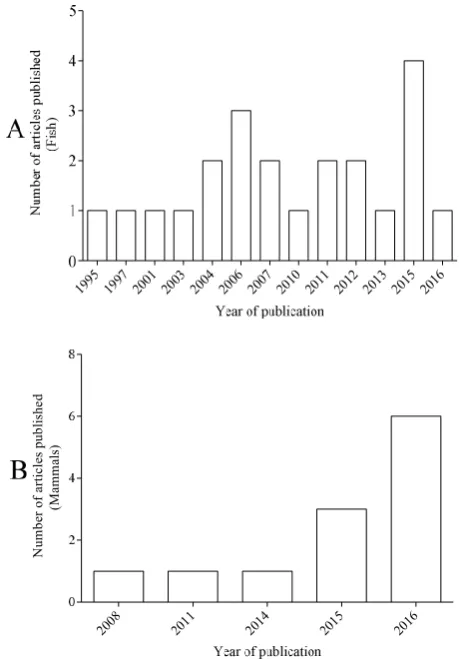
It was herein found that studies that have assessed the effects tannery effluents can haveon vertebrate experimental models are very few. Considering the adopted selection criteria, 34 papers were analyzed, and 58.8% (n = 20) of them have assesed the effects of tannery effluentson fish; 2.9% (n = 1),on amphibians;0%,on reptiles; 2.9% (n = 1),on birds; and 35.4% (n = 12),on mammals. Therefore, it can be seen that most of the studied groups of vertebrates were composed of fish, which were followed by mammals.The years of 2006 and 2015 have presented the larger number of published articles about fish (Figure 1A).Recently (2015 and 2016), there was an increase trend in the number of publications involving tannery effluents and mammals (Figure 1B). These data, therefore, indicate that the most studied group of vertebrates in recent years was the mammals, and it shows the concern of researchers and institutions about the toxic effects effluents can have onthese animals.The understanding about the magnitude of the effects caused by these wastes can be extrapolated to living organisms in terrestrial environments. Itis not limited to aquatic environments, where these residues are often discarded into, without any pre- and/or appropriate treatment.
Figure 1. (A) List of published articles involving tannery effluents and groups of fish between 1995 and 2016; (B) list of published articles involving tannery effluents and groups of mammals between the 2008 and 2016
An interesting fact shown in the present study refers to places where thestudies were carried out. The published studies about tannery effluents and their effects on vertebrates were mainly conducted in India and Brazil. India, in particular, was the country where more studies involving tannery effluent and fish
1995 1997 2001 2003 2004 2006 2007 2010 2011 2012 2013 2015 2016
N
u
m
b
e
r
o
f
a
rt
ic
le
s
p
u
b
li
sh
e
d
(M
a
m
m
a
ls
)
2008 2011 2014 2015 2016
[image:2.595.318.548.340.670.2]group were observed, whereas Brazilholds most of the studies involving mammalian experimental models (Figure 2).
Figure 2. Countries where the identified studies involving tannery effluents and vertebrates were conducted between March 1981 and July 2016
Figure 3. Number of published articles about tannery effluents and vertebrates, and about the effects of these xenobiotics on the investigated animals. The sum of the number of published articles involving different effects has exceeded the total number of articles identified in the present review; more than one effect is studied in a single research
These data are probably related to the amount of tannery industries installed in these countries. India, for example, is one of the countries where thetannery activity stands out, and it has caused negative impacts on the country’s ecosystem, as well as on its biota. Different studies point out the problem of tannery activity in China (Mondal et al., 2005; Zahid et al., 2006; Altaf et al., 2008; Brindha &E lango, 2012),and itmay explain the large amount of published articles about the effects the waste produced in these industries have on animals. In Brazil, exports of leathers and skins in the November 2015, for example, were $ 144,585.000 million. Regarding the amount of leather, considering only the cattle hides that same month (November 2015) was recorded 2.668 million units (CICB, 2016). However, it is a highly polluting industry generating
highly toxic and hazardous waste, which justifies the need for research aimed at new technologies and aimed to know the impact that these residues cause on animals. Anyway, more recently, it has been observed that the Brazilian tanning industry has been demonstrating its commitment to sustainable management. The evolution achieved over the last years in the application of this concept can be seen along the production chain and is recognised internationally. Brazil is one of the countries with the highest number of tanneries certified by the Leather Working Group, a multi-stakeholder group aimed at the development of best environmental practises and a protocol to assess the performance of the certified tanneries. It is worth mentioning that most of the certified plants in Brazil have very good grades for traceability, a challenge for other countries around the world, which have difficulties in achieving the same success. The sector is continuously improving its environmental performance in areas such as water consumption, management, treatment of wastewater effluents, emission reduction, raw materials traceability and waste disposal. Thus, there are great expectations regarding the reduction of environmental and/or biological damage of this activity industrial. It was also noticed that the same studies were published in different journals, some of them werewell qualified (Chart 1). Publications in journals such as The Journal of Steroid Biochemistry and Molecular Biology, Environmental and Molecular Mutagenesis, Toxicology Letters, Chemosphere and Ecotoxicology and Environmental Safety show that the effectstannery effluents can have onvertebratesare relevant and of great interest for the academic and scientific community worldwide. When it comes to thescientific fields covered by the selected studies, it was observed among several assessed issues/topics, that there is little prevalenceof genotoxic, histological, mutagenic, immunological, biochemical and behavioral studies about the effects tannery effluents can have onanimals (Figure 3). Many aspects need to be further investigated, given the reduced number of studies involving tannery effluents and vertebrates (n = 34), even in the most prevalent areas. It is noteworthy that studies that have assessed genotoxic effects have shown that animals exposed to high tannery effluent concentrations present DNA damage through the comet assay (Matsumoto
et al., 2006; Nagpure et al., 2015; Walia et al., 2015; Walia et al., 2016); as well as mutagenic effects, such as micronucleus, which cause chromosomal instability (Matsumoto et al., 2006; Tagliari et al., 2012; Walia et al., 2015). On the other hand, studies about behavioral aspects are more often focused on mammals. Considering the potential of some metals or toxic organic contaminants found in the effluents to damage the animals’ nervous system,the studies by Siqueira et al. (2011), Rabelo et al. (2016), Souza et al. (2016b), Guimarães et al. (2016a), Almeida et al. (2016) and Silva et al. (2016) (using mammals) had the aim to identify the potential anxiolytic effects, as well as depression and/or memory deficits in rodents. Although the behavioral fieldis more focused on this group of animals, there are studies showingthe great complexity of the effects caused by these xenobiotics. Variables such as sex, age, type of effluent (derivedfrom different bovine leather processing stages), rodent species and lines, effluent concentration and exposure route are important factors contributing to the obsereved diversity of results, as shown in Chart 2. Anyways, although it is not possible coming to ultimate conclusions about many studies about the effects of tannery effluents on vertebrates, due to the small number of herein identified studies, and the variability in theresults, it is worth considering some important questions about the topic.
[image:3.595.50.285.340.547.2]One of these questions concerns the diverse and complex chemical composition of tannery effluents. It was noticed that the vast majority of the herein identified studies did not show the chemical composition of the used effluent.The group of studies presenting any feature of the physicochemical and chemical compositionswas the largest one. Kumar et al. (2008) showed, for example, the features of the identified xenobiotic organic compounds, in addition to the physicochemical and chemical features. Therefore, the lack of effluent features has considerably hampered not only the comparison between results of different studies, but also prevented the understanding of action mechanisms correlated with the effects observed in animals, fact that probably justifies the large number of articles whose discussions were often based on speculations. Another aspect missing in most studies identified in the present study was the type of effluent used in the assessment. As discussed by Gödecke et al. (2012), the leather tanning process requires several mechanical and chemical processes at different stages and it generates different types of waste. According to Hu et al. (2011), the leather industrial processing operations can be divided in different stages, from the rawhide to the final product. The initial operations are called beamhouse: soaking, the first step of the tanning process which cleans and moisturesthe skin; liming, which adds lime and sulfides to the skin, as well as raises the pH and chemically removes the hair; fleshing, removes the fatty tissue under the skin, and cuts unwanted parts of the leather; and splitting, horizontal cutting process that standardizes the leather height. After the beamhouse tanning process takes place, thetanning process starts: deliming - removal of the lime used in the liming process; bating - removal of proteins using enzymes; pickling - pH reduction through the use of acids; tanning - addition of trivalent chromium salts (chrome III); and basification - pH elevation. At the end of this stage,the commodity (wet blue) is ready. Thus, it is evident that the leather processing is a complex activity and that the different mentioned stages (solid and liquid) cangenerate waste. Therefore, it is very important that the studies about the effects of tannery effluents on the biota specify what type of effluent
is being used and its features (inorganic and organic), since, depending on the type of effluent and on the stage the
contaminant is obtained in, the observed effect may be completely different. A trend observed in many studies (particularly the group of fish and mammals) refers to the used methodological procedures. The vast majority of studies involving fish and some studies involving mammals used sublethal doses determined from the median lethal dose (LD50)
to assess the effects of xenobiotics can have on this group. Therefore, one should think about the ethical issues correlated with the theme, as well as on the applicability of these studies. It is important noticing that the use of lethal doses (although they are allowed in special situations) is not recommended by the agencies responsible for trials involving national, (such as the National Council for Animal Experimentation Control (CONCEA), which is a member of the Brazilian Ministry of Science and Technology) and international animals (Organization for Economic Co-operation and Development (OECD)). The OECD is an international organization formed by 34 countries that have accepted the principles of representative democracy and free market economy.It officially announced some plans to extinguish the LD50 test
(Test Guideline 401) and protocols in favor of alternative methods, in 2000. The lethal dose tests force animals to drink large amounts of compounds to determine the lethal dose of the substance. On the other hand, one mayhave a hard time extrapolating the results of studies that have adopted experimental designs based on lethal dose mediansthrough the fractions of those doses, which are often called sublethal (Chart 2). The concentrations may not reflect the reality in places where these tannery effluents are discharged into, such as watercourses. The effluent concentration in small tannery effluent receptor watercourses uses to be greater than the experimentally measured concentrations. On this point, it is important to emphasize that of all the evaluated articles, just Guimarães et al. (2016a) reported a justification for the selection of the tannery effluent concentrations used in the study. Besides the findings reported in adult models Guimarães
et al. (2016a) assessed possible changes in the cognitive functions of C57Bl/6J mice offspring originated from a parental generation exposed to different tannery effluent concentrations (7.5% and 15%) in order to broaden the knowledge about the effects of the exposure to tannery effluents.
Chart 1. Periodic information on studies involving vertebrates and tannery effluents published between March 1981 and April 2016
Journal Impact Factor (2015) Fish Amphibians Reptiles Birds Mammals
Asian Journal of Experimental Biological Sciences Does not have 1 0 0 0 0
Chemosphere 3.689 1 0 0 0 1
Ecotoxicology and Environmental Safety 3.246 1 0 0 0 0
Environmental Engineering and Management Journal 0.806 1 0 0 0 0
Genetics and Molecular Biology 1.285 1 0 0 0 0
Internation Journal of Scientific Research Does not have 1 0 0 0 0
International Journal of Biological & Medical Research Does not have 1 0 0 0 0
Journal of Environment and Sociobiology Does not have 1 0 0 0 0
Journal of Toxicology and Environmental Health Does not have 1 0 0 0 0
Mutation Research 2.254 1 0 0 0 0
Nucleus 2.446 1 0 0 0 0
Toxicological & Environmental Chemistry 2.273 1 0 0 0 0
Bulletin of Environmental Contamination and Toxicology 1.191 2 0 0 0 0
Indian Journal of Experimental Biology 1.165 2 0 0 0 0
The Science of the Total Environment 3.976 2 0 0 0 0
Journal of Environmental Biology 0.56 4 0 0 0 0
Environmental and Molecular Mutagenesis 3.326 0 1 0 0 0
Toxicology Letters 3.522 0 0 0 1 0
Multi Science Journal Does not have 0 0 0 0 3
The Journal of Steroid Biochemistry and Molecular Biology 3.985 0 0 0 0 1
Neurotoxicology and Teratology 2.488 0 0 0 0 2
Physiology & Behavior 2.461 0 0 0 0 1
Ambiente & Água Does not have 0 0 0 0 2
JSM Anxiety and Depression Does not have 0 0 0 0 2
Chart 2. Summary of identified studies that have assessed the effects of tannery effluents on different subphylum of classes of Vertebrata animals (1981-2016)
Fish Studies
References Species Age gender Kind of study Exposure type exposure period Main goals Main findings Sudhan et al. (1995) Oreochromis
mossambicus
NID NID In vivo NID NID “To evaluate the immune response in fish exposed to various sublethal concentrations of tannery efluente”.
“A concentration-dependent suppression of both primary and secondary antibody responses to bovine serum albumin (BSA) was observed after primary or secondary immunization. The fish were able to compensate the effluent-induced suppression of antibody response when the antigen (BSA) was administered along with an oil adjuvante”.
Jordão et al. (1997) Oreochomis sp., Astyanax sp., Cichlasoma sp. e Hypostomus sp.
NIF NIF In vivo Dermal - natural NIF “To evaluate the chromium contamination from tannery dischargesin to rivers in the State of Minas Gerais, Brazil, samples of fluvial sediment, vegetation and fish were collected and submitted to chemical analysis”.
“Metal inputs were related to effluent discharges in to the rivers. High concentrations of chromium were found in samples when compared with controls”.
Gbem et al. (2001) Clarias gariepinus
Juvenis NIF
In vivo Dermal -experimental
60 days “The concentration and distribution of Cr, Cu, Pb and Zn among the tissues of a freshwater fish, C. gariepinus exposed to combined (composite) tannery effluent was investigated at two sublethal concentrations 2 and 6% in static bioassay for 8 weeks”.
“The distribution of the four metals in fish was of the order of Pb>Cr>Cu>Zn and the accumulation was found to be dose- and time-dependent. The metal levels in the liver were significantly higher than other tissues. This was followed by the gill and the gut. Relatively low accumulation of these metalswas found in muscle tissue”. Gbem et al. (2003) Clarias gariepinus
Juvenis NIF
In vivo Dermal -experimental
60 days “To evaluate the effects of tannery efluente on blood parameters and growth of a common and economocally importante Nigerian fresh water fish, C. gariepinus”.
“Change was observed in hematological parameters in animals exposed to tannery effluent. A dose- dependente impairment of growth was observed in C. gariepinus exposed to tannery efluente with the highest concentration (i.e. 6%) exhibiting the most marked suppression of growth”.
Dhanapakiam et al. (2004)
Labeo rohita NIF NIF In vivo Dermal -experimental
24 h e 40 days “The major carp, L. rohita, were exposed to (0.873%) lethal and sublethal (0.073%) concentrations of tannery effluent for 24h and 40 days respectively under static bioassay condition”.
“The surface architecture of gill revealed severe damages. The interlamellar space was filled either with hyperplastic epithelial or mucous cells. Secondary lamellae lost their identity and appeared finger like in structure in the lethal concentration and necrosis was observed in the primary and secondary epithelium. Swelling of primary and secondary epithelial cells was evident in sublethal concentration”.
Tagliari et al. (2004) Gymnogeophagus gymnogenys
Youth and adults Youth and adults
In vivo Dermal - natural NIF “The mutagenicity of interstitial water and organic extracts from the sediments in the Cadeia and Feitoria Rivers, RS, Brazil, were evaluated by Salmonella microsuspension bioassay using TA97a, TA98, TA100 and TA102 strains, in the absence and presence of S9 mix”.
analyzed for oxidative stress parameters”. Matsumoto et al.
(2006)
Oreochromis niloticus
NIF NIF In vivo Dermal -experimental
72 hours “Water samples from three sites in the Córrego dos Bagres stream in the Franca municipality of the Brazilian state of São Paulo were subjected to the comet assay and micronucleus test using erythrocytes from the fish O. niloticus”.
“Nuclear abnormalities of the erythrocytes included blebbed, notched and lobed nuclei, probably due to genotoxic chromium compounds. Onion root-tip cell mutagenicity was highest for water samples containing the highest levels of chromium”.
Dhanapakiam et al. (2006)
Labeo rohita NID NID NID Dermal
-experimental
10 a 40 days “The activity of alanine aminotransferase (ALAT) and aspartate aminotransferase (AAT) of different tissues of fingerlings of L. rohita under the influence of two effluents has been studied”.
“The alanine aminotransferase in the liver showed increased activity at different periods than that of the muscle, kidney, gill and brain (60.09%) over the control during the 40 days exposure in both the effluents treatments. The increased activity of alanine aminotransferase was highly significant in all the tissue in tannery and distillery effluents treatments”.
Ganeshwade et al.( 2006)
Cyprinus carpio
NIF NIF
In vivo Dermal -experimental
96 hours “Fish were collected from Nath Sagar, Paithan 50 km away from Aurangabad and were brought to the laboratory and exposed to industrial effluent (tannery effluent)”.
“Behavioral changes and responses of the fish to the tannery effluent were observed. Fish exposed to effluent showed abnormal swimming, loss of equilibrium, fading of colour, coughing and opercular movements”.
Prabakaran et al. (2007)
Oreochromis mossambicus
NIF NIF In vivo Dermal -experimental
28 days “To investigate the effect of chronic exposure to sublethal concentrations of tannery effluent on the specific immune response and nonspecific immunity in tilapia”.
“The study shows that exposure to sublethal concentrations of tannery effluent, can lead to adverse effects on selected immune reactions in tilapia. Further, these findings may be important in terms of monitoring fish health and risk assessment during periods of fluctuating levels of pollutants in the natural and farm environments”. Muley et al. (2007) Labeo rohita NIF NIF In vivo Dermal
-experimental
96 hours “To assess the effect of industrial effluents on the biochemical composition of gill, liver, muscle and kidney of the fish L. rohita”.
“The study showed that effluents at sublethal and lethal concentrations altered the biochemical composition of the various organs of test fish, due to utilization of biochemical energy to counteract the toxic stress caused due to heavy metals presente in effluents”.
Mohanta et al. (2010)
Channa punctatus
NIF NIF
In vivo Dermal -experimental
29 days “To investigate the toxicity of effluents, and their effects on survival and histopathological changes and to know the role of microorganisms in the bioremediation of toxic pollutants through fish survival experiments”.
“It can be concluded that the survival fish is seriously affected by the tannery effluents, even after dilution of the effluents by the fresh water. But after treating of the effluents with bacteria, the fishes survive for longer periods. The released bacteria are also able to detoxify the toxic pollutants”. Aich et al. (2011) Poecilia reticulata NIF NIF In vivo Dermal
-experimental
4 a 15 days “To determine the acute and chronic toxicity of composite tannery wastewater on a fish (P. reticulata) biosystem”.
“The tannery effluent was capable of interfering with the metabolic processes by altering the enzyme activity in liver and gills attributed to cellular injury and following chronic exposure there is evidence of an adaptation mechanism”. Sreenivasan et al.
(2011)
Tilapia mossambica NIF NIF In vivo Dermal -experimental
30 days “To analyze and understand the toxic effects of tannery effluents on agriculture aquatic fauna and the day-to-day life of people in Puliyankannu Village, SIPCOT Industrial Estate of
Ranipet”. study can be attributed to the sublethal effect of chromium from tannery effluents”. Murugesan et al.
(2012)
Cyprinous carpio NIF NIF In vivo Dermal
-experimental 96 hours
“To determine the effect of chronic exposure to sub-lethal concentrations of tannery effluent on the humoral antibody response and the cell-mediated immune response of the fish C. carpio”.
“Exposure of C. carpio to the tannery effluent had a significant effect on mean acceptance time (MAT) for transplanted scales. MAT was found to be 5–8 days for autografts and 4–7 days for allografts. The somatic indices of the kidney and spleen were reduced compared with controls”. Taju et al. (2012) Etroplus suratensis NIF NIF
In vitro e In vivo
Dermal -experimental
48 e 96 hours “Cell lines of E. suratensis established were evaluated for their potential use as screening tools for the ecotoxicological assessment of tannery effluent”.
“The toxic effect of tannery effluent on the survival of fish was found to be concentration and time dependent. The cytotoxicity of tannery effluent was found to be similar in the three cell lines tested, independent of the toxic endpoints employed”.
Roy et al. (2012) Poecilia reticulata NID NID In vivo Dermal -experimental
4, 7,15 days “To study the toxicity of the untreated effluents discharged from tanneries located at the fringe of East Calcutta wetlands. Guppy was chosen as a model fish and was exposed to three diferente sublethal concentrations (3%, 6% and 9%) of composite tannery effluents for different time periods (4 days, 7 days and 15 days)”.
“The expression of all the three chosen biomarkers were significantly dose and time dependent upon tannery effluent exposure. Major significances drawn from the present study was that fish species cultivated in east Calcutta wetland ecosystem are under potential threat of contamination and stress induced by composite tannery effluents that could lead to adverse physiological conditions”. Dasgupta et al.
(2015)
Labeo rohita NID NID In vivo Dermal -experimental
96 hours “Acute toxicity of the tannery effluent was determined for 96 hours period against L. rohita”.
“Concentration of 3.53% was found to be highly toxic whereas 1.76% and 0.88% concentrations cannot be overlooked as they also induced alterations in morphology and behavior of fishes”.
Nagpure et al. (2015)
Channa punctatus
NIF NIF
In vivo Dermal - natural NIF “To assessed the genotoxicity, mutagenicity and bioaccumulative aspects of tannery effluents in freshwater murrel”.
“The significantly higher micronuclei induction, nuclear abnormalities and % tail DNA was observed in the specimens collected from the polluted sites”.
Aich et al. (2015) Poecilia reticulata NID NID In vivo Dermal -experimental
NID “To investigate acute and chronic toxicity of tannery effluent on a fish biosystem by examining oxidative stress enzyme expression in different organs including liver, gills, and muscle following exposure”.
“Tannery effluent was capable of interfering with metabolic processes of fish by altering stress enzyme activities in fish organs, resulting in cellular injury. Data suggest that elevated activities of stress enzymes in fish upon exposure to environmental pollutants may serve as important biomarkers for oxidative stress”. Walia et al. (2015) Labeo rohita NIF NIF In vivo Dermal
-experimental
96 hours “The genotoxic effect was analyzed in erythrocytes of a freshwater fish, L. rohita exposed to tannery industry effluent using micronucleus test”.
“Presence of one micronucleus was predominant than two and three to five micronuclei in erythrocytes of fishes exposed to effluent. Concentration 3.53%proved to be highly toxic and 0.88%can act as a safe disposal concentration. Thus, results revealed that discharge of tannery effluent caused clastogenic effects in fish erythrocytes”. Walia & Handar,
(2016)
Labeo rohita NIF NIF In vivo Dermal -experimental
120 hours “To determine acute toxicity of the tannery industrial effluent for 120 h”.
toxic than 1.93% concentrations”. Amphibian Studies
Rajaguru et al.(2001)
Rana hexadactyla
NIF NIF
In vivo NIF 24 hours “To evaluate the DNA damage caused by four sulfur dyes used in the textile and tannery industries”.
“The dye-treated tadpoles showed significant DNA damage, measured as mean DNA length:width ratio, when compared with unexposed control animals”. Birds Study
Hoffman & Eastin, (1981)
Anas platyrhynchos NIF NIF In vivo NIF 18 days “Mallard eggs were externally exposed at 3 and 8 days of incubation to 7 different industrial effluents and to 7 different heavy metal, organic solvent, and petroleum solutions to screen for potential embryotoxic effects”.
“The findings in combination with other studies suggest that petroleum pollutants and certain industrial effluents may pose a hazard to birds’ eggs if transferred from the plumage to the eggs”.
Mammalian Studies
Kumar et al. (2008) Rattus norvegicus albinus
56 days Male In vivo Orally (gavage) 20 days “To understand the molecular mechanism of action of androgenic endocrine disrupting chemicals of the leather industry effluents”.
“The content of this effluent can interfere with transcriptional activity of major steroidogenic enzymes and the downstream effects, thus amplifying its potential endocrinedisrupting impact”.
Siqueira et al. (2011)
Mus musculus 90 days Male In vivo Orally 15 days “To investigate the neurobehavioral effects of exposure of mice to tannery effluents using animal models of depression and anxiety”.
“Exposure to tannery effluent did not alter immobility time in the forced swim test, suggesting that tannery effluents did not induce depression-like behaviour in the mice. These behavioural data suggest that non-photoelectrooxidation process (PEO) tannery effluent has an anxiogenic effect, whereas PEO-treated tannery effluents do not alter anxiety levels”.
Moysés et al. (2014) Rattus norvegicus albinus
90 days Male In vivo Orally (gavage) 30 days “To study the effects of exposure to tannery efluente (non-PEO or PEO-treated) on behavioral and neurochemical markers in Wistar rats”.
“Exposure to tannery effluent with orwithout photoelectrochemical treatment did not alter any behavioral and neurochemical parameters evaluated”. Silva et al. (2015) Mus musculus
Between 21 e 30 days
Male and Female
In vivo Intraperitoneal 5 days “To determine lethal doses of tannery effluents in experimental mammalian models”.
“The concentration of 25% tannery effluent administered intraperitoneally is shown to innocuous C57BL/6J mice (female) and doses of up to 44% of tannery effluents show no signs of acute toxicity in male mice of the same strain”.
Oliveira et al. (2015)
Mus musculus Between 35 e 45 days
Female In vivo Orally 1 days “To evaluate the acute toxicity and to determine the median lethal dose (LD50) of tannery effluent,
administered orally in Swiss mice females”.
“The LD50 corresponded to 60% of tannery
effluent diluted in water”.
Lemos et al. (2015) Mus musculus Between 70 e 90 days
Female In vivo Intraperitoneal 1 days “To determine potentially lethal doses of tannery effluents, through acute toxicity induction in BALB/c mice, accompanied by an assessment of physical parameters (body mass and relative mass of different bodies), biochemical and behavioral”.
“The data do not point to any physical change in the body mass of animals, nor the relative masses of the liver, spleen, thymus and kidneys. No behavioral change by screening hippocratic was observed in animals, except for an animal of the group 45% who died on the 3rd day of evaluation, corresponding to the dose one tannery effluent concentration that kills 16.66 % of the animals, it is not possible to calculate the LD50. The biochemical parameters was
that receiving tannery effluent in comparison to control group”.
Souza et al. (2016a) Mus musculus 21 days Male In vivo Orally 120 days “To histological assessment of organs of C57Bl/6J mice exposed to the intake of diferente concentrations of raw tannery effluents”.
“Alterations were observed only in liver fragments. Moderate hydropic degeneration was detected in animals exposed to tannery effluents, mainly in the periportal space. A large number of necrotic hepatocytes in animals exposed to higher tannery effluent concentrations. Further, the largest number of hepatocytes with karyomegaly was observed in animals exposed to the highest effluent concentrations”.
Rabelo et al. (2016) Mus musculus Between 36 e 44 days
Male and Female
In vivo Orally 15 days “To assess the effect of the exposure to tannery effluent on the memory of male and female Swiss mice”.
“The exposure to tannery efluente caused memory deficit in Swiss mice in a similar way for both sexes”.
Souza et al. (2016b) Mus musculus Between 21 e 30 days
Male In vivo Orally 120 days “To assess the neurobehavioral effects of chronic exposure of different concentrations of tannery effluents diluted with water in C57Bl/6J mice”.
“It is concluded that male C57Bl/6J mice exposed to tannery effluents have predictive neurobehavioral changes of anxiety and depression, with no memory déficit”. Guimarães et al.
(2016a)
Mus musculus 28 days Male and Female
In vivo Orally Offspring originated from a parental generation exposed to different tannery effluent
“To assessed possible changes in the cognitive functions of C57Bl/6J mice offspring originated from a parental generation exposed to different tannery effluent concentrations”
“The C57Bl/6J mice offspring originated from a parental generation exposed to tannery effluents (7.5% and 15% concentrations) presented object recognition de cit, right after weaning”. Almeida et al.
(2016)
Mus musculus Between 150 e 180 days
Female In vivo Orally 15 days “To evaluate the physical and behavioral effects of the exposure of female Swiss mice to tannery efluente”.
“The exposure of female Swiss mice to tannery effluents (5% and 10% diluted with water) causes behavioral changes, possibly related to the neurotoxicity of this waste, without causing physical changes in the animals”.
Silva et al. (2016) Mus musculus Between 90 a 120 days
Male In vivo Dermal 15 days “To analyze the effects of dermal exposure to tannery effluents in male mice of the C57Bl/6J and Swiss lineages, focusing on anxiety and memory déficit”.
“The data confirm the hypothesis that the dermal exposure to tannery effluent promotes behavioral alterations predictive of anxiety and memory deficit in mice”.
Legend: NIF: no information on the assessed article. NID: not identified by the authors, since it was not possible to access the full article
In the study, the tannery effluent used in the present study derived from the bovine skin tanning stage, which is classified as wet-blue, and it was provided by a tanning industry located in Goiás State, Brazil. The effluent generation data of the providing company, which were based on the company’s operation and on the regulated amount of daily-treated leather, were taken into consideration at the time to set the tannery effluent concentrations of the present study. The data of two available watercourses (illegally) used as effluent receptors were also taken into account in order to calculate the tannery effluent concentrations. The 7.5% tannery effluent concentration was set to the larger watercourse contaminated with these residues, and the 15% concentration was set to the smaller watercourses. According to authors, the name of the company that provided the effluents, as well as that of the receptor watercourses, was omitted for ethical reasons.
When the authors justify the selection of tannery effluent concentrations studied, greatly contributes to estimates of the impact that the discharge of these waste into watercourses can have on aquatic biota or in organisms that igerem these waters. The mere mention of certain tannery effluent concentrations little to the practical application of the study on the regional/local situation where it was developed. Therefore, one must seek a certain proximity between the observed reality (at least in the area where the tannery effluent was collected in) and the planned experimental designs, avoiding to under- or overestimate the effects tannery effluents can have onthe assessed animals.
Conclusion
The present study leads to the following conclusions:
The number of articles abouttannery effluents and their effects on vertebrate animals remains small, althrough diverse.It impairs the development of a golden standard to meet particular trends of each vertebrate class;
Studies involving fish and, more recently, mammals prevail among the publications in this field;thus, future studies about the possible effects tannery effluents can have onamphibians (animals that may be in direct contact with xenobiotic-contaminated water), as well as on birds and reptiles,should be conducted;
Studies about the reproductive aspects of species exposed to tannery effluents are rare, and the reproductive toxicology area is a research field with great exploration potential;
Finally, it is necessary conducting new investigations about tannery effluents and the exposure of vertebrate organisms to them. Such relation must describe in details the type and composition of the used xenobiotic,as well as use methodological procedures better correlated with the local reality in order to extrapolate the experimental data.
It is worth noticing that identifying the effects and the action compression mechanisms of these xenobiotics in organisms can be a way to support measures related to the preservation of the vertebrates. We believe that understanding how these residues affect animals can be extremely useful to establish priority areas for conservation, understanding declines or population increases of different vertebrate species (in areas where they are located tannery industries), as well as proposing the recovery of affected areas, in order to keep the balance
between species and ecosystems. On the other hand, knowledge of environmental and / or biological impacts generated by tannery effluents can be very useful for reflection and the establishment of environmental policies in companies, encouraging environmental actions related the treatment of such waste before disposal in waterways (for example) and possible utilization of other waste generated for nobler purposes (agriculture, forestry, land reclamation, among others). Finally, it is believed that the expansion of knowledge of the negative impacts of waste from tannery industries on the biota can contribute to increased monitoring/inspection of tannery activities of a region / country and to the creation or adaptation of laws more stringent.
Acknowledgment
The authors are grateful to the Brazilian National Council for Research (CNPq) (Brazilian research agency) (Proc. No. 467801/2014-2) and Instituto Federal Goiano for the financial support. Moreover, the authors are grateful to the CNPq for supporting scholarships to the students who developed this study.
REFERENCES
ABDI - Agência Brasileira de Desenvolvimento Industrial: Relatório de acompanhamento setorial: indústria de couro, 2011. Available in< http://www.abdi.com.br/Estudo/ Couro_Relat%C3%B3rio%20de%20Acompanhamento%2 0Setorial_mar%C3%A7o2011_vers%C3%A3o%20eletr% C3%B4nica.pdf%20copy.pdf >.Access in 19 jun. 2016. Aich, Anulipi; Goswami, Abhishek Roy; Roy, UtpalSingha;
Mukhopadhyay,Subhra Kumar 2015. “Ecotoxicological Assessment of Tannery Effluent Using Guppy Fish (Poeciliareticulata) as an Experimental Model: A Biomarker Study”, Journal of Toxicology and Environmental Health, Vol. 78, nº 4, pp. 278-286.
Aich, Anulipi; Chattopadhyay, Buddhadeb; Datta, Siddhartha; Mukhopadhyay, Subhra Kumar 2011. “Impact of composite tannery effluent on the amino-transferase activities in a fish biosystem, using Guppy fish (Poeciliareticulata) as an experimental model”, Toxicological & Environmental Chemistry, Vol.93 nº 1, pp. 85-91.
Almeida, Sabrina Ferreira; Rabelo, Letícia Martins; Souza, Joyce Moreira; Ferreiral, Raissa Oliveira; Guimarães, Abraão Tiago Batista; Pereira, Caio César Oliveira; Rodrigues, Aline SueliLima;Malafaia, Guilherme 2016. “Behavioralchanges in female Swissmice exposed to tannery effluents”, Ambiente & Água, Vol. 11, nº 3, pp. 519-534.
Altaf, MohdMusheer; Masood, Farhana; Malik, Abdul, 2008. “Impact of long-term application of treated tannery effluents on the emergence of resistance traits in Rhizobium
sp. isolated from Trifoliumalexandrinum”,Turkish Journal of Biology, Vol.32,pp. 1–8.
Ayyappan, Durai; Sathiyaraj, Genesan; Ravindran, Konganapuram Chellappan 2016. “Phytoextraction of heavy metals by Sesuviumportulacastrum l. a salt marsh halophyte from tannery effluent”, International Journal of Phytoremediation, Vol. 18, nº 5, pp. 453-459.
Bhattacharya, Priyankari; Swarnakar, Snehasikta; Mukhopadhyay, Aniruddha; Ghosh, Sourja 2016. ”Exposure of composite tannery effluent on snail,
Pilaglobosa: A comparative assessment of toxic impacts of
the untreated and membrane treated effluents”,
Ecotoxicology and Envionmental Safety, Vol. 126, pp. 45-55.
Brindha, K; Elango, L. 2012. “Impact of Tanning Industries on Groundwater Quality near a Metropolitan City in India”,
Water Resources Management, Vol. 26,nº6, pp.1747-1761. Buljan J. 1995. “Pollution limits for discharge of tannery
effluents into water bodies and severs”, Word Leather, Vol. 9, pp. 65-68.
China, Cecilia Rolence and Ndaro, Mbwana Suleiman 2015. ”A study on leather sector investimento status in Tanzania”, African Journal of Science and Research, Vol. 6, nº 4 pp.19-22.
CICB - Centro das Indústrias de Curtumes do Brasil:Exportações brasileiras de couros e peles – novembro/2015. Available in: http://www.cicb.org.br/? p=12836. Access in: 21 setembro 2016.
Dasgupta, Somsuvra and Panigrahi, Ashis Kr 2015. “Studies on Morphological and Behavioral Alterations of a Freshwater Fish, Labeorohita Exposed to Tannery Effluents in Ramsar Wetland of West Bengal, India”,
Journal of Environment and Sociobiology,Vol. 0, pp. 47-48.
Dhanapakiam P, RamasamyVK, Joseph M. 2006. “Changes in the level of transaminases in Indian major carp, Labeorohita exposed to sublethal concentration of tannery and distillery effluents”, Journal of Environmental Biology, Vol.27,pp.567-570.
Dhanapakiam P, Sampoorani V, Kavitha M, Ramasamy VK, Chandrakala A, Aruna KC 2004. “Gill lesions in the major carp, Labeorohita exposed to lethal and sublethal concentrations of tannery effluent”, Journal of Environmental Biology, Vol. 25, pp. 333-336.
Ferreira, Raissa Oliveira; Guimarães, Abraão Tiago Batista; Silva, Bianca Costa; Silva, Wellington Mizael Alves; Mendes Bruna Oliveira; Rodrigues, Aline Sueli Lima; Almeida, Sabrina Ferreira, Souza, Joyce Moreira; Rabelo, Letícia Martins; Estrela,DiefersonCosta;Malafaia, Guilherme 2015. “Análise de toxicidade aguda e determinação da dose letal mediana (DL50) de efluente de curtume em camundongos Swiss”, Multi-Science, Vol.1, nº 3, pp. 83-87.
GaneshwadeRM, RokadePBSonwane RS 2006. “Behavioral responses of Cyprinuscarpio to industrial effluents”,
Journal of Environmental Biology, January,Vol. 27, nº1,pp. 159-160.
Gbem TT, Balogun JK, Lawal FA, Annune PA, Auta J. 2003. “Sublethal Effects of Tannery Effluent on Some Hematological Indices and Growth of Clariasgariepinus
(Teugels)”, Bulletin of Environmental Contamination and Toxicology, Vol.71, pp. 1200–1206.
GbemTT, BalogunJK, Lawal FA, Annune PA 2001. “Trace metal accumulation in Clariasgariepinus (Teugels) exposed to sublethal levels of tannery effluent”, The Science of the Total Environment, Vol.271, pp. 1-9. Godecke, Marcos Vinicius; Rodrigues, Marco Antonio
Siqueira;Naime, Roberto Harb 2012.“Resíduos de curtume: estudo das tendências de pesquisa”, Revista Eletrônica em Gestão, Educação e Tecnologia Ambiental, Vol. 7, nº 7, pp. 1357-1378.
Guimarães, Abraão Tiago Batista; Ferreira, Raissa Oliveira; Rabelo, Letícia Martins; Silva, Bianca Costa; Souza, Joyce Moreira; Silva, Wellington Alves Mizael;Menezes, IvandilsonPessoa Pinto; Rodrigues, Aline Sueli Lima; Vaz, Boniek Gontijo; Costa, Denys Ribeiro de Oliveira; Pereira,
Igor; Silva, Anderson Rodrigo;Malafaia Guilherme 2016. “The C57BL/6Jmiceoff springorig inated from a parental generation exposed to tannery effluents shows object recognitiondéficits”, Chemosphere, Vol.164, nº13, pp. 593-602.
Hoffman DJ, EastinJr WC. 1981. “Effects Of Industrial Effluents, Heavy Metals, And Organic Solvents On Mallard Embryo Development”, Toxicology Lefrers, Vol. 9,pp.35-40.
Hu, Jing; Xiao,Zuobing; Zhou,Rujun; Deng,Weijun; Wang, Mingxi;Ma, Shuangshuang 2011. “Ecological utilization of leather tannery waste with circular economy model”,
Journal of Cleaner Production, Vol. 19, nº 2-3,pp. 221-228.
Jordão,Cláudio Pereira; P, Pereira JL, JhamGN 1997. “Chromium contamination in sediment, vegetation and fish caused by tanneries in the state of Mina GeraisBrasil”, The Science of the Total Enviromental, Vol. 207, nº1, pp. 1-11. Koetz PR, FariaOLV, Nunes WA. 1995. “Tratamento de
efluentes homogeneizados de curtume por digestão anaeróbia em reatores de fluxo ascendente, Revista Brasileira de agrociências, Vol.1,pp. 23-19.
Kumar, Vikas; Majumdar,Chandrajeetbalo; RoyPartha, 2008. “Effects of endocrine disrupting chemicals from leather
industry effluents on male reproductive system, ”The Journal of Steroid Biochemistry and Molecular
Biology, Vol.111, nº3-5, pp. 208-216.
Lemos, Dalila Cristina Socorro; Silva, BiancaCosta; Souza, Joyce Moreira; Silva, Wellington AlvezMizael; Estrela,DiefersonCosta; Ferreira, Raissa Oliveira; Guimarães, Abraão Tiago Batista;Malafaia, Guilherme 2015. “Toxicidade aguda em camundongos BALB/c expostos a efluentes de curtume”, Multi-Science Journal,
Vol.1, nº 3,pp.56-63.
Manivasagam, N. 1987. “Industrial effluents origin, characteristic effects, analysis and treatment Kovaipudur, India”, Shakti Publication, Vol. 42.
Matsumoto, Silvia Tamie; Mantovani, MárioSérgio; Malaguttii, Mirtis Irene Ariza; Dias, Ana Lúcia; Fonseca, Inês Cristina; Marin-Morales, Maria Aparecida 2006. “Genotoxicity and mutagenicity of water contaminated with tannery effluents, as evaluated by micronucleus test and comet assay using the fish Oreochomisniloticus and chomosome aberrations in onion root-tips”, Genetics and Molecular Biology, Vol. 29, nº1, pp. 148-158.
Matsumoto, Silvia Tamie; Marin-Morales, Maria Aparecida, 2004. ”Mutagenic potencial of the water of a river that receives tannery effluent using the Allium cepa test system”, Cytologia, Vol. 69, nº4, pp. 399-408.
Mengistie, Embialle; Ambelu, Argaw; Gerven, Tom Van; SmetsIlse 2016. “Impact of tannery effluent on the self-purification capacity and biodiversity level of a river”,
Bulletin of Environmental Contamination and Toxicology, Vol.96, nº 3, pp. 369-375.
Mohanta MK, Salam MA, Saha MA, Saha AK, Hasan A, & Roy AK. 2010. “Effects of Tannery Effluents on Survival and Histopathological Changes in Different Organs of
Channapunctatus”. Society of Applied Sciences, Vol. 1, nº 2, pp. 294-302.
Mondal NC, SaxenaVK, Singh VS 2005. “Assessment of groundwater pollution due to tannery industries in and around Dindigul, Tamilnadu, India”, Environmental Geology, Vol. 48, nº 2, pp. 149–157.
Moysés, Felipe dos Santos; Bertoldi, Karine; Spindler, Christiano; Sanches Eduardo Farias, Elsner,Viviane