ISSN Print: 1940-9893
DOI: 10.4236/jssm.2018.116037 Nov. 28, 2018 543 Journal of Service Science and Management
Smart Library and Smart Campus
Hubert C. Y. Chan
1, Linus Chan
21The Hong Kong Polytechnic University, Hong Kong, China 2University of Montana, Missoula, USA
Abstract
The consequence of digitalization, Internet proliferation, and technology ad-vancement, our way of teaching and learning has been changing. The role of library has to be converted into a place for discourse, peer collaboration, so-cial learning, and exhibition concourse. Some scholars believed that the fu-ture Library is tied to the technological development of Web4.0 which is cha-racterized by the terminology of Convergence, Remixability, Standardization, Participation, Usability, Economy, and Design. This concept has been ex-tended to Campus. Some universities have started to adopt the latest tech-nology to convert their Campus and Library into Smart ones for the interests of students. The findings of this paper support that the latest development of Smart Campus and library aligns with the new trend of education system, and creates positive impact on the competitiveness of a city. The applications in Smart Camus and Library in reality are also revealed.
Keywords
Smart Library, Smart Campus, Connectivism, Education System, Competitiveness
1. Introduction
In the digital age, information can be disseminated through a variety of media besides hardcopy books or journals. The traditional role of library which is con-sidered as an institution of information supply with a specific information structure that operates as an intermediary between supply and demand on di-verse (information) markets (Hanekop and Wittke, 2006) [1] has been changing from passive mode as Web1.0 to active mode as Web2.0 onward. The changing natures of library will not only reflect that of the web but will also feature new attributes based on the uniqueness of libraries (Noh, Y., 2015) [2]. The characte-ristics of Web2.0 are rich user experience, user participation, dynamic content, How to cite this paper: Chan, H.C.Y. and
Chan, L. (2018) Smart Library and Smart Campus. Journal of Service Science and Management, 11, 543-564.
https://doi.org/10.4236/jssm.2018.116037
Received: October 31, 2018 Accepted: November 25, 2018 Published: November 28, 2018
Copyright © 2018 by authors and Scientific Research Publishing Inc. This work is licensed under the Creative Commons Attribution International License (CC BY 4.0).
http://creativecommons.org/licenses/by/4.0/
DOI: 10.4236/jssm.2018.116037 544 Journal of Service Science and Management metadata, scalability, openness, freedom and collective intelligence by way of user participation (Best, 2006) [3] while Library2.0 is defined as a subset of li-brary services designed to meet user needs precipitated by the direct and peri-pheral effects of Web2.0 (Habib, 2006) [4]. Web2.0 was further developed into Web3.0. It combines the semantic web, Web2.0 applications and artificial intel-ligence, creates the opportunities and possibilities for the use of semantic tagging and annotation for the social web. This social semantic characteristic has been emphasized in library 3.0 (Alotaibi, 2010) [5]. Web3.0 is being evolved to Web4.0. Web4.0 is defined as an intelligent electronic agent, symbiotic, ubiquit-ous, and a machine which will be developed up to the level of human brain with advanced nanotechnology and human interaction interfaces (Patel K, 2013) [6]. We are already living in the era of Library 3.0, and Noh, Y (2015) [2] suggested a Library 4.0 model based on the development of Web4.0. He posited that Library 4.0 must include not only software-based approaches but also technological en-vironment development such as maker space, Google Glass, context aware technology, digitalization of contents, big data, Cloud computing, and aug-mented reality. This concept has been extended to the whole Campus. Educa-tionists believe that this Smart evolution can strengthen the learning capacity and capability of students. As we are moving toward this trend, would it align with that of the desirable education system development? The purpose of this paper is to examine the alignment of these two trends, and reveal the current technologies which are already deployed in the market.
2. Education System
South Korea, Japan, Hong Kong and Singapore, and Finland are considered to dominate the conversation of good education system
(https://www.linkedin.com/pulse/education-systems-around-world-comparison -sashi-gundala) [7]:
South Korea: South Korea spends 8% of its GDP on education as compared to a 6% average of other OECD participating countries. The main focus of their system is primary education. They make a good start with students, which carry them through the rest of their educational life. The students are known to go to school seven days a week. Parents are very involved and are willing to spend a lot of money to get their child the education they need. Teachers have to be highly qualified and are also highly paid. It is one of the coveted career choices in South Korea.
fo-DOI: 10.4236/jssm.2018.116037 545 Journal of Service Science and Management cused to deeper conceptual understanding and problem-based learning. The Singapore’s ministry of education’s recent policy of “Teach less, learn more” is highly popular and has catapulted its education system onto the top rungs in the world. The trend is adding Art into the STEM, and advocating the concept of STEAM.
Finland: School does not begin for children until they are 7 years old. There is no homework and no standardized testing until they reach high school. They have shorter school days. All schools follow a national curriculum. Students and teachers spend less time in schools in comparison to their American counter-parts. Finland also provides three years of maternity leave, subsidized daycare and pre-school for 5 - 7 year olds where the emphasis is on playing and socializ-ing.
Canada: They focus on three main parts: literacy, math and high school graduation. With a clear vision, they have created a transparent system in colla-boration with administrators, teachers and the union to create a curriculum and methodology that is successful. The system encourages teamwork, quality edu-cation, continued teacher training, transparent results and a culture of sharing best practices. The teacher morale is also high because their pay is acceptable, working conditions are favorable, facilities are good and there are all kinds of opportunities for teachers to improve their practice. Most importantly, perhaps, there is discretion for teachers to make their own judgments.
The share of national universities in the top-200 of Hong Kong, Singapore, Canada, Finland, South Korea, and Japan are 18.2%, 4.5%, 4.3%, 2.3%, 0.8% and 0.3% respectively while their Global Competitive Index
(https://www.weforum.org/agenda/2017/09/what-is-economic-competitiveness/) [8] are all above 5 as shown in Chart 1 below. It shows the current status but its policy, ultimate resource (teachers), openness and freedom must be aligned with the future needs [9] if they want to keep and improve their future competitive-ness. The overall results of worldwide educating for the future index [9] has been listed for comparison. High Education and training is one of the 12 pillars of Competitiveness. This pillar measures secondary and tertiary enrollment rates as well as the quality of education as evaluated by business leaders. However, the Happy Planet Index is the other way round with the exception of Finland. It seems that no homework and no standardized testing in primary school do en-hance Happiness. Competiveness and happiness can co-exist if our Education system is properly designed. In fact, Educational curricula cannot be remain unchanged, a career paths change faster, and are less linear than ever before ac-cording to the World Economic Forum’s 2017 white paper [10] “Realizing Hu-man Potential in the Forth Industrial Revolution”. There is a consensus that no single skill set or area of expertise is able to sustain a long term career in the economics of the future. Educational institutions need to provide both in-depth subject knowledge as well as inter-disciplinary connections. The Future core
skills of the 21st century are complex problem solving, critical thinking,
DOI: 10.4236/jssm.2018.116037 546 Journal of Service Science and Management
Chart 1. Comparison of top-200 universities, global competitiveness index, happy plant index and the worldwide educating for
the future index. (Sources: The Worldwide Educating for the Future Index (2018), https://yidanprize.org/research/ [9];
https://www.weforum.org/agenda/2017/05/which-countries-provide-their-citizens-with-the-best-higher-education [22]; World
Economic Forum, The Global Competitiveness Report 2017-2018 [23]; http://happyplanetindex.org/ [24]).
DOI: 10.4236/jssm.2018.116037 547 Journal of Service Science and Management fields, and ideas. This connection can be made through social networks which are built on the premise of collaboration and sharing. They are ideal for connec-tivity particularly in external learning situations that are not always available, or feasible, in face-to-face classrooms (Mallon, 2013) [13]. This intangible asset produced by social relationships as a result of social networking is defined as so-cial capital (Coleman, 1994) [14]. It has been indicated that frequent library us-ers have a higher social capital than those who use the library less often (Johnson and Griffis, 2009) [15].
Modern libraries represent ideal environments for supporting connected learning. They are centers for knowledge creation and sharing, they support self-directed and interest-based learning, and they are inclusive public spaces that bring many different groups together. Once primarily thought of as infor-mation providers or repository managers, libraries have undergone a transfor-mation (Braun et al., 2014 [16]; Garmer, 2014 [17]; Ito & Martin, 2013 [18]). Connected learning is an educational framework that emphasizes learning expe-riences that are “socially embedded, interest driven and oriented toward educa-tional, economic, or political opportunity” (Ito et al., 2013, p. 4) [19]. Connected learning emphasizes openly networked connections outside of traditional learn-ing spaces. Libraries can help forge those connections through social and digital media, through peer culture and teens’ social lives, and by finding new audiences and outlets for youth’s creative work (Hoffman et al., 2016) [20]. Public libraries may no longer be needed to provide formal community information, but they can engage as information shepherds with local community service agencies in informal community information provision (Gorichanaz and Turner, 2017) [21]. On the other hand, School libraries are centers of innovation while libra-rians are ambassadors of technology, makerspaces, STEM programming, and independent research. They are connectors and collaborators, working exten-sively alongside teaching faculty and engaging with the outside community. The same concept has been extended to Campus.
3. Smart Campus
DOI: 10.4236/jssm.2018.116037 548 Journal of Service Science and Management
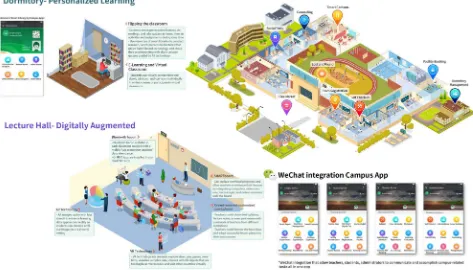
Figure 1. Smart campus.
3.1. Digitally Augmented Learning Spaces
Learning in universities tends to occur in classrooms or lecture halls. Generally speaking, the professor would be in front of the lecture hall and present infor-mation in front of dozens, if not hundreds, of students. The professor could use a whiteboard or PowerPoint for ease of presentation, or even use science expe-riments to illustrate a phenomenon. Even though professors in smaller class-rooms can more easily interact with individual students or small groups of stu-dents, tools in these traditional learning spaces are limited. Relying on Power-Point, books, iClickers, and the occasional hands-on could greatly benefit from additional technology (Mayer et al., 2009) [27]. Although this type of learning has worked in many fields that centers around texts and the exchange of ideas that can be adequately communicated via class discussions or essays (e.g. Eng-lish, philosophy, communication), many fields that involve micro or macro vi-sualization (e.g. STEM) would need digitally augmented classrooms. Universities that adopt these technologies would be more competitive as students cannot learn the same way by themselves.
DOI: 10.4236/jssm.2018.116037 549 Journal of Service Science and Management their lessons by integrating computers, video cameras, microscopes, and online resources with the board. These SMARTboards can serve as digital whiteboards; teachers can project their PowerPoint slides whilst writing on them. Teachers can bring up previously saved slides via QR codes and hand out virtual copies of class notes without a printer. Students can see the board update on their screens in real-time, and even contribute to the whiteboard by drawing on their own screens. They can customize their digital class notes with their classmates’ notes, animations, or links to online resources.
Besides SMARTboards, VR technology lets students explore ideas, play games, view films, visualize complex data, interact with 3D objects that are too fragile or microscopic, and visit other countries virtually (Merchant et al., 2014) [30]. Stu-dents interested in painting can use “Tiltbrush” to paint in a variety of colors, brush styles, and in a 3D setting without wasting canvases. Tiltbrush allows stu-dents to navigate around their painting, import previously drawn art into their work, and easily share their work. Medical students can use “Share care”, which visualizes various human organs (e.g. brain, stomach, and kidney) at various le-vels of analysis. Students can rotate these organs and learn about the human body in ways that no traditional textbook can provide. Organs in Share care have labeled descriptions on them, thereby supplementing visuals with factual infor-mation. Lamb et al. (2018) [31] found that learning science concepts are using VR technology, specifically DNA, increased students learning due to the real-ism and 3D modeling. But it doesn’t stop there. VR has been used as an effec-tive way to simulate dangerous scenarios such as earthquake or evacuation training (Feng et al., 2018) [32]. Instead of flyers or posters on what to do during these dangerous situations, immersive VR can help humans envision the situation, which includes moving, crouching, turning, and simulate quick reactions to fake stimuli. Immersive VR can provide better memory recall abili-ty compared to non-immersive VR conditions (Krokos, et al., 2018) [33]. Their research showed that participants felt more focused on the task due to better immersion experience.
Lastly, classrooms can be augmented with computer-generated stimuli that appear in reality, namely augmented reality. AR technology can be cost-effective; students can download apps and utilize AR through their smartphone cameras. AR merges reality with fake stimuli to enhance learning; data appear over reality so students can observe artificial images in a real-world setting. There are cur-rently AR apps for almost any subject, such as geometry, translation, math, and art. For instance, users of the free Google Translate app can translate text into other languages in real-time by capturing the text on their smartphone.
DOI: 10.4236/jssm.2018.116037 550 Journal of Service Science and Management Smart Campus can assist education, smart campuses enhance learning in other ways as well.
3.2. Enhancing Student Learning and Teacher’s Instruction
Learning is both the student and instructor’s responsibility. Professors are re-sponsible for delivering and facilitating content delivery and application while students are expected to engage in the material. Since many university classes are so big that taking attendance becomes a daunting task, it is unrealistic to expect professors to remember every student’s face or call out each name one by one. Yet, keeping track of attendance is useful because participation is essential in some courses and attendance is a predictor for class success (Credé et al., 2010) [34]. Fortunately, teachers can accurately and efficiently monitor students’ class attendance via RFID tags in student ID cards. Another option is using Blu-etooth bacon installed in each classroom coupled with a mobile App since al-most all students are equipped with smart phone.
DOI: 10.4236/jssm.2018.116037 551 Journal of Service Science and Management Internet of Things (IoT) can also help students with disabilities succeed in the classroom. Students who struggle in class due to a medical condition often re-quest a note-taker to keep up (Boyle & Weishaar, 2001) [37]. The note-taker is usually a fellow classmate whose notes are shared with the disabled students. However, the notes are not guaranteed to be good, people have different styles of taking notes, and notes might be too brief or too detailed for the disabled stu-dents. In addition to note-takers, disabled students could benefit from adopt au-tomated audio transcribing technology that records and transcribes the instruc-tor. If the teacher permits, the note-taker could use apps such as “Trint” which records and transcribes audio and video files. Classrooms could instill their own recording devices to ensure that people sitting in the back of the lecture hall can still record the lecture clearly. These transcribed files can be seamlessly edited (e.g. highlight, elaborated, trimmed) and be shared with other users. These tran-scribed files can supplement class notes for students and serve as a tool for teachers to keep a record of what they taught in class. Inexperienced teachers may want to recall what they said to improve how they deliver their lectures in the future.
To further improve pedagogy, different instructors teaching the same courses could pool their knowledge to create crowd-sourced customized curriculums with replicable instructions (Johnson, 2006) [38]. Teachers could share their syl-labus, lecture notes, or even past exams with a network of teachers from differ-ent institutions. If done correctly, teachers could borrow the best ideas from dif-ferent teachers and adapt successful lesson plans into their own courses. Ex-tending this further, teachers could share practices of augmented classrooms and exemplary student work (with the names removed).
One example of customized curriculum is the creation of a textbook via com-pilation chapters. For instance, many scholars recognize that textbooks are ex-pensive (and possibly outdated) but writing a textbook themselves is far too strenuous. One non-profit publisher called NOBA tackled this problem by get-ting top scholars in various areas of psychology to write one chapter of the book with respect to their expertise. NOBA then makes the book completely free to students if they access the book online. NOBA also provide instructors with a bank of exam questions, lecture notes, suggested activities, as well as premade PowerPoints with detailed notes after instructors verify their identity. This al-lows students to save money on an updated textbook written by experts and in-structors to teach a customized curriculum, as they can choose to build their textbook by selecting which chapters to incorporate.
These initiatives strengthen learning capacity, which subsequently increases happiness as learning is made more effective and engaging. Students would po-tentially get more individualized attention when their written work and atten-dance is tracked, while teachers’ pedagogy would increase.
3.3. Developing a Campus App
DOI: 10.4236/jssm.2018.116037 552 Journal of Service Science and Management instance, some universities have utilized WeChat integration that allows teach-ers, students, administrators to communicate and accomplish campus-related tasks all in one app. These include voicing out opinions (and offering feedback) on various class and university policies, getting updates of campus facilities for effective coordination, posting and selling sell second-hand items, a virtual col-lective lost-and-found platform, a place for admin to release campus-wide news, and a tool for teachers to communicate with their class beyond Email. This con-cept has been developed into a Campus App, and other universities can follow suit. By the same token, individual institutions can fund apps that keep track of where their shuttle buses are in real time (e.g. Ride Systems which track campus shuttle buses in various U.S. universities), or available parking spots on campus.
3.4. Cognitive Offloading
Smartphone apps today have permitted students to look up their schedule, Emails, social media, and to access the Internet (Mims, 2012) [39]. Data stored in one’s smartphone serve as a digital repository that allow users to “cognitively offload” information, thereby reducing our cognitive demands to remember our schedules, appointments, and to-do lists (Risko & Gilbert, 2016) [40]. Because humans cannot retrieve everything in a given point in time, offloading detailed information such as scheduling frees up our mind to tackle other tasks.
Students who use campus apps such as WeChat integration allows them to cognitively offload their schedule, with all of their class times and professor’s of-fice hours already inputted. Teachers who use campus apps can look at when students have scheduled to meet with them, saving them the effort of inputting the appointment into their calendar. The app could remind both students and teachers to complete tasks via time-based or location-based pop-up messages. Nonetheless, overreliance on cognitive offloading can impair spatial memory (e.g. drive navigation if one overlies on using a GPS), episodic memory (e.g. re-member specific events in one’s life), and prospective memory (e.g. rere-member- remember-ing to do thremember-ings in the future) (Risko & Gilbert, 2016) [40]. Cognitive offloadremember-ing is handy, but one should be cautious of over relying on their digital repositories.
In sum, a Smart Campus has many benefits, including augmented learning spaces, student learning and teaching instruction, campus apps that contains a plethora of benefits, and cognitive offloading. These initiatives not only improve learning capability, happiness, and competitiveness, but also the advancement of education and knowledge proliferation.
4. Smart Library
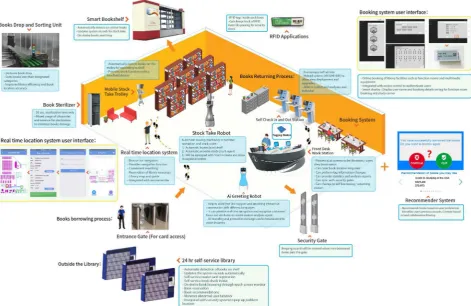
This paper reveals the smart library in reality. The applications below are di-vided into three sections namely Intelligent and Organized (Table 1), Apome-diated (Table 2), and Personalization (Table 3). An overview picture is depicted in Figure 2.
DOI: 10.4236/jssm.2018.116037 553 Journal of Service Science and Management
Table 1. Intelligent and organized. (Source: http://www.hkc.com.hk/library-management/ [40]).
Product Features
RFID Applications
- RFID tags inside each book
- Gate keeps track of RFID materials passing for security check, alarm or signal light will be triggered when patron passing through the gate without check-out the items
- Counts the number of visitors to view library traffic
- Configure settings and view statistics remotely
- Customizable graphic panels to match the library theme and style
Smart Bookshelf
- Returned items available immediately
- Automatically detects on-shelve books which can help to eliminate queues with a dedicated returns area
- Security is set and LMS is automatically updated, items are ready for circulation immediately
- Updates system records immediately and ease for stock take
24-hour Self-Service Library
- Extends the coverage and accessibility of the library service so that library can offer patron a self-service experience of locations and times more convenient to them.
- Automatically distributes reserved books into dedicated smart shelf holes
- Real time tracking and monitoring
- On shelve book browsing through touch screen monitor or apps
- Generates alerts in the case something has been misplaced
- Integrated with RFID, patrons can easily return multiple items at one time
- LMS automatically updates once item is collected or returned
- Monitor abnormal user behavior e.g. patron has picked up overdue items, report for missing items/damaged items or hardware problems
- Custom graphic wraps extend the library branding
Smart Locker
- Designed for RFID tagged items, providing the borrow or return items and integrated with LMS
- It allows using library card or ID card to login the locker, and it will show the items inside the particular locker on the screen
- Items which is remove from the locker or put into the locker will be detected and check-out/check-in to LMS
- Patron can borrow or return items at anytime and anywhere
- Flexible and highly customized with any dimensions to fit the location and environment
- Patron can also use the app to reserve the item and collect them from the locker
Robot (Stock take)
- Automatic moving robot to facilitate navigation by building a map, set its location and navigate to the target location and doing stock take
- Will be equipped with touch screens and voice recognition system
- Can support both HF or UHF RFID tag
- It can identify the lost books and check the wrong place-books then generate reports for librarians to take further action
- Automatic provides stock count report
Book Drop and Sorting Unit
- 24-hour book drop
- Sort books into their designated categories
- Patron accounts are updated and all returned books will be armed immediately
- Dedicated sort patterns allow for quicker material processing
- Improves library efficiency with books sorted and shelfed accordingly
- Delivering efficient workflows that keep the circulation moving and allow the librarians to focus on more meaningful tasks
Room & Equipment Booking System
- On-line booking of library facilities such as function rooms and multimedia equipment
- Integrated with access control to authenticate users
- Smart display, it displays user name and booking details on tag for function room booking and study corner
- Support synchronize among your phone, tablet and computer in real time
- Pre-booking with selection of the multimedia equipment
- Ready scene settings and door access based on booking arrangement
- Provides comprehensive reports that shows facilities usage, income and for further analysis
- Customization of themes and details
- Rules based control
DOI: 10.4236/jssm.2018.116037 554 Journal of Service Science and Management Continued
Self Check-In/Out Station
- Encourages self-service
- Hybrid system (HF/UHF/EM) to allow easy deployment and upgrades
- Able to collect and analyzes user behavior
- Touch screen with intuitive interface and support multiple languages
- Drive attendance to programs and events which can increase the marketing efforts and drive engagement.
- Customize promotions with user-friendly templates which can make a greater impact by scheduling promotions to target patrons
Book Sterilizer
- Kills 99.7% - 99.9% germs/virus in 30 seconds
- Kills E. Coli and Staphylococcus aureus
- Allows disinfecting up to 6 books at the same time
- Has a remaining time countdown function
- Uses UV-C Sanitization with up to 10 UV lamps
- Sanitizes book cover and inside page with air blower
- Safety interlock to stop the operation when door is opened
[image:12.595.62.529.84.260.2]- Tempered glass at the front door to block the UV-C light
Table 2. Apomediated. (Source: http://www.hkc.com.hk/library-management/ [41]).
Product Features
Intelligent Monitoring System
- Monitors abnormal user behavior
- Integrated with security system to pop up problem location
- Authority setting for different access levels in the web interface
Real Time Location System
- Beacon for navigation
Provides navigation function
Offers location-based promotions/services Convenient searching
Reservation of library resources Library map and guide Event promotions Enables social interactions
Integrated with recommender
Table 3. Personalization. (Source: http://www.hkc.com.hk/library-management/ [41]).
Product Features
Recommender System
- Recommends books based on user preferences
- Identifies user’s previous records. Content-based or/and collaborative filtering
- Recommend to friend by clicking the item and recommend to another user
- The user also can view recommended item from their friends
Face Recognition System
- Identifies user for security or recommender
- Report to the security room immediately once in the event of abnormal behavior
- Comprehensive web-based monitoring tool with intuitive system reports that include performance status and statistical reports
AI Greeting Robot
- To greet patron as enter the library
- Autonomous navigation
- Make conversation with pre-programmed scripts
- Enable to print and scan QR code
- Enable to support multi-languages
The library is intelligent: Self-renewing, flexible, functional, integrated, effi-cient, resilient, autonomous and sensitive (adaptive).
DOI: 10.4236/jssm.2018.116037 555 Journal of Service Science and Management
Figure 2. Smart library.
every piece of data to enable ease of access. Apomediated
The library is apomediated: Stand by the users and guide them to high quality information and services.
Personalization
The library is personalized is similar to what various service providers such as search engines and the media were offered their clients on various Internet plat-forms.
5. Impact on the Education System
DOI: 10.4236/jssm.2018.116037 556 Journal of Service Science and Management
5.1. Personalized Learning
Traditional learning in the 20th century grouped students by age cohorts instead
of ability (Leland & Kasten, 2002) [42]. Like goods in a factory, students are ex-pected to go through the “factory of education” and come out with similar out-comes. This factory model of education assumes that age and ability are corre-lated, but this might not be the case. Students in this education model are ho-mogenous, curriculum in these models tends to be standardized, and competi-tion among cohorts is vast.
Today, many education systems have moved towards a more personalized style of learning. Students in the Advanced Placement program can choose which courses to take and which courses not to take in an order of their prefe-rence, which enables students of different ages to take the same classes. Students in the International Baccalaureate (IB) program choose which subjects to take at “higher-level”, and which subjects to take at “standard-level,” or choose to take some IB courses to receive a certificate instead of a diploma. In higher education, some areas of study permit the student to craft their own progress (i.e. which classes to take across multiple semesters) to complete their degree. Evidently, education today has granted some degree of flexibility than before. With smart libraries and smart campuses, students would be able to personalize their learn-ing to new heights.
Promulgation of new technology enables educators to use the flipped class-room, which occurs when activities that are conventionally completed in the class are done at home, while activities conventionally done in the home are done in class, thereby “flipping the classroom.” In these types of classrooms, students watch prerecorded lectures, do readings, and take quizzes at home,
then do activities and assignments during class time (Akçayır & Akçayır, 2018)
[43]. Students can rewatch the lectures and re-take the quizzes as studying tools.
The flipped classroom could encourage students to use the resources of smart libraries to conduct research, watch prerecorded lectures that utilize SMART board technology, and check their understanding with short-answer quizzes graded by A.I. technology in their own time outside of class. Given that flipped classrooms use online materials for content delivery before class, students can learn anytime and anywhere (He, Holton, Farkas, & Warschauer, 2016) [44]. Teachers can make use AR and VR technology for demonstrations in class and give more personalized attention to each student. The teacher in flipped class-rooms assists the students and not just delivers information, while students are responsible for their own understanding.
DOI: 10.4236/jssm.2018.116037 557 Journal of Service Science and Management
5.2. E-Learning and Virtual Classroom
Some universities today already offer online degrees (even at the post-grad level) so those who cannot afford to temporarily relocate to the university (e.g. work-ing adults) can still obtain their degree. E-learnwork-ing allows learnwork-ing to occur vir-tually anywhere and anytime, making education free of time and geographical constraints. How can a smart campus benefit e-learning?
Students admitted to pursue education in a smart campus can learn without physically being on campus. Students can virtually contact their academic advi-sors, and can learn individually in online courses or participate in virtual class-rooms. Student could enter a virtual classroom via their own computer any-where in the world and see other students and the teacher virtually. In these classrooms, students and teachers can still interact by speaking, virtually raising one’s hands, and have their avatar react to other people’s thoughts (e.g. with a smile or confused look). Virtual classrooms have been used before. Petrakou (2010) [46] had American and Swedish students take a course in a virtual room with an avatar with good results. However, students in this virtual class-room who faced technical issues could not immediately notify the teacher, which goes to show that entering a virtual classroom requires getting acquainted to new norms of interaction. Technical issues aside, virtual classrooms allows people to learn together regardless of location. Students can be in the same class in a virtual setting with classmates from different countries and of different age groups. Virtual classrooms disengage from the factory model of learning and boasts personalized learning.
communica-DOI: 10.4236/jssm.2018.116037 558 Journal of Service Science and Management tion for more complex tasks. With this in mind, e-learning might be more effec-tive when teachers communicate with their students in more detailed ways (e.g. video-conferencing) or elaborate Emails when tasks are complex. That said, e-learning is more than communication between students and teachers.
Integration of smart library resources into online courses would enable stu-dents to conduct research online anywhere in the world using the library’s re-sources, provided there is Internet connection. Students can have access to the campus’ smart library that will find, collect, and synthesize relevant research in-formation like a colleague. That, and uses of IOT-based programs that edits one’s grammar, spelling, tone, and word choices (e.g. Grammarly) can improve student’s writing proficiency. Use of the smart library can be customized such that background readings are based on their student’s level, which can be as-sessed through a diagnostic test that captures the student’s current level of edu-cation (Tang & McCalla, 2003) [50]. Furthermore, IoT technology can link stu-dents in the same online courses together, enabling collaborative research projects and pooling of research resources.
Incorporating smart library has tremendous benefits, but its use in online learning creates implications for curriculum development. Educators need to decide the appropriate extent of using smart library, and find ways to give feed-back to students on how they used the library’s resources. To facilitate students’ research skills, college classes that involve research papers may need to adopt guidelines to teach students how to use but not over rely on the smart library.
E-learning is not the same as traditional learning. Smart technology improves learning, but this advancement faces pushback. This new way of teaching re-quires people to be “technological-savvy’ at a basic level, and long-time educa-tors who taught a subject for many years may resist redesigning their courses. Additionally, integrating text, video, and animations does not always promote understanding. It is expensive to develop multimedia instructions, and research shows that rich media is effective for complex learning, but ineffective for simple learning (Sun & Cheng, 2007) [51]. Sometimes, learning the traditional way, re-gardless if it is online or offline, is more effective. Lastly, e-learning in the digital age faces the issue of academic cheating.
5.3. Issue of Academic Cheating
DOI: 10.4236/jssm.2018.116037 559 Journal of Service Science and Management Because there is no way to verify the authenticity of the student’s quizzes, tests, essays, and assignments, this can inadvertently encourage cheating, fabri-cation, plagiarism, and collusion (Northcutt et al., 2016) [52]. Honest students may choose to cheat because they think they will be unfairly disadvantaged if they do not cheat as well (Parks et al., 2018) [53]. Honest students may also cheat if they think the education system is unfair. To make matters worse, there is a high correlation between students who cheat in academics and those who cheat in professional settings. Implications of cheating in online courses raise questions of whether students really earned the degree, and if students who ob-tain a degree with online courses are qualified for cerob-tain jobs.
5.4. Digital Literacy
In today’s digital age, citizens in developed countries tend to use their digital de-vices in many important activities (e.g., Email, social media, banking, GPS, pur-chasing plane tickets, professional video-conferencing). This reliance on digital devices prompts the need for people to increase their digital literacy (Eshet- Alkalai, 2004) [54]. For instance, many people spend up to one-third of their time on computers devoted to email communications (Acton, 2013) [55]. Many companies market their products and maintain their brand image via social me-dia (Laroche et al., 2013) [56]. As such, students need to have a minimum grasp of digital literacy before moving into the job market. Making use of technologi-cal advances would fulfill this goal.
Understanding the basics of today’s digital world involves knowing how to search and manage online information, as well as discerning the good sources from the bad (Koltay, 2011) [57]. Even though smart libraries help students compile relevant sources, it is ultimately up to the student to critically analyze the veracity of those sources. Arming students with digital literacy will allow them to thrive in an age where virtually everything is virtual.
6. Conclusion
DOI: 10.4236/jssm.2018.116037 560 Journal of Service Science and Management index includes 4 components: 1) well-being (taken from Gallup World Poll’s da-ta on citizens in each country rating their satisfaction with life overall), 2) life expectancy (taken from United Nation’s data on the average number of years citizens in each country is expected to live), 3) inequality of outcomes (compares the distribution life expectancy to well-being in a percentage), and 4) ecological footprint (which calculates the average person’s impact on the environment). Put together, the HPI is calculated by [well-being x life expectancy x inequality of outcomes] all divided by a [standardized measure of ecological footprint]. If we apply use this conceptualization of happiness, smart campus and library might increase happiness. Technological advances will undoubtedly increase well-being because of all the benefits education and convenience it brings. Bols-tering education and access to information elevates society as a whole. However, it may also increase inequality of outcomes between and within countries. Wealthy countries will be able to adopt smart campus, smart libraries, and even smart cities, while other less wealthy countries may potentially lag behind. That being said, technological advances always come with this issue of who benefits from it. Since it is virtually impossible for new technological to benefit everyone, some people will inevitably not get the benefits until later. For instance, the in-troduction of the Smartphone creates a barrier between the haves and have nots, but later on the smartphone market saturated in some parts of the world.
7. Limitations and Future Research
The automation of library has been changing with the evolution of Web4.0. It is in fact part of the Smart Campus which is still in its infant stage. How would it be integrated seamlessly with the Smart Campus worth further study. Its impact on happiness needs a longitudinal study. Another upcoming application is the Blockchain which is a decentralized secure information technology creating and maintaining a global ledger of transactions that doesn’t require a third-party middleman such as a bank, government or corporation. The idea rests on four pillars, namely transcripts retrieval, transcript detail information storage, au-thenticity and verification of certificate, and academic records update with a common standard across institutes for ongoing education.
The adoption of any technology in education should strengthen our capability and capacity in acquiring new knowledge, and making learning more fun. Smart Campus and Smart Library should produce Smart People.
Conflicts of Interest
The authors declare no conflicts of interest regarding the publication of this pa-per.
References
DOI: 10.4236/jssm.2018.116037 561 Journal of Service Science and Management Internet. In: Hagenhoff, S. (Hrsg.): Internetökonomie in der Medienbranche, Un-iversitätsverlag Göttingen.
[2] Noh, Y. (2015) Imagining Library 4.0: Creating a Model for Future Libraries. The
Journal of Academic Librarianship, 41, 786-797.
https://doi.org/10.1016/j.acalib.2015.08.020
[3] Best, D. (2006) Web 2.0: Next Big Thing or Next Big Internet Bubble? Technische Universiteit Eindhoven.
[4] Habib, M.C. (2006) Toward Academic Library 2.0: Development and Application of a Library 2.0 Methodology. Unpublished Master’s Dissertation, University of North Carolina at Chapel Hill.
[5] Alotaibi, S. (2010) Semantic web Technologies for Digital Libraries: From Libraries to Social Semantic Digital Libraries (SSDL). Over Semantic Digital Libraries (SDL).
The 4th Saudi International Conference, University of Manchester, UK.
[6] Patel, K. (2013) Incremental Journey for World Wide Web: Introduced with Web1.0 to Recent Web 5.0—A Survey Paper. International Journal of Advanced
Research in Computer Science and Software Engineering, 3, 410-417.
[7] Gundala, S. (2016) Education Systems around the World: A Comparison. https://www.linkedin.com/pulse/education-systems-around-world-comparison-sas
hi-gundala/
[8] Cann, O. (2017) What Exactly Is Economic Competitiveness?
https://www.weforum.org/agenda/2017/09/what-is-economic-competitiveness
[9] The Worldwide Educating for the Future Index (2018).
https://yidanprize.org/research/
[10] World Economic Forum (2017) White Paper, Realizing Human Potential in the Fourth Industrial Revolution.
http://www3.weforum.org/docs/WEF_EGW_Whitepaper.pdf
[11] World Economic Forum, Mapping Global Transformations.
https://toplink.weforum.org/knowledge/insight/a1Gb0000000LPFfEAO/explore/su
mmary
[12] Siemens, G. (2004) Connectivism: A Learning Theory for the Digital Age.
Interna-tional Journal of InstrucInterna-tional Technology & Distance Learning, 2.
[13] Mallon, M.N. (2013) Extending the Learning Process: Using the theory of Connec-tivism to Inspire Student Collaboration. Kansas Library Association College and
University Libraries Section Proceedings, 3.
[14] Coleman, J.S. (1994) Foundations of Social Theory. Harvard University Press. [15] Johnson, C.A. and Griffis, M.R. (2009) A Place Where Everybody Knows Your
Name? Investigating Relationship between Public Libraries and Social Capital.
Ca-nadian Journal of Information and Library Science, 33, 159-191.
[16] Braun, L.W., Hartman, M.L., Hughes Hassell, S., Kumasi, K. and Yoke, B. (2014) The Future of Library Services for and with Teens: A Call to Action. YALSA, Chi-cago.
[17] Garmer, A.K. (2014) Rising to the Challenge: Re-Envisioning Public Libraries. The Aspen Institute, Washington DC.
[18] Ito, M. and Martin, C. (2013) Connected Learning and the Future of Libraries.
Young Adult Library Services, 12, 29-32.
DOI: 10.4236/jssm.2018.116037 562 Journal of Service Science and Management Media and Learning Research Hub., Irvine.
[20] Hoffman, K.M., Subramaniam, M., Kawas, S., Scaff, L. and Davis, K. (2016) Con-nected Libraries: Surveying the Current Landscape and Charting a Path to the Fu-ture. The Connected Lib Project, College Park, Seattle.
[21] Gorichanaz, T. and Turner, D. (2017) All the Community’s a Stage: The Public Li-brary’s Part in Community Information Provision. The Library Quarterly, 87, 99-116.https://doi.org/10.1086/690737
[22] Chan, K. (2017) Which Countries Provide Their Citizens with the Best Higher Education?
https://www.weforum.org/agenda/2017/05/which-countries-provide-their-citizens-with-the-best-higher-education
[23] Schwab, K. (2017) The Global Competitiveness Report 2017-2018.
http://www3.weforum.org/docs/GCR2017-2018/05FullReport/TheGlobalCompetiti
venessReport2017%E2%80%932018.pdf
[24] Happy Planet Index (2018). http://happyplanetindex.org/
[25] Soria, K.M., Fransen, J. and Nackerud, S. (2013) Library Use and Undergraduate Student Outcomes: New Evidence for Students’ Retention and Academic Success.
Libraries and the Academy, 13, 147-164.https://doi.org/10.1353/pla.2013.0010
[26] Sari, M.W., Ciptadi, P.W. and Hardyanto, R.H. (2017) Study of Smart Campus De-velopment Using Internet of Things Technology. IOP Conference Series: Materials
Science and Engineering, 190, Article ID: 012032.
https://doi.org/10.1088/1757-899X/190/1/012032
[27] Mayer, R.E., Stull, A., Deleeuw, K., Almeroth, K., Bimber, B., Chun, D. and Zhang, H. (2009) Clickers in College Classrooms: Fostering Learning with Questioning Methods in Large Lecture Classes. Contemporary Educational Psychology, 34, 51-57.https://doi.org/10.1016/j.cedpsych.2008.04.002
[28] Price, S. and Rogers, Y. (2004) Let’s Get Physical: The Learning Benefits of Inte-racting in Digitally Augmented Physical Spaces. Computers & Education, 43, 137-151.https://doi.org/10.1016/j.compedu.2003.12.009
[29] Wu, H., Lee, S.W., Chang, H. and Liang, J. (2013) Current Status, Opportunities and Challenges of Augmented Reality in Education. Computers & Education, 62, 41-49.https://doi.org/10.1016/j.compedu.2012.10.024
[30] Merchant, Z., Goetz, E.T., Cifuentes, L., Keeney-Kennicutt, W. and Davis, T.J. (2014) Effectiveness of Virtual Reality-Based Instruction on Students Learning Outcomes in K-12 and Higher Education: A Meta-Analysis. Computers & Educa-tion, 70, 29-40.https://doi.org/10.1016/j.compedu.2013.07.033
[31] Lamb, R., Antonenko, P., Etopio, E. and Seccia, A. (2018) Comparison of Virtual Reality and Hands on Activities in Science Education via Functional near Infrared Spectroscopy. Computers & Education, 124, 14-26.
https://doi.org/10.1016/j.compedu.2018.05.014
[32] Feng, Z., González, V.A., Amor, R., Lovreglio, R. and Cabrera-Guerrero, G. (2018) Immersive Virtual Reality Serious Games for Evacuation Training and Research: A Systematic Literature Review. Computers & Education, 127, 252-266.
https://doi.org/10.1016/j.compedu.2018.09.002
[33] Krokos, E., Plaisant, C. and Varshney, A. (2018) Virtual Memory Palaces: Immer-sion Aids Recall. Virtual Reality.
[34] Credé, M., Roch, S.G. and Kieszczynka, U.M. (2010) Class Attendance in College.
DOI: 10.4236/jssm.2018.116037 563 Journal of Service Science and Management https://doi.org/10.3102/0034654310362998
[35] Pennebaker, J.W. and Graybeal, A. (2001) Patterns of Natural Language Use: Dis-closure, Personality, and Social Integration. Current Directions in Psychological
Science, 10, 90-93.https://doi.org/10.1111/1467-8721.00123
[36] Conway, L.G. III, Conway, K.R., Gornick, L.J. and Houck, S.C. (2014) Automated Integrative Complexity. Political Psychology, 35, 603-624.
https://doi.org/10.1111/pops.12021
[37] Boyle, J.R. and Weishaar, M. (2001) The Effects of Strategic Note Taking on the Recall and Comprehension of Lecture Information for High School Students with Learning Disabilities. Learning Disabilities Research and Practice, 16, 133-141. https://doi.org/10.1111/0938-8982.00014
[38] Johnson, J.A. (2006) Beyond the Learning Paradigm: Customizing Learning in American Higher Education: 10 Bellweather Principles for Transforming American Higher Education. Community College Journal of Research and Practice, 30, 97-116.https://doi.org/10.1080/10668920500432951
[39] Mims, C. (2012) A Surprisingly Long List of Everything Smartphones Replaced. https://www.technologyreview.com/s/428579/a-surprisingly-long-list-of-everything
-smartphones-replaced/
[40] Risko, E.F. and Gilbert, S.J. (2016) Cognitive Offloading. Trends in Cognitive
Sciences, 20, 676-688.https://doi.org/10.1016/j.tics.2016.07.002
[41] Library Management (2018). http://www.hkc.com.hk/library-management/ [42] Leland, C.H. and Kasten, W.C. (2002) Literacy Education for the 21st Century: It’s
Time to Close the Factory. Reading & Writing Quarterly, 18, 5-15. https://doi.org/10.1080/105735602753386315
[43] Akçayır, G. and Akçayır, M. (2018) The Flipped Classroom: A Review of Its Advan-tages and Challenges. Computers & Education, 126, 334-345.
https://doi.org/10.1016/j.compedu.2018.07.021
[44] He, W., Holton, A., Farkas, G. and Warschauer, M. (2016) The Effects of Flipped Instruction on Out-of-Class Study Time, Exam Performance, and Student Percep-tions. Learning and Instruction, 45, 61-71.
https://doi.org/10.1016/j.learninstruc.2016.07.001
[45] Kunze, A. and Rutherford, T. (2018) Blood from a Stone: Where Teachers Report Finding Time for Computer-Based Instruction. Computers & Education, 127, 165-177.https://doi.org/10.1016/j.compedu.2018.08.022
[46] Petrakou, A. (2010) Interacting through Avatars: Virtual Worlds as a Context for Online Education. Computers & Education, 54, 1020-1027.
https://doi.org/10.1016/j.compedu.2009.10.007
[47] Vrasidas, C. and McIsaac, M.S. (2000) Principles of Pedagogy and Evaluation for Web-Based Learning. Educational Media International, 37, 105-111.
https://doi.org/10.1080/095239800410405
[48] Sutton, L.A. (2001) The Principle of Vicarious Interaction in Computer-Mediated Communications. International Journal of Educational Telecommunications, 7, 223-242.
[49] An, Y. and Frick, T. (2006) Student Perceptions of Asynchronous Comput-er-Mediated Communication in Face-to-Face Courses. Journal of
Comput-er-Mediated Communication, 11, 485-499.
https://doi.org/10.1111/j.1083-6101.2006.00023.x
DOI: 10.4236/jssm.2018.116037 564 Journal of Service Science and Management e-Learning System: A Simulation-Based Study. Conference of the Canadian Society
for Computational Studies of Intelligence, London, 17-19 May 2004, 439-443.
https://doi.org/10.1007/978-3-540-24840-8_34
[51] Sun, P. and Cheng, H.K. (2007) The Design of Instructional Multimedia in e-Learning: A Media Richness Theory-Based Approach. Computers & Education, 49, 662-676.https://doi.org/10.1016/j.compedu.2005.11.016
[52] Northcutt, C.G., Ho, A.D. and Chuang, I.L. (2016) Detecting and Preventing “Mul-tiple-Account” Cheating in Massive Open Online Courses. Computers & Education, 100, 71-80.https://doi.org/10.1016/j.compedu.2016.04.008
[53] Parks, R.F., Lowry, P.B., Wigand, R.T., Agarwal, N. and Williams, T.L. (2018) Why Students Engage in Cyber-Cheating through a Collective Movement: A Case of De-viance and Collusion. Computers & Education, 125, 308-326.
https://doi.org/10.1016/j.compedu.2018.04.003
[54] Eshet-Alkalai, Y. (2004) Digital Literacy: A Conceptual Framework for Survival Skills in the Digital Era. Journal of Educational Multimedia and Hypermedia, 13, 93-106.
[55] Acton, A. (2017) How to Stop Wasting 2.5 Hours on Email Every Day.
https://www.forbes.com/sites/annabelacton/2017/07/13/innovators-challenge-how-t
o-stop-wasting-time-on-emails/#47004153978
[56] Laroche, M., Habibi, M.R. and Richard, M. (2013) To Be or Not to Be in Social Me-dia: How Brand Loyalty Is Affected by Social Media? International Journal of
In-formation Management, 33, 76-82.https://doi.org/10.1016/j.ijinfomgt.2012.07.003
[57] Koltay, T. (2011) The Media and the Literacies: Media Literacy, Information Lite-racy, Digital Literacy. Media, Culture & Society, 33, 211-221.
https://doi.org/10.1177/0163443710393382
[58] Diener, E. (2000) Subjective Well-Being: The Science of Happiness and a Proposal for a National Index. American Psychologist, 55, 45-43.
https://doi.org/10.1037/0003-066X.55.1.34
[59] Diener, E., Oishi, S. and Lucas, R.E. (2003) Personality, Culture, and Subjective Well-Being: Emotional and Cognitive Evaluations of Life. Annual Review of
Psy-chology, 54, 403-425.https://doi.org/10.1146/annurev.psych.54.101601.145056
[60] Diener, E., Oishi, S. and Lucas, R.E. (2015) National Accounts of Subjective Well-Being. American Psychologist, 70, 234-242.https://doi.org/10.1037/a0038899 [61] Lyubomirsky, S. (2013) The Myths of Happiness: What Should Make You Happy,
But Doesn’t, What Shouldn’t Make You Happy, But Does. Penguin, New York. [62] Haidt, J. (2006) The Happiness Hypothesis: Finding Modern Truth in Ancient
Wisdom. Basic Books, New York.
![Table 1. Intelligent and organized. (Source: http://www.hkc.com.hk/library-management/ [40])](https://thumb-us.123doks.com/thumbv2/123dok_us/9247564.412663/11.595.59.530.79.765/table-intelligent-and-organized-source-http-library-management.webp)
![Table 2. Apomediated. (Source: http://www.hkc.com.hk/library-management/ [41]).](https://thumb-us.123doks.com/thumbv2/123dok_us/9247564.412663/12.595.62.529.84.260/table-apomediated-source-http-www-hkc-library-management.webp)