EFFECT OF CORE MUSCLE STRENGTHENING ON BALANCE IN BADMINTON PLAYERS
*,1
Akhtar Pooja, M.,
1
Assistant Professor in Physiotherapy, V.S.P.M’s College of Physiotherapy, Digdoh Hills, Hingna, Nagpur
2
Ex-Professor and Head, Pad. Dr. D.Y.Patil University, Nerul, Navi Mumbai
ARTICLE INFO ABSTRACT
Background:
component of badminton players, which functions to maintain postural alignment and balance. However, it is not clear how it affects dynamic balance in sports persons. The pu
core strengthening on static and dynamic balance in badminton players using SEBT, Stork test and Tandem Walk test.
Methods:
age 13.70 ± 1.47 years) from Badminton Academy, Mumbai were selected. Measurements of their pre test parameters were recorded.
Intervention:
program which consisted of four levels and lasted for 30 minutes per session. Subjects progressed to the next level at 2
Main outcome Me
Stork test and tandem walk test. Results:
and Stork test measuring static balance. (p value< 0.001)
dynamic balance in healthy, young badminton players.
Copyright © 2015 Akhtar Pooja et al. This is an open access article distributed under the Creative distribution, and reproduction in any medium, provided the original work is properly cited.
INTRODUCTION
Outdoor and recreational sports participation is increasing in adolescents and an increase in the frequency or duration of recreational sports participation is leading to proportional increase in the incidence of activity induced musculoskeletal injury. (Bliss and Teeple, 2005) In this changing scenario, fitness training and injury prevention, programs incorporating spinal muscular training, including core strengthening and stability exercises have become popular because the core is considered to be the anatomic and functional centerpiece. (Haapasalo et al., 2007) And the power house of
concepts of core stabilization, strengthening or endurance training in the sports medicine community have evolved throughout the years. Previously core stability exercises were widely used for the prevention and rehabilitation of injuries of the lower back and lower extremities. (Willardson, 2007; McGill, 1998; King, 2000; Langevin and Sherman, 2007; Hodges and Moseley, 2003)Recently core stability training has
*Corresponding author: Akhtar Pooja,
Assistant Professor in Physiotherapy, V.S.P.M’s College of Physiotherapy, Digdoh Hills, Hingna, Nagpur
ISSN: 0975-833X
Article History:
Received 21st July, 2015
Received in revised form 18th August, 2015
Accepted 07th September, 2015
Published online 20th October,2015
Key words:
Star excursion Balance Test (SEBT), Stork test and tandem walk test.
Citation: Akhtar Pooja, M., Bokil Apoorva, N. and Yardi Sujata
players”, International Journal of Current Research
RESEARCH ARTICLE
EFFECT OF CORE MUSCLE STRENGTHENING ON BALANCE IN BADMINTON PLAYERS
Akhtar Pooja, M.,
2Bokil Apoorva, N. and
1Yardi Sujata
Assistant Professor in Physiotherapy, V.S.P.M’s College of Physiotherapy, Digdoh Hills, Hingna, Nagpur
Professor and Head, Pad. Dr. D.Y.Patil University, Nerul, Navi Mumbai
ABSTRACT
Background: Balance is a key component of a complex game like badminton. Core, is an important component of badminton players, which functions to maintain postural alignment and balance. However, it is not clear how it affects dynamic balance in sports persons. The pu
core strengthening on static and dynamic balance in badminton players using SEBT, Stork test and Tandem Walk test.
Methods: It was a pre-test post-test study design, in which 30 healthy young badminton players (Mean age 13.70 ± 1.47 years) from Badminton Academy, Mumbai were selected. Measurements of their pre test parameters were recorded.
Intervention: Subjects were assessed and subjected to 8 weeks (4 days/week) of core strengthening program which consisted of four levels and lasted for 30 minutes per session. Subjects progressed to the next level at 2-week intervals. After 8 weeks post-test was conducted.
Main outcome Measures: The subjects were evaluated using the Star excursion Balance Test (SEBT), Stork test and tandem walk test.
Results: There was statistically significant improvement in SEBT scores measuring dynamic balance and Stork test measuring static balance.
(p value< 0.001) Conclusion: Core strengthening of eight weeks duration is effective in improving dynamic balance in healthy, young badminton players.
is an open access article distributed under the Creative Commons Attribution License, which distribution, and reproduction in any medium, provided the original work is properly cited.
Outdoor and recreational sports participation is increasing in increase in the frequency or duration of recreational sports participation is leading to proportional increase in the incidence of activity induced musculoskeletal In this changing scenario, ention, programs incorporating spinal muscular training, including core strengthening and stability exercises have become popular because the core is considered to be the anatomic and functional centerpiece. the power house of the body. The concepts of core stabilization, strengthening or endurance training in the sports medicine community have evolved throughout the years. Previously core stability exercises were widely used for the prevention and rehabilitation of injuries of (Willardson, 2007; McGill, 1998; King, 2000; Langevin and Sherman, 2007; Recently core stability training has
.M’s College of
been purported to enhance athletic performance, but the literature has not supported these and, in fact, reported a small effect on performance. (Stanton
2003; Sato and Mokha, 2009; Nesser
2005) However, the use of core stability training improved dynamic postural control. (Sato and Mokha, 2009; Kibler 2006; Samson et al., 2007; Aggarwal
that repeated activation of core musculature along with extremity movements helps improve postural control.
et al., 2006) During performance of sports skills, a stable core
provides a foundation upon which the muscles of the upper and lower extremities can accelerate body segments and transfer force between distal and proximal body segments.
et al., 2007)
The core musculature includes muscles of the trunk and pelvis that are responsible for maintaining the stability of the spine and pelvis and are critical for the transfer of energy from larger torso to smaller extremities during many sports activities.
et al., 2005) Therefore, it is theoretically believed that if the extremities are strong and the core is weak the decrease in muscular summation through the core will result in less force production and inefficient movement patterns. The core
International Journal of Current Research Vol. 7, Issue, 10, pp.21287-21291, October, 2015
INTERNATIONAL
Akhtar Pooja, M., Bokil Apoorva, N. and Yardi Sujata, 2015. “Effect of core muscle strengt
International Journal of Current Research, 7, (10), 21287-21291.
EFFECT OF CORE MUSCLE STRENGTHENING ON BALANCE IN BADMINTON PLAYERS
Sujata
Assistant Professor in Physiotherapy, V.S.P.M’s College of Physiotherapy, Digdoh Hills, Hingna, Nagpur
Professor and Head, Pad. Dr. D.Y.Patil University, Nerul, Navi Mumbai
Balance is a key component of a complex game like badminton. Core, is an important component of badminton players, which functions to maintain postural alignment and balance. However, it is not clear how it affects dynamic balance in sports persons. The purpose was to study the effects of core strengthening on static and dynamic balance in badminton players using SEBT, Stork test and
test study design, in which 30 healthy young badminton players (Mean age 13.70 ± 1.47 years) from Badminton Academy, Mumbai were selected. Measurements of their pre
ed and subjected to 8 weeks (4 days/week) of core strengthening program which consisted of four levels and lasted for 30 minutes per session. Subjects progressed to the
test was conducted.
The subjects were evaluated using the Star excursion Balance Test (SEBT),
There was statistically significant improvement in SEBT scores measuring dynamic balance
Core strengthening of eight weeks duration is effective in improving
ribution License, which permits unrestricted use,
been purported to enhance athletic performance, but the literature has not supported these and, in fact, reported a small (Stanton et al., 2004; Lewarchick et al., 2003; Sato and Mokha, 2009; Nesser et al., 2008; Tse et al., However, the use of core stability training improved (Sato and Mokha, 2009; Kibler et al., ., 2007; Aggarwal et al., 2010) It appears peated activation of core musculature along with extremity movements helps improve postural control. (Kibler During performance of sports skills, a stable core provides a foundation upon which the muscles of the upper and n accelerate body segments and transfer force between distal and proximal body segments. (Samson
The core musculature includes muscles of the trunk and pelvis that are responsible for maintaining the stability of the spine pelvis and are critical for the transfer of energy from larger torso to smaller extremities during many sports activities. (TSE
Therefore, it is theoretically believed that if the extremities are strong and the core is weak the decrease in scular summation through the core will result in less force production and inefficient movement patterns. The core INTERNATIONAL JOURNAL OF CURRENT RESEARCH
stability in athletics dynamically control and transfer large forces from the upper and lower extremities through the core in order to maximize performance and promote efficient biomechanics. (Hibbs et al., 2008)
Balance is a complex motor skill that describes the dynamics of body posture to prevent falls. Balance is related to the inertial forces acting on the body and the inertial characteristics of body segments. (Aggarwal et al., 2010)
SEBT, a test for dynamic stability is a simple, reliable and valid method of lower extremity functional performance and it is a low-cost alternative to more sophisticated instrumented methods that are currently available. (Gray, 1995; Kinzey and Armstrong, 1998; Hertel et al., 2000)
Previous studies (Sandrey and Mitzel, 2013) have reported that balance measures like SEBT improve after 6 week core stabilization program, with few studies stating that there is significant correlation of the lower extremity balance performance with that of the core stability. (TSE et al., 2005) However, the effect of core strengthening on dynamic and static balance performance in badminton players has not been reported in quantitative fashion till date conclusively. Thus, the aim of the present study was to study the effect of eight week of core strengthening on dynamic and static balance in Badminton players.
Aims and objectives
The study was aimed at evaluating the effects of core muscle strengthening on balance in badminton players using sports specific tests such as Star-excursion balance (SEBT), Tandem walk test and Stork test.
Methodology
Study design
Before and after effect evaluation study
Study population
The study population was drawn from Badminton players who were attending Badminton Academy of Dadoji Kondev stadium, Thane, Mumbai and Dr. D. Y. Patil Sports Academy, Nerul, Navi Mumbai, either practicing or playing badminton.
Subjects
Inclusion criteria
Either gender, subjects between the age group of 8 to 18 years, playing badminton for more than two years, atleast 30 minutes a day for 4 days per week, and not involved in any formal abdominal or core training program.
Exclusion criteria
1. Had low back pain during last six months
2. Participation in any formal core training and balance training program.
3. Having Ankle fracture/Injuries in the last four months, chronic ligament sprain, Trauma to lower limb and Neurological disorders having balance impairment
4. Not willing to join the study
Sample size
Thirty subjects were enrolled in the study and no formal sample size calculation was carried out.
Study factors
At the time of recruitment, the subject’s basic demographic data, injury and treatment details if any, were recorded. Subjects were explained about the study, its importance and the need for his/her cooperation in attending the exercises regularly. After he/she agreed to participate, the patient was asked to fill the consent form. Pretesting was carried out for the three tests SEBT, stork test and Tandem walk test, following the protocol to the exact specifications as described in the literature. Participants were instructed not to change their training schedule or activity level acutely during the period of whole study.
Outcome measures
In the present study, static balance was measured using the stork Balance test; dynamic balance using Star Excursion Balance Test (SEBT) and Tandem walk test. Stork balance test and SEBT were measured on the dominant lower leg. Using the recommendation and method by Gribble and Hertel (2003), we considered only three reach directions (Anteror, Posteromedial and Posterolateral) The reach distance in all the three directions were normalized to the reaching limb length and the average distance was considered.
INTERVENTION: CORE STABILITY TRAINING
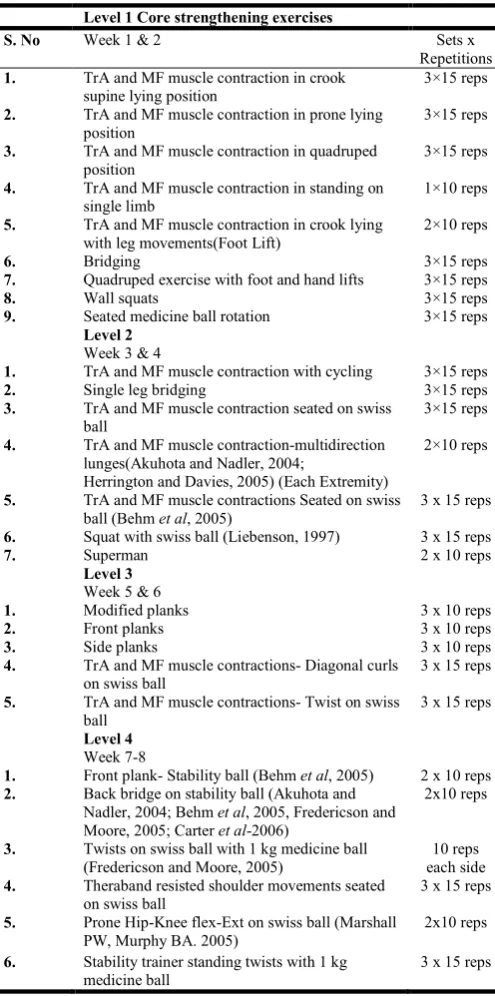
After the initial testing, the subjects performed core strengthening exercises for a period of 8 weeks. The subjects performed the exercises with the researcher, 4 times a week for a maximum of 30 min/ session. The 8-week protocol for the core strengthening program was a 4 progressive levels of exercises focusing on strengthening the abdominals, low back and pelvic muscles while maintaining neuro-muscular control. (Table 1)
Statistical analysis
The basic demographic data is presented as Descriptive statistic in tables. The Analytical statistics included the pre and post intervention values which are analyzed using parametric Student’s t-test for statistical change in the outcome after ascertaining the normality of data using Graph Pad.
RESULTS
Table 1. Protocol for core stability training
During following functional tasks the participants were instructed to maintain the isometric contraction of the transversus abdominus (TrA) and multifidus (MF) muscles.
Level 1 Core strengthening exercises
S. No Week 1 & 2 Sets x
Repetitions
1. TrA and MF muscle contraction in crook supine lying position
3×15 reps
2. TrA and MF muscle contraction in prone lying position
3×15 reps
3. TrA and MF muscle contraction in quadruped position
3×15 reps
4. TrA and MF muscle contraction in standing on single limb
1×10 reps
5. TrA and MF muscle contraction in crook lying with leg movements(Foot Lift)
2×10 reps
6. Bridging 3×15 reps
7. Quadruped exercise with foot and hand lifts 3×15 reps
8. Wall squats 3×15 reps
9. Seated medicine ball rotation 3×15 reps
Level 2
Week 3 & 4
1. TrA and MF muscle contraction with cycling 3×15 reps
2. Single leg bridging 3×15 reps
3. TrA and MF muscle contraction seated on swiss ball
3×15 reps
4. TrA and MF muscle contraction-multidirection lunges(Akuhota and Nadler, 2004;
Herrington and Davies, 2005) (Each Extremity)
2×10 reps
5. TrA and MF muscle contractions Seated on swiss ball (Behm et al, 2005)
3 x 15 reps
6. Squat with swiss ball (Liebenson, 1997) 3 x 15 reps
7. Superman 2 x 10 reps
Level 3
Week 5 & 6
1. Modified planks 3 x 10 reps
2. Front planks 3 x 10 reps
3. Side planks 3 x 10 reps
4. TrA and MF muscle contractions- Diagonal curls on swiss ball
3 x 15 reps
5. TrA and MF muscle contractions- Twist on swiss ball
3 x 15 reps
Level 4
Week 7-8
1. Front plank- Stability ball (Behm et al, 2005) 2 x 10 reps
2. Back bridge on stability ball (Akuhota and Nadler, 2004; Behm et al, 2005, Fredericson and Moore, 2005; Carter et al-2006)
2x10 reps
3. Twists on swiss ball with 1 kg medicine ball (Fredericson and Moore, 2005)
10 reps each side
4. Theraband resisted shoulder movements seated on swiss ball
3 x 15 reps
5. Prone Hip-Knee flex-Ext on swiss ball (Marshall PW, Murphy BA. 2005)
2x10 reps
6. Stability trainer standing twists with 1 kg medicine ball
3 x 15 reps
Star Excursion Balance Test
Definite improvement in star excursion balance test was observed with the mean pre intervention score of 4.847±0.289 which increased to 5.270±0.404 post intervention. This improvement was statistically significant. (p value<0.0001)
(Table 2)
Stork Test
The mean pre intervention value was 6.030±2.256 which increased to7.740±3.026 after intervention. This was statistically significant. (p value<0.016) (Table 3)
Table 2. Change in post intervention SEBT score
Parameter N Mean Std. Dev 95% CI SEBT Pre 30 4.847 0.289 -0.605 to -0.242 SEBT Post 30 5.27 0.404
[image:3.595.39.287.112.611.2]The two-tailed P value is < 0.0001, considered extremely significant.
Table 3. Changes in post interventional Stork test
Parameter N Mean Std. Dev 95% CI
Stork Pre 30 6.03 2.256 -3.089to -0.331
Stork Post 30 7.74 3.03
[image:3.595.309.556.218.251.2]The two-tailed P value is < 0.016, considered statistical significant.
Table 4. Changes in post interventional Tandem walking test
Parameter N Mean Std. Dev 95% CI
Tandem Pre 30 10.34 0.9046 -0.303 to 0.6414
Tandem Post 30 10.17 0.9219
The two-tailed P value is < 0.0476, considered not statistical significant.
Tandem walking
The pre intervention mean value improved from 10.340±0.90 sec to10.171±0.921 sec in post test. This was statistically not significant. (p value is < 0.0476) (Table 4)
DISCUSSION
The purpose of the current study was to examine the effects of 8-weeks of core strengthening program on balance in badminton players. To observe the effects of the same, dynamic balance was measured with SEBT and tandem walk test and static balance was measured with stork test. We hypothesized that balance would improve in badminton players after 8 weeks of core strengthening program.
Badminton is an extremely demanding sport. At an elite level, players are often required to perform at their limits of speed, agility, flexibility, endurance and strength. It is a complex game which involves strength, stamina, co-ordination and timely execution of the movement. Analysis of badminton biomechanics has revealed that loading on the spinal structures and the transfer of the torque forces to the spinal segments can be very high during various badminton shots. These dynamic activities cause the centre of gravity to move in response to muscular activity which requires integration of appropriate levels of proprioception, range of motion and strength. This dynamic balance is important for injury prevention. A useful measure of dynamic balance is star excursion balance test.
The SEBT is a measure of dynamic balance and postural control. The core becomes activated before gross body movements as part of the postural control system. Since the core is responsible for postural control, assessments of dynamic balance are alternatives to assess core strength. The three reach directions of the SEBT used in this study were thought to best simulate multiplanar human movement (Sandrey and Mitzel, 2013) noted in badminton sport and would be able to evaluate balance and stability.
indirect measurement tool which assesses the dynamic balance and functional capacity of lower extremity where the concept of neuromuscular control is integrated in an optimal performance enhancement program. This test uses the biomechanical principle that the subjects center of gravity must be adequately located over the base of support of the stance leg, as well as it involves an efficient eccentric and isometric neuromuscular control of the joints of the stance leg. In addition, the present study has used SEBT as it mimics the excursions that are used in badminton to prepare for certain shots. After the interventions, significant improvements in the mean SEBT scores were observed in present study. This may be attributed to the abdominal bracing incorporated in the core strengthening program that stabilized the core for the lower-limb movement (Kahle and Gribble, 2009)or to the fact that the subjects possessed neuromuscular control systems that were better suited to their respective movements in sports field. Similar results were also observed by Blackburn and Guskiewicz, Piegaro (Blackburn et al., 2000).
It was found that maximal reach distances improved for the SEBT at posttest using healthy subjects compared with a control group after a 6- week core-stability-training program. They summarized that the improvements were related to contraction of the transverse abdominis, internal and external obliques, and the rectus abdominis to provide stabilization to the spine and provide a stronger base of support for lower extremity movement. (Kahle and Gribble, 2009) This stabilization occurs because of initiation of the limb movement. (Kibler et al., 2006) Furthermore, the core strengthening program improved the strength and recruitment of the trunk musculature to such an extent that standing on one limb during the SEBT while using the opposite limb to reach may have activated the core muscles and perhaps led to greater reach distances posttest.
The present study also analyzed the effect of core on two other tests i.e. the stork test and tandem walking which are routinely utilized as balance measures. The unilateral balancing stance that is required in stork test is again a measure of trunk balance and stability which is known to be improved with core trunk muscle stability program. In a study by Anoop Agrawal et al. they concluded that there was a significant correlation between Stork test i.e. single limb balance performance and core stability. (Gladwell and Samantha, 2006; Hatzitaki et al., 2002) Thus stork test was used as one of the outcome measures tests to assess the effect of core strengthening program. During stork balance test there is need to stabilize the whole body weight, in balanced fashion, on the ball of toes.
It is well known that position of the spine significantly determines the position of the body’s COG and the compensatory muscle synergy/strategy to counteract the perturbations, to maintain the body’s equilibrium state and to regulate body’s postural control. Higher core stability performance allows optimal and long sustained contraction of deeper spinal stabilizer muscles. These stabilizer muscles due to their close proximity with the spine are responsible for better control of the intersegment motion of the spine and thus a better control of the body’s COG. (TSE et al., 2005)
The core muscles after eight weeks of strengthening will respond like any other skeletal muscle, to training, thereby improving the ability of the neuromuscular system to perform dynamic concentric, eccentric, isometric stabilization contractions in response to gravity and momentum. Higher core stability performance might lead to more efficient neural recruitment patterns, increased nervous system activation, improved synchronization of motor units and a lowering of neural inhibitory reflexes (Ludmila et al., 2003; Staron et al., 1994)
Tandem gait is a high demand activity requiring careful control of both centre of mass movement (head, trunk, pelvis) and the successive reestablishment of a stable, narrow BOS. Compared to normal gait, the tandom walk test tends to be more specific to impairments affecting balance. We hypothesized that this simple tool to assess balance would stress the core muscles, since the torso is important for any movement, involving a more efficient control of upper and lower body muscles thus having a better body balance. It was presumed that better core would offer a better tandem walking score but values of this test were not statistically significant in present study.
The current study used a variety of core strengthening methods that included using unstable surfaces, using limb movement to challenge the postural-control system, and performing some exercises in the weight-bearing position thereby contributing to improved balance scores.
Methodologically this was an exploratory study as there were no similar studies in literature on badminton players. Sample size calculations were not done and best implication of this study is to carry out an RCT in Badminton players comparing core strengthening with other standard training programs and assessing balance as well as performance and long time injury prevention.
Conclusion
The core strengthening program of 8 week duration was effective in improving both dynamic and static balance in badminton players thus leading to the conclusion that core muscle strengthening could become part of standard training program for Badminton players and other sports activities.
Implications
Sports medicine practitioners must incorporate core strengthening techniques as a part of training protocol to improve performance and prevent injury. Core strengthening program can be used in patients with balance deficits, so as to improve balance and reduce the risk of falls and injuries.
REFERENCES
Aggarwal A, Surajkumar, Zutshi K, Munjal J, Sharma V. The relationship between core stability performance and the lower extremities static balance performance in recreationally active individuals. Nigerian journal of
Aggarwal A, Zutshi K, Munjal J, Kumar S, Sharma V. Comparing stabilization training with balance training in recreationally active individuals. Int J Ther Rehabil.,
2010;17(5):244–253.
Blackburn, T., Guskiewicz, K.M., Petschauer, M.A., Prentice, W.E. Balance and joint stability: the relative contributions of proprioception and muscular strength. J Sport Rehabil., 2000; 9:315–328.
Bliss LS, Teeple P. 2005. Core stability: the centerpiece of any training program. Current Sports Medicine Reports, 4: 179-183.
Gladwell V, Samantha H. Does a program of pilates improves chronic non-specific low back pain? New Zealand Journal
of Sports Rehabilitation, 2006; 15:338-350.
Gray G W. Wynn Marketing Inc; Adrian, MI: 1995. Lower Extremity Functional Profile.
Haapasalo H, Parkkart J, Kannus P, Natri A. Knee injuries in leisure time physical activities: a prospective one year follow-up of a finish population cohort. International
Journal of Sports Medicine, 2007; 28: 72-77.
Hatzitaki V, Zisi V, Kollias I. Perceptual motor contributions to static and dynamic balance control in children. Journal
of Motor Behavior 2002; 34(2): 161-170
Hertel J, Miller S J, Denegar C R. Intratester and intertester reliability during the Star Excursion Balance Tests. J Sport
Rehabil., 2000;9:104–116.
Hibbs AE, Thompson KG, French D, Wrigley A, Spears I. Optimizing performance by improving core stability and core strength. Sports Medicine, 2008;38(12):995– 1008. [PubMed]
Hodges PW, Moseley GL. Pain and motor control of the lumbopelvic region: effect and possible mechanisms. J
Electromyogr Kinesiol. 2003;13:361–370. PubMed.,
doi:10.1016/S1050-6411(03)00042-7
Hodges PW, Richardson CA. Contraction of the abdominal muscles associated with movement of the lower limb.
Physical Therapy, 1997; 77:132-144
Kahle N, Gribble P. Core stability training in dynamic balance testing among young, healthy adults. Athl Train Sports
Health Care, 2009;1(2):65–73.
doi:10.3928/19425864-20090301-03
Kibler WB, Press J, Sciascia A. The role of core stability in athletic function. Sports Med., 2006;36:189–198. PubMed doi:10.2165/00007256-200636030-00001
King MA. Core stability: creating a foundation for functional rehabilitation. Athl Ther Today, 2000;5:6–13.
Kinzey S J, Armstrong C W. The reliability of the star-excursion test in assessing dynamic balance. J Orthop
Sports Phys Ther., 1998;27:356–360. [PubMed]
Langevin HM, Sherman KJ. Pathophysiological model for chronic low back pain integrating connective tissue and nervous system mechanisms. Med Hypotheses.2007;68:74– 80. PubMed doi:10.1016/j.mehy.2006.06.033
Lewarchick TM, Bechtel ME, Bradley DM, Hughes CJ, Smith TD. The effects of a seven week core stabilization program on athletic performance in collegiate football players. J
Athl Train., 2003;38S:S-81.
Ludmila MC, Reynolds KL, Winter C, Vincent P, Jones MT. effects of physioball and conventional floor exercises on early phase adaptations in back and abdominal core stability and balance in women. Journal of Strength &
Conditioning Research, 2003;17(4): 721-725.
McGill SM. Low back exercises: evidence for improving exercise regimens. Phys Ther. 1998;78:754–765. PubMed Nesser TW, Huxel KC, Tincher JL, Okada T. The relationship
between core stability and performance in Division I football players. J Strength Cond Res., 2008;22(6):1750– 1754. PubMed doi:10.1519/JSC.0b013e3181874564 Samson K, Sandrey MA, Hetrick A. A core stabilization
training program for tennis athletes. Athl Ther Today. 2007;12(3):41–46.
Sandrey M A, Mitzel J G. Improvement in dynamic balance and core endurance after 6-week core stability training program in high school track and field athletes. Jr Sport
Rehabil., 2013;22:264-271
Sato K, Mokha M. Does core strength training influence running kinetics, lower extremity stability, and 5000-m performance in runners? J Strength Cond Res., 2009; 23(1):133–140. PubMed doi:10.1519/ JSC.0b013e31818 eb0c5
Stanton R, Reaburn PR, Humphries B. The effect of shortterm Swiss ball training on core stability and running economy.
J Strength Cond Res., 2004;18:522–528. PubMed
Staron RS, Karapondo DL, Kraemer WJ, Fry AC, Gordon SE, Falkel JE, Hagerman FE, and Hikida RS. Skeletal muscle adaptations during the early phase of heavy-resistance training in men and women. Journal of Applied Physiology,
1994; 76:1247-1255.
Tse MA, McManus AM, Masters RSW. Development and validation of a core endurance intervention program: implications for performance in college-age rowers. J
Strength Cond Res., 2005;19(3):547–552
TSE MA, McManus MA, Masters RS. Development and validation of a core endurance intervention program: Implications for performance in college age rowers. J
Strength and Conditioning Res., 2005;19:547–552.
Willardson JM. Core stability training: applications to sports condition programs. J Strength Cond Res., 2007;21:979– 985. PubMed