MATERIALS AND METHODS USED FOR COMPLETE DENTURE IMPRESSION BY PRIVATE
PRACTITIONERS IN GOA: A SURVEY
*AnkitaChamaria (BDS),
Department of Prosthodontics,
ARTICLE INFO ABSTRACT
Impression making is a crucial step of complete denture construction. While many surveys have been conducted on this topic elsewhere, there are few such surveys in India with none in Goa. The purpose of this study was to survey dental practitioners across
impression materials and techniques. A questionnaire consisting of 27 questions regarding complete denture impression procedures was prepared which was distributed to 156 dental practitioners at Indian Dental Associati
to show the percentage of responses. 107 responses were received, yielding a response rate of 69%. The following conclusions could be drawn from the results: Impression compound wa
frequently used material (45%) for preliminary impression. Selective pressure was the most predominant impression philosophy (60%). Most dentists performed final impressions in a border molded custom tray. The most common materials of choice for
were modeling plastic impression compound (86%) and zinc oxide eugenol paste (51%) respectively.
Copyright©2017, Ankita Chamaria et al. This is an open access article distributed under the Creative Commons Att use, distribution, and reproduction in any medium, provided the original work is properly cited.
INTRODUCTION
There has been a considerable decline in the rate of edentulism owing to the fact that more people are retaining their natural teeth to a greater age. However, as the adult population is also on a rise, a sizable patient population will continue to need complete denture services. (Douglass et al., 2002
the socioeconomic status of India will keep the complete denture services among the population in demand.
making is a crucial step for complete denture fabrication. The impression procedures are essential in that they impart a border seal with proper extensions, thus resulting in a stable and retentive denture base. (Smutko, 2012) Various impression materials and techniques have been introduced for complete denture fabrication. Many surveys have been conducted in the past involving schools, laboratories and practitioners both in U.S. and U.K. (Levin and Sauer, 1969; Jaggers
Hyde and McCord, 1999; Petropoulos and Rashedi Petropoulos and Rashedi, 2005; Mehra et al.,
surveys have been done in India as well (Singh
Kakatkar, 2013; Shah et al., 2015) but there are no reports in the literature about the materials and techniques followed by practitioners in Goa for complete denture fabrication. purpose of this survey was to evaluate the dental practitioners
*Corresponding author: Ankita Chamaria,
Department of Prosthodontics, Goa Dental College and Hospital
ISSN: 0975-833X
Article History:
Received 20th January, 2017
Received in revised form 12th February, 2017 Accepted 21st March, 2017
Published online 30th April,2017
Key words:
Impression material, Impression method, Survey,
Complete dentures.
Citation: AnkitaChamaria (BDS), Meena Aras (BDS, MDS) and Vidya Chitre (BDS, MDS)
impression by private practitioners in Goa: A survey”,
RESEARCH ARTICLE
MATERIALS AND METHODS USED FOR COMPLETE DENTURE IMPRESSION BY PRIVATE
PRACTITIONERS IN GOA: A SURVEY
*AnkitaChamaria (BDS), Meena Aras (BDS, MDS) and Vidya Chitre (BDS, MDS)
t of Prosthodontics, Goa Dental College and Hospital
ABSTRACT
Impression making is a crucial step of complete denture construction. While many surveys have been conducted on this topic elsewhere, there are few such surveys in India with none in Goa. The purpose of this study was to survey dental practitioners across the state of Goa for complete denture impression materials and techniques. A questionnaire consisting of 27 questions regarding complete denture impression procedures was prepared which was distributed to 156 dental practitioners at Indian Dental Association Conference, Goa State Branch. Microsoft Excel was used to prepare graphs to show the percentage of responses. 107 responses were received, yielding a response rate of 69%. The following conclusions could be drawn from the results: Impression compound wa
frequently used material (45%) for preliminary impression. Selective pressure was the most predominant impression philosophy (60%). Most dentists performed final impressions in a border molded custom tray. The most common materials of choice for border molding and final impressions were modeling plastic impression compound (86%) and zinc oxide eugenol paste (51%) respectively.
is an open access article distributed under the Creative Commons Attribution License, which use, distribution, and reproduction in any medium, provided the original work is properly cited.
There has been a considerable decline in the rate of edentulism owing to the fact that more people are retaining their natural However, as the adult population is also on a rise, a sizable patient population will continue to need ., 2002) In addition, the socioeconomic status of India will keep the complete denture services among the population in demand. Impression making is a crucial step for complete denture fabrication. The cedures are essential in that they impart a border seal with proper extensions, thus resulting in a stable and Various impression materials and techniques have been introduced for complete surveys have been conducted in the past involving schools, laboratories and practitioners both in Jaggers et al., 1985; and Rashedi, 2003; ., 2014) A few such Singh et al., 2010; but there are no reports in the literature about the materials and techniques followed by practitioners in Goa for complete denture fabrication. The purpose of this survey was to evaluate the dental practitioners
Department of Prosthodontics, Goa Dental College and Hospital
in Goa regarding the materials and techniques used in complete denture fabrication and compare the results with previous surveys, thus discussing its scientific basis.
MATERIALS AND METHODS
A survey questionnaire comprising of 27 questions regarding complete denture impression procedures and techniques was prepared. The aim of the survey was to find out the current clinical practice rather than to test textbook knowledge. study was conducted at 15th Indian Dental Association Conference, Goa State Branch on dates at 23
2016. Identification of individual respondents was not required and confidentiality of the answers was assured. The survey forms were distributed to 156 p
excluded the participants who were student members of IDA and those practicing outside Goa state.
asked to circle the response that applied to their practice. Combinations of choices or writing comments were ind under “other”. All responses remained anonymous. The results were prepared in graphs using Microsoft Excel.
RESULTS
A total of 107 responses were received yielding a response rate of 69%. (All percentages are rounded to the nearest whole number in this article). In response to question 1, 76% (81) of
International Journal of Current Research
Vol. 9, Issue, 04, pp.49391-49397, April, 2017
INTERNATIONAL
OF CURRENT RESEARCH
AnkitaChamaria (BDS), Meena Aras (BDS, MDS) and Vidya Chitre (BDS, MDS), 2017. “Materials and methods
”, International Journal of Current Research, 9, (04), 49391-49397.
MATERIALS AND METHODS USED FOR COMPLETE DENTURE IMPRESSION BY PRIVATE
Chitre (BDS, MDS)
Goa Dental College and Hospital
Impression making is a crucial step of complete denture construction. While many surveys have been conducted on this topic elsewhere, there are few such surveys in India with none in Goa. The purpose the state of Goa for complete denture impression materials and techniques. A questionnaire consisting of 27 questions regarding complete denture impression procedures was prepared which was distributed to 156 dental practitioners at on Conference, Goa State Branch. Microsoft Excel was used to prepare graphs to show the percentage of responses. 107 responses were received, yielding a response rate of 69%. The following conclusions could be drawn from the results: Impression compound was the most frequently used material (45%) for preliminary impression. Selective pressure was the most predominant impression philosophy (60%). Most dentists performed final impressions in a border border molding and final impressions were modeling plastic impression compound (86%) and zinc oxide eugenol paste (51%) respectively.
ribution License, which permits unrestricted
in Goa regarding the materials and techniques used in complete denture fabrication and compare the results with previous surveys, thus discussing its scientific basis.
MATERIALS AND METHODS
A survey questionnaire comprising of 27 questions regarding complete denture impression procedures and techniques was prepared. The aim of the survey was to find out the current clinical practice rather than to test textbook knowledge. The ucted at 15th Indian Dental Association Conference, Goa State Branch on dates at 23rd and 24th August 2016. Identification of individual respondents was not required and confidentiality of the answers was assured. The survey forms were distributed to 156 practitioners. This study excluded the participants who were student members of IDA and those practicing outside Goa state. Each respondent was asked to circle the response that applied to their practice. Combinations of choices or writing comments were indicated under “other”. All responses remained anonymous. The results were prepared in graphs using Microsoft Excel.
A total of 107 responses were received yielding a response rate of 69%. (All percentages are rounded to the nearest whole In response to question 1, 76% (81) of
INTERNATIONAL JOURNAL OF CURRENT RESEARCH
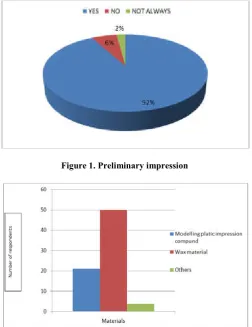
respondents were graduates. 24% (26) were post graduates out of which 38% (10) were Prosthodontists. For question 2, a majority of respondents- 92% (98) reported practicing complete denture prosthodontics. The response to question 3 is illustrated in (Figure 1), which indicates that 92% (90) performed preliminary impression while 6% (6) did not. Only 2% reported making preliminary impression in certain cases with comments like “as per alveolar ridge condition”, “with repeat dentures, only one final impression is made”. The response to question 4 indicates that out of 92 respondents who perform preliminary impressions, 73% (67) think that the preliminary impression should be as perfect as possible with proper borders and peripheral seal. 6% do not believe in making very accurate impressions. The response to question 5 indicates the usage of stock metal trays by 56% (52) respondents. 30% (28) uses perforated edentulous trays and 7% (6) uses stock plastic trays. The response under “other” is presented in (Table 1). 42% (39) respondents did not modify the stock tray with any material prior to impression. 39% (36) modified and 19% (17) did not at all as is illustrated in response to question 6. The response of question 7 is presented in (Figure 2), which shows that the material of choice for separately modifying the stock tray is modelling wax for 67% (50) of respondents while 28% (21) uses modelling plastic impression compound. 5% reported “others” indicating using both materials.
Figure 1. Preliminary impression
Figure 2. Materials for modifying stock trays
Table 1. Tray for preliminary impression
OTHER response Number of respondents
Stock metal trays and stock plastic trays 3 Stock metal trays and thermoplastic trays 1 Stock metal trays and perforated edentulous tray
2
[image:2.595.312.552.248.301.2]Figure 3. Preliminary impression material
Table 2. Impression material for preliminary impression
Other response Number of
respondents
Impression compound and alginate 4
Alginate and elastomer putty 2
Impression compound, alginate and elastomer putty 1
[image:2.595.38.291.364.692.2]The choice of impression material used for preliminary impression among the 92 respondents performing preliminary impression in response to question 8 is illustrated in (Figure 3). It indicates the majority 45% (41) using impression compound while 35% (32) using irreversible hydrocolloid. 13% uses elastomeric putty and 7% are reported under “others” (Table 2). In response to question 9, 61% (60) of respondents preferred selective impression technique for making a final impression. 24% (23) preferred functional technique followed by 15% (15) using mucostatic technique (Figure 4). With regards to the choice of material for special tray fabrication in question 10, self-cure acrylic resin turned out to be chosen by 67% of respondents. 12% (12) uses shellac, 1% each uses light cure acrylic resin or visible light cured composite resin material. 19% of respondents were reported under “others” (Table 3). 96% (94) of respondents think the accuracy of custom tray is important. Hence, 50%(49) of them prefer to make it few hours before the final impression followed by 44% (43) of them making it few days before the final impressionas in illustrated in question 11 and 12. 3% prefers to make the custom tray few weeks before and another 3% came under “others”. A spacer was used by 93% (91) respondents while other 7% (7) did not, under the response of question 13. In response to question 14, of the 91 respondents who used a spacer; 85% (77) employed a full spacer design with tissue stops and additional relief, 10% (9) employed full spacer not covering the major stress areas with additional relief if required. 3% (3) used a spacer design covering only the secondary stress bearing areas and relief areas while remaining 2% (2) used a spacer in special circumstances only. In response to question 15, of the 91 respondents using spacer, 47% (43) decided the spacer thickness arbitrarily, 30% (27) decided it based on the amount of relief while remaining 23% (21) decided it based on the choice of impression material to be used.
Table 3. Material for special tray fabrication
OTHER response Number of respondents
Shellac and self-cured acrylic resin 11 Self-cured acrylic resin and light cured acrylic resin
[image:2.595.38.287.743.797.2]Figure 4. Impression concept
Table 4. Handle design
Handle design Number of respondent
“L” shaped 48
“stub” shaped in centre 29
“Stub” shaped in premolar 4
One handle in incisor area and one in molar area 13
[image:3.595.296.565.74.156.2]Others 4
Table 5. Area of vent holes
OTHER response Number of respondent
Ridge area and mid-palatal region 12
Mid-palatal and mixed region 2
Ridge area, mid-palatal and lateral palatal region 1 Ridge area, mid-palatal and mixed region 2
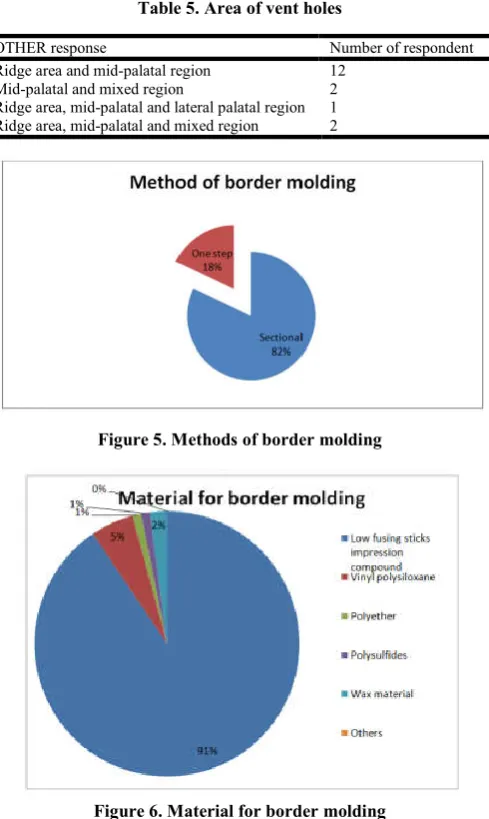
Figure 5. Methods of border molding
Figure 6. Material for border molding
Table 6. Material of choice for border molding
OTHERS response Number of respondents
Low fusing sticks impression compound and vinyl polysiloxane
3
Polyether and polysulfides 1
Table 7. Material of choice for final impression
OTHER response Number of respondents
Metallic oxide impression paste and vinyl polysiloxane
7
Vinyl polysiloxane and polyether 4
Metallic oxide impression paste, alginate and polysulfide
1
Metallic oxide impression paste, alginate and vinyl polysiloxane
[image:3.595.308.557.186.395.2]1
Table 8. Impression disinfection
OTHER response Number of respondents
Rinse under tap water and alcohol 2
Rinse under tap water and glutaraldehyde 6
Alcohol and glutaraldehyde 1
Figure 7. Disinfection methods
[image:3.595.43.288.308.718.2]either polysulfides or polyether. Remaining 13% (13) fell under the category of “others” (Table 7). In response to question 25, a majority of respondents 63% (62) uses tray adhesives when using specific impression materials while remaining 37% did not. In response to question 26, 81% (79) of respondents disinfect the impression prior to the dispatch to the lab while 19% did not. The response to question 27 is summarized in Figure 7, which indicates 63% (50) of respondents disinfecting the impression by rinsing under tap water, 18% (14) disinfecting with glutaraldehyde, 6% (5) using alcohol, 1% using bleach to disinfect. 12% (9) were indicated under “others” (Table 8).
DISCUSSION
The results of this survey show that a variety of material and techniques are being used for complete denture prosthodontics. The design of this survey allowed the respondents to indicate more than one answer or write any comments under “others”. This was helpful as the questions did not “lead” any respondent to choose a response that did not accurately or fully represent his/her situation. Majority of the dentists (92%) participating in the survey practiced complete denture prosthodontics. The remaining 8% who did not, dropped out from the rest of the survey. So the final sample size after question 2 was 98. Regarding preliminary impressions, majority of the dentists 90% performed it while 6% did not as a part of complete denture therapy. This is consistent with the results of previous surveys. (Jaggers et al., 1985; Hyde and McCord, 1999; Singh
et al., 2010; Kakatkar, 2013) Most of them believed in
recording the preliminary impressions as perfect as possible with proper borders and peripheral seal. The tray mostly used by the practitioners is stock metal trays (56%) and perforated edentulous trays (30%). In a recent survey conducted in US, almost equal preferences were found for both metal and plastic trays. (Mehra et al., 2014)Although any tray can be used, but rigid trays with proper extensions tends to produce successful results, hence the advantage of using metal trays. Most participants believe in making perfect preliminary impressions with metal trays, but majority (47%) did not modify the stock tray extensions. Those who didmodified the tray by using wax material (67%). This is in agreement with the previous survey wherein wax was used mostly. (Mehra et al., 2014) Regarding the choice of material for preliminary impression, 45% cited impression compound as their first choice followed by irreversible hydrocolloid by 35%.Many studies conducted in the past in U.S. and U.K.reported alginate as the primary choice of material (Jaggers et al., 1985; Hyde and McCord, 1999; Singh et al., 2010) but the surveys in India reported impression compound as the choice of material. (Kakatkar, 2013; Shah et al., 2015)
The most prevalent impression philosophy being followed by majority of the dentists (60%) was selective pressure technique. This technique attempts to place stress on those areas of maxilla and mandible which can best resist functional forces of the denture base. (Petropoulos and Rashedi, 2005)Levin and Sauer also found that 58% of dental schools surveyed in US taught the selective pressure technique. (Levin and Sauer, 1969) The second most used technique is functional pressure technique (24%) which records the denture bearing areas while under occlusal functional loading. 15% of the participants used mucostatic technique which advocates covering only the attached mucosa by the future denture base. For fabricating custom trays, 67% use autopolymerizing acrylic resins and
12% still use shellac base plate. This is in agreement to a survey conducted across several Indian cities. (Kakatkar, 2013; Shah et al., 2015) Being a thermoplastic material, shellac base are not recommended. Previous surveys of U.S. dental schools revealed that majority of them use visible light cured resin for the fabrication of custom trays. (Petropoulos and Rashedi, 2003; Mehra et al., 2014) 96% of the participants believe in the accuracy of the custom tray. Hence 50% fabricates the custom tray few hours before the final impression. 44% fabricates it few days before. Research indicates that autopolymerizing acrylic resin tray should be fabricated 24 hours before the impression procedure to prevent distortion. In a previous U.S. dental school survey, 73% respondents fabricated custom trays few days before the final impression. (Mehra et al., 2014)Out of those who selected selective pressure technique, 93% participants use custom tray with spacer, with 85% practitioners among them employing full spacer design with tissue stops and additional relief. 10% of the participants employ full spacer not covering the major stress areas with additional relief if required. Respondents were asked about the criteria they considered for deciding the spacer thickness. Majority of them decided the thickness arbitrarily (47%) while 23% decided based on the choice of impression material to be used. In a survey of U.S. dental schools, it was found out that majority uses one layer of baseplate wax for relief. (Petropoulos and Rashedi, 2003) Use of a single layer of baseplate wax which provides approximately one mm of relief has been suggested by many authors. (Davis, 1997; Jacob and Zarb, 2012; Levin, 1984; Komiyama et al., 2004; Davis, 2004) Since the purpose of a wax spacer is to provide space for impression material, (Jacob and Zarb, 2012; Levin, 1984; Komiyama et al., 2004; Davis, 2004) the type of impression material to be used for final impression should have an influence on the spacer thickness. A. Roy Macgregor (MacGregor, 1989) has given the following thickness recommendation: 2.5mm for impression plaster, 0.5mm for zinc-oxide eugenol paste, 2mm for alginate, 1.3-3mm for elastomeric impression materials. There are different opinions on the thickness of a spacer with few authors suggesting of no need for a spacer when using plaster of Paris or metallic oxide impression pastes as they have minimal viscosity, hence minimal displacement. (Jacob and Zarb, 2012)While there are others who are of opinion that a certain amount of space is always required for the impression material. (Shetty et al., 2007)
Sharry, 1974)30% use “stub” in the center while 13% use one handle in incisor area and one in molar area in mandibular tray. Regarding the vent holes number and location, over 92% of respondents placed vent holes in the tray apart from spacers and out of them, over 61% places 4-6 holes. 21% placed 1-3 and 16% places 7-10 holes. Vent holes in the tray allows for selective relief of pressure during final impression making and also provides an escape route for final impression material. The fact that majority places vent holesalong with spacer is in agreement with the high percentage of respondents following the selective pressure technique. The preferred location of vent holes among the respondents was mixed by 44%, mid-palatal region by 24% followed by “others” which mainly includes mid palatal region and ridge area. Levin recommends drilling 8-10 holes over the crest of the ridge. (Jacob and Zarb, 2012) Some authors suggest holes placement in palate to furnish relief over the secondary stress areas of the rugae and midpalatine suture; 10mm apart in the center of alveolar groove and retromolar pads in mandibular trays. (Kakatkar, 2013; Shah
et al., 2015; Davis, 1997; Jacob and Zarb, 2012)
A very high percentage of respondents (86%) who used a custom tray also performed border molding to capture vestibule and achieve peripheral seal. Most respondents (86%) use low fusing sticks for border molding. Only 7% use elastomeric impression materials including polyvinylsiloxanes, polyether and polysulfides. Many surveys conducted before reported to have similar results. (Levin and Sauer, 1969; Jaggers et al., 1985; Petropoulos and Rashedi, 2003; Mehra et al., 2014; Shah
et al., 2015) Though low fusing sticks impression compound
are used by majority but elastomeric materials are showing a gradual rise as a border molding material. The advantages of modelling plastic impression compound are low cost, long shelf life, incremental placement, allows modifications. On the other hand, elastomeric materials are less time consuming. The choice of modelling plastic impression compound as border molding materials is in agreement with the sectional method of border molding by 82%of the respondents. With regards to final impression material, almost half of the respondents indicated to use metallic oxide impression paste (51%) followed by 24% using elastomeric impression material in which majority use vinyl polysiloxane (82% among them). 12% reported of using alginate as final impression material. Similar results were found with previous surveys conducted in India. (Kakatkar, 2013; Shah et al., 2015)Though the trends followed in U.S.is to useelastomeric materialsover zinc oxide eugenol. (Levin and Sauer, 1969; Jaggers et al., 1985; Petropoulos and Rashedi, 2003; Mehra et al., 2014; Shah et al., 2015) The advantages of the elastomeric materials are its dimensional stability, adequate working time, ease of handling. Its major drawback is its hydrophobicity. Zinc oxide eugenol has low cost, produces good surface details and dimensionally stable. Its stickiness to the skin and mucosa, inelasticity and burning sensation tendency are the disadvantages. 63% respondents use tray adhesives when required, hence indicating their knowledge and application in clinical practice. Infection control is mandatory in day to day clinical practice. 81% respondents did routinely disinfect impressions before dispatch to a dental laboratory. Of greater concern was the failure of respondents to appreciate the appropriate method of disinfection, with 63% opting to just rinse under tap water.
Conclusion
The present survey presents a general picture of impression making trends among dentists in Goa. Knowledge of the trends
in impression making will help us to evaluate the scientific validity of various procedures that are being followed. The results of the present survey show the use of conventional materials and techniques to be in use for complete denture fabrication. This could be attributed to either economic concerns or comfort factor in using these materials and techniques. The survey did not ask the years of practice to the respondents which could have given an insight to the influence of experience on the materials and techniques used. The response rate of the survey was 69%. It is possible that higher response rate could have affected the results.
Within the limitations of the survey, the following conclusions can be drawn:
1. The most commonly used material for making preliminary impression was impression compound in a stock metal tray.
2. Majority of the dentists make final impression in a border molded custom tray made with self-cured acrylic resins with L-shaped handle, fabricated a few hours before the procedure.
3. Selective pressure technique was the predominant impression concept used with a majority using spacer and vent holes in the tray.
4. Most commonly used material for border molding and for making final impression were low fusing sticks impression compound and metallic oxide impression paste, respectively.
5. Most of the dentists did routinely disinfect the impressions by rinsing under tap water.
REFERENCES
Al-Ahmad A, Masri R, Driscoll CF, von Fraunhofer J and Romberg E. 2006. Pressure generated on a simulated mandibular oral analog by impression materials in custom trays of different design, J Prosthodont, 15(2), 95-101. Davis DM. 1997. Developing an analogue for the
maxillary/mandibular denture-bearing area, in Zarb GA, Bolender CL, Carlsson GE (Ed.), Boucher’s prosthodontic treatment for edentulous patients, 11th ed. (St. Louis: Mosby) 141-182.
Davis DM. 2004. Developing an analogue for the maxillary/mandibular denture-bearing area, in Zarb GA and Bolender CL (Ed.), Boucher’s prosthodontic treatment for edentulous patients, 12th ed. (St. Louis: Mosby) 211-251. Douglass CW, Shih A, Ostry L. 2002. Will there be a need for
complete dentures in the United States in 2020? J Prosthet Dent, 87(1), 5-8.
Frank RP. 1970. Controlling pressures during complete denture impressions, Dent Clin North Am, 14(3), 453-470. Hickey JC, Zarb GA, Bolender CL. 1985. Boucher’s
prosthodontic treatment for edentulous patients. 9th ed. St. Louis:CV Mosby; P. 119-230.
Hyde TP and McCord JF, 1999. Survey of prosthodontic impression procedures for complete dentures in general dental practice in the United Kingdom, J Prosthet Dent, 81(3), 295-299.
Jaggers JH, Javid NS and Colaizzi FA. 1985. Complete denture curriculum survey of dental schools in the United States, J Prosthet Dent, 53(5), 736-739.
Kakatkar VR. 2013. Complete denture impression techniques practiced by private dental practitioners: a survey, J Indian
Prosthodont Soc, 13(3), 233-235.
Komiyama O, Saeki H, Kawara M, Kobayashi K and Otake S, 2004. Effects of relief space and escape holes on pressure characteristics of maxillary edentulous impressions, J
Prosthet Dent, 91(6), 570-576.
Levin B and Sauer JL Jr, 1969. Results of a survey of complete denture procedures taught in American and Canadian dental schools, J Prosthet Dent, 22(2), 171-177.
Levin B, 1984. Impressions for Complete Dentures (Chicago: Quintessence) 71-93, 116, 125.
MacGregor A. Roy, 1989. Fenn, Liddelow and Gimson’s clinical dental prosthetics, 3rd ed. (London: Wright) 43-78. Masri R, Driscoll CF, Burkhardt J, Von Fraunhofer A and
Romberg E, 2002. Pressure generated on a simulated oral analog by impression materials in custom trays of different designs, J Prosthodont, 11(3), 155-160.
Mehra M, Vahidi F and Berg RW. 2014. A complete denture impression technique survey of postdoctoral prosthodontic programs in the United States, J Prosthodont, 23(4), 320-327.
Petropoulos VC and Rashedi B, 2005. Complete denture education in U.S.dental schools, J Prosthodont, 14(3), 191-197.
Petropoulos VC and Rashedi B, 2003. Current concepts and techniques in complete denture final impression procedures, J Prosthodont, 12(4), 280-287.
Reddy SM, Mohan CA, Vijitha D, Balasubramanian R, Satish and Kumar M. 2013. Pressure produced on the residual maxillary alveolar ridge by different impression materials and tray design: an in vivo study, J Indian Prosthodont Soc., 13(4), 509-512.
Shah DR, Lagdive DS, Barajod DP, Patel DM. 2015. Complete Denture Impression Procedures and Techniques Practiced by Dentists across the State of Gujarat: A Survey.
J Dent Med Sci., 14:1-1.
Sharry JH. 1974. Complete denture prosthodontics. 3rd ed. New York: McGraw-Hill; P. 191-211.
Shetty S, Nag PV and Shenoy KK. 2007. The selective pressure maxillary impression: A review of the techniques and presentation of an alternate custom tray design, J
Indian Prosthodont Soc., 7(1), 8-11.
Singh G, Kapoor V, Gambhir R and Bansal V. 2010. Application of prosthodontic techniques by private practitioners in Northern India—a survey, Internet Journal
of Epidemiology, 9(2).
Smutko GE. 2012. Making edentulous impressions, in Winkler S (Ed.), Essentials of complete denture prosthodontics, 2nd ed. (Delhi: AITBS Publishers) 88-106.
Questionnaires:
Q1) Qualification: 1) B.D.S
2) M.D.S
If M.D.S, then mention your specialty…
Q2) Do you practice complete denture prosthodontics? 1) Yes
2) No
Q3) Do you perform both preliminary for a complete denture prosthodontics?
1) Yes 2) No 3) Not always
Q4) How accurate do you think the preliminary impression should be?
1)As perfect as possible with proper borders and peripheral seal.
2)Recording supporting areas with not much emphasis on borders and PPS extensions.
3)Not very accurate impressions.
Q5) Which type of tray is used for making the preliminary impression?
1)1) Stock metal trays 2)Stock plastic trays 3)Thermoplastic trays. 4)Perforated trays 5)Others (please specify)
Q6) Do you separately modify the extension of stock tray using any material prior to making the preliminary impression? 1)1) Yes.
2)No. 3)Not always. If yes, then
Q7) What material is used for modification of the stock tray? 1)1) Modeling Plastic Impression Compound.
2)Wax Materials.
3)Others (Please Specify).
Q8) What material is used for making the preliminary impression?
1)1) Impression Compound.
2)Irreversible Hydrocolloid (Alginate). 3)Elastomer putty
4)Other (Please Specify)
Q9) What impression concept do you prefer for making a final impression in the fabrication of a complete denture?
1)1) Mucostatic (Non-Pressure). 2)Functional (Pressure). 3)SelectivePressure. 4)Others(plsspecify)
Q10) In which of the following materials would you normally have your special tray constructed?
1)Shellac.
2)Self cured acrylic resin. 3)Light cured acrylic resin.
4)Visible light cured composite resin material 5)Other (pls specify).
Q11) Do you think the accuracy of custom tray fabrication is important?
1)Yes 2)No If yes, then...
Q12) When do you prefer to make the custom tray?
3)Few hours before the final impression 4) Others (pls specify)
Q13) Do you use a spacer in the design of the custom tray? 1) Yes
2) No If yes, then…
Q14) which design of spacer is mostly used? 1) Full spacer with tissue stops and additional relief
2) Full spacer not covering the major stress areas with additional relief if required
3) Spacer covering only the secondary stress bearing areas and relief areas
4) Spacer in special circumstances only (flabby tissues, high vault, spicules)
Q15) How do you decide the thickness of the spacer? 1) Arbitrary regardless of the impression material used. 2) Based on the choice of impression material
3) Based on the amount of relief 4) Others, please specify
Q16) Do you think special designs to the tray aids in impression making?
1) Yes 2) No If yes, then…
Q17) Which handle design do you routinely ask for to your technician?
1) “L “shaped handle 2) ‘’ Stub ‘’ shaped in center 3)‘’Stub’’ shaped in premolar 4)No handles
5)One handle in incisor area and one in molar area in mandibular tray
6)Others please specify
Q18) Do you think placing vent holes in the tray helps in recording better impression?
1)Yes 2)No
If yes, then…
Q19) How many holes do you place in the tray? 1) 1-3
2)4-6 3)7-10 4)None
Q20) Where do you prefer to place vent holes? 1) Ridge area
2) Mid palatal region 3)Lateral palatal region 4)Mixed
Q21) Do you capture the vestibule though border molding technique for complete dentures before making the final impression?
1) Yes 2) No 3) Not always If yes, then…
Q22) Which method do you prefer? 1) Sectional
2)One step
Q23) What material do you prefer for border molding? 1) Low fusing sticks impression compound
2) Vinyl polysiloxane 3) Polyether
4) Polysulfides 5) Wax material 6) Others pls specify
Q24) Which material do you use for the final impression? 1) Metallic oxide impression paste
2) Irreversible hydrocolloid 3) Polysulfide
4) Vinyl polysiloxane 5) Polyether
6) Other
Q25) Do you use tray adhesives when using specific impression materials like polysulfides?
1) Yes 2)No
Q26)Do you routinely disinfect your impression prior to the dispatch to the lab?
1) Yes 2)No If yes, then…
Q27) How do you disinfect your impression? 1) Rinse under tap water
2) Bleach 3) Alcohol 4) Glutaraldehyde 5) Others