Noise Analysis in
Operational Amplifier
Circuits
1998
Digital Signal Processing Solutions
IMPORTANT NOTICE
Texas Instruments and its subsidiaries (TI) reserve the right to make changes to their products or to discontinue any product or service without notice, and advise customers to obtain the latest version of relevant information to verify, before placing orders, that information being relied on is current and complete. All products are sold subject to the terms and conditions of sale supplied at the time of order acknowledgement, including those pertaining to warranty, patent infringement, and limitation of liability.
TI warrants performance of its semiconductor products to the specifications applicable at the time of sale in accordance with TI’s standard warranty. Testing and other quality control techniques are utilized to the extent TI deems necessary to support this warranty. Specific testing of all parameters of each device is not necessarily performed, except those mandated by government requirements.
CERTAIN APPLICATIONS USING SEMICONDUCTOR PRODUCTS MAY INVOLVE POTENTIAL RISKS OF DEATH, PERSONAL INJURY, OR SEVERE PROPERTY OR ENVIRONMENTAL DAMAGE (“CRITICAL APPLICATIONS”). TI SEMICONDUCTOR PRODUCTS ARE NOT DESIGNED, AUTHORIZED, OR WARRANTED TO BE SUITABLE FOR USE IN LIFE-SUPPORT DEVICES OR SYSTEMS OR OTHER CRITICAL APPLICATIONS. INCLUSION OF TI PRODUCTS IN SUCH APPLICATIONS IS UNDERSTOOD TO BE FULLY AT THE CUSTOMER’S RISK.
In order to minimize risks associated with the customer’s applications, adequate design and operating safeguards must be provided by the customer to minimize inherent or procedural hazards.
TI assumes no liability for applications assistance or customer product design. TI does not warrant or represent that any license, either express or implied, is granted under any patent right, copyright, mask work right, or other intellectual property right of TI covering or relating to any combination, machine, or process in which such semiconductor products or services might be or are used. TI’s publication of information regarding any third party’s products or services does not constitute TI’s approval, warranty or endorsement thereof.
Contents
Introduction . . . 1
Notational Conventions. . . 1
Spectral Density. . . 1
Types of Noise . . . 2
Shot Noise . . . 2
Thermal Noise . . . 2
Flicker Noise. . . 3
Burst Noise . . . 3
Avalanche Noise . . . 3
Noise Characteristics. . . 4
Adding Noise Sources . . . 4
Noise Spectra. . . 6
Integrating Noise . . . 6
Equivalent Noise Bandwidth . . . 8
Resistor Noise Model . . . 10
Op Amp Circuit Noise Model . . . 10
Inverting and Non-Inverting Op Amp Circuit Noise Calculations . . . 11
Differential Op Amp Circuit Noise Calculations. . . 15
Summary . . . 20
References . . . 21
Figures
List of Figures
1 Gaussian Distribution of Noise Amplitude . . . 4
2 R1 and R2 Noise Model. . . 5
3 1/f and White Noise Spectra . . . 6
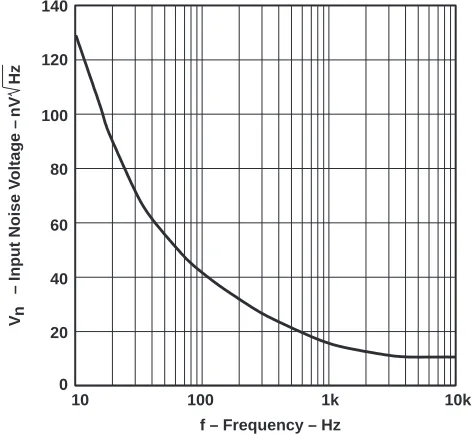
4 Equivalent Input Noise Voltage vs Frequency for TLV2772 as Normally Presented . . . 8
5 Equivalent Input Noise Voltage vs Frequency for TLV2772 on Log-Log Scale . . . 8
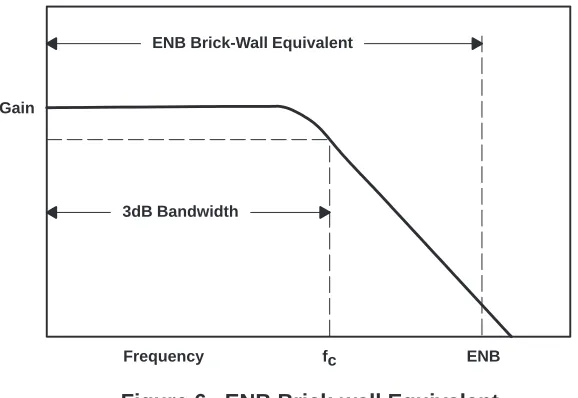
6 ENB Brick-wall Equivalent. . . 9
7 RC Filter . . . 9
8 Resistor Noise Models . . . 10
9 Op Amp Noise Model . . . 10
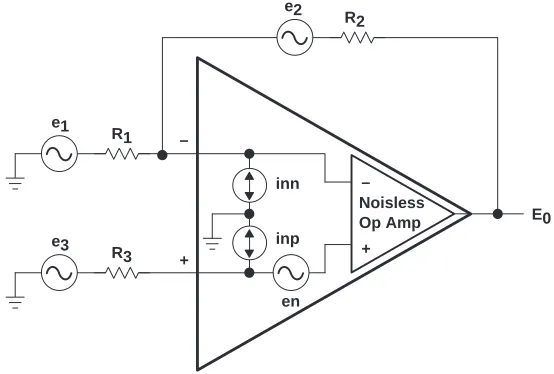
10 Inverting and Non-Inverting Noise Analysis Circuit. . . 11
11 E1 . . . 11
12 E2 . . . 12
13 E3 . . . 12
14 Ep . . . 13
15 Enp . . . 13
16 Enn . . . 14
17 Differenital Op Amp Circuit Noise Model . . . 15
18 e1 . . . 15
19 e2 . . . 16
20 e3 . . . 16
21 e4 . . . 16
22 inp . . . 17
23 ep . . . 17
24 inn . . . 18
Noise Analysis in Operational Amplifier Circuits
ABSTRACT
This application report uses standard circuit theory and noise models to calculate noise in op amp circuits. Example analysis of the inverting, noninverting, and differential-amplifier circuits shows how calculations are performed. Characteristics of noise sources are presented to help the designer make informed decisions when designing for noise.
Introduction
“Statistical fluctuation of electric charge exists in all conductors, producing random variation of potential between the ends of the conductor. The electric charges in a conductor are found to be in a state of thermal agitation, in thermodynamic equilibrium with the heat motion of the atoms of the conductor. The manifestation of the phenomenon is a fluctuation of potential difference between the terminals of the conductor” – J.B. Johnson[1]
“The term spontaneous fluctuations, although, perhaps, theoretically the most appropriate, is not commonly used in practice; usually it is simply called noise” – Aldert van der Ziel[2]
Early investigators of noise likened spontaneous fluctuations of current and voltage in electric circuits to Brownian motion. In 1928 Johnson[1] showed that electrical noise was a significant problem for electrical engineers designing sensitive amplifiers. The limit to the sensitivity of an electrical circuit is set by the point at which the signal-to-noise ratio drops below acceptable limits.
Notational Conventions
In the calculations throughout this report, lower case letters e and i indicate independent voltage and current noise sources; upper case letters E and I indicate combinations or amplified versions of the independent sources.
Spectral Density
Types of Noise
Types of Noise
In electrical circuits there are 5 common noise sources:
•
Shot noise•
Thermal noise•
Flicker noise•
Burst noise•
Avalanche noiseIn op amp circuits, burst noise and avalanche noise are normally not problems, or they can be eliminated if present. They are mentioned here for completeness, but are not considered in the noise analysis.
Shot Noise
Shot noise is always associated with current flow. Shot noise results whenever charges cross a potential barrier, like a pn junction. Crossing the potential barrier is a purely random event. Thus the instantaneous current, i, is composed of a large number of random, independent current pulses with an average value, iD. Shot noise is generally specified in terms of its mean-square variation about the average value. This is
written as in2 , where :
in2+
ǒ
i–iD
Ǔ
2+
ŕ
2qiDdfWhere q is the electron charge (1.62 × 10⁻¹⁹ C) and dƒ is differential frequency. Shot noise is spectrally flat or has a uniform power density, meaning that when plotted vs. frequency, it has a constant value. Shot noise is independent of temperature.
The term qiD is a current power density having units A2/Hz.
Thermal Noise
Thermal noise is caused by the thermal agitation of charge carriers (electrons or holes) in a conductor. This noise is present in all passive resistive elements. Like shot noise, thermal noise is spectrally flat or has a uniform power density, but thermal noise is independent of current flow.
Thermal noise in a conductor can be modeled as voltage, or current. When modeled as a voltage it is placed in series with an otherwise noiseless resistor. When modeled as a current it is placed in parallel with an otherwise noiseless resistor. The average mean-square value of the voltage noise source or current noise source is calculated by:
e2+
ŕ
4kTRdf ori2+ŕ
ǒ
4kTńRǓ
dfWhere k is Boltzmann’s constant (1.38 × 10⁻²³ j/K), T is absolute temperature in Kelvin (K), R is the resistance of the conductor in ohms (Ω) and df is differential frequency.
(1)
Types of Noise
The terms 4kTR and 4kT/R are voltage and current power densities having units of V2/Hz and A2/Hz.
Flicker Noise
Flicker noise is also called 1/f noise. It is present in all active devices and has various origins. Flicker noise is always associated with a dc current, and its average mean-square value is of the form:
e2+
ŕ
ǒ
K 2e ńf
Ǔ
df or i2+ŕ
ǒ
K 2 i ńfǓ
dfWhere Ke and Ki are the appropriate device constants (in volts or amps), f is frequency, and df is differential frequency.
Flicker noise is also found in carbon composition resistors where it is often referred to as excess noise because it appears in addition to the thermal noise. Other types of resistors also exhibit flicker noise to varying degrees, with wire wound showing the least. Since flicker noise is proportional to the dc current in the device, if the current is kept low enough, thermal noise will predominate and the type of resistor used will not change the noise in the circuit.
The terms K ƒ
e2/ and Ki2/ƒ are voltage and current power densities having units
of V2/Hz and A2/Hz.
Burst Noise
Burst noise, also called popcorn noise, appears to be related to imperfections in semiconductor material and heavy ion implants. Burst noise makes a popping sound at rates below 100 Hz when played through a speaker. Low burst noise is achieved by using clean device processing.
Avalanche Noise
Avalanche noise is created when a pn junction is operated in the reverse breakdown mode. Under the influence of a strong reverse electric field within the junction’s depletion region, electrons have enough kinetic energy that, when they collide with the atoms of the crystal lattice, additional electron-hole pairs are formed. These collisions are purely random and produce random current pulses similar to shot noise, but much more intense.
Noise Characteristics
Noise Characteristics
Since noise sources have amplitudes that vary randomly with time, they can only be specified by a probability density function. Thermal noise and shot noise have Gaussian probability density functions. The other forms of noise noted do not. If
δ is the standard deviation of the Gaussian distribution, then the instantaneous value lies between the average value of the signal and ±δ 68% of the time. By definition, δ2 (variance) is the average mean-square variation about the average value. This means that in noise signals having Gaussian distributions of amplitude, the average mean-square variation about the average value, i2 or e2, is the variance δ2, and the rms value is the standard deviationδ.
Theoretically the noise amplitude can have values approaching infinity. However, the probability falls off rapidly as amplitude increases. An effective limit is
±
3δ, since the noise amplitude is within these limits 99.7% of the time. Figure 1 shows graphically how the probability of the amplitude relates to the rms value.3σ 2σ 1σ
–3σ –2σ –1σ Mean Value
Gaussian Probability Density Function
rms Value Noise Signal
99.7% Probility Signal Will Be
[image:8.612.125.484.290.474.2]≤ 6 X rms Value
Figure 1. Gaussian Distribution of Noise Amplitude
Since the rms value of a noise source is equal to δ, to assure that a signal is within peak-to-peak limits 99.7% of the time, multiply the rms value by 6(+3δ–(–3δ)): Erms × 6 = Epp. For more or less assurance, use values between 4(95.4%) and 6.8(99.94%).
Adding Noise Sources
With multiple noise sources in a circuit, the signals must be combined properly to obtain the overall noise signal.
Consider the example of two resistors, R1 and R2, connected in series. Each resistor has a noise generator associated with it as shown in Figure 2 where
e2
1+
ŕ
4kTR1df and e 2Noise Characteristics
e1
R1
e2
R2
Et
Figure 2. R1 and R2 Noise Model
To calculate the average mean square voltage, 2
t
E , across the two resistors, let
Et(t) = e1(t) + e2(t) be the instantaneous values. Then
Et (t)2+
ƪ
e1(t))e2(t)ƫ
2+e1(t)2)e2(t)2)2e1(t)e2(t)Since the noise voltages, e1(t) and e2(t), arise from separate resistors, they are independent, and the average of their product is zero:
2e1(t)e2(t)+0 This results in
E2t +e21)e22.
Therefore, as long as the noise sources arise from separate mechanisms and are independent, which is usually the case, the average mean square value of a sum of separate independent noise sources is the sum of the individual average mean square values. Thus in our example E = t2 ∫ 4kT(R1 + R2)df, which is what would be expected. This is derived using voltage sources, but also is true for current sources. The same result can be shown to be true when considering two independent sine wave sources.
(4)
(5)
Noise Characteristics
Noise Spectra
A pure sine wave has power at only one frequency. Noise power, on the other hand, is spread over the frequency spectrum. Voltage noise power density,
Hz
e /2 , and current noise power density, i /2 Hz are often used in noise
calculations. To calculate the mean-square value, the power density is integrated over the frequency of operation. This application report deals with noise that is constant over frequency, and noise that is proportional to 1/f.
Spectrally flat noise is referred to as white noise. When plotted vs frequency, white noise is a horizontal line of constant value.
Flicker noise is 1/f noise and is stated in equation form as:
e2+
ŕ
ǒ
K2eńfǓ
df or i2+ŕ
ǒ
K2ińf
Ǔ
df [image:10.612.141.440.355.559.2]See equation (3). When plotted vs frequency on log-log scales, 1/f noise is a line with constant slope. If the power density V2/Hz is plotted, the slope is –1 decade per decade. If the square root of the power density, Vrms/√Hz, is plotted, the slope is –0.5 decade per decade.
Figure 3 shows the spectra of 1/f and white noise per root hertz.
1/f Noise
–0.5 dec/dec
White Noise
Frequency (Log Scale) Spectral
Density (Log Scale)
Figure 3. 1/f and White Noise Spectra Integrating Noise
Noise Characteristics
Given a white or constant voltage noise vs frequency source then:
e2+
ŕ
f H
fL
C df+C
ǒ
fH–fLǓ
where e2 is the average mean-square voltage, C is the spectral power density per hertz (constant), ƒL is the lowest frequency, and ƒH is the highest frequency. Given a 1/f voltage noise vs. frequency source then:
e2+
ŕ
fH
fL
K2
f df+K
2 ln fH
fL
where e is the average mean-square voltage, K is the appropriate device2 constant in volts, ƒL is the lowest frequency, and ƒH is the highest frequency. The input noise of an op amp contains both 1/f noise and white noise. The point in the frequency spectrum where 1/f noise and white noise are equal is referred to as the noise corner frequency, fnc. Using the same notation as in the equations above, this means that K2/fnc = C. It is useful to find fnc because the total average mean-square noise can be calculated by adding equations (7) and (8) and substituting Cfnc for K2:
E2+C
ǒ
fnc ln fHfL)fH–fL
Ǔ
Where C is the square of the white noise voltage specification for the op amp. Figure 4 shows the equivalent input noise voltage vs frequency graph for the TLV2772 as normally displayed in the data sheet.
fnc can be determined visually from the graph of equivalent input noise per root hertz vs. frequency graph that is included in most op amp data sheets. Since at fnc the white noise and 1/f noise are equal, fnc is the frequency at which the noise is √2 x white noise specification. This would be about 17 nV/√Hz for the TLV2772, which is at 1000 Hz as shown in Figure 4.
Another way to find fnc, is to determine K2 by finding the equivalent input noise voltage per root hertz at the lowest possible frequency in the 1/f noise region, square this value, subtract the white noise voltage squared, and multiply by the frequency. Then divide K2 by the white noise specification squared. The answer is fnc.
For example, the TLV2772 has a typical noise voltage of 130 nV/√Hz at 10 Hz. The typical white noise specification for the TLV2772 is 12 nV/√Hz
K2+
ƪ
ǒ
130 nVńǸHzǓ
2–ǒ
12 nVńǸHzǓ
2ƫ
(10 Hz)+167560 (nV)2 Therefore, fnc = (167560(nV)2)/(144(nV)2/Hz) = 1163 Hz(7)
(8)
Noise Characteristics
100
f – Frequency – Hz
1k 10k 10
120
80
40
0 100
60
20 140
– Input Noise V
oltage
–
n
V
Hz
[image:12.612.165.403.78.295.2]Vn
[image:12.612.154.388.380.594.2]Figure 4. Equivalent Input Noise Voltage vs. Frequency for TLV2772 as Normally Presented
Figure 5 was constructed by interpreting the equivalent input noise voltage vs frequency graph for the TLV2772 and plotting the values on log-log scales. The –0.5 dec/dec straight line nature of 1/f noise when plotted on log-log scales can be seen.
1/f Noise Noise Voltage White Noise
100
10
10 100
f – Frequency – Hz 1000
1000 10000
Input Noise V
oltage – RMS V/ rt Hz
Figure 5. Equivalent Input Noise Voltage vs. Frequency for TLV2772 on Log-Log Scale Equivalent Noise Bandwidth
Noise Characteristics
ENB Brick-Wall Equivalent
3dB Bandwidth
ENB fc
[image:13.612.162.451.74.273.2]Frequency Gain
[image:13.612.132.505.556.613.2]Figure 6. ENB Brick-wall Equivalent
Figure 7 shows and example of a simple RC filter used to filter a voltage noise source, ein.
An(f)+ 1
1)jwRC å
Ť
An(f )Ť
2+ 1
1)(wRC)2 R
ein C eon
Figure 7. RC Filter
An(f) is the frequency-dependant gain of the circuit, and eon is calculated:
eon+
ŕ
R
0
Ť
An(f )Ť
2
ein2 df
Ǹ
Assuming ein is a white noise source (specified as a spectral density in V/√Hz), using radian measure for frequency, and substituting for An(f), the equation can be solved as follows:
eon+ein
ŕ
R
0
1 1)(wRC)2
dw
Ǹ
+ein 1RC
|
R
0
tan–1wRC
Ǹ
+ein 1 RCP
2
Ǹ
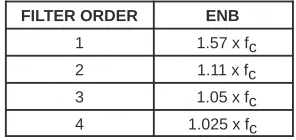
So that the ENB = 1.57 x 3dB bandwidth in this first-order system. This result holds for any first-order low-pass function. For higher order filters the ENB approaches the normal cutoff frequency, fc, of the filter. Table 1 shows the ENB for different order low-pass filters.
(10)
Op Amp Circuit Noise Model
Table 1. ENB vs Filter Order for Low-Pass Filters
FILTER ORDER ENB
1 1.57 x fc
2 1.11 x fc
3 1.05 x fc
4 1.025 x fc
Resistor Noise Model
[image:14.612.189.404.258.324.2]To reiterate, noise in a resistor can be modeled as a voltage source in series, or a current source in parallel, with an otherwise noiseless resistor as shown in Figure 8. These models are equivalent and can be interchanged as required to ease analysis. This is explored in Appendix A.
i2+
ŕ
4kT R dfe2+
ŕ
4 kTR df RR
Figure 8. Resistor Noise Models
Op Amp Circuit Noise Model
Op amp manufacturers measure the noise characteristics for a large sampling of a device. This information is compiled and used to determine the typical noise performance of the device. The noise specifications published by Texas Instruments in their data sheets refer the measured noise to the input of the op amp. The part of the internally generated noise that can properly be represented by a voltage source is placed in series with the positive input to an otherwise noiseless op amp. The part of the internally generated noise that can properly be represented by current sources is placed between each input and ground in an otherwise noiseless op amp. Figure 9 shows the resulting noise model for a typical op amp.
– Noisless Op Amp + –
+
[image:14.612.211.374.528.685.2]en inn inp
Inverting and Non-Inverting Op Amp Circuit Noise Calculations
Inverting and Non-Inverting Op Amp Circuit Noise Calculations
To perform a noise analysis, the foregoing noise models are added to the circuit schematic and the input signal sources are shorted to ground. When this is done to either an inverting or a noninverting op amp circuit, the same circuit results, as shown in Figure 10. This circuit is used for the following noise analysis.
– Noisless Op Amp
+ –
+
en inn inp e2
R2
e1 R1
e3 R3
[image:15.612.164.441.157.344.2]E0
Figure 10. Inverting and Non-Inverting Noise Analysis Circuit
At first, this analysis may appear somewhat daunting, but it can be deciphered piece by piece. Using the principles of superposition, each of the noise sources is isolated, and everything else is assumed to be noiseless. Then the results can be added according to the rules for adding independent noise sources. An ideal op amp is assumed for the noiseless op amp. In the end it will all seem simple, if a little tedious the first time through.
Figures 11 through 13 show the analysis.
E1+e1 R2 R1 E 21 +e12
ǒ
R2 R1
Ǔ
2 e12+
ŕ
4kTR1df –Noisless Op Amp
+ R2 e1
R1
R3 E1
Noiseless Resistor 0 V
[image:15.612.137.474.479.612.2]Noiseless Resistor
Inverting and Non-Inverting Op Amp Circuit Noise Calculations
E2+e2
[image:16.612.118.464.73.411.2]e22+
ŕ
4kTR2df E 22 +e22 – Noisless Op Amp + R2 e2 R1 R3 E2 0 V Noiseless Resistor Noiseless ResistorFigure 12. E2
E3+e3
ǒ
R1)R2 R1Ǔ
E 22 +e22
ǒ
R1)R2R1
Ǔ
2 e32+ŕ
4kTR3df – Noisless Op Amp + R2 e3 R1 R3 E3 Noiseless Resistor Noiseless ResistorFigure 13. E3
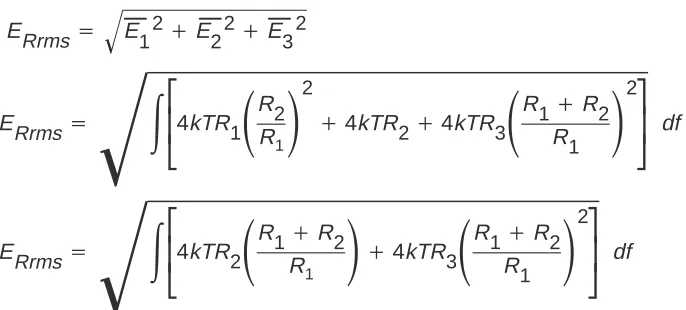
Combining to arrive at the solution for the circuit’s output rms noise voltage, ERrms, due to the thermal noise of the resistors in the circuit:
ERrms+
Ǹ
E12)E22)E32ERrms+
ŕ
ȧ
ȱ
Ȳ
4kTR1ǒ
R2 R1
Ǔ
2
)4kTR2)4kTR3
ǒ
R1)R2 R1Ǔ
2
ȧ
ȳ
ȴ
Ǹ
dfERrms+
ŕ
ȧ
ȱ
Ȳ
4kTR2ǒ
R1)R2
R1
Ǔ
)4kTR3ǒ
R1)R2 R1
Ǔ
2
ȧ
ȳ
ȴ
Ǹ
dfIf it is desired to know the resistor noise referenced to the input, EiRrms, the output noise is divided by the noise gain, An, of the circuit:
An+
ǒ
R1)R2 R1Ǔ
(12)
[image:16.612.101.444.460.615.2]Inverting and Non-Inverting Op Amp Circuit Noise Calculations
E 2 iRrms +
ǒ
ERrms An
Ǔ
2 +ŕ
ȧ
ȱ
Ȳ
4kTR2ǒ
R 1)R2
R 1
Ǔ
)4kTR 3
ǒ
R 1)R2
R 1
Ǔ
2ȧ
ȳ
ȴ
dfǒ
R1)R2 R1Ǔ
2 +
ŕ
4kTƪ
ǒ
R1R2 R
1)R2
Ǔ
)R3
ƫ
dfNormally R3 is chosen to be equal to the parallel combination of R1 and R2 to minimize offset voltages due to input bias current. If this is done, the equation simplifies to:
EiRrms+
Ǹ
ŕ
8kTR3 df When R3 +ǒ
R1R2 R1)R2Ǔ
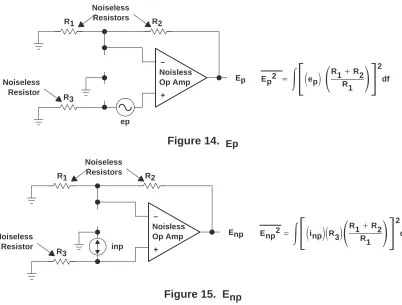
Now consider the noise sources associated with the op amp itself. The analysis proceeds as before as shown in Figures 14 through 16.
Ep2 +
ŕ
ƪ
ǒ
epǓ
ǒ
R1)R2 [image:17.612.85.566.82.184.2]R1
Ǔ
ƫ
2 df – Noisless Op Amp + ep R2 R1 R3 Ep Noiseless Resistors Noiseless ResistorFigure 14. Ep
Enp2+
ŕ
ƪ
ǒ
inpǓǒ
R3Ǔ
ǒ
R1)R2 R1Ǔ
ƫ
2 df – Noisless Op Amp + R2 R1 R3 Enp Noiseless Resistors Noiseless Resistor inp
Figure 15. Enp
(14)
[image:17.612.114.516.322.627.2]Inverting and Non-Inverting Op Amp Circuit Noise Calculations
[image:18.612.84.478.73.223.2]Enn2+
ŕ
ƪ
ǒinnǓǒ
R2Ǔ
ƫ
2df – Noisless Op Amp + R2 R1 R3 Enn Noiseless Resistors Noiseless Resistor inn 0 VFigure 16. Enn
Combining to arrive at the solution for the circuit’s output rms noise voltage, Eoarms, due to the input referred op amp noise in the circuit:
Eoarms+
Ǹ
Ep2)Enp2)Enn2Eoarms+
ŕ
ȧ
ȱ
Ȳ
ǒ
innǒ
R2Ǔ
Ǔ
2
)
ǒ
ǒ
inpǓ
R3ǒ
R1)R2 R1Ǔ
Ǔ
2
)
ǒ
epǒ
R1)R2 R1Ǔ
Ǔ
2
ȧ
ȳ
ȴ
Ǹ
dfNow combining the resistor noise and the op amp noise to get the total output rms noise voltage, ETrms.
ETrms+
ŕ
ȧ
ȱ
Ȳ
4kTR2ǒ
R1)R2
R1
Ǔ
)4kTR3ǒ
R1)R2 R1
Ǔ
2
)
ǒ
ǒ
inpǓ
R2Ǔ
2
)
ǒ
ǒ
inpǓ
R3ǒ
R1)R2 R1Ǔ
Ǔ
2
)
ǒ
enǒ
R1)R2 R1Ǔ
Ǔ
2
ȧ
ȳ
ȴ
dfǸ
The only work left is to evaluate the integral. Most of the terms are constants that can be brought straight out of the integral. The resistors and their associated noise are constant over frequency so that the first two terms are constants. The last three terms contain the input referred noise of the op amp. The voltage and current input referred noise of op amps contains flicker noise, shot noise, and thermal noise. This means that they must be evaluated as a combination of white and 1/f noise. Using equation (9) and Table 1, the output noise is:
ETrms+ ENB
ǒ
4kTR2A)4kTR3A2Ǔ
)iw2ǒ
R2 2 )R2 3A
2
Ǔ
ǒ
finc ln fH
fL)ENB
Ǔ
)e 2w A2
ǒ
fencln fHfL)ENB
Ǔ
Ǹ
Where A = (R1 + R2)/R1, iw is the white current noise specification (spectral density in A/√Hz), finc is the current noise corner frequency, ew is the white voltage noise specification (spectral density in V/√Hz, and fenc is the voltage noise corner frequency. ENB is determined by the frequency characteristics of the circuit. fH/fL is set equal to ENB.
(16)
Differential Op Amp Circuit Noise Calculations
In CMOS input op amps, noise currents are normally so low that the input noise voltage dominates and the iw terms are not factored into the noise computation. Also, since bias current is very low, there is no need to use R3 for bias current compensation, and it, too, is removed from the circuit and the calculations. With these simplifications the formula above reduces to:
ETrms+ ENB 4kTR2 A)ew2 A2
ǒ
fenc ln fHfL)ENB
Ǔ
Ǹ
CMOS input op ampsDifferential Op Amp Circuit Noise Calculations
A noise analysis for a differential amplifier can be done in the same manner as the previous example. Figure 17 shows the circuit used for the analysis.
– Noisless Op Amp
+ –
+
en inn inp e2
R2
e1 R1
e3 R3
E0 R4
[image:19.612.162.439.281.482.2]e4
Figure 17. Differenital Op Amp Circuit Noise Model
Figures 18 through 21 show the analysis.
E21+e21
ǒ
R2 R1Ǔ
2 –
Noiseless Op Amp
+ R2 e1
R1
R3 E1
0 V R4
Noiseless Resistors
Noiseless Resistors
Differential Op Amp Circuit Noise Calculations
E 22 +e 22 –
Noiseless Op Amp
+
R2 e2 R1
R3 E2
[image:20.612.110.505.72.632.2]0 V R4 Noiseless Resistors Noiseless Resistors
Figure 19. e2
E 2
3 +e32
ƪ
ǒ
R4 R3)R4Ǔǒ
R1)R2 R1
Ǔ
ƫ
2 –
+ R2
e3 R1
R3 E3
R4
Noiseless Op Amp
Noiseless Resistors
Noiseless Resistors
Figure 20. e3
E 24 +e42
ƪ
ǒ
R3 R3)R4Ǔǒ
R1)R2 R1
Ǔ
ƫ
2 –
Noiseless Op Amp
+ R2
e4 R1
R3 E4
R4 Noiseless
Resistors Noiseless
Resistors
Differential Op Amp Circuit Noise Calculations
Combining to arrive at the solution for the circuit’s output rms noise voltage, ERrms, due to the thermal noise in the resistors in the circuit:
ERrms+ǸE12)E22)E32)E42
E
Rrms+
ŕ
ƪ
ǒ
4kTR1ǒ
R2R1Ǔ
2Ǔ
)(4kTR2))
ǒ
4kTR3ǒ
R4 R3)R4Ǔ
2
ǒ
R1)R2 R1Ǔ
2
Ǔ
)
ǒ
4kTR4ǒ
R3 R3)R4Ǔ
2
ǒ
R1)R2 R1Ǔ
2
Ǔ
ƫ
dfǸ
E
Rrms+
ŕ
4kTƪ
R2R1 2)R2)
ǒ
R3ǒ
R4 R3)R4Ǔ
2
ǒ
R1)R2 R1Ǔ
2
Ǔ
)
ǒ
R4ǒ
R4 R3)R4Ǔ
2
ǒ
R1)R2 R1Ǔ
2
Ǔ
ƫ
dfǸ
Normally R1 = R3 and R2 = R4. Making this substitution reduces the above equation to:
ERrms+
ŕ
8kTR2ǒ
1)R2 R1Ǔ
dfǸ
If R1+R3 and R2+R4 Now consider the noise sources associated with the op amp itself. The analysis proceeds as before as shown in Figures 22 through 24.Enp2+
ŕ
ƪ
ǒinpǓǒ
R3R4 R3)R4Ǔǒ
R1)R2 R1
Ǔ
ƫ
[image:21.612.93.566.90.736.2]2 df – Noiseless Op Amp + R2 R1 R3 Enp Noiseless Resistors Noiseless Resistors inp
Figure 22. inp
Ep2+
ŕ
ƪ
ǒepǓǒ
R1)R2 R1Ǔ
ƫ
2 df – + R2 R1 R3 Ep Noiseless Resistors Noiseless Resistors ep Noiseless Op Amp
Figure 23. ep
(18)
[image:21.612.127.520.344.702.2]Differential Op Amp Circuit Noise Calculations
Enn 2+
ŕ
[(inn)(R2)]2df –+ R2 R1
R3
Enn Noiseless
Resistors
Noiseless Resistors
inn
[image:22.612.116.469.75.245.2]Noiseless Op Amp
Figure 24. inn
Combining to arrive at the solution for the circuit’s output rms noise voltage, Eoarms, due to the input referred op amp noise in the circuit:
Eoarms+
Ǹ
Ep2)Enp2)Enn2Eoarms+
ŕ
ȧȱȲ
((inn) R2)2)ǒ
(inp)ǒ
R3R4 R3)R4Ǔǒ
R1)R2 R1
Ǔ
Ǔ
2
)
ǒ
epǒ
R1)R2 R1Ǔ
Ǔ
2
ȧȳȴ
dfǸ
Normally R1 = R3, R2 = R4, and inn = inp = in. Making this substitution reduces the above equation to:
E
oarms+
ŕ
ȧȱȲ
(2inR2) 2)
ǒ
enǒ
R1)R2 R1Ǔ
Ǔ
2
ȧȳȴ
dfǸ
R1+R3, R2+R4 and inn+inp+in
(20)
Differential Op Amp Circuit Noise Calculations
Now combine the resistor noise and the op amp noise to get the total output rms noise voltage, ETrms.
ETrms+
ŕ
ȧȱȲ
((inn) R2)2)ǒ
(inp)ǒ
R3R4 R3)R4Ǔ
ǒ
R1)R2 R1
Ǔ
Ǔ
2
)
ǒ
enǒ
R1)R2 R1Ǔ
Ǔ
2
)
ǒ
4kTR1ǒ
R2 R1Ǔ
2Ǔ
ȧȳȴ
Ǹ
ȧ
ȱ
Ȳ
)(4kTR2))ǒ
4kTR3ǒ
R3R4)R4Ǔ
2ǒ
R1)R2 R1Ǔ
2
Ǔ
)
ǒ
4kTR4ǒ
R3 R3)R4Ǔ
2
ǒ
R1)R2 R1Ǔ
2
Ǔ
ȧ
ȳ
ȴ
dfETrms+
ŕ
ȧȱȲ
((inn) R2)2)ǒ
(inp)ǒ
R3R4 R3)R4Ǔ
ǒ
R1)R2 R1
Ǔ
Ǔ
2
)
ǒ
enǒ
R1)R2 R1Ǔ
Ǔ
2
ȧȳȴ
Ǹ
ȧ
ȱ
Ȳ
)4kTȧ
ȡ
Ȣ
R2R1 2)R2)
ǒ
R3ǒ
R4 R3)R4Ǔ
2
ǒ
R1)R2 R1Ǔ
2
Ǔ
)
ǒ
R4ǒ
R4 R3)R4Ǔ
2
ǒ
R1)R2 R1Ǔ
2Ǔ
ȧ
ȣ
Ȥȧ
ȳ
ȴ
dfSubstituting R1 = R3, R2 = R4, and inn = inp = in:
ETrms+
ŕ
ȧȱȲ
2 (inR2)2)ǒ
enǒ
R1)R2 R1Ǔ
Ǔ
2
)8kTR2
ǒ
R1)R2 R1Ǔ
ȧȳȴ
dfǸ
R1+R3, R2+R4 and inn+inp+in Evaluating the integral using these simplifications results in:
ETrms+ ENB 8kTR2A)2
ǒ
iw2 R22Ǔ
ǒ
finc ln fHfL )ENB
Ǔ
)e 2w A2
ǒ
fenc ln fHfL )ENB
Ǔ
Ǹ
R1+R3, R2+R4 and inn+inp+in
Where A = (R1 + R2)/R1, iw is the white current noise specification (spectral density in A/√Hz), finc is the current noise corner frequency, ew is the white voltage noise specification (spectral density in V/√Hz ), and fenc is the voltage noise corner frequency. ENB is determined by the frequency characteristics of the circuit. fH/fL is set equal to ENB.
(22)
(23)
Summary
Summary
The techniques presented here can be used to perform a noise analysis on any circuit. Superposition was chosen for illustrative purposes, but the same solutions can be derived by using other circuit analysis techniques.
Noise is a purely random signal; the instantaneous value and/or phase of the waveform cannot be predicted at any time. The only information available for circuit calculations is the average mean-square value of the signal. With multiple noise sources in a circuit, the total root-mean-square (rms) noise signal that results is the square root of the sum of the average mean-square values of the individual sources.
ETotalrms+
Ǹ
e21rms)e22rms)...e2nrmsBecause noise adds by the square, when there is an order of magnitude or more difference in value, the lower value can be ignored with very little error. For example:
12)102
Ǹ
+10.05If the 1 is ignored, the error is 0.5%. With modern computational resources, evaluation of all the terms is trivial, but it is important to understand the principles so that time will be spent reducing the 10 before working on the 1.
Noise is normally specified as a spectral density in rms volts or amps per root Hertz, V/√Hz or A/√Hz. To calculate the amplitude of the expected noise signal, the spectral density is integrated over the equivalent noise bandwidth (ENB) of the circuit.
References
References
1. J. B. Johnson. Thermal Agitation of Electricity in Conductors. Physical Review, July 1928, Vol. 32.
2. Aldert van der Ziel. Noise. Prentice-Hall, Inc., 1954.
3. H. Nyquist. Thermal Agitation of Electric Charge in Conductors. Physical Review, July 1928, Vol. 32.
4. Paul R. Gray and Robert G Meyer. Analysis and Design of Analog Integrated Circuits. 2d ed., John Wiley & Sons, Inc., 1984.
5. Sergio Franco. Design with Operational Amplifiers and Analog Integrated Circuits. McGraw-Hill, Inc., 1988.
Using Current Sources for Resistor Noise Analysis
Appendix A
Using Current Sources for Resistor Noise Analysis
Figures A1 through A3 show analysis of the resistor noise in the inverting/noninverting op amp noise analysis circuit using current sources in parallel with the noiseless resistors.
E1+i1R1 R2 R1+i1R2 E 2
1 +
ǒ
i1R2Ǔ
2 i12+ŕ
4kTR1 df –
Noiseless Op Amp
+ R2 R1
R3 0 V i1
Noiseless Resistor
[image:26.612.140.490.142.639.2]Noiseless Resistor
Figure A–1. E1
E2+i2R2 E 2
2 +
ǒ
i2R2Ǔ
2 i22+ŕ
4kTR2 df –
+ R2 R1
R3 0 V
i2
Noiseless Resistors
Noiseless Op Amp
Figure A–2. E2
E3+i3R3
ǒ
R1)R2 R1Ǔ
E 23 +
ƪ
i3R3ǒ
R1)R2R1
Ǔ
ƫ
2 i32+ŕ
4kTR3 df –
+ R2 R1
R3 i3
Noiseless Op Amp
Using Current Sources for Resistor Noise Analysis
Combining the independent noise signals:
ERrms+
Ǹ
E12)E22)E32ERrms+
ŕ
ȧ
ȱ
Ȳ
4kT R1 R
2
2)4kTR 2
R22)4kT R3 R
2 3
ǒ
R1)R2 R1
Ǔ
2
ȧ
ȳ
ȴ
Ǹ
dfERrms+
ŕ
ȧ
ȱ
Ȳ
4kTR2ǒ
R1)R2
R1
Ǔ
)4kTR3ǒ
R1)R2 R1
Ǔ
2
ȧ
ȳ
ȴ
Ǹ
dfThe resulting equation is the same as equation (12) presented earlier.