doi:10.4236/jmp.2011.25050 Published Online May 2011 (http://www.SciRP.org/journal/jmp)
The Liquid-Bridge with Large Gap in Micro
Structural Systems
Shiqiao Gao, Lei Jin, Jingqing Du, Haipeng Liu
School of Mechatronic Engineering, Beijing Institute of Technology, Beijing, China E-mail: [email protected]
Received April 8, 2010; revised March 12, 2011; accepted March 17, 2011
Abstract
Based on the analysis of the total free energy of the liquid-bridge, several methods are presented to analyze the pull-off force of liquid-bridge. For the liquid bridge system with a large gap width, accurate solutions of a two-plate liquid bridge and a sphere-plane liquid bridge are given. In addition, the edge-effect resulting from the profile of the top solid in the liquid-bridge system is analyzed and calculated. It is proved by the subsequent tests.
Keywords:Liquid-Bridge, MEMS, Capillary, Pull-Off Force
1. Introduction
When a small amount of liquid is introduced at the small gap between two solid surfaces, a liquid-bridging phe- nomenon can be observed. Such a liquid-bridging phe- nomenon occurs in many cases. For example, a small water between the tip and the substrate surface of atomic force microscopy (AFM) will form a liquid-bridge [1,2], some water films or other liquids will cause a liq- uid-bridge between the tip and sample of the scanning force microscope (SFM) [3], a protective lubricant thin- film used over the surface of the disk to separate the head slider from the disk can also cause meniscus rings around contacting asperities and liquid bridges between the head and the disk [4], an adsorbed water droplet due to hu- midity between the cantilever beam and the substrate of micro accelerator (or RF-MEMS) will result in a liq- uid-bridge [5], similarly many liquid-bridges between combs and substrate or between the neighbor combs of micro gyroscope will be formed when there is some wa- ter. With miniaturization of system and microminiaturi- zation of the structures and objects, adhesion caused by capillary appears to be one major problem during the assembly and/or fabrication of micro-components and the operation of system.
The liquid-bridge will cause a capillary interaction between the solid surface and the liquid. To separate two solid surfaces in a liquid-bridge system, a force is needed to overcome the capillary attractive force caused by the liquid. This force is usually called as pull-off force or
capillary force (or adhesion force). Such a capillary force is too insignificant for normal macro mechanical system to consider. But it will play a significant role in a micro scale system, especially in a nanoscale system. This is because surface forces become more and more important when size diminishes and the objects are scaled down. Capillary force is one of the adhesion forces. Capillary force can cause the thin polymer beams of the 3D micro- structures to deflect and collapse during the evaporative drying of structures from liquid resin [6]. Adhesion can also prevent micro structures like RF-MEMS, micro sensor, micro gyroscope, or any high aspect ratio struc- tures from normal functioning.
Of course, from another point of view, capillary force between two objects can be also used to manipulate small object [7]. In such a case, the capillary force applied onto the object should be controllable. Nevertheless, the major opposing force to picking up and releasing parts becomes adhesion. In assembly, it is as important to pick up as to release the object. In macro-assembly, this problem does
not exist, because usual grippers can be closed (i.e. the
part is locked between the digits of the gripper) or open (and the gripping force falls to zero). In micro-assembly, adhesion provides a very small value for the “gripping” force. If the weight of the object is smaller than adhesion, the object cannot be released. Conversely, if adhesion is smaller than the object weight, the object cannot be picked up.
The liquid of a liquid-bridge may exist originally (i.e.
be also subsequently formed by the phase transition from a condensable vapor near saturation to liquid. Therefore, for a micro structural system, especially for a nano- structural system, whether there is original liquid or not, it is possible for a liquid-bridge to be formed when am- bient humidity is relatively large. To avoid the formation of a liquid-bridge for a micro system or a nanoscale sys- tem, an appropriate packing with sufficient drying vac- uum is necessary.
In order to understand the liquid-bridging phenome- non, much effort has been made by earlier researchers [8-11]. In the aspect of theoretical studies, there are two ways to establish the models. One approach to determin- ing force is the macroscopic Laplace-Kelvin Equation based on the meniscus theory. The other way is to make numerical computations based on the molecular theories, including molecular dynamics and Monte Carlo simula- tions, integral Equation and density functional theories. The profile of the liquid shows meniscus. According to the Laplace-Young Equation, a negative pressure differ- ence between the inside and the outside of the meniscus will be formed. This negative pressure difference will be also applied on the wetted surface of solids in terms of the Pascal’s law that no pressure gradient can exist for static liquids. This macroscopic approach usually as- sumes that the meniscus shape can be described by two principal radii, and its volume remains unchanged as the gap width changes. Even though this approach is simple, it has been validated for relative large scale structures. However, for nanoscale problems, this approach is not appropriate because of finite molecular size effects that give large fluctuations in meniscus size and shape. To study the capillary force in such a nanoscale case, some analyses based on the molecular theory are needed. For micro scale problem, this conventional simple approach can not be directly used either. Orr, Scriven and Rivas [12] presented a detailed literature survey on the earlier work related to the meniscus properties and capillary force involved in the liquid bridging between two solid surfaces by means of solving the Laplace-Young Equa- tion. They discussed the aspects of liquid mechanics, including the volume of liquid, surface area, and mean curvature of the meniscus, and the liquid-bridging forces exerted on the solid surfaces. Recently, on the one hand, instead of a rigid solid, some elastic deformations and the coupling interaction between solid and liquid have been considered and discussed by the well-known Hertzian solution for the contact between a sphere and a plane [4,13]. On the other hand, the effect of humidity on the capillary has been studied by many researchers [14]. In the same time, of course, some computational simula- tions have been made and developed based on the mod- ern molecular theory [2,15], e.g. a density functional
theory (DFT), the molecular dynamics (MD), the Monte Carlo (MC) method, the grand canonical MC (GCMC) method, and so on. In addition to the equilibrium method mentioned above, the energy method has also been used to solve the pull-off force [16]. Although the equilibrium method based on the Laplace-Young Equation is equiva- lent to the energy method, there are also some differ- ences in detail between them because many factors have been neglected in the equilibrium method.
In the aspect of experiments, many studies have been also made by earlier researchers [8,17-20]. The earliest measurement was made by McFarlane and Tabor [8]. They measured the meniscus force of water in atmos- pheres with different relative humidities by measuring the pull-off force between a glass ball and a glass plane surface in contact. According to the conventional simple theory, the pull-off force is independent of the relative humidity. However, McFarlane and Tabor found in their experiments that the pull-off force decreased suddenly when the relative humidity was less than 90% and the decrease was dependent on the roughness of the glass surfaces. They concluded that the decrease would occur when the height of the surface roughness was compara- ble with the thickness of the adsorbed liquid film. Later, Fisher and Israelachvili [17] made a more precise meas- urement of the meniscus force for water, benzene,
cyclohexane, n-hexane and 2-methylbutane in atmos-
pheres of their own vapors at a relative vapor pressure in the range of 0% - 99%. They used molecularly smooth mica in contact surfaces instead of glass to avoid the effect of surface roughness on measurement. They found that for organic liquids the surface tension theory based on bulk thermodynamics was applicable even when the adsorbed film was only a few molecules in thickness. However, for water it was quite different. Their experi- mental results for water showed that the meniscus force due to the Laplace pressure reduced to 90% of that ex- pected from bulk thermodynamics when the relative va- por pressures is 0.9, corresponding to a Kelvin meniscus radius of about 5 nm. They explained the results in terms of the assumption that the long-range cooperative nature of the hydrogen bonding interaction and electric double layer forces in water film between solid surfaces may play a role in reducing the effective surface tension of water. Christenson [18] modified the surface force appa- ratus by adopting a double cantilever spring. They ob- tained very different experimental results from those of Fisher and Israelachvili. They found that for organics
such as cyclohexane and n-hexane the measured pull-off
V
Fisher and Israelachvili. With the inventions of the scan- ning force microscope (SFM), scanning tunnel micro- scope (STM) [21], the atomic force microscope (AFM), scanning probe microscope (SPM), and the surface force apparatus (SFA), many powerful tools have been made and developed for observing surface morphology on an nano-scale and atomic scale. They make a powerful probe for a variety of surface studies available. They enable us to investigate various sample properties such as adhesion, surface charge, and magnetic properties on a nanometer scale. But on the other hand, it is unavoidable for them to face the liquid-bridge problems on nanometer scale.
From the earlier research worksmentioned above, whether the theoretical studies or the experimental stud- ies, most of the investigated objects are the liquid-bridge system composed of a spherical tip and a plane substrate. Most of those studies were made with the constraint of small separating distance. When the wetted area is much
larger than the gap between the two solids (i.e. large
deep-wide ratio), the shape of meniscus can be negligible during calculating the volume of liquid. Even in the
modified model established by Mingyan He, et al. [1],
instead of the meniscus curve surface, a cylindrical sur- face was still used for calculation of the liquid volume. Nevertheless, when the gap becomes large, the shape of profile has an apparent effect on the volume and other geometrical parameters. From the theoretical analysis, it can be also apparently seen that the capillary force de- pends tightly on the geometric (shape) parameters of meniscus profile, such as the principle radii, the contact angles, the fulfilling angles, the volume, the interfacial areas, the gap width, and so on. In order to model the
meniscus profile accurately, O. H. Pakarinen et al. [14]
presented a method to numerically calculate the exact (non-circular) meniscus profile from the Kelvin Equation. But it is not analytical model. The computation based on the difference Equations was also approximate. For a micro scale problem, the conventional continuum model is too simple to predict the capillary force. But the com- putational simulation is too complicated to analyze. In view of this micro scale, this current article attempts to give a relatively accurate solution of the pull-off force of micro liquid-bridge by means of an analytical method based on the energy theory.
2. The Total Free Energy of the
Liquid-Bridge
The surface tension is always trying to make the area contract. Therefore, with the increase of area, the poten- tial energy will increase. On the contrary, the pressure is always trying to make the volume expand. Therefore,
with the decrease of volume, the potential energy will increase. The total free energy consists of two parts which are free surface energy and free bulk energy re- spectively. The free surface energy arises from the con- tributions of the solid/liquid and liquid/vapor interfaces. The free bulk energy arises from the contributions of liquid and vapor volumes with corresponding pressures. In order to calculate the free energy of the liquid-bridg- ing system, the liquid volume and the surface areas of the interfaces are need to be calculated. For a liquid bridge, the total free energy can be written by
1 1
n m
i i j j
i j
E A p
(1)where the first sum term in right-hand side is the total free surface energy, the second sum term is the total free
bulk energy, A stands for interfacial area and the
interfacial tension, stands for the phase volume and
the phase pressure, where the subscript stands for
the interface and the subscript stands for the phase.
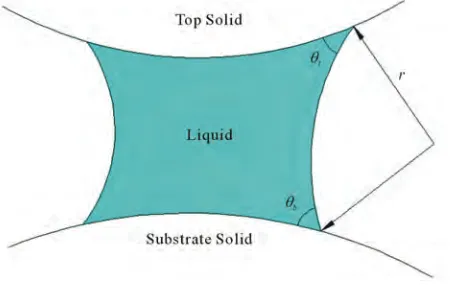
Naturally there are usually three phases, which are vapor phase, liquid phase and solid phase respectively. The interface means the contact surface between every two phases, e.g. the interface between vapor phase and liquid phase, the interface between vapor phase and solid phase, and the interface between liquid phase and the solid phase. Liquid bridge is a system constructed by two solid phase, one liquid phase and one vapor phase. Therefore there are two vapor-solid interfaces, two liquid-solid
interfaces and one vapor-liquid interface shown in Fig-
ure 1.
V
p i
j
If the interface area between top solid and liquid is
lst
A (top wetted area), the interface area between top
solid and vapor is Avst, the interface area between sub-
strate solid (bottom solid) and liquid is Alsb (bottom
wetted area), the interface area between substrate solid
and vapor is Avsb, whereas the interface area between
vapor and liquid (i.e. the profile of the liquid) is Alvp,
[image:3.595.312.537.562.706.2]the volume of liquid is Vl, and the volume of vapor is
v, the total free energy of the liquid bridge system de-
scribed by Equation (1) can be rewritten as
V
lst lst vst vst lsb lsb vsb vsb
lvp lvp l l v v
E A A A A
A p V p V
(2)
Because the interfacial tension between solid and va- por is very small, the effect of solid-vapor interface in Equation (2) can be neglected. Then, we have
lst lst lsb lsb lvp lvp l l v v
E A A A p V p V (3)
When we solve some forces by means of the energy theory, it is needed to differentiate the total free energy. At a constant temperature, the differentiation of total free energy can be derived by
δ δ δ δ
δ δ
lst lst lsb lsb lvp lvp
l l v vv
E A A A
p V p V
(4)
Because the total volume of liquid phase and vapor phase is constant, i.e. δ
Vl Vv
0, there isδVv δVl
V
(5) Substituting Equation (5) into Equation (4), leads to
δElstδAlstlsbδAlsblvpδAlvp plpv δ l (6)
For rigid solids, there is no deformation on the inter- faces of solid and liquid. The interfaces have the same shapes as the solid surface. Nevertheless, the interface of liquid and vapor will keep meniscus shape with some corresponding curvatures due to the capillary effect.
3. The Solution on the Interface of Liquid
and Vapor of the Liquid-Bridge
On the interface of liquid and vapor of the liquid bridge,
i.e. the meniscus profile, excepting the pressure of vapor
and the pressure of liquid, there is no other external force. In terms of work-energy conservation theory, there is
δ
δ δ
δ
δ δ δ
δ
0
δ
lvp
lst lsb
lvp lst lsb lvp
l l v δ A A A E f
r r r
V p p r
r (7)
where is the normal coordinate of the curve surface of
the meniscus profile. Considering
r
0
lst lsb
A A
, we
have
δ δ 0 δ δ lvp llvp l v
A V
p p
r r
(8)
Supposing the two principal radii of the curve surface
of the meniscus profile are 1 and 2 respectively, by
means of the geometric relationships of the spatial curve surface, we can obtain the following relationship
r r
1 2 1 1 δAlvp δVl
r r
(9)
Substituting Equation (9) into Equation (8), leads to
1 2 δ 1 1 0 δ llvp l v
V p p
r r r
(10)
That is
1 2 1 1 v l lvp
p p p
r r
(11)
This equation is the so called Young-Laplace Equation.
4. The Pull-Off Force of the Top Solid in the
Liquid-Bridge System
4.1. The Solution for Constant Wetted Areas
To obtain the pull-off force of the top solid in the liquid bridge, a classical derivative of the energy with respect to the distance between the top and substrate solid ob-
jects (i.e. vertical coordinate ) can be used. This prin-
ciple of work-energy conservation can be explained as
follows. An increment displacement in direc-
tion will result in an increment of total free energy of the
liquid bridge system . In terms of the principle of
work-energy conservation, this increment of en-
ergy should arise from the work done by pull-off force
a
z
δz z
E
δE
δ
f in the distance of , that is , which
leads to
δz δE faδz
δ δ a E f z
(12)
Substituting Equation (6) into Equation (12), leads to
δ
δ δ
δ
δ δ δ
δ δ
lvp
lst lsb
a lst lsb lvp
l l v δ A A A E f
z z z
V p p z
z (13)
In the case of constant interfacial areas, there are
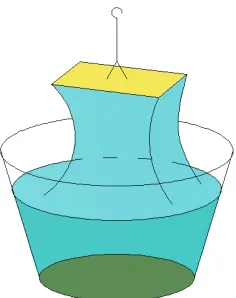
δAlstδAlsb0. To take liquid with a small chip from a
cup of liquid belongs to this case shown in Figure 2. The
increment of the profile area is
δAlvp lt δz sint (14)
where t is the contact angle of the liquid with respect
to the top solid, and t is the perimeter of the interfacial
(wetted) area lst
l
A . Whereas VlAlstz. Substituting
them into Equation (13), leads to
δ
sin δ
sin
a lvp t t l v
lvp t t lst
E
lst
f l p p
z
l p A
Figure 2. Taking liquid with a piece of thin plate from a cup.
Taking lvp (the surface tension) and
2
m
p r
where is the mean radii of the meniscus profile
where
m r
1
2 rm1 r1r2, leads to
2 sin
a t t
m lst
f l
r A
(16)
4.2. An Approximate Solution for Constant
Liquid Volume
For a general liquid bridge, the liquid keeps a constant
volume, that is . Equation (13) can be rewritten
by
δVl0
δ
δ δ
δ
δ δ δ
lvp
lst lsb
a lst lsb lvp
δ A
A A
E f
z z z
z (17)
To obtain the solution of Equation (17), some geomet- ric relationships need to be analyzed and discussed. We
define a deep-wide ratio as d w where is
thickness of liquid film or the minimum gap width be-
tween the two solid objects and is the length in
maximum wide direction of area
d
w
t ls
A . If the liquid bridge
has a small deep-wide ratio, i.e. 1 and AlstAlsb,
the volume of liquid can be approximately expressed as
l lst
V d A d Alsb (18)
Considering the volume as a constant (isovolume), we have
δVl d δAlstδd A lst d δAlst δz Alst 0 (19)
Therefore, there is
δ δ
lst lst
A A
z d (20)
Similarly there is
δ δ
lsb lsb
A A
z d (21)
From the geometric relationship of meniscus profile of
the liquid bridge shown in Figure 3, the relationship
between the thickness of liquid film (the distance be-
tween the two solid objects) and the curvature radius can be written by
d
1 r
1 cos t cos
d r b (22)
where b is the contact angle of the liquid with respect
to the substrate solid.
Substituting Equations (14), (20) and (21) into Equation (17) and noting that lst cost, lsb cosb
and lvp, leads to
δ
cos cos sin
δ
lst
a t b
A E
t t
f l
z d
(23)
Substituting Equation (22) into Equation (23), leads to
1
sin
lst
a t t
A
f l
r
(24)
4.3. An Accurate Solution for Large Gap Width
If the deep-wide ratio is not small, a more general model should be built. If the top and substrate solids are all
planes shown in Figure 4, the increment of the vertical
distance can be also written as
1
δzδr cost cosb (25)
[image:5.595.119.237.80.229.2]Whereas the increment of volume should be written as
[image:5.595.52.530.303.735.2]Figure 3. A circular liquid bridge.
[image:5.595.333.521.434.564.2]δz
δVl AlvpδxAlst (26)
Because the volume keeps a constant, there is Vl0.
Therefore we have
δ lst lvp δ A x z A
(27)
In this case, the area change of top interface can be written as
δ δ t lst lst t
lvp l A
δ
A l x z
A
(28)
The area change of substrate interface can be written as
δ δ b lsb
lsb b δ
l A
lvp A l x z
A
where t and b are perimeters of the top interface and
the substrate interface respectively.
(29)
l l
The change of profile area can be written as
δAlvp lt sintδz (30)
Substituting Equation (28), (29) and (30) into Equa- tion (17) and noting lst cost, lsb cosb
and lvp, leads to
δ
cos cos sin
δ
lst
a t t b b
lvp A E
f l l
z A t tl
(31)
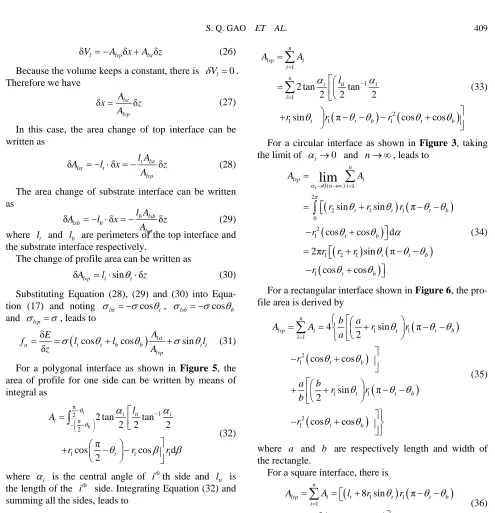
For a polygonal interface as shown in Figure 5, the
area of profile for one side can be written by means of integral as π 1 2 π 2 1 1
2 tan tan
2 2 2
π
cos cos d
2
t b
i ti i
i t l A r r 1 r
(32)where i is the central angle of th side and ti is
the length of the side. Integrating Equation (32) and
summing all the sides, leads to
th i l th i
1 1 1 21 1 1
2 tan tan
2 2 2
sin π cos cos
n
lvp i
i n
i ti i
i
t t b t
A A
l
r r r
b
(33)For a circular interface as shown in Figure 3, taking
the limit of i0 and n , leads to
n A A
0( ) 1
2
2 1 1
0
2 1
1 2 1
1
sin sin π
cos cos d
2π sin π
cos cos
lim
i
lvp i
n i
t t t
t b
t t b
t b
r r r
r
r r r
r
b
(34)For a rectangular interface shown in Figure 6, the pro-
file area is derived by
1 1 1 2 1 1 1 2 14 sin π
2 cos cos sin π 2 cos cos n b
Alvp Ai t t b
i
t b
t t b
t b a r r a r a b r r b r (35)
where and are respectively length and width of
an
a b
the rect gle.
For a square interface, there is
8 sinn
lvp i t
A A l r
1 1 1 2 1 π8 cos cos
t t b
i t b r r
(36)It should be pointed out that, for a narrow-long rec-
[image:6.595.51.546.34.547.2]tangular solid shown in Figure 6, the interface area will
[image:6.595.322.534.608.705.2]first a
quation (31), leads to* Eq
al of top solid is the same as that of sub- st
vature radius. But the contact angles should keep con- stant. Supposing the curvature center has a tiny displace-
ment in left-hand direction δx0 and a tiny upward dis-
placement 0, and the curvature radius has an incre-
ment , the wetted boundary on the spherical interface
will contract with a displacement
δy
δr
δxt in left-hand di-
rection, which can be written as ly contract apart from the long side until to form
square shape, and then will contract apart from the short side until to form a circler shape.
Substituting Equation (34) into E uation (37)
If the materi
rate solid, there are t b and ltlb. Then there is
0
δxt δx δrsin t rcos t δ
1 1 1
2 cos
2 sin π 2 4π cos
sin
t t lst a
t t t t
t t
l A
f
r l r r
l
(42)
(38)
For a liquid bridge with small deep-wide ratio,
where is called the filling angle and δ is defined
as positive in clockwise direction.
The vertical upward displacement can be written as .
t l
1cos t r
2 . Equation (38) can be rewritten as δyt δy0δrcos
t
rsin
t
δ (43)
1
2 cos A
sin
π 2
t lst
a t t
t
l r
From the geometric relationships shown in Figure 7, the
displacement of meniscus curve surface of profile (or the displacement in left-hand direction of the horizontal apex of the profile) can be written as
f
(39)
Comparing Equation (24) with Equation (39), it is found that these two Equations are not the same. It should be said that Equation (39) is a more accurate Equation in which the curve surface of profile has been considered during the calculation of liquid volume. If we
use the straight line distance 2 cosr1 t instead of the
curve arc distance r1
π2t
, E (39) will changeto Equation (24). are interface, substituting
Equation (36) into Equation (31) and considering .lt
1
2 cosr t
quation For a squ
, the same Equation as (39) can be obtained
t be pointed out that, with the contracting .
of It mus
0
δxδx δr (44) The wetted area on the substrate plane will contract with a following decrement
δ δx 1 sinb δr (45)
Because there are xtRcos andy0rcosb,
we can obtain the following relationships
δzδytRsin δ (46) and
so
4.5. An Accurate Solution for the Sphere-Plane
When the top solid has the spherical shape and the sub-
(40)
Then there is
lid-liquid interface apart from every boundary side, the shape of interface tends to a circle acted by the surface
tension force. δyt cosbcos
t
δrrsin
t
δ (47)Substituting Equation (47) into Equation (46), leads to
δ cos cos δ
sin sin δ
b t
t
z r
R r
(48)
Liquid Bridge System with a Large Gap Width
Substituting Equation (42) into Equation (44), leads to
δ 1 sin δ
cos cos δ
t
t
x r
R r
(49)
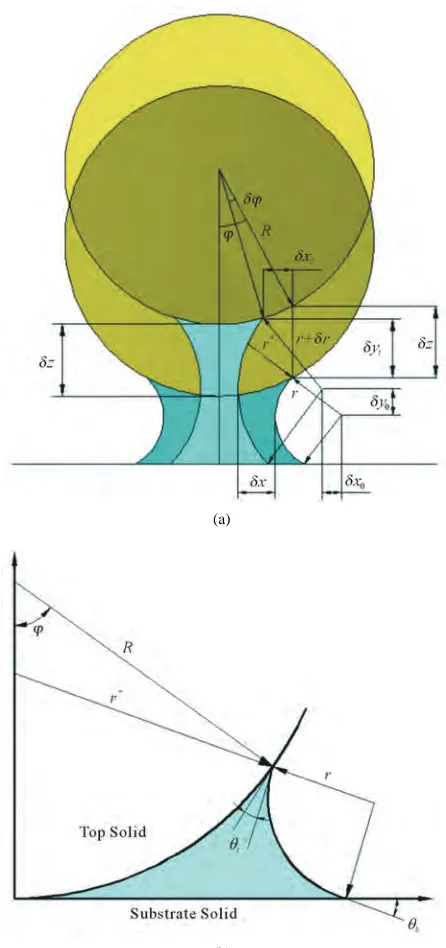
strate is plane shown in Figure 7(a), the problem becomes
relatively complicated. The conservation condition of volume can be also written by
δV A δx From the Equations (41), (45), (47) and (48), the fol-
lowing solutions can be obtained
δ 0
l lvp Alst z
1 3
1 2 3 4
δ δ
C C
r
z C C C C
(50)
δ lst δ
lvp A
x z
A
(41)
When the sphere moves upward with a tiny displace- m
an
and
2 4
1 2 3 4
δ δ
C C
z C C C C
(51)
ent δz, the meniscus interface of liquid-vapor will
also ch ge, including the curvature center and the cur-
1 1 1
cos cos
sin 2π sin π 2π cos cos
t t b b lst
a t t
t t t b t b
l l A
f l
r l r r
(37)
(a)
[image:8.595.61.284.77.551.2](b)
Figure 7. A sphere-plane liquid bridge system with a large gap width.
and
5 1 3
δ C C C
1 2 3 4
δz C C C C
(52)
e wher
1 cos cos t
C R r ,C2cosbcos
t
,
sin sin t
C3R r ,C4 1 sin
t
,5 1 sin b
C and Alst Alvp.
2 2π 1 cos lst
A R (53)
The wetted area on the sub as
strate plane can be written
2
π lsb
A (54)
The incremen niscus area f profile can be de-
sc
t of me o
ribed as
δAlvp2πRsinδs (55)
where sis the increment of the meridian of the pro-
file, which can be derived as
b
δsrδδ πr t (56)
By means of Equations (50), (51) and (52), deriving Equations (53), (54) and (55) with respect to the vertical
coordinate z, leads to
2
2 4
1
2π sin δ
lst R C C
A
z C C C C
(57)
2 3 4
δ
The wetted area on the sphere can be written as
5 1 3
δAlsb C C C
1 2 3 4 2π
δz C C C C
(58)
δAlvp
2 4 1 3
1 2 3 4
δ
π
2π sin t
z
r C C C C
R
C C C C
b
Substituting Equations (57), (58) and (5 tion (17) and noting
(59)
9) into Equa-
cos
lst t
, lsb cosb
and lvp, leads to
2
2 4
1 2 3 4
5 1 3
4 1 3
1 2 3 4
2π sin
cos
π sin
a t
t b
R C C
f
C C C C
C C C
C C
R
C C C C
1 2 3 4 2
2π cos
2
b C C C C
r C C
(60) As
goes to zero (i.e. 0
), the liquid-bridging
force fa also approach but not to a constant
as po ted out by Ref. 22 . This is in consisten
with and not in conflict with the practical physical phe- nomenon. Nevertheless, if a approximate cylindrical pro- file instead of an accurate meniscus profile is used to calculate the profile area or the volume of liquid, a
fli w r
es to zero
and 14 t
con- in
ction ill occur. This can be add essed as follows.
When the thickness of liquid film is very small, the curvature radius will be much smaller than the radius of
sphere, i.e. rR. In this case, instead of the practical
meniscus profile, an approximate cylindrical profile can be used as in Ref. 1. The profile area described by (34)
2π sin lvp
A R Dd (61)
where D is the distance between the sphere and the
plane and d is the height of the sphere cap (the same as
in Ref. 1).
Substituting Equations (61) and (53) into Equation (60), neglecting the surface tension (the third term of
Equation (60)), considering b t andRsin,
and taking D0 and the limit of 0, leads to
4π cos
fa R
he p
(62)
This is t conventional Equation. Because Equation
(62) is inde endent of the filling angle , this expres-
sion shows that the liquid-bridging force approaches to a
constant as goes to zero. Of course, this is in conflict
with the fact that there is no liqu ridging e-
tween two c tely dry surfaces.
In terms of Re 1, the wetted area
id-b force b
omple f. approximately written as
on the plane can be
2 2
π sin
lsb
A R (63)
Equation (49) can be approximately rewritten as
δxRcos δ (64) The conservation condition of volume results appro- ximately in
δ Alsbδ
lvp
x z
A
(65)
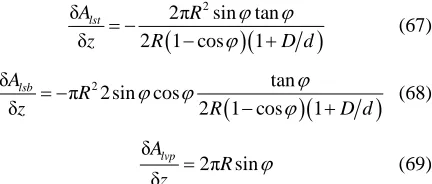
Substituting Equations (61), (63) tio
and (64) into Equa-n (65), leads to
δ tan tan
δz 2 D d 2R 1 cos 1 D d
uations (53), (61) and (63) with respect to
the vertical coordinate and subs
into them, leads to
(66)
Deriving Eq
z tituting Equation (66)
2
δ 2π sin tan
δ lst
A R
z R
2 1 cos 1 D d
(67)
2
δ tan
π 2 sin cos
δ 2 1 cos 1
lsb A
R
z R D d
(68)
δ
2π sin
A
R
δ
lvp
z (69)
Substituting Equations (67), (68) and (6 tion (17) and noting
9) into Equa-
cos lst
, lsb cos
and lvp, leads to
2
1 cos
π cos 2π sin
cos 1
a
f R R
D d
(
If the surface tension is negligible be rewritten as
70)
, Equation (70) can
2 (1 cos )
π cos
a
f R )
cos 1 D d (71
This is the same as that obtained by He, et al. in Ref. 1.
Although Equation (71) is not independent of th angle
e filling
, the same form as Equation (62) can be ob-
tained. This is because an approximate cylindrical profile is also used for calculation of the liquid volume. As
0
D (as shown in Figure 7(b)) and 0, Equation
(71) changes to
4π cos
a
f R (72)
on
film a
This is the same as the conventional Equation (62). It should be pointed out that, Equation (72) is appro-
priate ly for large sphere and thin liquid film. Al-
though Equation (71) has been partially modified relative to Equation (72), it is appropriate only for a thin liquid
nd a small deep-wide ratio, i.e. 1.
The model built in this article is appropriate not only for the large sphere and thin liquid
sm
ive pressure film, but also for the all sphere and large separating distance.
4.6. The Edge-Effect Resulting From the
Profile of the Top Solid in the
Liquid-Bridge System
In a general liquid-bridge system, the liquid will not only wet the major surface of top solid but also wet the profile near the edge of it. In this case, the pull-off force will be caused not only by the Laplace negat
2
p m
F r A and the profile surface tension of li
sin
F l
quid
(e.g. as shown in Equations (16)
but also by the surface tension of liquid ear the edge of top solid. Th
and on the
pro-file n e former as shown in
[image:9.595.71.287.522.614.2](24))
Figure 8 can be expressed by
2
sin
T p
m
F F F A l
r
(73)
where A stands for the wetted area of top solid and
is the surface tension of liquid p
is the contact angl
the liqu with respect to the to solid, and is th
rime wetted area
e of e pe- id
ter of the
l
A, rm is the m rad
the me s profile.
The latter as shown in Figure 9 can be expressed by
ean ii of
niscu
cos
E
F l (74)
The total pull-off force as shown in Figure 10 can be
expressed by 2
sin cos
m
F A l l
r
(75)
5. Exper
To validate the above model in which the
considered, a series of experiments are conducted. One
th n
. re an
lates range from 200 mm to 400
m e
iments and Comparisons
edge effect is
kind of em is to take water from a water cup as show
in Figure 11. The other kind is to pull the water from a
silicon substrate plate as shown in Figure 12 The shapes
of top silicon plate include ct gular and square. The
areas of top silicon p 2
m2. When the amount of the water is enough, the sam
Figure 9. The edge is wetted.
Figure 11. Taking water from cup.
Figure 12. Taking water from the silicon substrate.
both kinds of experiments. The relationship curves between the pull force and the
displacement of top silicon plate are shown in Figure 13.
The used top silicon plate is a rectangular plate which
has 20 mm length and 15.71 mm width. Figure 13 in-
cludes seven curves corresponding the different test times. It is clear that they are very consistent and have very little deviation. The peak value of the curve is con- sidered as pull-off force of the liquid-bridge system. It is found that the pull-off force depends strongly on the area of the top silicon plate. The corresponding curves are
shown in Figure 14. In Figure 14 the calculated curves
results may be obtained for
Figure 10. The total pull-off force comes from the major
Figure 14. The curves of pull-off forces vs areas.
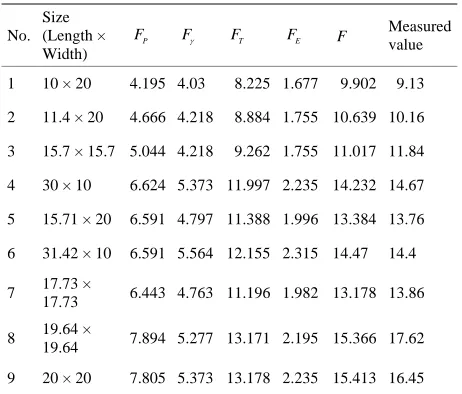
Table 1. Several kinds of calculated pull-off force results and the measured pull-off force.
No. Size (Length × Width)
P
F F FT FE F
Measured value
1 10 × 20 4.195 4.03 8.225 1.677 9.902 9.13
2 11.4 × 20 4.666 4.218 8.884 1.755 10.639 10.16
3 15.7 × 15.7 5.044 4.218 9.262 1.755 11.017 11.84
4
5 15.71 × 20 6.591 4.797 11.388 1.996 13.384 13.76
6 31.42 × 10 6.591 5.564 12.155 2.315 14.47 14.4
7 17.73 ×
17.73 6.443 4.763 11.196 1.982 13.178 13.86
8 19.64 ×
19.64 7.894 5.277 13.171 2.195 15.366 17.62 9 20 × 20 7.805 5.373 13.178 2.235 15.413 16.45
30 × 10 6.624 5.373 11.997 2.235 14.232 14.67
by different models are also given. It can be seen that, the results from the model which considering the edge effect are more close to the testing results. In add more information including
ition,
p
F and F are given
Table 1.
. R
a of Water Bridges in Na-erity Contacts,” Journal of Chemical Phy
, 200 , pp. 55-1 doi:10.1063/1.
[2] G. C. Schatz and M. A. Ratner, “Capillary Force
ic n
63
[ B
es-of t r an
aals F rce icro y,”
R V pp.
R
[4] la ng-
i l t e ics,
0, No. 12, 2001, pp. 5904-5910. 63
[5] au, S. Regnier, A. Delchambre and P. Lambert,
e e lary
Forces,” Proceedings of the 2007 IEEE International
A al, , pp. 109-115. doi:10.1016/j.sna.2005.12.041
[7] P. Lambert, F. Seigneur, S. Koelemeijer and J. Jacot, “A f Surface Tension Gripping: The Watch al of Micromechanics and
Microengi-l
ation of niversity Press, London, 1954.
00572
eering,
oparticle ,” Journal of Chemical
ations,” Ap-. 71, NoAp-. 13, 1997, ppAp-.
t
in
[14] O. H. Pakarinen, A. S. Foster, M. Paajanen, T. Kalinainen, J. Katainen, I. Makkonen, J. Lahtinen and R. M. Niemi-nen, “Towards an Accurate Description of the Capillary Force in Nanoparticle-surface Interactions,” Modelling and Simulation in Materials Science and Engin
6
eferences
[1] M. He, A. S. Blum, D. E. Aston, C. Buenviaje and R. M. Overney, “Critical Phenomen
noasp sics, Vol.
1331298 114, No. 3
J. Jang,
1 13 360. Phy
in Atom Force Microscopy,” Jour al of Chemical Physics, Vol. 12
doi:10.10
0, No. 3, 2004, p /1.164
p. 1157-1160. 0332
3] T. Stifter, O. Marti and . Bhushan, “Theoretical Inv
tigation der W
he Dis orces
tance D in S
epende cannin
nce of g Fo
Capilla M
y and V scop Physical eview B, ol. 62, No. 20, 2000, 13667-13673.
d Y. X.
doi:10.1103
Ga
/Phys
stic Soluti
evB.62.13667
on for H. Fan an
induced M Vol. 9
o, “E Liquid-bridgi
crosca e Con act,” Journal of Appli d Phys doi:10.10
A. Ch
/1.1415057
“Influnc of G ometrical Parameters on Capil
Symposium on Assembly and Manufacturing, Ann Arbor, 22-25 July 2007, pp. 215-220.
[6] D. Wu, N. Fang, C. Sun and X. Zhang, “Stiction Prob-lems in Releasing of 3D Microstructures and Its Solu-tion,” Sensors and Actuators : Physic Vol. 128, No. 1, 2006
Case Study o Bearing,” Journ
neering, Vol. 16, No. 7, 2006, pp. 1267-1276. doi:10.1088/0960-1317/16/7/021
[8] J. S. McFarlane and D. Tabor, “Adhesion of Solids and the Effect of Surface Films,” Proceedings of the Roya Society A, London, July 1950, pp. 224-243.
doi:10.1098/rspa.1950.0096
[9] F. P. Bowden and D. Tabor, “Friction and Lubric Solids, Part I,” Oxford U
[10] F. P. Bowden and D. Tabor, “Friction and Lubrication of Solids, Part II,” Oxford University Press, London, 1964.
[11] B. Bhushan, “Principles and Applications of Tribology,” Wiley, New York, 1999.
[12] F. M. Orr, L. E. Scriven and A. P. Rivas, “Pendular Rings between Solids: Meniscus Properties and Capillary Force,” Journal of Fluid Mechanics, Vol. 67, No. 4, 1975, pp. 723-742. doi:10.1017/S00221120750
[13] B. Zhang and A. Nakajima, “Nanometer Deformation Caused by the Laplace Pressure and the Possibility of Its Effect on Surface Tension Measurements,” Journal of Colloid and Interface Science, Vol. 211, No. 1, 1999, pp. 114-121. doi:10.1006/jcis.1998.5978
Vol. 13, No. 7, 2005, pp. 1175-1186. doi:10.1088/0965-0393/13/7/012
[15] H. Shinto, K. Uranishi, M. Miyahara and K. Higashitani, “Wetting-induced Interaction between Rigid Nan
and Plate: A Monte Carlo Study
sics, Vol. 116, No. 21, 2002, pp. 9500-9509. doi:10.1063/1.1473817
[16] C. Gao, “Theory of Menisci and Its Applic plied Physics Letters, Vol
1801-1803. doi:10.1063/1.119403
[image:11.595.57.288.310.507.2]of the Effect of Meniscus Forces on Adhesion: A Study of the Applicability of Macroscopic Thermodynamics to
Meas
Microscopic Liquid Interfaces,” Colloids and Surfaces, Vol. 3, No. 4, 1981, pp. 303-319.
doi:10.1016/0166-6622(81)80058-3
[18] H. K. Christenson, “Adhesion between Surfaces in Un-saturated Vapors – A Reexamination of the Influence of Meniscus Curvature and Surface Forces,” Journal of Col-loid and Interface Science, Vol. 121, No. 1, 1988, pp. 170-178. doi:10.1016/0021-9797(88)90420-1
[19] H. K. Christenson and V. V. Yaminsky, “Adhesion and Salvation Forces between Surfaces in Liquids Studied by Vapor-Phase Experiments,” Langmuir, Vol. 9, No. 9, 1993, pp. 2448-2454. doi:10.1021/la00033a030
[20] J. P. Kirkness, H. K. Christenson, J. R. Wheatley and T. C. Amis, “Application of the ‘Pull-Off’ Force Method for
urement of Surface Tension of Upper Airway Mu-cosal Lining Liquid,” Physiological Measurement, Vol. 26, No. 5, 2005, pp. 677-688.
doi:10.1088/0967-3334/26/5/009
[21] J. Yuan, Z. Shao and C. Gao, “Alternative Method of Imaging Surface Topologies of Nonconducting Bulk Specimens by Scanning Tunneling Microscopy,” Physical Review Letters, Vol. 67, No. 7, 1991, pp. 863-866. doi:10.1103/PhysRevLett.67.863
[22] H. Fan and G. F. Wang, “Stability Analysis for Liquid- bridging Induced Contact,” Journal of Applied Physics, Vol. 93, No. 5, 2003, pp. 2554-2558.
doi:10.1063/1.1544652