DEPARTMENT OF ECONOMICS AND FINANCE
COLLEGE OF BUSINESS AND ECONOMICS
UNIVERSITY OF CANTERBURY
CHRISTCHURCH, NEW ZEALAND
ABC on Deals
Martin Dufwenberg, Maroš Servátka and Radovan Vadovič
WORKING PAPER
No. 14/2012
Department of Economics and Finance
College of Business and Economics
University of Canterbury
Private Bag 4800, Christchurch
ABC on Deals
Martin Dufwenberg, Maroš Servátka & Radovan Vadoviµc
August 26, 2012
Abstract
We develop, and experimentally test, a behavioral model of deal-making which includes binding contracts and informal agreements as distinct but related special cases. The key assumptions: people are mostly honest; they su¤er costs of overcoming temptation to renege; and they tend to split gains down the middle.
1
Introduction
Bargaining theory, e.g. building on Nash (1950, 1953), focuses on binding contracts. Less attention has been given to informal (non-binding) agree-ments. A likely reason is that if people maximize own income, a common assumption, then there is limited scope for informal agreements to have im-pact.1 A sel…sh agent would simply renege if this were in his interest.
Humans have tendencies that curb such opportunism. Successful entre-preneur Karl Eller, for example, wrote his book Integrity Is All You’ve Got
(2005) in which that message is clear. One can justify a preference for hon-esty with reference to repetition or reputation, but that cannot be the whole story. Eller writes about “the happiness that comes with knowing you’ll never be ashamed to face yourself in the mirror” (p. 103). Indeed, experiments indicate that honesty matters even in non-repeat settings with anonymity guaranteed. For example, Kessler & Leider (2012) …nd that subjects who were o¤ered an opportunity to enter an informal agreement often did so and then delivered although they could have pro…tably reneged.2
We propose that people are mainly honest, and o¤er a theory of deal-making which treats informal agreements and binding contracts as special cases. Honest folk have much to gain by striking informal agreements. Bind-ing contracts may be infeasible (e.g. in developBind-ing countries with unreliable courts), illegal (e.g. for cartelists), or costly (e.g. nuptials). This begs ques-tions regarding the shape and impact of informal agreements, and how they compare with binding contracts. Our theory delivers predictions.
Assuming that honesty is prevalent does not imply that informal agree-ments and binding contracts look the same. We highlight two reasons. First, 1Informal agreements may allow Pareto improvements in games with multiple
equilib-ria; see e.g. MacLeod & Malcolmson (1989), McCutcheon (1997), Levin (2003).
2Irlenbusch (2004), Ben-Ner & Putterman (2009), and (from social psychology)
lots of research indicates that humans su¤er cognitive costs when …ghting temptations.3 An honest person ful…ls the terms he agrees to, and yet he
may not be immune to costs incurred when overcoming temptation to re-nege. The anticipation may a¤ect his evaluation of what deals are worth striking. Second, while we assume most people are honest, we do not assume all are. When deciding whether to enter an informal agreement, a party takes account of the costs associated with opportunistic counter-part behavior.
Apart from responding to these costs we propose that informal agreements look like binding contracts. So how do binding contracts look? Classical bar-gaining theory provides answers. However, we are skeptical of the relevance of this scholarship for describing the behavior of honest people. Much of classical theory assumes players know each others’utilities. As an empirical proposition this was questioned early on – Luce & Rai¤a (1957, p. 134) …nd it “extremely doubtful” –but over time scholars seem to have not wor-ried too much. Again this may be because economists often accept the idea that utility equals (or is monotone in) own money, making the issue largely moot. However, for honest deal-makers own monetary gain is not all that matters. More generally, modern research on social preferences shows that people often care not only about their own monetary rewards. Experimen-tal research has revealed many insights regarding what people care about instead; nevertheless there is a lot of debate and little consensus.4
If human motivation is complicated, rich, and hard-to-pin-down in math-ematical formulae, perhaps one should not be surprised if humans strike deals that refer to readily observable data like dollars earned? Indeed, many agreements often simply divide dollar gains equally.5 We assume that
bind-ing contracts have this property. We then propose that informal agreements 3See Benartzi & Thaler (2004), Brown, Chua & Camerer (2009), and Martinsson,
Myrseth & Wollbrant (2012) for experiments and Thaler & Shefrin (1981), Gul & Pe-sendorfer (2001), Loewenstein & O’Donoghue (2005), Fudenberg & Levine (2006), Salant, Silverman & Ozdenoren (2011), and Lipman & Pesendorfer (2011) for theory.
4For surveys, see Camerer (2003) and Fehr & Schmidt (2006).
work the same way except that new participation constraints enter the pic-ture to take into account costs of temptation and co-player opportunism.
The framework in which we formulate these statements precisely is game-theoretic and structured as follows:
1. An agreement, be it binding or informal, may be reached by a group of players about to play a game.
2. The object of negotiation concerns which strategy pro…le to play.
3. If the agreement is binding then the players have to play accordingly.
4. If the agreement is informal then the players still have to play the game.
5. If no agreement is reached then the players still have to play the game.
A key feature here is the explicit anchoring on an “underlying game” that has to be played. This allows us to be explicit about the nature of the economic situation in which an agreement may be struck, and it allows informal agreements to be truly non-binding, since post-agreement the game must still be played. The approach is, however, not idiosyncratic to informal agreements; as seen in 1-3 & 5, it allows for binding contracts as well.
The underlying game does not describe the players’haggling. Agreement-formation is instead captured implicitly, through a solution-concept: Let S be the set of strategy pro…les in the underlying game. We select a; b; c 2 S such that a is the agreement,b is the behavior following the agreement, and c the con‡ict outcome that would happen if the players failed to agree. Our predictions are formulated in terms of restrictions on a; b; and c.
subsequently fail to reach an agreement.6 We share the outlook that
strat-egy pro…les are objects of negotiation, but neither limit attention to binding contracts nor presuppose access to an umpire.7
The contribution of our paper has two parts. Developing the theory is #1. What’s next? One option would be to explore applications, say prenups, car-tel collusion, auction bidding rings, political logrolling, or diplomacy. How-ever, it seems premature to spend such e¤ort before one has direct evidence that the theory’s key features make empirical sense. Our contribution part #2 reports on an experiment designed to provide a relevant testbed.
Sections 2, 3, & 4 present theory, experiment, & concluding remarks.
2
Theory
This section describes and interprets the game-theoretic framework (2.1) and develops our solution concept (2.2).
2.1
General Framework
Our analysis of a bargaining scenario starts with a two-player extensive game form with given material/dollar payo¤s speci…ed at end nodes. Let Si be playeri’s set of strategies (taken to be singleton ifiowns no information set), and S =S1 S2. Let mi : S !R be i’s dollar-payo¤-from-strategy-pro…le function, derived from . We’ll write mi(sns0j)to indicatei’s dollar payo¤ if j unilaterally deviates from s= (si; sj)to use s0j instead ofsj.
6See Kalai (1977) and Kalai & Tauman Kalai (2010) for more work in this vein. 7The cheap talk literature (see e.g. Crawford & Sobel 1982, Farrell & Rabin 1996) also
This underlying game describes the strategic structure of a situation where two persons just “met”and face some opportunity of collaboration for mutual gain. The payo¤s represent dollar increments relative to whatever wealth the two had before. If someone gets a payo¤ of 0 when the underly-ing game is played, we interpret this to mean that his overall dollar wealth remains the same as if he had never met the other player.
We assume that the underlying game allows enough opportunities for the players to transfer money between each other that they can achieve the following: Let H denote the highest sum of the players’dollar payo¤s at any endnode in . We assume thatH >0 and that if$1;$2 0and $1+ $2 =H then admits some endnode with dollar payo¤s($1;$2). This implies, among other things, that allows in…nite choice sets and that there is a way to play
that results in equal dollar payo¤s for each player.
We assume that is a multi-stage game form with observed actions (see Fudenberg & Tirole 1991, Chapter 3), so that all instances of imperfect in-formation concern simultaneous choices. This restriction simpli…es the key de…nitions below by allowing us to refer to subgames in a useful way, with-out essentially compromising the scope of the model since most applied and experimental work is concerned with such games.
When the negotiation phase is over the players have to play the game. What will they do? Our framework asks for speci…cation of two more strategy pro…les b 2 S and c 2 S. b describes what actually happens in the game after agreementa is struck andcdescribes what would happen if negotiation failed. b and c also describe o¤-path play, again interpreted as re‡ecting the players’agreed upon understanding of what would happen following any possible deviation.8
Several clarifying comments are warranted. First, we theorize only about what happens when negotiations generate agreements. c should thus be understood counter-factually; it describes what would happen had a not oc-curred, given that a does occur. As we shall see below it is possible that in some game no deal (a; b; c) exists which satis…es the postulated proper-ties. The interpretation is that no agreement would be reached in that case. We o¤er no explicit prediction for play following such non-counterfactual negotiation-breakdown.
Second, with binding contractsb =a by de…nition, but with non-binding agreements it is conceivable that b 6= a. Third, as regards c, one could imagine a richer structure such that cdepend on how negotiations stranded (e.g., which player caused the break down). We abstract away from such nuances. Fourth, we interpret o¤-path parts of a; b; c as re‡ecting common understanding by all players regarding o¤-path behavior. One could imagine alternatives, e.g., as in a self-con…rming equilibrium (Fudenberg & Levine 1993; cf. Greenberg 2000). We do not do so in this paper.
Fifth, we elucidate why we do not explicitly model the strategic structure of the pre-play negotiation. Consider the example in Figure 1, where 1 < X <3, which comes with a story:
Player1is hospital and player2is an employed radiologist. A new radiog-raphy technique has been made available, and at the root 1decides whether to Invest or N ot invest in costly training for 2 to learn the new methods. 8With binding agreements b=a and o¤-path play is by de…nition not possible so (as
Figure 1: Hospital-Doctor game
In the former case 2 becomes more productive but also more attractive to other hospitals; choice Leave with subsequent payo¤s re‡ects what happens if 2resigns and takes employment at Johns Hopkins. That would be bad for
1who stands to gain if 2insteadContinues at the current job. In that case,
1can choose what wagew2[0;3]to pay 2, thereby determining1’s life-time income.9
The point of this example is that the game, like many others, can describe a somewhat meaningful situation where deals can be made. However, that situation also seems unrealistically barren, as it incorporates no opportunities for wage negotiation, promises, threats, etc. A more meaningful situation would arguably be the same one augmented so that the players can meet and strike agreements regarding whether player1should pay for the training, and what player 2’s pension should be.
How should one model such considerations? How should one make pre-9The implicit assumption is that later in2’s life he has fewer outside opportunities and
dictions? One possibility may be to change the game, to include every o¤er, every counter-o¤er, every promise, every threat, every signing on a dotted line, etc., as explicit choices in a larger game. But that game is likely to get unmanageable. The players’strategy sets would be very complex. It may be intractable to apply an adequate solution concept. It is against this back-drop that we propose our approach. It is reminiscent of cooperative game theory in that we do not model every aspect of the negotiation, yet it is non-cooperative in that the strategic structure of the situation to which we add a negotiation possibility is allowed to in‡uence our analysis.
What agreements may one expect to occur? That depends on many things, including the nature of the players’ motivation, whether the agree-ment is binding or non-binding, and game details such as X. We propose a generally applicable theory next.
2.2
The Model
What psychological and economic principles determine a deal (a; b; c)2S3? Many answers are conceivable. We propose a particular one, as follows:
c2S : Sel…sh SPE
Before we describe the agreement (a 2 S) and post-agreement behavior (b 2 S), let us ponder what would have happened should negotiations fail (c 2 S). We assume that players would behave sel…shly in the sense that c is a subgame perfect equilibrium (SPE) of using the dollar payo¤s.
suppose that players who do not manage to agree would end up being irri-tated with one another. All in all, it seems unclear whether c 2 S should re‡ect that players would be friendly or hostile towards one another. Our assumption that players would act sel…shly takes a middle road.10
b a: Pacta sunt servatka
With a binding contract, b = a by de…nition. Informal agreements, on the other hand, are not explicitly enforced. We assume that if an informal agreement a 2 S is struck, most players i honor the agreement and choose bi =ai. Some economists may …nd this assumption extreme. Our experiences from life as well as readings of related literature (cited in the introduction, including footnote 2) tell us it actually makes sense. It is indeed a stark antidote to the more typical economists’assumption that people are sel…sh. But ultimately it is an empirical question whether most people are honest, one than can be experimentally tested and potentially rejected.
Honest behavior can be actually justi…ed with reference to a variety of social preferences. For example, if one thinks of informal agreements as embodying a process where players make promises, then several authors have suggested that players may prefer to keep promises or (more generally) not to have lied.11 One may alternatively imagine that players simply obey some
social norm that says that one should honor agreements.12 Or players could
be guilt averse, inclined not to hurt others relative to their expectations;13 negotiation may then foster common and self-ful…lling beliefs that an informal agreement will be honored. Honesty may also be backed up by reciprocity, if the agreed on strategy pro…le plus correct beliefs imply that the players 10Note that there is scant data to guide our modeling choice: existing data on the
relevance of social preferences typically neither concern games played after negotiations break down nor concern what would happen after counter-factual negotiation breakdown.
11See the references in footnote 2 (except Malhotra & Murnighan) plus Demichelis &
Weibull (2008) and Kartik (2009).
are kind to one another.14 Or players may be uncertain about the nature
of their own preferences and stick with the agreement to avoid negative self-signalling.15 While it is an interesting issue to determine which motivational story may be most empirically relevant, in this paper we just assume that agreements are mostly honored.
What choices should one expect from those who renege? Are they per-haps spiteful and minimize others payo¤s? Do they trade o¤ their own gain against the loss of their co-players? While these possibilities do not seem unreasonable, we shall assume that renegers are sel…sh and maximize their own payo¤. This way we obtain fairly easy to state de…nitions and a clear benchmark to test with data.
a 2S: Equal gains
Recall our remarks from the introduction regarding classical bargain-ing theory: While that scholarship is conceptually related to our (a; b; c) -approach, it is of questionable applied relevance as regards the behavior of honest individuals. Most classical models presume that utilities are com-monly known, but modern research on social preferences has in our view made it clear that utilities are nowhere near commonly known. Is it not rea-sonable, then, that bargainers give scant reference to such complicated, rich, and hard-to-pin-down notions? Is it not likely that they instead strike deals that, most of the time, refer to readily observable data like dollars gained?
Even if dollar gains is the object of negotiation it is not obvious which split is most likely. Di¤erent contexts may trigger di¤erent thinking. In an intriguing recent paper, Isoni, Poulsen, Sugden & Tsutsui (2011) discuss Schelling’s (1960) idea that outcomes under tacit bargaining (where commu-nication is incomplete or impossible) may depend on focal points which in turn may depend on cues such as object proximity, existing location of bar-gaining parties, salience of geographical boundaries (e.g. a river), precedence
of supply chains, or a historical consumer base. Isoni et al experimentally test Schelling’s theory and …nd support. We suggest that these ideas may naturally extend beyond tacit bargaining, to explicit haggling, which is our focus. That said, while it would seem an exciting long run goal to merge the ideas of Schelling + Isoni et al with our framework, in this paper we focus on a simpler norm which may nevertheless be very relevant in many contexts (that perhaps lack salient locations, rivers, or historical antecedents): 50/50 splits.
Andreoni & Bernheim (2010, p. 1607) reference a variety of studies docu-menting prevalence of equal splits of dollar gains (e.g. joint ventures between corporations, share tenancy in agriculture, bequests to children, negotiation and arbitration, business partners splitting earnings from joint projects, or friends splitting tabs). Some experiments point in the same direction. Bin-more, Shaked & Sutton (1989) let subjects bargain over sums of money. If one of the parties breaks the negotiations both get prespeci…ed outside op-tion payo¤s. It turns out that these do not in‡uence the agreements, except as imposing lower bounds on what each party will get. The money is simply split equally, as long as each party at least gets his outside option. Binmore
et al call this a “deal-me-out solution.”16
Our solution may be viewed as a version of deal-me-out. It modi…es or adds to Binmoreet al’s notion in two ways: First, we assume that the object of the negotiation is a strategy pro…le (a 2S) rather than a sum of money. Second, we do not restrict attention to binding contracts but also consider informal agreements.
We propose that deals generate equal dollar payo¤s, as long as each player i is made no worse o¤ than when play proceeds according to c 2 S. If the deal involves a binding contract then what this means is straightforward: i is made no worse o¤ if mi(a) mi(c). (Think of mi(c) as the counterpart in our theory to Binmoreet al’s outside option for i.)
16For further evidence supporting deal-me-out, see Binmore, Proulx, Samuelson &
If the deal involves an informal agreement then it is not as obvious whether or not i is made no worse o¤ relative toc2S. There are (at least) two reasons. First, there are the dishonest individuals who renege. Suppose that player i believes that with probability"i >0 his co-playerj will renege and choose sel…shly; let the relevant strategy be^sj 2arg maxsj2Sjmj(ansj).17 Then i’s expected dollar payo¤ under an informal agreement will be lower than with the same agreement under a binding contract. If the di¤erence is big enough, imay accept an equal-split inducinga2S as a binding contract but not as an informal agreement.
A second factor complicating how a player evaluates whether or not he is made no worse o¤ concerns the temptations to renege that he has to overcome if he honors an informal agreement. There is a sizable literature on human tendency to resist temptations.18 It is often argued that humans
can overcome temptation, but that this comes at a cost. If playeri considers such costs when evaluating an informal agreement, then his subjective dollar gain (i.e., net of the temptation cost) under an informal agreement will be lower than with the same strategy pro…le as a binding contract. Again, if the di¤erence is big enough, i may accept a 2 S as a binding contract but not as an informal agreement.
How should one calculate costs of overcoming temptation to renege? Are they linear or perhaps convex in how much a player may gain (cf. Fudenberg & Levine 2006 who discuss both versions)? Are they stochastic (cf. Dekel & Lipman 2011)? Do they depend on how many times along a path a player is tempted (cf. Salant, Silverman & Ozdenoren 2011), or does only the 17This formulation assumes a sel…sh playerj does not take into account the possibility
that his co-player reneges too, a feature we could easily change with little conceptual gain, much added complexity, and no importance in many games incl. those of Sect. 4.
18See the references in footnote 3. The literature mainly focuses on single decision
maximum temptation along the path matter? Are they moderated to the extent that reneging hurts others (cf. Gneezy 2005), or even via some nuanced notion of “empathy” (O’Donoghue & Loewenstein 2005)? The answers are by no means obvious. We go with the following straightforward version that allows us to state de…nitions fairly easily. The cost of overcoming temptation is proportional to the maximum foregone dollar gains from reneging; let the proportional factor of player i be i >0.19 With an informal agreement,i’s cost-of-temptation associated with a2S equals
i (max
si2Si mi(ansi) mi(a)):
With a binding contract, by contrast, temptation-costs equal zero; there cannot be any reneging on a binding contract, hence no temptation-cost.
We next give de…nitions that formally pin down, respectively, binding contracts and informal agreements. We then o¤er further comments on in-terpretation and predicted di¤erences.
A binding contract (BC) a2S satis…es two conditions:
BC(i) for i= 1;2 and some M >0 we have
mi(a) = maxfM; mi(c)g;
BC(ii) M is the largest number for which BC(i) holds.
An informal agreement (IA) a2S satis…es three conditions: 19We adopt notation
i from Fudenberg & Levine. Their Assumption 5’makes a
IA(i) for i= 1;2 and some M >0 we have
mi(a) = maxfM; mi(c) + i[max
si2Si mi(ansi) mi(a)]
+"i[mi(a) mi(ans^j)]g;
where i; "i >0 and s^j 2arg maxsj2Sjmj(ansj), IA(ii) M is the largest number for which IA(i) holds,
IA(iii) o¤ its induced path,aprescribes SPE-play using the dollar payo¤s.
Condition BC(i) is our take on deal-me-out for binding contracts; players simply split dollar payo¤s equally, unless someone would then get less than he would at c. BC(ii) is an e¢ ciency condition such that no money is left on the table; obviously M = maxa2S[m1(a) +m2(a)].
Condition IA(i) captures the deal-me-out idea for informal agreements. Comparing with BC(i), one sees that i’s “participation constraint” becomes tighter; he now needs to get not only mi(c) but also be compensated for the costs of overcoming temptation and of co-player opportunism.20 Note
that if i; "i ! 0 then IA(i) approaches BC(i). In this sense, relative to informal agreements, binding contracts “switch o¤” the costs of temptation and opportunism. IA(ii) is again an e¢ ciency condition, but this time it may be that M < maxa2S[m1(a) +m2(a)] (the reader may verify this by constructing an example). IA(iii) is an assumption about play after a player reneges,21 analogous to what lead us to assume that c
2 S is a subgame perfect equilibrium using the dollar payo¤s.
20IA(i) re‡ects the idea that playerifactors in temptation costs evaluated with respect
to a fully honest opponent, independently of"i. This makes sense if one assumes that any
temptation cost is borne (only) at the point of agreement, before any actions are taken. This modeling has the advantage of allowing a straightforward mathematical formulation, and it is in line with the modeling choices of Fudenberg & Levine (2006).
21There is no need for a counterpart condition BC(iii), since o¤-path play is inconceivable
The informal agreement de…nition implicitly assumes that i and "i are commonly known by the parties. We also assume that i and"i di¤er across players, so that the nature of a deal will vary across negotiation instances. There is an obvious tension between those two sentences! How can this be reconciled? We interpret the solution to presume that the parties reveal i and "i to each other in the course of negotiations. After all, they are mainly honest.
We admit that this assumption may be quite strong. Sticking to an agreement may be one thing, revealing private information about i and "i quite another.22 Neverthless, the assumption is at least consistent with the
idea that players are honest, and it allows us to close the model and to generate predictions for general games. Extreme as the assumption may be, we feel it may be a useful benchmark for exploring the deal-making of honest people.
Note that the predicted agreement in many cases does not change with i and "i. For example, if i and "i are “small enough”and there is a “large enough” distance between mi(a) and mi(c), for all i, then the players will simply go for the equal split in all cases.
a; b; c2S: Square dealing
It is time to sweep everything together in our key de…nition. According to dictionaries, “square”can mean “straightforward and honest.”It can also mean (in math) that all sides are equal. Since we assume that most players are honest and that many deals involve straightforward equal splits, we …nd it appropriate to call our predictions “square deals”:
De…nition: The triple (a; b; c)2S3 is asquare deal if 1-3 hold:
1. Depending on whetherais a binding contract or an informal agreement, 22In addition, in line with Loewenstein’s (1996) contention that “people underestimate
a satis…es conditions BC(i) & BC(ii) or IA(i) & IA(ii) & IA(iii).
2. Ifais a binding contract or ifiis honest, thenbi =ai. Ifais an informal agreement andiis dishonest then he chooses^si 2arg maxsi2Simi(ansi),
3. c is an SPE of using the dollar payo¤s.
It follows from the restrictions we imposed on the underlying game that if we consider binding contracts then a square deal always exists. However, if we consider informal agreements then existence is an issue. The interpre-tation is natural: taking costs of overcoming tempinterpre-tation and of co-player opportunism into account, there is no square deal available that can make both players feel at least as well o¤ as they would be at c. We illustrate non-existence further in the next section as we analyze in detail the games we use in our experiment.
3
An Experiment
Is the theory empirically relevant? We shed light on this issue through an experiment. Next we introduce the games and derive predictions (3.1); then present the design (3.2) and report results (3.3–3.4).
3.1
Games and Predictions
using the dollar payo¤s. The two players, A and B (named as in the exper-iment), only have to consider "A and B (and can ignore "B and A), which substantially reduces complexity regarding unobservables and predictions.23
Figure 2: The Lost Wallet game
Player A chooses In or Out. If he chooses Out, then A and B receive their respective payo¤s 10 d andd, where d2 f0;5gis a parameter (which in the experiment varies by treatment). Alternatively, if A chooses In then B divides $30 between them. B keeps x2 [0;30] and transfers 30 xto A. The subgame perfect equilibrium for sel…sh players is (Out; x = 30), with resulting dollar payo¤s (5;5) or(10;0)depending on d.
In the rest of section 3 we refer to y as the agreed-upon x and to z as the post-agreement choice of x. Note that with a binding contract z =y by de…nition, while with an informal agreement z 6=y is possible.
Now suppose that before playing the game the parties negotiate about what strategy pro…le to play. We consider the case where negotiations can lead to an informal agreement as well as the case when they can lead to a binding contract. With d 2 f0;5g the dollar payo¤s following Out are
(5;5)and (10;0). We thus get four cases, which we accordingly label IA[5,5], 23For instance, if we had instead used the hospital-doctor game, then"
B and A would
IA[10,0], BC[5,5], and BC[10,0]:
Binding contracts: Reneging is ruled out by de…nition. This immedi-ately takes costs of temptations as well as anticipated opportunism out of the picture. Since 30=2 = 15 > mi(c) for i 2 fA; Bg, the theory predicts that players will agree on (and then play to) an equal split of 15 for each player (cf. BC(i)). That is, a= (In; y = 15) and mA(a) =mB(a) = 15.
Informal agreements: For su¢ ciently low "A and B we again obtain a = (In; y = 15) as the prediction. Too see this clearly, glance at condition IA(i) and note that, since mi(a)> mi(c), for small enough "i and i we get mi(a)> mi(c) + i[max
si2Si mi(ansi) mi(a)] +"i[mi(a) mi(ans^j)]. Hence, we can set M = 15> mi(c). However, if either "A or B is large enough we get either a compensated deal where y6= 15 or no deal at all. IA(i) implies that a square deal must compensate player A so that y <15 when
15 "A(15 0) A 0<10 d()"A>(5 +d)=15: (1)
Suppose (1) holds. Using IA(i), we see that the compensated deal must allocate A an amount30 y such that
(30 y) "A[(30 y) 0] A 0 = 10 d()30 y =
10 d
1 "A :
Notice, however, that there is a limit on how muchA can get in a square deal. Because compensation is a direct transfer from B to A, a too high demand may not be feasible in the sense that B would eventually reject it, i.e., conditions IA(i) and IA(ii) would fail to hold for B. Speci…cally, player B is willing to compensate player A if
(30 10 d
1 "A
) "A 0 B(
10 d
1 "A
) d, B
20 "A(30 d)
10 d : (2)
arrangement need not be a square deal when it is informal and not explicitly enforced. With a binding contract, each player perceives that he is better o¤ than under the con‡ict outcome (since mi(a)> mi(c); i2 fA; Bg). With an informal agreement being better o¤ means not only comparingmi(a)and mi(c) but also factoring in the costs of overcoming temptation and of the belief about the other player’s opportunism. If "A and B are large enough it is not possible to compensate both parties, so no informal agreement is viable as a square deal.
To complete the characterization of square deals for this game similar calculations need to be made for playerB. Suppose the agreement is for him to choose y. IA(i) implies that a square deal must compensate B so that y >15 when
15 "A 0 B 15< d, B>(15 d)=15; (3)
in which case he must get
y=d+ B 15:
The deal can of course be accepted by player A only if
[30 (d+ B15)] "A ([30 (d+ B15)] 0) A 0 10 d
, B
20 +"A(30 d)
15(1 "A)
: (4)
Figure 3: Predictions
The corresponding regions in the two treatments vary in size and position. Moreover regions ES and regions ND have di¤erent shapes and nontrivial overlap. Because of this, predictions will depend on the distribution of types in our subject population. Ex-ante we have no way of knowing what the distribution of types might be. However, many distributional assumptions would admit qualitative conclusions based simply on a comparison of the relevant region-areas in Figure 3. This would be the case for example for any distribution that has strictly positive density across [0;4=5] [0;4=3]which is non-increasing in directions away from the origin. For any such distribution, lettingESIA[5;5] denote the regionES in the IA[5,5] panel of Figure 3 etc, we get the following predictions:
1. Deals compensating B: The regionCBIA[5;5] is a strict superset of (the closure of) the regionCBIA[10;0] (in("A; B)-space). It follows that
be more frequent in IA[5;5] than inIA[10;0].
2. Deals compensating A: The area of region CAIA[10;0] is larger than area of regionCAIA[5;5]; moreoverCAIA[5;5] is located east of CAIA[10;0] (in("A; B)-space). It follows thatCAIA[10;0]is more likely thanCAIA[5;5]. Hence, deals compensatingAshould be more frequent inIA[10;0]than in IA[5;5].
3. No deals: CAIA[5;5][CBIA[5;5][ESIA[5;5]is a strict superset of (the clo-sure of)CAIA[10;0][CBIA[10;0][ESIA[10;0], which implies thatNDIA[10;0] is more likely than NDIA[5;5]. Hence, an outcome with no deal should be more frequent in IA[10;0]than in IA[5;5].
4. Equal split deals: The area of CAIA[5;5] is smaller than the area of
ESIA[5;5]; moreover,CAIA[5;5] is located east ofESIA[5;5]. It follows that
ESIA[5;5] is more likely than CAIA[5;5]. By similar reasoning, ESIA[5;5] is more likely than CBIA[5;5], and ESIA[10;0] is more likely than either of CAIA[10;0] andCBIA[10;0]. Hence, in each treatment, equal split deals should be more frequent than any particular kind of deals compensating one of the parties.24
3.2
Design & Procedures
The experiment was computerized and conducted at the University of Ari-zona’s Economic Science Laboratory. The software was written in Visual Basic 6. In total, 204 undergraduate students participated as subjects; the sessions and participation is summarized in Table 7 in Appendix A. Subjects played one game –no repetitions –and were then privately paid.
Once all subjects were seated at computer terminals separated by pri-vacy dividers, hard copies of instructions were handed out (see Appendix B) and subjects were given 10-15 minutes to read them. When everyone 24The nontrivial overlap of the ES regions does not yield clear-cut predictions for
had …nished reading, the instructions were also read out loud. After this, the experimenters answered any questions individually. The software then started up with a set of comprehension questions. Every subject had to get all answers correct before the experiment proceeded further.
Our theory presumes pre-play negotiation but leaves the strategic details of this process implicit, re‡ected only through the solution concept. In the lab, however, one has to o¤er some speci…c format for the haggling. We chose an alternating-o¤er structure. After being acquainted with game details, and learning their respective roles as playerAor playerB, the subjects could send proposals back and forth and agree on how to play. One person from each pair was randomly selected to make an opening proposal. Each proposal speci…ed whether player A would choose InorOut, and, conditional on In, the amount, y, that playerB would keep. The party who received a proposal could accept it, make a counter-proposal, or disagree and quit negotiating. Acceptance of a proposal led to an agreement. This ended the negotiations and a message saying either “Player A chooses OUT” or, for, e.g., y = 18, “Player A chooses IN and Player B keeps $18 and gives $12 to Player A” appeared on the pair’s computer screens. A counter-proposal reversed the negotiation roles while a disagreement terminated the negotiation process. There was no limit imposed neither on the length of negotiations nor on the time within which a subject had to submit his decision.
We implemented a 2 2 design, varying the type of agreement, to be either a binding contract or an informal agreement, and the payo¤ following option Out to be either (10;0) or (5;5). We refer to the treatments as IA[5,5], IA[10,0], BC[5,5], and BC[10,0], in accordance with the cases of section 3.1. If an informal agreement was made, or if no agreement was made, the paired subjects entered the game stage where they were free to make any decisions. In the BC-treatments the agreements from the negotiation stage were automatically implemented.
3.3
Main Results
In this section we present a series of results regarding speci…c tests of our theory. This is then followed (in section 3.4) by a few other observations of striking data patterns for which our theory has no direct implications.
Table 1 presents raw data on negotiated agreements (y) and path of play.25
In the IA-treatments, the path of play is described by the amount kept (z) by player B, implying that A chose In, or by indicating that A chose Out (and hence implying that B had no decision to make in the game). In the BC-treatments, z =y by de…nition.
Agreement formation
Table 1 shows that apart from two cases in BC[5,5] all other pairs of subjects reached an agreement. This is in line with the theory in the BC-treatments. All binding contracts involved player A choosing In.
In the IA-treatments temptations or high suspicion of dishonesty could have led to disagreements, but this did not happen. 100% of our subject-pairs formed an agreement. From the vantage point of our theory, this would suggest that the subjects’ B’s and "A’s are relatively low.26 Finally, all but
one informal agreements involved player A choosing In.27
Do players honor agreements?
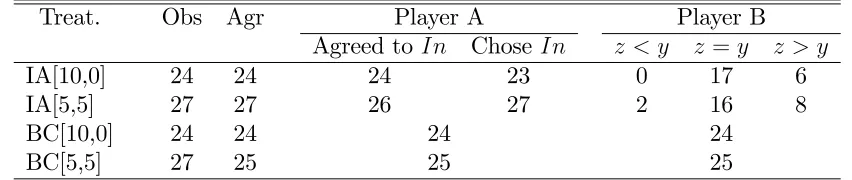
Table 2, distilled from Table 1, provides a summary of reached agreements and subsequent behavior. The …rst column, Obs, denotes the number of subject pairs who participated in a given treatment. The second column, Agr, provides the count of reached agreements which we further split (in subsequent columns) into what these agreements prescribe that players A and B will do. For A’s we compare the number of subjects who agreed on a
25Descriptive statistics could be found in Appendix A.
26Due to lack of disagreements in the data we cannot perform a meaningful test of our
prediction involving no deals.
Table 1: Raw data on agreements and path of play
IA[10,0] IA[5,5] BC[10,0] BC[5,5]
y z y z y=z y=z
0 15 15 15 14 14
10 20 15 15 15 15
13 18 15 15 15 15
15 15 15 15 15 15
15 15 15 15 15 15
15 15 15 15 15 15
15 15 15 15 15 15
15 15 15 15 15 15
15 15 15 15 15 15
15 15 15 15 15 15
15 15 15 15 15 15
15 15 15 16 15 15
15 15 15 17 15 15
15 15 15 25 15 15
15 15 15 20 15 15
15 15 15 30 15 15
15 15 15 30 15 15
15 15 15 30 15 15
15 15 16 16 15 15
15 15 16 20 15 15
15 20 17 15 15 15
15 30 18 18 15 16
15 30 18 18 15 17
15 Out 20 20 20 20
20 20 20
24 22 Disagr.
Out 15 Disagr.
Note: y refers to the agreed-upon amount that playerB would keep andz to the amountB actually kept.
Highlighted in bold are all observations that di¤er from 15.
Table 2: Agreements and honesty
Treat. Obs Agr Player A Player B
Agreed to In Chose In z < y z =y z > y
IA[10,0] 24 24 24 23 0 17 6
IA[5,5] 27 27 26 27 2 16 8
BC[10,0] 24 24 24 24
BC[5,5] 27 25 25 25
Note: In IA[5,5] one pair has agreed on playerAchoosingOut. Following this player A
choseInand playerB kept $15.
with the number who indeed chose In (column “Chose In”). For example, in the IA[10,0] treatment, presented in the …rst row, twenty-four A’s agreed to chooseIn, out of which twenty-three subsequently honored the agreement and chose In. In IA[5,5] twenty-six A’s agreed on In, all twenty-six indeed chose In. The twenty-seventh observation is the subjects who agreed to choose Out but in the end chose In. Finally, in the rightmost part of the table we list the number of B’s for whom the amount they kept (z) was smaller than, equal, or greater than the agreed upon amount (y). Naturally, in the BC-treatments, presented in the two bottom rows, there is no variation between the agreement and observed behavior of either player.
Table 2 shows that a majority of agreements were indeed honored. In all cases where playerAagreed to chooseIn, he indeed did so. B’s face a direct temptation to renege. Nevertheless, the proportion of B’s who honored the agreement is quite high. In IA[10,0] 74% of B’s did exactly as they agreed and in IA[5,5] the proportion was slightly lower at 64%.28
What about the subjects who reneged? Do they represent the sel…sh-fringe (captured by "i) as assumed by our theory? Recall that a player B who reneges on the agreement should act in his best self-interest by keeping 28Unlike PlayerA’s, Player B’s cost themselves a lot of money by not reneging. In the
all $30. Out of sixteen subjects who reneged (about 10% of all player B’s), …ve kept everything (i.e. 31% for those who reneged). The remaining eleven gave their paired player A’s a non-zero amount.29
Equal splits & e¤ect of d
[image:28.612.209.404.373.463.2]The theory makes the following predictions: First, in the BC-treatments sub-jects will agree on equal splits and there will be no sensitivity to d. Second, in IA-treatments equal splits will be more frequent than deals compensating playerA, and also more frequent than deals compensating playerB. Third, in IA[5,5], deals compensatingB will be more frequent and deals compensating A less frequent than in IA[10,0].
Table 3: Agreements
Treat. y <15 y = 15 y >15
BC[10,0] 1 22 1
BC[5,5] 1 20 4
IA[10,0] 3 21 0
IA[5,5] 0 18 8
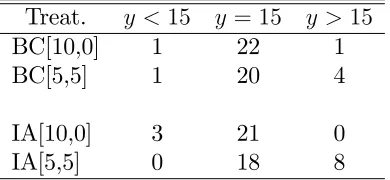
Table 3 categorizes data on individual agreements with respect to equal splits. In line with the …rst two predictions, in all treatments (BC and IA), equal splits (y = 15) are the most frequent agreements. We observe 86% pairs in the BC-treatments agree on the equal split and 78% pairs in the IA-treatments. There is a relatively small number of data points on compensated deals. Nevertheless, we …nd statistical support for the remaining predictions regarding treatment comparisons: First, in the BC-treatments we observe only a few deals that are not equal splits and …nd that binding contracts are not sensitive to variation in payo¤s following Out, i.e., there is no statistical
di¤erence in frequencies presented in the …rst two rows of Table 3 (two-sided Fisher’s exact test has p value = 0:58). Second, when it comes to compensated deals (y 6= 15), there is a distinct pattern: In IA[10,0] all pairs agree on player B keeping at least $15 (three pairs or 12.5% of the sample agreed on y < 15) while in IA[5,5] all pairs agree on B keeping at most $15 (eight pairs or 30.7% of the sample agreed on y > 15). The equality of distributions is rejected at 1% level (two-sided Fisher’s exact test has p value = 0:001).30 Informal agreements thus show sensitivity in the
predicted direction: A’s (B’s) get compensated more (less) often when their payo¤ following Out increases (decreases).
3.4
Additional Observations
As seen in section 3.3, the theory holds up rather well. However, the data exhibits a few seemingly systematic patterns which are either at odds with the theory, or not explicitly predicted. This section highlights three such occurrences that we …nd intuitively striking. We allow ourselves some leeway commenting on what may be going on.
Reneging and semi-honesty
Our …rst comment belongs to subjects who reneged but did not keep all $30. Such behavior lies outside the tight boundaries of our simple model. It is not easy to judge whether these subjects acted in an honest or a dishonest manner. On one hand, they did break the agreement; on the other hand, they still showed concern for their respective player A’s by sending them some money. Perhaps one might refer to them as semi-honest.
What should we think of their behavior? In IA[10,0] three pairs nego-tiated compensated deals, according to which B’s were supposed to keep y = 0;10; and 13. Following each of those deals, B’s reneged by “shading”
30If one runs a test on just the observations for which y6= 15, the results are virtually
the agreed-on amount by some fraction and keeping z = 15;20; and 18, re-spectively. It seems as if these semi-honest B’s had di¤erent deals in mind – ones that compensate them instead. The remaining data are in line with this story. In IA[5,5] we observe eight compensated deals (y = 16;17; and 24) but this time only three of theB’s reneged (z = 20;15;and22, respectively). Each of the three subjects gave his matched player A a positive amount. In two of those casesB actually gaveA more money than what they agreed on!
The sel…sh fringe
Next let us examine the behavior of playerB subjects who have kept all $30 for themselves. Only …ve subjects fall into this category. It might nev-ertheless be interesting to look at the negotiation patterns of these subjects. If their behavior was planned then they knew at the point of the agreement that they were going to renege. One would think that their main objective would then be to maximize the chances that their paired player A chooses In. What is the most likely behavior to do the job?
Looking at the data all …ve B’s in question ended up agreeing on an equal split. Three of them accepted the opening equal split proposals made by their respective A’s. One of them proposed an equal split which was accepted. And the last one initially proposed $25 for himself but that was rejected and countered with an equal split. This B accepted.
Beware of people who do not goof around! The sel…sh fringe in our data set hide among the subjects who strike 50/50 deals. We …nd it intriguing that there thus seem to be some degree of conformity in the community of con…dence tricksters. An analogous …nding, for a di¤erent strategic setting with asymmetric information, is reported by Charness & Dufwenberg (2011; see Section III.C)
Bargaining delay
all instances where the negotiating proceeds several rounds, this happens in the BC-treatments and involves some player who demands more than $15. To illustrate this, in Table 4 we list the sequences of proposal exchange for all deals that gave player B more money in treatments BC[5,5] and IA[5,5]. Notice that in BC[5,5] compensated deals involved a struggle between the paired subjects, with one pair negotiating for …fteen periods. In contrast, the compensated deals in IA[5,5] were negotiated in early rounds. We …nd the same pattern for other departures from equal split in BC[10,0] and IA[10,0] (see Table 5 which presents data on the length of negotiations broken down by …nal agreement y). Agreements that depart from equal splits in the BC-treatments were hard bargains while this is not the case in the IA-BC-treatments. Why do we observe this bargaining delay with informal agreements but not with binding contracts? Our intuition is as follows. In the BC-treatments a square deal is for the players to split the $30 right down the middle. On the other hand, in the IA-treatments anyycould be part of a possible square deal. If we suppose that the only legitimate proposals are those that could become a part of a square deal, then we might expect these o¤ers to be accepted more easily than others. These data patterns suggest an auxiliary observation that square deals form smoothly and without much delay. On the other hand, agreements that are not square deals must have involved illegitimate proposals and have led to con‡ict and longer o¤er-exchanges.
There are multiple ways of evaluating this conjecture. One is in terms of the length of negotiations. Table 5 provides clear support for the argument suggested above. The average length of negotiations for illegitimate proposals (in the BC-treatments when y 6= 15) is distinctly longer, 4.5-7 rounds, than for legitimate proposals, 1.048-1.818.31
Another way of looking at the same issue is by comparing acceptance rates for the initial proposals.32 Table 6 gives the summary of the data. One
Table 4: Sequences of proposals
IA[5,5] BC[5,5]
Obs: 1 2 3 4 5 6 7 8 1 2 3 4
Op. Prop.: B B A A B B A A B B B B
Rnd: 1 16 20 17 18 16 20 20 24 20 20 20 20
2 15 18 15 15 15
3 18 17 18 20
4 16 16 16 10
5 18 20
6 17 15
7 18 20
8 15 15
9 18 20
10 16 15
11 18 20
12 17 15
13 18 20
14 Out
15 17
Agreem.: 16 16 17 18 18 20 20 24 16 17 20 20
Note: Row “Op. Prop:” lists the player (AorB) who opened the negotiations. Sequences of proposal-exchange run from top to bottom. E.g., sequence 2 in IA[5,5] reads as follows: playerB made the …rst proposal to keep 20; playerAcountered with 15; playerB rejected this and suggested he keeps 18; then playerA went up to 16; and
this was accepted by player B.
Table 5: Average length of negotiations
IA[10,0] IA[5,5] BC[10,0] BC[5,5]
y= 15 1.048 1.5 1.818 1.55
(0.218),{21} (0.985),{18} (1.79),{22} (1.791),{20}
y6= 15 1.667 1.556 4.5 7
(1.155),{3} (1.014),{9} (2.121),{2} (6.52),{5}
Note: Standard deviations are in parentheses; number of observations are in braces; two cases in BC[5,5] where subjects failed to reach an agreement are excluded.
Table 6: Acceptance rates of initial proposals
IA[10,0] IA[5,5] BC[10,0] BC[5,5] Op. proposal= 15 20/20 13/15 14/15 16/17
100% 86.7% 93.3% 94.1%
Op. proposal6= 15 2/4 6/12 0/9 1/10
50% 50% 0% 10%
(Fisher’s exact test has p-value = 0:000). This evidence also suggests that the departures from equal splits in the BC-treatments are typically found unjusti…ed and become hard bargains. The resulting deals are then likely driven by an imbalance in subjects’patience and obstinacy.
Informal agreements a¤ect play
[image:33.612.134.473.325.414.2]on their data.33 The comparison is not perfect as the available money for
the second-mover to split was $20, not $30, but with that caveat we can record the following di¤erences most of which are statistically signi…cant (we give proportions only but number of observations and formal test results are available on request):
OurB’s choose more equal splits than S&V’s (78% vs 35% for the [10,0]-treatments); 50% vs 31% for the [5,5]-treatments). OurB’s give zero (z = 0) less often than S&V’s (9% vs 38% for [10,0]; 12% vs 31% for [5,5]). Our B’s give more than S&V’s (the average amounts given, measured as percentages of the available pie, are 44% vs 31% for [10,0]; 39% vs 26% for [5,5]).
4
Discussion
Informal agreements have been given rather scant attention in economic the-ory. Are they economically unimportant? Couldn’t agents simply always rely on binding contracts to achieve good partnership outcomes? We do not think so for several reasons.
First, binding contracts may be infeasible. Consider two impatient …sher-men who live in a developing country where neither courts nor police…sher-men are reliable. It may be impossible to draft a binding contract which regulates the …shermen’s access to a nearby lake. Does this mean that they are destined to ine¢ cient excessive depletion of the …sh stock? Even if the interaction is repeated, classical theory would say yes (because of the impatience). How-ever, according to our theory, the answer may be no, if the …shermen rely on an informal agreement.
Second, binding contracts may be illegal. Think of collusion in a one-shot government procurement auction in industrial countries. Courts exist and police can be relied on, yet bid rigging would not be legal. Does that imply that the outcome will conform with standard auction theory, where 33Similar conclusions would be reached if we considered the data of Dufwenberg &
the competing …rms maximize pro…t taking each others’ actions as given? Perhaps not. Suppose the …rm representatives meet in a bar, have a pint, shake hands, and agree to collude. Will this stick? If the representatives take pride in standing by their word, the answer may be yes.
Third, even if binding contracts are feasible in principle (as they perhaps usually are) they may be costly. A guy meets a girl and they play the (one-shot, sequential) game of life with decisions on kids, who works, divorce, alimony, etc. A binding contract may involve signi…cant costs ranging from lawyers’ fees to unforeseen contingencies to awkward feelings regarding le-gal chit-chat during courtship. Perhaps, instead, the couple will shun the formalities, look one another in the eye, and promise to be faithful forever?
Just how compelling are these examples? Under which circumstances will informal agreements work? How will the terms be structured? How will the deals shape subsequent play? How do the outcomes compare to those that would obtain under a binding contract? Answers require theory.
We have proposed a theory of deal-making which covers informal agree-ments and binding contracts as special cases. We suggest that people –who deep down may be motivated in complicated, rich, and hard-to-pin-down-in-mathematical-formulae ways –do not engage in any elaborate utility calculus when striking deals. They rather focus on easy-to-observe data, namely dol-lars gained. Inspired by Binmore et al’s so-called deal-me-out solution, we assume that people agree to split dollar gains equally, as long as each person is thereby made better o¤ than if the negotiations stranded.
of these predictions, and found considerable support.
We hope this will inspire economists to apply our model, to study various economic settings where people strike deals, be they informal or binding. That said, we conclude by noting a few issues we did not address so far. First, in context where both informal agreements and binding contracts are feasible, one may wish to endogenize the choice between the two. So far we assumed the feasible deals to involve one or the other. Second, one may imagine deals that regulate some but not all choices, and so would be intermediate to the polar cases of an informal agreement and a binding contract. Our framework may be adequate for exploring such “incomplete contracts”. Third, in many contexts material costs and revenues are not as readily observable as our above account (with given mi functions) may suggest. For example, how should considerations of unobserved cost-of-e¤ort or consumer surplus be dealt with? Fourth, (as discussed in section 2.2) even when dollar payo¤s are given, 50/50 splits may not be focal in all setting and a re…ned theory may consider alternatives. Fifth, we limited attention to games with two players, but many situations involve multiple bargaining parties. We plan to explore these extentions in future work.
References
[1] Andreoni, J. & B.D. Bernheim (2009): “Social Image and the 50-50 Norm: A Theoretical and Experimental Analysis of Audience E¤ects,”
Econometrica 77, 1607–1636.
[2] Battigalli, P. & M. Dufwenberg (2007): “Guilt in Games,”American Economic Review, Papers and Proceedings, 97, 170–176.
[4] Benartzi, S. & R. Thaler (2004): “Save More Tomorrow: Using Be-havioral Economics to Increase Employee Savings,”Journal of Political
Economy 112, 164–187.
[5] Ben-Ner, A. & L. Putterman (2009): "Trust, Communication and Con-tracts: An Experiment," Journal of Economic Behavior & Organization
70, 106–121.
[6] Binmore, K., A. Shaked & J. Sutton (1989): “An Outside Option Ex-periment,”Quarterly Journal of Economics 104, 753–770.
[7] Binmore, K., C. Proulx, L. Samuelson & J. Swierzbinski (1998): “Hard Bargains and Lost Opportunities,”Economic Journal 111, 1279–1298.
[8] Brown, A. L., Z. E. Chua & C. F. Camerer (2009): “Learning and Vis-ceral Temptation in Dynamic Savings Experiments,"Quarterly Journal of Economics 124, 197–231.
[9] Camerer, C. (2003): Behavioral Game Theory: Experiments in Strategic Interaction, Princeton University Press.
[10] Charness, G. & M. Dufwenberg (2006): “Promises & Partnership,”
Econometrica 74, 1579–1601.
[11] –(2011) : “Participation,”American Economic Review 101, 1213–39.
[12] Charness, G., E. Haruvy & D. Sonsino (2007): "Social distance and reciprocity: an internet experiment," Journal of Economic Behavior & Organization, 63(1), 88–103.
[13] Cox, J., M. Servátka & R. Vadoviµc (2010): “Saliency of Outside Options in the Lost Wallet Game,”Experimental Economics, 13(1), 66–74.
[14] Crawford, V. & J. Sobel (1982): “Strategic Information Transmission,”
[15] Dekel, E. & B. Lipman (2011): “Costly Self Control and Random Self Indulgence,” unpublished manuscript.
[16] Demichelis, S. & J. Weibull (2008): “Language, Meaning and Games –A Model of Communication, Coordination and Evolution,”American
Economic Review 98, 1292–1311.
[17] Dufwenberg, M. & U. Gneezy (2000): “Measuring Beliefs in an Experi-mental Lost Wallet Game,”Games & Economic Behavior 30, 163–182.
[18] Dufwenberg, M. & G. Kirchsteiger (2004): “A Theory of Sequential Reciprocity,”Games & Economic Behavior 47, 268–298.
[19] Eller, K. (2004): Integrity Is All You’ve Got, McGraw-Hill.
[20] Ellingsen, T. & M. Johannesson (2004): “Promises, Threats and Fair-ness,”Economic Journal 114, 397–420.
[21] Falk, A. & U. Fischbacher (2006): “A Theory of Reciprocity,”Games & Economic Behavior 54, 293–315.
[22] Farrell, J. & M. Rabin (1996): “Cheap Talk,”Journal of Economic Perspectives 10, 103–118.
[23] Fehr, E. & K. Schmidt (2003): “Theories of Fairness & Reciprocity – Evidence & Economic Applications,”in: M. Dewatripont, L. Hansen, S. Turnovsky (eds.), Advances in Economics & Econometrics, 8th World Congress Econometric Society Monographs, Cambridge Univ Press.
[24] Feltovich, N. & J. Swierzbinski (2011): “The Role of Strategic Uncer-tainty in Games: An Experimental Study of Cheap Talk and Contracts in the Nash Demand Game,”European Economic Review 55, 554–574.
[26] Fudenberg, D. & D.K. Levine (1993): “Self-Con…rming Equilibrium,”
Econometrica 61(3), 523–545.
[27] –(2006): “A Dual-Self Model of Impulse Control,”American Economic Review 96, 1449–1476.
[28] Fudenberg, D. & J. Tirole (1991): Game Theory, MIT Press.
[29] Geanakoplos, J., D. Pearce & E. Stacchetti (1989): “Psychological Games and Sequential Rationality,”Games & Economic Behavior 1, 60–79.
[30] Gneezy, U. (2005): “Deception: The Role of Consequences,”American Economic Review 95, 384–394.
[31] Greenberg, J. (2000), “The Right to Remain Silent,”Theory & Decision
48, 193-204.
[32] Gul, F. & W. Pesendorfer (2001): “Temptation and Self-Control,”
Econometrica 69, 1403–1435.
[33] Irlenbusch, B. (2004): "Relying on a Man’s Word? An Experimental Study on Non-Binding Contracts," International Review of Law & Eco-nomics 24, 299-332.
[34] Isoni, A., A. Poulsen, R. Sugden & K. Tsutsui (2011): "Focal Points in Tacit Bargaining," CBESS Discussion Paper 11-13, University of East Anglia.
[35] Kalai, E. (1977): “Proportional Solutions to Bargaining Situations: Inter-Personal Utility Comparisons,”Econometrica 45, 1623–1630.
[37] Kartik, N. (2009): “Strategic Communication with Lying Costs,”Review of Economic Studies 76, 1359–1395.
[38] Kerr, N.L. & C.M. Kau¤man-Gilliland (1994): “Communication, Com-mitment, and Cooperation in Social Dilemmas,”Journal of Personality & Social Psychology 66, 513–529.
[39] Kessler, J. & S. Leider (2012): “Norms & Contracting,”Management Science 58, 62–77.
[40] Levin, J. (2003): “Relational Incentive Contracts,”American Economic Review 93, 835–57.
[41] Lipman, B. & W. Pesendorfer (2011): “Temptation,”unpublished man-uscript.
[42] Loewenstein, G. (1996): “Out of Control: Visceral In‡uences on Behav-ior,”Organizational Behavior & Human Decision Processes 65, 272–292.
[43] Loewenstein, G. & T. O’Donoghue (2005): “Animal Spirits: A¤ective and Deliberative Processes in Economic Behavior,” unpublished manu-script.
[44] MacLeod, B. & J. Malcolmson (1989): “Implicit Contracts, Incentive Compatibility and Involuntary Unemployment,”Econometrica 56, 447– 480.
[45] Malhotra, D. & J. Murnighan (2002): “The e¤ects of contracts on in-terpersonal trust,”Administrative Science Quarterly 47, 534–559.
[46] Martinsson, P., K. Myrseth & C. Wollbrant (2012): "Reconciling Pro-Social vs. Sel…sh Behavior: On the Role of Self-Control," Judgment & Decision Making 7, 304-315.
[48] Myerson, R. (1986): “Multi-Stage Games with Communication,” Econo-metrica 54, 323–358.
[49] Nash, J. (1950): “The Bargaining Problem,”Econometrica 18, 155–162.
[50] –(1953): “Two-person Cooperative Games,”Econometrica, 21, 128–40.
[51] Ozdenoren, E., S. Salant & D. Silverman (2011): “Willpower and the Optimal Control of Visceral Urges,”Journal of the European Economic Association, forthcoming.
[52] Rabin, M. (1993): “Incorporating Fairness into Game Theory and Eco-nomics,”American Economic Review 83, 1281–1302.
[53] Schelling, T. (1960): The Strategy of Con‡ict, Harvard University Press.
[54] Servátka, M., S. Tucker & R. Vadoviµc (2011): “Words Speak Louder Than Money,”Journal of Economic Psychology 32, 700–709.
[55] Servátka, M. & R. Vadoviµc (2009): “Unequal Outside Options in the Lost Wallet Game,”Economics Bulletin, 29(4), 2870-2883.
[56] Thaler, R. & H. Shefrin (1981): “An Economic Theory of self-Control,”
Journal of Political Economy 89, 392–410.
Appendix
[image:42.612.112.501.231.363.2]A
Session overview
Table 7: Treatments
Tr. Name Type of Agreement Outside Opt. Session # of subj.
IA[10,0] Informal [10,0] Sess. 1 20
IA[10,0] Informal [10,0] Sess. 2 28
IA[5,5] Informal [5,5] Sess. 1 28
IA[5,5] Informal [5,5] Sess. 2 26
BC[10,0] Binding [10,0] Sess. 1 & 2 10
BC[10,0] Binding [10,0] Sess. 3 28
BC[5,5] Binding [5,5] Sess. 1 30
BC[5,5] Binding [5,5] Sess. 2 24
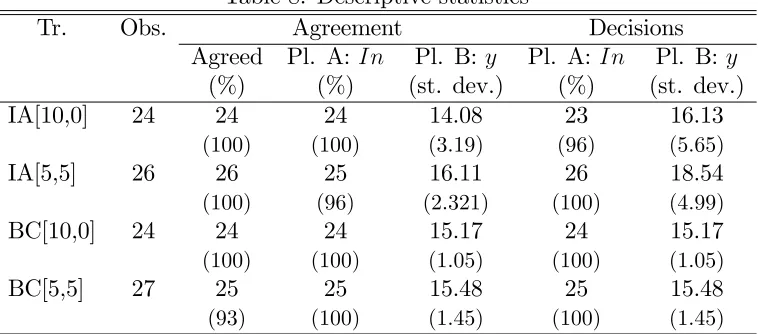
Table 8: Descriptive statistics
Tr. Obs. Agreement Decisions
Agreed Pl. A:In Pl. B: y Pl. A: In Pl. B: y (%) (%) (st. dev.) (%) (st. dev.)
IA[10,0] 24 24 24 14.08 23 16.13
(100) (100) (3.19) (96) (5.65)
IA[5,5] 26 26 25 16.11 26 18.54
(100) (96) (2.321) (100) (4.99)
BC[10,0] 24 24 24 15.17 24 15.17
(100) (100) (1.05) (100) (1.05)
BC[5,5] 27 25 25 15.48 25 15.48
(93) (100) (1.45) (100) (1.45)
Note: In IA[10,0] one pair has agreed that playerA chooses Out. Following this player
[image:42.612.117.496.420.587.2]B
Instructions
In what follows we present the universal version of the instructions in which {... or ...} always contains two di¤erent versions of the text that was used appropriately in di¤erent treatments.
Now that the experiment has begun, we ask that you do not talk with each other for the duration of the experiment. If you have a question after we …nish reading the instructions, please raise your hand and the experimenter will approach you and answer your question in private.
You will receive $5 for participating in this experiment. You may also re-ceive additional money, depending on the choices made (as described below). Your earnings will be paid to you in cash individually and privately.
During the session, you will be paired with another person. However, no participant will ever know the identity of the person he or she is paired with. In the experiment, one person from each pair will be randomly selected to be Player A and the other to be Player B. The players will interact in two stages: 1. The Negotiation Stage and 2. The Game. In the negotiation stage the players can form an agreement about how to play the game. Any agreement reached in the negotiation stage {will or will not}be enforced and the players {will have to play according to the agreement or be free to make any decisions} in the game that follows. The decisions in the negotiation stage will determine how much each of the players earns in the experiment.
We next describe …rst the game and then the negotiation stage that pre-cedes it.
The Game
Player A moves …rst and chooses either IN or OUT by clicking a button labeled either “IN” or “OUT.”
If Player A chose OUT, then the game ends. Player A receives {$5 or $10} and Player B receives { $5 or $0} .
If Player A chose IN, thenPlayer B splits $30 between the two of them: Player B keeps $x and gives $30-x to Player A, choosing x such that $0 x $30.
The Negotiation Stage
Before the game is played the players can form an agreement about how to play the game. One player from each pair will be randomly selected to make the …rst proposal and the other player will be asked to respond to it. A proposal describes the choices of Player A and Player B in the game.
It could be:
Player A chooses OUT or it could be
Player A chooses IN and
Player B keeps $x and gives $30 –x to Player A.
The proposal is sent to the other player by clicking on the “Submit” button. The responding player observes the proposal and chooses one of the following three options:
Agree with the proposal by clicking on the button “Agree.”In this case an agreement is formed and {will or will not} be enforced.