Organized by G. V. S. E. T., Jaipur. Available Online at www.ijpret.com294
INTERNATIONAL JOURNAL OF PURE AND
APPLIED RESEARCH IN ENGINEERING AND
TECHNOLOGY
A PATH FOR HORIZING YOUR INNOVATIVE WORK
ADVANCED USE OF CERAMICS
VIKASH KUMAR1, SACHIN KUMAR2
1. Student, Department of Mechanical Engineering, Suresh Gyan Vihar University (SGVU), Jaipur, India
2. Assistant Professor, Department of Mechanical Engineering, Suresh Gyan Vihar University (SGVU), Jaipur, India Accepted Date: 19/03/2018; Published Date: 01/04/2018
Abstract:The terms ceramic is used for making clay based element in our domestic life at
law cost. The products of ceramics have a smooth and good finished surface with law cost. Ceramic is used as biometric in making artificial teeth, bone parts and have a huge scope in future. In this paper advance use of ceramics is discussed.
Keywords: Ceramics
Corresponding Author: VIKASH KUMAR
Access Online On:
www.ijpret.com
How to Cite This Article:
Vikas Kumar, IJPRET, 2018; Volume 6 (8): 294-298
PAPER-QR CODE
SPECIAL ISSUE FOR
NATIONAL LEVEL CONFERENCE
Organized by G. V. S. E. T., Jaipur. Available Online at www.ijpret.com295 INTRODUCTION
Ceramic is a Greek word meaning ‘POTTERY’. The ceramic may be in crystalline form or in powdered form. The component used for making ceramic is clay, sand, soil, earthen elements, powders and water. When these elements are mixed together in a desired composition and shaped them into desired shape, is called ceramic product. Ceramics are the substance formed by providing them the desired shape and heating in high temperature and subsequent them, this process is known as ‘KILN’. The products of ceramic is covered with thin plastic film, paints for long lasting, this process is called as glazes.
Most ceramics are good insulator and can be operated at high temperature. This type of ceramic is used in modern life. We can find ceramic all around us .The objects like brick, statue, pot, toys, toilets, plates, glass, electric appliance are ceramic product. Ceramics can be found in products like watches, automobiles, phone lines, space shuttles. On the basis of their formation they can be dense or lightweight. They have good strength and hardness. However they are brittle in nature. They can with stand at high temperature from 1000°C to 1600°C. In actual practical glass is not a ceramic, it is a amorphous solid (non-crystal) but during the formation glass some steps are similar to ceramic and the mechanical properties are similar so the glass can be a part of ceramic.
Advantages of Ceramic
Low cost
Easy to use
Can be use at high temperature
Disadvantages of Ceramic
Can’t be operating at high stress.
For small surface processing is critical
Types of Ceramic
Organized by G. V. S. E. T., Jaipur. Available Online at www.ijpret.com296 Traditional Ceramic: - Traditional ceramic is also known as pottery ceramic. It is one of the human oldest technologies. Fragments of clay pottery is recently found in China, have been carbonated to 17500°C -18300°C years old. Nearby 1950s the most important were traditional ceramic clays, used to make bricks, tiles.
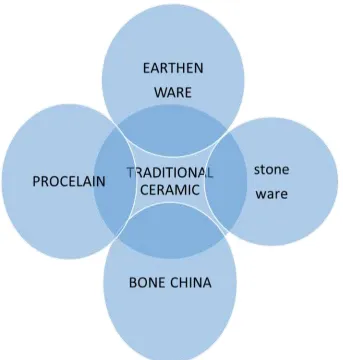
Traditional ceramic is clay based, the composition of the clay used, types of additives heating and cooling determines the end product.
Types of Traditional Ceramic
Fig. 2 Types of Traditional Ceramic
Organized by G. V. S. E. T., Jaipur. Available Online at www.ijpret.com297 Stoneware: - it is heated at high temperature, about 1200 till converted into mold and then cast in to desired shape used for kitchen, cooking, baking, and storing liquid. The material used in stoneware is mostly similar to glass in respect of processing and mechanical properties.
Porcelain: - Porcelain is very hard in nature. The earliest form porcelain is in China. The porcelain is obtained used to make plates, cups, toys and other fine arts. The porcelain is now a day’s is known as “FINE CHINA”. The component used for making porcelain is glass, granite, and feldspar material are mixed with white kaolin clay and water. Water is added to make the mixture porous so that it can be casted in to desired shape. Then the final product is heated at 1200°C to 1450°C.
Bone China: - Bone china is easier to make and it is harder then porcelain. The components of bone china are clay, feldspar, minerals and fine silica sand.
Advanced Ceramic: - These are based on oxides or non-oxides or combination of oxides and non-oxides. The oxides used are alumina and zirconia and non-oxides are carbides, borides, nitrides, and silicides. Tiles are made through this process.
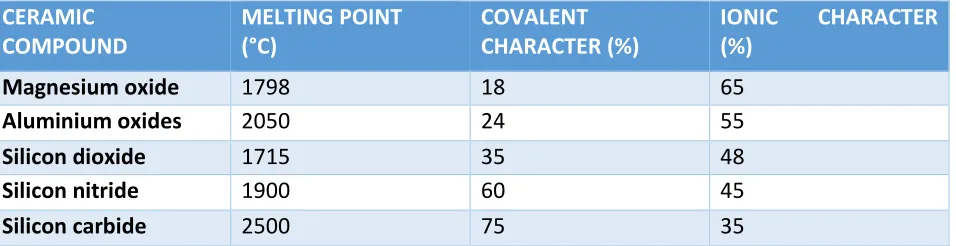
For the formation of ceramic the metals are fused with oxides, nitrides, carbides, and dioxides. The table 1 shows the different ceramic types with their characteristics,
Table 1: Different ceramic types with their characteristics
CERAMIC COMPOUND MELTING POINT (°C) COVALENT CHARACTER (%)
IONIC CHARACTER
(%)
Magnesium oxide 1798 18 65
Aluminium oxides 2050 24 55
Silicon dioxide 1715 35 48
Silicon nitride 1900 60 45
Silicon carbide 2500 75 35
For this process raw materials are converted in to very fine powder and then casted into desired shape and heated at a temperature of 1,600-1,800C, this process is performed in oxygen free atmosphere. The high temperature helps the particles of powder to form a strong and compact bond between them.
The advanced ceramic are used in industries, metals production and processing, aerospace, personal protection, in automobile engine as a spark plug.
Advantages of Advance Ceramic
Most of the advanced ceramics are opaque i.e. light can be passed through them these are
used to make window glass, wood stoves.
Organized by G. V. S. E. T., Jaipur. Available Online at www.ijpret.com298
These are used in art work
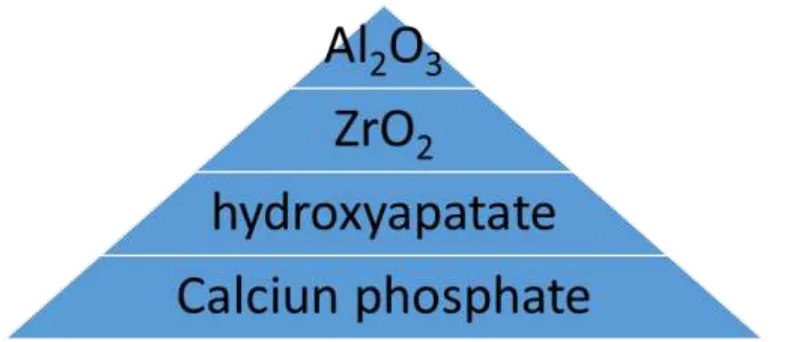
The chemical bond of ceramic can be covalent, polar or ionic covalent based on their chemical composition and heat treatment. When metals and non metals are used as constituents then the bonding between particles is ionic. Advanced ceramic is used in Medical Science as “Biomaterial”.
Biomaterial Ceramics
Fig. 3 Biomaterial ceramics
A variety of materials has been developed which fulfill such criteria has been developed in recent years. The most frequently biometric ceramics due to their properties of mechanical,
chemical, physical and non-toxic properties are Al2O3 and ZrO2.
The calcium phosphate is mostly used as biometric ceramic due to its advantages like.
Porosity.
Chemical and phase combination.
REFERENCES
1. Ceramic material progress in modern ceramic by feng shi, PDF
2. ROBYN L. Johnson ceramics in the classroom
3. Science learning hub ceramics
4. AMERICAN CERAMIC SOCIETY EROM http//www.ceramics.org