Petabytes to Science
Amanda E. Bauer,1Eric C. Bellm,2, 3Adam S. Bolton,4Surajit Chaudhuri,5 A.J. Connolly,3Kelle L. Cruz,6, 7, 8Vandana Desai,9Alex Drlica-Wagner,10, 11 Frossie Economou,1Niall Gaffney,12J. Kavelaars,13J. Kinney,14Ting S. Li,11, 10
B. Lundgren,15R. Margutti,16G. Narayan,17B. Nord,10, 11, 18Dara J. Norman,4 W. O’Mullane.,1S. Padhi,19J. E. G. Peek,17, 20C. Schafer,21Megan E. Schwamb,22
Arfon M. Smith,17Alexander S. Szalay,23, 20Erik J. Tollerud,17and Anne-Marie Weijmans24
1Large Synoptic Survey Telescope (LSST/AURA) 2LSST
3DIRAC Institute, Department of Astronomy, University of Washington 4NOAO
5Microsoft Research
6Hunter College, City University of New York 7American Museum of Natural History
8Center for Computational Astrophysics, Flatiron Institute 9Caltech/IPAC
10Fermi National Accelerator Laboratory
11Kavli Institute of Cosmological Physics, University of Chicago 12Texas Advanced Computing Center
13National Research Council of Canada 14Google Inc.
15University of North Carolina Asheville 16Northwestern University 17Space Telescope Science Institute
18Department of Astronomy and Astrophysics, University of Chicago 19Amazon Web Services
20Department of Physics & Astronomy, The Johns Hopkins University 21Carnegie Mellon University
22Gemini Observatory
23Department of Computer Science, The Johns Hopkins University 24School of Physics and Astronomy, University of St Andrews
Abstract
A Kavli foundation sponsored workshop on the themePetabytes to Sciencewas held 12t h to 14t h of February 2019 in Las Vegas. The aim of the this workshop was to discuss
important trends and technologies which may support astronomy. We also tackled how to better shape the workforce for the new trends and how we should approach education and public outreach. This document was coauthored during the workshop and edited in the weeks after. It comprises the discussions and highlights many recommendations which came out of the workshop.
We shall distill parts of this document and formulate potential white papers for the decadal survey.
Contents
1. Introduction 5
2. Recommendations 6
3. Scientific Context and Drivers 9
3.1. Planetary Systems; Star and Planet Formation 9
3.2. Stars and Stellar Evolution; Resolved Stellar Populations 10
3.3. Compact Objects; Time-Domain and Multi-Messenger Astrophysics 11
3.4. Galaxy Evolution 11
3.5. Cosmology and Fundamental Physics 12
3.6. Combining Multiple Probes of Cosmology and Galaxy Evolution 13
4. Data Management 15
4.1. Interoperability 16
4.1.1. Common observation models 16
4.1.2. Data storage 16
4.1.3. Eliminating file systems 17
4.1.4. Interoperable science platforms 17
4.2. Lowering the barriers to public data access 17
4.2.1. Computational resources 18
4.2.2. Documentation 18
4.2.3. Professional training 18
4.2.4. Education and Public Outreach 19
4.3. Long-term data preservation 19
5. Technology & Infrastructure 21
5.1. Commodity services andsoftwarebased community architecture 21
5.1.1. Identity and Access Management (IAM) 25
5.2. Data co-location and creating data lakes 25
5.2.1. Network layer 26
5.2.2. Vendor freedom 27
5.3. Operations 27
5.4. Sustainability and effectiveness 29
6. Software 31
6.1. Recommendations 31
6.2. Why sharedsoftwarematters, today and in the next decade. 32
6.2.1. Software is everywhere 32
6.2.2. Software encodes knowledge 33
6.3. Progress in the last the decade 33
6.4. Communitysoftwareas a force multiplier 36
6.4.1. Open development/Open collaboration 36
6.5. Communitysoftwareproblems and solutions 37
6.6. Software is alive 38
6.6.1. Thesoftwarestack is always changing. We need to be adaptable. 38
6.6.2. Software needs to be sustainable 39
7. Analysis Methods: Algorithms and Statistical Foundations 41
7.1. Recommendations 41
7.2. Overview 42
7.3. Discovery in the Petabyte Era 42
7.4. The state of statistics: statistical methodologies for astrophysics 44
7.4.1. Technical Challenges 45
7.4.2. Organizational Challenges 46
7.5. The state of algorithms: developments in the last decade 47
7.5.1. Technical challenges 48
7.5.2. Organizational challenges 49
7.6. Emerging trends in industry and other fields 49
7.7. Enhancing Interdisciplinary Programs and Collaborations 50
7.8. Education and training 52
8. Workforce & Career Development 54
8.1. The growing importance of a tech-savvy workforce of astronomers 54
8.2. Demographics - who is this workforce and where are they now 54
8.3. Training to contribute tosoftwaredevelopment: Building the next generation 55
8.4. Training to take advantage of big data for research: Bytes to Science 58
8.5. Identifying career paths around scientificsoftwaredevelopment & big data
science 59
8.5.1. Universities 59
8.5.2. Science/Data centers 60
8.6. Elevating the role ofsoftwareas a product of the research enterprise 61
8.6.1. Measuring/citing the impact of software 62
8.6.2. Strategies for elevating the role of software 62
9. A need for dedicated education and outreach expertise 64
9.1. Create accessible online activities for the public 65
9.1.1. Examples of online activities 65
9.2. Bring expertise to astronomy education and outreach teams 68
9.3. Fund dedicated astronomy education and outreach groups 69
1. INTRODUCTION
Contributors: William O’Mullane <[email protected]>, Ting Li <[email protected]>
In the Petabyte era the lines between software, technology and science are blurred - the chance to do science with petabytes without major infrastructure is pretty slim. Therefore the importance of technology in science exploitation becomes ever more important, which also implies we pick up the pace in training the workforce and in the areas of education and public outreach.
The Kavli foundation sponsored a series of workshops on the themePetabytes to Science1,
the second of which was held 12t h to 14t h of February 2019 in Las Vegas. The aim of the
this second workshop was to formulate potential APC white papers. To facilitate this we discussed important trends, technologies, approaches to workforce management, education and public outreach. We took a holistic approach and built a single document encompassing several broad categories, namely:
• Science drivers (Section 3) - which science cases need new techniques and ap-proaches?
• Data Management (Section 4) - what data management challenges does this present? • Software (Section 6) - how shouldsoftwarebe developed to meet those challenges? • Technology and Infrastructure (Section 5) - what technologies and infrastructure is
needed to under pin the services?
• Workforce and Inclusion (Section 8) - what training should we do to prepare ? How can we improve and diversify the workforce?
• Education and Public Outreach (Section 9) - through EPO can we increase awareness of the public about astronomy and ensure future finding streams? What are the challenges and opportunities for EPO?
From each of the sections a number of recommendations were identified, these are sum-marized inSection 2. For each recommendation we suggest the audiences they are useful to and the time period in which they should be executed (this may be seen as a sort of priority). The time periods or terms are short term (1-3 years), medium term (3-5 years) and long term (5-10 years).
The intention is to extract some decadal survey APC papers from these ideas. If you are interested in contributing to or endorsingwhite papers on these topics sign up here2 or contact the authors listed in this document – names followed by an email address are the leads of each chapter.
Note: This document is a collection of ideas and a record from a workshop - it is not a polished document. We have made some effort to not have repetitions between chapters however we do not guarantee a pleasant coherent read.
2. RECOMMENDATIONS
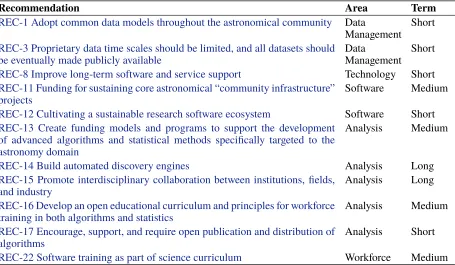
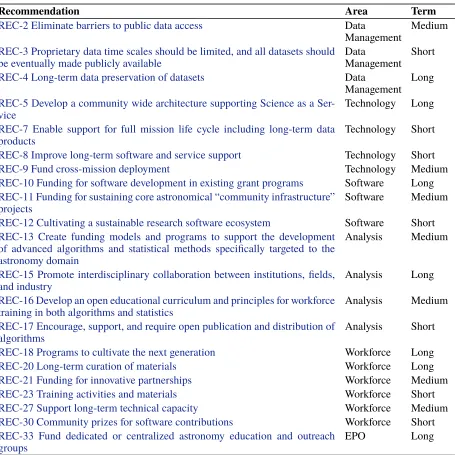
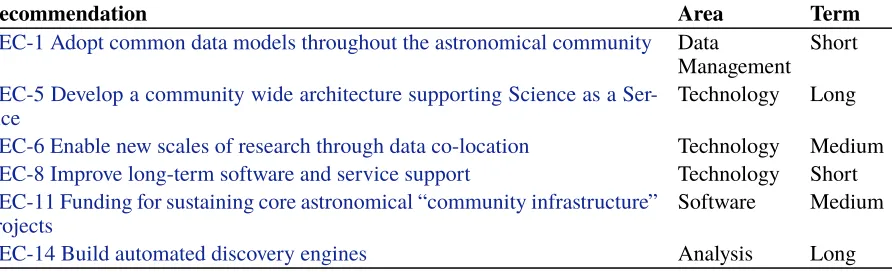
These tables summarize the recommendations in the document per audience we feel would be interested. Clicking the label or text will take you to the full recommendation in the document.3 Please note that a recommendation may be aimed at multiple audiences and
[image:6.612.97.552.178.443.2]therefore may appear more than once in the tables below.
Table 1. Astronomer recommendations.
Recommendation Area Term
REC-1 Adopt common data models throughout the astronomical community Data
Management Short
REC-3 Proprietary data time scales should be limited, and all datasets should
be eventually made publicly available DataManagement Short
REC-8 Improve long-term software and service support Technology Short
REC-11 Funding for sustaining core astronomical “community infrastructure”
projects Software Medium
REC-12 Cultivating a sustainable research software ecosystem Software Short
REC-13 Create funding models and programs to support the development of advanced algorithms and statistical methods specifically targeted to the astronomy domain
Analysis Medium
REC-14 Build automated discovery engines Analysis Long
REC-15 Promote interdisciplinary collaboration between institutions, fields,
and industry Analysis Long
REC-16 Develop an open educational curriculum and principles for workforce
training in both algorithms and statistics Analysis Medium
REC-17 Encourage, support, and require open publication and distribution of
algorithms Analysis Short
[image:6.612.95.551.486.632.2]REC-22 Software training as part of science curriculum Workforce Medium
Table 2. Manager recommendations.
Recommendation Area Term
REC-4 Long-term data preservation of datasets Data
Management Long
REC-12 Cultivating a sustainable research software ecosystem Software Short
REC-15 Promote interdisciplinary collaboration between institutions, fields,
and industry Analysis Long
REC-25 Recognize software as part of the career path Workforce Short
REC-29 Adopt promotion metrics that acknowledge software and other science
support Workforce Long
REC-32 Bring dedicated experts onto astronomy education and outreach teams EPO Medium
Table 3. University recommendations.
Recommendation Area Term
3In a PDF it may be useful to note that CMD←(CTRL on Windows/Linux) returns you to from whence
REC-22 Software training as part of science curriculum Workforce Medium
REC-26 Partnerships to support data science staff Workforce Medium
Table 4. Agency recommendations.
Recommendation Area Term
REC-2 Eliminate barriers to public data access Data
Management Medium
REC-3 Proprietary data time scales should be limited, and all datasets should
be eventually made publicly available DataManagement Short
REC-4 Long-term data preservation of datasets Data
Management Long
REC-5 Develop a community wide architecture supporting Science as a
Ser-vice Technology Long
REC-7 Enable support for full mission life cycle including long-term data
products Technology Short
REC-8 Improve long-term software and service support Technology Short
REC-9 Fund cross-mission deployment Technology Medium
REC-10 Funding for software development in existing grant programs Software Long
REC-11 Funding for sustaining core astronomical “community infrastructure”
projects Software Medium
REC-12 Cultivating a sustainable research software ecosystem Software Short
REC-13 Create funding models and programs to support the development of advanced algorithms and statistical methods specifically targeted to the astronomy domain
Analysis Medium
REC-15 Promote interdisciplinary collaboration between institutions, fields,
and industry Analysis Long
REC-16 Develop an open educational curriculum and principles for workforce
training in both algorithms and statistics Analysis Medium
REC-17 Encourage, support, and require open publication and distribution of
algorithms Analysis Short
REC-18 Programs to cultivate the next generation Workforce Long
REC-20 Long-term curation of materials Workforce Long
REC-21 Funding for innovative partnerships Workforce Medium
REC-23 Training activities and materials Workforce Short
REC-27 Support long-term technical capacity Workforce Medium
REC-30 Community prizes for software contributions Workforce Short
REC-33 Fund dedicated or centralized astronomy education and outreach
[image:7.612.97.552.161.616.2]groups EPO Long
Table 5. Educator recommendations.
Recommendation Area Term
REC-22 Software training as part of science curriculum Workforce Medium
REC-31 Create accessible online Activities for the Public EPO Short
Table 6. Technologist recommendations.
Recommendation Area Term
REC-1 Adopt common data models throughout the astronomical community Data
Management Short
REC-5 Develop a community wide architecture supporting Science as a
Ser-vice Technology Long
REC-6 Enable new scales of research through data co-location Technology Medium
REC-8 Improve long-term software and service support Technology Short
REC-11 Funding for sustaining core astronomical “community infrastructure”
projects Software Medium
3. SCIENTIFIC CONTEXT AND DRIVERS
Contributors: Adam Bolton <[email protected]>, Eric Bellm, Alex Drlica-Wagner, Ting Li, Raffaella Margutti, Gautham Narayan, Meg Schwamb
Note: If you have come directly to this chapter we suggest you please read at least the Introduction inSection 1before delving further.
The last two decades have seen a significant increase in the prominence of data-intensive, survey-scale astronomy. Surveys such as Sloan Digital Sky Survey (SDSS), Dark Energy Survey (DES), Pan-STARRS, and Zwicky Transient Facility (ZTF) have pioneered these modes. Even more ambitious projects such as Dark Energy Spectroscopic Instrument (DESI),Large Synoptic Survey Telescope (LSST),WFIRST, andSquare Kilometer Array (SKA) are rapidly approaching, bringing new opportunities and challenges for petascale astronomical science.
From an experimental design perspective, the development of large survey projects and facilities has been driven by fundamental scientific questions about the Solar System, our Milky Way and its stellar populations and satellites, the evolution of galaxies and quasars, and the nature of dark matter and dark energy. These questions have in common the need to obtain significant statistics over large population samples or volumes, or alternatively, to realize significant probabilities for the discovery of rare objects or events.
Big surveys naturally lead to big datasets. These big datasets in turn bring qualitatively new challenges in data management, computing, software, and professional development that must be tackled to realize the scientific promise of the surveys themselves.
Big datasets from big surveys also open up diverse opportunities fordata-driven science: research and discovery programs defined entirely on the basis of available datasets, not on the basis of collecting new data. This approach is especially empowering of exploratory science, as described in the series of Astro2020 white papers by Fabbiano et al. (2019a,b,c,d,e,f). Data-driven research can multiply the scientific impact of a survey, and can be especially effective for broadening participation in forefront astronomical research beyond those groups with the greatest access to resources. Data-driven science with large surveys calls on many of the same data-intensive methods as are required for “primary” survey science, while also presenting new challenges and requirements such as public data release and broad data accessibility.
In the following subsections, we outline some current scientific opportunities, and their associated data-intensive challenges, across a broad range of astrophysics and cosmology drawn from science white papers submitted to the Astro2020 Decadal Survey. In the subsequent chapters of this report, we address the crosscutting technology, methods, and professional considerations that will support success in these scientific areas in the next decade.
LSST will conduct a 10-year survey across the southern sky, revisiting the same locations approximately every three days. This time-resolved dataset will detect both transient objects in the fixed sky and moving objects in the Solar System. Chanover et al.(2019) describe the promise ofLSSTfor the discovery ofdynamicSolar System phenomena such as active asteroids and small-body collisions. To yield their scientific potential, these objects require rapid detection, alert, and follow-up observation. This implies the need for a coordinated real-timesoftwareinfrastructure beyond the scope ofLSSToperations deliverables. Simi-larly,Holler et al.(2019) describe the Solar System science potential ofWFIRST, which will require the deployment of robust moving-object detection algorithms within the WFIRST
data management framework.
A core goal of the WFIRST mission is to conduct a microlensing census of extrasolar planets. Yee et al.(2019) andGaudi et al.(2019) describe both core and ancillary science potential of this aspect ofWFIRST, which highlights the algorithmic and software-systems engineering challenge of addressing diverse microlensing applications within a petascale dataset with quality comparable to space-based telescopes.
Ford et al.(2019) discuss the essential role of advanced statistical and machine-learning methodologies for optimal extraction of Doppler signatures of extrasolar planets with high-resolution spectroscopy in the coming decade. As the experimental forefront approaches the 10 cm s−1precision necessary to detect true Earth analogs around Sun-like stars, new statistics and algorithms become ever more crucial.
3.2. Stars and Stellar Evolution; Resolved Stellar Populations
Pevtsov et al.(2019) highlight the potential scientific return for stellar astrophysics from digitizing historical astronomy data and making it available in accessible forms within modern data-management systems.
Dey et al.(2019) andKollmeier et al.(2019) describe the potential for data-mining within large spectroscopic survey datasets (e.g. SDSS, DESI) to discover primordial Population III stars as well as new, rare, and unexpected stellar types.
Several Astro2020 white papers highlight the scientific potential that arises from combin-ing multiple large-scale resolved stellar datasets. Asteroseismology results can be sharpened through the combination of time-series data fromTESS,PLATO, andWFIRSTwith stellar spectroscopic parameters measured by SDSS-V,Maunakea Spectroscopic Explorer (MSE), and other surveys (Huber et al. 2019). Our knowledge of the structure, formation, stellar populations, and cosmological context of the Milky Way will be maximized through the combination of photometry, astrometry, and spectroscopy from multiple survey missions (Sanderson et al. 2019;Williams et al. 2019). Joint time-resolved analysis of photometric, astrometric, and spectroscopic survey data will also enable diverse astrophysical applica-tions of stellar multiplicity (Rix et al. 2019). For all these scientific goals to be realized, full
3.3. Compact Objects; Time-Domain and Multi-Messenger Astrophysics
Graham et al.(2019) highlight the explosive-transient discovery-space potential forLSST
combined withExtremely Large Telescope (ELT)follow-up, which will only be realized if detection, filtering, and follow-up can be triggered rapidly by scientifically tunedsoftware
systems. Kirkpatrick et al. (2019) argue for increasing the transient and variable science return of the NEOCam mission through investment in thesoftwareinfrastructure needed to detect, monitor, and alert on non-moving (i.e. non-Solar system) variable sources. This is an example of howsoftwarealone can qualitatively change the scientific opportunity space of a given survey/mission.
Cowperthwaite et al.(2019) argue for the importance of “target-of-opportunity” observing with LSST to follow up onLIGO gravitational wave triggers in search of a counterpart. This points to the need for sophisticated real-time data-managementsoftwaresystems such as LSST’s to be implemented in ways that are flexible to the development of new and potentially unanticipated operational modes.
Binary systems with compact-object components provide “astrophysical laboratories” that will be central to many time-domain and multi-messenger applications in the coming decade.
Maccarone et al.(2019) describe the scientific potential for increasing the sample of known stellar binaries with a black hole component, and highlight the importance of time-domain photometric surveys such asLSST, ZTF, ATLAS, PanSTARRS for identifying candidate systems through analysis of light curves to identify ellipsoidally modulated binaries and optically-outbursting X-ray binaries. Eracleous et al.(2019) describe the role ofLSSTand
ZTFin catching the disruption of white dwarf stars by a black hole companion, which can be further informed byLISAobservations when available. Littenberg et al.(2019) andKupfer et al.(2019) describe the importance ofLSST,ZTF, Gaia, BlackGEM, SDSS-V, andDESI
for identifying ultracompact binaries that will be potential future persistent gravitational wave sources forLISA. In all these cases, algorithmic time-domain analysis and discovery implemented through science-drivensoftwaresystems will be essential.
Palmese et al. (2019) highlight the potential for large spectroscopic surveys to provide redshifts for hosts of future gravitational-wave inspiral sources, both “bright” and “dark”. These redshifts will enable “standard siren” cosmology in combination with the inferred intrinsic parameters of the Gravity Wave (GW)sources. This points to the need for spec-troscopic surveys to make their data archives fully accessible.
Cutting across several of the scientific topics above, Chang et al. (2019) provide an overview of “cyberinfrastructure” needs for multi-messenger astrophysics in the coming decade.
3.4. Galaxy Evolution
Dickinson et al. (2019) envision a future spectroscopic galaxy survey that would provide a highly complete SDSS-like sample across multiple redshifts, which would enable a comprehensive study of the coevolution of galaxies and their stellar populations with the formation of dark matter halos across cosmic time. Additional galaxy-evolution (and cosmology) science drivers are discussed below in Section Section 3.6 in the context of combining data from multiple surveys and facilities.
Multiple quasar science opportunities in the next decade will be driven by survey-scale and data-intensive methodologies. Shen et al. (2019) describe the role of large, time-resolved spectroscopic surveys to map the structure and growth of quasars through the method of reverberation mapping. Fan et al.(2019) highlight the prospects for data mining inLSSTandWFIRSTfor large samples of high-redshift luminous quasars, which can probe the coevolution of galaxies and their central SMBHs at early times. Pooley et al.(2019) highlights the role ofLSSTas a resource for discovery of strongly lensed quasars which can uniquely probe the dark-matter fraction in the lensing galaxy, whileMoustakas et al.(2019) describe the role that these same systems can play in reconstructing the detailed structure of quasars themselves.
Lehner et al. (2019) highlight the importance of high-quality spectroscopic reduction pipelines and accessible data archives to maximize the science potential of high-resolution spectroscopy on large ground-based telescopes to trace the evolution of the intergalactic and circumgalactic medium over cosmic time.
3.5. Cosmology and Fundamental Physics
With its goal of understanding the contents and evolution of the universe as a whole, cos-mology has driven many of the recent advances in “big data” astronomy. This trend is likely to continue through the 2020s. Many Astro2020 science white papers describe planned and proposed missions for which robust data-processing and data-management systems will be essential baseline requirements. These projects require not just basic management of petascale data, but also the automated execution of sophisticated inference algorithms—for galaxy shapes, photometric and spectroscopic redshifts, selection functions—across their entire datasets.
Slosar et al. (2019a) provide a broad overview of prospects for ongoing study of dark energy and cosmology with large-scale surveys. Dore et al. (2019) give an overview of the cosmological science capabilities ofWFIRSTvia the channels of weak lensing, galaxy clustering, supernovae, and redshift-space distortions. Wang et al. (2019) describe the dark-energy science potential of multi-tracer wide-field spectroscopic surveys that achieve higher completeness and spatial density than existing or planned surveys. Slosar et al.
ab-solute neutrino mass scale through several large-scale observational channels. Rhodes et al.
(2019b) envision the definitive large-scale structure survey to map the three-dimensional position of all galaxies and dark-matter halos in the visible universe. Geach et al.(2019) envision a future wide-field spectroscopic survey in the sub-millimeter which would cover redshifts 1–10.
Large surveys and their associatedsoftware and data systems will likewise be central to the quest to understand dark matter in the coming decade. Gluscevic et al.(2019) describe the potential for galaxy and Lyman-alpha forest surveys, in combination with modeling and simulation of baryonic effects, to constrain the nature of particle dark matter. Bechtol et al.
(2019) describe the dark-matter science potential ofLSST on its own and in combination with spectroscopic facilities. Other channels for constraining particle dark matter with large spectroscopic surveys of galaxies and Milky Way stars are described by Li et al. (2019).
Grin et al.(2019) describe how a combination ofCosmic Microwave Background (CMB), optical, infrared, and gravitational wave observations will contribute to our understanding of ultra-light dark matter candidates.
Survey-scale cosmological science in the 2020s will also leverage machine learning (ML) supported by large and well-calibrated datasets. Ntampaka et al. (2019) describe recent applications ofMLto a diverse range of applications in cosmology, and highlights some of the most significant opportunities forMLto increase the scientific return fromLSST,SKA, and other major future projects.
3.6. Combining Multiple Probes of Cosmology and Galaxy Evolution
A central theme of many Astro2020 science white papers at the interface of galaxy evolu-tion and cosmology—and one that will significantly drive requirements for the computing, data, andsoftwaresystems of the 2020s—is the need to combine and co-analyze data from multiple major surveys. These use cases imply requirements for data accessibility, interop-erability, and mobility between data-hosting locations. They will also drive the astronomy and cosmology communities to leverage the capabilities of research-supercomputing and commercial-cloud computing providers in new ways.
Newman et al. (2019) and Mandelbaum et al. (2019) describe the synergistic potential for deep and wide-field survey spectroscopy to enhance the dark-energy science return from LSST. Chary et al. (2019), Eifler et al. (2019), and Rhodes et al. (2019a) describe joint analysis approaches forLSST, Euclid, andWFIRSTthat would enhance the resulting weak-lensing and galaxy-clustering cosmology measurements of these missions. Capak et al.(2019) describe the scientific benefit from coordination of “deep field” regions across multiple surveys and multiple wavelengths. (Here, standardized data and metadata formats will be necessary not only to realize the scientific potential of diverse datasets in common areas of sky, but also to enable discovery of existing datasets and coordination of planned future deep-field campaigns.) Furlanetto et al.(2019),Cooray et al.(2019), andCuby et al.
4. DATA MANAGEMENT
Contributors: Anne-Marie Weijmans <[email protected]>, JJ Kavelaars <[email protected]>, Surajit Chaudhuri, Vandana Desai, Jamie Kinney, William O’Mullane, Alex Szalay
Note: If you have come directly to this chapter we suggest you please read at least the Introduction inSection 1before delving further.
In this section we recognize two of the main challenges related to data management in the next decade:
• Big Data: datasets will be of such large volume, that moving them across individual data repositories is not practical. This will affect the way that we interact with data, and has the risk that some users will be excluded from access to large datasets. (See alsoSection 5.2)
• Time Domain: datasets will contain a time domain element, i.e. will contain data of the same part of the sky obtained at different time intervals. This will put challenges on current visualisation and discovery tools.
To address these two challenges, we make the following recommendations: REC-1 Adopt common data models throughout the astronomical community. Area: Data Management. Audience: Astronomer, Technologist. Term: Short
The astronomical community should work towards a common data model. This will allow astronomers to concentrate on scientific exploration of datasets, without having to worry about data formats and structures
REC-2 Eliminate barriers to public data access.
Area: Data Management. Audience: Agency. Term: Medium
Astronomical public datasets should be accessible to everyone, and everyone should have the opportunity to contribute to astronomical public datasets
REC-3 Proprietary data time scales should be limited, and all datasets should be eventually made publicly available.
Area: Data Management. Audience: Agency, Astronomer. Term: Short
To maximize scientific output, and allow wider-community access of centralized funded projects, all astronomical datasets should be made publicly available and accessible after an appropriate but short proprietary time limit
REC-4 Long-term data preservation of datasets.
Area: Data Management. Audience: Agency, Manager. Term: Long
Long-term data preservation and management should be an integral part of community-wide project planning
4.1. Interoperability
In the 2020s, new datasets such asLSST, WFIRST, and Euclid hold enormous science promise. Realizing this potential for transformative science presents a number of challenges for data management. As we outlined above: the main challenges are the volumes of the data, as well as the additional dimension that time domain observations will bring to these large datasets.
4.1.1. Common observation models
Data centers should adopt a common observation model (REC-1). A common observation
model is a set of standard metadata parameters that can be used to describe any astronomical dataset. The widespread adoption of a common observation model has many advantages, outlined below.
The large volume of data in the 2020s implies that re-processing these data will incur high cost, thus increasing sharply the importance of a common data model that can serve as the basis for information exchange and reuse. International Virtual Observatory AllianceIVOA
is on the way to adopting the Common Archive Observation Model (CAOM) for images. It has already been adopted by a number of large archives, including theCanadian Astronomy Data Centre (CADC), theEuropean Space Astronomy Centre (ESAC), the Mikulski Archive for Space Telescopes (MAST), and theNASA/IPACInfrared Science Archive (IRSA).
Effective re-use of data requires careful, ongoing curation of this metadata model. This includes both preserving the expertise and context of what the nuances of a particular dataset are, but also periodically updating metadata to conform to new standards and meet new use cases. For example, astrometry of old datasets may need to be updated to support real-time querying/matching/aligning/jointly processing for time domain studies.
4.1.2. Data storage
Data Centers should adopt industry standards for data storage when possible,see also Section 5.2. Perhaps the most obvious challenge is simply storing the data. The large volumes mean efficiency in storage representation is important.
We recommend that data centers leverage ‘off-the-shelf’, open data management services, tools, and technologies that have been developed by industry. Moving to industry standards for things like images allow us to leverage new technologies such as the ability to stream and operate remotely onobjectsusing standard tools. File systems as we know them will not be the most appropriate storage model at petascale levels. Alternatives include the use of cloud object stores, cloud compute, ‘big data native’ formats such as Apache parquet
and OpenEXR, and cloud-optimizedFITS (see cloud optimized GeoTIFF as an example https://www.cogeo.org). Traditional astronomy file formats (e.g. FITS) should be used as they were originally intended, for transport only. That being said, one big advantage ofFITS
4.1.3. Eliminating file systems
The community should develop a flexible suite of application program interfaces to abstract the file system.
The previous recommendation calls for using storage formats that are optimized for the
cloud, in order to meet the challenge of “Big Data” storage. This also implies that the current often used practice of storing files and file systems locally on astronomers’ laptops of analysis will have to change to this more global approach of accessing and analyzing data remotely. To avoid a difficult transition for many individual astronomers, global file structures and formats should be abstracted by two layers of application program interfaces (APIs). The bottom layer consists of a limited set of (Virtual Observatory (VO))-based APIs implemented by data centers. We recommend that data centers implement a critical set of core VO APIs, including cone search, image search, spectral search,Table Access Protocol (TAP), the standardized language used to report observations of astronomical events VOEvent, and Ephemeris Lookup (still to be adopted by the IVOA). Other VO
standard protocols have become obsolete, and should not be implemented (e.g. VOSpace in favor ofS3). The top layer consists of user-facingAPIs developed by the community to “hide” the file formats from the user. In the 2020s, this top layer should focus on Python. However, lightweightAPIs can be built in other languages as community needs dictate.
4.1.4. Interoperable science platforms
Data Centers should provide a set of interoperable science platforms.
A science platform provides users with access to compute and analytic services close to the datasets of interest. With new astronomy survey datasets measured in petabytes, it is quickly becoming infeasible to copy entire datasets to another location for analysis. At the same time, it is increasingly common for researchers to leverage big data and inefficient parallel compute technologies to analyze large subsets, if not entire datasets. Cloud services provided by commercial organizations andDepartment Of Energy (DOE)/National Science Foundation (NSF)-funded High Performance Computing (High Performance Computing (HPC)) centers offer both the scale of compute resources and the networking infrastructure required to analyze these datasets using modern techniques. Furthermore, by physically co-locating datasets, we make it possible for researchers to conduct investigations that incorporate data from multiple mission archives. Therefore, we recommend that theDOE,
NSF, and other funding agencies encourage data archives to be physically stored and perhaps co-located in facilities which are accessible to the global research community and which provide the compute and higher-level analytical services that will be used to analyze these datasets at scale.
4.2. Lowering the barriers to public data access
ensure that barriers to work with data are removed: we concentrate here on astronomical community (including students), and refer to Section 9 for promoting astronomical data with the general public. We also recommend that although proprietary data has its use within the astronomical community (e.g. ensuring that the astronomers and students who invested in collecting and reducing the data have the opportunity to explore the datasets for their science), that these proprietary times are kept short to maximize over-all science output.
4.2.1. Computational resources
Projects should make their datasets available for remote data analysisAs mentioned in the previous section, the big datasets of the next astronomical surveys will be too large to download and store on individual astronomers computing systems (laptops). Projects should therefore ensure that their data is available for remote analysis, and provide opportunities for cloudcomputing. This will ensure that the whole astronomical community will have access to the data, and that lack of large data storage and/or computing facilities will not prevent astronomers from taking part in the scientific exploration of large datasets. We note thatcloudcomputing does require reliable internet connections, which for most of the astronomical community will be available, but not necessarily for a more general audience (e.g. schools and individuals in remote areas).
4.2.2. Documentation
Projects should allocate sufficient resources and attention to capturing the expertise on collection, processing and interpretation of their data products. A dataset is only as strong as its documentation. Without documenting the expertise needed to work with a dataset, scientific analysis based on that data has a high risk of being flawed. Including detailed documentation with data resources is therefore a must. The documentation that captures the projects expertise should be easily accessible: the documentation should be released at the same time as the datasets. The documentation should be clearly written, with jargon explained and with tutorials and examples for clarification. The documentation should not be aimed at the experts within a project, but be written with inexperienced, new users in mind (e.g. students). There should be a mechanism (e.g. helpdesk, forum), in place to collect feedback and errata, and the documentation should be updated and improved accordingly during the life time of the project. Having excellent documentation does not only lower the barriers of entry to work with large datasets, but will also be invaluable when the project has reached the end of its lifetime, and the datasets will (eventually) go into long-term archiving (see SectionSection 4.3).
4.2.3. Professional training
should be aimed at appropriate levels, as the education needs of a beginning students are different than those of a postdoc or faculty member. These resources should be available and accessible to a large audience, and therefore should be linked to from dataset documentation pages.
4.2.4. Education and Public Outreach
Data facilities should invest in collaborations with Education and Public Outreach teams. Having real astronomical public data available for education and public outreach purposes is a big advantage for developing resources that closely mimic and can even contribute to scientific research. As outlined in Section 9 the Education and Public Outreach (EPO) chapter of this document, we recommend supporting dedicated education and outreach groups with relevant expertise to maximize the impact ofEPOactivities. To work closely with theseEPOteams, we recommend that each data facility has at least one team member to liaise with theEPOteam, and provide input on data requirements forEPOactivities.
4.3. Long-term data preservation
Long-term data preservation and management should be an integral part of community-wide project planning (REC-4) Data that is actively used will continue to exist in the community: there is a sort of Darwinian selection going on constantly. Expertise is therefore also kept reasonably current while the data are in use. But the implication is that some data will be getting used less and less over time, and at some point is going to be compressed (including documentation and possible email archives) and put into cold storage for long term preservation. Catalogs and derived data products could potentially persist in regular use for longer than their source data.
The long term preservation of data is a problem that is not unique to Astronomy or Science, neither in volume nor in characteristics. Such preservation has the following components:
1. Ensuring data integrity (no tampering)
2. Sufficient redundancy so that there is no single point of failure, to ensure data access 3. Packaging of information that provides “recoverability” of essential information 4. Funding for such preservation, as well as data format andsoftwaremaintenance. The first challenge (data integrity) is a general problem, and there are many techniques that have been developed in research and in industry to ensure integrity. These include tamper-proof logs and signature based comparison of multiple copies of preserved data including watermarking. We should select a preferred method in astronomy.
The second challenge is met b and perhaps co-located having multiple sites to ensure that there is no single point of failure. There is a cost vs. “how many failures you can tolerate” trade-off. Offloading this task to multiple vendors of publiccloud companies is probably the simplest solution. One compelling reason to do that is because they will, due to market pressure, continue to support changing data formats and media as technology change. Through all these, the data should remain accessible, even when incold storage.
especially after several years, when the experts that generated and worked with the data have moved on to other projects. Therefore, it is critical to have good documentation and metadata enrichment. We need to capture theexpertise so we may want to compress and store communications such as Slack channels, mailing lists and logs etc. As well as the actual data. By having such additional catalogs, the “recoverability” of value from preserved data is much enhanced. However, we need to acknowledge that such often more informal and unsorted communication does not replace the need for comprehensive and understandable documentation and tutorials to work with the data. The value of archived communication would be for the (hopefully) rare instances that an issue occurs that is not documented probably, but was discussed on communication channels, and for historic and/or social studies.
5. TECHNOLOGY & INFRASTRUCTURE
Contributors: William O’Mullane <[email protected]>, Niall Gaffney <[email protected]>, JJ Kavelaars, Frossie Economou, Surajit Chaudhuri
Note: If you have come directly to this chapter we suggest you please read at least the Introduction inSection 1before delving further.
We discussed many of the challenges and potential technological and infrastructure in-novations which could be future solutions to current problems. In these discussions, we concluded that the goal was not to predict future problems and unknown technological solutions, but to unite and align cross mission and research communitycyberinfrastructure
needs. We should standardize and establish best practices based on those already found within missions. These goals are best served with a design that enables common user identity models, along with common data,software, and infrastructure as services joining systems in a loosely coupled cyberinfrastructure. This will drive the the field towards a more interoperable cross missioncyberinfrastructure by design rather than common API
and piecemeal translation layers which we currently have. This will enable developers to reach velocity more rapidly as they move between projects and missions since they will be more familiar with the common development practices and reference architecture.
5.1. Commodity services andsoftwarebased community architecture
The astronomy and astrophysics community community have historically relied on the development and use of bespokesoftwareand hardware infrastructure to solve challenges related to the managing and analyzing datasets at a scale that was difficult to find in industry or other scientific domains. These requirements are no longer unique and we have access to a wealth of open source software, commodity hardware, and managed cloud services (offered by commercial providers and federally-funded institutions) that are well positioned to meet the needs of astronomers and astrophysicistsMomcheva et al. (2019);Bektesevic et al.(2019). By providing documentation and reference implementations of the “astronomy stack” using these technologies and making it easier for researchers and missions to access
cloudcomputing services, we can reduce operations costs, accelerate time to science, and increase the scientific return on Federally-funded research in astronomy and astrophysics.
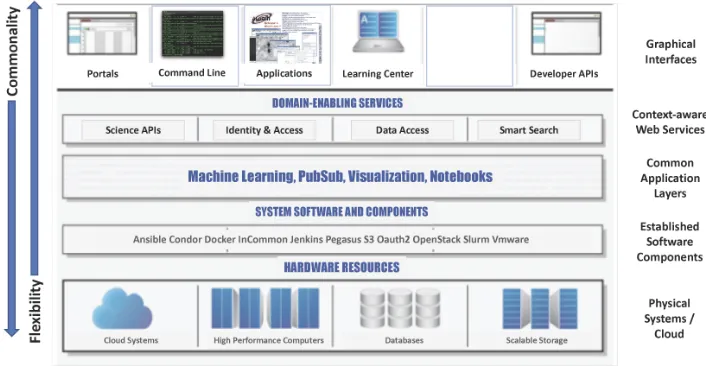
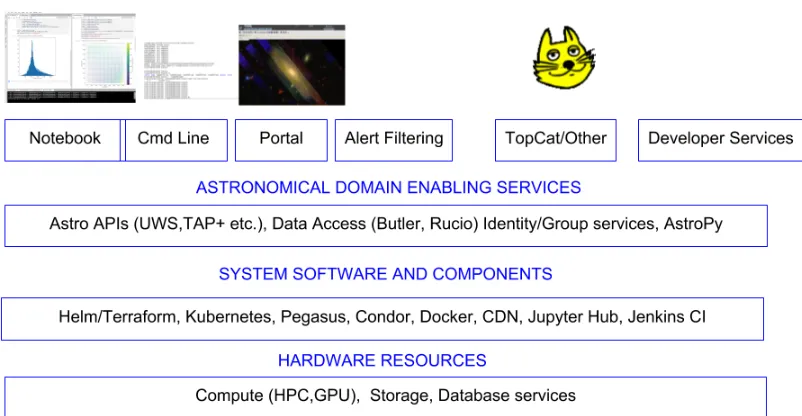
Figure 1. An example acyberinfrastructurebuilt on an Infrastructure as Code design model. Note
that while this example does not have astronomy-specific tooling, our recommendations highlight the importance of developing astro-specific layers that are fully accessible to scientists in both the application and the graphical interface layers. Figure2presents an LSST/Astronomy instantiation of this.
cost can be minimized as less coordination will be needed to implement cross mission services.
REC-5 Develop a community wide architecture supporting Science as a Service. Area: Technology. Audience: Agency, Technologist. Term: Long
Agencies should fund the major missions to define and adopt a community wide supported data and compute service architecture with easy to adopt components leveraging widely adopted infrastructure standards both in the community and in industry. This "Infras-tructure as Code" (Morris 2016) approach lowers the bar to entry and allows for easier adoption of more standardized services that will enable large-scale astronomical research in ways that are well demonstrated in plant genomics (CyVerse and Galaxy), natural hazards (Designsafe), and surface water research (Hydroshare).
implementable across service providers. Design and support for this infrastructure should be community driven, prioritized and funded, to allow for development of features across missions and science use cases.
Pictured in Figure1is the structure of acyberinfrastructure(CI) that has been used across multiple fields from plant and animal genomics (CyVerse) to natural hazards engineering (DesignSafe). This shows the layers of theCIfrom the interfaces for service access exposed at multiple levels, the common domain wide enabled services, and a collection of system level components that support the higher levels of theCI. The lower down the diagram are commodity layers based on well established and supported components. As one moves up from these layers, more abstraction can be done to expose these pieces in domain or even question level interfaces. By making these abstractions, more universal service can be developed that can be applied more globally across the entirety of thecyberinfrastructure
as a whole. An example of this would be authentication, where each university or agency may provide their own authentication method but unifying services like CILogin can bring those together to give global spaced identity for a wide range of users based on disparate authentication systems. By providing this structure along with a reference architecture of these System Services based on well supportedsoftwarecomponents, providers are easily able to both deploy and support these common services which enable cross mission and centerinteroperability. This structure also reflects how this architecture allows for greater reusability as one gets closer to the actual implementation of these services while supporting greater flexibility and general usability as one works further from the core components. This service architecture should be based on using standard reusablesoftware from many of the established standards developed outside of astronomy (e.g. common authentication mechanisms such as CILogin, standard data and metadata management systems). Standard
APIinterfaces should also be used to expose these components to higher levelAPIs. Data formatting and metadata structure can be exposed at the service level, allowing for more data and metadata reuse.
Figure 2. An exampleLSST cyberinfrastructurebuilt analogous to theCImodel shown in Figure1.
Many of the advances in the current data revolution have come about from the broad adoption of commodity hardware and softwareservices being applied in domain agnostic ways. While over a decade ago, astronomy was one of the first domains to explore these technologies, the current momentum in the area is driven outside of the astronomical field. Current technologies like Spark, Cassandra, Kubernetes, and MongoDB were all created to support large data problems outside of astronomy but are finding support in the astronomical community in a piecemeal manner. By shifting the focus from local to a more distributedcyberinfrastructure, such new technologies could be implemented and leveraged much quicker than if each center had to support and integrate their own solution, Further, by embracing and adopting a more commodity base infrastructure will allow current and future projects to choose and experiment with hardware alternatives such as TPUs, FPGAs, or Quantum computing as they become more commonplace or to integrate newer architectures that best suited to the problem.
There is a current tension or incompatibility with the direction of High Performance Com-putingHPCto many more cores with not much more memory and large image processing which requires more throughput. Historically, systems designed forHPCwere more suited to simulation as opposed to the embarrassingly parallel yet often memory intensive High Throughput ComputingHigh Throughput Computing (HTC). WhileHTCdoes not get as much attention, it has been key to missions such as the Human Genome project, LIGO, andSDSS. While some are moving to bridge this gap (some in support of missions such as
of astronomical discovery. Finally, they should formally adopt support for mission long computational support at these facilities for all major missions.
We note the general idea here especially on the importance ofcloudare compatible with Rob Pike’s thoughts4.
Where ever possible, review ofcyberinfrastructuredriven proposals should be ranked on both their immediate impact to the field as well as their ability to sustain such impact through several technology and vendor cycles. Proposals should also be ranked based on their reuse and/or integration into the overall cyberinfrastructure developed across the astronomical community.
5.1.1. Identity and Access Management (IAM)
User identity is key to all data systems to date. In the past, each mission has had its own
IAMsystem to provide data access for embargoed or otherwise restricted data access and for accessing services. With a more globalCI, this problem must be further abstracted to allow for the notion of identity of a user (aka authentication) and permissions (aka authorization) for services and data. By separating these pieces, identity can be brought from multiple sources (CI-Login, OAuth, ORCID) while the permissions can be enforced by each provider. All aspects of thisCImust embrace role based authorization for both data and services in a federated manor so that data and services can be effectively orchestrated while not impacting site or mission specific access restrictions. While the authentication may be global, each provider will enforce their own access roles for all users. As data analysis moves into the petabyte and even exabyte scale across multiple missions and multiple computational environments, it will be paramount to for all members of thecyberinfrastructure to share a common IAM infrastructure to allow for federated access controls for both data and computational services.
Proposals and missions should be ranked on their adoption of such anIAMfor data and for software services. Further, by creating a common CI layer for identity, missions and smaller services will be able to adopt and adapt the common system to their needs, thus saving development costs for implementing and finally supporting their own system.
5.2. Data co-location and creating data lakes
REC-6 Enable new scales of research through data co-location. Area: Technology. Audience: Technologist. Term: Medium
We must enable the co-location of data thus enabling large scale cross mission research. While some research are well supported using specific services, ones which require comin-gling data to produce new data products or results should be able to schedule access to co-located data in ways similar to acquiring new data.
Astronomy archives, especially in the USA, are somewhat fragmented. ThoughTBscale permanently co-locating all data n one or more centers is technically possible it is probably
not desirable nor socially possible. In the PB data era permanent co-location becomes less feasible, yet researchers will require data lakes or reservoirs to house massive datasets and allow computations to be done across multiple missions and epochs of data at scale. The data lake concept, where data from multiple missions and schemes are temporarily co-located so as to allow codes to more tightly integrate with multiple data sources, is the most attractive for researchers (who have become accustom to immediate data access), the idea of a reservoir that can be filled and drained of data based on the demand of users is one that will need to be explored due to the economical viability of any one institution housing all the data.
Collocation is more than justinteroperabilitybut will also mean generating new formats e.g. parquetfiles (e.g.) to make dynamic data frames and data services as demands change. It will also mean generating new data products across missions which are equally valuable for both preservation and publication. Thus the lake is more than a simple pool of storage, but should be operated similar to other key infrastructures in the observational astronomical infrastructure.
Software and technologies change on timescales faster than a decade (see alsoSection 6.6) and data centers need to be agile enough to keep up. One approach is to create interoper-ability interfaces to allow data to be pulled or pushed from managed repositories to dynamic data lake environments where users can produce their own custom subsets mixing the avail-able datasets. Data movement will not be simple (see also Section 5.2.1) and to not be prohibitive specific infrastructure would need to be supported and evolved.
While the immediately obvious argument for co-locating data is the potential for scientif-ically rich co-processing of heterogeneous data holdings (e.g. Euclid,WFIRSTandLSST), the advantages do not end there. Co-locating large data holdings on a common commodity computing platform enables bring-your-code-to-the-data capabilities (sometimes referred to as Science Platforms or server-side analytics) to enable co-analysis of data from a single service without necessitating data transfer. For example, a single Jupyter notebook can present an runnable analysis drawing on separate datasets (e.g. a multi-wavelength analysis of a class of objects). Furthermore, co-locating data holdings allows the co-locationand sharingof services accessing those data holdings. That not only includes the possibility of collaboration in sharing a singleAPIservice between data publishers, but also reducing the development burden of infrastructural services (for example, documentation infrastructure could be shared with multiple missions, migration paths to new operating systems are eas-ier, etc). In an era where Infrastructure as Code engineering paradigms represent emerging best practice, re-using the code that underwrites common astronomical services because they are developed within a common underlying infrastructure (such asDockercontainers orchestrated by Kubernetes) provides an avenue for fruitful ongoing collaboration between data publishers and better value for money for science infrastructure dollars.
5.2.1. Network layer
a service will require optimizations often at the point to point level. Tools like PerfSonar and others from Internet2 can help optimize connections. But these have been used to optimize research done at the terabyte scale today. Where as in theTBscale it was possible sometimes to move the compute to the data (e.g. SDSS), discovery often comes from the
TBscale data lakes. To meet the demand for petabyte scale data motion as a service in a terabit network age, systems to support Just In Time data delivery are needed for any large scale data collocation and must be a part of the support for the overall infrastructure of repository/cloud/data center collaborations. Computation on large datasets may need to be scheduled no different than any other instrument used in observational astronomy.
We recommend funding projects in astronomy (and in other research domains) to create the data management and migration layers and best practices that will enable these new forms of observation. We also recommend that proposals show how they will develop and sustain such services over the course of the mission and beyond.
5.2.2. Vendor freedom
When co-location of data holding and services on acloudplatform is discussed, inevitable there are concerns raised about "vendor lock-in". These objections are often rooted in a misunderstanding of the nature of these services. First of all, these services often themselves share common open source technologies between them (for example there are a number of object store technologies that implement the an interface compatible with Amazon’sS3
service). But more than that, the commercial landscape is designed around low barriers to change: Google Cloud Platform tries to acquire Amazon Web Services customers by making its services easy to switch to. Moreover all these platforms drive a service-oriented architecture that inherently results in more portable systems. In any case if one is concerned about vendor lock-in, in-house data center infrastructures are the worst possible choice: the inevitably lead to infrastructure-specific choices that are poor candidates for evolution, and they typically lack the effort to support ongoing refreshing of the technical stack thus creating on-going support burdens and a change-averse culture. For example, LSST is a project that will go into operations in 2022, and yet LSST Data Management (DM)are frequently called on to support CentOS 6, an operating system released in 2011, because that is the onlyOperating System (OS)some university in-house clusters support for researchers.
5.3. Operations
REC-7 Enable support for full mission life cycle including long-term data products. Area: Technology. Audience: Agency. Term: Short
and, in the current environment, can not simply be maintained in the same way physical facilities are.
A more operations oriented view of construction by funding organizations would lead to facilities which are more cost effective to run. Recognizing thatsoftwareand cyberinfras-tructuredevelopment work is distinct from concrete and physical facilities would also help to make more maintainable and agilecyberinfrastructure. Current MREFCs funding splits construction from operations thus limiting support on ongoing work forcyberinfrastructure, there is little incentive in construction to build easy to operate systems.5 If we blur the line
between construction and operations forcyberinfrastructurethe issue becomes more one of long term support.
REC-8 Improve long-termsoftwareand service support.
Area: Technology. Audience: Technologist, Agency, Astronomer. Term: Short
Funding should support repositories not just for code and data, but for computational environments. Use of proven standards in the wider research community for sharing and discovering runtime-readysoftwareusingsoftware containerenvironments likeDockerand
DockerHub but with domain specific curation (e.g. BioContainers) is crutical6 for both broader impacts ofsoftware products and result reproducibility as compute environments continue to rapidly evolve with low emphasis given to backward compatibility.
Long term support could be improved by requiring proposals to state how code reuse and common practices will be used. Looking for proposals which aim to push to the Code andAPIcommunities (AstroGit? AstroContainers? AstroHub) and which aim to build on commonsoftwaredevelopment practices. Of course we should also foster development of those best practices based on best practices outside astronomy. Concretely proposals could have a line item for making software reusable in funding budgets and funding agencies should see that as a good thing and try to develop metrics for success in the area.
We must also consider how to move to a more self service architecture in astronomy such as GitOps (Limoncelli 2018) - that requires some rigor but establishment of adhered to best practices would be a start.
Needless to say all of the code should be available under open licensing such as Apache (Apache Public License (APL)) or Gnu (GNU Public License (GPL)) public license. REC-9 Fund cross-mission deployment.
Area: Technology. Audience: Agency. Term: Medium
Missions that developsoftware that can and should be adaptable to other common goals in other missions should be funded to develop and support cross-mission resources as part of this and other cyberinfrastuctures.
Past examples of this success can be found as far back as theIRAFenvironment and include now significantly more broadly adopted numpy, the cost of development and support have
been paid back multifold across many funded projects and missions which did not have to develop their own versions ofsoftware.
Deployability is part of the problem but service oriented architectures are and will remain at the forefront for at least the next decade. So we should now be thinking more ofsoftware
as a service and defining infrastructure as a service. This would all funding agencies to push us more toward commodity compute and infrastructure services thus concentrating efforts on the astronomy problems at hand rather than the computer science problems.
Funding agencies could also favor proposals that use/leverage existingsoftwaresolution, it may take time but this would be a positive fundamental change in astronomysoftware.
5.4. Sustainability and effectiveness
An architecture as laid out in Section 5.1 gives us a framework to start a sustainable
softwaredevelopment in astronomy. Software sustainability is a complex issue, with mixed results in astronomy — seeSection 6.6.2for more on this complexity. The approach laid out here, however, presents greater challenges than ever before in sustainability, as larger datasets and more complex infrastructure means that reinventing the wheel will become ever more costly.
By providing a reference architecture we can allow for more openness, collaboration, and when necessary, competition in each component. While competition and alternatives can be useful in a controlled manner, i.e. funding two approaches for a specific component, by providing a reference architecture this can be adopted only when needed without interfering with other layers. We should also consider that this architecture may be good for a decade at which point it also should be revisited - such a refresh should be built in to our thinking from the start. This is critical for sustainability because sustainability is much more challenging if the architecture does not keep up with the technology, as more and more “hacks” become necessary until the house of cards comes toppling down.
The Astropy project has been successfully fostering a community approach to the user-facing end of Python astronomy. They do face challenges for funding and are beginning to tackle some management issue for an organically grown organisation. This has been successfully because they have worked hard to join the zeitgeist of opensoftwareand have dedicated individuals who believe this is a useful project - and many users who agree. The project also produces useful tools. The role of the Astropy project in the ecosystem can be misunderstood i.e. it is not meant to be a data management system or a replacement for a mission-specific toolchain, rather it is a toolbox that is accessible to astronomers for doing many of the tasks they want to use or understand. While the re-use and contribution to these tools by missions or observatories is desirable (seeSection 6), without a clear understanding of where the components lie in a larger architecture, it is almost impossible for astronomers and projects to understand how they can fit such components into their system. A reference architecture can thus help define where projects like this belong and how they fit with other efforts. For example,LSSTwill not process data usingastropybut will make their
has taken both projects a while to understand this delineation because neither LSST nor
6. SOFTWARE
Contributors: Arfon Smith <[email protected]>, Erik Tollerud <[email protected]>, Kelle Cruz, Stuart Mumford, Nirav Merchant, Gautham Narayan, Alex Drlica-Wagner
Note: If you have come directly to this chapter we suggest you please read at least the Introduction inSection 1before delving further.
In the Petabyte era, all projects are software projects — that is, sophisticated software is necessary throughout the system for essentially any scientific output at this scale. That said, the termsoftware can mean many things to many people. Other Sections (e.g. Section 3,
Section 4,Section 7) discuss thecontentof this software, and the software “infrastructure” components and how they fit together are discussed in more detail in Section 5. Here, by contrast, our focus is on the process by which software distributed to and used by the astronomy community is built and funded. We particularly focus on community software
as it is the most relevant for the community to be involved in and for funding agencies to support. Note that that while clearly critical to the process of software development, relevant career and workforce issues are discussed separately inSection 8.3.
6.1. Recommendations
REC-10 Funding forsoftwaredevelopment in existing grant programs. Area: Software. Audience: Agency. Term: Long
Software that enables science should be allowable as a sole deliverable for all existing funding programs (e.g. NSF AAG, NASA ROSES, postdoctoral prize fellowships). It should not be necessarily coupled to a specific science effort, as long as thesoftwareis of demonstrable use to the scientific community.
REC-11 Funding for sustaining core astronomical “community infrastructure” projects.
Area: Software. Audience: Agency, Astronomer, Technologist. Term: Medium
Funding agencies and the community as a whole should support funding of domain-specific community-developedsoftwareprojects e.g. Astropy project, SunPy. Such projects should be recognized as vital infrastructure and placed on an equal footing to physical facili-ties such as national observatories. This support should be available for domain-specific
software, rather than funding being primarily tied to interdisciplinary applicability. It should also be allowed to fund community-development efforts in addition to actual code development.
REC-12 Cultivating a sustainable researchsoftwareecosystem.
Area: Software. Audience: Agency, Manager, Astronomer. Term: Short
ecosystem of available tools, and 3) Favor programs that propose developingcommunity software as part of their funded activities. These same goals and considerations should also be considered and acted on by the broader astronomy science community when e.g. working as grant review panelists.
Note that cultivating a researchsoftwareworkforceis critical to all of the above. Hence, while not detailed in this Section, the recommendations ofSection 8are also as critical to the discussion in this section as the above.
6.2. Why sharedsoftwarematters, today and in the next decade.
In this chapter, we argue that the Petabyte era of discovery in astronomy means that the role ofsoftwareis increasingly important and that well-organized, well-maintainedsoftware
serves to shallow the learning curve, enable scientific investigation, and lends confidence to scientific results. To set scope, though, we emphasize this mainly applies in the context of shared software. That is, the “throw away” analysis script written, say, by a graduate student when writing their thesis and never shared with anyone else does not count for this discussion. However, that changes when the same student shares that script with their collaborators, makes it available online, or contributes it to The Astropy Project, rOpenSci, or another opencommunity software resource. Such an act makes the software part of a community process, and the astronomy community is the target of this discussion. Hence, in this chapter we are focused onsharedsoftware.
6.2.1. Software is everywhere
“Software is a central part of modern scientific discovery. Software turns a theoretical model into quantitative predictions;software controls an experi-ment; andsoftware extracts from raw data evidence supporting or rejecting a theory” - Gaël Varoquaux, scikit-learn7 creator, (Varoquaux 2013;Pedregosa et al. 2011).
Software is an integral, and growing part of the scientific endeavor: It is responsible for driving the control systems of instruments, the operation of surveys, the processing of raw data products, the extraction of physical parameters, and the theoretical modeling of physical systems,softwareis critical to all parts of modern computational research. Indeed, ‘Software is eating the world’ (Andreessen 2011). This reality is well-recognized by the scientific community: In a survey carried out in 2009, more than 2000 scientists reported thatsoftwarewas either important or very important to their research, and that it would be impractical for them to carry out their research without it (Hannay et al. 2009).
The rapid increase in the size and complexity of astronomical experiments and the data they produce has led to an increasing demand for astronomical software. An illustration of this point is the LSST project and their allocation of 25% of the construction budget ($187M) for data managementsoftware, infrastructure, and services8.
7https://scikit-learn.org