UTILIZING OF FRACTIONAL PROGRAMMING FOR MULTI
TRANSPORTATION PROBLEMS IN FUZZY ENVIRONMENT
1,*
1Operations Research Department, Institute of Statistical Studies and Research, Cairo University, Giza, Egypt
2Department of Management Information System, College of Business Administration, Taibah University, Saudi Arabia
ARTICLE INFO ABSTRACT
In this
solid transportation
represent the decision maker's performance between fuzzy costs, supply, demand and conveyances are defined by
method, 1996,the problem is converted into the
MOMISTP is transformed into the single objective linear programming using the proposed method of Guzel, 2013, and hence software progra
numerical example is given to the utility of our proposed method.
Copyright © 2018,Khalifa and Al- Shabi. This is an open use, distribution, and reproduction in any medium, provided
INTRODUCTION
The solid transportation problem (STP) is a generalization of the well
dimensional properties are taken into consideration in the objective and constraint set instead of source and destination (Ku al. 2013). The STP was first stated by Shell, 1955. Haley,1962 introduced a solution procedure for solving STP which is an extension of the modified distribution method.
Up to now, fuzzy set theory has been applied to broad fields.
of the real line, known as fuzzy numbers). For the fuzzy set theory development, we may referee to the papers of Kaufmann, 1975, and Dubois and Prade ,1980, they extended the use of algebraic operations of real numbers to fuzzy numbers by the use a fuzzifaction principle. Fuzzy linear constraints with fuzzy numbers were studied by Dubois and Prade,1980. Bellman and Zadeh, 1970 introduced the concept of a maximizing decision
fuzzy parameters both in the objective functions and constraints and determined the stability set of the first kind correspon the obtained solution. Ammar and Khalifa, 2015 presented multi
presented multi- objective mutli- item STP with fuzzy numbers in the supplies, demands, capacity of conveyances, and costs. Ida et al. 1995 studied fuzzy multi- criteria STP. Using general fuzzy cost and time, Ojha et al. 2009 studied entropy basedSTP. Under stochastic environment, Yang and Yuan, 2007 investigated a bicriteria STP. Under various uncertain environments, Kundu et al 2014 investigated multi- objective STP. Rani and Gulati, 2015 applied fuzzy programming approach fully fuzzy multi
multi- item STP. Kumar and Dutta, 2015 applied fuzzy goal programming for fuzzy multi
on transported amount, Baidya et al. 2016 introduced different types of transportation models. Jimenez and Verdegay, 1999 solved fuzzy STP by applying an evolutionary algorithm based on parametric approach. Nagarajan et al. 2014 introduced a solution procedure for multi-objective interval STP under a stochastic environment. Cui and Sheng, 2012 introduced an expected constrained programming for an uncertain STP problem. Pramanik et al. 2018 formulated and solved a multi
damageable item.
*Corresponding author: Khalifa, H. A.,
Operations Research Department, Institute of Statistical Studies and Research, Cairo University, Giza, Egypt
ISSN: 0975-833X
Vol. 10, Issue,
Article History:
Received 06th August, 2018
Received in revised form 19th September, 2018
Accepted 24th October, 2018
Published online 29th November, 2018
Citation:Khalifa, H. A. and Al- Shabi, M. 2018. “Utilizing of fractional programming for multi environment”, International Journal of Current Research
Key Words:
Multi-Objective Multi-Item solid Transportation Problem; Fractional Programming; LR Fuzzy Numbers
RESEARCH ARTICLE
UTILIZING OF FRACTIONAL PROGRAMMING FOR MULTI- OBJECTIVE MULTI
TRANSPORTATION PROBLEMS IN FUZZY ENVIRONMENT
,*
Khalifa, H. A. and
2Al- Shabi, M.
Department, Institute of Statistical Studies and Research, Cairo University, Giza, Egypt Department of Management Information System, College of Business Administration, Taibah University, Saudi Arabia
ABSTRACT
In this paper, a fully fuzzymulti - objective linear fractional programming is applied for multi solid transportation (FFMOMISTP) problem. To minimize the problem, the order relations which represent the decision maker's performance between fuzzy costs, supply, demand and conveyances are defined by LRflat fuzzy numbers. Using the fuzzy number compariso
method, 1996,the problem is converted into the corresponding crisp
MOMISTP is transformed into the single objective linear programming using the proposed method of Guzel, 2013, and hence software programming is applied for solving the problem.
numerical example is given to the utility of our proposed method.
open access article distributed under the Creative Commons Attribution provided the original work is properly cited.
transportation problem (STP) is a generalization of the well- known transportation problem(TP) in which three dimensional properties are taken into consideration in the objective and constraint set instead of source and destination (Ku
e STP was first stated by Shell, 1955. Haley,1962 introduced a solution procedure for solving STP which is an extension of the modified distribution method. As known, fuzzy set theory was introduced by Zadeh, 1965 to deal with fuzziness.
et theory has been applied to broad fields. Fuzzy numerical data canbe represented by means of fuzzy subsets
of the real line, known as fuzzy numbers). For the fuzzy set theory development, we may referee to the papers of Kaufmann, Prade ,1980, they extended the use of algebraic operations of real numbers to fuzzy numbers by the use a fuzzifaction principle. Fuzzy linear constraints with fuzzy numbers were studied by Dubois and Prade,1980. Bellman and Zadeh,
ept of a maximizing decision making. Ammar and Khalifa, 2014introduced multi
fuzzy parameters both in the objective functions and constraints and determined the stability set of the first kind correspon r and Khalifa, 2015 presented multi- objectiveto the obtained solution. Ammar and Khalifa, 2015
item STP with fuzzy numbers in the supplies, demands, capacity of conveyances, and costs. Ida criteria STP. Using general fuzzy cost and time, Ojha et al. 2009 studied entropy basedSTP. Under stochastic environment, Yang and Yuan, 2007 investigated a bicriteria STP. Under various uncertain environments, Kundu et al
tive STP. Rani and Gulati, 2015 applied fuzzy programming approach fully fuzzy multi
item STP. Kumar and Dutta, 2015 applied fuzzy goal programming for fuzzy multi- objective STP. Under some restriction . 2016 introduced different types of transportation models. Jimenez and Verdegay, 1999 solved fuzzy STP by applying an evolutionary algorithm based on parametric approach. Nagarajan et al. 2014 introduced a solution TP under a stochastic environment. Cui and Sheng, 2012 introduced an expected constrained programming for an uncertain STP problem. Pramanik et al. 2018 formulated and solved a multi
Operations Research Department, Institute of Statistical Studies and Research, Cairo University, Giza, Egypt. International Journal of Current Research
Vol. 10, Issue, 11, pp.75024-75035, November, 2018
DOI: https://doi.org/10.24941/ijcr.32742.11.2018
Utilizing of fractional programming for multi- objective multi- item solid transportation problems in fuzzy Research, 10, (11), 75024-75035.
OBJECTIVE MULTI- ITEM SOLID
TRANSPORTATION PROBLEMS IN FUZZY ENVIRONMENT
Department, Institute of Statistical Studies and Research, Cairo University, Giza, Egypt Department of Management Information System, College of Business Administration, Taibah University, Saudi Arabia
objective linear fractional programming is applied for multi- item (FFMOMISTP) problem. To minimize the problem, the order relations which represent the decision maker's performance between fuzzy costs, supply, demand and conveyances comparison introduced by Rouben's corresponding crisp FMOMISTP problem. Then the MOMISTP is transformed into the single objective linear programming using the proposed method of
mming is applied for solving the problem. Finally, a numerical example is given to the utility of our proposed method.
ribution License, which permits unrestricted
known transportation problem(TP) in which three- dimensional properties are taken into consideration in the objective and constraint set instead of source and destination (Kundu et e STP was first stated by Shell, 1955. Haley,1962 introduced a solution procedure for solving STP which is an As known, fuzzy set theory was introduced by Zadeh, 1965 to deal with fuzziness. be represented by means of fuzzy subsets of the real line, known as fuzzy numbers). For the fuzzy set theory development, we may referee to the papers of Kaufmann, Prade ,1980, they extended the use of algebraic operations of real numbers to fuzzy numbers by the use a fuzzifaction principle. Fuzzy linear constraints with fuzzy numbers were studied by Dubois and Prade,1980. Bellman and Zadeh, Ammar and Khalifa, 2014introduced multi- objective STP with fuzzy parameters both in the objective functions and constraints and determined the stability set of the first kind correspondingto objectiveto the obtained solution. Ammar and Khalifa, 2015 item STP with fuzzy numbers in the supplies, demands, capacity of conveyances, and costs. Ida criteria STP. Using general fuzzy cost and time, Ojha et al. 2009 studied entropy basedSTP. Under stochastic environment, Yang and Yuan, 2007 investigated a bicriteria STP. Under various uncertain environments, Kundu et al. tive STP. Rani and Gulati, 2015 applied fuzzy programming approach fully fuzzy multi- objective objective STP. Under some restriction . 2016 introduced different types of transportation models. Jimenez and Verdegay, 1999 solved fuzzy STP by applying an evolutionary algorithm based on parametric approach. Nagarajan et al. 2014 introduced a solution TP under a stochastic environment. Cui and Sheng, 2012 introduced an expected constrained programming for an uncertain STP problem. Pramanik et al. 2018 formulated and solved a multi- objective STP for OF CURRENT RESEARCH
Dalman and Sivri, 2017 present some approaches to find the compromised optimal solution for uncertain multi- objective ST.Pandian and Anuradha, 2010proposed a new method for solving STP based on the principle of zero point method introduced by Pandian and Natarajan, 2010. Fractional Programming (FP) is a decision problem arises to optimize the ratio subject to constraints. In real world decision situations, MOLFP programming arises very frequently. As, for instance, the ratio between inventory& sales, actual cost & standard cost, output& employee, measuring relative efficiency of decision making unit in the public/ or nonprofit sectors, Data Envelopment Analysis (DEA) & many other areas of economics, non- economics and indirect applications. Charnes and Cooper, 1962 studied a linear fractional programming (LFP) problem and showed that it can be optimized by solving two linear programs. Ammar and Khalifa, 2009 studied LFP problem with fuzzy parameters. Ammar and Khalifa, 2004 introduced aparametric approach for solving multi-criteria LFP problem.Luhandjula, 1984 applied fuzzy programming approach for solving MOLFP problem. Nykowski and Zolkiewski, 1985 solved the MOLFP problem by converting it into the multi- objective linear programming (MOLP) problem. Gupta and Chakraborty, 1999 introduced a methodology for a restricted class of MOLFP problem in the sense that there exists some values of decision variables for which the numerator is positive and the denominator is positive for all values of decision variables in the feasible region, and then applied fuzzy approach for solving the problem by defining a linear membership function. Moumita and De, 2014 suggested a novel approach for solving MOLFP. Using the complementary development method introduced by Dheyab, 2012, Jain, 2014 extended this work for the MOLFP and fuzzy MOLFP problems. Porchelvi et al. 2014 proposed a n approach for solving the MOLFP. The rest of the paper is as follows: In section 2; some preliminaries need in the paper are presented. In section 3, a multi- objective linear fractional programming for multi- item solid transportation problem with fuzzy costs, supply, demand is introduced as specific definition and properties. In section 4, a solution procedure for solving the problem is given. In section 5, a numerical example is given for illustration. Finally some concluding remarks are reported in section 6.
Preliminaries: In order discuss our problem conveniently, we introduce fuzzy numbers and some of the results of applying fuzzy arithmetic on them and also comparison of fuzzy numbers by Robubens's method(Kauffmann and Gupta, 1988; Fottemps and Roubens, 1996)).
Definition1. (Kauffmann and Gupta, 1988). Let R be the set of real numbers, the fuzzy number
a
~
is a mapping ],1 , 0 [ :
~ R
a
with the following properties:(i)
~a(
x
)
is an upper semi- continuous membership function;(ii)
~
a
is a convex fuzzy set, i. e.,
~a(
x
1
(
1
)
x
2)
min
{
a~(
x
1),
a~(
x
2)},
for allx
1,
x
2
R
,
0
1
;
(iii)
a
~
is normal, i. e.,
x
0
R
for which
~a(
x
0)
1
;
(iv) Supp
(
a
~
)
{
x
R
:
~a(
x
)
0
}
is the support of thea
~
, and its closure cl (supp(a~))is compact set.It is assumed that
F
0(
R
)
is the set of all fuzzy numbers.Definition2. The level set of the fuzzy number
a
~
F
0(
R
),
0
1
, denoted by(
~
a
)
and is defined as the ordinary set:
0
)),
~
(
(sup
1
0
,
)
(
:
)
~
(
~
a
p
cl
x
R
x
a
aA function, usually denoted by ''
L
'' or ''R
'', is a reference function of a fuzzy number if and only if 1.L(x)L(x),2.L(0) 1,
3.
L
is non increasing on
0,
.A convenient representation of fuzzy numbers in the LRflat fuzzy number which is defined as
eleswhere
A
x
if
A
x
R
A
x
if
x
A
L
x
A
,
1
,
0
,
,
)
(
,
0
,
,
)
(
)
(
~
Where,
A
A
,
A
,
A
is the core of A~ ,
A~(
x
)
1
;
x
A
,
A
,
A
,
A
are the lower and upper modal values ofRemark1. A flat fuzzy number is denoted by
A
~
(
A
,
A
,
,
)
LRAmong the various type of LRfuzzy numberz, trapezoidal fuzzy numbers, denoted by
A
~
(
A
,
A
,
,
)
, are the greatest importance ( Roubens, 1991). Let~
p
(
p
,
p
,
,
)
, and~
q
(
q
,
q
,
,
)
both trapezoidal fuzzy numbers, the formulas for the addition, subtraction, and scalar multiplication are as follow:Addition:
).
,
,
,
(
~
~
q
p
q
p
q
p
Subtraction:
).
,
,
,
(
~
)
(
~
q
p
q
p
q
p
Scalar multiplication:
).
,
,
,
(
~
:
,
0
),
,
,
,
(
~
:
,
0
x
x
xp
xp
p
x
R
x
x
x
x
xp
xp
p
x
R
x
x
Division:
.
0
~
;
0
~
,
,
,
,
~
(/)
~
q
p
q
p
q
p
q
p
q
p
q
p
q
p
q
p
The main concept of comparison of fuzzy numbers is based on the compensation of areas determined by the membership
functions( Baldwin and Guild, 1979; Nakamura, 1986). Let p~,q~be fuzzy and numbers and
S
L(
~
p
,
q
~
),
S
R(
p
~
,
q
~
)
be the areas determined by their membership functions according to
q
d
p
q
p
S
q p I
L
)
~
inf
~
(inf
)
~
,
~
(
) ~ , ~ (
, and
q
d
p
q
p
S
q p S
R
)
~
sup
~
(sup
)
~
,
~
(
) ~ , ~ (
, where
:
inf
~
inf
~
,
1
,
0
)
~
,
~
(
p
q
p
q
I
, andS
(
~
p
,
q
~
)
:
sup
~
p
sup
q
~
,
1
,
0
.The degree to which p~ q~ is defined (Roubens, 1991) as
).
~
,
~
(
)
~
,
~
(
)
~
,
~
(
)
~
,
~
(
)
~
,
~
(
p
q
S
p
q
S
q
p
S
p
q
S
q
p
C
L
L
R
RHere, let us consider that ~p q~ when C(~p,~q) 0.
Proposition1. (Roubens, 1991). Let ~p, and q~ be LR fuzzy numbers with parameters
(
p
,
p
,
,
),
(
q
,
q
,
,
)
and reference functions(
L
~p,
R
p~),
(
L
q~,
R
q~)
, where all reference functions are invertible. Then p~()q~ if and only ifL q R
q L
p R
p
p
q
q
p
, ~ ,
~ ,
~ ,
~
~
inf
~
sup
~
inf
~
sup
.If k ~pq~ . Then
1
0 1 .
(
)
k RR
kR
kd
,
1
0 1 .
(
)
k LL
kL
kd
.Remark2.~p q~ if and only if
(
).
2
1
)
(
2
1
q
q
p
Notation. The associated real number
p
corresponding top
~
(
p
,
p
,
,
)
is(
).
2
1
ˆ
p
p
p
Let F(R)be the set of all trapezoidal fuzzy numbers.
Problem formulation and solution concepts: A multi- objective multi- item solid transportation problem under fuzzy environment in fractional programming form is formulated as follows
d
d
x
r
S
x
c
c
x
d
x
c
x
M
x
N
Z
l p m i n j K k p ijk rp ijk rp ijk rp ijk rp ijk l p m i n j K k p ijk rp ijk rp ijk rp ijk rp ijk l p m i n j K k p ijk rp ijk l p m i n j K k p ijk rp ijk r r r,...,
3
,
2
,
1
,
,
,
,
,
,
,
~
~
)
(
~
(
)
~
~
min
1 1 1 1
1 1 1 1
1 1 1 1
1 1 1 1
Subject to (2)
.
,
,
,
;
0
,
...,
,
2
,
1
,
~
,
,
,
~
,
...,
,
2
,
1
;
...,
,
2
,
1
,
~
,
,
,
~
,
...,
,
2
,
1
;
...,
,
2
,
1
,
~
,
,
,
~
~
1 1 1
1 1 1 1
p
k
j
i
x
K
k
E
e
e
e
x
l
p
n
j
B
b
b
b
x
l
p
m
i
A
a
a
a
x
X
rp ijk k k k k k k l p m i n j p ijk j p j p j p j p j p j m i K k p ijk i p i p i p i p i p i n j K k p ijk
Where,
p
products can be transported from m originsA
~
ito ndestinationB
~
jby means ofE
~
kconveyances, andr
objectives are to be minimized.rp ijk rp ijk d c ~ ~
represent fuzzy unit transportation penalty from
i
- th origin toj
- th destination byk
- th conveyance forp
- th item.~
,
~
p,
j pi
b
a
ande
~
k represent total fuzzy supply, total fuzzy demand, and total fuzzy capacity. Also,rp ijk
c
~
, rpijk
d
~
,A
~
i,B
~
j,and
E
~
k
F
0(
R
).
To solve the problem(2), the following conditions must be satisfied:
n j p j p j p j p j m i p i p i p i pi
a
b
b
a
1 1,
,
,
,
,
,
if and only if
a
a
b
b
p
l
n j p j p j p j p j m i p i p i p i p
i
,
1
,
2
,...,
2
1
2
1
1 1
, and
l p n j p j p j p j p j K k k k kk
e
b
b
e
1 1 1.
,
,
,
,
,
,
if and only if
l p n j p j p j p j p j K k k k kk
e
b
b
Definition3(fuzzy efficient solution).A point
x
X
~
(
~
A
i,
B
~
j,
E
~
k)
is said to be fuzzy efficient solution to the problem(2) if andonly if there does not exist another
x
X
~
(
A
~
i,
B
~
j,
E
~
k)
, such that:Z
~
r(
x
)
Z
~
r(
x
),
andZ
~
r(
x
)
Z
~
r(
x
)
for at least one .rProblem(2) is converted into the corresponding crisp problem as
l
p m
i n
j K
k
p ijk rp ijk rp ijk rp
ijk rp
ijk l
p m
i n
j K
k
p ijk rp ijk rp ijk rp
ijk rp
ijk l
p m
i n
j K
k
p ijk rp ijk l
p m
i n
j K
k
p ijk rp ijk
r r r
x
d
d
x
c
c
x
d
x
c
x
M
x
N
Z
1 1 1 1
1 1 1 1
1 1 1 1
1 1 1 1
2
1
2
1
)
(
)
(
min
Subject to (3)
.
,
,
,
;
0
,
~
2
1
,
~
2
1
,
~
2
1
1 1 1
1 1
1 1
p
k
j
i
x
C
e
e
x
B
b
b
x
A
a
a
x
X
rp ijk
k k
k k
k l
p m
i n
j p ijk
j p
j p j p
j p
j m
i K
k p ijk
i p i p i p
i p
i n
j K
k p ijk
Definition4 (Efficient solution). A point
x
X
(
A
i,
B
j,
E
k)
is said to be fuzzy efficient solution to the problem(3) if and only
if there does not exist another
x
X
(
A
i,
B
j,
E
k)
, such that:Z
r(
x
)
Z
r(
x
),
andZ
r(
x
)
Z
r(
x
)
for at least one .rTheorem1.(Dinkelbach, 1967).
X
x
x
M
x
N
x
M
x
N
Z
:
)
(
)
(
max
)
(
)
(
if and only if
N
x
z
M
x
x
X
x
z
f
z
f
(
)
(
,
)
max
(
)
(
)
:
.According to Guzel (2013), problem (3) becomes
(
)
(
)
min
1x
M
Z
x
N
r r rS
r
Subject to
X
x
.Where,
S
r
X
x
x
M
x
N
x
M
x
N
Z
r r
r r
r
:
,
1
,
2
,
...,
)
(
)
(
min
)
(
)
(
.
It is clear that
Z
rmay be calculated using any of the following proposed method( Bajaliov, 2003; Charnes& cooper, 1962; and Swarup, 1965).Solution procedure
Step1: Formulate the problem (2)
Step2: Convert the (2) problem into the corresponding crisp problem (3) using the method of Roubens, 1991
Step3: Solve each objective function subject to the given constraints of problem(3) to obtain individual minimum value
S
R
Z
r,
1
,
2
,
...,
Step4: Formulate the equivalent linear programming(LP) based on the method introduced by Guzel, 2013
Step5: Solve the LP programming to obtain the optimal fuzzy solution which is the efficient fuzzy solution for the FFMOMISTP problem.
Numerical example
Consider the following problem
,
,
,
,
,
,
,
1 1 1 1
1 1 1 1 2 1 2 1 3 1 2 1 1 1 1 1 1
l p m i n j K k p ijk p ijk p ijk p ijk p ijkp i j k
p ijk p ijk p ijk p ijk p ijk
x
d
d
x
c
c
Z
Min
,
,
,
,
,
,
,
1 1 1 1
2 2 2 2 2 1 2 1 3 1 2 1 2 2 2 2 2
l p m i n j K k p ijk p ijk p ijk p ijk p ijkp i j k
p ijk p ijk p ijk p ijk p ijk
x
d
d
x
c
c
Z
Min
(4)Subject to:
x
X
~
.Where,
.
,
,
,
;
0
4
,
2
,
65
,
58
,
5
,
3
,
60
,
55
,
1
,
1
,
19
,
17
,
4
,
2
,
18
,
15
,
4
,
2
,
19
,
18
,
2
,
2
,
22
,
20
,
3
,
1
,
25
,
23
,
)
4
,
2
,
19
,
16
,
3
,
1
,
30
,
28
,
6
,
2
,
37
,
34
,
1
,
1
,
35
,
32
,
4
,
2
,
26
,
24
~
2 1 2 1 2 1 2 1 2 1 1 1 2 1 2 1 2 3 2 1 2 1 1 3 2 1 2 1 2 2 2 1 2 1 1 2 2 1 2 1 2 1 2 1 2 1 1 1 3 1 2 1 2 2 3 1 2 1 2 1 3 1 2 1 1 2 3 1 2 1 1 1p
k
j
i
x
x
x
x
x
x
x
x
x
x
x
x
x
X
rp ijk i j ij i j ij i k k i i k k i i k k i i k k i i k k i i k k i j k jk j k jk j k jk j k jkWhere, the unit transportation penalties are given in Tables 1-8 as follow:
Table1. Penalties/ costs 11
ijk
c
i
j j
1 2 3 1 2 3
2 (10, 12, 3, 5) (7, 9, 2, 4) (13, 15, 2, 6) (11, 13, 1,1) (8, 10, 2, 4) (16, 18, 3, 5)
2
1
k
Table2. Penalties/ costs d11ijk
i
j j
1 2 3 1 2 3 1 (2, 4, 2, 4) (1,3,3, 5) (4, 6, 2, 4) (5, 7, 3, 5) (4, 8, 3, 5) (7, 9, 2, 6)
2 (3, 5, 1, 1) (7, 9, 4, 8) (11, 13, 4, 6) (8, 12, 3, 7) (6, 10, 2, 4) (16, 18, 3, 5)
2
1
k
Table3. Penalties/ costs c12ijk
i
j j
1 2 3 1 2 3 1 (10, 12, 4, 6) (8, 10, 1, 1) (10, 12, 2, 4) (12, 14, 3, 5) (6, 10, 2, 4) (9, 11, 3, 5)
2 (12, 14, 2, 6) (8, 12, 3, 5) (14, 16, 2, 4) (16, 18, 2, 4) (10, 12, 2, 6) (13, 15, 3, 5)
2
1
k
Table 4. Penalties/ costs
12
ijk
d
i
j j
1 2 3 1 2 3
1 (7, 9, 2, 4) (7, 9, 3, 5) (12, 14, 2, 6) (11, 13, 1, 1) (8, 10, 2, 4) (8, 12, 2, 6)
2 (10, 14, 3, 5) (7, 9, 1, 3) (13, 15, 3, 5) (11, 13, 2, 4) (8, 10, 3, 5) (16, 18, 2,6)
2
1
k
Table 5. Penalties/ costs cijk21
i
j j
1 2 3 1 2 3 1 (5, 7, 1, 3) (4, 6, 2, 6) (8, 10, 2, 4) (4, 8, 2, 6) (5, 7, 1, 3) (7, 9, 1, 5)
2 (7, 9, 2, 4) (5, 7, 1, 3) (7, 9, 1, 3) (6, 8, 2, 4) (9, 11, 1, 5) (9, 11, 2, 4)
2
1
k
Table 6. Penalties/ costs dijk21
i
j j
1 2 3 1 2 3
1 (7, 9, 1, 1) (5, 9, 2, 4) (12, 14, 2, 4) (10, 13, 2, 4) (8, 10, 1, 3) (6, 12, 3, 5)
2 (10, 14, 2, 6) (7, 9, 1, 3) (13, 15, 1, 5) (11, 13, 1, 3) (8, 10, 1, 3) (16, 18, 2, 4)
2
1
k
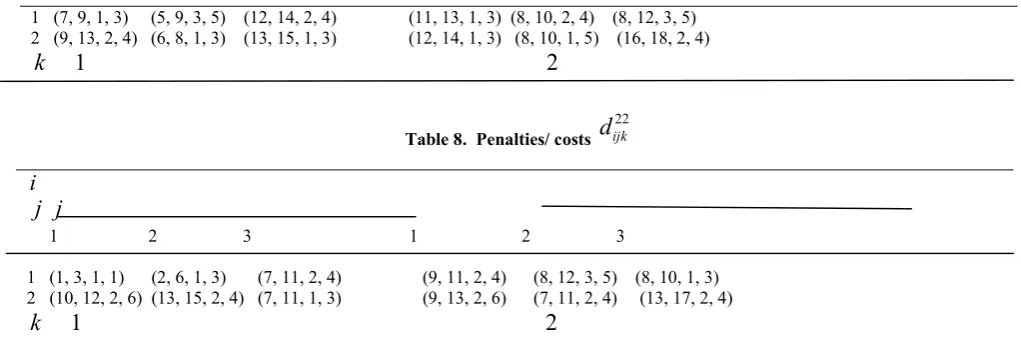
Table 7. Penalties/ costs cijk22
i
j j
1 (7, 9, 1, 3) (5, 9, 3, 5) (12, 14, 2, 4) (11, 13, 1, 3) (8, 10, 2, 4) (8, 12, 3, 5)
2 (9, 13, 2, 4) (6, 8, 1, 3) (13, 15, 1, 3) (12, 14, 1, 3) (8, 10, 1, 5) (16, 18, 2, 4)
2
[image:8.595.38.549.51.227.2]1
k
Table 8. Penalties/ costs
22
ijk
d
i
j j
1 2 3 1 2 3
1 (1, 3, 1, 1) (2, 6, 1, 3) (7, 11, 2, 4) (9, 11, 2, 4) (8, 12, 3, 5) (8, 10, 1, 3)
2 (10, 12, 2, 6) (13, 15, 2, 4) (7, 11, 1, 3) (9, 13, 2, 6) (7, 11, 2, 4) (13, 17, 2, 4)
2
1
k
From the tables above, the FFMOMISTP problem can be formulated
2 2 1 1 21
,
,
min
M
N
M
N
Z
Z
Subject to (5)
2 232 2
222 2
212
2 231 2
221 2
211 2
132 2
122 2
112 2
131
2 121 2
111 1
232 1
222 1
212 1
231 1
221
1 211 1
132 1
122 1
112 1
131 1
121 1
111
2
31
19
23
19
29
24
19
21
21
19
9
4
35
19
25
30
17
26
19
19
24
27
15
16
x
x
xx
x
x
x
x
x
x
x
x
x
x
x
x
x
x
x
x
x
x
x
x
x
[image:9.595.126.461.140.434.2]M
Table 9. The optimal solution of
Z
1Variables values Objectivevalue (optimum value)
14
38
35
27
34
15
2
2 222 2 122
2 111
1 221 1 112
1 121
1 111
x
x
x
x
x
x
x
0
2 232 2212 2
231 2
221 2
211
2 132 2
112 2
121 2
131
1 232 1
222 1
212 1
231
1 211 1
132 1
122 1
131
x
x
x
x
x
x
x
x
x
x
x
x
x
x
x
x
x
2961534
.
1
1
Z
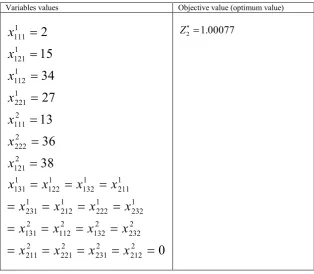
Table 10. The optimal solution of
Z
2Variables values Objective value (optimum value)
38
36
13
27
34
15
2
2 121
2 222 2 111 1 221 1 112 1 121 1 111
x
x
x
x
x
x
x
0
2 212 2
231 2
221 2
211
2 232 2
132 2
112 2
131
1 232 1
222 1
212 1
231
1 211 1
132 1
122 1
131
x
x
x
x
x
x
x
x
x
x
x
x
x
x
x
x
00077 . 1
2
Z
[image:9.595.140.455.475.749.2]
2 232 2
222 2
212 2
231 2
221 2
211
2 132 2
122 2
112 2
131 2
121 2
111
1 232 1
222 1
212 1
231 1
221 1
211
1 132 1
122 1
112 1
131 1
121 1
111
687
.
13
357
.
0
577
.
6
397
.
3
061
.
15
424
.
6
531
.
5
645
.
9
125
.
0
307
.
5
959
.
1
964
.
13
395
.
24
051
.
0
537
.
14
43
.
15
345
.
10
606
.
3
347
.
4
867
.
3
128
.
0
717
.
3
505
.
6
912
.
4
min
x
x
x
x
x
x
x
x
x
x
x
x
x
x
x
x
x
x
x
x
x
x
x
x
F
Subject to
G
x
p [image:10.595.123.475.239.533.2]ijk
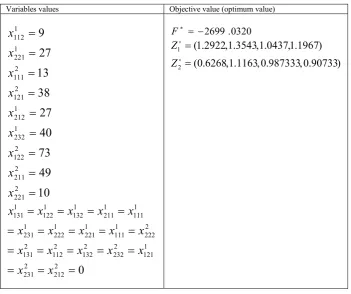
.Table 11. The optimal solution of
F
, and the fuzzy efficient solutionVariables values Objective value (optimum value)
10
49
73
40
27
38
13
27
9
2 221 2 211 2 122 1 232 1 212 2 121
2 111 1 221 1 112
x
x
x
x
x
x
x
x
x
0
2 212 2
231
1 121 2
232 2
132 2
112 2
131
2 222 1
111 1
221 1
222 1
231
1 111 1
211 1
132 1
122 1
131
x
x
x
x
x
x
x
x
x
x
x
x
x
x
x
x
x
0320 . 2699
F
)
90733
.
0
,
987333
.
0
,
1163
.
1
,
6268
.
0
(
)
1967
.
1
,
0437
.
1
,
3543
.
1
,
2922
.
1
(
2 1
Z
Z
Concluding Remarks
In this paper, a MOMISTP problem with fuzzy costs, supply, demand, and conveyances has been investigated based on fractional fuzzy programming approach. The advantages are that the problem with fuzzy numbers allows the decision maker(DM) to deal with a situation realistically. To deal with the minimization problem, the order relations who represents the DM performance
between fuzzy costs, supply, demand and conveyances has been defined by the LR trapezoidal fuzzy numbers.Using the fuzzy
number comparison introduced by Rouben's method, 1996, the FMOMISTP has been converted into the corresponding crisp MOMISTP. Then the MOMISTP has been transformed into the single objective linear programming using the proposed method of Guzel, 2013, and hence software programming is applied for solving the problem.
REFERENCES
Ammar, E.E. and Khalifa, H. A. 2004. A parametric approach for solving the multicriteria linear fractional programming
problem. Journal of Fuzzy Mathematics, 12(3): 527-535.
Ammar, E.E. and Khalifa, H. A. 2009. On fuzzy parametric linear fractional programming problem. Journal of Fuzzy
Mathematics, 17(3): 555–568.
Ammar, E.E. and Khalifa, H.A. 2014. Study on multi- objective solid transportation problem with fuzzy numbers. European
Journal of Scientific Research, (125): 9- 16.
Ammar, E.E. and Khalifa, H.A. 2015. On fuzzy multi- objective multi- item solid transportation problems. International
Journal of Computer & Organization Trends, 17(1): 1- 19.
Bajalinov, E. B. 2003. Linear- Fractional Programming: Theory, Methods, Applications, and Software. Kluwer Academic, Boston.
Baldwin,F. F. and Guild, N. C. F. 1979. Comparison of fuzzy sets on the same decision space. Fuzzy Sets and Systems, (2):
213- 231.
Bellman, R. E. and Zadeh, L. A. 1970. Decision making in a fuzzy environment. Management Science, 17, 141-164.
Charnes, A. and Cooper, W. W. 1962. Programming with linear fractional functional. Naval Research Logistic Quarterly,
(9): 181- 186.
Cui, Q. and Sheng, Y. 2012. Uncertain programming model for solid transportation problem. Information, 15(12): 342- 348.
Dalman, H. and Sivri, M. 2017. Multi- objective solid transportation problem in uncertain Environment. Iranian Journal of
Science and Technology, Transaction A, Science, 41(4). DOI:10.1007/s40995- 017-0254-5.
Dheyab, A.N. 2012. Finding the optimal solution for fractional linear programming problems with fuzzy numbers. Journal
of Kerbala University, 10(3): 105- 110.
Dinkelbach, W.1967. On nonlinear fractional programming. Management Science, 13(7): 492- 498.
Dubois, D. and Prade, H. 1980. Possibility Theory: An Approach to Computerized Processing of Uncertainty, Plenum, New York.
Fottemps, D. and Roubens, M. 1996. Ranking and defuzzification methods based on area compensation. Fuzzy Sets and Systems, (82): 314- 330.
Gupta, S. and Chakraborty, M. 1999. Fuzzy programming approach for a class of multiple objective linear fractional
programming problem. Journal of Fuzzy Mathematics, 7(1): 29- 34.
Guzel, N. 2013. A proposal to the solution of multiobjective linear fractional programming problem. Abstract and Applied
Analysis, volume 2013. Hindawi Publishing Comparison.
Haley, B.K. 1962. The solid transportation problem. Operational Research, (11): 446- 448.
Ida, K., Gen, M. and Li, Y. 1995. Solving multicriteria solid transportation problem with fuzzy numbers by genetic algorithms. European Congress on Intelligent Techniques and Soft Computing (EUFIT' 95), Aachen, Germany, 434- 441.
Jain, S. 2014. Modeling of Gauss elimination technique multi- objective fractional programming problem. South Asian
Journal of Mathematics, 4(3): 148- 153.
Jimenez, F. and Verdegay, L. J. 1999. Solving fuzzy solid transportation problem by an evolutionary algorithm based on
parametric approach. European Journal of Operational Research, (117): 485- 510.
Kaufmann, A. 1975. Introduction to the Theory of Fuzz Subsets, Vol. I. Academic Press, New York.
Kaufmann, A. and Gupta, M. M. 1988. Fuzzy Mathematical Models in Engineering and Management Science. Elsevier Science Publishing Company INC, New York.
Kumar, N. G. and Dutta, D. 2015. Solving multi- objective fuzzy solid transportation problem based on expected value and
the goal programming approach. IOSR Journal of Mathematics, 11(2): 88- 96.
Kundu, P., Kar, S. and Maiti, M. 2013. Multi- objective multi- item solid transportation problem in fuzzy environment.
Applied Mathematical Modeling, (37): 2028- 2038.
Kundu, P., Kar, S. and Maiti, M. 2014. Multi- objective solid transportation problems with budget constraint in uncertain
environment. International Journal of Systems Science, 45(8): 1668- 1682.
Luhandjula, K. M. 1984. Fuzzy approaches for multiple objective linear fractional optimization. Fuzzy Sets and Systems,
(13): 11- 23.
Moumita, D. and De, P. K. 2014. A note on fuzzy multi- objective linear fractional programming problem. International
Journal of Computer Science and Network, 3(6(: 568- 572.
Nagarajan, A., Jeyaraman, K. and Prabha Krishna, S. 2014. Multi- objective solid transportation problem with interval cost
in source and demand parameters. International Journal of Computer & Organization Trends, 8(1): 33- 41.
Nakamura, K. 1986. Preference relations on a set of cost in source and fuzzy utilities. Fuzzy Sets and Systems, (20):
147-162.
Nykowski, I. and Zoliewski, Z. 1985. A compromise procedure for the multiple objective linear fractional programming
problem. European Journal of Operational Research, (19): 91- 97.
Ojha, A., Das, B., Mondal, S. and Maiti, M. 2009. An entropy based solid transportation problem for general fuzzy costs
and time with fuzzy equality. Mathematical Computation Model, 50(1-2): 166- 178.
Pandian, P. and Anuradha, G. 2010. A new approach for solving solid transportation problems. Applied Mathematical
Sciences, 4(72): 3603- 3610.
Pandian, P. and Natarajan, G. 2010. A new method for finding an optimal solution for transportation problems.
International Journal of Mathematical Sciences and Engineering Applications, (4): 59- 65.
Pramanik, K.S. 2010. A multi- objective solid transportation with reliability for damageable items in random fuzzy
environment. International Journal of Operational Research, 31(1): 1- 23.
Porchelvi , R. S., Vasanthi, L. and Hepzibah, R. I. 2014. On solving multi objective fractional linear programming
problems. Global Journal of Current Research, 6(8): 8095- 8102.
Rani, D. and Gulati, R.T. 2016. Uncertain multi- objective multi- product solid transportation problems. Indian Academy of
Roubens, M. 1991. Inequality constraints between fuzzy numbers and their use in mathematical programming, in: R. Slowinski, J. Teghem (Edt). Stochastic Versus Fuzzy Approach to Multi objective Mathematical Programming Under Uncertainty. Kluwer Academic Publishers, Dordercht, 321- 330.
Shell, E. 1955. Distribution of a product by several properties, Directorate of Management Analysis, Proc. 2ndSymp. On
Linear Programming, (2): 615- 642,DCS/ Comptroller H.Q.U.S.A.F., Washington, DC. solid transportation problem with fixed charge under stochastic environment Applied Mathematical Modeling, (31): 2668- 2683.
Swarup, K. 1965. Linear fractional functionals programming. Operations Research, 13(6): 1029- 1036.
Yang, L. and Yuan, F. 2007. A bicriteria solid transportation problem with fixed charge under stochastic environment Applied Mathematical Modeling, (31): 2668- 2683.
Zadeh, L. A. 1965. Fuzzy sets. Information Control, (8) 338- 353.