
Forestry and Environment
Legislation in Collision –
Case Study Serbia
Radovan Nevenić
Institute of Forestry, Kneza Višeslava 3, 11030 Beograd, Serbia [email protected]Renata Gagić – Serdar
Institute of Forestry, Kneza Višeslava 3, 11030 Beograd, Serbia [email protected]Ljubinko Rakonjac
Institute of Forestry, Kneza Višeslava 3, 11030 Beograd, Serbia [email protected]Zoran Poduška
Institute of Forestry, Kneza Višeslava 3, 11030 Beograd, Serbia [email protected]
Abstract
Background and purpose: Conflicts in the Serbian for-estry sector have not been very often used as a research topic in our country. This paper presents the results from a case study conducted in the National park ‘Fruška gora’. The aim of the study was to explore the collision between forestry and environmental legislation and re-lated institutions and organizations.
Material and Methods: Data were collected from prima-ry and secondaprima-ry sources. Primaprima-ry data were collected through in-depth interviews. Interviews were conducted with the managers of the National park and the repre-sentatives of the scientific communities, private forest owners as well representatives from the relevant Min-istry. The theoretical framework is a combination of the main conflict elements embedded in the structure of the main aspects like culture, conflict management and policy development.
Results and conclusion: According to the interviewees` opinions the roots of the conflict can be found in over-lapping jurisdictions of the institutions and organizations in the forestry sector as well as in the implementation of the legislative and management plans. Conflict manage-ment strategy is based on sustainable managemanage-ment of protected areas and better implementation of laws.
Keywords: conflict management, National Park Fruška gora, legislative, protected areas
Preliminary communication
In a world in which the bio-physical environment and socio-cultural systems are changing rapidly, conflicts involving protected areas are inevitable.
There is no single definition of conflict. According to FAO [2], natural resource conflicts can be seen as disagreement and disputes over access to, control or use of, natural resources. Conflict is also defined as a process in which two or more parties attempt to frustrate the other’s goal attainment. The factors underlying conflict are threefold: interdependent, dif-ferences in goals, and difdif-ferences in perceptions [3].
According to Hellström and Reunala [4] main con-flicts can be caused by: (I) intensification of forestry operations; (II) increased societal needs like recre-ation, and (III) growing importance of the environ-mental movements.
Conflict can represent the productive interaction of competing interests and values, an ever-present function in a dynamic society. Conflicts that are prop-erly addressed can be opportunities for problems to be identified and solved, and progress achieved [5]. Many conflicts, when not managed become coun-terproductive and destructive, leading to detrimental results and hostile relationships.
Protected area staffs are challenged to respond to conflicts so that unproductive consequences can be avoided while human well being and the natural en-vironment are protected. Conflict will always exist to some degree in every community, but it can often be managed and resolved [6, 7].
It is important to emphasize that conflict when managed have the positive impact on relations and even policy development [8, 9]. If conflicts – even in-tense ones – raise important political concerns, help to keep the administration alert, motivate creative plan-ning and problem-solving and make sure everyone’s opinions are heard, they can work as important cata-lysts for positive social change and development [10].
INTRODUCTION
The Countries of South East Europe (SEE) are cur-rently in process of joining the European Union (EU) and strive to become full member states. The process to join the EU requires SEE Countries to integrate up-dated policy concerning environmental protection [1] and related legislation into the countries’ legislative frameworks.
As the previous research on forest conflicts is limit-ed or non-existent in the SEE region and on the other hand the forest policies in each of the countries are in stages of development, the issue of conflicts can be very significant in identifying the range of interests and related conflicts of different broad stakeholder groups.
MATERIALS AND METHODS
Fruška Gora is an isolated, narrow, low island moun-tain in Pannonia plain. The area in which is situated is 80 km long. Its location, specific geological history and different microclimatic conditions make it very in-teresting and important to science. In 1948 the gov-ernment of Pupils Republic of Serbia founded state enterprise called Pupils excursion-place centered in Sremska Kamenica. The aim of this company was es-tablishment, usage and forest complex management for mass picnics and tours of people, together with other tasks for which the forest management unit is competent. In 1952 the first forest management unit basic document has been done, by terrain section of Ministry of forestry. In that time, localization of excur-sion places has been done, together with landscape architecture, building of roads, footpaths, drink foun-tains, desks and benches. In 1960, a law proclaiming the Fruska Gora a National Park (NP) was passed. The borders have largely remained the same till today and mark a territory of 25 520.00 hectares [11].
NP “Fruška gora” was chosen deliberately, because in this type of protected areas overlapping jurisdic-tion with regard to forest management between sec-tors of forestry and nature protection is present.
NP “Fruška gora” is obliged to respect several lows, regarding National parks, forestry, environmental
protection, water, fishing, hunting, tourism, cultural heritage, planning and construction, geological re-searching and mining.
Managing of NP is under the several Laws and reg-ulations, such as:
a. Law on National Parks (Official Gazette Repub-lic of Serbia No 39 from 31st May 1993); b. Environmental protection law (Official Gazette
Republic of Serbia No 66/91 and 135/04); c. Law on Forestry (Official Gazette Republic of
Serbia No 30/10);
d. Spatial Plan of National Park Fruška Gora (Offi-cial Gazette of Province Vojvodina 16/04 from 27th August 2004)
e. Management Plan (Faculty of Forestry, Bel-grade 2006.)
The objectives of this research were to identify the most important conflicts and to deduce are identified conflicts managed properly? This research was con-ducted at NP “Fruška gora” in Serbia as well parallel similar protected areas in the five countries in SEE re-gion: Albania, Bosnia and Herzegovina, Croatia, and Macedonia. Each country has one or two case studies.
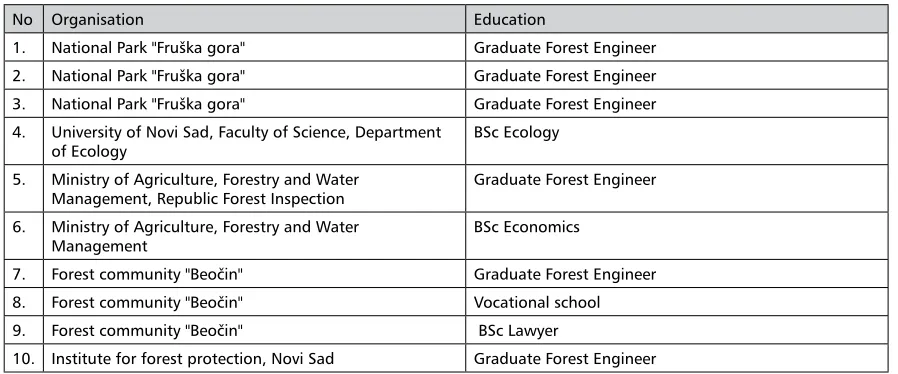
For that reason the specific open questionnaire was designed and executed in all cases [12]. Questionnaire was designed to capture all four important elements of the conflicts (content, procedure, relations and cul-ture) in targeted group of actors involved in manage-ment of protected areas (PA), in governmanage-ment and in related conflicts as well. The data collected through face to face interviews was our primary data. Inter-viewees were employees in institutions directly or in-directly involved management of PAs Target groups were: employees from the governmental institution related to forestry and nature conservation; public enterprises for forestry; local administration; private
No Organisation Education
1. National Park ''Fruška gora'' Graduate Forest Engineer 2. National Park ''Fruška gora'' Graduate Forest Engineer 3. National Park ''Fruška gora'' Graduate Forest Engineer 4. University of Novi Sad, Faculty of Science, Department
of Ecology
BSc Ecology
5. Ministry of Agriculture, Forestry and Water
Management, Republic Forest Inspection Graduate Forest Engineer 6. Ministry of Agriculture, Forestry and Water
Management
BSc Economics
7. Forest community ''Beočin'' Graduate Forest Engineer
8. Forest community ''Beočin'' Vocational school
9. Forest community ''Beočin'' BSc Lawyer
[image:2.499.27.476.481.668.2]10. Institute for forest protection, Novi Sad Graduate Forest Engineer
TABLE 1
forest owners association; protected area administra-tion; scientific institutions.
Since this is the qualitative research there is no strict rule defining the number of interviewees. Researchers take account of the saturation and repetition of the same data and answers and based on that define the number of interviews. Number of case study inter-views is presented in the Table 1.
The respondents were asked main questions: are there any conflicts in forestry sector, how the conflicts are managed, how should an organization react to the conflict and did conflicts initiate any changes in your organization and policy process [12]?
Beside the data collected from the interviews all ad-ditional data related to the specific case study were collected. Additional data included: documentation, archival records, text analysis, interviews and sur-veys, direct observations, participant observation and physical artifacts. Main source of information about: behavior, opinion and, values were answers to the open questions which were analyzed qualitatively. This was supported with information on knowledge, educational background and demographics charac-teristic of the interviewees.
Three elements of conflict also named Progressive triangle and also occurs during the management of conflict. The substance and process are tangible ele-ments of conflict where the relations are based on the personal way of the understanding things. Theoreti-cal framework used is Walker and Daniels [3] is em-bedded into theoretical framework of Eeva Hellström [10] adding to the theoretical framework fourth im-portant cultural element (Figure 2).
By recognizing major forestry/environmental con-flicts in the country, with its themes, actors and in-tensity, defining its tangibility, it is possible to portrait also conflict management in a triangle of three inter-related dimensions - substance, procedure and rela-tionships - and it will illustrate a number of things re-garding various stakeholder’s attitudes toward their view on impact on policy development, in order to allow stakeholders meaningful voice in the process.
Since the factor of the “ideal culture” plays an im-portant role for each stakeholder in recognizing self-interests, it can be applied towards an in-depth analy-sis of interests.
Upon the basis of improved information a process of “rethinking” is to take place, serving to alleviate the conflict [13].
Conflict management strategies must account for the particular situation in which a conflict occurs. But, complex conflict situations can never be resolved, but they can be managed well, so that the conflict situa-tions do not become destructive. So, the term man-agement is a broad notion that includes, but does not require resolution. It is the way of situation improve-ment [3].
The role of conflict in actor identity and problem definition: Missing from the discussion so far is the What is the conflict
all about? Substance
Procedure How is the conflict
manifested?
Relationships What is the relation between the conflicting
parties?
THEORETICAL FRAMEWORK
[image:3.499.253.472.56.255.2]Theory defines the conflict in the different ways, us-ing the different terms to explain the word “conflict”. The terms such as: struggle, pressure, opposition, aspirations, interaction, cooperation, rivalry, competi-tion are frequently used in the defining of the conflict situation. The theory conflict management frame-work created by Walker and Daniels [3] includes three elements: substance, process and relations (Figure 1).
FIGURE 1
Progressive triangle
Culture - cultural background - attitudes towards conflicts (eg. role of conflict in policy development)
Conflicts - substance - processes - relations
Conflicts management - substance - processes - relations
1 2
3 5 4
Policy development 6
FIGURE 2
recognition of the importance and contribution of social conflict in political discussion. Often conflict is viewed as a destructive force that should be reduced or eliminated. However, without conflict actors can-not define themselves. Actors define themselves in relation to others and “other” is recognized through recognition of difference. Thus, the recognition of difference leads to the establishment of boundaries between “self” and “other” [14].
RESULTS
The results are divided into groups of elements de-termining conflict, conflict management elements as well as cultural background and policy development, issues directly affecting or affected by the conflicts.
1. Conflict and conflict determinants
Regarding theoretical dividing upon conflict ele-ments, the analyses is set in order according to the gathered data and therefore the substance determin-ing issues, the process indicators as well as the rela-tions defining the conflict.
Substance as a conflict element
From the data gathered with the interviews, can be concluded that majority of conflicts arise between public and private sector. Some data regarding con-flict elements results and therefore for this case study more data besides substance, as well as conflict stage, its beginning and lifespan, main actors involved with-in conflict, the jurisdiction over the conflictwith-ing issue and the powerfulness of the main actors, presented below within the Table 2.
From the data (Table 2), we can see that conflict have appeared years ago and are still existing. For most of them the causes of appearance are as a result of the new ongoing ecological/environmental initiatives.
positive answer and NP offer a service of the main-tenance of the meadow. The price of the service was much higher than the financial solvency of the forest community. Therefore the limit of the right to use the private property was imposed, and in turn the expen-sive service of the maintained was offered.
Overlapping legislation, struggle for competencies, different interests, values and attitudes of forestry and nature conservation sector is likely source of this conflict.
Common denominators
In NP ‘’Fruška Gora’’case study differing manage-ment objectives are the key issue. Therefore, these can refer to the values of the conflicting issues (for-estry-nature conservation) and interests of the op-posed parties [15].
There are several lows, regarding National parks, forestry, environmental protection, water, fishing, hunting, tourism, cultural heritage, planning and construction, geological researching and mining, to be respected. Beside that the restitution process is about to start and will open new possible areas of conflicts where about 50 % of forest areas should be given back to the old owners. The overlapping of several laws consequently lead to poor law enforce-ment, which could result with new problems sousing new conflicts. This puts parties on the field in more complex situation that before, without proper tools to manage it.
2. Process
Ministries responsible for protected areas has juris-diction over the substance of the conflict. National parks are good examples of areas where various and mutually interdependent stakeholders with differing interests and attitudes struggle to achieve their goals.
The substance is disagreement about the manage-ment of the meadow. The meadow is privately owned by Forest community ‘’Beočin’’. The meadow is favor -ite picnic place of the citizens of town Novi Sad. On the other hand it is the site of numerous protected and rare herbaceous species. The owners intend to fulfill the tourist offer by proper open-air equipment and other serviceable for tourists. This requirement was sent to the Institute of Nature Protection and to the administration of NP ‘’Fruška Gora’’. There are no
Case
study Conflict substance Duration of conflictBeginning / (stakeholders)Main actors Stage of conflict
Jurisdiction over conflict
More powerful
actor
SER-Fruska Gora
meadow maintenance between PFOs and
NP Fruska gora
NP proclamation (1960) / Ongoing
NP Fruška gora, PFOA ‘’Sumska
zajednica’’
latent stage
Institute for Nature Protection
Institute for Nature Protection
TABLE 2
Conflict element data
There are significant changes in management of pri-vately owned forests and forest land. The new man-agement plan for Manman-agement unit of Forest com-munity ‘’Beočin’’ was made in year 2007.
3. Relations
parties in these cases varies from distrust or very low level of trust, and that can be seen from answers of the interviewees in all countries.
Primary parties in conflict are: NP ‘’Fruska gora’’, Institute for Nature Protection and Forest community ‘’Beočin’’. Secondary parties are: Ministry of Agricul -ture, Forestry and Water Management, Ministry of Spatial Planning.
The conflict is, according to interviewees, in the la-tent phase hidden from public view. Relations consist of dialogue, cooperation and participation of all par-ties in management of protected area.
4. Conflict management and conflict
man-agement determinants
At the time when the conflict is determined usually subsequently follow up activities towards solving or mitigating the appeared situation. There is variety of activities that can be undertaken in that direction and usually depends on the actor’s choices and more or less of the conflict environment attitude and the given situation. Within the Table 3 the conflict management components and the analyzed elements are present.
‘The management and solution of the collision be-tween forestry and environmental sector legislation depends to inter-sectoral cooperation. There is obvi-ously lack of collaboration as different view of nature protected area maintenance, process through which parties who see different aspects of a problem can constructively explore their difference and search for solutions that go beyond their own limited vision of what is possible.
4.1. Substance
Evidently there are great number of laws and regu-lations related to the same area. By interpreting and judging them as such, each of the sectors can in the-ory justify its activity. In practice, it causes misunder-standing, disagreements and even the open conflict between interests of the Association of Private Forest Owners and nature protection requirements.
4.2. Process
Although the development of transparent and par-ticipatory structures for governing natural resources
is an essential step, the process side of conflict man-agement is advance stage. The cooperation between administration of NP and Forest Community result in extraction unique forest management unit, privately owned. Management of this specific Unit differs from management of NP as a whole.
4.3. Relations
Conflict management was carried out by Secre-tariat for Environmental Protection and Sustainable Development who are in the same time stakeholders in the protected areas.
Constructing an environment in which conflicts over natural resources can be dealt with productively will also require new structures and processes for governing natural resources management decisions. Changes to national policies and legal frameworks are needed to accommodate the development of re-lations between institutions and organizations at var-ious levels. The critical problem is incapacity of stake-holders to provide transparency and accountability to community-based organizations.
5. Cultural background
Employees in PFEs with different professional back-ground as conflict parties show differing attitudes to conflicts. Some of them deny the very existence of the conflict some do find conflicts neither negative, nor completely positive.
Traditional values are reflected in the attitudes of the management of the NP as well as in the attitudes of the members of the Forest community. The inter-viewees from NP use the phrases about “necessity and superiority of the forestry profession in the man-agement of the protected area” since “only forest-ers have the sufficient scope of knowledge and skills” which can be appropriately used in the management of the NP. The members of the Forest community em-phasize the long tradition in management of same forests.
6. Policy development
In case study there have been no policy changes made, during or after the conflict management. Some improvement with regard to communication is
TABLE 3
Conflict management elements data outlined per case studies
Case study
Conflict
substance CM strategy
Primary actors
Power is on the side of
Professional background
Organizational culture
Actor attitudes towards
conflict
SER-FRU
meadow maintenance,
different management
objectives
Avoidance / Competitiveness
NP Fruška
Gora, PFOA
NP Fruška gora
NP-foresters PFOA-various
NP –traditional, PFOA-various
NP perceives no conflict.
evident. Application of the forestry legislation often presents a problem for employees in forest sector. The employees in the public institutions, public enter-prises, and owners of the private forests, as well as experts from the forestry sector and the domain of en-vironment consider that the forestry legislation is not adapted to the needs of the forestry sector. Also there are opposite opinion that the forestry legislation pro-motes and supports the sustainable forest manage-ment in the appropriate way. More than 70 % of the interviewees emphasized that there are difficulties re-garding harmonizing the legal regulation of the envi-ronmental protection law with the forestry legislation, or think that the harmonisation is not good enough.
DISCUSSION AND CONCLUSIONS
Origin of the conflicts were related to overlapping or not harmonized law regulative; different way of management of PAs or different property rights. It means that the majorities of conflicts belong to sub-stance part, but in some case studies procedure and relation part were also stressed as components which can improve the substance issue. There was not prop-er conflict management.
It is evident that there is a great number of laws and sub-legal act which are related with the same area. By interpreting and judging them as such, each
of the sectors can in theory justify its activity. In prac-tice, it causes misunderstanding, disagreements and even the open conflict between the forestry and en-vironmental protection legislation, since they are sim-ply used double and impartially as the legal remedy. The views of the people which are in touch with these laws also confirm the theory.
The management and solution of the collision be-tween the forestry sector and legislation which is re-lated to the protected natural resources to a great extent depends upon the inter-sector cooperation, in-vestment in the sectors, as well as monitoring and ap-praisal of the sectors. The international and regional cooperation becomes a key to the improvement of the legislation and contributes to the investment in the sectors, which is reflected in the connecting of the legal regulations.
IF conflicts are managed, THEN the management of natural resources can become more participative, equative and efficient, rendering benefits to a larger group of stakeholders. Conflicts are actually good, they provide an opportunity to discuss, differ and find common solutions and improve things. If they are not managed then this potential is lost.
Policy processes can be more successful, when they recognize the potential influences of conflicting is-sues and interests [12].
REFERENCES
1. UNITED NATIONS 1992 Convention on Biological Diver-sity. Available at: http://www.cbd.int/doc/legal/cbd-en. pdf (Accessed 20 May 2010)
2. FAO 2000a Conflict and natural resource management. In: Yasmi Y 2003: Understanding conflict in the co-management of forests: the case of Bulungan Research Forest. International Forestry Review 5 (1) p. 38 3. WALKER G B, DANIELS S E 1997 Foundation of natural
resource conflict: Conflict theory and public policy. In: Solberg B, Miina S (eds) Conflict management and participation in land management. European Forestry Institute Proceeding No. 14. Joensuu. Finland, p 7–36 4. HELLSTRÖM E, REUNALA A 1995 Forestry conflicts from
the 1950s to 1983. Research Report 3, European Forest Institute, Joensuu, Finland
5. COSIER R A, DALTON D R 1990 Positive Effects of Con-flict: A Field Assessment. Int J Confl Manage 1: 81-92 6. FAO 2000b Conflict management series: Proceedings electronic conference on addressing natural resource conflicts through community forestry (January–May 1996). Community Forestry Unit Forests, Trees and People Programme, Forestry Department. In: Yasmi Y 2003: Understanding conflict in the co-management of forests: the case of Bulungan Research Forest. Interna-tional Forestry Review 5 (1), p 38
7. PRUITT D G, KIM S H 2004 Social conflict: Escalation, stale-mate, and settlement (3rd ed.). New York: McGraw-Hill
8. BARON R 1991 Positive effects of conflict: A cognitive perspective: The relative efficacy of four interventions. Employees Responsibilities and Rights Journal 4 (1): 25-36.
9. LEWIS C 1996 Managing Conflicts in Protected Areas. IUCN, Gland, Switzerland, and Cambridge, UK, p xii + 100 10. HELLSTROM E 2001 Conflict cultures: Qualitative
com-parative analysis of environmental conflicts in forestry. Silva Fennica 2: 1–109
11. www.fruskagora.rs (Accessed 15 May 2011) 12. VULETIĆ D, STOJANOVSKA M, AVDIBEGOVIĆ M,
NEVENIĆ R, PETROVIĆ N, POSAVEC S, HASKA H, PERI L, BLAGOJEVIĆ D 2010 Forest Related Conflicts in the
South-East European Region: Regional aspects and Case studies in Albania, Bosnia and Hercegovina, Croatia, Macedonia and Serbia. EFI Proceedings No. 58. ISSN 1237-8801; ISBN 978-052-5453-35-5.
13. KROTT M 2005 Forest Policy Analysis. Springer – EFI. ISBN 1-4020-3478-4 (HB), p 15-20
14. SHANNON M 2003 Cross-Sectoral Policy Impacts Be-tween Forestry and other sectors. Chapter 5. Mecha-nisms for coordination. FAO Forestry Paper
![FIGURE 1Upon the basis of improved information a process of “rethinking” is to take place, serving to alleviate Progressive trianglethe conflict [13]](https://thumb-us.123doks.com/thumbv2/123dok_us/1260757.653727/3.499.253.472.56.255/figure-improved-information-rethinking-alleviate-progressive-trianglethe-conflict.webp)
