A Review of Resource Scheduling in Fog based
Cloud Environment
Antim Malik1, Vikas Malik2
1, 2
Department of Computer science and technology
Abstract: The paper has considered resource scheduling concept in fog environment. Here in this research paper the discussion has been made on cloud computing with Fog computing system. Requirement of Fog computing has been discussed here. Moreover several researches in the field of cloud and fog are explained. The research paper focuses on the scheduling algorithm for resource management. The concept of node duplication has been discussed in critical path algorithm. Such algorithms are suppose to minimize the make span time. These algorithms are performing efficiently to manage cloud resources.
Keywords: Cloud computing, Fog Computing, Scheduling, Resource scheduling, Critical path algorithm.
I. INTRODUCTION
Cloud computing [1] is known as recent computational model that is dependent on grid computing. Regularly the Cloud computing has been outlined as a computing surroundings. Here the computing is required by one user. These are often outsourced to separate party. It would like occur to apply the computing power.
Using cloud services [2], organizations are capable to deploy the software systems over resources pool. Such company rely on the company-vital environment. Such systems has been created after a long periods. This legacy software’s have been implemented on-basis. Several researches in cloud migration have been carried out in last few decades. Requirement of storage of data [3] is enhancing every day. It may be considered as a record or as the memory. Under the traditional [22] way of storing hard disks were used in computers or in the smart phones. Data store is increasing simultaneously with the increase in profiles number of individuals and there was a parallel increase in the store of data. There is elasticity, scalability, efficiency and multi-mobility in cloud computing.
It [5] has been determined as the expansion of cloud computing application up to border of network. The purpose is to minimize latency as well as overcrowding of network. [20] It is comparatively a trend of the present research.
Even though same type of resources and services are offered by cloud and fog, latter has been categorized with low latency along with broader spread as well as geographically circulated nodes for supporting movement as well as interaction of actual time. However, development of applications in Fog environment [11] is tougher than the Cloud because of the dispersed nature of Fog systems.
The extension of cloud computing [5] has become possible because of Fog computing. It offers the information, the computation of data, the storage of data. It also provides the application applications to use by the user. Several facilities for example as the information and computation of data are offered by Fog computing. It also provides the storage of data as well the application to end user.
II. LITERATURE SURVEY
There have been several research in field of cloud and fog computing. Some of them have been discussed in this section. In 2010, J. Deng, et.al [1] wrote on research and application of cloud storage.
In 2013, P. Jamshidi, et.al [2] proposed on cloud migration research. They provide a systematic review. In 2013, S. Sharma, et.al [3] discussed the survey paper on cloud storage.
In 2014, A. O. Joseph, et.al [4] did research on cloud security technique. The research is found significant for data protection over cloud environment. They provided review over cloud security techniques for data security. Research paper is considering different protection techniques. These techniques have been given in enterprises. Techniques have make discussion of some general protection techniques. These protection techniques consist of authentication and authorization. Research has also considered encryption and control mechanism for accessing private data.
In 2015, N. S. Dhande, et.al [5] wrote on Fog Computing. They also offered the Review of Privacy and Security Issues.
In 2016, S. Agarwal, et.al [8] reviewed an efficient architecture. They also considered the suitable algorithm in order to implement proposed task. These architecture and algorithm have been frequently used in order to provision resource. The research focused on the performance enhancement in fog computing environment.
Virtualization is allowing a server to behave like a slice. It occurs in case of virtual devices. Thus every virtual device is having the particular mechanism. It is capable to adjust resource distribution quickly. Cloud computing is providing many benefits. The most common benefit is the flexibility in distribution of resource.
In 2016, M. Chiang ,et.al [9] stated the fog environment in case of internet of things. Research has considered introduction to opportunity in research.
In 2016, S. N. K. Dr., et.al [10] gave a review on fog computing. They discussed purposed and significance of fog computing in field of IOT. In this paper research explained characteristics that are making Fog suitable environment for lot of complex Internet of Things applications. These services are connecting vehicle. Services may be smart grid or smart cities. It could be used in wireless sensors and actuators.
In 2016, N. K. Giang, et.al [11] did research on development of smart transportation devices with fog computing concept.
Therefore, the development of devices in Fog system has been considered complex as compare to Cloud. It is due to the shared environment of Fog environment. The work has investigated the pattern by which the smart transportation devices have been created developed.
In 2016, M. Niranjanamurthy, et.al [12] wrote research paper to consider the concept of data protection in fog computing. In this paper they performed survey on fog computing. They explained the requirement of fog along with challenges.
In 2016, F. Y. Okay, et.al [13] proposed a fog computing. Research is dependent on smart grid model. This study provides overview fog computing in smart grids. It is performed analyzing its efficiency and challenges.
In 2016, D. Zeng, et.al [14] discussed the joint optimization of task scheduling. they also gave their view on positioning of graphics. Research is based on fog computing. Work is supporting embedded system that is software-defined.
In 2017, S. Chakraborty, et.al [15] provided a review on fog networks in healthcare application. Research represents that their system has taken small time. It is taking less time in achieving data accuracy and data consistency. This type of work is found significant in several applications such as medical data.
In 2017, K. Dolui ,et.al [16] made comparison of edge computing implementations. In this paper, they explained various functionalities of fog based system. These executions are Fog based Computing and Mobile Edge Computing. Research made comparison of their features.
In 2017, S. Khan, et.al [17] wrote research on protection of fog computing. Research has given idea of present applications along with solutions for security. This research has determined influence of such protection challenges. Research has also considered the possible answers.
In 2017, M. M. Lopes, et.al [18] did research on my IFOG SIM . It is well known simulator. This simulator is frequently used for virtual machine migration. Such mechanism improves the functionality of computing based on fog technology.
In 2017, H. A. M. Name, et.al [19] wrote on User mobility and resource scheduling. They also explained the management in fog computing. Such mechanism is capable to assist IoT devices. Research has suggested scheduling policies. These are capable to improve the algorithm.
In 2017, O. Osanaiye, et.al [20] did research on cloud to fog computing. This research is describing fog computing architecture. Paper has also made review of various services along with its usage.
In 2017, T. Pandikumar, et.al [21] wrote on DDOS attack detection in software defined networking with cloud computing. In 2017, S. Waghmare, et.al [22] stated the securing cloud with the use of fog computing with Hadoop framework. In 2018, V. P. Lalitha, et.al [23] discussed the data security in cloud.
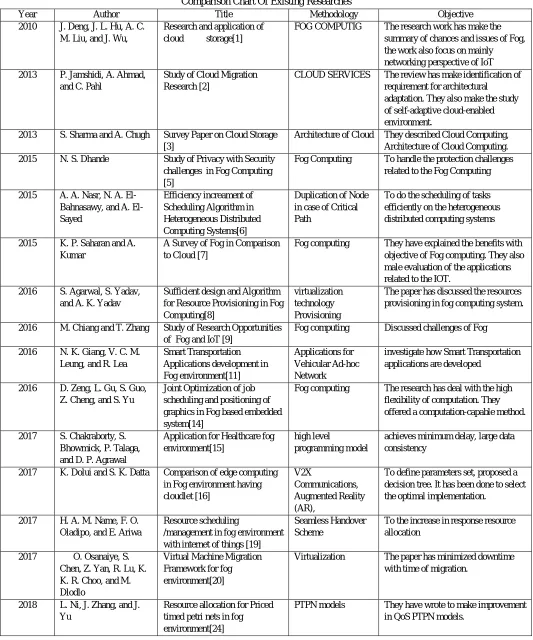
Table I
Comparison Chart Of Existing Researches
Year Author Title Methodology Objective
2010 J. Deng, J. L. Hu, A. C. M. Liu, and J. Wu,
Research and application of cloud storage[1]
FOG COMPUTIG The research work has make the summary of chances and issues of Fog, the work also focus on mainly networking perspective of IoT 2013 P. Jamshidi, A. Ahmad,
and C. Pahl
Study of Cloud Migration Research [2]
CLOUD SERVICES The review has make identification of requirement for architectural adaptation. They also make the study of self-adaptive cloud-enabled environment.
2013 S. Sharma and A. Chugh Survey Paper on Cloud Storage [3]
Architecture of Cloud They described Cloud Computing, Architecture of Cloud Computing. 2015 N. S. Dhande Study of Privacy with Security
challenges in Fog Computing [5]
Fog Computing To handle the protection challenges related to the Fog Computing
2015 A. A. Nasr, N. A. Bahnasawy, and A. El-Sayed
Efficiency increament of Scheduling Algorithm in Heterogeneous Distributed Computing Systems[6]
Duplication of Node in case of Critical Path
To do the scheduling of tasks efficiently on the heterogeneous distributed computing systems
2015 K. P. Saharan and A. Kumar
A Survey of Fog in Comparison to Cloud [7]
Fog computing They have explained the benefits with objective of Fog computing. They also male evaluation of the applications related to the IOT.
2016 S. Agarwal, S. Yadav, and A. K. Yadav
Sufficient design and Algorithm for Resource Provisioning in Fog Computing[8]
virtualization technology Provisioning
The paper has discussed the resources provisioning in fog computing system.
2016 M. Chiang and T. Zhang Study of Research Opportunities of Fog and IoT [9]
Fog computing Discussed challenges of Fog
2016 N. K. Giang, V. C. M. Leung, and R. Lea
Smart Transportation Applications development in Fog environment[11]
Applications for Vehicular Ad-hoc Network
investigate how Smart Transportation applications are developed
2016 D. Zeng, L. Gu, S. Guo, Z. Cheng, and S. Yu
Joint Optimization of job scheduling and positioning of graphics in Fog based embedded system[14]
Fog computing The research has deal with the high flexibility of computation. They offered a computation-capable method.
2017 S. Chakraborty, S. Bhowmick, P. Talaga, and D. P. Agrawal
Application for Healthcare fog environment[15]
high level
programming model
achieves minimum delay, large data consistency
2017 K. Dolui and S. K. Datta Comparison of edge computing in Fog environment having cloudlet [16]
V2X
Communications, Augmented Reality (AR),
To define parameters set, proposed a decision tree. It has been done to select the optimal implementation.
2017 H. A. M. Name, F. O. Oladipo, and E. Ariwa
Resource scheduling
/management in fog environment with internet of things [19]
Seamless Handover Scheme
To the increase in response resource allocation
2017 O. Osanaiye, S.
Chen, Z. Yan, R. Lu, K. K. R. Choo, and M. Dlodlo
Virtual Machine Migration Framework for fog environment[20]
Virtualization The paper has minimized downtime with time of migration.
III. FEATURES OF FOG COMPUTING
Fog [9] is a developing architecture for storage, computing, controlling and networking. Reside over network edge; these are traversing across hardware and software.
Fog computing [24] is known as clouds at edge. It has been determined a rising concept. It is capable to provide the services in close of appliance. It has been done to increase the Quality of Service. It has been found complex in order to make improvement in the performance of utilization of resources. Satisfaction of the need of user is becoming a huge challenge.
Major characteristics [7] of the Fog are discussed as follow
A. Fog system provides mobility to applications.
B. Fog based system is aware to location.
C. Such systems are working on low latency.
D. Fog system is capable to manage large number of nodes.
E. These systems allow extensive geographical distribution.
F. Several real time applications are exploring benefits and motivation of Fog computing.
IV. RESOURCE SCHEDULING IN FOG COMPUTING
Fog computing is that dispersed computing networking device which is omnipresent. It is often considered as IoT devices and some new devices and analytics. It is considered to be happening in Fog infrastructures because of mobility of various applications, allocation of resources and distribution of management .
This is done by a fog layer in which present user movement is forwarded to geographically distributed data centers of cloud. More than this, fog layer time can handle the application execution requests distribution of IoT devices at the network edges. Here data generation and processing is not taken into consideration.
Due to these there comes a hike in response resource allocation. It also has an effect on the mobility of user from edge of network. It explains our experience of our research in finding the problem for reducing the network traffic. It shows a low delay. Lot of the researches have proposed [24] resource allocation mechanism. These mechanisms perform fog computing rely over Priced Timed Petri nets. The clients are efficient that they can choose favourable resources out of the catalogue of resources which are already allocated.
V. SCOPE OF RESEARCH
Such researches consider cost and time in order to fulfil the operation. It results in credibility evaluation of resources available on fog. There is always requirement to construct the models to manage fog resources. Algorithms are predicting task completion time need enhancement.
There is need to develop technique of computing credibility to make analyze of fog resource. Changeable allocation algorithms are required related to the fog resources. These systems may obtain a high performance than still allocation methods. These systems could be useful for completion of task and takes less time with minimum charges.
VI.ACKNOWLEDGMENT
I would especially like to thank my worthy guide Guide name, whose supervision dissertation work has been carried out. Her technical advice, ideas, and consecutive criticism and motivation contributed to the success of this research. She suggested me many ideas and solved my puzzles when I was in need. Her motivation and help have been a great inspiration to me.
I would also like to thank our Vice-Chancellor, college name, Vice-Chancellor name for his continuous support and guidance from the institution.
I convey my thanks to respected Chairman Department of CSE, NAME OF CHAIRMAN and all the faculty members of CSE Department for providing me the opportunities, support and the necessary help to complete this project.
I would like to express a deep sense of gratitude and thanks profusely to our dissertation coordinator, Name of Assistant Professor Assistant Professor for his wise counsel and able guidance.
REFERENCES
[1] J. Deng, J. L. Hu, A. C. M. Liu, and J. Wu, “Research and application of cloud storage,” Proc. - 2010 2nd Int. Work. Intell. Syst. Appl. ISA 2010, pp. 2–6,
2010.
[2] P. Jamshidi, A. Ahmad, and C. Pahl, “Cloud Migration Research: A Systematic Review,” IEEE Trans. Cloud Comput., vol. 1, no. 2, pp. 142–157, 2013.
[3] S. Sharma and A. Chugh, “Survey Paper on Cloud Storage,” vol. 1, no. 2, pp. 208–213, 2013.
[4] A. O. Joseph, J. W. Kathrine, and R. Vijayan, “Cloud security mechanisms for data protection: A survey,” Int. J. Multimed. Ubiquitous Eng., vol. 9, no. 9, pp.
81–90, 2014.
[5] N. S. Dhande, “Fog Computing : Review of Privacy and Security Issues,” vol. 3, no. 2, pp. 864–868, 2015.
[6] A. A. Nasr, N. A. El-Bahnasawy, and A. El-Sayed, “Performance Enhancement of Scheduling Algorithm in Heterogeneous Distributed Computing Systems,”
Int. J. Adv. Comput. Sci. Appl., vol. 6, no. 5, pp. 88–96, 2015.
[7] K. P. Saharan and A. Kumar, “Fog in Comparison to Cloud: A Survey,” Int. J. Comput. Appl., vol. 122, no. 3, pp. 975–8887, 2015.
[8] S. Agarwal, S. Yadav, and A. K. Yadav, “An Efficient Architecture and Algorithm for Resource Provisioning in Fog Computing,” Int. J. Inf. Eng. Electron.
Bus., vol. 8, no. 1, pp. 48–61, 2016.
[9] M. Chiang and T. Zhang, “Fog and IoT: An Overview of Research Opportunities,” IEEE Internet Things J., vol. 3, no. 6, pp. 854–864, 2016.
[10] S. N. K. Dr., “A Review-Fog Computing and Its Role in the Internet of Things,” Proc. first Ed. MCC Work. Mob. cloud Comput., no. November, pp. 13–16,
2016.
[11] N. K. Giang, V. C. M. Leung, and R. Lea, “On Developing Smart Transportation Applications in Fog Computing Paradigm,” Proc. 6th ACM Symp. Dev.
Anal. Intell. Veh. Networks Appl. - DIVANet ’16, pp. 91–98, 2016.
[12] M. Niranjanamurthy, P. B. Kavitha, P. Kasana, and S. N. Vishnu, “Research Study on Fog Computing for Secure Data Security,” Int. J. Sci. Technol. Manag.,
vol. 5, no. 1, pp. 221–228, 2016.
[13] F. Y. Okay and S. Ozdemir, “A fog computing based smart grid model,” 2016 Int. Symp. Networks, Comput. Commun. ISNCC 2016, 2016.
[14] D. Zeng, L. Gu, S. Guo, Z. Cheng, and S. Yu, “Joint Optimization of Task Scheduling and Image Placement in Fog Computing Supported Software-Defined
Embedded System,” IEEE Trans. Comput., vol. 65, no. 12, pp. 3702–3712, 2016.
[15] S. Chakraborty, S. Bhowmick, P. Talaga, and D. P. Agrawal, “Fog Networks in Healthcare Application,” Proc. - 2016 IEEE 13th Int. Conf. Mob. Ad Hoc
Sens. Syst. MASS 2016, pp. 386–387, 2017.
[16] K. Dolui and S. K. Datta, “Comparison of edge computing implementations: Fog computing, cloudlet and mobile edge computing,” GIoTS 2017 - Glob.
Internet Things Summit, Proc., 2017.
[17] S. Khan, S. Parkinson, and Y. Qin, “Fog computing security: a review of current applications and security solutions,” J. Cloud Comput., vol. 6, no. 1, 2017.
[18] M. M. Lopes, M. A. M. Capretz, and L. F. Bittencourt, “MyiFogSim : A Simulator for Virtual Machine Migration in Fog Computing,” Proc. 10th Int. Conf.
Util. Cloud Comput., no. Vm, pp. 47–52, 2017.
[19] H. A. M. Name, F. O. Oladipo, and E. Ariwa, “User mobility and resource scheduling and management in fog computing to support IoT devices,” 7th Int.
Conf. Innov. Comput. Technol. INTECH 2017, pp. 191–196, 2017.
[20] O. Osanaiye, S. Chen, Z. Yan, R. Lu, K. K. R. Choo, and M. Dlodlo, “From Cloud to Fog Computing: A Review and a Conceptual Live VM Migration
Framework,” IEEE Access, vol. 5, no. c, pp. 8284–8300, 2017.
[21] T. Pandikumar and T. Belissa, “Distributed Denial of Service ( DDOS ) Attack Detection in Software Defined Networking with Cloud Computing,” Int. J.
Eng. Sci. Comput., vol. 7, no. 6, pp. 12685–12690, 2017.
[22] S. Waghmare, S. Ahire, H. Fegade, and P. Darekar, “Securing Cloud using Fog Computing with Hadoop Framework,” vol. 5, no. 3, pp. 34–38, 2017.
[23] V. P. Lalitha, M. Y. Sagar, S. Sharanappa, S. Hanji, and R. Swarup, “Data security in cloud,” 2017 Int. Conf. Energy, Commun. Data Anal. Soft Comput.
ICECDS 2017, vol. 2, no. 4, pp. 3604–3608, 2018.
[24] L. Ni, J. Zhang, and J. Yu, “Priced timed petri nets based resource allocation strategy for fog computing,” Proc. - 2016 Int. Conf. Identification, Inf. Knowl.