Efficient and Secure Image Sharing in Cloud
through Data and Storage Encryption Process
S. Matheen Uddin Sharief
1and T. Narmadha
2,1B.E-Computer Science and Engineering, 2Assistant professor, Department of computer science and engineering
VMKV engineering college, salem ,
Abstract: Millions of private images are generated in various digital devices every day. The consequent massive computational workload makes people turn to cloud computing platforms for their economical computation resources. Meanwhile, the privacy concerns over the sensitive information contained in outsourced image data arise in public. In fact, once uploaded to cloud, the security and privacy of the image content can only presume upon the reliability of the cloud service providers. Lack of assuring security and privacy guarantees becomes the main barrier to further deployment of cloud-based image processing systems. In existing various image processing tasks, including image feature detection, digital watermarking, content-based image search were implemented. The state-of-the-art techniques, including secure multiparty computation, and homomorphic encryption are investigated. In our proposed, data is encrypted and stored in cloud with watermarked technique. This is used to ensure originality of image and repository key has been generated to ensure security to user data in maximum. This shows our proposed system attains maximum performance compared to existing system.
Keywords: Cloud, security, ABE, repository encryption and water marking.
I. INTRODUCTION
The cloud is designed to hold a large number of encrypted documents. With the appearance of distributed computing, developing number of customers and driving associations have begun adjusting to the private stockpiling redistributing. This permits asset compelled customers to secretly store a lot of encoded information in cloud requiring little to no effort. Distributed storage administrations have a few focal points, for example, convenience and cost sparing, and they are generally utilized in numerous fields. Be that as it may, a few difficulties are related with them. With the expanding notoriety of distributed storage, security issues have turned into a critical factor confining its advancement. To counter the data spillage, information proprietors and endeavors normally re-appropriate the encoded business information, instead of the plaintext information, to distributed storage servers. Visual information is in charge of one of the biggest offers of worldwide Internet traffic in both corporate and individual use situations. The measure of pictures, designs, and photographs being produced and shared each day, particularly through cell phones, is developing at a regularly expanding rate. The regular way to deal with location protection in this setting is to scramble touchy information before re-appropriating it and run all calculations on the customer side. Anyway this forces unsuitable customer overhead, as information should ceaselessly be downloaded, decoded, prepared, and safely re-transferred.
To address these difficulties we propose another safe structure for protection safeguarding redistributed capacity, pursuit, and recovery of vast scale, progressively refreshed picture archives. We base our proposition on IES-CBIR, a novel Image Encryption Scheme (IES) with Content-Based Image Retrieval (CBIR) properties. Key to the structure of IESCBIR is the perception that in picture preparing, unmistakable component types can be isolated and encoded with various cryptographic calculations. For instance, picture shading and surface information can be isolated so that CBIR in the scrambled space can be performed on one component type while alternate remains completely randomized and ensured with semantically-secure cryptography.
II. LITERATURE SURVEY
C.-Y. Hsu, et al (2012), security has gotten extensive consideration however is still generally disregarded in the sight and sound network. Consider a distributed computing situation where the server is asset bottomless, and is fit for completing the assigned errands. It is imagined that protected media applications with security conservation will be dealt with truly. In perspective on the way that scale-invariant component change (SIFT) has been generally received in different fields, this paper is the first to focus on the significance of protection saving SIFT (PPSIFT) and to address the issue of secure SIFT include extraction and portrayal in the encoded area. As the majority of the tasks in SIFT must be moved to the scrambled space, we propose a protection saving acknowledgment of the SIFT strategy dependent on homomorphic encryption. We appear through the security investigation dependent on the discrete logarithm issue and RSA that PPSIFT is secure against ciphertext just assault and known plaintext assault. Test results acquired from various contextual analyses exhibit that the proposed homomorphic encryption-based security saving SIFT performs equivalently to the first SIFT and that our strategy is valuable in SIFT-based protection saving applications.
M. Naehrig, et al (2011), presents data recovery assignments while saving information privacy is an attractive capacity when a database is put away on a server kept up by an outsider specialist co-op. This paper tends to the issue of empowering content-based recovery over encoded sight and sound databases. Pursuit lists, alongside sight and sound records, are first scrambled by the substance proprietor and after that put away onto the server. Through mutually applying cryptographic systems, for example, request safeguarding encryption and randomized hash capacities, with picture handling and data recovery strategies, secure ordering plans are intended to give both security insurance and rank-requested inquiry ability. Recovery results on a scrambled shading picture database and security investigation of the safe ordering plans under various assault models demonstrate that information secrecy can be safeguarded while holding exceptionally great recovery execution. This work has promising applications in secure sight and sound administration.
Z. Qin, et.al (2014) describes the sum and accessibility of client contributed picture information have been drastically expanded amid the previous ten years. Well known interactive media interpersonal organizations, for example Flash, regularly use client picture information to develop client conduct models, social inclinations, and so on., with the end goal of powerful promotion, better client maintenance and fascination, and numerous others. Existing practices of information use, be that as it may, genuinely disintegrate clients' close to home protection and have prompted expanding reactions and enactment weights. In this paper, we expect to build a protection saving component discovery conspire over encoded picture information. The proposed framework empowers an invested individual to play out an assortment of picture highlight discovery assignments, incorporating visual descriptors in MPEG-7 standard, while securing client protection identifying with picture substance. We actualize a model framework dependent on fairly homomorphic encryption conspire and the benchmark Caltech256 database. The exploratory outcomes demonstrate that our framework can ensure viable picture highlight location without giving up client protection.
Qia Wang, Wenjun Zeng presents protection is a basic issue when the information proprietors redistribute information stockpiling or handling to an outsider figuring administration, for example, the cloud. In this paper, we distinguish a distributed computing application situation that requires all the while performing secure watermark discovery and protection safeguarding interactive media information stockpiling. We at that point propose a compressive detecting (CS)- based structure utilizing secure multiparty calculation (MPC) conventions to address such a prerequisite. In our system, the mixed media information and mystery watermark design are introduced to the cloud for secure watermark recognition in a CS space to ensure the protection. Amid CS change, the security of the CS framework and the watermark design is ensured by the MPC conventions under the semi-genuine security display. We infer the normal watermark recognition execution in the CS area, given the objective picture, watermark design, and the measure of the CS lattice (yet without the CS grid itself). The accuracy of the inferred execution has been approved by our trials. Our hypothetical examination and test results demonstrate that safe watermark recognition in the CS area is plausible. Our system can likewise be stretched out to other community oriented secure flag preparing and information mining applications in the cloud.
III. PROPOSED SYSTEM
In this section, the implementation of our proposed system is explained briefly. Images are stored in our system in secure way through encryption and to ensure originality of user water marking has been implemented. In addition to provide more security in our system repository encryption has been implemented.
IV. PROBLEM STATEMENT
Securing data in cloud is a difficult process because the cloud is honest but curious server.
Proper authentication and key management is not available.
A. Implementation
1) User Module: In this module, users are the client. Client can create account in the cloud and can create a repository for individual. User can store their image on their respective repository and can store their image with privacy using encryption scheme and they can search the image through key with respective query. Where they can both add their own images and/or search using a query image. Users can also request access to stored images from their creators/owners.
2) Key Distribution Service and Watermarking: Key distribution and management process are handled in this module. User requests the key to encrypt the image and stored in repository. Here separate key is generated for storage space of image and for image encryption is generated. Therefore image is stored in repository in encrypted format. Before storing data in cloud water marking is done by owner of the data and then encrypted and stored in cloud.
3) Image Storing and Indexing: When the cloud receives an encrypted image for storage it extracts its relevant features and indexes the image based on these features. The same action is performed for a query image, which after being encrypted by a user with repository key, is then processed by the cloud and has its features extracted and matched with the repository’s index. 4) Decrypting the Image: User searches the image through query. The reply to a query will contain k number of encrypted images
and respective metadata. Initially user gets the result of image with watermarked content. With the decryption key of respective user image can be obtained with originality assurance. If a user needs original image of particular data he/she should need respective repository key to obtain original image. To achieve this user should request particular repository key to respective user therefore without owners knowledge original image cannot be shared in cloud.
B. Attribute-Based Encryption (ABE)
An attribute based encryption scheme was introduced by Sahai and Waters in 2005 and the goal is to provide security and access control Sahai et al 2007. Attribute - based encryption (ABE) is a public – key algorithm based one to many encryptions that allows users to encrypt and decrypt data based on user attributes. In their context, the role of the parties is taken by the attributes. Thus, the access structure will contain the authorized sets of attributes. They restrict the attention to monotone access structures. However, it is also possible to realize general access structures using the techniques by having the attribute as a separate attribute altogether. Thus, the number of attributes in the system will be doubled. From now on, unless stated otherwise, by an access structure we mean a monotone access structure.
Data owner
Register
Create
repository
Cloud
Create repository
Store encrypted
image
Key distribution
Image
encryption key
Repository
key
User
Fig 1: SYSTEM ARCHITECTURE
In ABE scheme both the user secret key and the cipher - text are associated with a set of attributes. A user is able to decrypt the cipher-text if and only if at least a threshold number of attributes overlap between the cipher-text and user secret key. Different from traditional public key cryptography such as Identity-Based Encryption, ABE is implemented for one-to many encryption in which cipher-texts are not necessarily encrypted to one particular user, it may be for more than one number of users.
C. RC4 Algorithm
RC4 is a stream cipher type. It processes unit or input data at one time. Unit or data is a byte or even sometimes bits. In this way, the encryption or decryption can be implemented on the length of the variable. This algorithm does not have to wait a certain amount of data input before it is processed or add extra bytes to encrypt. Another type is a block cipher that processes at the same time a certain amount of data (typically a 64-bit or 128-bit blocks).
In cryptography, RC4 (also known as ARC4 or ARCFOUR meaning Alleged RC4, see below) is the most widely-used software stream cipher and is used in popular protocols such as Secure Sockets Layer (SSL) (to protect Internet traffic) and WEP (to secure wireless networks). While remarkable for its simplicity and speed in software, RC4 has weaknesses that argue against its use in new systems. It is especially vulnerable when the beginning of the output key stream is not discarded, nonrandom or related keys are used, or a single key stream is used twice; some ways of using RC4 can lead to very insecure cryptosystems such as WEP.RC4 generates a pseudorandom stream of bits (a key stream) which, for encryption, is combined with the plaintext using bit - wise exclusive - or; decryption is performed the same way (since exclusive - or is a symmetric operation).
[image:4.595.87.511.377.645.2]V. RESULT AND DISCUSSION
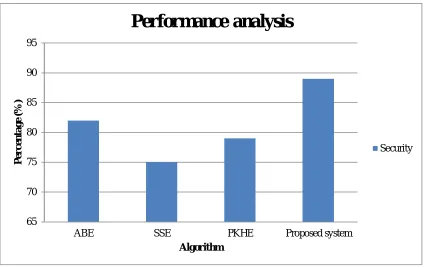
Fig 5.1: Performance analysis
However existing methods provide better security to store and retrieve our data from cloud. As we discussed before the key logic of extracting user data can be done if respective key has been identified by any attackers. Hence to overcome this issue we propose double step verification such as encrypting image as well as encrypting repository. If an authorized user wants a particular image he or she should have respective repository key. If key is not available then, water marked image will be delivered to user. Hence our system level of security is shown in above graph.
65 70 75 80 85 90 95
ABE SSE PKHE Proposed system
P
e
rc
en
ta
g
e
(
%
)
Algorithm
Performance analysis
VI. CONCLUSION
In this paper we have proposed a new secure framework for the privacy-preserving outsourced storage, search, and retrieval of large-scale, dynamically updated image repositories, where the reduction of client overheads is a central aspect. In the basis of our framework is a novel cryptographic scheme, specifically designed for images, named IES-CBIR. Key to its design is the observation that in images, color information can be separated from texture information, enabling the use of different encryption techniques with different properties for each on, and allowing privacy preserving Content-Based Image Retrieval to be performed by third-party, untrusted cloud servers. We formally analyzed the security of our proposals, and additional experimental evaluation of implemented prototypes revealed that our approach achieves an interesting trade-off between precision and recall in CBIR, while exhibiting high performance and scalability when compared with alternative solutions. An interesting future work direction is to investigate the applicability of our methodology - i.e. the separation of information contexts when processing data (color and texture in this contribution) - in other domains beyond image data.
REFERENCES
[1] W. Lu, et al. Secure image retrieval through feature protection. In Proc. of ICASSP, 2009.
[2] C.-Y. Hsu, et al. Image feature extraction in encrypted domain with privacy-preserving SIFT. IEEE TIP, 21.11 (2012): 4593-4607. [3] C.-Y. Hsu, et al. Homomorphic encryption-based secure SIFT for privacy-preserving feature extraction. In Proc. of SPIE, 2011. [4] M. Naehrig, et al. Can homomorphic encryption be practical?. In Proc. of CCSW, 2011.
[5] W. Lu, et al. Enabling search over encrypted multimedia databases. In Proc. of SPIE, 2009.
[6] Z. Erkin, M. Franz, J. Guajardo, S. Katzenbeisser, I. Lagendijk, and T. Toft. Privacy-preserving face recognition. In Proc. of PET, 2009.
[7] M. K. Khan, J. Zhang, and K. Alghathbar. Challenge-response-based biometric image scrambling for secure personal identification, Future Generation Computer Systems. 27.4 (2011): 411-418.