Text-Translation Alignment
M a r t i n K a y *
Xerox Palo Alto Research Center and
Stanford University
M a r t i n R 6 s c h e i s e n *
Xerox Palo Alto Research Center and
Technical University of Munich
We present an algorithm for aligning texts with their translations that is based only on internal evidence. The relaxation process rests on a notion of which word in one text corresponds to which word in the other text that is essentially based on the similarity of their distributions. It exploits a partial alignment of the word level to induce a maximum likelihood alignment of the sentence level, which is in turn used, in the next iteration, to refine the word level estimate. The algorithm appears to converge to the correct sentence alignment in only a few iterations.
1. The Problem
To align a text with a translation of it in another language is, in the terminology of this paper, to s h o w which of its parts are translated by w h a t parts of the second text. The result takes the form of a list of pairs of items--words, sentences, paragraphs, or w h a t e v e r - - f r o m the two texts. A pair (a~ b> is on the list if a is translated, in whole or in part, by b. If (a, b> a n d (a, c) are on the list, it is because a is translated partly by b, a n d partly by c. We say that the alignment is partial if only some of the items of the chosen kind from one or other of the texts are represented in the pairs. Otherwise, it is complete.
It is notoriously difficult to align good translations on the basis of words, because it is often difficult to decide just which words in an original are responsible for a given one in a translation and, in a n y case, some words apparently translate morphological or syntactic p h e n o m e n a rather than other words. However, it is relatively easy to establish correspondences between such words as proper nouns a n d technical terms, so that partial alignment on the w o r d level is often possible. On the other hand, it is also easy to align texts a n d translations on the sentence or paragraph levels, for there is rarely m u c h d o u b t as to which sentences in a translation contain the material contributed by a given one in the original.
The growing interest in the possibility of automatically aligning large texts is at- tested to by i n d e p e n d e n t work that has been done on it since the first description of our m e t h o d s was m a d e available (Kay a n d R6scheisen 1988). In recent years it has been possible for the first time to obtain machine-readable versions of large corpora of text with accompanying translations. The most striking example is the Canadian "Hansard," the transcript of the proceedings of the Canadian parliament. Such bilin- gual corpora make it possible to undertake statistical, and other kinds of empirical, studies of translation on a scale that was previously unthinkable.
Alignment makes possible approaches to partially, or completely, automatic trans- lation based on a large corpus of previous translations that have been d e e m e d accept-
* Xerox PARC, 3333 Coyote Hill Road, Palo Alto, CA 94306.
Computational Linguisti4s Volume 19, Number 1
able. Perhaps the best-known example of this approach is to be found in Sato and Nagao (1990). The method proposed there requires a database to be maintained of the syntactic structures of sentences together with the structures of the corresponding translations. This database is searched in the course of making a new translation for examples of previous sentences that are like the current one in ways that are relevant for the method. Another example is the completely automatic, statistical approach to translation taken by the research group at IBM (Brown et al. 1990), which takes a large corpus of text with aligned translations as its point of departure.
It is widely recognized that one of the most important sources of information to which a translator can have access is a large body of previous translations. No dic- tionary or terminology bank can provide information of comparable value on topical matters of possibly intense though only transitory interest, or on recently coined terms in the target language, or on matters relating to house style. But such a body of data is useful only if, once a relevant example has been found in the source language, the corresponding passage can be quickly located in the translation. This is simple only if the texts have been previously aligned. Clearly, what is true of the translator is equally true of others for w h o m translations are a source of primary data, such as students of translation, the designers of translations systems, and lexicographers. Alignment would also facilitate the job of checking for consistency in technical and legal texts where consistency constitutes a large part of accuracy.
In this paper, we provide a method for aligning texts and translations based only on internal evidence. In other words, the method depends on no information about the languages involved beyond what can be derived from the texts themselves. Fur- thermore, the computations on which it is based are straightforward and robust. The plan rests on a relationship between word and sentence alignments arising from the observation that a pair of sentences containing an aligned pair of words must them- selves be aligned. It follows that a partial alignment on the word level could induce a much more complete alignment on the sentence level.
A solution to the alignment problem consists of a subset of the Cartesian product of the sets of source and target sentences. The process starts from an initial subset excluding pairs whose relative positions in their respective texts is so different that the chance of their being aligned is extremely low. This potentially alignable set of sentences forms the basis for a relaxation process that proceeds as follows. An initial set of candidate word alignments is produced by choosing pairs of words that tend to occur in possibly aligned sentences. The idea is to propose a pair of words for alignment if they have similar distributions in their respective texts. The distributions of a pair of words are similar if most of the sentences in which the first word occurs are alignable with sentences in which the second occurs, and vice versa. The most apparently reliable of these word alignments are then used to induce a set of sentence alignments that will be a subset of the eventual result. A new estimate is now made of what sentences are alignable based on the fact that we are now committed to aligning certain pairs. Because sentence pairs are never removed from the set of alignments, the process converges to the point when no new ones can be found; then it stops.
Martin Kay and Martin R6scheisen Text-Translation Alignment
2. The Alignment Algorithm
2.1 Data Structures
The principal data structures u s e d in the algorithm are the following:
Word-Sentence Index (WSI). One of these is p r e p a r e d for each of the texts. It
is a table with an e n t r y for each different w o r d in the text s h o w i n g the sentences in w h i c h that w o r d occurs. For the m o m e n t , w e m a y take a w o r d as being simply a distinct sequence of letters. If a w o r d occurs m o r e than once in a sentence, that sentence occurs on the list once for each occurrence.
Alignable Sentence Table (AST). This is a table of pairs of sentences, one from
each text. A pair is included in the table at the beginning of a pass if that pair is a candidate for association b y the algorithm in that pass.
Word Alignment Table (WAT). This is a list of pairs of words, together with sim-
ilarities and frequencies in their respective texts, that have been aligned b y c o m p a r i n g their distributions in the texts.
Sentence Alignment Table (SAT). This is a table that records for each pair of
sentences h o w m a n y times the two sentences were set in c o r r e s p o n d e n c e b y the algorithm.
Some additional data structures w e r e used to i m p r o v e p e r f o r m a n c e in o u r im- p l e m e n t a t i o n of the algorithm, b u t they are not essential to an u n d e r s t a n d i n g of the m e t h o d as a whole.
2.2 Outline of the Algorithm
At the beginning of each cycle, an AST is p r o d u c e d that is expected to contain the eventual set of alignments, generally a m o n g s t others. It pairs the first and last sentences of the two texts with a small n u m b e r of sentences from the beginning a n d end of the other text. Generally speaking, the closer a sentence is to the m i d d l e of the text, the larger the set of sentences in the other text that are possible c o r r e s p o n d e n t s for it.
The next step is to h y p o t h e s i z e a set of pairs of w o r d s that are a s s u m e d to cor- r e s p o n d based on similarities b e t w e e n their distributions in the two texts. For this p u r p o s e , a w o r d in the first text is d e e m e d to occur at a position c o r r e s p o n d i n g to a w o r d in the second text if they occur in a pair of sentences that is a m e m b e r of the AST. Similarity of distribution is a function of the n u m b e r of c o r r e s p o n d i n g sentences in which they occur a n d the total n u m b e r of occurrences of each. Pairs of w o r d s are entered in the WAT if the association b e t w e e n t h e m is so close that it is not likely to be the result of a r a n d o m event. In o u r algorithm, the closeness of the association is estimated on the basis of the similarity of their distributions and the total n u m b e r of occurrences.
The next step is to construct the SAT, which, in the last pass, will essentially b e c o m e the o u t p u t of the p r o g r a m as a whole. The idea here is to associate sentences that contain w o r d s paired in the WAT, giving preference to those w o r d pairs that a p p e a r to be m o r e reliable. Multiple associations are recorded.
Computational Linguistics Volume 19, Number 1
the s a m e interpolation m e t h o d initially u s e d for all sentences in the m i d d l e of the texts.
In p r e p a r a t i o n for the next pass, a n e w set of c o r r e s p o n d i n g w o r d s is n o w hy- p o t h e s i z e d u s i n g distributions b a s e d on the n e w AST, a n d the cycle repeats.
2.3 The Algorithm
The m a i n a l g o r i t h m is a relaxation process that leaves at the e n d of each p a s s a n e w WAT a n d SAT, each p r e s u m a b l y m o r e refined t h a n the o n e left at the e n d of the p r e c e d i n g pass. The i n p u t to the w h o l e process consists o n l y of the WSIs of the t w o texts. Before the first p a s s of the relaxation process, an initial AST is c o m p u t e d s i m p l y f r o m the lengths of the t w o texts:
Construct Initial AST. If the texts contain m a n d n sentences respectively, t h e n
the table can be t h o u g h t of as an m x n a r r a y of o n e s a n d zeros. The a v e r a g e n u m b e r of sentences in the second text c o r r e s p o n d i n g to a g i v e n o n e in the first text is
n/m,
a n d the a v e r a g e position of the sentence in the second text c o r r e s p o n d i n g to the i-th sentence in the first text is thereforei. n/m.
In other w o r d s , the expectation is that the true c o r r e s p o n d e n c e swill lie close to the diagonal. Empirically, sentences typically c o r r e s p o n d o n e for one; c o r r e s p o n d e n c e s of o n e sentence to t w o are m u c h rarer, a n d c o r r e s p o n d e n c e s of o n e to three or m o r e , t h o u g h t h e y d o u b t l e s s occur, are v e r y rare a n d w e r e u n a t t e s t e d in o u r data. The m a x i m u m d e v i a t i o n can be stochastically m o d e l e d as O ( v ~ ) , the factor b y w h i c h the s t a n d a r d d e v i a t i o n of a s u m of n i n d e p e n d e n t a n d identically d i s t r i b u t e d r a n d o m variables multiplies. 1
We construct the initial AST u s i n g a function that pairs single sen- tences n e a r the m i d d l e of the text w i t h as m a n y as O(v~ff) sentences in the other text; it is g e n e r o u s l y d e s i g n e d to a d m i t all b u t the m o s t i m p r o b a b l e associations. Experience s h o w s that b e c a u s e of this policy the results are highly insensitive to the particular function u s e d to build this initial table. 2
The m a i n b o d y of the relaxation process consists of the following steps:
B u i l d t h e WAT. For all sentences s a in the first text, each w o r d in s a is c o m p a r e d w i t h each w o r d in those sentences s B of the s e c o n d text that are c o n s i d e r e d as c a n d i d a t e s for c o r r e s p o n d e n c e , i.e., for w h i c h (s A, s B) E A S T . A p a i r of w o r d s is e n t e r e d into the WAT if the distributions of the t w o w o r d s in their texts are sufficiently similar a n d if the total n u m b e r of occurrences indicates that this p a i r is unlikely to be the result of a s p u r i o u s match. N o t e that the n u m b e r of c o m p a r i s o n s of the w o r d s in t w o sentences is q u a d r a t i c o n l y in the n u m b e r of w o r d s in a sentence, w h i c h can b e a s s u m e d to b e n o t a function of the length of the text. Because of t h e . c o n s t r a i n t on the m a x - i m u m d e v i a t i o n f r o m the d i a g o n a l as outlined above, the c o m p u t a t i o n a l c o m p l e x i t y of the a l g o r i t h m is b o u n d b y
O(nx/n)
in each pass.1 In such a model, each random variable would correspond to a translator's choice to move away from the diagonal in the AST by a certain distance (which is assumed to be zero mean, Gaussian
distributed). However, the specific assumptions about the maximum deviation are not crucial in that the algorithm was observed to be insensitive to such modifications.
Martin Kay and Martin R6scheisen Text-Translation Alignment
Our definition of the similarity between a pair of words is complicated by the fact that the two texts have unequal lengths and that the AST allows more than one correspondence, which means that we cannot simply take the inner product of the vector representations of the w o r d ' s occurrences. Instead, we use as a measure of similarity: 3
2c
NA (v) + N~ (w)
where c is the n u m b e r of corresponding positions, a n d
Nv(x)
is the n u m - ber of occurrences of the w o r d x in the text T. This is essentially Dice's coefficient (Rijsbergen 1979). Technically, the value of c is the cardinality of the largest set of pairs (i, j) such that1.
(s~(v),s~(w)) c
AST, whereszr(x)
is the sentence in text T thatcontains the z-th occurrence of w o r d x.
2. Pairs are
non-overlapping
in the sense that, if (a, b) and (c, d) are distinct members of the set then they are distinct in both components, that is, a ~ c and b ~ d.Suppose that the w o r d " d o g " occurs in sentences 50, 52, 75, a n d 200 of the English text, a n d " H u n d " in sentences 40 and 180 of the German, a n d that the AST contains the pairs (50, 40), (52, 40), and (200,180), a m o n g others, but not (75, 40). There are two sets that meet the requirements, n a m e l y ~(1, 1), (4,2)} and {(2, 1), (4,2)}. The set {(1, 1), (2, 1), (4,2)} is excluded on the grounds that (1, 1) a n d (2, 1) overlap in the above sense--the first occurrence of " H u n d " is represented twice. In the example, the similarity 2 _ 1 regardless of the ambiguity between w o u l d be c o m p u t e d as 4 + 2 - 2 - - 2'
(1, 1) a n d (2, 1).
The result of the comparisons of the words in all of the sentences of one text with those in the other text is that the word pairs with the highest similarity are located. Comparing the words in a sentence of one text with those in a sentence of the other text carries with it an amortized cost of constant computational complexity, 4 if the usual memory-processing tradeoff on serial machines is exploited by maintaining r e d u n d a n t data structures such as multiple hash tables a n d ordered indexed trees. 5
The next task is to determine for each w o r d pair, whether it will ac- tually be entered into the WAT: the WAT is a sorted table where the more reliable pairs are p u t before less reliable ones. For this purpose, each en- try contains, as well as the pair of words themselves, the frequencies of those words in their respective texts and the similarity between them. The closeness of the association between two words, and thus their rank in the WAT, is evaluated with respect to their similarity and the total n u m ~ ber of their occurrences. To u n d e r s t a n d w h y similarity cannot be used
3 Throughout this paper, w e use the w o r d similarity to denote this similarity measure, w h i c h does not necessarily have to be an indicator of w h a t one w o u l d intuitively describe as "similar" words. In particular, w e will later see that similarity alone, w i t h o u t consideration of the total frequency, is not a good indicator for "similarity."
4 The basic idea is this: more processing has to be done to c o m p u t e the similarity of a high-frequency w o r d to another frequent word, but there are also m o r e places at w h i c h this comparison can later be saved. Recall also that w e a s s u m e sentence length to be i n d e p e n d e n t of text length.
Computational Linguistics Volume 19, Number 1
alone, note that there are far more one-frequency words than words of higher frequency. Thus, a pair of words with a similarity of 1, each of them occurring only once, may well be the result of a random event. If such a pair was proposed for entry into the WAT, it should only be added with a low priority.
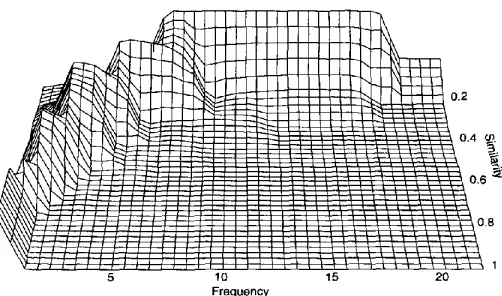
The exact stochastic relation is depicted in Figure 1, where the proba- bility is shown that a word of a frequency k that was aligned with a word in the other text with a certain similarity s is just the result of a random process. 6 Note that, for a high-frequency word that has a high similarity with some other word (right front corner), it is very unlikely (negligible plateau height) that this association has to be attributed to chance. On the other hand, low similarities (back) can easily be attained by just associat- ing arbitrary words. Low-frequency words--because there are so many of them in a text--can also achieve a high similarity with some other words without having to be related in an interesting way. This can be intuitively explained by the fact that the similarity of a high-frequency word is based on a pattern made up of a large number of instances. It is therefore a pat- tern that is unlikely to be replicated by chance. Furthermore, since there are relatively few high-frequency words, and they can only contract high similarities with other high-frequency words, the number of possible cor- respondents for them is lower, and the chance of spurious associations is therefore less on these grounds also. Note that low-frequency words with low similarity (back left corner) have also a low probability of being spuriously associated to some other word. This is because low-frequency words can achieve a low similarity only with words of a high frequency, which in turn are rare in a text, and are therefore unlikely to be associated spuriously. 7
Our algorithm does not use all the detail in Figure 1, but only a simple discrete heuristic: a word pair whose similarity exceeds some threshold is assigned to one of two or three segments of the WAT, depending on the word frequency. A segment with words of higher frequency is preferred to lower-frequency segments. Within each segment, the entries are sorted in order of decreasing similarity and, in case of equal similarities, in order of decreasing frequency. In terms of Figure 1, we take a rectangle from the right front. We place the left boundary as far to the left as possible, because this is where most of the words are.
Build the SAT. In this step, the correspondences in the WAT are used to estab- lish a mapping between sentences of the two texts. In general, these new
6 The basis for this graph is an analytic derivation of the probability that a word with a certain
frequency in a 300-sentence text matches some random pattern with a particular similarity. The analytic formula relies on word-frequency data derived from a large corpus instead of on a stochastic model for word frequency distribution (such as Zipf's law, which states that the frequency with which words occur in a text is indirectly proportional to the number of words with this frequency; for a recent discussion of more accurate models, see also Baayen [1991]). Clearly, the figure is dependent on the state of the AST (e.g. lower similarities become more acceptable as the AST becomes more and more narrow), but the thresholds relevant to our algorithm can be precomputed at compile-time. The figure shown would be appropriate to pass 3 in our experiment. In the formula used, there are a few reasonable simplifications concerning the nature of the AST; however, a Monte-Carlo simulation that is exactly in accordance with our algorithm confirmed the depicted figure in every essential detail. 7 This discussion could also be cast in an information theoretic framework using the notion of "mutual
Martin Kay and Martin R6scheisen Text-Translation Alignment
/////JIIfJi
",~1 / [ / [ / [ I ] I I J t I f 5
.... i iiiii i ,, i
i i i i i i i i i l ,
i i,~,kkNk~,\:,:,\k,
t r i P i i i i iiiiiiii\\\\\\\
°8
t ! ! ! ! ! ! ! ! [ ! ! ~ \ \ \ \ \ \ \ \ \ \
10 15 20
Frequency
Figure 1
Likelihood that a word pair is a spurious match as a function of a word's frequency and its similarity with a word in the other text (maximum 0.94).
associations are a d d e d to the ones inherited from the p r e c e d i n g pass. It is an obvious r e q u i r e m e n t of the m a p p i n g that lines of association s h o u l d not cross. At the beginning of the relaxation process, the SAT is initialized such that the first sentences of the two texts, and the last sentences, are set in c o r r e s p o n d e n c e with one another, regardless of a n y w o r d s they m a y contain. The process that adds the remaining associations scans the WAT in o r d e r a n d applies a three-part process to each pair Iv, w/.
1. Construct the
correspondence set
for/v~ w / using essentially the same p r o c e d u r e as in the calculation of the denominator, c, of w o r d similarities above. Now, however, we are concerned to avoid a m b i g u o u s pairs as characterized above. The set contains a sentence pairIsiA(v),s~(w)l
if (1)IsiA(v)~ s~(w)l EAST,
and (2) v occurs in no other sentence h (resp. w in no g) such thatIs~(v), h I
(resp.Ig~ s~(w)l)
is also in the AST.2. If a n y sentence pair in the c o r r e s p o n d e n c e set crosses a n y of the associations that have already been a d d e d to the SAT, the w o r d pair is rejected as a whole. In other words, if a given pair of sentences c o r r e s p o n d , then sentences p r e c e d i n g the first of t h e m can be associated only with sentences p r e c e d i n g the second. 3. A d d each sentence pair in the c o r r e s p o n d e n c e set of the w o r d
pair Iv, w / to the SAT. A c o u n t is r e c o r d e d of the n u m b e r of times a particular association is s u p p o r t e d . These counts are later t h r e s h o l d e d w h e n a n e w AST is c o m p u t e d or w h e n the process terminates.
[image:7.468.129.380.66.214.2]Computational Linguistics Volume 19, Number 1
p r o v i d e s none. The idea is to fill gaps b e t w e e n associated pairs of sentences in the same m a n n e r that the gap b e t w e e n the first a n d the last sentence was filled before the first pass. H o w e v e r , only sentence associations that are r e p r e s e n t e d m o r e than some m i n i m u m n u m b e r of times in the SAT are transferred to the AST. In w h a t follows, w e will refer to these sentence pairs as anchors.
As before, it is c o n v e n i e n t to think of the AST as a rectangular array, e v e n t h o u g h it is r e p r e s e n t e d m o r e economically in the program. C o n s i d e r a m a x i m a l sequence of e m p t y AST entries, that is, a sequence of sentences in one text for w h i c h there are no associated sentences in the other, b u t w h i c h is b o u n d e d a b o v e and b e l o w b y an anchor. The n e w associations that are a d d e d lie on a n d adjacent to the diagonal joining the t w o anchors. The distance from the diagonal is a function of the distance of the current candidate sentence pair a n d the nearest anchor. The function is the same one used in the construction of the initial AST.
Repeat. Build a n e w WAT and continue.
3. Morphology
As w e said earlier, the basic alignment algorithm treats w o r d s as atoms; that is, it treats strings as instances of the same w o r d if they consist of identical sequences of letters, a n d otherwise as totally different. The effect of this is that m o r p h o l o g i c a l variants of a w o r d are not seen as related to one another. This m i g h t not be seen as a d i s a d v a n t a g e in all circumstances. For example, n o u n s a n d verbs in one text m i g h t be expected to m a p onto n o u n s with the same n u m b e r and verbs with the same tense m u c h of the time. But this is not always the case and, m o r e importantly, some languages m a k e m o r p h o l o g i c a l distinctions that are absent in the other. G e r m a n , for example, m a k e s a n u m b e r of case distinctions, especially in adjectives, that are not reflected in the m o r p h o l o g y of English. For these reasons, it seems desirable to allow w o r d s to contract associations with other w o r d s b o t h in the f o r m in w h i c h they actually occur, and in a m o r e n o r m a l i z e d f o r m that will t h r o w t h e m together w i t h m o r p h o l o g i c a l l y related other w o r d s in the text.
3.1 The Basic Idea
The strategy we a d o p t e d was to m a k e entries in the WSI, not only for m a x i m a l strings of alphabetic characters occurring in the texts, b u t also for other strings that could usefully be r e g a r d e d as n o r m a l i z e d forms of these.
Martin Kay and Martin R6scheisen Text-Translation Alignment
For us, a n o r m a l i z e d f o r m of a w o r d is a l w a y s an initial or a final s u b s t r i n g of that w o r d - - n o attention is p a i d to m o r p h o g r a p h e m i c or w o r d - i n t e r n a l changes. A w o r d is b r o k e n into t w o parts, o n e of w h i c h b e c o m e s the n o r m a l i z e d form, if there is e v i d e n c e that the resulting prefix a n d suffix b e l o n g to a p a r a d i g m . In particular, b o t h m u s t occur as prefixes a n d suffixes of other forms.
3.2 The Algorithm
The a l g o r i t h m p r o c e e d s in t w o stages. First a data structure, called the
trie,
is con- structed in w h i c h i n f o r m a t i o n a b o u t the occurrences of potential prefixes a n d suffixes in the text is stored. Second, w o r d s are split, w h e r e the trie p r o v i d e s e v i d e n c e for d o i n g so, a n d one of the resulting p a r t s is chosen as the normalization..
.
A trie (Knuth 1973; pp. 481--490) is a d a t a structure for associating i n f o r m a t i o n w i t h strings of characters. It is particularly e c o n o m i c a l in situations w h e r e m a n y of the strings of interest are substrings of others in the set. A trie is in fact a tree, w i t h a b r a n c h at the root n o d e for e v e r y character that b e g i n s a string in the set. To l o o k u p a string, o n e starts at the root, a n d follows the b r a n c h c o r r e s p o n d i n g to its first character to a n o t h e r node. F r o m there, the b r a n c h for the second character is f o l l o w e d to a third node, a n d so on, until either the w h o l e string has b e e n m a t c h e d , or it has b e e n d i s c o v e r e d not to be in the set. If it is in the set, then the n o d e r e a c h e d after m a t c h i n g its last character contains w h a t e v e r i n f o r m a t i o n the structure contains for it. The e c o n o m y of the s c h e m e lies in the fact that a n o d e containing i n f o r m a t i o n a b o u t a string also serves as a p o i n t on the w a y to longer strings of w h i c h the g i v e n one is a prefix. In this application, t w o items of i n f o r m a t i o n are stored w i t h a string, n a m e l y the n u m b e r of textual w o r d s in w h i c h it occurs as a prefix a n d as a suffix.
C o n s i d e r the possibility of b r e a k i n g an n-letter w o r d before the i-th character of the w o r d (1 < i _< n). T h e conditions for a b r e a k are: The n u m b e r of other w o r d s starting w i t h characters 1 •. • i - 1 of the c u r r e n t w o r d m u s t be g r e a t e r t h a n the n u m b e r of w o r d s starting w i t h characters 1 • .. i because, if the characters 1 .. • i - 1 constitute a useful prefix, t h e n this prefix m u s t be followed, in different w o r d s , b y other suffixes t h a n characters i . . . n. So, consider the w o r d " w a n t i n g , " a n d s u p p o s e that w e are c o n s i d e r i n g the possibility of b r e a k i n g it before the 5th character, "i." For this to be desirable, there m u s t be other w o r d s in the text, such as " w a n t s , " a n d " w a n t e d , " that share the first i - 1 = 4 characters. Conversely, there m u s t be m o r e w o r d s e n d i n g w i t h characters i . . . n of the w o r d t h a n w i t h i - 1 -. • n. So, there m u s t be m o r e w o r d s w i t h the suffix "ing" t h a n w i t h the suffix "ting"; for e x a m p l e "seeing" a n d "believing."
Computational Linguistics Volume 19, Number 1
the function has the same value for more than one potential break point, the one farthest to the right is preferred, also for the reason that we prefer to maximize the lengths of prefixes.
Once it has been decided to divide a word, and at what place, one of the two parts is selected as the putative canonical form of the word, namely, whichever is longer, and the prefix if both are of equal length. Finally, any other words in the same text that share the chosen prefix (suffix) are split at the corresponding place, and so assigned to the same canonical form.
The morphological algorithm treats words that appear hyphenated in the text specially. The hyphenated word is treated as a unit, just as it appears, and so are the strings that result from breaking the word at the hyphens. In addition, the analysis procedure described above is applied to these components, and any putative normal forms found are also used. It is worth pointing out that we received more help from hyphens than one might normally expect in our analysis of the German texts because of a tendency on the part of the
Spektrum der Wissenschaft
translators, following standard practice for technical writing, of hyphenating compounds.
4. Experimental Results
In this section, we show some of the results of our experiments with these algorithms, and also data produced at some of the intermediate stages. We applied the meth- ods described here to two pairs of articles from
Scientific American
and their German translations inSpektrum der Wissenschaft
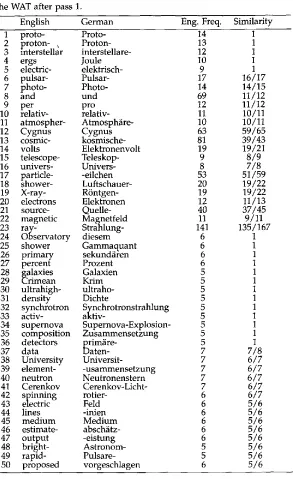
(see references). The English and German ar- ticles about human-powered flight had 214 and 162 sentences, respectively; the ones about cosmic rays contained 255 and 300 sentences, respectively. The first pair was primarily used to develop the algorithm and to determine the various parameters of the program. The performance of the algorithm was finally tested on the latter pair of articles. We chose these journals because of a general impression that the translations were of very high quality and were sufficiently "free" to be a substantial challenge for the algorithm. Furthermore, we expected technical translators to adhere to a narrow view of semantic accuracy in their work, and to rate the importance of this above stylistic considerations. Later we also give results for another application of our algo- rithm to a larger text of 1257 sentences that was put together from two days from the French-English Hansard corpus.Table 1 shows the first 50 entries of the WAT after pass 1 of the algorithm. It shows part of the first section of the WAT (lines 1-23) and the beginning of the second (lines 24-50). The first segment contains words or normalized forms with more than 7 occurrences and a similarity not less than 0.8. Strings shown with a following hyphen are prefixes arising from the morphological procedure; strings with an initial hyphen are suffixes. Naturally, some of the word divisions are made in places that do not accurately reflect linguistic facts. For example, English "proto-" (1) comes from "pro- ton" and "protons"; German "-eilchen" (17) is the normalization for words ending in "-teilchen" and, in the same way, "-eistung" (47) comes from "-leistung."
Martin Kay and Martin R6scheisen Text-Translation Alignment
Table 1
The WAT after pass 1.
English German Eng. Freq. Similarity
1 proto- Proto- 14 1
2 proton- , Proton- 13 1
3 interstellar interstellare- 12 1
4 ergs Joule 10 1
5 electric- elektrisch- 9 1
6 pulsar- Pulsar- 17 16/17
7 photo- Photo- 14 14/15
8 and und 69 11/12
9 per pro 12 11/12
10 relativ- relativ- 11 10/11
11 atmospher- Atmosph~ire- 10 10/11
12 Cygnus Cygnus 63 59/65
13 cosmic- kosmische- 81 39/43
14 volts Elektronenvolt 19 19/21
15 telescope- Teleskop- 9 8/9
16 univers- Univers- 8 7/8
17 particle- -eilchen 53 51/59
18 shower- Luftschauer- 20 19/22
19 X-ray- R6ntgen- 19 19/22
20 electrons Elektronen 12 11/13
21 source- Quelle- 40 37/45
22 magnetic Magnetfeld 11 9/11
23 ray-- Strahlung- 141 135/167
24 Obs ervatory diesem 6 1
25 shower Gammaquant 6 1
26 primary sekund~iren 6 1
27 percent Prozent 6 1
28 ~a!axies Galaxien 5 1
29 ~ n m e a n Krim 5 1
30 ultrahigh- ultraho- 5 1
31 density Dichte 5 1
32 synchrotron Synchrotronstrahlung 5 1
33 activ- aktiv- 5 1
34 supernova Supernova-Explosion- 5 1
35 composition Zusammensetzung 5 1
36 detectors l~rim~ire- 5 1
37 data Daten- 7 7/8
38 University Universit- 7 6/7
39 element- -usammensetzung 7 6/7
40 neutron Neutronenstern 7 6/7
41 Cerenkov Cerenkov-Licht- 7 6/7
42 spinning rotier- 6 6/7
43 electric Feld 6 5/6
44 lines -inien 6 5/6
45 medium Medium 6 5/6
46 estimate- absch~itz- 6 5/6
47 output -eistung 6 5/6
48 bright- Astronom- 5 5/6
49 rapid- Pulsare- 5 5/6
50 proposed vorgeschlagen 6 5/6
occurs w i t h it five out of six times. Notice, h o w e v e r , that the association " p u l s a r - " "Pulsar-" is also in table (6). F u r t h e r m o r e , the G e r m a n strings "Pulsar" a n d "Pulsar-" are b o t h g i v e n correct associations in the next pass (lines 17 a n d 20 of Table 2).
[image:11.468.85.378.81.560.2]Computational Linguistics Volume 19, Number 1
~J
g
i
. . . ~ .. . . : .. . . _ . . . ~__t..1.~, ...
3 3~3
2 1 . . .
1 t
. . . t . . . 1
1 1 . . . . . . "1
. . . ~ . . .
.... -3----~ . . .
150 160 170 180 190 200
E n g l i s h S e n t e n c e N o
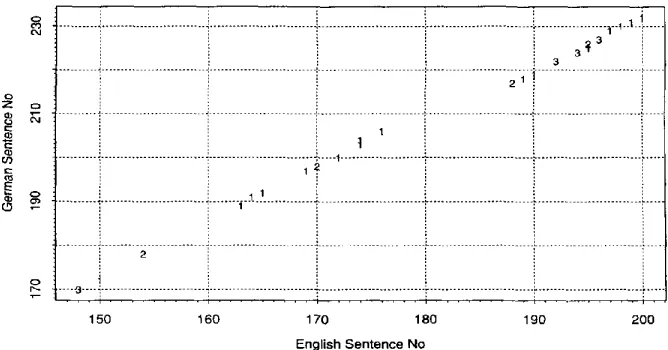
Figure 2
The SAT after pass 1.
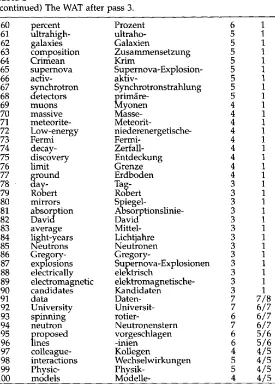
(18) with a frequency of 20. On the other hand, the incorrect association of "ele- ment" with "-usammensetzung" (39) is on the basis of a normalized form (for words ending in "Zusarnmensetzung'), whereas "Zusammensetzung," unnormalized, is cor- rectly associated with "composition" (35). Totally unrelated words are associated in a few instances, as in "Observatory"/"diesem" (24), "detectors"/"prim~ire-" (36), and "bright-"/"Astronom-" (48). Of these only the second remains at the end of the third pass. The English "Observatory" is then properly associated with the German word "Observatorium-." At that stage, "bright-" has no association.
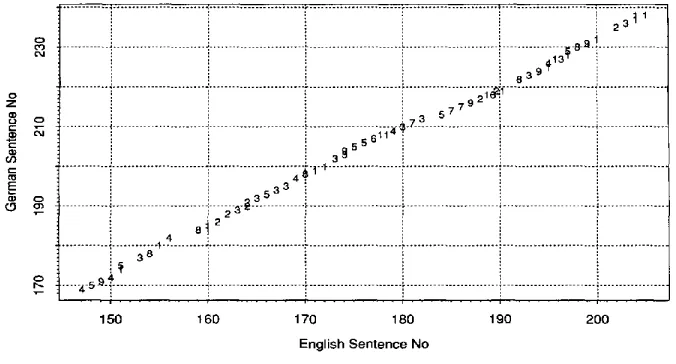
Figure 2 shows part of the SAT at the end of pass I of the relaxation cycle. Sentences in the English text and in the German text are identified by numbers on the abscissa and the ordinate respectively. Entries in the array indicate that the sentences are con- sidered to correspond. The numbers show how often a particular association is sup- ported, which is essentially equivalent to how many word pairs in the WAT support such an association. If there are no such numbers, then no associations have been found for it at this stage. For example, the association of English sentence 148 with German sentence 170 is supported by three different word pairs. It is already very striking how strongly occupied entries in this table constrain the possible entries in the unoccupied slots.
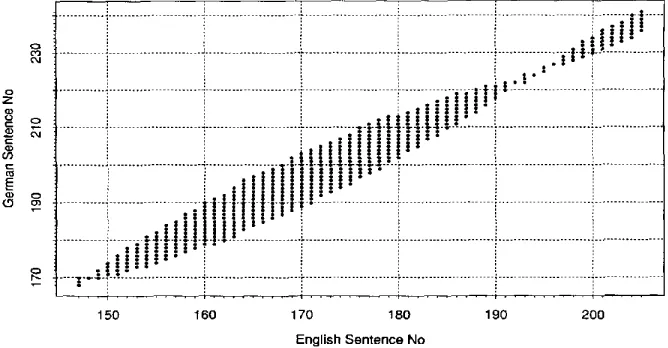
Figure 3 shows part of the AST before pass 2. This is derived directly from the material illustrated in Figure 2. The abscissa gives the English sentence number and in direction of the ordinate the associated German sentences are shown (bullet). Those sentence pairs in Figure 2 supported by at least three word pairs, namely those shown on lines 148, 192, 194, and 196, are assumed to be reliable, and they are the only associations shown for these sentences in Figure 3. Candidate associations have been provided for the intervening sentences by the interpolation method described above. Notice that the greatest number of candidates are shown against sentences occurring midway between a pair assumed to have been reliably connected (English sentence numbers 169 to 171).
[image:12.468.89.423.62.237.2]Martin Kay and Martin R6scheisen Text-Translation Alignment
Table 2
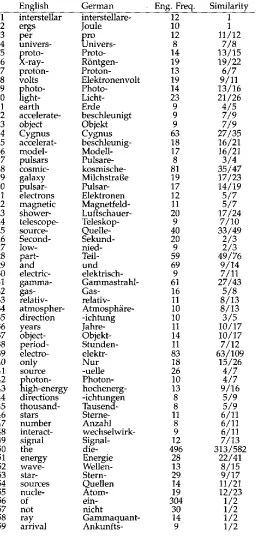
The WAT after pass 3.
English German Eng. Freq. Similarity 1 interstellar interstellare- 12 1
2 ergs Joule 10 1
3 per plro 12 11/12
4 univers- Univers- 8 7/8
5 proto- Proto- 14 13/15
6 X-ray- R6ntgen- 19 19/22
7 proton- Proton- 13 6/7
8 volts Elektronenvolt 19 9 / 11
9 photo- Photo- 14 13/16
10 light- Licht- 23 21/26
11 earth Erde 9 4/5
12 accelerate- beschleunigt 9 7/9
13 object Objekt 9 7/9
14 Cygnus Cygnus 63 27/35
15 accelerat- beschleunig- 18 16/21
16 model- Modell- 17 16/21
17 pulsars Pulsare- 8 3/4
18 cosmic- kosmische- 81 35/47
19 galaxy Milchstrat~e 19 17/23
20 pulsar- Pulsar- 17 14/19
21 electrons Elektronen 12 5/7
22 magnetic Magnetfeld- 11 5/7
23 shower- Luftschauer- 20 17/24
24 telescope- Teleskop- 9 7/10
25 source- Quelle- 40 33/49
26 Second- Sekund- 20 2/3
27 low- nied- 9 2/3
28 part- Teil- 59 49/76
29 and und 69 9/14
30 electric- elektrisch- 9 7/11
31 gamma- Gammastrahl- 61 27/43
32 gas- Gas- 16 5/8
33 relativ- relativ- 11 8/13
34 atmospher- Atmosphere- 10 8/13
35 direction -ichtung 10 3/5
36 years Jahre- 11 10/17
37 object- Objekt- 14 10/17
38 period- Stunden- 11 7/12
39 electro- elektr- 83 63 / 109
40 only Nur 18 15/26
41 source -uelle 26 4/7
42 photon- Photon- 10 4/7
43 high-energy hochenerg- 13 9/16
44 directions -ichtungen 8 5/9
45 thousand- Tausend- 8 5/9
46 stars Sterne- 11 6/11
47 number Anzahl 8 6/11
48 interact- wechselwirk- 9 6/11
49 signal Signal- 12 7/13
50 the die- 496 313/582
51 energy Energie 28 22/41
52 wave- Wellen- 13 8 / 15
53 star- Stern- 29 9/17
54 sources Quellen 14 11/21
55 nude- Atom- 19 12/23
56 of ein- 304 1/2
57 not nicht 30 1/2
58 ray Gammaquant- 14 1/2
[image:13.468.99.355.109.645.2]Computational Linguistics Volume 19, Number 1
Table 2
(continued) The WAT after pass 3.
60 percent Prozent 6 1
61 ultrahigh- ultraho- 5 1
62 galaxies Galaxien 5 1
63 composition Zusammensetzung 5 1
64 Crimean Krim 5 1
65 supernova Supernova-Explosion- 5 1
66 activ- aktiv- 5 1
67 synchrotron Sy.nchrotronstrahlung 5 1
68 detectors p rlmare- "" 5 1
69 muons lvlyonen 4 1
70 massive Masse- 4 1
71 meteorite- Meteorit- 4 1
72 Low-energy niederenergetische- 4 1
73 Fermi Fermi- 4 1
74 decay- Zerfall- 4 1
75 discovery Entdeckung 4 1
76 limit Grenze 4 1
77 ground Erdboden 4 1
78 • aa - Ta - 3 1
79 R ~ e r t Rto~ert 3 1
80 mirrors Spiegel- 3 1
81 absorption Absorptionslinie- 3 1
82 D a v i d David 3 1
83 average Mittel- 3 1
84 !i~ht-years Lichtjahre 3 1
85 Neutrons Neutronen 3 1
86 Gregory- Gregory- 3 1
87 explosions Supernova-Explosionen 3 1
88 electrically elektrisch 3 1
89 electromagnetic elektromagnetische- 3 1
90 candidates Kandidaten 3 1
91 data Daten- 7 7/8
92 University Universit- 7 6 / 7
93 spinning rotier- 6 6 / 7
94 neutron Neutronenstern 7 6 / 7
95 p.roposed vorgeschlagen 6 5/6
96 nnes -inien 6 5/6
97 colleague- Kollegen 4 4/5
98 interactions Wechselwirkungen 5 4/5
99 Physic- Physik- 5 4/5
100 models Modelle- 4 4/5
for the similarity w a s l o w e r e d to 0.5. As w e p o i n t e d o u t earlier, m o s t of the incor- rect associations in Table 1 h a v e b e e n eliminated. G e r m a n "Milchstrafge" (19) is not a translation of the English "galaxy," b u t the M i l k y W a y is i n d e e d a g a l a x y a n d "the g a l a x y " is s o m e t i m e s u s e d in place of "Milky W a y " w h e r e the reference is clear. T h e association b e t w e e n " p e r i o d - " a n d " S t u n d e n - " (38) is of a similar kind. The w o r d s are s t r o n g l y associated b e c a u s e of r e c u r r i n g p h r a s e s of the f o r m "in a 4.8-hour p e r i o d . "
[image:14.468.105.380.80.468.2]Martin Kay and Martin R6scheisen Text-Translation Alignment
8
GO
[image:15.468.78.412.68.242.2]~ a
... i ... i ... i ... ~ ...
i
i
i i .
t =
... i ... : . . : _ i _ L L i ...
i i ! i . = ! t t t t i ' i i
i E i . : t t t t ! t t t " i
... ] ... ] ... r ... ~ ~l;7-il-l'"Jl !i i~ ... i ... i ...
i = : t t t l i ~ i
... i ... ~ ... ,.t-,-t.,,-ii.Li-' ... i ... i ...
i
i!,,i!llli!!ii'"i
i
i
............
i ... ;;i;iii!-lilll,,'-T' ... ... i ... i ...
... i--mti!i= ... i ... i ... i ... i ...
,iilii~'" i i i i i
.... i . . . . i ... l . . .
1 5 0 1 6 0 1 7 0 1 8 0 1 9 0 2 0 0
English Sentence N o
Figure 3
The AST before pass 2.
from stylistic differences in the w a y the texts w e r e p r e s e n t e d in the two journals. The practice of Scientific American is to collect sequences of p a r a g r a p h s into a logical unit b y beginning the first of t h e m with an oversized letter. This is not d o n e in
Spektrum
der Wissenschafl,
which instead p r o v i d e s a s u b h e a d i n g at these points. This therefore appears as an insertion in the translation. Two such are sentences n u m b e r 179 a n d 233, b u t o u r p r o c e d u r e has not created incorrect associations for them.Recall that the alignment p r o b l e m derives its interest from the fact that single sentences are sometimes translated as sequences of sentences a n d conversely. These cases generally stand out strongly in the o u t p u t that o u r m e t h o d delivers. For example, the English sentence pair (5, 6):
Yet whereas m a n y of the most exciting advances in a s t r o n o m y h a v e c o m e from the detailed analysis of X-ray a n d radio sources, until re- cently the source of cosmic rays was largely a m a t t e r of speculation. T h e y seem to come from e v e r y w h e r e , raining d o w n on the earth from all directions at a u n i f o r m rate.
is r e n d e r e d in G e r m a n b y the single sentence (5):
D e n n o c h blieben die Quellen der kosmischen Strahlung, die aus allen Richtungen gleichm~t~ig auf die Erde zu treffen scheint, bis v o r k u r z e m reine Spekulation, w~ihrend einige der a u f r e g e n d s t e n Fortschritte in der A s t r o n o m i e aus d e m detaillierten S t u d i u m v o n R6ntgen- u n d Ra- diowellen herriihrten.
The second English sentence b e c o m e s a relative clause in the G e r m a n .
Computational Linguistics Volume 19, Number 1
o = o
E
[image:16.468.88.426.64.246.2]23 t l
... ~ ... ~-~.! ...
839~ 13
... i ... i ... ... i ...
... ~ ... 6.i;~..~.z~---~.Y. ...
3855
... ~.~-~--~ ...
3 5 3 3 ,
. . . ~ - ~ - ~ . . . ~ . . . , . . .
s~ 2
4 3 8 4
.... .4-s~_i ...
150 160 170 180 190 200
English Sentence No
F i g u r e 4
The SAT after pass 3.
where 254 is a translation of the latter part of 218 and the early part of 219:
When a proton strikes a gas nucleus, it produces three kinds of pion, of which one kind decays into two gamma rays. The gamma rays travel close to the original trajectory of the proton, and the model predicts they will be beamed toward the earth at just two points on the pulsars orbit around the companion star.
Trifft ein Proton auf einen Atomkern in dieser Gash/.ille, werden drei Arten von Pionen erzeugt. Die neutralen Pionen zerfallen in jeweils zwei Gammaquanten, die sich beinahe in dieselbe Richtung wie das ursprfingliche Proton bewegen. Nach der Modellvorstellung gibt es gerade zwei Positionen im Umlauf des Pulsars um seinen Begleitstern, bei denen die Strahlung in Richtung zum Beobachter auf der Erde ausgesandt wird.
Another example is provided by English sentences 19 and 20, which appear in Ger- man as sentences 21 and 22. However the latter part of English sentence 19 is in fact transferred to sentence 22 in the German. This is also unmistakable in the final results. Notice also, in this example, that the definition of "photon" has become a parenthet- ical expression at the beginning of the second German sentence, a fact which is not reflected.
Martin Kay and Martin R6scheisen Text-Translation Alignment
Table 3
Correctness of sentence alignment in the various passes of the algorithm.
P a s s Correctness Coverage Constraint
in SAT of SAT by AST
1 100 % 12 % 4 %
2 100 % 47 % 17 %
3 100 % 89 % 38 %
4 99.7 % 96 % 41 %
Das untere Ende des Spektrums der kosmischen Strahlen ist verh~iltnism~it~ig unscharf definiert. Jedes Photon (Quant der elektromagnetischen Strahlung) oder Teilchen mit einer Energie von mehr als 10 s Elektronenvolt, das aus dem Weltraum eintrifft, bezeichnet man als kosmischen Strahl.
It frequently occurred in our data that sentences that were separated by colons or semicolons in the original appeared as completely distinct sentences in the German translation. Indeed, the common usage in the two languages would probably have been better represented if we had treated colons and semicolons as sentence separa- tors, along with periods, question marks, and the like. There are, of course, situations in English in which these punctuation marks are used in other ways, but they are considerably less frequent and, in any case, it seems that our program would almost always make the right associations. An example involving the colon is to be found in sentence 142 of the original, translated as sentences 163 and 164:
The absorption lines established a lower limit on the distance of Cygnus X-3: it must be more distant than the farthest hydrogen cloud, which is believed to lie about 37,000 light-years away, near the edge of the galaxy.
Aus dieser Absorptionslinie kann man eine untere Grenze der Ent- fernung von Cygnus X bestimmen. Die Quelle mud jenseits der am weitesten entfernten Wasserstoff-Wolke sein, also weiter als ungefahr 37000 Lichtjahre entfernt, am Rande der Milchstrat~e.
English sentence 197, containing a semicolon, is translated by German sentences 228 and 229:
The estimate is conservative; because it is based on the gamma rays observed arriving at the earth, it does not take into account the like- lihood that Cygnus X emits cosmic rays in all directions.
Computational Linguistics Volume 19, Number 1
8
c
E $
o
o X e e
®°
|
.® ¥" o X °
o o X ° ¥"
X @x"
. ~ ® X I x °
X ® " x X °
X °
.®¥
0 10 20 30 40
English Sentence No
50
Figure 5
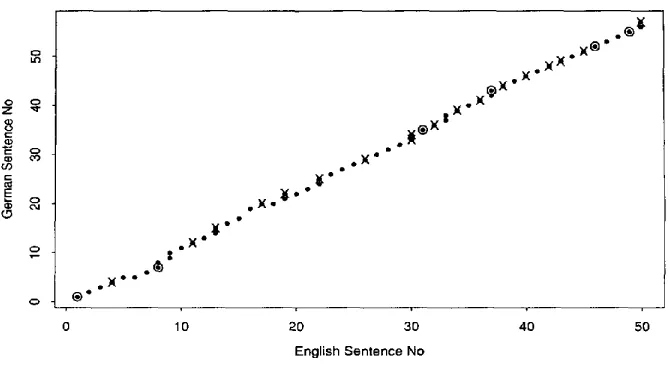
Sentence alignment of the first 50 sentences of the test texts: true alignment (dots) and hypothesis of the SAT after the first pass (circles) and after the second pass (crosses).
Table 3 summarizes the accuracy of the algorithm as a function of the number of passes. The (thresholded) SAT is evaluated by two criteria: the number of correct alignments divided by the total number of alignments, and--since the SAT does not necessarily give an alignment for every sentence---the coverage, i.e., the number of sentences with at least one entry relative to the total number of sentences. An align- ment is said to be correct if the SAT contains exactly the numbers of the sentences that are complete or partial translations of the original sentence. The coverage of 96% of the SAT in pass 4 is as much as one would expect, since the remaining nonaligned sentences are one-zero alignments, most of them due to the German subheadings that are not part of the English version. The table also shows that the AST always provides a significant number of candidates for alignment with each sentence before a pass: the fourth column gives the number of true sentence alignments relative to the total number of candidates in the AST. Recall that the final alignment is always a subset of the hypotheses in the AST in every preceding pass.
[image:18.468.89.424.61.244.2]Martin Kay and Martin R6scheisen Text-Translation Alignment
the algorithm without using the appropriate data structures can easily lead to times that are a factor of 30 higher and do not scale up to larger texts.
The application of our method to a text that we put together from the Hansard corpus had essentially no problem in identifying the correct sentence alignment in a process of five passes. The alignments for the first 1000 sentences of the English text were checked by hand, and seven errors were found; five of them occurred in sentences where sentence boundaries were not correctly identified by the program because of periods that did not mark a sentence boundary and were not identified as such by a very simple preprocessing program. The other two errors involved two short sentences for which the SAT did not give an alignment. Processing time increased essentially linearly (per pass): the first pass took 8.3 min, the second 3.2 min, and it further decreased until the last pass, which took 2.1 min. (Initialization took 4.2 min.) Note that the error rate depends crucially on the kind of "annealing schedule" used: if the thresholds that allow a word pair in the WAT to influence the SAT are lowered too fast, only a few passes are needed, but accuracy deteriorates. For example, in an application where the process terminated after only three passes, the accuracy was only in the eighties (estimated on the basis of the first 120 sentences of the English Hansard text checked by hand). Since processing time after the first pass is usually already considerably lower, we have found that a high accuracy can safely be attained when more passes are allowed than are actually necessary.
In order to evaluate the sensitivity of the algorithm to the lengths of the texts that are to be aligned, we applied it to text samples that ranged in length from 10 to 1000 sentences, and examined the accuracy of the WAT after the first pass; that is, more precisely, the number of word pairs in the WAT that are valid translations relative to the total number of word pairs with a similarity of not less than 0.7 (the measurements are cross-validated over different texts). The result is that this accuracy increases asymptotically to 1 with the text length, and is already higher than 80% for a text length of 100 sentences (which is sufficient to reach an almost perfect alignment in the end). Roughly speaking, the accuracy is almost 1 for texts longer than 150 sentences, and around 0.5 for text length in the lower range from 20 to 60. In other words, texts of a length of more than 150 sentences are suitable to be processed in this way; text fragments shorter than 80 sentences do not have a high proportion of correct word pairs in the first WAT, but further experiments showed that the final alignment for texts of this length is, on average, again almost perfect: the drawback of a less accurate initial WAT is apparently largely compensated for by the fact that the AST is also narrower for these texts; however, the variance in the alignment accuracies is significantly higher.
5. R e l a t e d W o r k
Computational Linguistics Volume 19, Number 1
• ° ~ • Re •
S. d . S
40 60 80 120
English: Length in words
"i°
, ° % of
200 400 600 800
English: Length in chars
Figure 6
Lengths of Aligned Paragraphs are Correlated: Robust regression between lengths of aligned paragraphs. Left: length measured in words. Right: length measured in characters.
and annotations: these are used in a preprocessing step to find anchors for sentence alignment such that, on average, there are only ten sentences in between. Moreover, this particular corpus is well known for the near literalness of its translations, and it is therefore unclear to what extent the good results are due to the relative ease of the problem. This would be an important consideration when comparing various algorithms; when the algorithms are actually applied, it is clearly very desirable to in- corporate as much prior knowledge (say, on potential anchors) as possible. Moreover, long texts can almost always be expected to contain natural anchors, such as chapter and section headings, at which to make an a priori segmentation.
Gale and Church (1991) note that their method performed considerably better when lengths of sentences were measured in number of characters instead of in num- ber of words. Their method is based on a probabilistic model of the distance between two sentences, and a dynamic programming algorithm is used to minimize the total distance between aligned units. Their implementation assumes that each character in one language gives rise to, on average, one character in the other language. 8 In our texts, one character in English on average gives rise to somewhat more than 1.2 char- acters in German, and the correlation between the lengths (in characters) of aligned paragraphs in the two languages was with 0.952 lower than the 0.991 that are men- tioned in Gale and Church (1991), which supports our impression that the Scientific American texts we used are hard texts to align, but it is not clear to what extent this would deteriorate the results. In applications to economic reports from the Union Bank of Switzerland, the method performs very well on simple alignments (one-to-one, one- to-two), but has at the moment problems with complex matches. The method has the
[image:20.468.92.425.63.256.2]Martin Kay and Martin R6scheisen Text-Translation Alignment
advantage of associating a score with pairs of sentences so that it is easy to extract a subset for which there is a high likelihood that the alignments are correct.
Given the simplicity of the methods proposed by Brown, Lai, and Mercer and Gale and Church, either of them could be used as a heuristic in the construction of the initial AST in our algorithm. In the current version, the number of candidate sentence pairs that are considered in the first pass near the middle of a text contributes disproportionally to the cost of the computation. In fact, as we remarked earlier, the complexity of this step is
O(nvFff).
The proposed modification would effectively make it linear.6. Future W o r k
For most practical purposes, the alignment algorithm we have described produces very satisfactory results, even when applied to relatively free translations. There are doubtless m a n y places in which the algorithm itself could be improved. For example, it is clear that the present method of building the SAT favors associations between long sentences, and this is not surprising, because there is more information in long sentences. But we have not investigated the extent of this bias and we do not therefore know it as appropriate.
The present algorithm rests on being able to identify one-to-one associations be- tween certain words, notably technical terms and proper names. It is clear from a brief inspection of Table 2 that very few correspondences are noticed among everyday words and, when they are, it is usually because those words also have precise tech- nical uses. The very few exceptions include " o n l y ' / " n u r " and "the" / "die-." The pair "per" / "pro" might also qualify, but if the languages afford any example of a scientific preposition, this is surely it. The most interesting further developments would be in the direction of loosening up this dependence on one-to-one associations both because this would present a very significant challenge and also because we are convinced that our present method identifies essentially all the significant one-to-one associations.
There are two obvious kinds of looser associations that could be investigated. One would consist of connections between a single vocabulary item in one language and two or more in the other, or even between several items in one language and several in the other. The other would involve connections--one-one, one-many, or m a n y - m a n y - - b e t w e e n phrases or recurring sequences.
We have investigated the first of these enough to satisfy ourselves that there is latent information on one-to-many associations in the text, and that it can be revealed by suitable extensions of our methods. However, it is clear that the combinatorial prob- lems associated with this approach are severe, and pursuing it would require much fine tuning of the program and designing much more effective ways of indexing the most important data structures. The key to reducing the combinatorial explosion probably lies in using tables of similarities such as those the present algorithm uses to suggest combinations of items that would be worth considering. If such an approach could be made efficient enough, it is even possible that it would provide a superior way of solving the problem for which our heuristic methods of morphological analysis were introduced. Its superiority would come from the fact that it would not depend on words being formed by concatenation, but would also accommodate such phenom- ena as umlaut, ablaut, vowel harmony, and the nonconcatenative process of Semitic morphology.
Computational Linguistics Volume 19, Number 1
the WAT m u c h as we n o w a d d the results of m o r p h o l o g i c a l analysis. Needless to say, this w o u l d only allow for u n i n t e r r u p t e d sequences. A n y a t t e m p t to deal w i t h discontinuous sequences w o u l d doubtless also involve great combinatorial problems. These a v e n u e s for f u r t h e r d e v e l o p m e n t are intriguing a n d w o u l d surely lead to interesting results. But it is unlikely that they w o u l d lead to m u c h better sets of asso- ciations a m o n g sentences than are to be f o u n d in the SATs that o u r present p r o g r a m produces, a n d it was mainly these results that w e were interested in f r o m the outset. The other a v e n u e s w e have m e n t i o n e d concern i m p r o v e m e n t s in the WAT which, for us, was always a s e c o n d a r y interest.
References
Baayen, H. (1991). "A stochastic process for word frequency distributions." In
Proceedings, 29th Annual Meeting of the Association for Computational Linguistics,
Berkeley, CA.
Brown, P.; Lai, J. C.; and Mercer, R. L. (1991). "Aligning sentences in parallel corpora." In Proceedings, 29th Annual Meeting of the Association for Computational Linguistics, Berkeley, CA.
Brown, P.; Cocke, J.; Della Pietra, S.; Della Pietra, V.; Jelinek, F.; Lafferty, J.; Mercer, R.; and Roossin P. (1990). "A statistical approach to machine translation."
Computational Linguistics, 16, 79-85. Church, K. W., and Hanks, P. (1990). "Word
association norms, mutual information, and lexicography." Computational Linguistics, 16(1), 22-29.
Drela, M., and Langford, J. S. (1985). "Human-powered flight." Scientific American, 253(5).
Drela, M., and Langford, J. S. (1986). "Fliegen mit Muskelkraft." Spektrum der Wissenschaft.
Fano, R. (1961). Transmission of Information. A
Statistical Theory of Communications. MIT Press.
Gale, W. A., and Church, K. W. (1991). "A program for aligning sentences in bilingual corpora." In Proceedings, 29th Annual Meeting of the Association for Computational Linguistics. Berkeley, CA. Kay, M., and R6scheisen, M. (1988).
"Text-translation alignment." Technical Report, Xerox Palo Alto Research Center. Knuth, D. E. (1973). The Art of Computer
Programming. Vol. 3, Sorting and Searching. Addison-Wesley.
MacKeown, P. K., and Weekes, T. C. (1985). "Cosmic rays from Cygnus X-3." Scientific American, 253(5).
MacKeown, P. K., and Weekes, T. C. (1986). "Kosmische Strahlen von Cygnus X-3."
Spektrum der Wissenschafl.
van Rijsbergen, C. J. (1979). Information Retrieval. Butterworths.
Sato, S., and Nagao, M. (1990). "Toward memory-based translation." In
Proceedings, I5th International Conference on Computational Linguistics (COLING-90).