Workshop on Monolingual Text-To-Text Generation, pages 20–26,
An Unsupervised Alignment Algorithm for Text Simplification Corpus
Construction
Stefan Bott
TALN Research Group Universitat Pompeu Fabra C/Tanger 122 - Barcelona - 08018
Spain
Horacio Saggion
TALN Research Group Universitat Pompeu Fabra C/Tanger 122 - Barcelona - 08018
Spain
Abstract
We present a method for the sentence-level alignment of short simplified text to the orig-inal text from which they were adapted. Our goal is to align a medium-sized corpus of par-allel text, consisting of short news texts in Spanish with their simplified counterpart. No training data is available for this task, so we have to rely on unsupervised learning. In con-trast to bilingual sentence alignment, in this task we can exploit the fact that the probability of sentence correspondence can be estimated from lexical similarity between sentences. We show that the algoithm employed performs better than a baseline which approaches the problem with a TF*IDF sentence similarity metric. The alignment algorithm is being used for the creation of a corpus for the study of text simplification in the Spanish language.
1 Introduction
Text simplification is the process of transforming a text into an equivalent which is more understand-able for a target user. This simplification is bene-ficial for many groups of readers, such as language learners, elderly persons and people with other spe-cial reading and comprehension necessities. Simpli-fied texts are characterized by a simple and direct style and a smaller vocabulary which substitutes in-frequent and otherwise difficult words (such as long composite nouns, technical terms, neologisms and abstract concepts) by simpler corresponding expres-sions. Usually unnecessary details are omitted. An-other characteristic trait of simplified texts is that usually only one main idea is expressed by a single
sentence. This also means that in the simplification process complex sentences are often split into sev-eral smaller sentences.
The availability of a sentence-aligned corpus of original texts and their simplifications is of paramount importance for the study of simplifica-tion and for developing an automatic text simplifi-cation system. The different strategies that human editors employ to simplify texts are varied and have the effect that individual parts of the resulting text may either become shorter or longer than the orig-inal text. An editor may, for example, delete de-tailed information, making the text shorter. Or she may split complex sentences into various smaller sentences. As a result, simplified texts tend to be-come shorter than the source, but often the number of sentences increases. Not all of the information presented in the original needs to be preserved but in general all of the information in the simplified text stems from the source text.
The need to align parallel texts arises from a larger need to create a medium size corpus which will al-low the study of the editing process of simplifying text, as well as to serve as a gold standard to evalu-ate a text simplification system.
Sentence alignment for simplified texts is related to, but different from, the alignment of bilingual text and also from the alignment of summaries to an orig-inal text. Since the alignment of simplified sentences is a case of monolingual alignment the lexical sim-ilarity between two corresponding sentences can be taken as an indicator of correspondence.
This paper is organized as follows: Section 2 briefly introduces text simplification which
tualises this piece of research and Section 3 dis-cusses some related work. In Section 4 we briefly describe the texts we are working with and in Sec-tion 5 we present the alignment algorithm. SecSec-tion 6 presents the details of the experiment and its results. Finally, section 7 gives a concluding discussion and an outlook on future work.
2 Text Simplification
The simplification of written documents by humans has the objective of making texts more accessible to people with a linguistic handicap, however manual simplification of written documents is very expen-sive. If one considers people who cannot read doc-uments with heavy information load or docdoc-uments from authorities or governmental sources the percent of need for simplification is estimated at around 25% of the population, it is therefore of great importance to develop methods and tools to tackle this problem. Automatic text simplification, the task of transform-ing a given text into an ”equivalent” which is less complex in vocabulary and form, aims at reducing the efforts and costs associated with human simpli-fication. In addition to transforming texts into their simplification for human consumption, text simpli-fication has other advantages since simpler texts can be processed more efficiently by different natural language processing processors such as parsers and used in applications such as machine translation, in-formation extraction, question answering, and text summarization.
Early attempts to text simplification were based on rule-based methods where rules were designed following linguistic intuitions (Chandrasekar et al., 1996). Steps in the process included linguistic text analysis (including parsing) and pattern matching and transformation steps. Other computational mod-els of text simplification included processes of anal-ysis, transformation, and phrase re-generation (Sid-dharthan, 2002) also using rule-based techniques. In the PSET project (Carroll et al., 1998) the pro-posal is for a news simplification system for aphasic readers and particular attention is paid to linguistic phenomena such as passive constructions and coref-erence which are difficult to deal with by people with disabilities. The PorSimples project (Alu´ısio et al., 2008) has looked into simplification of the
Por-tuguese language. The methodology consisted in the creation of a corpus of simplification at two different levels and on the use of the corpus to train a deci-sion procedure for simplification based on linguistic features. Simplification decisions about whether to simplify a text or sentence have been studied fol-lowing rule-based paradigms (Chandrasekar et al., 1996) or trainable systems (Petersen and Ostendorf, 2007) where a corpus of texts and their simplifica-tions becomes necessary. Some resources are avail-able for the English language such as parallel cor-pora created or studied in various projects (Barzilay and Elhadad, 2003; Feng et al., 2009; Petersen and Ostendorf, 2007; Quirk et al., 2004); however there is no parallel Spanish corpus available for research into text simplification. The algorithms to be pre-sented here will be used to create such resource.
3 Related Work
The problem of sentence alignment was first tack-led in the context of statistical machine translation. Gale and Church (1993) proposed a dynamic pro-gramming algorithm for the sentence-level align-ment of translations that exploited two facts: the length of translated sentences roughly corresponds to the length of the original sentences and the se-quence of sentences in translated text largely corre-sponds to the original order of sentences. With this simple approach they reached a high degree of accu-racy.
on a handcrafted set of sentence alignments. Af-ter that they grouped all paragraphs of unseen text pairs into the same topic clusters as in the first step and aligned the texts on the paragraph level, al-lowing for multiple matches. Finally they aligned the sentences within the already aligned paragraphs. Their similarity measure, both for paragraphs and sentences, was based on cosine distance of word overlap. Nelken and Shieber (2006) improve over Barzilay and Elhadad’s work: They use the same data set, but they base their similarity measure for aligning sentences on a TF*IDF score. Although this score can be obtained without any training, they apply logistic regression on these scores and train two parameters of this regression model on the train-ing data. Both of these approaches can be tuned by parameter settings, which results in a trade-off be-tween precision and recall. Barzilay and Elhadad report a precision of 76.9% when the recall reaches 55.8%. Nelken and Shieber raise this value to 83.1% with the same recall level and show that TF*IDF is a much better sentence similarity measure. Zhu et al. (2010) even report a precision of 91.3% (at the same fixed recall value of 55.8%) for the alignment of simple English Wikipedia articles to the English Wikipedia counterparts using Nelken and Shieber’s TF*IDF score, but their alignment was part of a larger problem setting and they do not discuss fur-ther details.
We consider that our task is not directly compara-ble to this previous work: the texts we are working with are direct simplifications of the source texts. So we can assume that all information in the simplified text must stem from the original text. In addition we can make the simplifying assumption that there are one-to-many, but no many-to-one relations between source sentences and simplified sentences, a simpli-fication which largely holds for our corpus. This means that all target sentences must find at least one alignment to a source sentence, but not vice versa. Nelken and Shieber make the interesting observa-tion that dynamic programming, as used by Gale and Church (1991) fails to work in the monolingual case. Their test data consisted of pairs of encyclo-pedia articles which presented a large intersection of factual information, but which was not necessar-ily presented in the same order. The corpus we are working with, however, largely preserves the order
in which information is presented.
4 Dataset
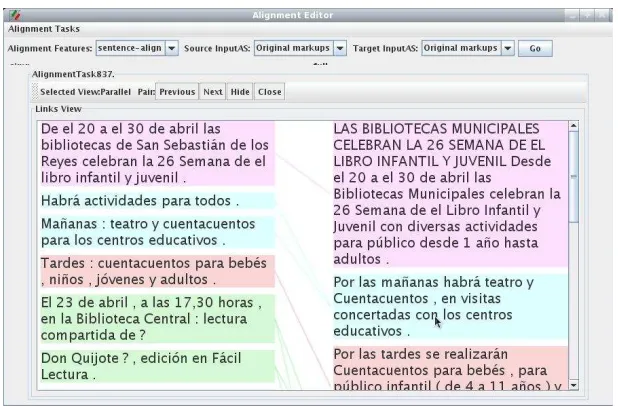
We are working with a corpus of 200 news arti-cles in Spanish covering the following topics: Na-tional News, Society, InternaNa-tional News and Cul-ture. Each of the texts is being adapted by the DILES Research Group from Universidad Aut´onoma de Madrid (Anula, 2007). Original and adapted ex-amples of texts in Spanish can be seen in Figure 1 (the texts are adaptations carried out by DILES for Revista “La Plaza”). The texts are being processed using part-of-speech tagging, named entity recogni-tion, and parsing in order to create an automatically annotated corpus. The bi-texts are first aligned us-ing the tools to be described in this paper and then post-edited with the help of a bi-text editor provided in the GATE framework (Cunningham et al., 2002). Figure 2 shows the texts in the alignment editor. This tool is however insufficient for our purposes since it does not provide mechanisms for uploading the alignments produced outside the GATE frame-work and for producing stand-alone versions of the bi-texts; we have therefore extended the functionali-ties of the tool for the purpose of corpus creation.
5 Algorithm
Our algorithm is based on two intuitions about sim-plified texts (as found in our corpus): As repeatedly observed sentences in simplified texts use similar words to those in the original sentences that they stem from (even if some of the words may have undergone lexical simplification). The second ob-servation is very specific to our data: the order in which information is presented in simplified texts roughly corresponds to the order of the information in the source text. So sentences which are close to each other in simplified texts correspond to original sentences which are also close to each other in the source text. In many cases, two adjacent simplified sentences even correspond to one single sentence in the source text. This leads us to apply a simple Hid-den Markov Model which allows for a sequential classification.
Firstly, we define an alignment as a pair of sen-tences as
Original Text Adapted Text Un Plan Global desde tu hogar
El Programa GAP (Global Action Plan) es una iniciativa que se desarrolla en distintos pa´ıses y que pretende dis-minuir las emisiones de CO2, principales causantes del cambio clim´atico y avanzar hacia h´abitos m´as sostenibles en aspectos como el consumo de agua y energ´ıa, la movilidad o la gesti´on de los residuos dom´esticos. San Sebasti´an de los Reyes se ha adherido a este Pro-grama.
Toda la informaci´on disponible para actuar desde el hogar en la construcci´on de un mundo m´as sostenible se puede encontrar en ssreyes.org o programagap.es.
Un Plan Global desde tu hogar
San Sebasti´an de los Reyes se ha unido al Plan de Acci´on Global (GAP).
El Plan es una iniciativa para luchar contra el cambio clim´atico desde tu casa.
Los objetivos del Plan son:
Disminuir nuestros gastos dom´esticos de agua y energ´ıa. Reducir los efectos da˜ninos que producimos en el planeta con nuestros residuos.
Mejorar la calidad de vida de nuestra ciudad.
Tienes m´as informaci´on en ssreyes.org y en programa-gap.es.
Ap´untate al programa GAP y desc´argate los manuales con las propuestas para conservar el planeta.
[image:4.612.152.461.255.458.2]Figure 1: Original Full Document and Easy-to-Read Version
Figure 2: The Alignment Editor with Text and Adaptation
where a target sentence belongs to the simplified text and the source sentence belongs to the original sentence. Applying standard Bayesian decomposi-tion, the probability of an alignment to a given target text can be calculated as follows:
P(alignn
1|target sentm1) =
P(alignn
1)P(target sentm1|alignn1)
P(target sentm
1)
SinceP(target sentm1)is constant we can calcu-late the most probable alignment sequencealignd as follows:
d
align=
arg maxP(alignn1)P(target sentm1 |alignn1) = arg maxQn
i=1P(aligni,j)P(target sentj|aligni,j)
This leaves us with two measures: a measure
of sentence similarity (the probability of alignment proper) and a measure of consistency, under the as-sumption that a consistent simplified text presents the information in the same order as it is presented in the source text. In order to determinealignd , we apply theViterbialgorithm (Viterbi, 1967).
Sentence similarity can be calculated as follows:
P(wordl
1|target sentj) =
Ql k=1
P(target sentj|wordk)P(target sentj)
P(wordk)
where wordl1 is the sequence of words in the source sentenceiandlis the length of sentencei.
words which are frequent in the source text and boosts the score for less frequent words. In addi-tion we eliminated a short list of stopwords from the calculation, but this has no significant effect on the general performance.
Note that P(wordk) may correspond to a MLE of 0 since simplified texts often use different (and simpler) words and add connectors, conjunctions and the like. For this reason we have to recalcu-lateP(wordk)according to a distortion probability
α. Distortion is taken here as the process of word insertion or lexical changes. αis a small constant, which could be determined empirically, but since no training data is available we estimatedαfor our ex-periment and set it by hand to a value of 0.0075. Even if we had to estimateαwe found that the per-formance of the system is robust regarding its value: even for unrealistic values like 0.0001 and 0.1 the performance only drops by two percent points.
P(wordk|distortion) =
(1−α)P(wordk) +α(1−P(wordk))
For the consistency measure we made the Markov assumption that each alignment aligni,j only depends on the proceeding alignment
aligni−1,j0. We assume that this is the proba-bility of a distance d between the corresponding sentences ofsource senti−1andsource senti, i.e.
P(source senti|aligni−1,j−k) for each possible jump distance k. Since long jumps are relatively rare, we used a normalized even probability dis-tribution for all jump lengths greater than 2 and smaller than -1.
Since we have no training data, we have to ini-tially set these probabilities by hand. We do this by assuming that all jump distancesk in the range between -1 and 2 are distributed evenly and larger jump distances have an accumulated probability mass corresponding to one of the local jump dis-tances. Although this model for sentence transitions is apparently oversimplistic and gives a very bad es-timate for eachP(source senti|aligni−1,j−k), the probabilities forP(alignn1)give a counterweight to these bad estimates. What we can expect is, that af-ter running the aligner once, using very unreliable transitions probability estimates, the output of the aligner is a set of alignments with an implicit align-ment sequence. Taking this alignalign-ment sequence, we
can calculate new maximum likelihood estimates for each jump distance P(source senti|aligni−1,j−k) again, and we can expect that these new estimates are much better than the original ones.
For this reason we apply the Viterbi classifier it-eratively: The first iteration employs the hand set values. Then we run the classifier and determine the values forP(source senti|aligni−1,j−k)on its output. Then we run the classifier again, with the new model and so on. Interestingly values for
P(source senti|aligni−1,j−k)emerge after as little as two iterations. After the first iteration, precision already lies only 1.2 percent points and recall 1.3 points below the stable values. We will comment on this finding in Section 7.
6 Experiment and Results
Our goal is to align a larger corpus of Spanish short news texts with their simplified counterparts. At the moment, however, we only have a small sample of this corpus available. The size of this corpus sam-ple is 1840 words of simplified text (145 sentences) which correspond to 2456 (110 sentences) of source text. We manually created a gold standard which in-cludes all the correct alignments between simplified and source sentences. The results of the classifier were calculated against this gold standard.
As a baseline we used a TF*IDF score based method which chooses for each sentence in the sim-plified text the sentence with the minimal word vec-tor distance. The procedure is as follows: each sen-tence in the original and simplified document is rep-resented in the vector space model using a term vec-tor (Saggion, 2008). Each term (e.g. token) is wei-thed using as TF the frequency of the term in the document and IDF =log(N+ 1/Mt+ 1)whereMt is the number of sentences1 containingtand N is the number of sentences in the corpus (counts are obtained from the set of documents to align). As similarity metric between vectors we use the cosine of the angle between the two vectors given in the following formula:
1The relevant unit for the calculation of IDF (the D in IDF)
cosine(s1, s2) =
Pn
i=1wi,s1∗wi,s2
pPn
i=1(wi,s1)
2∗pPn
i=1(wi,s2) 2
Heres1ands2are the sentence vectors andwi,sk
is the weight of term i in sentencesk. We align all simplified sentences (i.e. for the time being no cut-off has been used to identify new material in the sim-plified text).
For the calculation of the first baseline we calcu-late IDF over the sentences in whole corpus. Nelken and Shieber (2006) argue that that the relevant unit for this calculation should be each document for the following reason: Some words are much more fre-quent in some texts than they are in others. For ex-ample the word unicorn is relatively infrequent in English and it it may also be infrequent in a given colletion of texts. So this word is highly discrimina-tive and it’s IDF will be reladiscrimina-tively high. In a specific text about imagenary creatures, however, the same wordunicornmay be much more frequent and hence it’s discrimiative power is much lower. For this rea-son we calcuated a second baseline, where we cal-culate the IDF only on the sentences of the relevanct texts.
Results of aligning all sentences in our sample corpus using both the baseline and the HMM algo-rithms are given in Table 6.
precision recall
HMM aligner 82.4% 80.9%
alignment only 81.13% 79.63% TF*IDF + transitions 76.1% 73.5% TF*IDF (document) 75.47% 74.07% TF*IDF (full corpus) 62.2% 61.1%
If we compare these results to those presented by Nelken and Shieber (2006), we can observe that we obtain a comparable precision, but the recall im-proves dramatically from 55.8% (with their specific feature setting) to 82.4%. Our TF*IDF baselines are not directly comparable comparable to Nelken and Shieber’s results. The reason why we can-not compare our results directly is that Nelken and Shieber use supervised learning in order to optimize the transformation of TF*IDF scores into probabili-ties and we had no training data available.
We included the additional scores for our system, when no transition probabilities are included in the
calculation of the optimal alignment sequence and the score comes only from the probabilies of our clalculation of lexical similarity between sentences (alignment only). These scores show that a large part of the good performance comes from lexical similar-ity and sequencial classification only give an addi-tional final boost, a fact which was already observed by Nelken and Shieber. We also attribute the fact that the system alrives at stable values after two it-erations to the same efect: lexical similarity seems to have a much bigger effect on the general perfor-mance. Still our probability-based similarity meas-sure clearly outperforms the TF*IDF baselines.
7 Discussion and Outlook
We have argued above that our task is not directly comparable to Nelken and Shieber’s alignment of two versions of Encyclopedia articles. First of all, the texts we are working with are simplified texts in a much stricter sense: they are the result of an edit-ing process which turns a source text into a simpli-fied version. This allows us to use sequential classi-fication which is usually not successful for mono-lingual sentence alignment. This helps especially in the case of simplified sentences which have been largely re-written with simpler vocabulary. These cases would normally be hard to align correctly. Al-though it could be argued that the characteristics of such genuinely simplified text makes the alignment task somewhat easier, we would like to stress that the alignment method we present makes no use of any kind of training data, in contrast to Barzilay and Elhadad (2003) and, to a minor extent, Nelken and Shieber (2006).
experiment.
Finally, the alignment tool will be used to sentence-align a medium-sized parallel Spanish cor-pus of news and their adaptations that will be a much needed resource for the study of text simplification and other natural language processing applications. Since the size of the corpus we have available at the moment is relatively modest, we are also investi-gating alternative resources which could allow us to create a larger parallel corpus.
Acknowledgments
We thank three anonymous reviewers for their com-ments and suggestions which help improve the fi-nal version of this paper. The research described in this paper arises from a Spanish research project called Simplext: An automatic system for text sim-plification (http://www.simplext.es). Sim-plext is led by Technosite and partially funded by the Ministry of Industry, Tourism and Trade of the Government of Spain, by means of the National Plan of Scientific Research, Development and Tech-nological Innovation (I+D+i), within strategic Ac-tion of TelecommunicaAc-tions and InformaAc-tion Soci-ety (Avanza Competitiveness, with file number TSI-020302-2010-84). We thanks the Department of In-formation and Communication Technologies at UPF for their support. We are grateful to Programa Ram´on y Cajal from Ministerio de Ciencia e Inno-vaci´on, Spain.
References
Sandra M. Alu´ısio, Lucia Specia, Thiago Alexan-dre Salgueiro Pardo, Erick Galani Maziero, and Re-nata Pontin de Mattos Fortes. 2008. Towards brazil-ian portuguese automatic text simplification systems. InACM Symposium on Document Engineering, pages 240–248.
A. Anula. 2007. Tipos de textos, complejidad ling¨u´ıstica y facilicitaci´on lectora. InActas del Sexto Congreso de Hispanistas de Asia, pages 45–61.
Regina Barzilay and Noemi Elhadad. 2003. Sentence alignment for monolingual comparable corpora. In In Proceedings of the 2003 conference on Empirical methods in natural language processing, pages 25–32. John Carroll, Guido Minnen, Yvonne Canning, Siobhan Devlin, and John Tait. 1998. Practical simplification of english newspaper text to assist aphasic readers. In
In Proc. of AAAI-98 Workshop on Integrating Artificial Intelligence and Assistive Technology, pages 7–10. Raman Chandrasekar, Christine Doran, and Bangalore
Srinivas. 1996. Motivations and methods for text sim-plification. InCOLING, pages 1041–1044.
H. Cunningham, D. Maynard, K. Bontcheva, and V. Tablan. 2002. GATE: A framework and graphi-cal development environment for robust NLP tools and applications. InProceedings of the 40th Anniversary Meeting of the Association for Computational Linguis-tics.
Lijun Feng, Noemie Elhadad, and Matt Huenerfauth. 2009. Cognitively motivated features for readability assessment. InEACL, pages 229–237.
William A. Gale and Kenneth W. Church. 1993. A program for aligning sentences in bilingual corpora. Computational Linguistics.
Hongyan Jing. 2002. Using hidden markov modeling to decompose human-written summaries. Comput. Lin-guist., 28:527–543, December.
Rani Nelken and Stuart M. Shieber. 2006. Towards ro-bust context-sensitive sentence alignment for monolin-gual corpora. InIn 11th Conference of the European Chapter of the Association for Computational Linguis-tics.
Sarah E. Petersen and Mari Ostendorf. 2007. Text sim-plification for language learners: a corpus analysis. In In Proc. of Workshop on Speech and Language Tech-nology for Education.
Chris Quirk, Chris Brockett, and William Dolan. 2004. Monolingual machine translation for paraphrase gen-eration. InIn Proceedings of the 2004 Conference on Empirical Methods in Natural Language Processing, pages 142–149.
H. Saggion. 2008. SUMMA: A Robust and Adapt-able Summarization Tool. Traitement Automatique des Langues, 49(2):103–125.
Advaith Siddharthan. 2002. An architecture for a text simplification system. InIn LEC 02: Proceedings of the Language Engineering Conference (LEC02, pages 64–71.
A. Viterbi. 1967. Error bounds for convolutional codes and an asymptotically optimum decoding algorithm. IEEE Transactions on Information Theory, 13:260– 269.