Proceedings of the 22nd Conference on Computational Natural Language Learning (CoNLL 2018), pages 508–518 508
The Lifted Matrix-Space Model for Semantic Composition
WooJin Chung1
Sheng-Fu Wang1
Samuel R. Bowman1,2
1Dept. of Linguistics
New York University 10 Washington Place New York, NY 10003
2Center for Data Science
New York University 60 Fifth Avenue New York, NY 10011
Abstract
Tree-structured neural network architectures for sentence encoding draw inspiration from the approach to semantic composition gener-ally seen in formal linguistics, and have shown empirical improvements over comparable se-quence models by doing so. Moreover, adding multiplicative interaction terms to the com-position functions in these models can yield significant further improvements. However, existing compositional approaches that adopt such a powerful composition function scale poorly, with parameter counts exploding as model dimension or vocabulary size grows. We introduce the Lifted Matrix-Space model, which uses a global transformation to map vector word embeddings to matrices, which can then be composed via an operation based on matrix-matrix multiplication. Its compo-sition function effectively transmits a larger number of activations across layers with rela-tively few model parameters. We evaluate our model on the Stanford NLI corpus, the Multi-Genre NLI corpus, and the Stanford Sentiment Treebank and find that it consistently outper-forms TreeLSTM (Tai et al.,2015), the previ-ous best known composition function for tree-structured models.
1 Introduction
Contemporary theoretical accounts of natural lan-guage syntax and semantics consistently hold that sentences are tree-structured, and that the mean-ing of each node in each tree is calculated from the meaning of its child nodes using a relatively sim-plesemantic compositionprocess which is applied recursively bottom-up (Chierchia and McConnell-Ginet,1990;Dowty,2007). In tree-structured re-cursive neural networks (TreeRNN;Socher et al.,
[image:1.595.309.527.168.417.2]2010), a similar procedure is used to build repre-sentations for sentences for use in natural language understanding tasks, with distributed representa-tions for words repeatedly fed through a neural
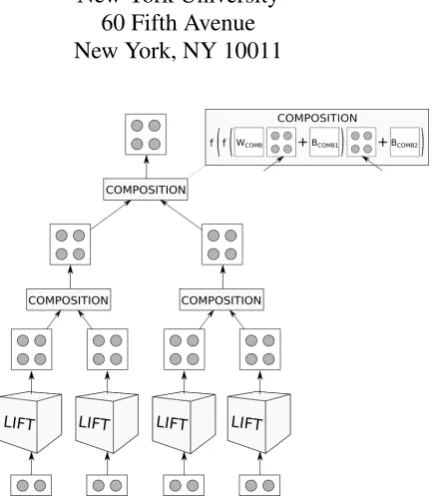
Figure 1: The Lifted Matrix-Space model in schematic form. Words are stored as vectors and projected into matrix space by theLIFTlayer. A parametricCOMPO -SITIONfunction combines pairs of these matrices using multiplicative interactions.
network composition function according to a bi-nary tree structure supplied by a parser. The suc-cess of a tree-structured model largely depends on the design of its composition function.
fed. Figure1illustrates the model design.
Our model was inspired by Continuation Se-mantics (Barker and Shan,2014;Charlow,2014), where each symbolic representation of words is converted to a higher-order function. There is a consensus in linguistic semantics that a sub-set of natural language expressions correspond to higher-order functions. Inspired by the works in programming language theory, Continuation Se-mantics takes a step further and claims that all ex-pressions have to be converted into a higher-order function before they participate in semantic com-position. The theory bridges a gap between lin-guistic semantics and programming language the-ory, and reinterprets various linguistic phenomena from the view of computation. While we do not directly implement Continuation Semantics, we follow its rough contours: We convert low-level representations (vectors) to higher-order functions (matrices), and composition only takes place be-tween the higher-order functions.
A number of models have been developed to capture the multiplicative interactions between distributed representations. While having a sim-ilar objective, the proposed model requires fewer model parameters than the predecessors because it does not necessarily learn each word matrix repre-sentation separately, and the number of parameters for the composition function is not proportional to the cube of the hidden state dimension. Because of this, it can be trained with larger vocabularies and more hidden state activations than was possi-ble with its predecessors.
We evaluate our model primarily on the task ofnatural language inference(NLI;MacCartney,
2009). The task consists in determining the infer-ential relation between a given pair of sentences. It is a principled and widely-used evaluation task for natural language understanding, and knowing the inferential relations is closely related to under-standing the meaning of an expression (Chierchia and McConnell-Ginet, 1990). While other tasks such as question answering or machine transla-tion require a model to learn task-specific behavior that goes beyond understanding sentence mean-ing, NLI results highlight sentence understanding performance in isolation. We also include an eval-uation on sentiment classification for comparison with some earlier work.
We find that our model outperforms existing ap-proaches to tree-structured modeling on all three
tasks, though it does not set the state of the art on any of them, falling behind other types of complex model. We nonetheless expect that this method will be a valuable ingredient in future models for sentence understanding and a valuable platform for research of compositionality in learned repre-sentations.
2 Related work
Composition functions for tree-structured mod-els have been thoroughly studied in recent years (Mitchell and Lapata,2010;Baroni and Zampar-elli, 2010; Zanzotto et al., 2010; Socher et al.,
2011). While this line of research has been suc-cessful, the majority of the existing models ulti-mately rely on the additive linear combination of vectors. The Tree-structured recursive neural net-works (TreeRNN) of Socher et al. (2010) com-pose two child node vectors~hl and~hr using this
method:
(1) ~h=tanh(W
"
~hl
~hr
#
+~b)
where~hl, ~hr,~h,~b ∈ Rd×1, and W ∈ Rd×2d.
Throughout this paper,dstands for the number of activations of a given model.
However, there is no reason to believe that the additive linear combination of vectors is adequate for modeling semantic composition. Formal work in linguistic semantics has shown that many lin-guistic expressions are well-represented as func-tions. Accordingly, composing two meanings typ-ically require feeding an argument into a function (function application; Heim and Kratzer, 1998). Such an operation involves a complex interac-tion between the two meanings, but the classic TreeRNN does not supply any additional means to capture the interaction.
Rudolph and Giesbrecht(2010) report that ma-trix multiplication, as opposed to element-wise ad-dition, is more suitable for semantic composition. Their Compositional Matrix-Space model (CMS) represents words and phrases as matrices, and they are composed via a simple matrix multiplication:
(2) P =AB
whereA,B,P∈Rd×dare matrix representations
capturing the semantic composition because natu-ral language is order-sensitive.
However, as Socher et al. (2012) note, CMS loses syntactic information during composition due to the associative character of matrix multipli-cation. For instance, the following two tree struc-tures in (3) are syntactically distinct, but CMS would produce the same result for both structures because its mode of composition is associative.
(3) a.
A B C b. A B C
CMS cannot distinguish the meaning of the two tree structures and invariably produces ABC (a se-quence of matrix multiplications). Therefore, the information on syntactic constituency would be lost. This makes the model less desirable for han-dling semantic composition of natural language expressions for two reasons: First, the principle of compositionality is violated. Much of the suc-cess of the tree-structured models can be credited to the shared hypothesis that the meaning of ev-ery tree node is derived from the meanings of its child nodes. Abandoning this principle of com-positionality gives up the advantage. Second, it cannot handle structural ambiguities exemplified in (4).
(4) John saw a man with binoculars.
(5) a.
John
saw
a man with binoculars b.
John saw
a man
with binoculars
The sentence has two interpretations that can be disambiguated with the following paraphrases: (i) John saw a man via binoculars, and (ii) John saw a man who has binoculars. The common syntactic analysis of the ambiguity is that the prepositional phrasewith binocularscan attach to two different locations. If it attaches to the verb phrasesaw a man, the first interpretation arises. On the other hand, if it attaches to the noun man, the second interpretation is given. However, if the structural information is lost, we would have no way to dis-ambiguate the two readings.
Socher et al.’s (2012) Matrix-Vector RNN (MV-RNN) is another attempt to capture the multiplica-tive interactions between two vectors, while con-forming to the principle of compositionality. They hypothesize that representing operators as matri-ces can better reflect operator semantics. For each lexical item, a matrix (trained parameter) is as-signed in addition to the pre-trained word embed-ding vector. The model aims to assign the right matrix representations to operators while assign-ing an identity matrix to words with no operator meaning. One step of semantic composition is de-fined as follows:
(6) ~h=f(B~a, A~b) =g(W
B~a A~b
)
(7) H =fM(A, B) =WM
A B
where~a,~b,~h∈Rd×1,A,B,H∈
Rd×d, andW,
WM ∈Rd×2d.
MV-RNN is computationally costly as it needs to learn an additionald×dmatrix for each lexi-cal item. It is empirilexi-cally known that the size of the vocabulary is roughly proportional to the size of the corpus (Heaps’ law; Herdan,1960), there-fore the number of model parameters increases as the corpus gets bigger. This makes the model less ideal for handling a large corpus: having a huge number of parameters causes a problem both for memory usage and for learning efficiency.
Chen et al. (2013) and Socher et al. (2013) present the recursive neural tensor network (RNTN) which reduces the computational com-plexity of MV-RNN, while capturing the multi-plicative interactions between child vectors. The model introduces a third-order tensorVwhich in-teracts with the child node vectors as follows:
(8) ~h=tanh(W
"
~hl
~hr
#
+~b+~hTl V~hr)
where~hl, ~hr,~b ∈ Rd×1, W ∈ Rd×2d, and V ∈Rd×d×d. RNTN improves on MV-RNN in that
its parameter size is not proportional to the size of the corpus. However, the addition of the third-order tensorVof dimensiond×d×dstill requires proportionally more parameters.
Model Params. Associative Multiplicative Activation size w.r.t. TreeRNN
TreeRNN/LSTM O(d×d) No No 1
CMS O(V ×d×d) Yes Yes 1/V
MV-RNN O(V ×d×d) No Yes 1/V
RNTN O(d×d×d) No Yes 1/d
[image:4.595.72.267.552.691.2]LMS(this work) O(d×demb) No Yes 1/demb
Table 1: Summary of the models. Params. is the number of model parameters (not counting pretrained word vectors),dis the number of activations at each tree node, dembis the dimension of the word embeddings, and V is the size of the vocabulary. Associative andMultiplicativeindicate whether composition is associative and whether it includes multiplicative interactions between inputs, respectively.Activation size w.r.t. TreeRNNshows how activation sizes scale with respect to TreeRNN when all of the models have the same parameter count.
extension of TreeRNN which adapts long short-term memory (LSTM;Hochreiter and Schmidhu-ber, 1997) networks. It shares the advantage of LSTM networks in that it prevents the vanishing gradient problem (Hochreiter et al.,2001).
Unlike TreeRNN, the output hidden state~hof TreeLSTM is not directly calculated from the hid-den states of its child nodes,~hl and~hr. Rather,
each node in TreeLSTM maintains a cell state~c that keeps track of important information of its child nodes. The output hidden state~his drawn from the cell state~cby passing it through an out-put gate~o.
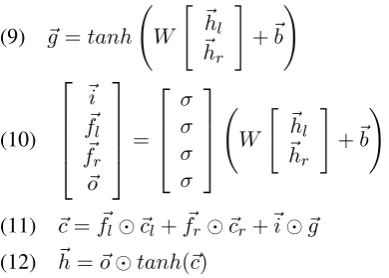
The cell state is calculated in three steps: (i) Compute a new candidate ~g from ~hl and ~hr.
TreeLSTM selects which values to take from the new candidate ~g by passing it through an input gate~i. (ii) Choose which values to forget from the cell states of the child nodes,~cl and~cr. For each
child node, an element-wise product () between its cell state and the forget gate (eitherf~l andf~r,
depending on the child node) is calculated. (iii) Lastly, sum up the results from (i) and (ii).
(9) ~g=tanh W
"
~hl
~hr
#
+~b
!
(10)
~i ~ fl
~ fr
~ o
=
σ σ σ σ
W
"
~hl
~hr
#
+~b
!
(11) ~c=f~l~cl+f~r~cr+~i~g
(12) ~h=~otanh(~c)
TreeLSTM achieves the state-of-the-art perfor-mance among the tree-structured models in var-ious tasks, including natural language inference and sentiment classification. However, there are non-tree-structured models on the market that
outperform TreeLSTM. Our goal is to design a stronger composition function that enhances the performance of tree-structured models. We de-velop a composition function that captures the multiplicative interaction between distributed rep-resentations. At the same time, we improve on the predecessors in terms of scalability, making the model more suitable for larger datasets.
To recapitulate, TreeRNN and TreeLSTM re-flect the principle of compositionality but cannot capture the multiplicative interaction between two expressions. In contrast, CMS incorporates mul-tiplicative interaction but violates the principle of compositionality. MV-RNN is compositional and also captures the multiplicative interaction, but it requires a learned d× d matrix for each vo-cabulary item. RNTN is also compositional and incorporates multiplicative interaction, but it re-quires less parameters than MV-RNN. Neverthe-less, it requires significantly more parameters than TreeRNN or TreeLSTM. Table1is an overview of the discussed models.
Other interesting works enrich semantic com-position with additional context such as grammat-ical roles or function/argumenthood (Clark et al.,
2008; Erk and Pad´o, 2008; Grefenstette et al.,
2014;Asher et al.,2016;Weir et al.,2016).
3 The Lifted Matrix-Space model
3.1 Base model
We present the Lifted Matrix-Space model (LMS) which renders semantic composition in a novel way. Our model consists of three subparts: the LIFT layer, the composition layer, and the TreeL-STM wrapper. The LIFT layer takes a word em-bedding vector and outputs a corresponding√d× √
dmatrix (eq.13).
where ~c ∈ Rdemb×1, B
LIFT ∈ R
√
d×√d, and
WLIFT ∈ R
√
d×√d×demb. The resultingH matrix
serves as an input for the composition layer. Given the matrix representations of two child nodes,HlandHr, the composition layer first takes
Hl and returns a hidden stateHinner ∈ R √
d×√d
(eq.14). SinceHinneris also a matrix, it can
func-tion as the weight matrix forHr. The composition
layer multipliesHinner withHr, adds a bias, and
feeds the result into a non-linear activation func-tion (eq. 15). This yields Hcand ∈ R
√ d×√d,
which for the base model is the output of semantic composition.
(14) Hinner =tanh(WCOMBHl+BCOMB1)
(15) Hcand =tanh(HinnerHr+BCOMB2)
As in CMS, the primary mode of semantic com-position is matrix multiplication. However, LMS improves on CMS in that it avoids associativity. LMS differs from MV-RNN in that it does not learn a d× d matrix for each vocabulary item. Compared to RNTN, LMS transmits a larger num-ber of activations across layers, given the same parameter count. In both models, the size of the third-order tensor is the dominant factor in deter-mining the number of model parameters. The pa-rameter count of LMS is approximately propor-tional to the number of activations (d), but the pa-rameter count of RNTN is approximately propor-tional to the cube of the number of activations (d3). Therefore, LMS can transmit the same number of activations with fewer model parameters.
3.2 LMS augmented with LSTM components
We augment the base model with LSTM compo-nents (LMS-LSTM) to circumvent the problem of long-term dependencies. As in the case of TreeL-STM, we additionally manage cell states (~cl,~cr).
Since the LSTM components operate on vectors, we reshapeHcand,Hl, andHrintod×1column
vectors respectively, and produce ~g, ~hl, and~hr.
The output of the LSTM components are calcu-lated based on these vectors, and is reshaped back to a√d×√dmatrix (eq.22).
(16) ~g=VECTORIZE(Hcand)
(17) ~hl=VECTORIZE(Hl)
(18) ~hr=VECTORIZE(Hr)
(19)
~i ~ fl
~ fr
~o
=
σ σ σ σ
W
"
~hl
~hr
#
+B
!
(20) ~c=f~l~cl+f~r~cr+~i~g
(21) ~h=~otanh(~c)
(22) H=TO-MATRIX(~h)
3.3 Simplified variants
We implement two LMS-LSTM variants with a simpler composition function as an ablation study. The first variant replaces the equations in (14) and (15) with a single equation (eq. 23), which does not utilize a weight matrix. It simply mul-tiplies the matrix representations of two child nodes Hl, Hr ∈ R
√
d×√d, adds a bias B
COMB ∈
R √
d×√d, and feeds the result into a non-linear
ac-tivation function.
(23) Hcand =tanh(HlHr+BCOMB)
The second variant is more complex than the first, in a way that a weight matrix WCOMB ∈
R √
d×√d is added to the equation (eq. 24). But
unlike the full LMS-LSTM which has two tanh
layers, it only utilizes one.
(24) Hcand =tanh(WCOMBHlHr+BCOMB)
4 Experiments
4.1 Implementation details
As our interest is in the performance of compo-sition functions, we compare LMS-LSTM with TreeLSTM, the previous best known composition function for tree-structured models. To allow for efficient batching, we use the SPINN-PI-NT ap-proach (Bowman et al.,2016), which implements standard TreeLSTM using stack and buffer data structures borrowed from parsing, rather than tree structures. We implement our model by replacing SPINN-PI-NT’s composition function with ours and adding theLIFTlayer.
(25) ~xclassif ier=
~hpremise
~hhypothesis
~hpremise−~hhypothesis
~hpremise~hhypothesis
The feature vector is fed into an MLP that con-sists of two ReLU neural network layers and a softmax layer. In both models, the objective func-tion is a sum of a cross-entropy loss funcfunc-tion and an L2 regularization term. Both models use the Adam optimizer (Kingma and Ba,2014). Dropout (Srivastava et al.,2014) is applied to the classifier and to the word embeddings. The MLP layer also utilizes Layer Normalization (Ba et al.,2016).1
4.2 Datasets
We first train and test our models on the Stan-ford Natural Language Inference corpus (SNLI;
Bowman et al.,2015). The SNLI corpus contains 570,152 pairs of natural language sentences that are labeled forentailment,contradiction, and neu-tral. It consists of sentences that were written and validated by humans. Along with the MultiNLI corpus introduced below, it is two orders of mag-nitude larger than other human-authored resources for NLI tasks. The following example illustrates the general format of the corpus.
(26) PREMISE: A soccer game with multiple males playing.
HYPOTHESIS: Some men are playing a sport.
LABEL: Entailment
We test our models on theMulti-Genre Natural Language Inference corpus (MultiNLI;Williams et al., 2017). The corpus consists of 433k pairs of examples, and each pair is labeled for entail-ment, contradiction, and neutral. MultiNLI has the same format as SNLI, so it is possible to train on both datasets at the same time (as we do when testing on MultiNLI). Two notable features distin-guish MultiNLI from SNLI: (i) It is collected from ten distinct genres of spoken and written English. This makes the dataset more representative of hu-man language use. (ii) The examples in MultiNLI are considerably longer than the ones in SNLI. These two features make MultiNLI classification fairly more difficult than SNLI. The pair of sen-tences in (27) is an illustrative example. The
sen-1The source code and the checkpoints for the mod-els trained for the NLI tasks are available at https:// github.com/nyu-mll/spinn.
tences are from the section of the corpus that is transcribed verbatim from telephone speech.
(27) GENRE:Telephone speech
PREMISE: Yes now you know if if every-body like in August when everyevery-body’s on vacation or something we can dress a little more casual or
HYPOTHESIS: August is a black out month for vacations in the company.
LABEL: Contradiction
The MultiNLI training set consists of five dif-ferent genres of spoken and written English, the
matchedtest set contains sentence pairs from only those five genres, and themismatchedtest set con-tains sentence pairs from additional genres.
We also experiment on the Stanford Sentiment Treebank (SST;Socher et al.,2013), which is con-structed by extracting movie review excerpts writ-ten in English from rottentomatoes.com, and labeling them with Amazon Mechanical Turk. Each example in SST is paired with a parse tree, and each node of the tree is tagged with a fine-grained sentiment label (5 classes).
5 Results and Analysis
Table 2 summarizes the results on SNLI and MultiNLI classification. We use the same prepro-cessing steps for all results we report, including loading the parse trees supplied with the datasets. Dropout rate, size of activations, number and size of MLP layers, and L2 regularization term are tuned using repeated random search. MV-RNN and RNTN introduced in the earlier sections are extremely expensive in terms of computational re-sources, and training the models with comparative hyperparameter settings quickly runs out of mem-ory on a high-end GPU. We do not include them in the comparison for this reason. TreeLSTM per-forms the best with one MLP layer, while LMS-LSTM displays the best performance with two MLP layers. The difference in parameter count is largely affected by this choice, and in principle one model does not demand notably more compu-tational resources than the other.
Model Params. S tr. S te. M tr. M te. mat. M te. mism.
Baselines
CBOW (Williams et al.,2017) – – 80.6 – 65.2 64.6 BiLSTM (Williams et al.,2017) 2.8m – 81.5 – 67.5 67.1 Shortcut-Stacked BiLSTM (Nie and Bansal,2017) 34.7m – 86.1 – 74.6 73.6 DIIN (Gong et al.,2018) – – 88.0 – 78.8 77.8
Existing Tree-Structured Model Runs
300D TreeLSTM (Bowman et al.,2016) 3.4m 84.4 80.9 – – – 300D SPINN-PI (Bowman et al.,2016) 3.7m 89.2 83.2 – – –
Our Experiments
441D LMS (base) 2.0(+11.6m) 79.7 76.5 – – –
441D LMS-LSTM (simplified,−WCOMB,−tanh) 3.3(+11.6)m 90.5 84.1 – – – 324D LMS-LSTM (simplified,−tanh) 2.2(+11.6)m 92.5 84.5 – – –
700D TreeLSTM 2.0(+11.6)m 89.5 83.6 – – –
[image:7.595.75.524.66.278.2]576D LMS-LSTM (full) 4.6(+11.6)m 86.0 84.9 – – – 700D TreeLSTM 4.6(+30.2)m – – 78.9 70.0 69.7 576D LMS-LSTM (full) 5.9(+30.2)m – – 80.5 71.3 71.6
Table 2: Results on NLI classification with sentence-to-vector encoders. Params. is the approximate number of model parameters, and the numbers in parentheses indicate the parameters contributed by word embeddings.S tr., andS te. are the class accuracies (%) on SNLI train set and test set, respectively. M tr.,M te. mat., andM te. mism. are the class accuracies (%) on MultiNLI train set, matched test set, and mismatched test set, respectively. Underlining marks the best result among tree-structured models.
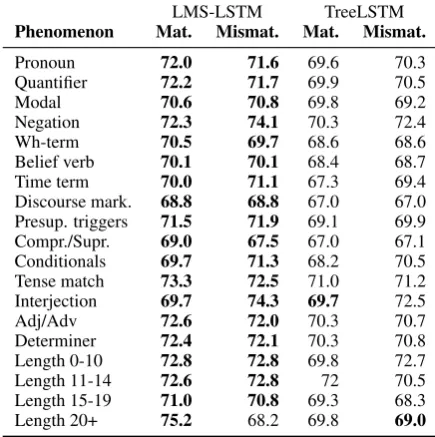
We cite the state-of-the-art results of non-tree-structured models, although these models are only relevant for our absolute performance numbers. The Shortcut-Stacked sentence encoder achieves the state-of-the-art result among non-attention-based models, outperforming LMS-LSTM. While this paper focuses on the design of the composi-tion funccomposi-tion, we expect that adding depth along the lines ofIrsoy and Cardie (2014) and shortcut connections to LMS-LSTM would offer compa-rable results. Gong et al.’s (2018) attention-based Densely Interactive Inference Network (DIIN) dis-plays the state-of-the-art performance among all models. Applying various attention mechanisms to tree-structured models is left for future research. We inspect the performance of the models on certain subsets of the MultiNLI corpus that mani-fest linguistically difficult phenomena, which was categorized byWilliams et al. (2017). The phe-nomena include pronouns, quantifiers (e.g.,every,
each, some), modals (e.g., must, can), negation, wh-terms (e.g.,who,where), belief verbs (e.g., be-lieve, think), time terms (e.g., then, today), dis-course markers (e.g., but, thus), presupposition triggers (e.g., again, too), and so on. In linguis-tic semanlinguis-tics, these phenomena are known to in-volve complex interactions that are more intricate than a simple merger of concepts. For instance, modals express possibilities or necessities that are
LMS-LSTM TreeLSTM Phenomenon Mat. Mismat. Mat. Mismat.
Pronoun 72.0 71.6 69.6 70.3 Quantifier 72.2 71.7 69.9 70.5 Modal 70.6 70.8 69.8 69.2 Negation 72.3 74.1 70.3 72.4 Wh-term 70.5 69.7 68.6 68.6 Belief verb 70.1 70.1 68.4 68.7 Time term 70.0 71.1 67.3 69.4 Discourse mark. 68.8 68.8 67.0 67.0 Presup. triggers 71.5 71.9 69.1 69.9 Compr./Supr. 69.0 67.5 67.0 67.1 Conditionals 69.7 71.3 68.2 70.5 Tense match 73.3 72.5 71.0 71.2 Interjection 69.7 74.3 69.7 72.5 Adj/Adv 72.6 72.0 70.3 70.7 Determiner 72.4 72.1 70.3 70.8 Length 0-10 72.8 72.8 69.8 72.7 Length 11-14 72.6 72.8 72 70.5 Length 15-19 71.0 70.8 69.3 68.3 Length 20+ 75.2 68.2 69.8 69.0
Table 3: MultiNLI development set classification ac-curacies (%), classified using the tags introduced in Williams et al.(2017).
[image:7.595.306.524.372.591.2]Model Test
Baselines
MV-RNN (Socher et al.,2013) 44.4 RNTN (Socher et al.,2013) 45.7 Deep RNN (Irsoy and Cardie,2014) 49.8 TreeLSTM (Tai et al.,2015) 51.0 TreeBiGRU w/ attention 52.4 (Kokkinos and Potamianos,2017)
Our Experiments
[image:8.595.337.497.63.174.2]312D TreeLSTM 48.9 144D LMS-LSTM 50.1
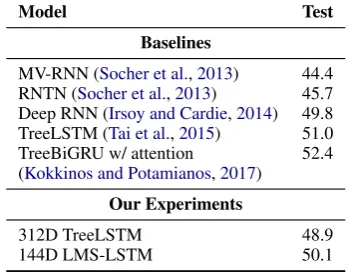
Table 4: Five-way test set classification accuracies (%) on the Stanford Sentiment Treebank.
categorize the data to make fair comparisons. In addition to the categories offered byWilliams et al. (2017), we inspect whether sentences con-taining adjectives/adverbs affect the performance of the models.Baroni and Zamparelli(2010) show that adjectives are better represented as matrices, as opposed to vectors. We also inspect whether the presence of a determiner in the hypothesis that refers back to a salient referent in the premise affects the model performance. Determiners are known to encode intricate properties in linguistic semantics and have been one of the major research topics (Elbourne, 2005; Charlow, 2014). Lastly, we examine whether the performance of the mod-els varies with respect to sentence length, as longer sentences are harder to comprehend.
Table 3 summarizes the result of the inspec-tion on linguistically difficult phenomena. We see gains uniformly across the board, but with particu-larly clear gains on negation (+2% on the matched set/+1.7% on the mismatched set), quanti-fiers (+2.3%/+1.2%), time terms (+2.7%/+1.7%), tense matches (+2.3%/+1.3%), adjectives/adverbs (+2.3%/+1.3%), and longer sentences (length 15-19: +1.7%/+2.5%; length 20+: +5.4%/-0.8%).
Table 4 summarizes the results on SST classi-fication, particularly on the fine-grained task with 5 classes. While our implementation does not ex-actly reproduce Tai et al.’s (2015) TreeLSTM re-sults, a comparison between our trained TreeL-STM and LMS-LTreeL-STM is consistent with the pat-terns seen in NLI tasks.
We examine how well the constituent represen-tations produced by LMS-LSTM and TreeLSTM encode syntactic category information. As men-tioned earlier, there is a consensus in linguistic se-mantics that semantic composition involves
func-Category # of samples Ratio (%)
NP 63346 43.31
VP 30534 20.08
PP 25624 17.98
ROOT 18267 12.49
S 4863 3.06
SBAR 2004 1.20
ADVP 1136 0.27
ADJP 408 0.13
[image:8.595.93.270.65.201.2]Etc. 160 1.45
Table 5: Syntactic category distribution of SNLI de-velopment set, classified using the tags introduced in Bowman et al.(2015).
tion application (i.e., feeding an argument to a function) which goes beyond a simple merger of two concepts. Given that the syntactic category of a node determines whether the node serves as a function or an argument in semantic composi-tion, we hypothesize that the distributed represen-tation of each node would encode syntactic cat-egory information if the models learned how to do function application. To assess the quality of the representations, we first split the SNLI devel-opment set into training and test sets. From the training set, we extract the hidden state of every constituent (i.e., phrase) produced by the best per-forming models. For each of the models, we train linear classifiers that learn to do the following two tasks: (i) 3-way classification, which trains and tests exclusively on noun phrases, verb phrases, and prepositional phrases, and (ii) 19-way classi-fication, which trains and tests on all 19 category labels attested in the SNLI development set. The distribution of the 19 category labels is provided in Table 5. We opt for a linear classifier to keep the classification process simple, so that we can properly assess the quality of the constituent rep-resentations.
[image:8.595.338.496.65.174.2]3-way 19-way Model Train Test Train Test
[image:9.595.332.506.63.405.2]300D BOW 86.4 85.6 82.7 82.1 700D TreeLSTM 93.2 91.2 90.0 86.6 576D LMS-LSTM 97.3 96.3 94.0 92.1
Table 6: Syntactic category classification accuracies (%) on SNLI development set, classified using the tags introduced inBowman et al.(2015).
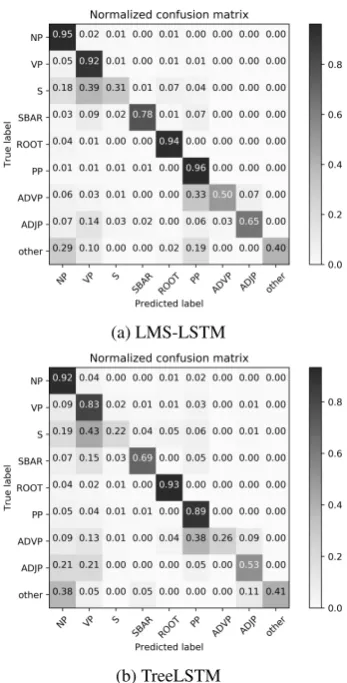
Figure 2 depicts the corresponding confusion matrices for the 19-way classification task. We show the most frequent eight classes due to space limitations. We observe notable gains on adver-bial phrases (ADVP; +24%), adjectival phrases (ADJP; +12%), verb phrases (VP; +9%), and clauses introduced by subordinate conjunction (SBAR; +9%). We also observe a considerable gain on non-terminal declarative clauses (S; +9%), although the absolute number is fairly low com-pared to other categories. While we do not have a full comprehension of the drop in classification accuracy, we speculate that the ambiguity of in-finitival clauses and gerund phrases is one of the culprits. As exemplified in (28) and (29) respec-tively, infinitival clauses and gerund phrases are not only labeled as a VP but also as an S in the SNLI dataset. Given that our experiment is set up in a way that each constituent is assigned exactly one category label, a good number of infinitival clauses and gerund phrases that are labeled as an S could have been classified as a VP, resulting in a drop in classification accuracy. On the other hand, VP constituents are less affected by the ambiguity because the majority of them are neither an infini-tival clause nor a gerund phrase, as shown in (30).
(28) A dog carries a snowball [S[VPto give it to his owner ]]
(29) Two women are embracing while [S [VP holding to-go packages after just eating lunch ]]
(30) A few people [VPare [VPcatching fish ]]
With the exclusion of non-terminal declarative clauses, the categories we see notable gains are known to play the role of a function in semantic composition. On the other hand, both models are efficient in identifying noun phrases (NP), which are typically arguments of a function in semantic composition. We speculate that the results are in-dicative of LMS-LSTM’s ability to identify
func-(a) LMS-LSTM
(b) TreeLSTM
Figure 2: Confusion matrices of LMS-LSTM and TreeLSTM for 19-way linear classification.
tions and arguments, and this hints that the model is learning to do function application.
6 Conclusion
In this paper, we propose a novel model for se-mantic composition that utilizes matrix multiplica-tion. Experimental results indicate that, while our model does not reach the state of the art on any of the three datasets under study, it does substantially outperform all known tree-structured models, and lays a strong foundation for future work on tree-structured compositionality in artificial neural net-works.
Acknowledgments
[image:9.595.81.283.64.123.2]References
Nicholas Asher, Tim Van de Cruys, Antoine Bride, and M´arta Abrus´an. 2016. Integrating type the-ory and distributional semantics: a case study on adjective–noun compositions. Computational Lin-guistics, 42(4):703–725.
Jimmy Lei Ba, Jamie Ryan Kiros, and Geoffrey E. Hin-ton. 2016. Layer Normalization. arXiv:1607.06450.
Chris Barker and Chung-chieh Shan. 2014. Continu-ations and natural language, volume 53. Oxford studies in theoretical linguistics.
Marco Baroni and Roberto Zamparelli. 2010. Nouns are vectors, adjectives are matrices: Represent-ing adjective-noun constructions in semantic space. In Proceedings of the 2010 Conference on Em-pirical Methods in Natural Language Processing (EMNLP), pages 1183–1193.
Samuel R. Bowman, Gabor Angeli, Christopher Potts, and Christopher D. Manning. 2015. A large an-notated corpus for learning natural language infer-ence. In Proceedings of the 2015 Conference on Empirical Methods in Natural Language Processing (EMNLP).
Samuel R. Bowman, Jon Gauthier, Abhinav Ras-togi, Raghav Gupta, Christopher D. Manning, and Christopher Potts. 2016. A fast unified model for parsing and sentence understanding. InProceedings of the 54th Annual Meeting of the Association for Computational Linguistics.
Simon Charlow. 2014. On the semantics of exceptional scope. Ph.D. thesis, New York University.
Danqi Chen, Richard Socher, Christopher D. Manning, and Andrew Y. Ng. 2013. Learning new facts from knowledge bases with neural tensor networks and semantic word vectors. InProceedings of workshop at ICLR, pages 1–4.
Gennaro Chierchia and Sally McConnell-Ginet. 1990.
Meaning and grammar: An introduction to seman-tics. MIT Press, Cambridge, MA.
Stephen Clark, Bob Coecke, and Mehrnoosh Sadrzadeh. 2008. A compositional distribu-tional model of meaning. In Proceedings of the Second Quantum Interaction Symposium (QI-2008), pages 133–140.
David Dowty. 2007. Compositionality as an empirical problem. InDirect Compositionality. Oxford Uni-versity Press.
Paul D. Elbourne. 2005. Situations and individuals, volume 90. Mit Press Cambridge, MA.
Katrin Erk and Sebastian Pad´o. 2008. A structured vec-tor space model for word meaning in context. In
Proceedings of the Conference on Empirical Meth-ods in Natural Language Processing (EMNLP), pages 897–906.
Yichen Gong, Heng Luo, and Jian Zhang. 2018. Natu-ral language inference over interaction space. ICLR 2018.
Edward Grefenstette, Mehrnoosh Sadrzadeh, Stephen Clark, Bob Coecke, and Stephen Pulman. 2014. Concrete sentence spaces for compositional distri-butional models of meaning. InComputing mean-ing, pages 71–86. Springer.
Irene Heim and Angelika Kratzer. 1998. Semantics in Generative Grammar. Blackwell Publishers.
Gustav Herdan. 1960. Type-token mathematics. Mou-ton.
Sepp Hochreiter, Yoshua Bengio, Paolo Frasconi, and J¨urgen Schmidhuber. 2001. Gradient flow in recur-rent nets: the difficulty of learning long-term depen-dencies.A Field Guide to Dynamical Recurrent Net-works, pages 237–243.
Sepp Hochreiter and J¨urgen Schmidhuber. 1997. Long short-term memory. Neural Computation, 9(8):1– 32.
Ozan Irsoy and Claire Cardie. 2014. Deep recursive neural networks for compositionality in language. In Proceedings of Advances in Neural Information Processing Systems, pages 2096–2104.
Diederik Kingma and Jimmy Ba. 2014. Adam: A Method for Stochastic Optimization. The Inter-national Conference on Learning Representations, pages 1–13.
Filippos Kokkinos and Alexandros Potamianos. 2017. Structural Attention Neural Networks for improved sentiment analysis.arXiv:1701.01811.
Phong Le and Willem Zuidema. 2015. Composi-tional DistribuComposi-tional Semantics with Long Short Term Memory. arXiv:1503.02510.
Bill MacCartney. 2009. Natural language inference. Ph.D. thesis, Stanford University.
Jeff Mitchell and Mirella Lapata. 2010. Composition in distributional models of semantics. Cognitive Sci-ence, 34(8):1388–1429.
Yixin Nie and Mohit Bansal. 2017. Shortcut-stacked sentence encoders for multi-domain inference. In
Proceedings of the 2nd Workshop on Evaluating Vector Space Representations for NLP, pages 41–45.
Jeffrey Pennington, Richard Socher, and Christo-pher D. Manning. 2014. Glove: Global vectors for word representation. In Proceedings of the 2014 Conference on Empirical Methods in Natural Lan-guage Processing (EMNLP), pages 1532–1543.
Sebastian Rudolph and Eugenie Giesbrecht. 2010. Compositional matrix-space models of language. In
Richard Socher, Brody Huval, Christopher D. Man-ning, and Andrew Y. Ng. 2012. Semantic composi-tionality through recursive matrix-vector spaces. In
Proceedings of the 2012 joint conference on Empir-ical Methods in Natural Language Processing and Computational Natural Language Learning, pages 1201–1211.
Richard Socher, Cliff C. Lin, Christopher D. Manning, and Andrew Y. Ng. 2011. Parsing natural scenes and natural language with recursive neural networks. In
Proceedings of the 28th international conference on machine learning (ICML), pages 129–136.
Richard Socher, Christopher D. Manning, and An-drew Y. Ng. 2010. Learning continuous phrase representations and syntactic parsing with recursive neural networks. Proceedings of the NIPS-2010 Deep Learning and Unsupervised Feature Learning Workshop, pages 1–9.
Richard Socher, Alex Perelygin, Jean Wu, Jason Chuang, Christopher D. Manning, Andrew Y. Ng, and Christopher Potts. 2013. Recursive Deep Mod-els for Semantic Compositionality over a Sentiment treebank. InProceedings of the 2013 Conference on Empirical Methods in Natural Language Processing (EMNLP), pages 1631–1642.
Nitish Srivastava, Geoffrey E. Hinton, Alex Krizhevsky, Ilya Sutskever, and Ruslan Salakhutdi-nov. 2014. Dropout: a simple way to prevent neural networks from overfitting. Journal of Machine Learning Research, 15(1):1929–1958.
Kai Sheng Tai, Richard Socher, and Christopher D. Manning. 2015. Improved semantic representations from tree-structured long short-term memory net-works. InProceedings of ACL, pages 1556–1566.
David Weir, Julie Weeds, Jeremy Reffin, and Thomas Kober. 2016. Aligning packed dependency trees: a theory of composition for distributional semantics.
Computational Linguistics, 42(4):727–761.
Adina Williams, Nikita Nangia, and Samuel R. Bow-man. 2017. A Broad-Coverage Challenge Cor-pus for Sentence Understanding through Inference.
arXiv:1704.05426.
Fabio Massimo Zanzotto, Ioannis Korkontzelos, Francesca Fallucchi, and Suresh Manandhar. 2010. Estimating linear models for compositional distribu-tional semantics. InProceedings of the 23rd Inter-national Conference on Computational Linguistics, pages 1263–1271.