[ 2 2 ]
A FURTHER STUDY OF THE REACTIONS OF FISH
TO TOXIC SOLUTIONS
BY J. R. ERICHSEN JONES
Department of Zoology, University College of Wales, Aberystzvyth
(Received 17 July 1947)
(With Nine Text-figures)
INTRODUCTION
In a previous publication (Jones, 19476) the writer has reviewed the work of Shelford & Allee (1913), Wells (1913, 1915a, b) and Shelford (1917, 1918), who studied the reactions of fish to toxic solutions with the 'gradient tank'. A modified type of apparatus was described in which the fish are confined in a horizontal glass tube, half of which may be filled with flowing tap water, the other half with flowing solution; water and solution are so sharply differentiated that in their movements up and down the tube the fish are presented with a definite concentration step, not a gradient. The reactions of the fish can be checked by reversing the directions of flow. Under these conditions Pygosteus pungitius reacts negatively to solutions of ethyl alcohol, chloroform, formalin, mercuric chloride and zinc sulphate, but appears to have no power of recognizing a copper sulphate solution. Into this the fish swims, to be stupefied and eventually killed.
The present paper describes further experiments on the same lines. When the work was resumed it was the writer's intention to continue using Pygosteus as test animal, but no further supply of this material could be obtained. Fortunately an adequate supply of Gasterostetis aculeatus was available and work was therefore carried on with this species. Some results have also been obtained with minnows (Phoxinus phoxinus L.).
SULPHIDE SOLUTIONS
The reactions offish to toxic solutions 23
substance to goldfish were made by Ellis (1937, p. 416). The toxic action of hydrogen sulphide resembles that of hydrogen cyanide; some observations on its effect on respiration in Gasterosteus have been made by the writer (1947a). Shelford (1917, chart 3) records two experiments to test the reactions of fish (rock bass and minnow) to sulphide solutions, but both are inconclusive.
Experiments with sulphide solutions present some difficulty. Solutions of fLjS of predetermined concentration are not easy to prepare in quantity; concentrated solutions of sodium sulphide are relatively stable, but are highly alkaline and when diluted to the degree necessary are very unstable as rapid oxidation to water and sulphur takes place. This decomposition appears to be accelerated when the solution is brought to pH 7 by the addition of hydrochloric or sulphuric acid.
Tap-water supply
10
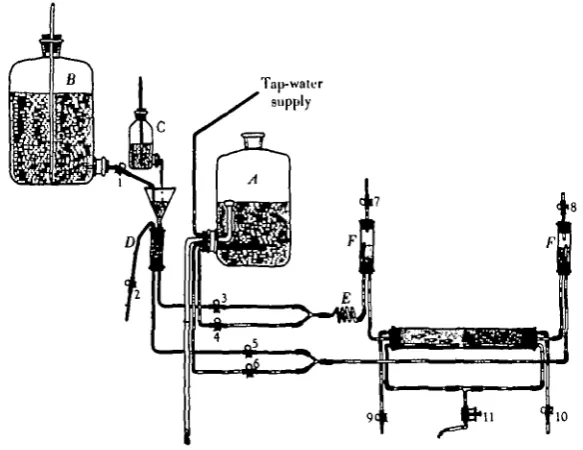
Fig. 1. Apparatus for experiments with sulphide solutions. A, 10 1. aspirator; B, 15 1. aspirator; C, 1000 ml. aspirator. 1-10, pinch clips; 11, screw clip. Bungs and rubber connexions black. Internal dimensions of tube in which fish are placed 580 x 30 mm. D, E, see text, p. 24. F, bubble traps.
[image:2.451.80.372.228.453.2]For satisfactory results it is necessary to employ an apparatus in which a dilute, neutral solution is automatically made up as it runs into the apparatus in which the fish are placed. The arrangement adopted in the present investigation is shown in Fig. i.
24 J. R. ERICHSEN JONES
one hundred times that required for experiment. This drips into the funnel at 2 ml./min.; here again the rate of flow is regulated by adjustment of the air intake tube, and a short length of fine capillary tubing makes a satisfactory delivery tube for the dripper. In the funnel water and sulphide solution mix; sufficient sulphuric acid is added to the water in B for the mixture to have a pH of 6-8. This is most easily accomplished by starting with neutral tap water in B, withdrawing a 500 ml. sample of solution through D, titrating this with N/IO sulphuric acid and bromo-thymol-blue, and thus estimating the amount of acid required to be added to the supply in B when this is refilled, but a certain amount of trial and error is generally necessary before the mixture is completely satisfactory. Finally, the concentration of the mixture is checked by withdrawing another 500 ml. sample and titrating this against standard iodine and starch. The diluted, neutralized solution appears to decompose so rapidly that the concentrations measured in this way are generally slightly below values calculated from the strength of the solution in the dripper and the degree of dilution. The values given in the results which follow are based on the iodine titrations.
When not required the solution can be run to waste through D. When solution is to run into the experiment tube clip 2 is closed, opening clip 3 delivers it to the left side, clip 5 to the right. The rate of discharge from the experiment tube is regulated by screw-clip 11 so that the solution level in the mixing funnel is main-tained at approximately the same height as the water supply level in A.
The part of the apparatus shown on the right resembles that used in the earlier investigation. Clips 9 and 10 are on delivery tubes which permit the expulsion of air when filling the apparatus and can also be used for drawing off samples of solution for checks of pH or concentration. The whole solution and water supply arrangement was fixed up on the experiment bench some distance from the tube in which the fish are placed, so that they are not disturbed by the operator's move-ments. The coil E is included to make the delivery tube to the left side equal in length to that leading to the right. The general method of experimentation and recording results followed closely that adopted in the earlier investigation. Before beginning an experiment the tap water is run for 1-2 hr. to ensure stability of temperature. The temperatures at which the experiments were conducted are recorded in the legends to the figures. It was found that provided this did not exceed 170 C. the movements of the fish are comparatively slow and deliberate. At 18-200 C , however, they tend to swim wildly up and down the tube and the results are very unsatisfactory.
The reactions of fish to toxic solutions
25
0-0003 N
20
35
0-00008 N
[image:4.451.51.405.91.331.2]0-00015 N
Fig. 2. The reactions of groups of five fish to 00007, 00003, 000015 and O-OOOO8N sodium sulphide solutions. Temperature of water and solution 140 C. pH of water and solution 6 8 . Fish, 28 mm.
Gasterosteus aculeatus L.
60
0-0003
Normality Na,S 0-001
[image:4.451.158.296.373.611.2]26 J. R. ERICHSEN JONES
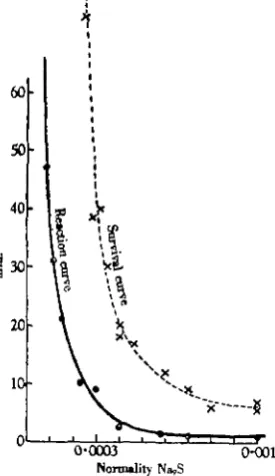
the water zone and will not voluntarily enter the solution, may be termed the ' reaction time'; in Fig. 3 the reaction times observed in all the sulphide experiments are plotted.
Below 0-0005 N the relation between reaction time and concentration is expressed fairly accurately by the equation log10 t = 2 — 4000c, where t is the reaction time in
minutes, c the concentration in normality. At higher concentrations theoretical values of t given by the equation are shorter than those observed, but in many of these experiments it was obvious that the 'reaction time' observed was really the time the fish took to find their way out of the solution zone, the unfavourable change in their environment being perceived in a much shorter time. Survival times for Gasterosteus are also given in Fig. 3, i.e. the times the fish survives when continually immersed in neutralized NaaS solutions. It will be noted that the reaction time is substantially shorter than the survival time over the whole concentration range tested.
It is well known that the human olfactory organs can detect hydrogen sulphide at great dilution. A 1/100,000 mixture is most unpleasant and Moncrieff (1944, p. 177) states that a io~7 mixture of air and H^S is detectable. No information appears to be available as to the capability of the human organs of smell and taste for detecting the gas in solution.
Inspection of the result for o-ooo 15 N (Fig. 2) shows that whereas the initial reaction time is 19-21 min. the response on reversing the water-solution flow at 25 min. is much more rapid (about 4 min.), and the third response at 30 min. more prompt still. A similar result is generally observed at any other concentration at which the primary response takes some measurable period of time, as the other recordings, in Fig. 2 indicate. This is not due to the fish becoming more familiar with the vessel in which they are confined, for keeping them in the apparatus for 7-8 hr. before the experiment is begun, during which period they explore their prison mo3t thoroughly, results in no shortening of the primary reaction time. It is possible that in their many journeys up and down the tube the fish gradually learn to distinguish between water and solution, for when the reaction time is several minutes some fish may cross the water-solution junction thirty or forty times; But it seems more probable tjiat the improved response displayed on reversing the flow results from a much more rapid development of the toxic symptoms which excite the response. Thus at the end of 25 min. (in the 0-00015 N experiment) the fish have all spent some considerable time in the solution, have developed some degree of toxaemia, and spent an insufficient time in the water zone for recovery. When the solution is now run in on the side on which they have congregated the toxic symptoms necessary to induce the negative response are developed much more rapidly, 'with an accompanying improvement in the speed of4 avoiding action.
The reactions of fish to toxic solutions
27LEAD NITRATE
Using Gasterosteus as test animal the effect of lead nitrate solutions was studied over the concentration range O-OOOOI-O-I N. The apparatus lay-out for these experi-ments resembles that adopted for sodium sulphide, but as lead nitrate is reasonably stable, even at great dilution, the dripper arrangement can be dispensed with and aspirator B filled with solution of the required concentration before beginning the experiment. With the air-intake tube in position this runs into the # funnel at
200 ml./min.; this was found a better arrangement than connecting B directly with the supply tubes leading to the bubble traps, for the level of solution in the funnel provides a convenient check on the rate at which water and solution flow through the observation vessel.
10
20
»—v PI)
40
• • •
: — « " ^
•• • • • "SIB
i'J
pi
Pb
- ^ 30
W
P?
20
[image:6.451.49.401.248.386.2]0-04 N 0 - 0 0 4 N 0-0004 N 0-00002 N
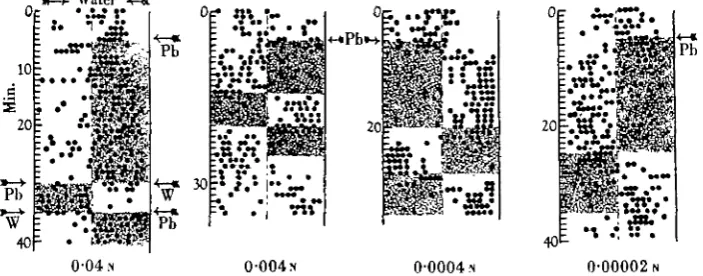
Fig. 4. The reactions of groups of five fish (Gasterosteus) to 004, 0004, 00004 and 0-00002 N, lead nitrate. Temp. 14° C. pH of solutions 54, 5-8, 6-4, 6-8. Survival times 3 hr., 4 hr., s i hr., 16 hr.
Four typical results are given in Fig. 4. At O-IN the experiment was not satisfactory, owing to stratification of the heavy solution, but it was evident that the fish reacted positively. At O-O4N a better separation of water and solution was achieved; at this concentration the fish react negatively at first (note their temporary retreat at 6-7 min.), then they persist in swimming into the solution, and sooner or later are seen to be deliberately avoiding the water. When the directions of flow are reversed they select the lead nitrate zone almost immediately. Shelford (1917) noted many instances of fish reacting positively to toxic substances; this he attributed to the fish failing to recognize the solution, swimming into it and becoming 'intoxicated'.
28 J. R. E R I C H S E N J O N E S
test this theory. Five fish were placed in the observation vessel and their reaction to 0-0007 N ^ d nitrate tested in the usual way; the result, a prompt negative response. Then after 5 min. of double water flow 0-04 N lead nitrate was run in at both ends for 15 min. This was washed out with water and then 0-0007N lead nitrate was run in on one side. Though the fish showed obvious distress after their 15 min. exposure to the more concentrated solution, they reacted to the dilute solution negatively, and quite as promptly as before.
Next the reaction of Gasterosteus to calcium nitrate was examined. To dilute solutions (e.g. O-OOIN) the fish appear quite indifferent, but to O-O4N Ca(NO3)2
a positive reaction is displayed. A similar result is observed with 0-03-0-05 N sodium nitrate or 0-03-0-07N sodium chloride. These results suggested that the osmotic pressure of the O-O4N lead nitrate might be its attractive feature and the
0-0007 Pb 10
0-OiiOTPIi
Fig. s- a, the reaction of Gatterotteui to o-ooo7N lead nitrate before and after 15 min. exposure to O-04N lead nitrate, b, the reaction of Gasterosteus to water of pH 5-4. c, the reaction of Gasterosteus to O-O4N calcium nitrate, pH 6-2.
reaction of Gasterosteus to glucose solutions of similar osmotic pressure was tested. Here, however, the reaction of the fish was negative; they preferred the water and if they ventured into the glucose appeared irritated, swimming in an erratic and nervous manner. It has to be admitted that at the present stage a satisfactory explanation of the positive reaction of the stickleback to concentrated lead nitrate is not forthcoming; in a subsequent section of this paper it will be shown that Gasterosteus is positive to dilute ammonia solutions.
The reactions of fish to toxic solutions 29
16 hr.) a delayed, but nevertheless definite negative reaction is displayed. The movements of the fish are leisurely and in their visits to the solution zone they display little irritation. On reversing the water-solution flow (at 25 min.) they again have some difficulty in selecting the water zone and some fish swim up and down the tube ten or more times before making up their minds. One experiment was run at 0*00001 N; in this a vague negative reaction developed in about 30 min.
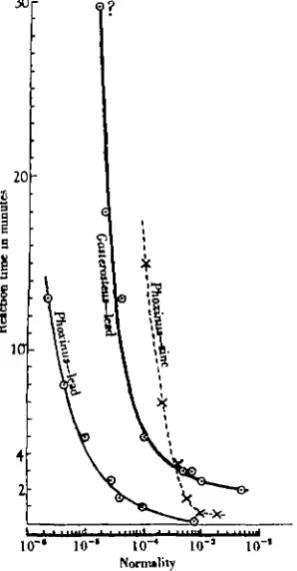
In Fig. 6 the reaction time-concentratiort curve is plotted together with some reaction times observed with zinc sulphate and with lead nitrate when the minnow
30r
20
.3
1
10
-X-10" 10"4 10"
Normality
[image:8.451.150.299.197.483.2]10"
Fig. 6. Reaction times for Phoxinus (lead nitrate and zinc sulphate), and for Gasterosteui (lead nitrate). Temp. 140 C.
30 J. R . E R I C H S E N JONES
It is possible that the minnow can detect, but is not irritated by, lead nitrate solutions of greater dilution than 0-000004 N, but even if this represents the threshold it is remarkably low. Moncrieff (1944, p. i n ) supplies some information on the sensitivity of the human sense of taste to heavy metal salts, stating that silver nitrate is just detectable in 0-003% solution. This would be about O-OOOI8N, or iomg./Ag/l.
V
I
15
»-+ Water +-«
SBBjaEj—^^-SgHEBsfi •_.
^ ^ 7
w
0
10
20
• *-"4BS
"''JJi_ jiff
i
Pb
0-0001 N 0-00003 N 0-0000 IN
Fig. 7. The reactions of single fish (Phoxinus) to o-oooi, 0-00003 and 000001N lead nitrate. pH of all solutions 6-8. Temp. 16° C.
WATER OF ABNORMAL HYDROGEN-ION CONCENTRATION
It is well known that the hydrogen-ion concentration of the water is one of the most important factors determining the type of fauna found in any aquatic environment and observations in field and laboratory on the pH ranges different animals can withstand are in plentiful supply. Using the goldfish as test animal Ellis (1937, p/409) has studied the lethality of eleven acids, and (1937, p. 379) reviews the results of a number of workers which seem to show that fresh-water fish have a considerable tolerance for variations in hydrogen-ion concentration. On the other hand, little study appears to have been made of the motor reactions of fish to water of abnormal acidity or alkalinity. Wells (1915 a) made some attempt at the problem, but his results are somewhat vague; using the gradient tank and three different species of fish he decided that fish are negative to neutrality in favour of slight acidity. According to Shelford (1929, p. 480, footnote) Wells took neutrality as the 'turning point' of phenolphthalein, presumably about 9-0.
The reactions of fish to toxic solutions 31
or sodium hydroxide solution dripping steadily from C. Samples of the mixture are withdrawn at D, their pH determined, and the concentration of the supply in C and its rate of flow adjusted until the mixture has the pH required. This is finally checked by the examination of samples drawn at 9 or 10.
Colorimetric estimation was found quite satisfactory for the acid range; for the alkaline range phenol-thymol-phthalein is satisfactory up to pH 10-4. Above this value no completely reliable indicator could be found, though alizarin S, methyl blue, nile blue and brilliant cresyl blue were tried, and pH determinations over the range 10-4-12-0 were therefore checked with a Cambridge hydrogen-ion apparatus.
One of the experiments with acid water is that recorded in Fig. 56, already referred to. All the other hydrogen ion experiments with Gasterosteus are sum-marized in Fig. 8. To water of acidity greater than pH 5-4 the stickleback is definitely
20
§10 a:
Negative Indifferent or positive [Negatm
PH
[image:10.451.77.373.261.470.2]10 11 12
Fig. 8. The reaction of Gasterosteus to acid and alkaline water. Five fish used for each reaction time determination. Temp. 140 C.
negative, avoiding it with the usual symptoms of discomfort. The writer (1939) has shown that the hydrogen ion threshold is about pH 5-0, which the stickleback survives for 9 days. Using nitric acid Carpenter (1927) obtained a similar result with Phoxinus.
J. R. ERICHSEN JONES
AMMONIA
The toxicity of ammonia solutions to fish has been studied by a number of investigators interested in pollution problems, including Ellis (1937), Shelford (1917), and Mason-Jones (1930). Grindley (1946) has measured the toxicity of ammonium chloride to rainbow trout, his experiments seem to place the threshold at 314 mg. NH4C1/1. (about 0-006 N). Shelford concluded that fish are unable to
recognize even highly toxic solutions of the gas, but the two experiments he records (1917, chart 2) are not very satisfactory for the fish were driven to the ammonia side of the gradient tank, nor does he state the actual concentration tested.
Four of the writer's results with Gasterosteus are given in Fig. 9. The apparatus arrangement used for lead nitrate was found satisfactory; the ammonia solutions were prepared by diluting a normal solution of ammonia standardized with N/IO HC1,
NH3
s m
0-04 N pH 10-6
0-OIN pH 10-4
0-001 N p H 9 8
0-0001 N pH8-8
Fig. 9. The reactions of groups of five fish {Gasterosteus) to 004, o'Oi, o-ooi and O-OOOIN ammonia. Survival times 2 min., 4^ min., 35 min., over 24 hr. Temp. 160 C. Open circles represent dead fish.
the concentrations of the solutions being checked by titrating 500 ml. samples at the end of the experiments, and the pH values given are those of samples drawn from the experiment tube.
To O-O4N ammonia the stickleback is promptly negative, a negative reaction is also developed towards a O-OIN solution, but somewhat tardily, though this con-centration is highly toxic (survival time 4^ min.). Two fish persisted in swimming into the solution with the result that they died suddenly with convulsive movements and widely distended mouths. With further dilution the negative response disappears and-is replaced by a most definite positive reaction; in the o-ooi N experiment note how the fish avoid the water and gather in the solution zone within 2 min. of the flow reversal at 12 min. At O-OOOIN the reaction is still positive.
The reactions of fish to toxic solutions 33
only conclude like Shelford that the toxic substance 'intoxicates' the fish in some way.
Furthermore, it will be noted that the general result with ammonia solutions is the converse of that observed with lead nitrate, to which Gasterosteus is positive at high concentrations, negative at great dilution. Hence, when the reaction of fish to any toxic substance is studied it is important to cover a wide concentration range, otherwise any conclusions based on the results may be inaccurate.
GENERAL OBSERVATIONS
Reviewing the whole of the writer's observations on the behaviour of fish to toxic solutions the following general observations may be made. The reaction observed may be of three types: (1) Positive, the fish being attracted by the toxic substance itself (ammonia), possibly by some other property of the solution, such as its osmotic pressure (concentrated lead nitrate). (2) A complete failure to distinguish between the solution and water, with a pseudo-positive reaction when the substance in question is highly toxic (copper sulphate). (3) A negative reaction, the promptness of which depends on the concentration of the-solution, and which may be maintained down to the threshold of toxicity (sulphide). Fish may be positive to a substance in high concentration, negative to the same substance in dilute solution, and vice versa.
Even when substances whose physiological effects are similar are considered the fishes' capability of detecting and rejecting them is not related to their degree of toxicity. The four heavy metal salts tested, in decreasing toxicity form the order mercuric chloride, copper sulphate, lead nitrate, zinc sulphate. According to the stickleback's ability to detect and avoid their presence the order is lead, mercury, zinc, copper.
Lastly it is evident that the sensitivity of one fish to a particular substance may differ considerably from that of another, for the minnow is some ten times as sensitive to lead nitrate as the stickleback.
SUMMARY
This paper records some further observations on the reactions of fish to toxic solutions. The method of experimentation resembles that described in a previous paper by the writer (Jones, 1947 b). In every case the solution is presented as an alternative to the Aberystwyth tap water, which is well aerated, very soft, of pH 6-8. In experiments with sodium sulphide a supply system is arranged in which dilute sodium sulphide solution, brought to pH 6-8 by the addition of sulphuric acid, is automatically made up as it runs into the observation vessel. Gasterosteus aculeatus L. reacts negatively to a O-OOIN solution almost immediately; at greater dilution the 'reaction time' lengthens, at O-OOOO8N is about 47 min. Over the concentration range tested the reaction time is always shorter than the survival time. Gasterosteus is positive to C-04N lead nitrate. As a positive reaction is also dis-played to equivalent concentrations of calcium nitrate, sodium nitrate and sodium chloride it is possible that the osmotic pressure of the solution is its attractive feature.
34 J. R. ERICHSEN JONES
At o-oi N the positive response to lead nitrate disappears and at O-OO4N is replaced by a very definite negative reaction which is maintained down to 0-00002 N. The minnow (Phoxinus phoxinus L.) is also negative to dilute lead nitrate and will detect and avoid a 0-000004 N solution.
Gasterosteus will avoid water more acid than pH 5-6 or more alkaline than pH 11 -4. Over the range 5-8-11-2 the fis.h are indifferent or very vaguely positive.
Gasterosteus is negative to 0-04 and o-oiN ammonia solution, positive to 0001 and o-oooi N. The general result with ammonia is thus the converse of that observed with lead nitrate.
REFERENCES CARPENTER, K. E. (1927). Brit. J. Exp. Biol. 4, 378. ELLIS, M. M. (1937). Bull. U.S. Bur. Fith. 48, no. 22. GRINDLEY, J. (1946). Arm. Appl. Biol. 33, 103.
JACQUES, A. G. (1936). J. Gen. Phytiol. 19, 397. JONES, J. R. E. (1939). J. Exp. Biol. 16, 425. JONES, J. R. E. (i947a)- 7- Exp- Biol. 23, 298. JONES, J. R. E. (19476). J. Exp. Biol. 24, n o .
LONGWELL, J. & PENTELOW, F. T. K. (1935). J. Exp. Biol. ia, 1.
MASON-JONES, A. J. (1930). Detailed Biological and Chemical Reports on Tars used for Road-Surfacing.
Ministry of Transport and Ministry of Agriculture and Fisheries. London: H.M. Stationery Office.
MONCRIEFF, R. W. (1944). The Chemical Senses. London: Leonard Hill. SHELFORD, V. E. (1917). Bull. III. Lab. Nat. Hist. 11, 381.
SHELFORD, V. E. (1918). Bull. III. Lab. Nat. Hist. 13, 25.
SHELFORD, V. E. (1929). Laboratory and Field Ecology. London: Bailliere Tindall & Cox.
SHELFORD, V. E. & ALLEE, W. C. (1913). J. Exp. Zool. 14, 207. STROEDE, W. (1933). Z. Fisch. 31, 345.
WELLS, M. M. (1913). Biol. Bull. Woods Hole, as, 323. WELLS, M. M. (1915a). Biol. Bull. Woods Hole, 39, 221.