for Automatic Document Summarization
Hal Daum´e III
∗Information Sciences Institute University of Southern California
Daniel Marcu
∗Information Sciences Institute University of Southern California
Current research in automatic single-document summarization is dominated by two effective, yet na¨ıve approaches: summarization by sentence extraction and headline generation via bag-of-words models. While successful in some tasks, neither of these models is able to adequately capture the large set of linguistic devices utilized by humans when they produce summaries. One possible explanation for the widespread use of these models is that good techniques have been developed to extract appropriate training data for them from existing document/abstract and document/ headline corpora. We believe that future progress in automatic summarization will be driven both by the development of more sophisticated, linguistically informed models, as well as a more effective leveraging of document/abstract corpora. In order to open the doors to simultaneously achieving both of these goals, we have developed techniques for automatically producing word-to-word and phrase-to-phrase alignments between documents and their human-written abstracts. These alignments make explicit the correspondences that exist in such docu-ment/abstract pairs and create a potentially rich data source from which complex summarization algorithms may learn. This paper describes experiments we have carried out to analyze the ability of humans to perform such alignments, and based on these analyses, we describe experiments for creating them automatically. Our model for the alignment task is based on an extension of the standard hidden Markov model and learns to create alignments in a completely unsupervised fashion. We describe our model in detail and present experimental results that show that our model is able to learn to reliably identify word- and phrase-level alignments in a corpus of
document, abstractpairs.
1. Introduction and Motivation
1.1 Motivation
We believe that future success in automatic document summarization will be made possible by the combination of complex, linguistically motivated models and effective leveraging of data. Current research in summarization makes a choice between these two: one either develops sophisticated, domain-specific models that are subsequently hand-tuned without the aid of data, or one develops na¨ıve general models that can
∗4676 Admiralty Way, Suite 1001, Marina del Rey, CA 90292. Email:{hdaume,marcu}@isi.edu.
Figure 1
Example alignment of a single abstract sentence with two document sentences.
be trained on large amounts of data (in the form of corpora of document/extract or document/headline pairs). One reason for this is that currently available technologies are only able to extract very coarse and superficial information that is inadequate for training complex models. In this article, we propose a method to overcome this problem: automatically generating word-to-word and phrase-to-phrase alignments between documents and their human-written abstracts.1
To facilitate discussion and to motivate the problem, we show in Figure 1 a rela-tively simple alignment between a document fragment and its corresponding abstract fragment from our corpus.2 In this example, a single abstract sentence (shown along the top of the figure) corresponds to exactly two document sentences (shown along the bottom of the figure). If we are able to automatically generate such alignments, one can envision the development of models of summarization that take into account effects of word choice, phrasal and sentence reordering, and content selection. Such models could be simultaneously linguistically motivated and data-driven. Furthermore, such alignments are potentially useful for current-day summarization techniques, including sentence extraction, headline generation, and document compression.
A close examination of the alignment shown in Figure 1 leads us to three obser-vations about the nature of the relationship between a document and its abstract, and hence about the alignment itself:
r
Alignments can occur at the granularity of words and of phrases.r
The ordering of phrases in an abstract can be different from the ordering of phrases in the document.r
Some abstract words do not have direct correspondents in the document, and many document words are never used in an abstract.In order to develop an alignment model that could recreate such an alignment, we need our model to be able to operate both at the word level and at the phrase level, we need it to be able to allow arbitrary reorderings, and we need it to be able to account for words onboththe documentandabstract side that have no direct correspondence. In this paper, we develop an alignment model that is capable of learning all these aspects of the alignment problem in a completely unsupervised fashion.
1 We will use the wordsabstractandsummaryinterchangeably. When we wish to emphasize that a particular summary isextractive, we will refer to it as anextract.
1.2 Shortcomings of Current Summarization Models
Current state-of-the-art automatic single-document summarization systems employ one of three techniques: sentence extraction, bag-of-words headline generation, or document compression. Sentence extraction systems take full sentences from a doc-ument and concatenate them to form a summary. Research in sentence extraction can be traced back to work in the mid 1950s and late 1960s by Luhn (1956) and Edmundson (1969). Recent techniques are startlingly not terribly divergent from these original methods; see Mani and Maybury (1999); Marcu (2000); Mani (2001) for a com-prehensive overview. Headline generation systems, on the other hand, typically extract individual words from a document to produce a very short headline-style summary; see Banko, Mittal, and Witbrock (2000); Berger and Mittal (2000); Schwartz, Zajic, and Dorr (2002) for representative examples. Between these two extremes, there has been a relatively modest amount of work in sentence simplification (Chandrasekar, Doran, and Bangalore 1996; Mahesh 1997; Carroll et al. 1998; Grefenstette 1998; Jing 2000; Knight and Marcu 2002) and document compression (Daum´e III and Marcu 2002; Daum´e III and Marcu 2004; Zajic, Dorr, and Schwartz 2004) in which words, phrases, and sentences are selected in an extraction process.
While such approaches have enjoyed some success, they all suffer from modeling shortcomings. Sentence extraction systems and document compression models make unrealistic assumptions about the summarization task (namely, that extraction is suffi-cient and that sentences are the appropriate level of granularity). Headline generation systems employ very weak models that make an incorrect bag-of-words assumption. This assumption allows such systems to learn limited transformations to produce headlines from arbitrary documents, but such transformations are not nearly complex enough to adequately model anything beyond indicative summaries at a length of around 10 words. Bag-of-words models can learn what the most important words to keep in a headline are, but say nothing about how to structure them in a well-formed, grammatical headline.
In our own work on document compression models (Daum´e III and Marcu 2002; Daum´e III and Marcu 2004), both of which extend the sentence compression model of Knight and Marcu (2002), we assume that sentences and documents can be summa-rized exclusively through deletion of contiguous text segments. In Knight and Marcu’s data, we found that from a corpus of 39,060 abstract sentences, only 1,067 were created from corresponding document sentences via deletion of contiguous segments. In other words, only 2.7% of the sentences in realdocument, abstractpairs can be explained by the model proposed by Knight and Marcu (2002). Such document compression models do not explain the rich set of linguistic devices employed, for example, in Figure 1.
1.3 Prior Work on Alignments
alignments are the least useful, because they can only be used to train sentence ex-traction systems.
In the context of headline generation, simple statistical models are used for aligning documents and headlines (Banko, Mittal, and Witbrock 2000; Berger and Mittal 2000; Schwartz, Zajic, and Dorr 2002), based on IBM Model 1 (Brown et al. 1993). These models treat documents and headlines as simple bags of words and learn probabilistic word-based mappings between the words in the documents and the words in the headlines. Such mappings can be considered word-to-word alignments, but as our results show (see Section 5), these models are too weak for capturing the sophisticated operations that are employed by humans in summarizing texts.
To date, there has been very little work on the word alignment task in the context of summarization. The most relevant work is that of Jing (2002), in which a hidden Markov alignment model is applied to the task of identifying word and phrase-level correspondences between documents and abstracts. Unfortunately, this model is only able to align words that are identical up to their stems, and thus suffers from a problem of recall. This also makes it ill-suited to the task of learning how to perform abstraction, in which one would desire to know how words get changed. For example, Jing’s model cannot identify any of the following alignments from Figure 1: (Connecting Point ↔ Connecting Point Systems), (Mac↔Macintosh), (retailer↔seller), (Macintosh↔Apple Macintosh systems) and (January 1989↔last January).
Word alignment (and, to a lesser degree, phrase alignment) has been an active topic of research in the machine translation community. Based on these efforts, one might be initially tempted to use readily available alignment models developed in the context of machine translation, such as GIZA++ (Och and Ney 2003), to obtain word-level alignments indocument, abstractcorpora. However, as we will show (Section 5), the alignments produced by such a system are inadequate for thedocument, abstract alignment task.
1.4 Article Structure
In this article, we describe a novel, general model for automatically inducing word-and phrase-level alignments between documents word-and their human-written abstracts. Beginning in Section 2, we will describe the results ofhumanannotation of such align-ments. Based on this annotation, we will investigate the empirical linguistic properties of such alignments, including lexical transformations and movement. In Section 3, we will introduce the statistical model we use for deriving such alignments automatically. The inference techniques are based on those of semi-Markov models, extensions of hidden Markov models that allow for multiple simultaneous observations.
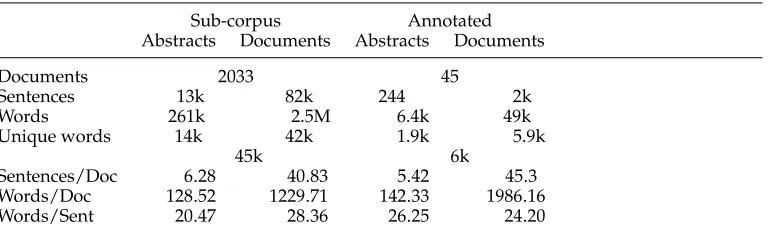
Table 1
Ziff-Davis corpus statistics.
Sub-corpus Annotated Abstracts Documents Abstracts Documents
Documents 2033 45
Sentences 13k 82k 244 2k Words 261k 2.5M 6.4k 49k Unique words 14k 42k 1.9k 5.9k
45k 6k
Sentences/Doc 6.28 40.83 5.42 45.3 Words/Doc 128.52 1229.71 142.33 1986.16 Words/Sent 20.47 28.36 26.25 24.20
2. Human-produced Alignments
In order to decide how to design an alignment model and to judge the quality of the alignments produced by a system, we first need to create a set of “gold standard” alignments. To this end, we asked two human annotators to manually construct such alignments between documents and their abstracts. These document, abstract pairs were drawn from the Ziff-Davis collection (Marcu 1999). Of the roughly 7,000 documents in that corpus, we randomly selected 45 pairs for annotation. We added to this set of 45 pairs the 2,000 shorter documents from this collection, and all the work described in the remainder of this paper focuses on this subset of 2,033 document, abstractpairs.3 Statistics for this sub-corpus and for the pairs selected for annotation are shown in Table 1. As can be simply computed from this table, the compression rate in this corpus is about 12%. The first five human-produced alignments were completed separately and then discussed; the last 40 were done independently.
2.1 Annotation Guidelines
Annotators were asked to perform word-to-word and phrase-to-phrase alignments between abstracts and documents, and to classify each alignment as either possible (P) or sure (S), whereS⊆P, following the methodology used in the machine translation community (Och and Ney 2003). The direction of containment (S⊆P) is because being asurealignment is a stronger requirement than being apossiblealignment. A full descrip-tion of the annotadescrip-tion guidelines is available in a document available with the alignment software on the first author’s web site (http://www.isi.edu/∼hdaume/HandAlign). Here, we summarize the main points.
The most important instruction that annotators were given was to align everything in the summary tosomething. This was not always possible, as we will discuss shortly, but by and large it was an appropriate heuristic. The second major instruction was to choose alignments withmaximal consecutive length:If there are two possible alignments for a phrase, the annotators were instructed to choose the one that will result in the longest consecutive alignment. For example, in Figure 1, this rule governs the choice of
the alignment of the wordMacintoshon the summary side: lexically, it could be aligned to the final occurrence of the wordMacintoshon the document side, but by aligning it to Apple Macintosh systems, we are able to achieve a longer consecutive sequence of aligned words.
The remainder of the instructions have to do primarily with clarifying particular linguistic phenomena including punctuation, anaphora (for entities, annotators are told to feel free to align names to pronouns, for instance) and metonymy, null elements, genitives, appositives, and ellipsis.
2.2 Annotator Agreement
To compute annotator agreement, we employed the kappa statistic. To do so, we treat the problem as a sequence of binary decisions: given a single summary word and document word, should the two be aligned? To account for phrase-to-phrase align-ments, we first converted these into word-to-word alignments using the “all pairs” heuristic. By looking at all such pairs, we wound up with 7.2 million items over which to compute the kappa statistic (with two annotators and two categories). Annotator agreement was strong for sure alignments and fairly weak for possible alignments. When considering only sure alignments, the kappa statistic for agreement was 0.63 (though it dropped drastically to 0.42 on possible alignments).
In performing the annotation, we found that punctuation and non-content words are often very difficult to align (despite the discussion of these issues in the alignment guidelines). The primary difficulty with function words is that when the summarizers have chosen to reorder words to use slightly different syntactic structures, there are lexical changes that are hard to predict.4 Fortunately, for many summarization tasks, it is much more important to get content words right, rather than function words. When words on a stop list of 58 function words and punctuation were ignored, the kappa value rose to 0.68. Carletta (1995) has suggested that kappa values over 0.80 reflect very strong agreement and that kappa values between 0.60 and 0.80 reflect good agreement.5
2.3 Results of Annotation
After the completion of these alignments, we can investigate some of their properties. Such an investigation is interesting both from the perspective of designing a model and from a linguistic perspective.
In the alignments, we found that roughly 16% of the abstractwords are left un-aligned. This figure includes both standard lexical words and punctuation. Of this 16%, 4% are punctuation marks (though not all punctuation is unaligned) and 7% are function words. The remaining 5% are words that would typically be considered content words. This rather surprising result tells us that any model we build needs to be able to account for a reasonable portion of the abstract to not have a direct correspondence to any portion of the document.
4 For example, the change fromI gave a gift to the boy.toThe boy received a gift from me.is relatively
straightforward; however, it is a matter of opinion whethertoandfromshould be aligned – they serve the same role, but certainly do not mean the same thing.
To get a sense of the importance of producing alignments at the phraselevel, we computed that roughly 75% of the alignments produced by humans involve only one word on both sides. In 80% of the alignments, the summary side is a single word (thus in 5% of the cases, a single summary word is aligned to more than one document word). In 6.1% of the alignments, the summary side involved a phrase of length two, and in 2.2% of the cases it involved a phrase of length three. In all these numbers, care should be taken to note that the humans were instructed to produce phrase alignments onlywhen word alignments were impossible. Thus, it is entirely likely that summary wordiis aligned to document wordjand summary wordi+1 is aligned to document word j+1, in which case we count this as two singleton alignments, rather than an alignment of length two. These numbers suggest that looking at phrases in addition to words is empirically important.
Lexical choice is another important aspect of the alignment process. Of all the aligned summary words and phrases, the corresponding document word or phrase was exactly the same as that on the summary side in 51% of the cases. When this constraint was weakened to looking only at stems (for multi-word phrases, a match meant that each corresponding word matched up to stem), this number rose to 67%. When broken down into cases of singletons and non-singletons, we saw that 86% of singletons are identical up to stem, and 48% of phrases are identical up to stem. This suggests that looking at stems, rather than lexical items, is useful.
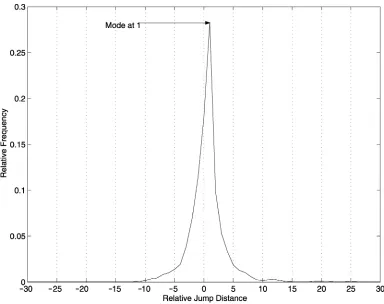
Finally, we investigated the issue of adjacency in the alignments. Specifically, we consider the following question: Given that a summary phrase ending at position i is aligned to a document phrase ending at position j, what is a likely position in the document for the summary phrase beginning at position i+1? It turns out that this is overwhelminglyj+1. In Figure 2, we have plotted the frequencies of such relative jumps over the human-aligned data. This graph suggests that a model biased toward stepping forward monotonically in the document is likely to be appropriate. However, it should also be noted thatbackwardjumps are also quite common, suggesting that a monotonic alignment model is inappropriate for this task.
3. Statistical Alignment Model
Based on linguistic observations from the previous section, we reach several conclu-sions regarding the development of a statistical model to produce such alignments. First, the model should be able to produce alignments between phrases of arbitrary length (but perhaps with a bias toward single words). Second, it should not be con-strained by any assumptions of monotonicity or word (or stem) identity, but it might be able to realize that monotonicity and word and stem identity aregood indicatorsof alignment. Third, our model must be able to account for words on the abstract side that have no correspondence on the document side (following the terminology from the machine translation community, we will refer to such words asnull generated).
3.1 Generative Story
Based on these observations, and with an eye toward computational tractability, we posit the followinggenerative storyfor how a summary is produced, given a document:
Figure 2
Analysis of the motion observed in documents when considering a movement of+1 on the summary side.
(b) Choose a document phrase lengthl.
(c) Generate a summary phrase based on the document phrase spanning positionsjtoj+l.
2. Jumpto the end of the document.
In order to account for null generated summary words, we augment the above gen-erative story with the option to jump to a specifically designatednull statefrom which a summary phrase may be generated without any correspondence in the document. From inspection of the human-aligned data, most such null generated words are function words or punctuation; however, in some cases, there are pieces of information in the summary that truly did not exist in the original document. The null generated words can account for these as well (additionally, the null generated words allow the model to “give up” when it cannot do anything better). We require that summary phrases produced from the null state have length 1, so that in order to generate multiple null generated words, they must be generated independently.
In Figure 3, we have shown a portion of the generative process that would give rise to the alignment in Figure 1.
Figure 3
Beginning and end of the generative process that gave rise to the alignment in Figure 1, which is reproduced here for convenience.
that “generated” it. In order to make this computationally tractable, we must introduce some conditional independence assumptions. Specifically, we assume the following:
1. Decision (a) in our generative story depends only on the position of the end of the current document phrase (i.e.,j+l).
2. Decision (b) is conditionally independent of every other decision.
3. Decision (c) depends only on the phrase at the current document position.
3.2 Statistical Model
Based on the generative story and independence assumptions described above, we can model the entire summary generation process according to two distributions:
r
jump(j|j+l), the probability of jumping to positionjin the document when the previous phrase ended at positionj+l.r
rewrite(s|dj:j+l), therewriteprobability of generating summary phrases given that we are considering the sub-phrase ofdbeginning at positionj and ending at positionj+l.Specific parameterizations of the distributions jump and rewrite will be discussed in Section 4 to enable the focus here to be on the more general problems of inference and decoding in such a model. The model described by these independence assumptions very much resembles that of a hidden Markov model (HMM), where states in the state space are document ranges and emissions are summary words. The difference is that instead of generating a single word in each transition between states, an entire phrase is generated. This difference is captured by the semi-Markov modelor segmental HMM framework, described in great detail by Ostendorf, Digalakis, and Kimball (1996); see also Ferguson (1980); Gales and Young (1993); Mitchell, Jamieson, and Harper (1995); Smyth, Heckerman, and Jordan (1997); Ge and Smyth (2000); Aydin, Altunbasak, and Borodovsky (2004) for more detailed descriptions of these models as well as other ap-plications in speech processing and computational biology. In the following subsections, we will briefly discuss the aspects of inference that are relevant to our problem, but the interested reader is directed to Ostendorf, Digalakis, and Kimball (1996) for more details.
3.3 Creating the State Space
fully defined by a state space (with designated start and end states), an output alpha-bet, transition probabilities, and observation probabilities. The semi-HMM functions like an HMM: Beginning at the start state, stochastic transitions are made through the state space according to the transition probabilities. At each step, one or more observa-tions are generated. The machine stops when it reaches the end state.
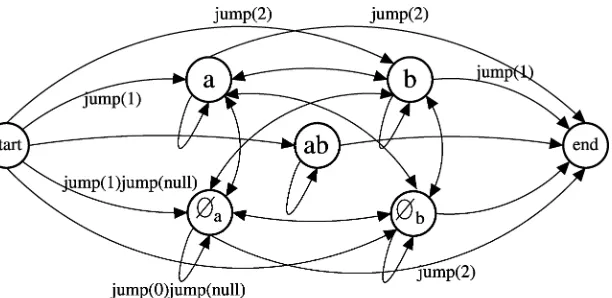
In our case, the state set is large, but well structured. There is a unique initial state start, a unique final stateend, and a state for each possible document phrase. That is, for a document of length n, for all 1≤i≤i≤n, there is a state that corresponds to the document phrase beginning at position i and ending at position i, which we will refer to asri,i. There is also a null state for each document positionr∅,i. Thus,S=
{start,end} ∪ {ri,i: 1≤i≤i≤n} ∪ {r∅,i: 1≤i≤n}. The output alphabet consists
of each word found inS, plus the end-of-sentence wordω. We only allow the wordω to be emitted on a transition to the end state. The transition probabilities are managed by the jump model, and the emission probabilities are managed by the rewrite model.
Consider the document a b (the semi-HMM for which is shown in Figure 4) in the case when the corresponding summary is c d. Suppose the correct alignment is that c d is aligned to a and b is left unaligned. Then, the path taken through the semi-HMM is start →a→ end. During the transition start →a, c d is emitted. During the transitiona→ end,ωis emitted.
3.4 Expectation Maximization
[image:10.486.58.364.483.632.2]The alignment task, as described above, is a chicken-and-egg problem: if we knew the model components (namely, the rewrite and jump tables), we would be able to efficiently find the best alignment. Similarly, if we knew the correct alignments, we would be able to estimate the model components. Unfortunately, we have neither. Expectation maximization is a general technique for learning in such chicken-and-egg situations (Dempster, Laird, and Rubin 1977; Boyles 1983; Wu 1983). The basic idea is to make aguessat the alignments, and then use this guess to estimate the parameters for the relevant distributions. We can use these re-estimated distributions to make a better guess at the alignments, and then use these (ideally better) alignments to re-estimate the parameters.
Figure 4
Formally, the EM family of algorithms tightly bound the log of an expectation of a function by the expectation of the log of that function, through the use of Jensen’s inequality (Jensen 1906). The tightness of the bound means that when we attempt to estimate the model parameters, we may do so overexpectedalignments, rather than the true (but unknown) alignments. EM gives formal guarantees of convergence, but is only guaranteed to find local maxima.
3.5 Model Inference
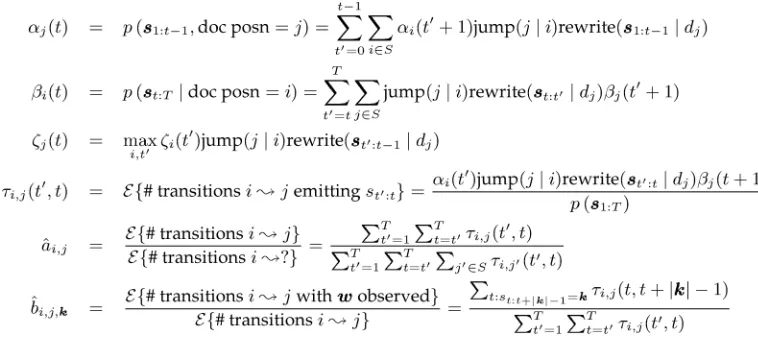
All the inference techniques utilized in this paper are standard applications of semi-Markov model techniques. The relevant equations are summarized in Figure 5 and described here. In all these equations, the variables tandtrange over phrases in the summary (specifically, the phrasest:t), and the variablesiandjrange over phrases in the
document. The interested reader is directed to Ostendorf, Digalakis, and Kimball (1996) for more details on the generic form of these models and their inference techniques.
Unfortunately, the number of possible alignments for a given document, summarypair is exponential in the length of the summary. This would make a na¨ıve implementation of the computation ofp(s|d) intractable without a more clever solu-tion. Instead, we are able to employ a variant of theforwardalgorithm to compute these probabilities recursively. The basic idea is to compute the probability of generating a prefix of the summary and ending up at a particular position in the document (this is known as the forward probability). Since our independence assumptions tell us that it does not matter how we got to this position, we can use this forward probability to compute the probability of taking one more step in the summary. At the end, the desired probability p(s|d) is simply the forward probability of reaching the end of the summary and document simultaneously. The forward probabilities are calculated in theαtable in Figure 5. This equation essentially says that the probability of emitting the first t−1 words of the summary and ending at position j in the document can be computed by summing over our previous position (t) and previous state (i) and multiplying the probability of getting there (αi(t+1)) with the probability of moving
[image:11.486.53.432.468.639.2]from there to the current position.
Figure 5
The second standard inference problem is the calculation of the best alignment: the Viterbi alignment. This alignment can be computed in exactly the same fashion as the forward algorithm, with two small changes. First, the forward probabilities implicitly include a sum over all previous states, whereas the Viterbi probabilities replace this with a max operator. Second, in order to recover the actual Viterbi alignment, we keep track of which previous state this max operator chose. This is computed by filling out theζ table from Figure 5. This is almost identical to the computation of the forward probabilities, except that instead of summing over all possible t and i, we take the maximum over those variables.
The final inference problem is parameter re-estimation. In the case of standard HMMs, this is known as the Baum-Welch, Baum-Eagon or Forward-Backward algo-rithm (Baum and Petrie 1966; Baum and Eagon 1967). By introducingbackward proba-bilities analogous to the forward probaproba-bilities, we can compute alignment probaproba-bilities of suffixes of the summary. The backward table is the β table in Figure 5, which is analogous to theαtable, except that the computation proceeds from the end to the start. By combining the forward and backward probabilities, we can compute the ex-pected number of times a particular alignment was made (the E-step in the EM frame-work). Based on these expectations, we can simply sum and normalize to get new parameters (the M-step). The expected transitions are computed according to theτtable, which makes use of the forward and backward probabilities. Finally, the re-estimated jump probabilities are given by ˆaand the re-estimated rewrite probabilities are given by ˆ
b, which are essentially relative frequencies of the fractional counts given by theτs. The computational complexity for the Viterbi algorithm and for the parameter re-estimation isON2T2, whereNis the length of the summary andTis the number of states (in our case,Tis roughly the length of the document times the maximum phrase length allowed). However, we will typically bound the maximum length of a phrase; we are unlikely to otherwise encounter enough training data to get reasonable estimates of emission probabilities. If we enforce a maximum observation sequence length ofl, then this drops to ON2Tl. Moreover, if the transition network is sparse, as it is in our case, and the maximum out-degree of any node isb, then the complexity drops to
O(NTbl).
4. Model Parameterization
Beyond the conditional independence assumptions made by the semi-HMM, there are nearly no additional constraints that are imposed on the parameterization (in terms of the jump and rewrite distributions) of the model. There is one additional technical requirement involving parameter re-estimation, which essentially says that the expec-tations calculated during the forward-backward algorithm must be sufficient statistics for the parameters of the jump and rewrite models. This constraint simply requires that whatever information we need to re-estimate their parameters is available to us from the forward-backward algorithm.
4.1 Parameterizing the Jump Model
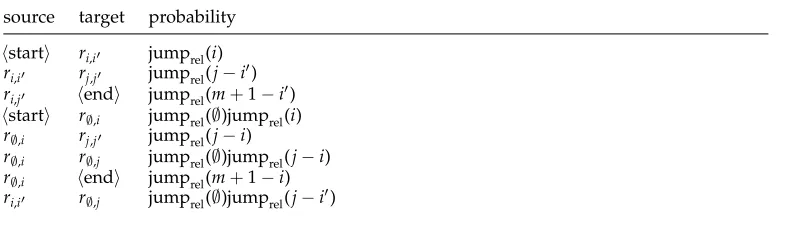
Table 2
Jump probability decomposition; the source state is either the designated start state, the designated end state, a document phrase position spanning fromitoi(denotedri,i) or a null
state corresponding to positioni(denotedr∅,i).
source target probability
start ri,i jumprel(i)
ri,i rj,j jumprel(j−i)
ri,j end jumprel(m+1−i) start r∅,i jumprel(∅)jumprel(i)
r∅,i rj,j jumprel(j−i)
r∅,i r∅,j jumprel(∅)jumprel(j−i)
r∅,i end jumprel(m+1−i)
ri,i r∅,j jumprel(∅)jumprel(j−i)
this distribution as a Gaussian (though, based on Figure 2 this is perhaps not the best model). Both of these models have been explored in the machine translation commu-nity. Our third parameterization employs a novel syntax-aware jump model that at-tempts to take advantage of local syntactic information in computing jumps.
4.1.1 The Relative Jump Model.In the relative jump model, we keep a table of counts for each possible jump distance, and compute jump(j|j)=jumprel(j−j). Each possi-ble jump type and its associated probability is shown in Tapossi-ble 2. By these calculations, regardless of document phrase lengths, transitioning forward between two consecutive segments will result in jumprel(1). When transitioning from the start state p to state ri,i, the value we use is a jump length ofi. Thus, if we begin at the first word in the
document, we incur a transition probability ofj1. There are no transitions into p. We additionally remember a specific transition jumprel(∅) for the probability of transition-ing to a null state. It is straightforward to estimate these parameters based on the estimations from the forward-backward algorithm. In particular, jumprel(i) is simply the relative frequency of lengthijumps, and jumprel(∅) is simply the count of jumps that end in a null state to the total number of jumps. The null stateremembersthe position we ended in before we jumped there, and so to jumpoutof a null state, we make a jump based on this previous position.6
4.1.2 Gaussian Jump Model.The Gaussian jump model attempts to alleviate the spar-sity of data problem in the relative jump model by assuming a parametric form to the jumps. In particular, we assume there is a mean jump lengthµand a jump varianceσ2, and then the probability of a jump of lengthiis given by:
i∼Nor(µ,σ2)∝exp 1 σ2(i−µ)
2 (1)
Some care must be taken in employing this model, since the normal distribution is defined over a continuous space. Thus, when we discretize the calculation, the nor-malizing constant changes slightly from that of a continuous normal distribution. In
practice, we normalize by summing over a sufficiently large range of possibleis. The pa-rametersµandσ2are estimated by computing the mean jump length in the expectations and its empirical variance. We model null states identically to the relative jump model.
4.1.3 Syntax-Aware Jump Model. Both of the previously described jump models are extremely na¨ıve in that they look only at the distance jumped and completely ignore what is being jumped over. In the syntax-aware jump model, we wish to enable the model to take advantage of syntactic knowledge in a very weak fashion. This is quite different from the various approaches to incorporating syntactic knowledge into ma-chine translation systems, wherein strong assumptions about the possible syntactic operations are made (Yamada and Knight 2001; Eisner 2003; Gildea 2003).
To motivate this model, consider the first document sentence shown with its syn-tactic parse tree in Figure 6. Though it is not always the case, forward jumps of distance more than one are often indicative of skipped words. From the standpoint of the rela-tive jump models, jumping over the four wordstripled it ’s salesand jumping over the four wordsof Apple Macintosh systemsare exactly the same.7 However, intuitively, we would be much more willing to jump over the latter than the former. The latter phrase is a full syntactic constituent, while the first phrase is just a collection of nearby words. Furthermore, the latter phrase is a prepositional phrase (and prepositional phrases might be more likely dropped than other phrases), while the former phrase includes a verb, a pronoun, a possessive marker, and a plain noun.
To formally capture this notion, we parameterize the syntax-aware jump model according to the types of phrases being jumped over. That is, to jump overtripled it ’s sales would have probability jumpsyn(VBD PRP POS NNS) while to jump overof Apple Macintosh systems would have probability jumpsyn(PP). In order to compute the prob-abilities for jumps over many components, we factorize so that the first probabil-ity becomes jumpsyn(VBD)jumpsyn(PRP)jumpsyn(POS)jumpsyn(NNS). This factorization explicitly encodes our preference for jumping over single units rather than several syntactically unrelated units.
In order to work with this model, we must first parse the document side of the corpus; we used Charniak’s parser (Charniak 1997). Given the document parse trees, the re-estimation of the components of this probability distribution is done by sim-ply counting what sorts of phrases are being jumped over. Again, we keep a single parameter jumpsyn(∅) for jumping to null states. To handle backward jumps, we simply consider a duplication of the tag set, where jumpsyn(NP-f) denotes a forward jump over anNP, and jumpsyn(NP-b) denotes a backward jump over anNP.8
4.2 Parameterizing the Rewrite Model
As observed from the human-aligned summaries, a good rewrite model should be able to account for alignments between identical word and phrases, between words that are identical up to stem, and between different words. Intuition (as well as further
7 As can be seen from this example, we have preprocessed the data to split off possessive terms, such as the mapping fromitstoit ’s.
Figure 6
The syntactic tree for an example document sentence.
investigations of the data) also suggest thatsynonymyis an important factor to take into consideration in a successful rewrite model. We account for each of these four factors in four separate components of the model and then take a linear interpolation of them to produce the final probability:
rewrite(s|d)=λidrewriteid(s|d)+λstemrewritestem(s|d) (2)
+λwnrewritewn(s|d)+λrwrewriterw(s|d) (3)
where theλs are constrained to sum to unity. The four rewrite distributions used are: id is a word identity model, which favors alignment of identical words; stem is a model designed to capture the notion that matches at the stem level are often sufficient for alignment (i.e.,walkandwalked are likely to be aligned); wn is a rewrite model based on similarity according to WordNet; and wr is the basic rewrite model, similar to a translation table in machine translation. These four models are described in detail in this section, followed by a description of how to compute theirλs during EM.
4.2.1 Word Identity Rewrite Model. The form of the word identity rewrite model is: rewriteid(s|d)=δs=d. That is, the probability is 1 exactly whensanddare identical, and 0 when they differ. This model has no parameters.
4.2.2 Stem Identity Rewrite Model. The form of the stem identity rewrite model is very similar to that of the word identity model:
rewritestem(s|d)=Z1
d
δ|s|=|d| |s|
i=1
δstem(si)=stem(di) (4)
normalization constant is computed offline based on a pre-computed vocabulary. This model also has no parameters.
4.2.3 WordNet Rewrite Model.In order to account for synonymy, we allow document phrases to be rewritten to semantically “related” summary phrases. To compute the value for rewritewn(s|d), we first require that bothsanddcan be found in WordNet. If either cannot be found, then the probability is zero. If they both can be found, then the graph distance between their first senses is computed (we traverse the hyper-nymy tree up until they meet). If the two paths do not meet, then the probability is again taken to be zero. We place an exponential model on the hypernym tree-based distance:
rewritewn(s|d)=Z1
dexp [−
ηdist(s,d)] (5)
Here, dist is calculated distance, taken to be +∞ whenever either of the failure conditions is met. The single parameter of this model isη, which is computed according to the maximum likelihood criterion from the expectations during training. The nor-malization constantZdis calculated by summing over the exponential distribution for allsthat occur on the summary side of our corpus.
4.2.4 Lexical Rewrite Model. The lexical rewrite model is the “catch all” model to handle the cases not handled by the above models. It is analogous to a translation-table (t-table) in statistical machine translation (we will continue to use this terminology for the remainder of the article), and simply computes a matrix of (fractional) counts corresponding to all possible phrase pairs. Upon normalization, this matrix gives the rewrite distribution.
4.2.5 Estimation of the Weight Parameters. In order to weight the four models, we need to estimate values for the λ components. This computation can be performed inside of the EM iterations by considering for each rewritten pair its expectation of belonging to each of the models. We use these expectations to maximize the likelihood with respect to theλs and then normalize them so they sum to one.
4.3 Model Priors
In the standard HMM case, the learning task is simply one of parameter estimation, wherein the maximum likelihood criterion under which the parameters are typically trained performs well. However, in our model, we are, in a sense, simultaneously estimating parameters and selecting amodel: The model selection is taking place at the level of deciding how to segment the observed summary. Unfortunately, in such model selection problems, likelihood increases monotonically with model complexity. Thus, EM will find for us the most complex model; in our case, this will correspond to a model in which the entire summary is produced at once, and no generalization will be possible.
ML optimizes the probability of the data given the parameters (the likelihood), MAP optimizes the product of the probability of the parameters with the likelihood (the unnormalized posterior). The difficulty in our model that makes ML estimation perform poorly is centered in the lexical rewrite model. Under ML estimation, we will simply insert an entry in the t-table for the entire summary for some uncommon or unique document word and are done. However,a prioriwe do not believe that such a parameter is likely. The question then becomes how to express this in a way that inference remains tractable.
From a statistical point of view, the t-table is nothing but a large multinomial model (technically, one multinomial for each possible document phrase). Under a multinomial distribution with parameterθwithJ-many components (with allθjpositive and sum-ming to one), the probability of an observationxis given byp(x|θ)=Jj=1θxjj(here, we consider xto be a vector of lengthJin which all components are zero except for one, corresponding to the actual observation).
This distribution belongs to theexponential familyand therefore has a natural conju-gatedistribution. Informally, two distributions are conjugate if you can multiply them together and get the original distribution back. In the case of the multinomial, the conju-gate distribution is the Dirichlet distribution. A Dirichlet distribution is parameterized by a vectorαof lengthJwithαj≥0, but not necessarily summing to one. The Dirichlet
distribution can be used as a prior distribution over multinomial parameters and has density:
p(θ|α)=
ΓJj=1αj
J
j=1Γ(αj)
J
j=1θ
αj−1
j .
The fraction before the product is simply a normalization term that ensures that the integral over all possibleθintegrates to one.
The Dirichlet is conjugate to the multinomial because when we compute the posterior of θ given α and x, we arrive back at a Dirichlet distribution: p(θ|x,α)∝
p(x|θ)p(θ|α)∝Jj=1θ
xj+αj−1
j . This distribution has the same density as the original
model, but a “fake count” of αj−1 has been added to component j. This means that if we are able to express our prior beliefs about the multinomial parameters found in the t-table in the form of a Dirichlet distribution, the computation of the MAP solution can be performed exactly as described before, but with the appropriate fake counts added to the observed variables (in our case, the observed variables are the alignments between a document phrase and a summary phrase). The application of Dirichlet priors to standard HMMs has previously been considered in signal process-ing (Gauvain and Lee 1994). These fake counts act as a smoothprocess-ing parameter, sim-ilar to Laplace smoothing (Laplace smoothing is the special case where αj=2 for allj).
4.4 Parameter Initialization
We initialize all the parameters uniformly, but in the case of the rewrite parameters, since there is a prior on them, they are effectively initialized to the maximum likelihood solution under their prior.
5. Experimental Results
The experiments we perform are on the same Ziff-Davis corpus described in the intro-duction. In order to judge the quality of the alignments produced, we compare them against the gold-standard references annotated by the humans. The standard precision and recall metrics used in information retrieval are modified slightly to deal with the sure and possible alignments created during the annotation process. Given the set S of sure alignments, the setS⊆Pof possible alignments, and a set Aof hypothesized alignments, we compute the precision as|A∩P|/|A|and the recall as|A∩S|/|S|.
One problem with these definitions is that phrase-based models are fond of making phrases. That is, when given an abstract containing the man and a document also containingthe man, a human will alignthetotheandmantoman. However, a phrase-based model will almost always prefer to align the entire phrasethe mantothe man. This is because it results in fewer probabilities being multiplied together.
To compensate for this, we define soft precision (SoftP in the tables) by counting alignments wherea bis aligned toa bthe same as ones in whichais aligned toaandbis aligned tob.Note, however, that this is not the same asaaligned toa bandbaligned to b. This latter alignment will, of course, incur a precision error. The soft precision metric induces a new, soft F-Score, labeled SoftF.
Often, even humans find it difficult to align function words and punctuation. A list of 58 function words and punctuation marks that appeared in the corpus (henceforth called theignore-list) was assembled. We computed precision and recall scores both on all words and on all words that do not appear in the ignore-list.
5.1 Systems Compared
Overall, we compare various parameter settings of our model against three other sys-tems. First, we compare against two alignment models developed in the context of machine translation. Second, we compare against the Cut and Paste model developed in the context of “summary decomposition” by Jing (2002). Each of these systems will be discussed in more detail shortly. However, the machine translation alignment models assumesentence pairsas input. Moreover, even though the semi-Markov model is based on efficient dynamic programming techniques, it is still too inefficient to run on very longdocument, abstractpairs.
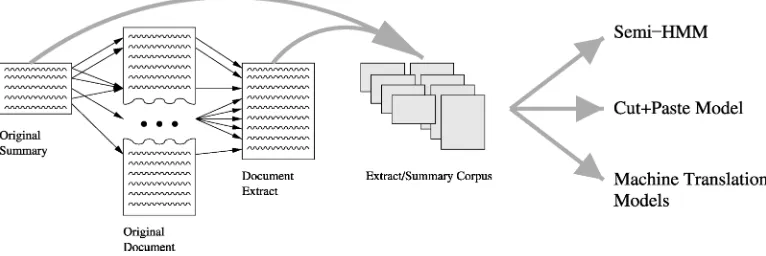
Figure 7
Pictorial representation of the conversion of thedocument, abstractcorpus to anextract, abstractcorpus.
information). Of the 20 random examples, none were labeled as 0; 5 were labeled as 1; and 15 were labeled as 2, giving a mean rating of 1.75. We refer to the resulting corpus as theextract, abstractcorpus, statistics for which are shown in Table 3. Finally, for fair comparison, we also run the Cut and Paste model only on the extracts.9
5.1.1 Machine Translation Models. We compare against several competing systems, the first of which is based on the original IBM Model 4 for machine translation (Brown et al. 1993) and the HMM machine translation alignment model (Vogel, Ney, and Tillmann 1996) as implemented in the GIZA++ package (Och and Ney 2003). We modified the code slightly to allow for longer inputs and higher fertilities, but otherwise made no changes. In all of these setups, 5 iterations of Model 1 were run, followed by five iterations of the HMM model. For Model 4, 5 iterations of Model 4 were subsequently run.
In our model, the distinction between the summaryand the documentis clear, but when using a model from machine translation, it is unclear which of the summary and the document should be considered the source language and which should be considered the targetlanguage. By making the summary the source language, we are effectively requiring that thefertilityof each summary word be very high, or that many words are null generated (since we must generate all of the document). By making the document the source language, we are forcing the model to make most document words have zero fertility. We have performed experiments in both directions, but the latter (document as source) performs better in general.
In order toseedthe machine translation model so that it knows that word identity is a good solution, we appended our corpus withsentence pairsconsisting of onesource word and one targetword, which were identical. This is common practice in the ma-chine translation community when one wishes to cheaply encode knowledge from a dictionary into the alignment model.
5.1.2 Cut and Paste Model.We also tested alignments using the Cut and Paste sum-mary decomposition method (Jing 2002), based on a non-trainable HMM. Briefly,
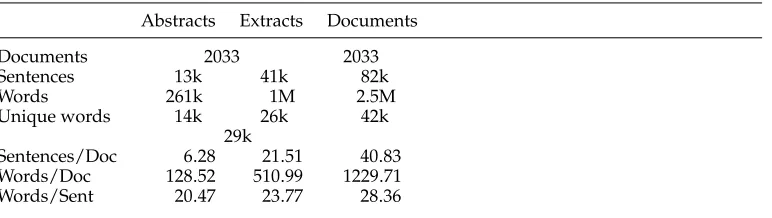
Table 3
Ziff-Davis extract corpus statistics.
Abstracts Extracts Documents
Documents 2033 2033 Sentences 13k 41k 82k Words 261k 1M 2.5M Unique words 14k 26k 42k
29k
Sentences/Doc 6.28 21.51 40.83 Words/Doc 128.52 510.99 1229.71 Words/Sent 20.47 23.77 28.36
the Cut and Paste HMM searches for long contiguous blocks of words in the document and abstract that are identical (up to stem). The longest such sequences are aligned. By fixing a length cutoff of n and ignoring sequences of length less than n, one can arbitrarily increase the precision of this method. We found that n=2 yields the best balance between precision and recall (and the highest F-measure). On this task, this model drastically outperforms the machine translation models.
5.1.3 The Semi-Markov Model. While the semi-HMM is based on a dynamic pro-gramming algorithm, the effective search space in this model is enormous, even for moderately sizeddocument, abstractpairs. The semi-HMM system was then trained on thisextract, abstractcorpus. We also restrict the state-space with a beam, sized at 50% of the unrestricted state-space. With this configuration, we run ten iterations of the forward-backward algorithm. The entire computation time takes approximately 8 days on a 128-node cluster computer.
We compare three settings of the semi-HMM. The first, semi-HMM-relative, uses the relative movement jump table; the second,semi-HMM-Gaussian, uses the Gaussian parameterized jump table; the third, semi-HMM-syntax, uses the syntax-based jump model.
5.2 Evaluation Results
The results, in terms of precision, recall, and F-score, are shown in Table 4. The first three columns are when these three statistics are computed over all words. The next three columns are when these statistics are only computed over words that do not appear in ourignore listof 58 stop words. Under the methodology for combining the two human annotations by taking the union, either of the human scores would achieve a precision and recall of 1.0. To give a sense of how well humans actually perform on this task, we compare each human against the other.
Table 4
Results on the Ziff-Davis corpus.
All Words Non-Stop Words System SoftP Recall SoftF SoftP Recall SoftF
Human1 0.727 0.746 0.736 0.751 0.801 0.775 Human2 0.680 0.695 0.687 0.730 0.722 0.726 HMM (Sum=Src) 0.120 0.260 0.164 0.139 0.282 0.186 Model 4 (Sum=Src) 0.117 0.260 0.161 0.135 0.283 0.183 HMM (Doc=Src) 0.295 0.250 0.271 0.336 0.267 0.298
Model 4 (Doc=Src) 0.280 0.247 0.262 0.327 0.268 0.295 Cut and Paste 0.349 0.379 0.363 0.431 0.385 0.407
semi-HMM-relative 0.456 0.686 0.548 0.512 0.706 0.593 semi-HMM-Gaussian 0.328 0.573 0.417 0.401 0.588 0.477 semi-HMM-syntax 0.504 0.701 0.586 0.522 0.712 0.606
The Cut and Paste method performs significantly better, which is to be expected, since it is designed specifically for summarization. As one would expect, this method achieves higher precision than recall, though not by very much. The fact that the Cut and Paste model performs so well, compared to the MT models, which are able to learn non-identity correspondences, suggests that any successful model should be able to take advantage of both, as ours does.
Our methods significantly outperform both the IBM models and the Cut and Paste method, achieving a precision of 0.522 and a recall of 0.712, yielding an overall F-score of 0.606 when stop words are not considered. This is still below the human-against-human F-score of 0.775 (especially considering that the true human-against-human scores are 1.0), but significantly better than any of the other models.
Among the three settings of our jump table, the syntax-based model performs best, followed by the relative jump model, with the Gaussian model coming in worst (though still better than any other approach). Inspecting Figure 2, the fact that the Gaussian model does not perform well is not surprising; the data shown there is very non-Gaussian. A double-exponential model might be a better fit, but it is unlikely that such a model will outperform the syntax based model, so we did not perform this experiment.
5.3 Error Analysis
Figure 8
Erroneous alignments are in bold. (Top) Example of an error made by our model (from file ZF207-585-936).From DOSshould be null generated, but the model has erroneously aligned it to an identical phrase that appeared 11 sentences earlier in the document. (Bottom) Error (from ZF207-772-628);The DMP 300should be aligned tothe printerbut is instead aligned to a far-away occurrence ofThe DMP 300.
from 0.548 to 0.594) in the case of all words and from 0.512 to 0.559 (F-score increases from 0.593 to 0.624). This corresponds to a relative improvement of roughly 8% F-score. Increases in score for the syntax-based model are roughly the same.
The second mistake our model frequently makes is to trust the identity rewrite model too strongly. This problem has to do either with synonyms that do not appear frequently enough for the system to learn reliable rewrite probabilities, or with corefer-ence issues, in which the system chooses to align, for instance, MicrosofttoMicrosoft, rather than Microsoft to the company, as might be correct in context. As suggested by this example, this problem is typically manifested in the context of coreferential noun phrases. It is difficult to perform a similar analysis of this problem as for the aforementioned problem (to achieve an upper bound on performance), but we can provide some evidence. As mentioned before, in the human alignments, roughly 51% of all aligned phrases are lexically identical. In the alignments produced by our model (on the same documents), this number is 69%. In the case of stem identity, the hand-aligned data suggests that stem identity should hold in 67% of the cases; in our alignments, this number was 81%. An example of this sort of error is shown in Example 2 in Figure 8. Here, the model has alignedThe DMP 300in the abstract toThe DMP 300in the document, while it should have been aligned tothe printerdue to locality constraints (note that the model also misses the (produces↔producing) alignment, likely as a side-effect of it making the error depicted in bold).
In Table 5, we have shown examples of common errors made by our system (these were randomly selected from a much longer list of errors). These examples are shown out of their contexts, but in most cases, the error is clear even so. In the first column, we show the summary phrase in question. In the second column, we show the document phrase to which itshouldbe aligned, and in the third column, we show the document phrase that our model aligned it to (ornull). In the right column, we classify the model’s alignment asincorrectorpartially correct.
Table 5
Ten example phrase alignments from the hand-annotated corpus; the last column indicates whether the semi-HMM correctly aligned this phrase.
Summary Phrase True Phrase Aligned Phrase Class
to port can port to port incorrect OS - 2 the OS / 2 OS / 2 partial will use will be using will using partial word processing programs word processors word processing incorrect consists of also includes nullof partial will test will also have to test will test partial the potential buyer many users the buyers incorrect The new software Crosstalk for Windows new software incorrect are generally powered by run on null incorrect Oracle Corp. the software publisher Oracle Corp. incorrect
several sentences away). The seventh and tenth examples (The new softwareandOracle Corp., respectively) show instances of the coreference error that occurs commonly.
6. Conclusion and Discussion
Currently, summarization systems are limited to either using hand-annotated data or using weak alignment models at the granularity of sentences, which serve as suitable training data only for sentence extraction systems. To train more advanced extraction systems, such as those used in document compression models or in next-generation abstraction models, we need to better understand the lexical correspondences between documents and their human written abstracts. Our work is motivated by the desire to leverage the vast number ofdocument, abstractpairs that are freely available on the Internet and in other collections and to create word- and phrase-aligned document, abstractcorpora automatically.
This article presents a statistical model for learning such alignments in a com-pletely unsupervised manner. The model is based on an extension of a hidden Markov model, in which multiple emissions are made in the course of one transition. We have described efficient algorithms in this framework, all based on dynamic programming. Using this framework, we have experimented withcomplexmodels of movement and lexical correspondences. Unlike the approaches used in machine translation, where only very simple models are used, we have shown how to efficiently and effectively leverage such disparate knowledge sources and WordNet, syntax trees, and identity models.
We have empirically demonstrated that our model is able to learn the complex struc-ture ofdocument, abstractpairs. Our system outperforms competing approaches, in-cluding the standard machine translation alignment models (Brown et al. 1993; Vogel, Ney, and Tillmann 1996) and the state-of-the-art Cut and Paste summary alignment technique (Jing 2002).
investigating the possibility of including some sort of weak coreference knowledge into the model might serve to help with the second class of errors made by the model.
One obvious aspect of our method that may reduce its general usefulness is the computation time. In fact, we found that despite the efficient dynamic programming algorithms available for this model, the state space and output alphabet are simply so large and complex that we were forced to first map documents down to extracts before we could process them (and even so, computation took roughly 1,000 processor hours). Though we have not pursued it in this work, we do believe that there is room for improvement computationally, as well. One obvious first approach would be to run a simpler model for the first iteration (for example, Model 1 from machine translation (Brown et al. 1993), which tends to be veryrecall oriented) and use this to see subsequent iterations of the more complex model. By doing so, one couldrecreatethe extracts at each iteration using the previous iteration’s parameters to make better and shorterextracts. Similarly, one might only allow summary words to align to words found in their corresponding extract sentences, which would serve to significantly speed up training and, combined with the parameterized extracts, might not hurt performance. A final option, but one that we do not advocate, would be to give up on phrases and train the model in a word-to-word fashion. This could be coupled with heuristic phrasal creation as is done in machine translation (Och and Ney 2000), but by doing this, one completely loses the probabilistic interpretation that makes this model so pleasing.
Aside from computational considerations, the most obvious future effort along the lines of this model is to incorporate it into a full document summarization system. Since this can be done in many ways, including training extraction systems, compression systems, headline generation systems, and even extraction systems, we left this to future work so that we could focus specifically on the alignment task in this article. Nevertheless, the true usefulness of this model will be borne out by its application to true summarization tasks.
Acknowledgments
We wish to thank David Blei for helpful theoretical discussions related to this project and Franz Josef Och for sharing his technical expertise on issues that made the
computations discussed in this paper possible. We sincerely thank the anonymous reviewers of an original conference version of this article as well reviewers of this longer version, all of whom gave very useful suggestions. Some of the computations described in this work were made possible by the High Performance Computing Center at the University of Southern California. This work was partially supported by DARPA-ITO grant N66001-00-1-9814, NSF grant IIS-0097846, NSF grant IIS-0326276, and a USC Dean Fellowship to Hal Daum´e III.
References
Aydin, Zafer, Yucel Altunbasak, and Mark Borodovsky. 2004. Protein secondary structure prediction with semi-Markov
HMMs. InProceedings of the IEEE
International Conference on Acoustics, Speech and Signal Processing (ICASSP), May 17–21. Banko, Michele, Vibhu Mittal, and Michael
Witbrock. 2000. Headline generation based on statistical translation. InProceedings of the Conference of the Association for Computational Linguistics (ACL),
pages 318–325, Hong Kong, October 1–8. Barzilay, Regina and Noemie Elhadad. 2003.
Sentence alignment for monolingual comparable corpora. InProceedings of the Conference on Empirical Methods in Natural Language Processing (EMNLP), pages 25–32.
Baum, Leonard E. and J. E. Eagon. 1967. An inequality with applications to statistical estimation for probabilistic functions of Markov processes and to a model of ecology.Bulletins of the American Mathematical Society, 73:360–363. Baum, Leonard E. and Ted Petrie. 1966.
Statistical inference for probabilistic functions of finite state Markov chains.
Berger, Adam and Vibhu Mittal. 2000. Query-relevant summarization using FAQs. InProceedings of the Conference of the Association for Computational Linguistics (ACL), pages 294–301, Hong Kong, October 1–8.
Boyles, Russell A. 1983. On the convergence of the EM algorithm.Journal of the Royal Statistical Society, B(44):47–50.
Brown, Peter F., Stephen A. Della Pietra, Vincent J. Della Pietra, and Robert L. Mercer. 1993. The mathematics of statistical machine translation: Parameter estimation.Computational Linguistics, 19(2):263–311.
Carletta, Jean. 1995. Assessing agreement on classification tasks: The kappa statistic.Computational Linguistics, 22(2): 249–254.
Carroll, John, Guido Minnen, Yvonne Canning, Siobhan Devlin, and John Tait. 1998. Practical simplification of English newspaper text to assist aphasic readers. InProceedings of the AAAI-98 Workshop on Integrating Artificial Intelligence and Assistive Technology.
Chandrasekar, Raman, Christy Doran, and Srinivas Bangalore. 1996. Motivations and methods for text simplification. In
Proceedings of the International Conference on Computational Linguistics (COLING), pages 1041–1044, Copenhagen, Denmark.
Charniak, Eugene. 1997. Statistical parsing with a context-free grammar and word statistics. InProceedings of the Fourteenth National Conference on Artificial Intelligence (AAAI’97), pages 598–603, Providence, RI, July 27–31.
Daum´e III, Hal and Daniel Marcu. 2002. A noisy-channel model for document compression. InProceedings of the Conference of the Association for Computational Linguistics (ACL), pages 449–456.
Daum´e III, Hal and Daniel Marcu. 2004. A tree-position kernel for document compression. InProceedings of the Fourth Document Understanding Conference (DUC 2004), Boston, MA, May 6–7.
Dempster, Arthur P., Nan M. Laird, and Donald B. Rubin. 1977. Maximum likelihood from incomplete data via the EM algorithm.Journal of the Royal Statistical Society, B39(1):1–37.
Edmundson, H. P. 1969. New methods in automatic abstracting.Journal of the Association for Computing Machinery, 16(2):264–285. Reprinted inAdvances in
Automatic Text Summarization, I. Mani and M. T. Maybury, (eds.).
Eisner, Jason. 2003. Learning non-isomorphic tree mappings for machine translation. In
Proceedings of the Conference of the Association for Computational Linguistics (ACL), Sapporo, Japan.
Ferguson, Jack D. 1980. Variable duration models for speech. InProceedings of the Symposium on the Application of Hidden Markov Models to Text and Speech, pages 143–179, October, Princeton, NJ.
Gales, Mark J. F. and Steve J. Young. 1993. The theory of segmental hidden Markov models. Technical report, Cambridge University Engineering Department. Gauvain, Jean-Luc and Chin-Hui Lee. 1994.
Maximum a-posteriori estimation for multivariate Gaussian mixture observations of Markov chains.IEEE Transactions Speech and Audio Processing, 2:291–298.
Ge, Xianping and Padhraic Smyth. 2000. Segmental semi-Markov models for change-point detection with applications to semiconductor manufacturing. Technical report, University of California at Irvine, March.
Gildea, Daniel. 2003. Loosely tree-based alignment for machine translation. In
Proceedings of the Conference of the Association for Computational Linguistics (ACL), pages 80–87, Sapporo, Japan. Grefenstette, Gregory. 1998. Producing
intelligent telegraphic text reduction to provide an audio scanning service for the blind. InWorking Notes of the AAAI Spring Symposium on Intelligent Text Summarization, pages 111–118, Stanford University, Stanford, CA.
Jensen, J. L. W. V. 1906. Sur les fonctions convexes et les in´egalit´es entre les valeurs moyennes.Acta Mathematica, 30:175–193. Jing, Hongyan. 2000. Sentence reduction for
automatic text summarization. In
Proceedings of the Conference of the North American Chapter of the Association for Computational Linguistics (NAACL), pages 310–315, Seattle, WA.
Jing, Hongyan. 2002. Using hidden Markov modeling to decompose human-written summaries.Computational Linguistics, 28(4):527–544.
Kupiec, Julian, Jan O. Pedersen, and Francine Chen. 1995. A trainable document
summarizer. InProceedings of the Annual ACM Conference on Research and Development in Information Retrieval, pages 68–73.
Luhn, H. P. 1956. The automatic creation of literature abstracts. In I. Mani and M. Maybury, editors,Advances in Automatic Text Summarization. MIT Press, Cambridge, MA, pages 58–63.
Mahesh, Kavi. 1997. Hypertext summary extraction for fast document browsing. In
Proceedings of the AAAI Spring Symposium on Natural Language Processing for the World Wide Web, pages 95–103, Stanford, CA. Mani, Inderjeet. 2001.Automatic
Summarization, volume 3 ofNatural Language Processing. John Benjamins, Amsterdam/Philadelphia.
Mani, Inderjeet and Mark Maybury, editors. 1999.Advances in Automatic Text
Summarization. MIT Press, Cambridge, MA.
Marcu, Daniel. 1999. The automatic construction of large-scale corpora for summarization research. InProceedings of the 22nd Conference on Research and Development in Information Retrieval (SIGIR–99), pages 137–144, Berkeley, CA, August 15–19.
Marcu, Daniel. 2000.The Theory and Practice of Discourse Parsing and Summarization. MIT Press, Cambridge, MA.
Mitchell, Carl D., Leah H. Jamieson, and Mary P. Harper. 1995. On the complexity of explicit duration HMMs.IEEE Transactions on Speech and Audio Processing, 3(3). Och, Franz Josef and Hermann Ney. 2000.
Improved statistical alignment models. InProceedings of the Conference of the Association for Computational Linguistics (ACL), pages 440–447, October, Hong Kong, China.
Och, Franz Josef and Hermann Ney. 2003. A systematic comparison of various
statistical alignment models.Computational Linguistics, 29(1):19–51.
Ostendorf, Mari, Vassilis Digalakis, and Owen Kimball. 1996. From HMMs to segment models: A unified view of stochastic modeling for speech recognition.IEEE Transactions on Speech and Audio Processing, 4(5):360–378, September.
Quirk, Chris, Chris Brockett, and William Dolan. 2004. Monolingual machine translation for paraphrase generation. In
Proceedings of the Conference on Empirical Methods in Natural Language Processing (EMNLP), pages 142–149, Barcelona, Spain. Schwartz, Richard, David Zajic, and Bonnie
Dorr. 2002. Automatic headline generation for newspaper stories. InProceedings of the Document Understanding Conference (DUC), pages 78–85, Philadelphia.
Smyth, Padhraic, David Heckerman, and Michael I. Jordan. 1997. Probabilistic independence networks for hidden Markov probability models.Neural Computation, 9(2):227–269.
Teufel, Simone and Mark Moens. 1997. Sentence extraction as a classification task. InIn ACL/EACL-97 Workshop on Intelligent and Scalable Text Summarization,
pages 58–65.
Vogel, Stephan, Hermann Ney, and Christoph Tillmann. 1996. HMM-based word alignment in statistical translation. InProceedings of the International Conference on Computational Linguistics (COLING), pages 836–841.
Wu, Jeff C. F. 1983. On the convergence properties of the EM algorithm.The Annals of Statistics, 11:95–103.
Yamada, Kenji and Kevin Knight. 2001. A syntax-based statistical translation model. InProceedings of the Conference of the Association for Computational Linguistics (ACL), pages 523–530.