1745
Single Document Summarization
as Tree Induction
Yang Liu, Ivan Titov and Mirella Lapata
Institute for Language, Cognition and Computation School of Informatics, University of Edinburgh
10 Crichton Street, Edinburgh EH8 9AB
[email protected], [email protected], [email protected]
Abstract
In this paper we conceptualize single-document extractive summarization as a tree induction problem. In contrast to previous approaches (Marcu, 1999; Yoshida et al.,
2014) which have relied on linguistically mo-tivated document representations to generate summaries, our model induces a multi-root dependency tree while predicting the output summary. Each root node in the tree is a summary sentence, and the subtrees attached to it are sentences whose content relates to or explains the summary sentence. We design a new iterative refinement algorithm: it induces the trees through repeatedly refining the structures predicted by previous iterations. We demonstrate experimentally on two benchmark datasets that our summarizer1 performs competitively against state-of-the-art methods.
1 Introduction
Single-document summarization is the task of au-tomatically generating a shorter version of a doc-ument while retaining its most important informa-tion. The task has received much attention in the natural language processing community due to its potential for various information access applica-tions. Examples include tools which digest textual content (e.g., news, social media, reviews), answer questions, or provide recommendations.
Of the many summarization paradigms that have been identified over the years (seeMani 2001 andNenkova and McKeown 2011for comprehen-sive overviews), two have consistently attracted attention. In abstractive summarization, various text rewriting operations generate summaries us-ing words or phrases that were not in the original text, whileextractiveapproaches form summaries by copying and concatenating the most important spans (usually sentences) in a document. Recent
1Our code is publicly available athttps://github.
com/nlpyang/SUMO.
approaches to (single-document) extractive sum-marization frame the task as a sequence labeling problem taking advantage of the success of neu-ral network architectures (Bahdanau et al.,2015). The idea is to predict a label for each sentence specifying whether it should be included in the summary. Existing systems mostly rely on recur-rent neural networks (Hochreiter and Schmidhu-ber, 1997) to model the document and obtain a vector representation for each sentence (Nallap-ati et al., 2017;Cheng and Lapata,2016). Inter-sentential relations are captured in a sequential manner, without taking the structure of the doc-ument into account, although the latter has been shown to correlate with what readers perceive as important in a text (Marcu,1999). Another prob-lem in neural-based extractive models is the lack of interpretability. While capable of identifying summary sentences, these models are not able to rationalize their predictions (e.g., a sentence is in the summary because it describes important con-tent upon which other related sentences elaborate).
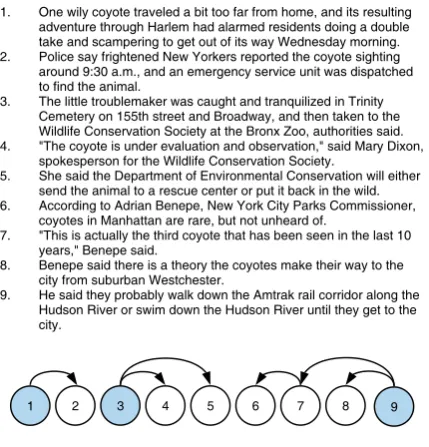
rep-1. One wily coyote traveled a bit too far from home, and its resulting adventure through Harlem had alarmed residents doing a double take and scampering to get out of its way Wednesday morning. 2. Police say frightened New Yorkers reported the coyote sighting around 9:30 a.m., and an emergency service unit was dispatched to find the animal.
3. The little troublemaker was caught and tranquilized in Trinity Cemetery on 155th street and Broadway, and then taken to the Wildlife Conservation Society at the Bronx Zoo, authorities said. 4. "The coyote is under evaluation and observation," said Mary Dixon,
spokesperson for the Wildlife Conservation Society.
5. She said the Department of Environmental Conservation will either send the animal to a rescue center or put it back in the wild. 6. According to Adrian Benepe, New York City Parks Commissioner,
coyotes in Manhattan are rare, but not unheard of.
7. "This is actually the third coyote that has been seen in the last 10 years," Benepe said.
8. Benepe said there is a theory the coyotes make their way to the city from suburban Westchester.
9. He said they probably walk down the Amtrak rail corridor along the Hudson River or swim down the Hudson River until they get to the city.
1 2 3 4 5 6 7 8 9
Figure 1: Dependency discourse tree for a docu-ment from the CNN/DailyMail dataset (Hermann et al.,
2015). Blue nodes indicate the roots of the tree (i.e., summary sentences) and parent-child links indi-cate dependency relations.
resenting individual reviews into a graph, from which an abstractive summary is generated. De-spite the intuitive appeal of discourse structure for the summarization task, the reliance on a parser which is both expensive to obtain (since it must be trained on labeled data) and error prone, presents a major obstacle to its widespread use.
Recognizing the merits of structure-aware rep-resentations for various NLP tasks, recent ef-forts have focused on learning latent structures (e.g., parse trees) while optimizing a neural net-work model for a down-stream task. Various methods impose structural constraints on the basic attention mechanism (Kim et al., 2017; Liu and Lapata, 2018), formulate structure learning as a reinforcement learning problem (Yogatama et al., 2017; Williams et al., 2018), or sparsify the set of possible structures (Niculae et al.,2018). Al-though latent structures are mostly induced for in-dividual sentences,Liu and Lapata(2018) induce dependency-like structures for entire documents.
Drawing inspiration from this work and ex-isting discourse-informed summarization mod-els (Marcu, 1999; Hirao et al., 2013), we frame extractive summarization as a tree induction prob-lem. Our model represents documents as multi-root dependency trees where each multi-root node is a summary sentence, and the subtrees attached to it are sentences whose content is related to and
cov-ered by the summary sentence. An example of a document and its corresponding tree is shown in Figure1; tree nodes correspond to document sen-tences; blue nodes represent those which should be in the summary, dependent nodes relate to or are subsumed by the parent summary sentence.
We propose a new framework that uses struc-tured attention (Kim et al., 2017) as both the ob-jective and attention weights for extractive sum-marization. Our model is trained end-to-end, it in-duces document-level dependency trees while pre-dicting the output summary, and brings more inter-pretability in the summarization process by help-ing explain how document content contributes to the model’s decisions. We design a new itera-tive structure refinement algorithm, which learns to induce document-level structures through re-peatedly refining the trees predicted by previous iterations and allows the model to infer complex trees which go beyond simple parent-child rela-tions (Liu and Lapata, 2018; Kim et al., 2017). The idea of structure refinement is conceptually related to recently proposed models for solving it-erative inference problems (Marino et al., 2018; Putzky and Welling, 2017; Lee et al., 2018). It is also related to structured prediction energy net-works (Belanger et al., 2017) which approach structured prediction as iterative miminization of an energy function. However, we are not aware of any previous work considering structure refine-ment for tree induction problems.
Our contributions in this work are three-fold: a novel conceptualization of extractive summariza-tion as a tree inducsummariza-tion problem; a model which capitalizes on the notion of structured attention to learn document representations based on iterative structure refinement; and large-scale evaluation studies (both automatic and human-based) which demonstrate that our approach performs competi-tively against state-of-the-art methods while being able to rationalize model predictions.
2 Model Description
[image:2.595.75.290.60.284.2]2.1 Baseline Model
Most extractive models frame summarization as a classification problem. Recent approaches (Zhang et al., 2018; Dong et al., 2018; Nallapati et al., 2017;Cheng and Lapata,2016) incorporate a neu-ral network-based encoder to build representations for sentences and apply a binary classifier over these representations to predict whether the sen-tences should be included in the summary. Given predicted scoresrand gold labelsy, the loss func-tion can be defined as:
L=− m
X
i=1
(yiln(ri) + (1−yi) ln(1−ri)) (1)
The encoder in extractive summarization mod-els is usually a recurrent neural network with Long-Short Term Memory (LSTM; Hochreiter and Schmidhuber 1997) or Gated Recurrent Units (GRU; Cho et al. 2014). In this paper, our baseline encoder builds on the Transformer ar-chitecture (Vaswani et al., 2017), a recently pro-posed highly efficient model which has achieved state-of-the-art performance in machine transla-tion (Vaswani et al., 2017) and question answer-ing (Yu et al., 2018). The Transformer aims at reducing the fundamental constraint of sequential computation which underlies most architectures based on RNNs. It eliminates recurrence in favor of applying a self-attention mechanism which di-rectly models relationships between all words in a sentence.
More formally, given a sequence of input vec-tors {x1,x2,· · ·,xn}, the Transformer is com-posed of a stack of N identical layers, each of which has two sub-layers:
˜
hl= LayerNorm(hl−1+ MHAtt(hl−1)) (2)
hl= LayerNorm(˜hl+ FFN(˜hl)) (3)
where h0 = PosEmb(x) and PosEmb is the function of adding positional embeddings to the input; the superscript l indicates layer depth;
LayerNorm is the layer normalization operation proposed in Ba et al.(2016); MHAtt represents the multi-head attention mechanism introduced inVaswani et al. (2017) which allows the model to jointly attend to information from different rep-resentation subspaces (at different positions); and
FFN is a two-layer feed-forward network with ReLU as hidden activation function.
For our extractive summarization task, the base-line system is composed of a sentence-level Trans-former (TS) and a document-level Transformer (TD), which have the same structure. For each sen-tencesi = [wi1,wi2,· · ·,win]in the input doc-ument,TSis applied to obtain a contextual repre-sentation for each word:
[ui1,ui2,· · · ,uin] =TS([wi1,wi2,· · ·,win]) (4)
And the representation of a sentence is acquired by applying weighted-pooling:
aij =W0uTij (5)
si=
1
n n
X
j=1
aijuij (6)
Document-level transformerTD takessi as input and yields a contextual representation for each sentence:
[v1,v2,· · · ,vm] =TD([s1,s2,· · · ,sm]) (7)
Following previous work (Nallapati et al., 2017), we use a sigmoid function after a linear transformation to calculate the probabilityriof se-lectingsias a summary sentence:
ri = sigmoid(W1vTi ) (8)
2.2 Structured Summarization Model
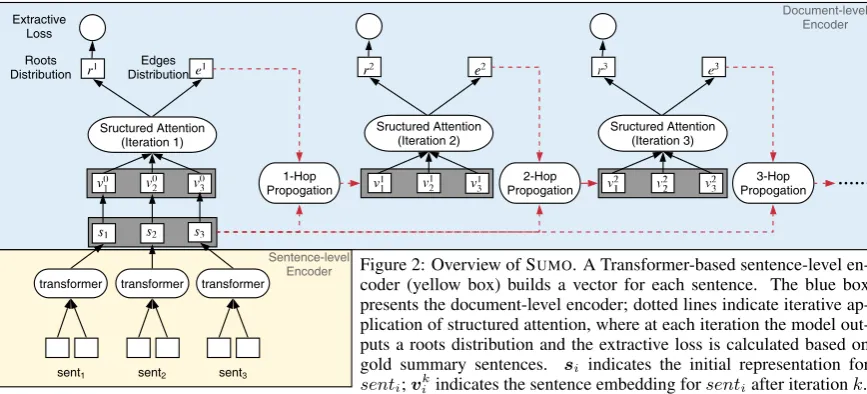
In the Transformer model sketched above, inter-sentence relations are modeled by multi-head at-tention based on softmax functions, which only capture shallow structural information. Our sum-marizer, which we call SUMO as a shorthand for Structured Summarization Model classifies sen-tences as summary-worthy or not, and simultane-ously induces the structure of the source document as a multi-root tree. An overview of SUMO is il-lustrated in Figure 2. The model has the same sentence-level encoder TS as the baseline
sent1 sent2 sent3 sent4 sent5 sent6
sent1 sent2 sent3 sent4 sent5 sent6
sent1 sent2 sent3 sent4 sent5 sent6
sent1 sent3
Sentence-level Encoder transformer
Document-level Encoder
sent2
transformer transformer Sructured Attention
(Iteration 1) Edges Distribution Roots
Distribution Extractive
Loss
Sructured Attention (Iteration 2)
1-Hop Propogation
Sructured Attention (Iteration 3)
2-Hop Propogation
3-Hop
[image:4.595.82.516.63.260.2]Propogation ...
Figure 2: Overview of SUMO. A Transformer-based sentence-level en-coder (yellow box) builds a vector for each sentence. The blue box presents the document-level encoder; dotted lines indicate iterative ap-plication of structured attention, where at each iteration the model out-puts a roots distribution and the extractive loss is calculated based on gold summary sentences. si indicates the initial representation for
senti;vikindicates the sentence embedding forsentiafter iterationk.
Structured Attention Assuming document sen-tences have been already encoded, SUMOfirst cal-culates the unnormalized root score r˜i for senti to indicate the extent to which it might be se-lected as root in the document tree. It also cal-culates the unnormalized edge score e˜ij for sen-tence pair hsenti, sentji indicating the extent to which senti might be the head of sentj in that tree (first upper block in Figure 2). To inject struc-tural bias, SUMO normalizes these scores as the marginal probabilities of forming edges in the doc-ument dependency tree.
We use the Tree-Matrix-Theorem (TMT; Koo et al. 2007;Tutte 1984) to calculate root marginal probabilityri and edge marginal probabilityeij, following the procedure introduced inLiu and La-pata (2017). As illustrated in Algorithm 1, we first build the Laplacian matrix L¯ based on un-normalized scores and calculate marginal proba-bilities by matrix inverse-based operations (L¯−1).
We refer the interested reader toKoo et al.(2007) and Liu and Lapata (2017) for more details. In contrast to Liu and Lapata (2017), who compute the marginal probabilities of a single-root tree, our tree has multiple roots since in our task the sum-mary typically contains multiple sentences. Given sentence vectorsias input, SUMOcomputes:
˜
ri =Wrsi (9)
˜
eij =siWesTj (10)
ri,eij = TMT( ˜ri,e˜ij) (11) Iterative Structure Refinement SUMO essen-tially reduces summarization to a rooted-tree pars-ing problem. However, accurately predicting a tree in one shot is problematic. Firstly, when pre-dicting the dependency tree, the model has solely
Algorithm 1:Calculate Tree Marginal Proba-bilities based on Tree-Matrix-Theorem
FunctionTMT(r˜i,e˜ij)l:
Aij =
0 ifi=j
exp(ˆrij) otherwise
Lij =
Pn
i′=1Ai′j ifi=j
−Aij otherwise
¯
Lij =
Lij+exp(ˆri) i=j Lij otherwise
eij = (1−δ1,j)Aij[ ¯L−1]jj
−(1−δi,1)Aij[ ¯L−1]ji
ri=exp(ˆri)[ ¯L−1]i 1 returnri,eij
access to labels for the roots (aka summary sen-tences), while tree edges are latent and learned without an explicit training signal. And as pre-vious work (Liu and Lapata, 2017) has shown, a single application of TMT leads to shallow tree structures. Secondly, the calculation ofr˜iande˜ij would be based on first-order features alone, how-ever, higher-order information pertaining to sib-lings and grandchildren has proved useful in dis-course parsing (Carreras,2007).
simple trees, and information propagates mostly between neighboring nodes; as the structure gets more refined, information propagates more glob-ally allowing the model to learn higher-order fea-tures.
Algorithm 2 provides the details of our refine-ment procedure. SUMOtakesKiterations to learn the structure of a document. For each sentence, we initialize a structural vector vi0 with sentence vectorsi. At iterationk, we use sentence embed-dings from the previous iterationvk−1to calculate unnormalized rootr˜ikand edgee˜kij scores using a linear transformation with weightWk
r and a bilin-ear transformation with weightWek, respectively. Marginal root and edge probabilities are subse-quently normalized with the TMT to obtain rk i andekij (see lines 4–6 in Algorithm 2). Then, sen-tence embeddings are updated withk-Hop Prop-agation. The latter takes as input the initial sen-tence representations s rather than sentence em-beddings vk−1 from the previous layer. In other words, new embeddings vk are computed from scratch relying on the structure from the previ-ous layer. Within thek-Hop-Propagationfunction (lines 12–19), edge probabilities ek
ij are used as attention weights to propagate information from a sentence to all other sentences inkhops.pliandcli represent parent and child vectors, respectively, while vectorzil is updated with contextual infor-mation at hopl. At the final iteration (lines 9 and 10), the top sentence embeddings vK−1 are used to calculate the final root probabilitiesrK.
We define the model’s loss function as the sum-mation of the losses of all iterations:
L=
K
X
k=1
[ylog(rk) + (1−y) log(1−rk)] (12)
SUMO uses the root probabilities of the top layer as the scores for summary sentences.
Thek-Hop-Propagationfunction resembles the computation used in Graph Convolution Networks (Kipf and Welling,2017;Marcheggiani and Titov, 2017). GCNs have been been recently applied to latent trees (Corro and Titov, 2019), however not in combination with iterative refinement.
3 Experiments
In this section we present our experimental setup, describe the summarization datasets we used, dis-cuss implementation details, our evaluation proto-col, and analyze our results.
Algorithm 2: Structured Summarization Model
Input:Documentd
Output:Root probabilitiesrKafterK iterations
1 Calculate sentence vectorssusing sentence-level TransformerTS
2 v0←s
3 fork←1toK−1do
4 Calculate unnormalized root scores:
˜
rki =Wrkvk
−1
i
5 Calculate unnormalized edge scores:
˜
ekij=vik−1Wekvk
−1
j T
6 Calculate marginal probabilities:
rk,ek= TMT(˜rk,e˜k)
7 Update sentence representations:
vk=k-Hop-Propagation(ek,s, k)
8 end
9 Calculate final unnormalized root and edge scores:r˜iK =WrKviK−1,
˜
eKij =viK−1WeKvK
−1
j T
10 Calculate final root and edge probabilities:
rK,eK = TMT(˜rK,e˜K)
11
12 Functionk-Hop-Propagation(e,s,k): 13 z0←s
14 forl←1tokdo
15 pli=n1Pnj=1ejizl
−1
i
16 cli= 1
n
Pn j=1eijzl
−1
i
17 zli= tanh(Wvk[pil−1,cli−1,zil−1]) 18 end
19 returnzk
3.1 Summarization Datasets
We evaluated SUMO on two benchmark datasets, namely the CNN/DailyMail news highlights dataset (Hermann et al., 2015) and the New York Times Annotated Corpus (NYT; Sand-haus 2008). The CNN/DailyMail dataset con-tains news articles and associated highlights, i.e., a few bullet points giving a brief overview of the article. We used the standard splits of Hermann et al. (2015) for training, valida-tion, and testing (90,266/1,220/1,093 CNN docu-ments and 196,961/12,148/10,397 DailyMail doc-uments). We did not anonymize entities.
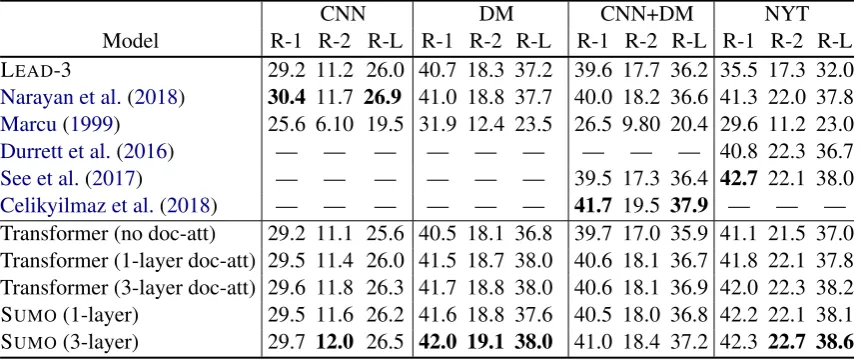
CNN DM CNN+DM NYT Model R-1 R-2 R-L R-1 R-2 R-L R-1 R-2 R-L R-1 R-2 R-L LEAD-3 29.2 11.2 26.0 40.7 18.3 37.2 39.6 17.7 36.2 35.5 17.3 32.0 Narayan et al.(2018) 30.4 11.7 26.9 41.0 18.8 37.7 40.0 18.2 36.6 41.3 22.0 37.8 Marcu(1999) 25.6 6.10 19.5 31.9 12.4 23.5 26.5 9.80 20.4 29.6 11.2 23.0 Durrett et al.(2016) — — — — — — — — — 40.8 22.3 36.7 See et al.(2017) — — — — — — 39.5 17.3 36.4 42.7 22.1 38.0 Celikyilmaz et al.(2018) — — — — — — 41.7 19.5 37.9 — — — Transformer (no doc-att) 29.2 11.1 25.6 40.5 18.1 36.8 39.7 17.0 35.9 41.1 21.5 37.0 Transformer (1-layer doc-att) 29.5 11.4 26.0 41.5 18.7 38.0 40.6 18.1 36.7 41.8 22.1 37.8 Transformer (3-layer doc-att) 29.6 11.8 26.3 41.7 18.8 38.0 40.6 18.1 36.9 42.0 22.3 38.2 SUMO(1-layer) 29.5 11.6 26.2 41.6 18.8 37.6 40.5 18.0 36.8 42.2 22.1 38.1 SUMO(3-layer) 29.7 12.0 26.5 42.0 19.1 38.0 41.0 18.4 37.2 42.3 22.7 38.6
Table 1: Test set results on the CNN/DailyMail and NYT datasets using ROUGEF1(R-1 and R-2 are shorthands
for unigram and bigram overlap, R-L is the longest common subsequence.
filtered test set includes 3,452 test examples out of the original 9,706. Compared to CNN/DailyMail, the NYT dataset contains longer and more elabo-rate summary sentences.
Both datasets contain abstractive gold sum-maries, which are not readily suited to training extractive summarization models. A greedy algo-rithm similar to Nallapati et al. (2017) was used to generate an oracle summary for each document. The algorithm explores different combinations of sentences and generates an oracle consisting of multiple sentences which maximize the ROUGE score with the gold summary. We assigned label 1 to sentences selected in the oracle summary and 0 otherwise and trained SUMOon this data.
3.2 Implementation Details
We followed the same training procedure for SUMO and various Transformer-based baselines. The vocabulary size was set to 30K. We used 300D word embeddings which were initialized randomly from N(0,0.01). The sentence-level Transformer has 6 layers and the hidden size of
FFN was set to 512. The number of heads in
MHAttwas set to 4. Adam was used for training (β1 = 0.9, β2 = 0.999). We adopted the
learn-ing rate schedule fromVaswani et al.(2017) with warming-up on the first 8,000 steps. SUMO and related Transformer models produced 3-sentence summaries for each document at test time (for both CNN/DailyMail and NYT datasets).
3.3 Automatic Evaluation
We evaluated summarization quality using ROUGEF1 (Lin, 2004). We report unigram and
bigram overlap (ROUGE-1 and ROUGE-2) as a means of assessing informativeness and the longest common subsequence (ROUGE-L) as a means of assessing fluency.
Table 1 summarizes our results. We evalu-ated two variants of SUMO, with one and three structured-attention layers. We compared against a baseline which simply selects the first three sen-tences in each document (LEAD-3) and several incarnations of the basic Transformer model in-troduced in Section 2.1. These include a Trans-former without document-level self-attention and two variants with document-level self attention in-stantiated with one and three layers. Several state-of-the-art models are also included in Table1, both extractive and abstractive.
an encoder-decoder architecture. Celikyilmaz et al.’s (2018) system is state-of-the-art in abstrac-tive summarization using multiple agents to repre-sent the document as well a hierarchical attention mechanism over the agents for decoding.
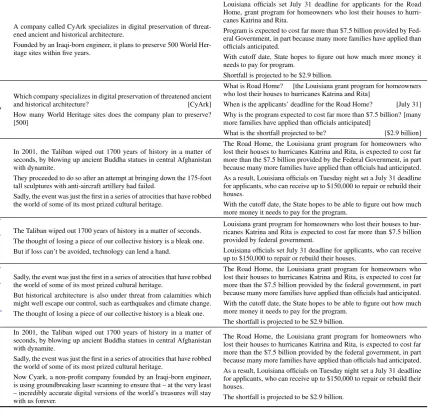
As far as SUMO is concerned, we observe that it outperforms a simple Transformer model with-out any document attention as well as variants with document attention. SUMOwith three layers of structured attention overall performs best, con-firming our hypothesis that document-level struc-ture is beneficial for summarization. The re-sults in Table 1 also reveal that SUMO and all Transformer-based models with document atten-tion (doc-att) outperform LEAD-3 across metrics. SUMO(3-layer) is competitive or better than state-of-the-art approaches. Examples of system output are shown in Table4.
Finally, we should point out that SUMO is su-perior toMarcu(1999) even though the latter em-ploys linguistically informed document represen-tations.
3.4 Human Evaluation
In addition to automatic evaluation, we also as-sessed system performance by eliciting human judgments. Our first evaluation quantified the degree to which summarization models retain key information from the document following a question-answering (QA) paradigm (Clarke and Lapata,2010;Narayan et al.,2018). We created a set of questions based on the gold summary under the assumption that it highlights the most impor-tant document content. We then examined whether participants were able to answer these questions by reading system summaries alone without ac-cess to the article. The more questions a system can answer, the better it is at summarizing the doc-ument as a whole.
We randomly selected 20 documents from the CNN/DailyMail and NYT datasets, respectively and wrote multiple question-answer pairs for each gold summary. We created 71 questions in total varying from two to six questions per gold sum-mary. We asked participants to read the summary and answer all associated questions as best they could without access to the original document or the gold summary. Examples of questions and their answers are given in Table 4. We adopted the same scoring mechanism used inClarke and Lapata(2010), i.e., a correct answer was marked
CNN+DM NYT
Model Rank QA Rank QA
LEAD 0.07 40.1 -0.18 36.3
Narayan et al.(2018) 0.21 62.4 0.12 46.1 Durrett et al.(2016) — — -0.11 40.1 See et al.(2017) -0.23 36.6 -0.44 35.3 Celikyilmaz et al.(2018) -0.64 37.5 — — SUMO(3-layer) 0.15 65.3 0.33 57.2
GOLD 0.11 — -0.16 —
[image:7.595.303.538.63.200.2]ORACLE 0.37 74.6 0.41 67.1
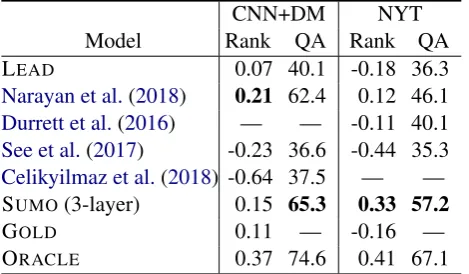
Table 2: System ranking according to human judg-ments on summary quality and QA-based evaluation.
with a score of one, partially correct answers with a score of 0.5, and zero otherwise. Answers were elicited using Amazon’s Mechanical Turk plat-form. Participants evaluated summaries produced by the LEAD-3 baseline, our 3-layered SUMO model and multiple state-of-the-art systems. We elicited 5 responses per summary.
Table2(QA column) presents the results of the QA-based evaluation. Based on the summaries generated by SUMO, participants can answer 65.3% of questions correctly on CNN/DailyMail and 57.2% on NYT. Summaries produced by LEAD-3 and comparison systems fare worse, with REFRESH (Narayan et al., 2018) coming close to SUMO on CNN/DailyMail but not on NYT. Overall, we observe there is room for improve-ment since no system comes close to the extractive oracle, indicating that improved sentence selec-tion would bring further performance gains to ex-tractive approaches. Between-systems differences are all statistically significant (using a one-way ANOVA with posthoc Tukey HSD tests;p <0.01) with the exception of LEAD-3 and See et al. (2017) in both CNN+DM and NTY,Narayan et al. (2018) and SUMO in both CNN+DM and NTY, and LEAD-3 andDurrett et al.(2016) in NYT.
CNN+DM NYT
P H EA P H EA
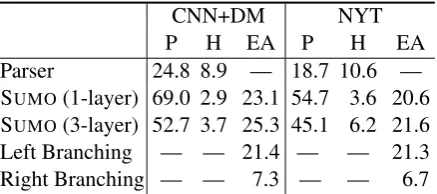
[image:8.595.72.291.62.159.2]Parser 24.8 8.9 — 18.7 10.6 — SUMO(1-layer) 69.0 2.9 23.1 54.7 3.6 20.6 SUMO(3-layer) 52.7 3.7 25.3 45.1 6.2 21.6 Left Branching — — 21.4 — — 21.3 Right Branching — — 7.3 — — 6.7
Table 3: Descriptive statistics Projectivity(%), Height and EdgeAgreement(%) for dependency trees pro-duced by our model and the RST discourse parser ofZhao and Huang(2017). Results are shown on the CNN/DailyMail and NYT test sets.
summaries generated from 3 out of 7 systems and were asked to decide which summary was better and which one was worse, taking into account the criteria mentioned above. We used the same 20 documents from each dataset as in our QA evalu-ation and elicited 5 responses per comparison.
The rating of each system was computed as the percentage of times it was chosen as best minus the times it was selected as worst. Ratings range from -1 (worst) to 1 (best). As shown in Ta-ble 2 (Rank column), participants overwhelming prefer the extractive oracle summaries followed by SUMO and REFRESH (Narayan et al., 2018). Abstractive systems (Celikyilmaz et al.,2018;See et al., 2017; Durrett et al., 2016) perform rela-tively poorly in this evaluation; we suspect that humans are less forgiving to fluency errors and slightly incoherent summaries. Interestingly, gold summaries fare worse than the oracle and extrac-tive systems. Albeit fluent, gold summaries natu-rally contain less detail compared to oracle-based ones; on virtue of being abstracts, they are writ-ten in a telegraphic style, ofwrit-ten in conversational language while participants prefer the more lucid style of the extracts. All pairwise comparisons among systems are statistically significant (using a one-way ANOVA with post-hoc Tukey HSD tests; p <0.01) except LEAD-3 and See et al. (2017) in both CNN+DM and NTY,Narayan et al. (2018) and SUMO in both CNN+DM and NTY, and LEAD andDurrett et al.(2016) in NYT.
3.5 Evaluation of the Induced Structures
To gain further insight into the structures learned by SUMO, we inspected the trees it produces. Specifically, we used the Chu-Liu-Edmonds algo-rithm (Chu and Liu,1965;Edmonds,1967) to ex-tract the maximum spanning tree from the
atten-tion scores. We report various statistics on the characteristics of the induced trees across datasets in Table3. We also examine the trees learned from different SUMO variants (with different numbers of iterations) in order to establish whether the iter-ative process yields better structures.
Specifically, we compared the dependency trees obtained from our model to those produced by a discourse parser (Zhao and Huang,2017) trained on a corpus which combines annotations from the RST treebank (Carlson et al., 2003) and the Penn Treebank (Marcus et al.,1993). Unlike tra-ditional RST discourse parsers (Feng and Hirst, 2014), which first segment a document into Ele-mentary Discourse Units (EDUs) and then build a discourse tree with the EDUs2as leaves,Zhao and Huang(2017) parse a document into an RST tree along with its syntax subtrees without segmenting it into EDUs. The outputs of their parser are ide-ally suited for comparison with our model, since we only care about document-level structures, and ignore the subtrees within sentence boundaries. We converted the constituency RST trees obtained from the discourse parser into dependency trees using Hirao et al.’s algorithm (2013).
As can be seen in Table3, the dependency struc-tures induced by SUMO are simpler compared to those obtained from the discourse parser. Our trees are generally shallower, almost half of them are projective. We also calculated the percent-age of head-dependency edges that are identical between learned trees and parser generated ones. Although SUMO is not exposed to any annotated trees during training, a number of edges agree with the outputs of the discourse parser. Moreover, we observe that the iterative process involving multi-ple structured attention layers helps generate bet-ter discourse trees. We also compare SUMOtrees against a left- and right-branching baseline, where the document is trivially parsed into a left- and right-branching tree forming a chain-like struc-ture. As shown in Table 3, SUMO outperforms these baselines (with the exception of the one-layered model on NYT). We should also point out that the edge agreement between SUMOgenerated trees and left/right branching trees is low (around 30% on both datasets), indicating that the trees we learn are different from a simple chain.
CNN/DM NYT
G
O
L
D A company called CyArk specializes in digital preservation of
threat-ened ancient and historical architecture.
Founded by an Iraqi-born engineer, it plans to preserve 500 World Her-itage sites within five years.
Louisiana officials set July 31 deadline for applicants for the Road Home, grant program for homeowners who lost their houses to hurri-canes Katrina and Rita.
Program is expected to cost far more than $7.5 billion provided by Fed-eral Government, in part because many more families have applied than officials anticipated.
With cutoff date, State hopes to figure out how much more money it needs to pay for program.
Shortfall is projected to be $2.9 billion.
QA
Which company specializes in digital preservation of threatened ancient
and historical architecture? [CyArk]
How many World Heritage sites does the company plan to preserve? [500]
What is Road Home? [the Louisiana grant program for homeowners who lost their houses to hurricanes Katrina and Rita]
When is the applicants’ deadline for the Road Home? [July 31] Why is the program expected to cost far more than $7.5 billion? [many more families have applied than officials anticipated]
What is the shortfall projected to be? [$2.9 billion]
L
E
A
D
-3
In 2001, the Taliban wiped out 1700 years of history in a matter of seconds, by blowing up ancient Buddha statues in central Afghanistan with dynamite.
They proceeded to do so after an attempt at bringing down the 175-foot tall sculptures with anti-aircraft artillery had failed.
Sadly, the event was just the first in a series of atrocities that have robbed the world of some of its most prized cultural heritage.
The Road Home, the Louisiana grant program for homeowners who lost their houses to hurricanes Katrina and Rita, is expected to cost far more than the $7.5 billion provided by the Federal Government, in part because many more families have applied than officials had anticipated. As a result, Louisiana officials on Tuesday night set a July 31 deadline for applicants, who can receive up to $150,000 to repair or rebuild their houses.
With the cutoff date, the State hopes to be able to figure out how much more money it needs to pay for the program.
See
et
al.
(
2017
)
The Taliban wiped out 1700 years of history in a matter of seconds. The thought of losing a piece of our collective history is a bleak one. But if loss can’t be avoided, technology can lend a hand.
Louisiana grant program for homeowners who lost their houses to hur-ricanes Katrina and Rita is expected to cost far more than $7.5 billion provided by federal government.
Louisiana officials set July 31 deadline for applicants, who can receive up to $150,000 to repair or rebuild their houses.
Narayan
et
al.
(
2018
)
Sadly, the event was just the first in a series of atrocities that have robbed the world of some of its most prized cultural heritage.
But historical architecture is also under threat from calamities which might well escape our control, such as earthquakes and climate change. The thought of losing a piece of our collective history is a bleak one.
The Road Home, the Louisiana grant program for homeowners who lost their houses to hurricanes Katrina and Rita, is expected to cost far more than the $7.5 billion provided by the federal government, in part because many more families have applied than officials had anticipated. With the cutoff date, the State hopes to be able to figure out how much more money it needs to pay for the program.
The shortfall is projected to be $2.9 billion.
S
U
M
O
In 2001, the Taliban wiped out 1700 years of history in a matter of seconds, by blowing up ancient Buddha statues in central Afghanistan with dynamite.
Sadly, the event was just the first in a series of atrocities that have robbed the world of some of its most prized cultural heritage.
Now Cyark, a non-profit company founded by an Iraqi-born engineer, is using groundbreaking laser scanning to ensure that – at the very least – incredibly accurate digital versions of the world’s treasures will stay with us forever.
The Road Home, the Louisiana grant program for homeowners who lost their houses to hurricanes Katrina and Rita, is expected to cost far more than the $7.5 billion provided by the federal government, in part because many more families have applied than officials had anticipated. As a result, Louisiana officials on Tuesday night set a July 31 deadline for applicants, who can receive up to $150,000 to repair or rebuild their houses.
[image:9.595.88.518.75.489.2]The shortfall is projected to be $2.9 billion.
Table 4: GOLD human authored summaries, questions based on them (answers shown in square brackets) and automatic summaries produced by the LEAD-3 baseline, the abstractive system ofSee et al. (2017), REFRESH
(Narayan et al.,2018), and SUMOfor a CNN and NYT (test) article.
4 Conclusions
In this paper we provide a new perspective on ex-tractive summarization, conceptualizing it as a tree induction problem. We present SUMO, a Struc-tured Summarization Model, which induces a multi-root dependency tree of a document, where roots are summary-worthy sentences, and subtrees attached to them are sentences which elaborate or explain the summary content. SUMO generates complex trees following an iterative refinement process which builds latent structures while using information learned in previous iterations. Exper-iments on two datasets, show that SUMOperforms competitively against state-of-the-art methods and induces meaningful tree structures.
In the future, we would like to generalize SUMO to abstractive summarization (i.e., to learn latent structure for documents and sentences) and per-form experiments in a weakly-supervised setting where summaries are not available but labels can be extrapolated from the article’s title or topics.
Acknowledgments
References
Jimmy Lei Ba, Jamie Ryan Kiros, and Geoffrey E Hin-ton. 2016. Layer normalization. arXiv preprint arXiv:1607.06450.
Dzmitry Bahdanau, Kyunghyun Cho, and Yoshua Ben-gio. 2015. Neural machine translation by jointly learning to align and translate. InIn Proceedings of the 3rd International Conference on Learning Rep-resentations, San Diego, California.
David Belanger, Bishan Yang, and Andrew McCallum. 2017. End-to-end learning for structured prediction energy networks.ICML.
Lynn Carlson, Daniel Marcu, and Mary Ellen Okurowski. 2003. Building a discourse-tagged cor-pus in the framework of rhetorical structure theory. InCurrent and new directions in discourse and dia-logue, pages 85–112. Springer.
Xavier Carreras. 2007. Experiments with a higher-order projective dependency parser. InProceedings of the 2007 Joint Conference on Empirical Methods in Natural Language Processing and Computational Natural Language Learning (EMNLP-CoNLL).
Asli Celikyilmaz, Antoine Bosselut, Xiaodong He, and Yejin Choi. 2018. Deep communicating agents for abstractive summarization. arXiv preprint arXiv:1803.10357.
Jianpeng Cheng and Mirella Lapata. 2016. Neural summarization by extracting sentences and words. arXiv preprint arXiv:1603.07252.
Kyunghyun Cho, Bart van Merrienboer, Caglar Gul-cehre, Dzmitry Bahdanau, Fethi Bougares, Holger Schwenk, and Yoshua Bengio. 2014. Learning phrase representations using rnn encoder–decoder for statistical machine translation. InProceedings of the 2014 Conference on Empirical Methods in Nat-ural Language Processing (EMNLP), pages 1724– 1734, Doha, Qatar.
Yoeng-Jin Chu and Tseng-Hong Liu. 1965. On shortest arborescence of a directed graph. Scientia Sinica, 14(10):1396.
James Clarke and Mirella Lapata. 2010. Discourse constraints for document compression. Computa-tional Linguistics, 36(3):411–441.
Caio Corro and Ivan Titov. 2019. Differentiable perturb-and-parse: Semi-supervised parsing with a structured variational autoencoder. InICLR.
Yue Dong, Yikang Shen, Eric Crawford, Herke van Hoof, and Jackie Chi Kit Cheung. 2018. Banditsum: Extractive summarization as a contextual bandit. In Proceedings of the EMNLP Conference.
Greg Durrett, Taylor Berg-Kirkpatrick, and Dan Klein. 2016. Learning-based single-document summariza-tion with compression and anaphoricity constraints. arXiv preprint arXiv:1603.08887.
Jack Edmonds. 1967. Optimum branchings. Journal of Research of the national Bureau of Standards B, 71(4):233–240.
Vanessa Wei Feng and Graeme Hirst. 2014. A linear-time bottom-up discourse parser with constraints and post-editing. InProceedings of the 52nd Annual Meeting of the Association for Computational Lin-guistics (Volume 1: Long Papers), volume 1, pages 511–521.
Shima Gerani, Yashar Mehdad, Giuseppe Carenini, Raymond T Ng, and Bita Nejat. 2014. Abstractive summarization of product reviews using discourse structure. InProceedings of the 2014 Conference on Empirical Methods in Natural Language Processing (EMNLP), pages 1602–1613.
Karl Moritz Hermann, Tomas Kocisky, Edward Grefenstette, Lasse Espeholt, Will Kay, Mustafa Su-leyman, and Phil Blunsom. 2015. Teaching ma-chines to read and comprehend. InAdvances in Neu-ral Information Processing Systems, pages 1693– 1701.
Tsutomu Hirao, Yasuhisa Yoshida, Masaaki Nishino, Norihito Yasuda, and Masaaki Nagata. 2013. Single-document summarization as a tree knapsack problem. InProceedings of the 2013 Conference on Empirical Methods in Natural Language Process-ing, pages 1515–1520.
Sepp Hochreiter and J¨urgen Schmidhuber. 1997. Long short-term memory. Neural computation, 9(8):1735–1780.
Yoon Kim, Carl Denton, Luong Hoang, and Alexan-der M Rush. 2017. Structured attention networks.
Thomas N Kipf and Max Welling. 2017. Semi-supervised classification with graph convolutional networks. ICLR.
Svetlana Kiritchenko and Saif Mohammad. 2017. Best-worst scaling more reliable than rating scales: A case study on sentiment intensity annotation. In Proceedings of the 55th Annual Meeting of the As-sociation for Computational Linguistics, pages 465– 470, Vancouver, Canada.
Terry Koo, Amir Globerson, Xavier Carreras P´erez, and Michael Collins. 2007. Structured prediction models via the matrix-tree theorem. In Joint Con-ference on Empirical Methods in Natural Language Processing and Computational Natural Language Learning (EMNLP-CoNLL), pages 141–150.
Jason Lee, Elman Mansimov, and Kyunghyun Cho. 2018. Deterministic non-autoregressive neural se-quence modeling by iterative refinement.EMNLP.
Yang Liu and Mirella Lapata. 2017. Learning structured text representations. arXiv preprint arXiv:1705.09207.
Yang Liu and Mirella Lapata. 2018. Learning struc-tured text representations. Transactions of the Asso-ciation for Computational Linguistics, 6:63–75.
Jordan J Louviere, Terry N Flynn, and Anthony Al-fred John Marley. 2015. Best-worst scaling: The-ory, methods and applications. Cambridge Univer-sity Press.
Inderjeet Mani. 2001. Automatic Summarization. John Benjamins Pub Co.
William C Mann and Sandra A Thompson. 1988. Rhetorical structure theory: Toward a functional the-ory of text organization. Text-Interdisciplinary Jour-nal for the Study of Discourse, 8(3):243–281.
Diego Marcheggiani and Ivan Titov. 2017. Encoding sentences with graph convolutional networks for se-mantic role labeling. InProceedings of the 2017 Conference on Empirical Methods in Natural Lan-guage Processing, pages 1507–1516, Copenhagen, Denmark. Association for Computational Linguis-tics.
Daniel Marcu. 1999. Discourse trees are good indica-tors of importance in text. Advances in automatic text summarization, 293:123–136.
Mitchell P. Marcus, Mary Ann Marcinkiewicz, and Beatrice Santorini. 1993. Building a large annotated corpus of English: The Penn treebank. Computa-tional Linguistics, 19(2):313–330.
Joseph Marino, Yisong Yue, and Stephan Mandt. 2018. Iterative amortized inference. InProceedings of the 35th International Conference on Machine Learn-ing, pages 3403–3412, Stockholm, Sweden.
Ramesh Nallapati, Feifei Zhai, and Bowen Zhou. 2017. Summarunner: A recurrent neural network based se-quence model for extractive summarization of docu-ments. InAAAI, pages 3075–3081.
Shashi Narayan, Shay B Cohen, and Mirella Lapata. 2018. Ranking sentences for extractive summariza-tion with reinforcement learning. arXiv preprint arXiv:1802.08636.
Ani Nenkova and Kathleen McKeown. 2011. Auto-matic summarization. Foundations and Trends in Information Retrieval, 5(2–3):103–233.
Vlad Niculae, Andr´e F. T. Martins, and Claire Cardie. 2018. Towards dynamic computation graphs via sparse latent structure. InProceedings of the 2018 Conference on Empirical Methods in Natural Lan-guage Processing, pages 905–911.
Rashmi Prasad, Nikhil Dinesh, Alan Lee, Eleni Milt-sakaki, Livio Robaldo, Aravind K Joshi, and Bon-nie L Webber. 2008. The penn discourse treebank 2.0. InLREC, Marrakech, Morocco. Citeseer.
Patrick Putzky and Max Welling. 2017. Recurrent inference machines for solving inverse problems. CoRR, abs/1706.04008.
Evan Sandhaus. 2008. The new york times annotated corpus. Linguistic Data Consortium. Philadelphia.
Abigail See, Peter J Liu, and Christopher D Man-ning. 2017. Get to the point: Summarization with pointer-generator networks. arXiv preprint arXiv:1704.04368.
Kai Sheng Tai, Richard Socher, and Christopher D. Manning. 2015. Improved semantic representations from tree-structured long short-term memory net-works. In Proceedings of the 2015 Annual Meet-ing of the Association for Computational LMeet-inguis- Linguis-tics, pages 1556–1566, Beijing, China.
William Thomas Tutte. 1984. Graph theory.
Ashish Vaswani, Noam Shazeer, Niki Parmar, Jakob Uszkoreit, Llion Jones, Aidan N Gomez, Łukasz Kaiser, and Illia Polosukhin. 2017. Attention is all you need. InAdvances in Neural Information Pro-cessing Systems, pages 6000–6010.
Adina Williams, Andrew Drozdov, and Samuel R. Bowman. 2018. Do latent tree learning models iden-tify meaningful structure in sentences? Transac-tions of the Association for Computational Linguis-tics, 6:253–267.
Dani Yogatama, Phil Blunsom, Chris Dyer, Edward Grefenstette, and Wang Ling. 2017. Learning to compose words into sentences with reinforcement learning. In Proceedings of the 5th International Conference on Learning Representations, Toulon, France.
Yasuhisa Yoshida, Jun Suzuki, Tsutomu Hirao, and Masaaki Nagata. 2014. Dependency-based dis-course parser for single-document summarization. In Proceedings of the 2014 Conference on Em-pirical Methods in Natural Language Processing (EMNLP), pages 1834–1839.
Adams Wei Yu, David Dohan, Minh-Thang Luong, Rui Zhao, Kai Chen, Mohammad Norouzi, and Quoc V Le. 2018. Qanet: Combining local convolution with global self-attention for reading comprehen-sion.arXiv preprint arXiv:1804.09541.
Xingxing Zhang, Mirella Lapata, Furu Wei, and Ming Zhou. 2018. Neural latent extractive document sum-marization. InProceedings of the EMNLP Confer-ence.