Performance of Time-Bound Negotiation in
Agent-Based Manufacturing Control
W L Yeung
Abstract—Agent-based software technology plays an impor-tant role in the manufacturing industry for achieving agility. Shop floor control applications can be designed based on the paradigm of agent negotiation to cope with variabilities and disturbances in the production environment. This often involves the contract net protocol (CNP) and previous research has suggested that the timing parameters of CNP can affect significantly the performance of agent negotiation. This work extends our knowledge in this area of research by considering the performance effects of the combinatorial variations of these parameters in a discrete-event simulation case study. The results provide not only a deeper understanding of the time-bound agent negotiation process, but also insights into the performance fine-tuning of CNP-based control schemes.
Index Terms—multi-agent systems; negotiation protocol; sim-ulation; work-in-progress; cycle time
I. INTRODUCTION
I
N today’s highly competitive global markets, agent-based software technology plays an important role in the man-ufacturing industry for achieving agility [1]. Multi-agent systems (MAS) have been applied in the manufacturing industry in a variety of fields including design [2], [3], enterprise resource planning [4], scheduling and monitoring [5], supply chain management [6], workflow management [7] and knowledge management [8]. At the shop floor control level, MAS support a heterarchical approach to the dynamic scheduling and dispatching of jobs in the presence of vari-abilities in manufacturing resources, production disturbances, uncertain arrival of parts, etc. [1], [9]–[14].In a typical MAS shop floor control application, software agents represent various entities in the system (tasks, sub-tasks, machines, people, etc.) and they jointly determine the allocation and routing of tasks among machines through a negotiation process. This often involves an auction/bidding scheme with valuation criteria such as production cost and expected finishing time. The main emphasis of research in this area has been on the design of such negotiation schemes for coping with challenging operating conditions under various system configurations. Many of these schemes are based on the contract net protocol (CNP) [15] which was originally proposed for cooperative problem solving in a distributed processing environment [16].
While the CNP approach has been applied to agent-based manufacturing control with promising results in many studies, there have been some concerns with the performance of the agent negotiation process. The performance issue of message congestion was initially mentioned in [15]. In [17], [18], the issue is highlighted as a potential problem in agent-based manufacturing control systems. In [19], the
W L Yeung is with Department of Computing and Decision Sciences Lingnan University, Hong Kong
Email: [email protected]
CNP approach is applied to the cooperative scheduling of production and maintenance activities wherein resource agents always submit bids in response to relevant task announcements, resulting in a time consuming negotiation process. It is pointed out in [20] that distributed agent-based manufacturing control systems could exhibit chaotic behavior, raising doubts about their predictability, reliability and performance.
Typically, CNP-based task allocation begins with the broadcasting of a task announcement message by a part agent, followed by a round of bid submission by agents representing eligible manufacturing resources. The part agent evaluates all the received bids, selects the best one, and then sends an award message to the selected bidder to confirm the allocation. Note that the bidding process is time-bound: an announced task is open for bidding for only a limited period of time and if no bids at all are received, the part agent would normally re-announce the task for another round of bidding. In a performance study on the CNP-based negotiation process in a (simulated) multi-agent manufacturing sys-tem [21], the results show clearly that varying the timing parameters of the bidding process affects its performance. Similar results can be found in [22] with the conclusion that timing parameters are related to the performance of their proposed CNP-based integrated process planning and scheduling approach. In [23], thecommitment durationof a bid is considered as a major timing parameter affecting the performance of a CNP-based negotiation process.
We follow the previous researchers in applying discrete-event simulation to the performance analysis of CNP-based negotiation processes. Our present case study extends pre-vious ones on the relationships between timing parameters and performance. Whereas individual timing parameters were considered separately in previous studies, our study considers thecombinatorial variationsof two major timing parameters, namely open-for-bidding time and commitment duration, of a negotiation process. Furthermore, we measure the impact of these variations on the number of bids received for each task announcement as an important performance indicator: the smaller the number of received bids, the less likely a task would get an optimal bid, hence undermining the overall performance of the system.
The results of our work contribute to a deeper understand-ing of the time-bound behavior of a CNP-based negotiation process. Furthermore, the experience of our work offers further insights into the fine-tuning of CNP-based control schemes for better performance.
Part ready to be processed
announces to the network
ready to accept parts
Machine agent Part agent
wait for bid submission deadline
Any bid(s)?
Y N
bid selection
send selection results
checks capabilities
Capable? N
Y
calculates potential workload
send bid
Fig. 1. Activities in a negotiation process based on the contract net protocol for allocation of parts on machines
the negotiation protocol are described, together with the methods and results of the simulation experiment. Section 5 summarizes and discusses further the case study results. Section 6 concludes the paper.
II. AGENT-BASED MANUFACTURING CONTROL
Multi-agent systems (MAS) have become a major paradigm for manufacturing control in a variety of ap-plications [10], [24], [25]. In [9], a heterarchical control approach to scheduling manufacturing resources based on autonomous software agents representing machines, parts, and operators is introduced. Advantages of this approach include reactivity to disturbances, reduced complexity and fault tolerance; whereas the lack of predictability, poor ability to define optimal loadings, lack of analytical solutions and possibility of deadlock are the main disadvantages [26]. The performance of a multi-agent scheduling and control system under manufacturing disturbances is studied in [12] and the results show that a heterarchical control architecture could provide reactive mechanisms to respond effectively to disturbances.
Many MAS manufacturing applications are based on the control net protocol (CNP) [15], which specifies how agents interact with each other in a negotiation process. A CNP-based negotiation process typically involves:
1) Task announcement—a part agent broadcasts a task announcement message to eligible machine agents. 2) Bid formulation and submission—each machine agent
evaluates the task; if the machine is capable of the task, the agent formulates a bid message and submit it to the announcer.
3) Bid evaluation and selection—the part agent evaluates all received bids and select the best one according to pre-defined criteria.
[image:2.595.47.291.49.300.2]4) Contract awarding—the part agent sends an award message to the winner for confirmation.
Figure 1 illustrates a CNP-based negotiation process in a UML diagram. The advantages of this approach include simplicity, reliability and scalability [27]. The CNP approach is applied to the YAMS (Yet Another Manufacturing System) prototype factory control system in [28]. The performance of a CNP-based distributed scheduling scheme and a central-ized scheduling scheme is compared in a simulation study with both schemes using the shortest processing time as the main criterion in the scheduling decisions [29] . The simulation results show that the distributed scheme performs significantly better than the centralized scheme in terms of late jobs, waiting time, tardiness and mean flow-time. The performance of CNP-based control for reconfigurable manufacturing systems under unpredictable disturbances is investigated in [30], [31]. Agents negotiate with each other in the event of machine breakdowns to determine the transfer of parts. Their simulation results suggest that, with intelligent internal strategies based on heuristic rules and fuzzy logic, agents can negotiate dynamically in allocating part transfers to achieve better overall average part flowtime.
In [32], CNP is extended with a pre-negotiation step called constraint propagation and applied it to order scheduling. The extension addresses scheduling conflicts among concur-rent negotiations by diffeconcur-rent resources/tasks. A CNP-based multi-agent architecture for the dynamic scheduling of steel production processes is proposed in [13] and the results of a simulation study show that the multi-agent approach yields higher and more stable performance than a centralized approach.
III. PERFORMANCE OF TIME-BOUND NEGOTIATION
Concerns with negotiation performance as mentioned in the Introduction section have prompted researchers to study the detailed design of CNP-based control schemes. The per-formance of distributed control schemes from the perspective of the communication system is analyzed in [33]. Control schemes are modelled as closed queuing networks and their performance is measured using asymptotic bounding analysis and mean value analysis. This was also followed by a second-phase performance analysis through discrete-event simulation. Furthermore, parallel computing is applied to the timed-based simulation of CNP-based shop-floor control in [34].
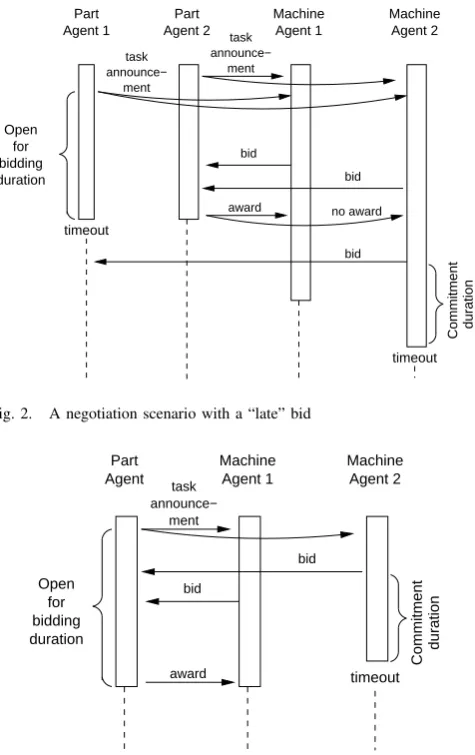
In [21], the task evaluation time (TET)—time required by a resource agent to evaluate a task announcement and formulate a bid—is considered as the main parameter in a simulation study. The results suggest that longer TET demands longer open-for-bidding duration. This also means that resources agents are tied up for longer time in each round of bidding and can only afford to bid less frequently. As a result, the chance of getting bids from all resource agents eligible for a particular task is reduced and, the lower the chance gets, the less likely the task would get an optimal bid, hence undermining the overall system performance. At the same time, the chance of not getting any bids at all in a bidding round increases and indeed the simulation results suggest that tasks could be re-announced several times before receiving any bids.
duration
task
ment
announce− task
ment Part
Agent 1
Part Agent 2
Machine Agent 1
Machine Agent 2
bid
bid award no award timeout
Open for bidding duration
timeout bid
Commitment
[image:3.595.52.290.50.428.2]announce−
Fig. 2. A negotiation scenario with a “late” bid
duration
task
ment
Open for bidding duration
Part Agent
Machine Agent 1
Machine Agent 2
award
bid
bid
timeout
Commitment
announce−
Fig. 3. A negotiation scenario with an expired bid
time limit as the two machine agents had been tied up with the first task.
In the original CNP [15], bids are binding and a resource agent is allowed to bid and be awarded multiple tasks that have to be queued for processing. For manufacturing control applications, however, tasks often carry completion deadlines and hence unrestricted queued processing would not be acceptable. It follows that a resource agent has to bid within its own capacity or risk failure in honouring contract awards. In [35], the different levels (stages) of commitment and the use of time-limited commitment in CNP-based negotiation are considered.
The commitment duration of a bid is considered in [23] as another important timing parameter affecting the per-formance of a CNP-based negotiation process. Bidders are required to submit binding bids within their capacities but the validity of a bid is limited to a certain commitment duration. If an award is received before the end of the commitment duration, the bidder is bound to it; if no award is received by the end of the commitment duration, the bidder’s obligation to accept an award is relieved. The results of a simulation experiment suggest that the length of bid commitment du-ration affects the outcomes of the negotiation process [23]. Specifically, extending the commitment duration lowers the risk of “premature” expiry of bids (Figure 3 illustrates such a risk), thereby increasing the success rate of negotiation.
(mean=
Parts
Machine
Processing time (seconds): normally distributed
(µ=10, σ=2)
Machine
Processing time (seconds): normally distributed
(µ=10, σ=2)
Machine
Processing time (seconds): normally distributed
(µ=10, σ=2)
MAS
Interarrival time (seconds):
Parts
Interarrival time (seconds): exponentially distributed
PA
PA MA
MA
λ)
MA1
1
2
2
3 3
2 1
λ)
exponentially distributed
[image:3.595.304.548.50.229.2](mean=
Fig. 4. Configuration of the multi-agent manufacturing system
IV. SIMULATION CASE STUDY
We present in this section a simulation case study of a hypothetic flexible manufacturing system with an aim to obtain a deeper understanding of the performance of timed-bound negotiation as discussed in the preceding section. Figure 4 depicts the configuration of the system. Parts arrive at the system from two separate sources and the arrival rate at each source is exponentially distributed with an mean inter-arrival time ofλseconds. There are three machines labelled as Machine1, Machine2 and Machine3 which can process any parts from either one of the sources. The amount of processing time (in seconds) for a part is estimated to be normally distributed with a mean and a standard deviation of 10 and 2.
A multi-agent system is responsible for allocating parts to the machines dynamically. It involves five software agents: PA1 and PA2represent parts from the two respective sources whereas MA1, MA2and MA3represent the three machines, respectively.
Details of the negotiation protocol are presented in the following subsection, followed by the methods and results of the simulation experiment.
A. Negotiation protocol
The negotiation protocol in this case study is based on the contract net protocol. Figure 1 illustrates the negotiation process in a UML activity diagram. Each part agent interacts independently with all three machine agents via messages. When a part arrives, the responsible part agent will send out a task announcement message to all machine agents with details about the type as well as some physical characteristics of the part. If a machine is capable of processing the announced part, the responsible machine agent will respond by sending back a bid message containing the estimated amount of processing time; otherwise, it simply ignores the current announcement.
estimated to be distributed (triangularly) as follows:
f(x) =
2(x−a)
(m−a)(b−a) for a≤x≤m
2(b−x)
(b−m)(b−a) for m≤x≤b
0 otherwise
(1)
where a = 3 (minimum), m = 5 (mode) and b = 9
(maximum).
Part agents are programmed to accept bids (ie. open for bidding) for a fixed period of time which we call the open for bidding duration (OBD) before making an allocation decision based on the received bids. Part agents simply select machines with the shortest estimated processing time. Bid selection results are announced immediately to bidders and parts are queued for processing according to the results.
However, if a part agent does not receive any bids during the OBD time, it will repeat the cycle of announcement and bidding for the part until an award is made. Then, and only then, the part agent will begin processing the next part in waiting. On the other hand, task announcement messages are also processed one at a time at each machine agent. Further-more, we assume thatmachine agents will keep at most one task announcement message in their input buffers; incoming messages beyond the buffer limit are simply ignored and dropped. Finally, if a submitted bid misses the OBD deadline, the bidder will not receive any bid selection results. Figure 3 illustrates such a case. As a safeguard against indefinite waiting, machine agents are programmed to wait for only a certain duration, ie. thecommitment duration(CD).
B. Methods
We followed the approach of [31] in developing our simulation test-bed on the Arena discrete event simulation platform by Rockwell Software, Inc. Arena is not only well suited for modelling shop floors of production systems [36], but also suitable for modelling the workflow behaviour of multi-agent systems.
For the experimental design and steady-state statistical analysis of simulation output, we adopted the truncated-replication strategy as discussed in [36]. The simulation model covers the timing of both the agent negotiation process as well as the physical machine processes. However, it does not account for any networking overheads or latencies in the transmission of messages; they are assumed as negligible in the case study.
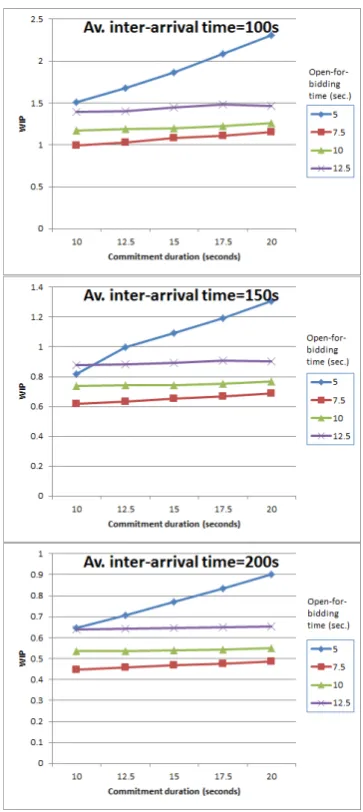
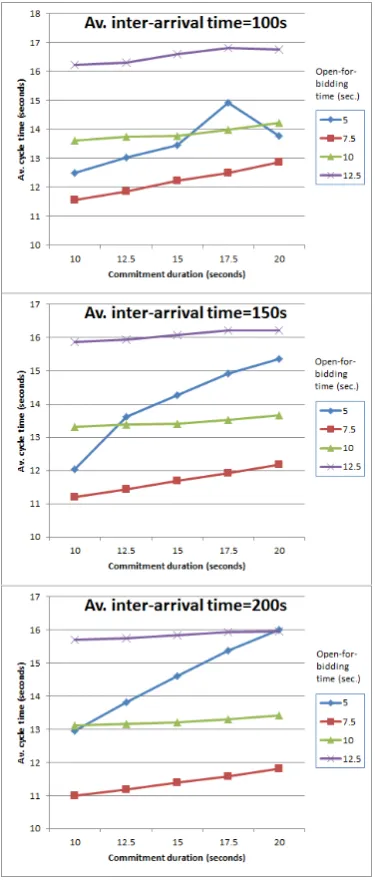
[image:4.595.335.517.49.456.2]We conducted simulation runs using different combina-tions of OBD and CD values (OBD = 5, 7.5, 10.0, 12.5 seconds and CD = 10, 12.5, 15, 17.5, 20 seconds). Each simulation run had a run length of 150 hours and was initially replicated for 10 times. We carried trial runs with various mean part inter-arrival times and settled with a range of mean part inter-arrival times (λ=100,150,200 seconds) that maintain the system in a steady state. Then, by plotting the system’s WIP against time during each run (in Arena’s Output Analyzer), we identified a suitable warm-up period of 30 hours for all the simulation runs included in our analysis. The performance of the system was examined by measur-ing the average work-in-progress (WIP) and average cycle
Fig. 5. Simulation results: WIP
time of parts. Furthermore, we measure the number of parts receiving bids from all three machine agents. Whenever necessary, the number of replications in a simulation run was increased to ensure that the 95% confidence interval half-width of each performance measure was no more than 2.5% of its average.
[image:4.595.50.295.69.180.2]C. Results
Fig. 6. Simulation results: Average part cycle time (in seconds)
level of WIP. This explains the impact of CD on WIP in the case of OBD=5s in our results.
In terms of average cycle time (see Figure 6), an OBD of 7.5s again represents the optimal choice in our simulation experiment. In general, a longer OBD time lengthens the cycle time of a part and hence a OBD of 12.5s tends to get the highest cycle time averages in the experiment results. On the other hand, when OBD is so short (OBD=5s) that machine agents easily miss the bidding deadlines as explained above, average cycle time also suffers from more task re-announcements and longer commitment durations.
Figure 7 compares the average counts of tasks receiving three bids under the different combinations of OBD and CD times. The comparison reveals that longer OBD time (10s & 12.5s) has the advantage of allowing more tasks to receive bids from all machine agents and potentially improving the optimality of bid selection.
[image:5.595.76.264.52.493.2]On the whole, OBD plays the more decisive role in our experiment on the performance of the agent negotiation process and this includes WIP, average cycle time and the number of bids received for each task.
Fig. 7. Simulation results: Average number of parts receiving three bids
V. SUMMARY AND DISCUSSION
as-sumed that machine agents keep at most one task announce-ment message in their input buffers and simply drop any incoming messages beyond the buffer limit. The limit is put in place to prevent machine agents from being overwhelmed by task re-announcement messages and, without it, machine agents would find themselves handling such messages long after the relevant tasks have been allocated.
Finally, communication overheads can also be a concern if the scale of operation is large enough to overload the network bandwidth and/or communication processors. In a previous simulation study [21], there were 50 machine agents and the communication overheads of the token-ring-based local area network were taken into account. The results did not suggest any bottlenecks in the network bandwidth or communication processors. Given the relatively small scale of our model, we have assumed that the amount of overheads is negligible.
VI. CONCLUDING REMARKS
We have conducted a simulation case study on agent-based manufacturing control with a focus on the time-bound agent negotiation process based on the contract net protocol. The results show that the process requires the judicious setting of its timing parameters in order to run smoothly and efficiently. To extend our work further, variations of other timing param-eters (e.g. machine setup time) can be incorporated into the experiment so as to study their performance implications.
REFERENCES
[1] H. V. D. Parunak, “Applications of Distributed Artificial Intelligence in Industry,” inFoundations of Distributed Artificial Intelligence, G. M. P. O’Hare and N. R. Jennings, Eds. New York, NY, USA: John Wiley & Sons, Inc., 1996, ch. 4, pp. 139–164.
[2] A. S. Koulinitch and L. B. Sheremetov, “Coordination and commu-nication issues in multi-agent expert system: concurrent configuration design advisor,”Expert Systems with Applications, vol. 15, no. 3-4, pp. 295 – 307, 1998.
[3] A. Aldea, R. Banares-Alcantara, L. Jimenez, A. Moreno, J. Martinez, and D. Riano, “The scope of application of multi-agent systems in the process industry: Three case studies,” Expert Systems with Applications, vol. 26, no. 1, pp. 39 – 47, 2004.
[4] O. B. Kwon and J. J. Lee, “A multi-agent intelligent system for efficient erp maintenance,”Expert Systems with Applications, vol. 21, no. 4, pp. 191 – 202, 2001.
[5] M. Caridi and S. Cavalieri, “Multi-agent systems in production plan-ning and control: an overview,” Production Planning & Control, vol. 15, no. 2, pp. 106–118, 2004.
[6] J.-H. Lee and C.-O. Kim, “Multi-agent systems applications in man-ufacturing systems and supply chain management: A review paper,”
International Journal of Production Research, vol. 46, no. 1, pp. 233– 265, January 2008.
[7] Y. J. Yang, T.-W. Sung, C. Wu, and H.-Y. Chen, “An agent-based workflow system for enterprise based on fipa-os framework,”Expert Systems with Applications, vol. 37, no. 1, pp. 393 – 400, 2010. [8] D. J. Wu, “Software agents for knowledge management: coordination
in multi-agent supply chains and auctions,” Expert Systems with Applications, vol. 20, no. 1, pp. 51 – 64, 2001.
[9] N. Duffie and R. Piper, “Nonhierarchical control of manufacturing systems,”Journal of Manufacturing Systems, vol. 5, no. 2, pp. 137– 139, 1986.
[10] A. Baker, “A survey of factory control algorithms that can be imple-mented in a multi-agent heterarchy: dispatching, scheduling, and pull,”
Journal of Manufacturing Systems, vol. 17, no. 4, pp. 297–320, 1998. [11] P. C. Pendharkar, “A computational study on design and performance issues of multi-agent intelligent systems for dynamic scheduling environments,”Expert Systems with Applications, vol. 16, no. 2, pp. 121 – 133, 1999.
[12] R. Brennan and W. O, “Performance analysis of a multi-agent schedul-ing and control system under manufacturschedul-ing disturbances,”Production Planning & Control, vol. 15, no. 2, pp. 225–235, 2004.
[13] P. Cowling, D. Ouelhadj, and S. Petrovic, “Dynamic scheduling of steel casting and milling using multi-agents,”Production Planning & Control, vol. 15, no. 2, pp. 178–188, 2004.
[14] T. Wong, C. Leung, K. Mak, and R. Fung, “Dynamic shopfloor scheduling in multi-agent manufacturing systems,” Expert Systems with Applications, vol. 31, no. 3, pp. 486–494, 2006.
[15] R. G. Smith, “The Contract Net Protocol: High-Level Communication and Control in a Distributed Problem Solver,”IEEE Transactions on Computer, vol. 29, pp. 1104–1113, 1980.
[16] R. Davis and R. G. Smith, “Negotiation as a Metaphor for Distributed Problem Solving,”Artificial Intelligence, vol. 20, pp. 63–109, 1983. [17] P. Gu, S. Balasubramanian, and D. Norrie, “Bidding-based process
planning and scheduling in a multi-agent system,” Computers & Industrial Engineering, vol. 32, no. 2, pp. 477–496, 1997.
[18] N. K. C. Krothapalli and A. V. Deshmukh, “Design of negotiation pro-tocols for multi-agent manufacturing systems,”International Journal of Production Research, vol. 37, no. 7, pp. 1601–1624, 1999. [19] T. Coudert, B. Grabot, and B. Archimede, “Production/maintenance
cooperative scheduling using multi-agents and fuzzy logic,” Interna-tional Journal of Production Research, vol. 40, no. 18, pp. 4611–4632, 2002.
[20] N. A. Duffie, V. V. Prabhu, and P. O. Kaltjob, “Closed-loop real-time cooperative decision-making dynamics in heterarchical manufacturing systems,”Journal of Manufacturing Systems, vol. 21, no. 6, pp. 409 – 418, 2002.
[21] K. J. Tilley, “Machining task allocation in discrete manufacturing sys-tems,” inMarket-Based Control: A Paradigm for Distributed Resource Allocation, S. H. Clearwater, Ed. River Edge, NJ, USA: World Scientific Publishing Co., Inc., 1996, ch. 9, pp. 224–252.
[22] T. Wong, C. Leung, K. Mak, and R. Fung, “An agent-based negotiation approach to integrate process planning and scheduling,”International Journal of Production Research, vol. 44, no. 7, pp. 1331–1351, 2006. [23] K. Lee, Y. Chang, and J. Lee, “Time-bound negotiation framework for electronic commerce agents,”Decision Support Systems, vol. 28, no. 4, pp. 319–331, 2000.
[24] W. Shen and D. Norrie, “Agent-based systems for intelligent manufac-turing: a state-of-the-art survey,”Knowledge and Information Systems, vol. 1, no. 2, pp. 129–156, 1999.
[25] P. Leit˜ao, “Agent-based distributed manufacturing control: A state-of-the-art survey,”Engineering Applications of Artificial Intelligence, vol. 22, no. 7, pp. 979 – 991, 2009.
[26] J. Frayret, S. D ´Amours, and B. Montreuil, “Coordination and control in distributed and agent-based manufacturing systems,” Production Planning & Control, vol. 15, no. 1, pp. 42–54, 2004.
[27] S. S. Heragu, R. J. Graves, B. I. Kim, and A. S. Onge, “Intelligent agent based framework for manufacturing systems control,” IEEE Transactions on Systems, Man and Cybernetics, Part A: Systems and Humans, vol. 32, no. 5, pp. 560 – 573, 2003.
[28] H. V. D. Parunak, “Manufacturing Experience with the Contract Net,” in Distributed Artificial Intelligence, M. N. Huhns, Ed. Pitman, London, 1987, pp. 285–310.
[29] M. J. Shaw, “A distributed scheduling method for computer integrated manufacturing: the use of local area networks in celluar systems,”
International Journal of Production Research, vol. 25, no. 9, pp. 1285– 1303, 1987.
[30] M. Bruccoleri, M. Amico, and G. Perrone, “Distributed intelligent control of exceptions in reconfigurable manufacturing systems,” Inter-national Journal of Production Research, vol. 41, no. 7, pp. 1393– 1412, 2003.
[31] M. Bruccoleri, P. Renna, and G. Perrone, “Reconfiguration: a key to handle exceptions and performance deteriorations in manufacturing operations,” International Journal of Production Research, vol. 43, no. 19, pp. 4125–4145, October 2005.
[32] P. Sousa, C. Ramos, and J. Neves, “The Fabricare system: a multi-agent-based scheduling prototype,”Production Planning & Control, vol. 15, no. 2, pp. 156–165, 2004.
[33] D. Veeramani and K. J. Wang, “Performance analysis of auction-based distributed shop-floor control schemes from the perspective of the communication system,” International Journal of Flexible Manufacturing Systems, vol. 9, no. 2, pp. 121 – 143, 1997. [34] D. Veeramani, K. J. Wang, and J. Rojas, “Modeling and simulation
of auction-based shop-floor control using parallel computing,” IIE transactions, vol. 30, no. 9, pp. 773 – 783, 1998.
[35] T. Sandholm and V. Lesser, “Issues in Automated Negotiation and Electronic Commerce: Extending the Contract Net Framework,” in
Proc. First International Conference on Multi-Agent Systems, V. R. Lesser, S. Conry, Y. Demazeau, and M. Tokoro, Eds., 1995, pp. 328– 335.
![Figure 1 illustrates a CNP-based negotiation process in aUML diagram. The advantages of this approach includesimplicity, reliability and scalability [27]](https://thumb-us.123doks.com/thumbv2/123dok_us/1282089.656768/2.595.47.291.49.300/figure-illustrates-negotiation-advantages-approach-includesimplicity-reliability-scalability.webp)