Abstract— In this paper we consider the use of tactile sensors to propose a better prosthetic hand from the given two types of artificial hands based upon the analysis of their force profiles when they are used to activate a push button of a mobile phone device. This experiment provides results which would lead to a possible adaptation of the better prosthetic hand. The results involve the stochastic analysis of the force profiles obtained from the human hand and the two prosthetic hands.
Index Terms—Dexterity, prosthetics, tactile sensors. I. INTRODUCTION
Human dexterity is a vital thing: people are able to grasp various objects, differentiate between objects, perform complex tasks, and switch between various actions in response to changing environments [1]. This is possible because of the physical structure of our hand (multiple fingers with multiple degrees of freedom) and also because of our sophisticated control system which is the brain. In recent times a lot of research has been conducted to try and create an artificial sense of touch for robots to bestow them with some of the manipulation capabilities that humans have [2]. These manipulations require a control of forces and motions at the area of contact between the fingers and the environment which can only be accomplished by touch. The artificial hands for sociable robotics and prosthetics are expected to be touched by other people [3]. Because the skin is the main interface during the contact, there arises a need to duplicate humanlike characteristics for artificial skins for safety and social acceptance [4].
Tactile sensing can provide essential information about properties such as compliance, friction, surface texture and hardness [5]. Tactile sensing is also essential for detecting physical contacts and it can effectively assist humans in object grasping and manipulation by providing information about the contact configuration [6]. Due to different shapes of objects, different forces and pressure patterns are generated. Object identification using tactile sensing has been shown to be accurate and quick, mostly in recognition through material properties [7]. However, emphasis of the researchers in this field has been mainly on analyzing the geometric
Manuscript received April 08, 2012; revised April 16, 2012.
Prerit Mishra is a student at the Faculty of Engineering, National University of Singapore; e-mail: [email protected]).
Hosmane Ramakrishna Venkatesh is a student at the Faculty of Engineering, National University of Singapore (e-mail: [email protected]).
Lasitha Dananjaya Ranawakage is a student at the Faculty of Engineering, National University of Singapore (e-mail:[email protected]).
characteristics due to their sufficiency for highly efficient recognition tasks. Knowledge of these parameters becomes crucial if robots are to reliably handle unknown objects in an unstructured environment [8].
Currently prosthetic arms and hands which can be controlled by electromyography are being developed. Eventually, these advanced prosthetic devices will be expected to touch and be touched by other people [9]. Although appearance wise the prosthetic hands are similar to human hands, currently available prosthetic hands have physical properties that are far from the characteristics of human skins because they are much stiffer [10]. Recent research in prosthetic hands aims at developing innovative cybernetic systems to allow users to feel an artificial hand as part of their bodies by providing the tactile sensation of a natural hand [11]. Such prostheses must be endowed with artificial proprioceptive and exteroceptive sensory systems as well as appropriate neural interfaces able to exchange sensory- motor signals between the body and the nervous system of an amputee [12].
Many works on the tactile sensing multi-fingered robot hand have been reported. Howe et al. developed a dynamic tactile sensor which detects slippage by means of the change of stresses due to deformation of the contact with the object (Howe & Cutkosky, 1993). Maeno et al. presented a tactile sensor, called “artificial finger skin” based on PVDF (Fusjimoto et al., 1999; Yamano et al., 2003). This sensor capable of detecting the incipient slip was designed to possess characteristics similar to that of the human finger [13]. Hosoda
et al. reported a soft fingertip with two layers made of different kinds of silicon rubbers (Hosoda et al., 2003). Hirzinger et al. developed DLR-Hand II, which build the actuators into the hand. Each finger of robot hand is equipped with motors, 6-DOF fingertip force torque sensor and integrated electronics (Butterfass et al., 2001; Gao et al., 2003). Shimojo et al. utilized the pressure conductive rubber as a pressure sensitive material (Shimojo et al., 2004). They attached the sensor on a four finger robot hand and demonstrated its grasping operations [14].
The developments of tactile sensors have focused on the individual sensor components rather than on complete systems for tactile sensing. This work demonstrates the feasibility of a tactile sensory system to be used in the force analysis for activating a tactile push button. The knowledge of the dynamic behavior of the sensor was essential for the correct acquisition and interpretation of the input signals. To avoid cognitive overload it is important that amputees with prosthetic devices are provided with sensory feedback congruent with physiological signals. If detecting discrete events – as would be possible with the proposed artificial sensory system – is indeed crucial for the control of the grasp and- lift task in humans as proposed in literature
Prerit Mishra, Hosmane Ramakrishna Venkatesh, and Lasitha Dananjaya Ranawakage, Member, IAENG
Differences in Human and Prosthetic Hand
Based on Tactile Feedback
remains to be shown in future studies. Likewise, further studies are required to explore the possibility to exploit these sensors in the development of autonomous systems for the control of manipulation [15].
Despite the amount of research in this area, a robotic hand which is similar to the human hand has not yet been developed. More research is required to put the tactile sensor into practical use, because there remain many problems such as the limitations in the hardware and algorithms for signal processing, the lack of the reliability, accuracy, response speed, dynamic static characteristic, economical efficiency (Nicholls & Lee, 1989; Lee & Nicholls, 1995).
The sense of touch is the basis of all dexterous manipulations. In this paper we focus on real time control of precision manipulation by a multi fingered hand [16]. The human sense of touch is the main source of insight and inspiration for the development of robotic tactile sensing. This experiment serves to play a part in the sensor driven manipulation research area. It focuses on analysis of the contact forces in action when a push button of a mobile phone is activated by the index finger of the right hand. This is extended to the study of contact forces applied by a human hand and also two types of prosthetic hands. The two prosthetic hands are artificially developed using dragon skin [17].
II. HUMANTACTILESENSING
A tactile sensor is a device which receives and responds to a signal or stimulus having to do with force. The term tactile refers to the somatosensory system or more commonly the sense of touch [18]. Tactile sensors are gaining more attention than ever before in the robot and medical research field. In humans, tactile sensing is indispensable for three different kinds of activities: manipulation, exploration and response. There are two types of contact sensing in human beings. One is kinesthetic sensing and the other is cutaneous sensing [19]. The most important distinction between these two components of contact sensing in humans is that kinesthetic sensing refers to perception of the limb motion and forces with internal receptors, while cutaneous sensing is the perception of contact information with receptors in the skin. Although this experiment takes into account these components, the main objective is to analyze the forces applied on a surface by a human\prosthetic hand.
The durability of the sensor and sensor package is critical to use in biomedical applications [20]. For example durability is vital in the field of medical rehabilitation, such as prosthetic arm design. A finger-or hand-mounted sensor is subjected to a wide range of forces, temperatures, and chemicals. Humans can localize lumps in soft tissue using the distributed tactile feedback and processing afforded by the fingers and brain [21]. This task becomes extremely difficult when the fingers are not in direct contact with the tissue, such as in laparoscopic or robot-assisted procedures.
In this work, we compare the performance of a capacitive tactile sensor with that of the human finger. We evaluate the
response of the sensor to the prosthetic finger and compare it to that of human subjects performing an equivalent task on the same surface. In this experiment the capacitive based pressure sensor is used to detect the force used to press the push-button of a mobile phone (Galaxy S1, Samsung, Korea). Three types of hands were used in this experiment. These were human hand, a stiff prosthetic hand and a soft prosthetic hand. The sensor was placed in the right index finger’s fingertip. Then each type of hand was used to exert force on the push- button. The sensor then detects the force exerted and displays the magnitude using the software Chameleon TVR.
III. EXPERIMENTALSETUP
In this experimental analysis we analyze the force differences at the tip of the right index finger of the human hand and the two prosthetic arms as described in the earlier sections in activating a push button. The development of a finger-mounted tactile sensor which meets the requirements necessary for typical applications poses a challenge [22]. Many types of commercially available sensors have been investigated for various applications in tactile sensing. Recent technological advances have provided small, thin sensors having promise for use in directly measuring individual finger forces during various normal activities [23].
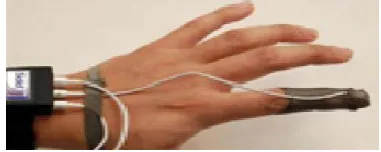
[image:2.595.330.521.484.560.2]We try and identify which of the artificial hands behaves more like the human hand. The development of a finger-mounted tactile sensor which meets the requirements necessary for typical applications has been elusive [23]. In this experiment we make use of a capacitive stress sensor (FingerTPS II, Pressure Profile Systems Inc., CA, USA) to analyze the force applied on a push button. The finger-mounted sensor is shown in Fig. 2.
Fig. 1 positioning of the FingerTPS II sensor
Precise force data and video images were captured and displayed in real-time via PPS’ Chameleon TVR software. The device which is used in this experiment on which the force sensing analysis is carried out is the push tactile button of the mobile phone (Samsung Galaxy S1). Samsung Galaxy S1 is a Bar phone weighing 118g. It′s dimensions are (122.4mm x 64.2mm x 9.9mm).The size of the push button in the phone is (13.5mm x 10mm), which also approximates the area of contact between the fingertip
and the button. We began by studying the human hands
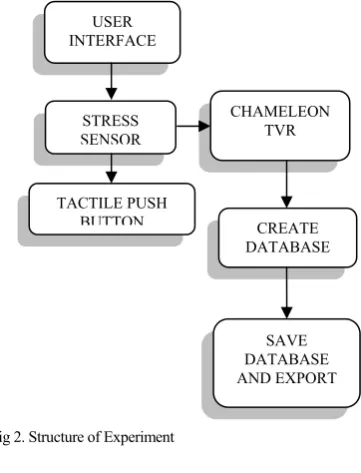
the soft and the stiff prosthetic hand are made from dragon skin material but the difference between the two is the that the softer version of the hand does not have the bone structure inside it whereas the stiff version is a mimic of the actual hand and has a bone structure embedded with a stiffer packaging which makes it hard [24]. The block diagram of the overall structure of this experimental setup is as shown in the following Fig. 2.
Fig 2. Structure of Experiment
IV. METHODOFTESTING
In this experiment, we only consider the force analysis at the right index finger tip which is in contact with the push button. A force sensor was attached to the PC from the tip of the index finger. Four subjects were selected to carry out this experiment. Approximately 40 to 45 samples were collected for each type of hand (human, soft and stiff) in a sequence. So a total of around 160 to 180 samples were collected for each type of hand. The FingerTPS stress sensor was wrapped around the right index finger of the subjects. They were made to apply force on the push button to activate it. The activation was sensed by the activation of the AMOLED screen which is off initially. A sequential order of the subjects was decided to conduct the experiment. The order followed was 1, 2, 3, 4, 1, 2… The live data was recorded and saved. The push button was activated approximately in a time gap of 5.6 seconds. The time gap was due to the user setting of the device used. The screen time out was set to be 5 seconds which meant that an individual force profile extended for approximately 250 to 275 seconds.
The sensor was then wrapped around the right index finger of the soft prosthetic hand. The soft prosthetic hand was held by the subjects approximately at an angle of 20 degrees to the horizontal over the push button. The push button was activated by applying force over it through the soft prosthetic hand by the subjects and about 40 samples were collected. The same time gap was observed in this case due to the already mentioned reason. The data for the soft prosthetic hand is stored in the same way. The above mentioned procedure was repeated for the stiff hand and the data.
V. RESULTS
[image:3.595.311.548.271.774.2]The raw data collected was imported and processed using MATLAB. We used ANOVA in the statistical analysis. The basis of the analysis of the data was on finding the closer match of the human hand among the two given artificial hand. For this type of analysis, stochastic interpretation of the data was required [25]. The samples were randomized for this purpose. The reason for randomness is to convert unknown or unknowable systematic differences (between experimental units or force profile of subjects) into random quantities whose behavior is controlled by the laws of probability [26]. The time domain plots of the sample data were generated and the force profile was observed. Besides the peak values of the force, the time duration of the forces applied were also observed. The data samples collected for the soft, stiff and the human hand are shown below in Fig. 3, Fig. 4 and Fig. 5 respectively.
Fig 3. Force data for soft hand
Fig 4. Force data for stiff hand
Fig 5. Force data for human hand USER
INTERFACE
STRESS SENSOR
TACTILE PUSH BUTTON
CHAMELEON TVR
CREATE DATABASE
The offset observed in the data samples is the calibration value. For the analysis purpose, only the actual value of the force is used. The maximum and minimum values are calculated from the samples using a peak detector algorithm. This actual value is then obtained by the calculating the difference of the maxima with the previous minima [27]. The general structure of the peakdet() function is as follows:
[maxtab,mintab]=peakdet(x,delta,t)
[image:4.595.309.554.47.197.2]Pertaining to this field of analysis the peakdet() function with a threshold value(delta) of 0.25 was found to be suitable by the trial and error method and hence was made use of which yielded a sample result as shown in the Fig. 6. The maxtab and mintab variables returned the maximum and minimum values shown by the red and the green dots respectively in the Fig. 6.
Fig 6. peakdet() function output
This was followed by the analysis of variance on the data to find the closeness of the prosthetic hands with the human hand. Experiments were conducted to find a closer match of the human hand based on their force profiles from given prosthetic hands. The analysis of variance gave the following results:
[image:4.595.50.284.250.402.2]Fig 7. human hand vs. soft hand
Fig 8. Human hand vs. stiff hand
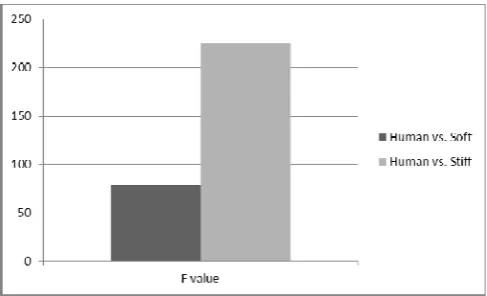
A one factor ANOVA served the purpose here as there was only one factor (the force applied on the tactile push button) to be considered [30]. The above graphs show the mean forces applied to be able to activate the push button of the mobile device. It can be clearly seen that the forces required with a stiff prosthetic hand is much lesser. Based on the results, it was observed that there was significant difference among the group of data which was taken and the null hypothesis could be rejected. The F value evaluated was greater than the F critical value and even the P value was found to be much lesser than the alpha value (0.05). The samples of the prosthetic hands (soft and stiff) showed significant differences from the human hand data sample which proves that they were picked up from different samples. However, statistically it can be said that the stiff hand is the better one due to its higher F value [31].
Fig 9. F value comparison obtained from the ANOVA. Note that the F critical value was found to be 3.873283
[image:4.595.309.553.457.605.2] [image:4.595.47.292.560.706.2]VI. CONCLUSION
Adequate devices and low level signal processing techniques have now been developed and we have a good understanding of how touch can be used to provide information about a variety of geometric and mechanical properties of the environment [33]. From the stochastic analysis we observed that the stiff hand is a closer match to the Human hand based upon the force profile analysis. It was also observed that the force required to activate the push button was less with the stiff hand. This would mean that an actuator running the prosthetic hand would require less power to drive it. Future work on automating the experimental setup by the introduction of a robotic hand controller to apply the forces on the device would result in concrete results [35]. However generalizing the fact that the stiff hand will prove to be an appropriate substitute for the human hand is not possible at this stage as various other factors related to human dexterity like the sensation of touch, degrees of freedom are yet to be considered. Although based upon the analysis of the force acting on the push button, it can be concluded that the stiff hand has a better performance than that of the soft hand.
REFERENCES
[1] P. Dario, “Tactile sensing: Technology and applications,” Sens. Actuators A, 25–27, pp. 251–256,
[2] J. G. Webster, Ed., Tactile Sensors for Robotics and Medicine. New York: Wiley, 1988.
[3] J. G. Webster, “Artificial sensors suitable for closed-loop control of FNS,” in Neural Prostheses: Replacing Motor Function After Disease or Disability, R. B. Stein, P. H. Peckham, and D. B. Popovic, Eds. New York: Oxford Univ. Press, 1992, pp. 88–98.
[4] D. Tandeske, Pressure sensors: Selection and Application. New York: Marcel Dekker, 1991
[5] Cabibihan JJ, Ge SS. In: Advances in Robotics. Kim JH, Ge SS,Vadakkepat P, Jesse N, editor. Vol. 5744. Springer; 2009. Towards humanlike social touch for prosthetics and sociable robotics: Three- dimensional finite element simulations of synthetic finger phalanges; pp. 80–86.
[6] G. L. Fellows and A. Freivalds, “The use of force sensing resistors in ergonomic tool design,” in Proc. Human Factors Society 33rd Annu. Meeting, 1989, pp. 713–717.
[7] R. G. Radwin and S. Oh, “External finger forces in submaximal five- finger static pinch prehension,” Ergonom., vol. 35, pp. 275–288, 1992 [8] Y. S. Lee and K. D. Wise, “A batch-fabricated silicon capacitive
pressure transducer with low temperature sensitivity,” IEEE Trans.Electron Devices, vol. ED-29, pp. 42–48, 1982.
[9] G. Box, W. Hunter, and J. Hunter, Statistics for Experimenters. New York: Wiley, 1978.
[10] J. Bentley. Principles of Measurement Systems. Longman, New York, 1983
[11] P. Dario. Tactile sensing for robots: present and future. In O. Khatib, J. J. Craig, and T. Lozano-Perez, editors, The Robotics Review 1, pages 133{146. M.I.T. Press, 1989.
[12] H. R. Nicholls. Advanced Tactile Sensing for Robotics. WorldScientific Press, 1992.
[13] [13] J. Son and R. Howe. Tactile sensing and stifness control with multingered hands. In Proc. of the 1996 IEEE International Conference on Robotics and Automation, pages 3228{3233,
1996.
[14] R.A. Russell, S. Parkinson: Sensing surface shape by touch, Robotics and Automation, 1993. Proceedings., 1993 IEEE International Conference on 1993 423 – 428 vol.1
[15] P. Dario, R. Lazzarini, R. Magni, S.R. Oh: An integrated miniature fingertip sensor, Micro Machine and Human Science, 1996., Proceedings of the Seventh International Symposium 1996 91 – 97 [16] Darwin G. Caldwell, Clarence Gosney: Enhanced tactile feedback
(Tele-taction) using a multifunctional sensory system, Proceedings - IEEE International Conference on Robotics and Automation 1 (1993) 955 – 960
[17] B. A. Auld, A. J. Bahr: A novel multifunction robot sensor, Proceedings of the 1986 IEEE International Conference on Robotics and Automation 1986 1262 – 1267
[18] H. Clergeot, D. Placko, J. M. Detriche: Electrical proximity sensors, Sensors and Sensory Systems for Advanced Robotics, ed. by P. Dario (SpringerVerlag 1986) 295 – 308
[19] M. Kaneko, K. Tanie: Contact point detection for grasping of an unknown object using selfposture changeability (SPC), Proceedings of the 1990 IEEE International Conference on Robotics and
Automation 1990 864 – 869
[20] J. K. Salisbury: Kinematic and force analysis of articulated hands. In: Robot hands and the mechanics of manipulation, ed. by M. T. Mason, J. K.Salisbury (MIT Press 1985)
[21] Alan Pugh (Ed.): Robot sensors, Volume 2: Tactile and Non-Vision(IFS Publications/SpringerVerlag, 1986)
[22] J. G. Webster: Tactile Sensors for Robotics and Medicine (John Wiley and Sons, 1988)
[23] D. Brock, S. Chiu: Environment Perception of an Articulated Robot Hand Using Contact Sensors, Robotics and Manufacturing Automation 1985 89 –96
[24] F. W. Sinden, R. A. Boie: A planar capacitive force sensor with six degrees of freedom, Proceedings of the 1986 IEEE International Conference on Robotics and Automation 1986 1806 – 1813
[25] B.B. Edin, L. Beccai, L. Ascari, S. Roccella, J.J. Cabibihan, M.C. Carrozza: A bio-inspired approach for the design and characterization of a tactile sensory system for a cybernetic prosthetic hand, Robotics and Automation, 2006. Proceedings., 2006 IEEE International Conference on 2006 1354 – 1358
[26] Yong-Lae Park, K. Chau, R. J. Black, M. R. Cutkosky: Force Sensing Robot Fingers using Embedded Fiber Bragg Grating Sensors and Shape Deposition Manufacturing, 2007 IEEE International Conference on Robotics and Automation (IEEE 2007) 1510 – 1516 [27] R. E. Ellis: Extraction of Tactile Features by Passive and Active
Sensing, Intelligent Robots and Computer Vision 1984, ed. by D. P. Casasent
[28] S. Omata, Y. Terunuma: Development of a new type of tactile sensor for detecting hardness and/or softness of an object like the human hand, TRANSDUCERS ’91: Proceedings of the 6th International Conference on Solid-State Sensors and Actuators 1991 868 – 871 [29] A. R. Grahn, L. Astle: Robotic ultrasonic force sensor arrays. In:
Robot sensors, Volume 2: Tactile and Non-Vision, ed. by Alan Pugh (IFS Publications/Springer-Verlag 1986) pp. 297 – 315
[30] J.J. Cabibihan, S. Pattofatto, M. Jomaa, A. Benallal, M.C. Carrozza. Towards humanlike social touch for sociable robotics and prosthetics: Comparisons on the compliance, conformance and hysteresis of synthetic and human fingertip skins, Inaugural Issue of the Intl J. of Social Robotics (2009) 1: 29-40.
[31] JJ Cabibihan, R Pradipta, SS Ge, Prosthetic finger phalanges with lifelike skin compliance for low-force social touching interactions Journal of NeuroEngineering and Rehabilitation 2011, 8:16. [32] JJ Cabibihan, I Ahmed, SS Ge,Force and motion analyses of the
human patting gesture for robotic social touching, Proc on Cybernetics and Intelligent Systems (CIS), 2011,Qingdao, China [33] JJ Cabibihan, Patient-Specific Prosthetic Fingers by Remote
Collaboration–A Case Study, Public Library of Science (PLoS) ONE, 2011, 6(5): e19508.
[34] S Salehi, JJ Cabibihan, SS Ge, Artificial Skin Ridges Enhance Tactile Shape Discrimination, Sensors, 2011, 11:1.