A Study on GST and its Implementation in India
E. Teja Shree
Studen , MBA Department , Anurag group of institutions
Abstract: GST is the biggest indirect tax reform of India. It is a comprehensive tax levy on manufacture, sale and consumption of goods and services at a national level. It has subsumed taxes like central excise law, service tax law, VAT, entry tax, Octroi etc. GST is expected to bring together state economies and improve overall economic growth of the nation.
They are more than 150 countries which has GST in place. In India the goods and services are taxed according to the slab rates. The taxes are made from both State and Central. They have been many problems raised at the initial stage of the GST implementation.
Some sectors are been selected for the study that has impact of GST and major changes made by the government in the tax rates of the selected sectors. The tax collection and revenue generated to the government are studied comparing with the previous year’s data.
I. INTRODUCTION
A. Goods and Service Tax
The Goods and Services Tax (GST) is a value-added tax levied on most of goods and services sold for domestic consumption. The GST is paid by consumers, but it is remitted to the government by the businesses selling the goods and services. In effect, GST provides revenue for the government.
The goods and services tax (GST) is an indirect tax which is applied to the cost of certain goods and services. The GST is added to the price of products were customers pays the sales price plus GST at the time of purchasing the products. It is collected by the seller and transferred to the government. It is also referred to as value-added tax (VAT).
B. GST Initiation
France was the first to introduce GST. It is introduced in the year 1954. Only Canada has dual GST model (just India is going to implement Dual GST Model). GST Tax rates ranges between 15-20% and it may differ to higher/lower side in few countries.
C. Models of GST in India
D. Benefits of GST
1) Making the process more transparent the electronic matching of input tax credits are made all-across India.
2) More efficient neutralization of taxes especially to the exports of the country.
3) Average tax burden on companies is likely to come down which is expected to reduce prices and low or prices mean more consumption.
4) It is expected that a relatively a large segment of small retailers will be either exempted from tax or will suffer very low tax rates under compounding scheme – purchase from such entities will cost less for the consumers;
5) is simpler tax regime with fewer exemptions;
E. Products Categorized Under GST
GST rates of all items in India on May 2017
EXEMPT 5% 12% 18% 28%
Food grains, gur, milk, eggs, Betel leaves, cane jiggery, unpacked paneer and natural honey, fresh vegetables, vegetable oil common salt, fish seeds, atta, besan, maida
Sugar, coffee, newsprint, edible oil , tea, milk food for babies, packed paneer, LPG brooms, beet sugar Natural graphite, chalk , natural calcium phosphates, Thorium oxalate
Butter, mobiles, cashew, almonds, sausages, fruit juice, packed coconut, water, agabatti, Bio gas, medicinal grade hydrogen peroxide, lodine
Hair oil, soap, toothpaste, capital goods, industrial intermediaries, jams, iron and steel, fountain pen, Indian katha, fluorine, chlorine, bromine, artificial waxes. Consumer durables, cars, cement, chewing gum, custard powder, shampoo makeup, fireworks, motorcycles, avgas, hair cream & dyes, prepared explosives.
GST rates that are reduced in December 2018
Goods/Services Old rate New rate
Marble rubble 18 5
Parts and accessories for the carriages for disabled persons 28 5
Natural cork, walking stick, fly ash blocks 15 5
Music books 12 0
Vegetables frozen, GST on solar power generating plant 5 0
Third party insurance premium of goods carrying vehicles 12 5
F. Objective Of The Study
1) To Identify the problems of GST implementation in India
2) To analyze the GST impact on selected sectors (Real estate, Banking, Automobiles, Advertising, Hospitality sector)
3) To study the impact of GST on tax collection and sales growth
G. Scope Of The Study
The Scope of the study is GST implementation in India. The period of the study is from July 2017 to March 2019.
H. Research Methodology
II. REVIEW OF LITERATURE
A. Benedict, (2011) The author studies the law provisions dealing with financial services under the Australian GST law with the intention to verify whether the provisions have been construed correctly in light of the original purpose of the legislation and how the concerns identified may be rectified.
B. Bikas, (2013) The authors have studied the VAT rate and the EU economy and also the link between the VAT and macroeconomic indicators and their influence on the VAT rate. The authors conclude that there is a positive relation between macroeconomic indicators like GDP, per capita income and consumption, export, import etc and the VAT rate applicable.
C. Dr. Yogesh Kailash Chandra Agrawal (2015), studied on “Goods and Service Tax and its impact on Indian economy” GST is at the infant stage in Indian economy. It will take some time to experience its effects on Indian economy. GST mechanism is designed in such a way that it is expected to generate good amount of revenue for both central and state government. Regarding corporate, businessmen and service providers it will be beneficial in long run. It will bring transparency in collection of indirect taxes benefiting both the Government and the people of India.
D. Poona m (2017), the biggest problems in Indian tax system like Cascading effect and tax evasion, distortion can be minimized by implementing GST. After amalgamation of local state and central taxes competitiveness of industry, exporter and company will increase. The extra revenue which can be generated from broaden tax base structure can be utilized for the growth of nation. In economy tax polices play an important role because of their impact on efficiency and equity. Indirect tax reforms have been as integral part of the liberalization process since new economic reforms.
E. Times of India dated (27 July, 2017), stated that the GST implication across different places for the same product has wider differences which the consumers are unaware resulting them in surprise. Ex A Rasamalai sold in counter at a shop is taxed with 5% but if it is served in the hotel it is taxed with 18% this has resulted in difference of consumers shopping to purchase the similar products.
III. GST IN GLOBAL SCENARIO
Goods and Service tax (GST) is commonly known as VAT all over the world. Around 150 countries have introduced GST/ National VAT. Among which France was the first country which has introduce GST system in 1954. India is one of the countries with a dual GST regime alongside Canada and Brazil. In most of the countries the standard GST rate ranges between 15-20%.
A. GST Structures in Different Countries
a) France: France was the first country to introduce VAT, followed by Germany and other EU member states. In the year 1954 it has introduced GST to reduce the tax-evasion due to high sales taxes and tariffs in the country encouraged cheating and smuggling which is one of the reason for introduction of the GST in the country. Later it was extended across the whole economy in 1968. There are four rates of VAT in France: 2.1 per cent, 5.5 per cent, 10 per cent and 20 per cent since its first implementation.
b) Australia: The country has first seeked the GST concept in the year 1975, and was implemented in the year 2000 which was after 25 years with the tax rate starting at 10%. The GST has replaced all the existing taxes in the country like the wholesale sales tax, debit tax, financial institutions duty, and stamp on shares, leases, mortgages and cheques.
c) Malaysia: The country introduced the GST in the year 2015. It introduced with a standard rate of 6% which is relatively low compared to VAT rates in other ASEAN countries. After implementation of GST, the country has seen the reduction of tax burden which was transferred from manufacturers to consumers.
d) Canada: The country introduced the GST in the year 1991 as a multi-level VAT on supplies of goods and services purchased in the country. It has included all the products except some like groceries, residential rent and medical services.
Canada has imposed its own sales tax besides GST which has created price distortions in the country. After the implementation, the bill led to new processing operations to verify the accuracy of the returns submitted by small entrepreneurs.
B. GST in India
1) SGST: State GST which is collected by the State Govt.
2) CGST: Central GST which is collected by the Central Govt.
3) IGST: Integrated GST which is collected by the Central Govt.
4) UTGST: Union territory GST which is collected by union territory Govt.
In India GST is governed by the GST Council and its chairman is the Finance Minister (Present Nirmala Sitharaman) of India. Under GST, goods and services will be taxed under tax slabs of 0 per cent, 5 per cent, 12 per cent, 18 per cent and 28 per cent. There is a special rate of 0.25 per cent on rough precious and semi-precious stones and 3 per cent on gold.GST Council is an apex member committee to modify, reconcile or to procure any law or regulation based on the context of goods and services tax in India and it is responsible for any changes made in the tax rates of goods and services or enactment of rules in India.
The 34th GST Council Meeting was held through via video conference on 19th March 2019. Shri Arun Jaitley has presided over the meeting of the GST Council members. The meeting was held to pass the notification drafted by the rate fitment and legal committees on the recent rate cuts on housing. Recently the 36th GST Council meeting was held on July 25, 2019 by the Union FM Nirmala Sitharaman on lowering tax rates for electric vehicles. Apart from this, the meeting also focused on the valuation of goods and services in solar power generating system and wind turbine projects towards levying of GST.
GST collections fall below Rs 1 trillion for the first time in FY20. For the first time in 4 months in June, the GST mop-up ranked below the Rs 1 trillion mark to Rs 99,939 cr. Total Gross GST revenue collected in June, 2019 is Rs.99, 939 crore of which CGST is Rs.18, 366 crore, SGST is Rs.25, 343 crore, IGST is Rs. 47,772 crore which includs Rs.21, 980 crore that are collected on imports and Cess is Rs. 8,457 crore were Rs.876 crore is collected on imports.
The Kerala Government would levy calamity cess on GST from June 1, the first state to do so. The move is aimed at raising funds for the Rebuild kerala, a state government project following the floods last year. All items with a GST slab above 5% will be taxed an additional 1% for two years. However, the levy will be applicable only for retail transactions taking place within the state. The government expects to raise Rs. 600 crore a year from the cess.
IV. GST PROBLEMS AND ITS IMPACT ON SELECT SECTORS AND DATA ANALYSIS
There are some of the problems faced in Introduction of GST in India
1) Lack of Clarity on GST Rules and Regulation: The GST provisions were still uncertain. There is no clear categorization of goods and services in various cases and also provisions for anti-profiteering, as well as the now-deferred e-way bill, which tracks consignments across states, are unclear. The new tax regime require transporters to generate e-way bills on the GST portals which includes incurring substantial costs to install radio frequency identification devices (RFIDs). Government has also made the rules related to assessment and audit public, but the absence of actual forms in the public domain has challenges the effectiveness of the rule.
2) Potential Issue in Introduction of the e-way Bills: The government had postponed the implementation of the e-way bill system (to October). Every transport of goods required the creation of an electronic way bill from the GSTN giving details of the parties to the transaction and of the goods being transported. It will add a burden to the businesses as well as transporters. Transporters have been reporting reduced tome on the road because of the introduction of the GST which may get undermined by the e-way bill requirement.
A. Impact of GST On Various Sectors
Following sectors are considered to show the impact of GST, they are
1) Real Estate: Real estate industry is one of the most important pillars of the economy. It contributes between 6-8% to the India’s Gross Domestic Product (GDP). In terms of employment generation Real estate stands in the second after IT industry.
a) Taxes before (until 31st March, 2019): The tax rates that are until 31st March 2019 allowed for complete utilization of the eligible Input Tax Credit, and the rates in force
Sr. No.
Construction Service Rate Effective Rate (excluding valuation
of land at 1/3rd of consideration)
1. Commercial apartments (shops, offices, godowns etc) 18% 12%
2. Residential apartments other than those at Sr. No. 3 18% 12%
3. Certain residential apartments under notified schemes such as Rajiv Awaas Yojana, Pradhan Mantri Awaas
b) Taxes after (from 1st April, 2019)
Sr. No. Construction Service Rate Effective Rate (excluding valuation of
land at 1/3rd of consideration)
1. Affordable residential apartments 1.5% 1%
2. Residential apartments other than
affordable residential apartments
7.5% 5%
3. Commercial apartments 7.5% 5%
2) Banking Sector: The impact of GST is high on the banking sector and the functioning of banks is much affected. Banking sector is one of the major sectors which have impact of GST among all other sectors. So, building a tax structure with GST changes is a necessity for both banks and NBFCs.
The GST tax rates were increased from 15% to 18% on the services provided by the banks and NBFCs. Issues and Impacts Related to the Provisions of GST law
a) Widespread Number of Branches; Registration a Hassle i) Under service tax compliances, a single ‘centralized’ registration
ii) They will be a separate registration for each and every state where they operate
iii) Increase in Compliance Burden
b) Paying of GST at Applicable Rate: As compared to earlier the GST rates on services increased by 3% i.e. from 15% to 18%
c) Assessment and Adjudication Made Bothersome: It would be difficult in clearing up and also dealing with the difference of opinion which is provided by the different adjudicating authority. The view on the same issue would be taken differently by different adjudicating authority under GST.
3) Automobile: The GST impact on automobile sector is considered as a positive thing because the manufacturer of automobiles can pay reduced taxes were customers will also be benefited. Before GST, there were various taxes such as road tax, sales tax, sector tax; VAT, registration duty, motor vehicle tax, etc were imposed. Now all of these have been subsumed to GST on automobile services. It is calculated with the fixed base rate of 28% pm cars with additional cess slabs such as 1%, 3%, 15%, 17%, 20% and 22%. In automobile sector both the cess and base rate together impacts GST rate. All the members of Automobile industry body Society of Indian Automobile Manufacturers (SIAM) are totally united in lowering GST rate on automobiles. The auto industry has huge multiplier effect on small companies and employment. By reducing the GST from 28% to 18% on the vehicles it would help the economy. The high-powered GST council on July 27, 2019 decided to reduce the tax rate on electric vehicles to 5% from the existing 12%, a move aimed at accelerating the adoption of eco-friendly mobility solutions. It will be effective from Aug 1st 2019, the finance ministry said in a statement after the 36th meeting of GST council. Additionally, the tax rate on charges or charging stations for EVs has been slashed from 18% to 5%. The council has also approved the GST exemption on hiring of electric buses (were carrying capacity is more than 12 passengers) by local authorities from August1.
4) Advertising: Advertisements act as a major role in the success of every business. For the year 2018 the advertising expenditure was estimated to be approx 0.45% of the Indian GDP.
a) GST Tax Rate On Advertisement In Case Of Digital Media: Advertisement through digital media is liable to GST at the rate of 18%
b) GST Tax Rate On Advertisement in Case of Print Media: The advertisement in print media is published through Newspapers and the GST is levied at 5%.
c) Advertisement That are Made Through Advertising Agencies: They are many ways an advertiser can advertise a business. An advertising agency is one among it wherein the businesses approach an agency for advertising. There are two possibilities in this kind of an arrangement
i) Advertisement in principal’s capacity
ii) Advertisement in Agent’s capacity
a) GST impact on the Hospitality Sector: The impact of GST on this sector has overall positive effect. It is expected to attract more customers and tourists with decreased rates. It also helps in the improvement of government’s revenue. Further, the tax structure will be further simplified for both customers and hotels and will have a positive impact in the long-term.
One-night Tariff GST Rate
Less Than INR 1,000 Not applicable
INR 1,000 To 2,500 12%
INR 2,500 To 7,500 18%
More Than INR 7,500 28%
Some of the benefits of GST on the Hospitality Sector
i) With unified tax system, tax structure is made easy and understandable by the customers and also they can recognize the correct tax order.
ii) Hospitality industry can be benefited of input tax credit, were hotels can reduce the tax which is already paid on input while paying the output.
iii) It is a time-saving process and also made easy calculation for the hospitality sector.
B. Data Analysis
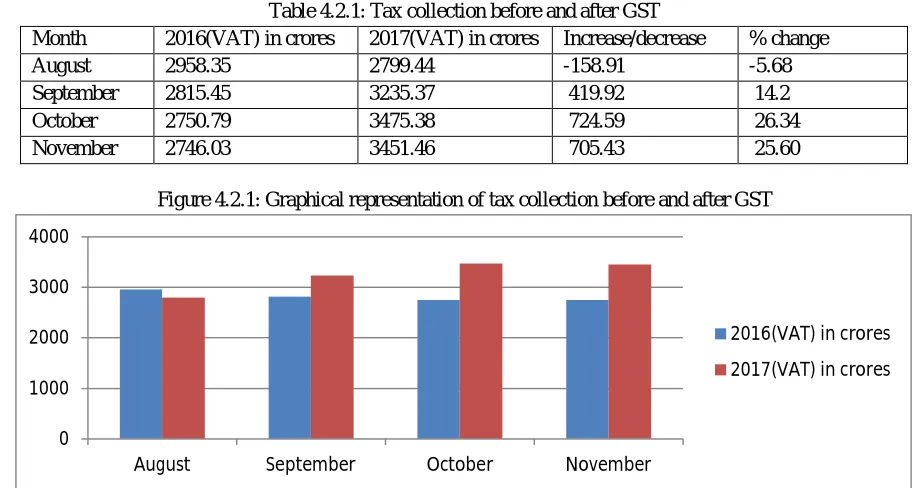
Table 4.2.1: Tax collection before and after GST
Month 2016(VAT) in crores 2017(VAT) in crores Increase/decrease % change
August 2958.35 2799.44 -158.91 -5.68
September 2815.45 3235.37 419.92 14.2
October 2750.79 3475.38 724.59 26.34
[image:6.612.74.531.312.556.2]November 2746.03 3451.46 705.43 25.60
Figure 4.2.1: Graphical representation of tax collection before and after GST
[image:6.612.67.546.645.727.2]1) Interpretation: In the above analysis the four months data (August, September, October, and November) of 2016 and 2017 is collected to compare tax collection before and after GST. In August 2016 the tax collection is 2958.35 and in 2017 is 2799.44, it says that the tax collection decreased initially when GST is implemented because people don’t have proper awareness about GST. In September, October and November the tax collection is increased more from 2016 to 2017.
Table 4.2.2: List showing growth of sales percentage of selected sectors
Sales Growth Pre GST Post GST Increase/decrease % change
Real estate 3.7 -2.8 -6.5 -175.5
Banking 4.2 2.2 -2 -47.61
Automobile 8.1 3.6 -4.5 -55.55
Advertising 5.9 4.5 -1.4 -23.72
Services 10.5 2.4 -10.5 -77.14
0 1000 2000 3000 4000
August September October November
2016(VAT) in crores
Figure 4.2.2 Graphical representation of growth of sales percentage of selected sectors
1) Interpretation: In the above analysis, to know the impact of GST on growth of sales percentage on various sectors, the data of FMCG, durable, automobile, real estate, banking, service has been collected. The sales of the selected sectors are more before GST when compared to the after GST. It has been declined more after GST implementation. The sales percentage of Real estate falls negative. Therefore, GST impact is negative on sales of various sectors.
V. FINDINGS, SUGGESTIONS & CONCLUSION
A. Findings
1) The tax collection was low at the initial stage of GST implementation, later it has increased tax collection rapidly due to wider tax base and better conformity.
2) The GST Council in its 33rd meeting on Feb 24th, 2019 had come up with new rates for housing units. From 1st April, the applicable GST rates on residential real estate were made 5% for non affordable housing properties and 1% for affordable housing properties.
3) The high-powered GST council on July 27, 2019 decided to reduce the tax rate on electric vehicles to 5% from the existing 12%, a move aimed at accelerating the adoption of eco-friendly mobility solutions.
4) With the removal of multiple taxes and VATs cascading effect, taxation is streamlined and simplified. The end-customers won’t have to pay a series of taxes on food and beverages and hotel bills
B. Suggestions
1) After GST implementation revenue collection from tax is increased.GST collections fall below Rs 1 trillion for the first time in FY20.Total Gross GST revenue collected in June, 2019 is Rs.99, 939 crore. It can be utilized for the growth of the nation.
2) The implementation of the GST will make industry more competitive through dismantling of the complex indirect tax structure and boost the tax revenue of states and thereby helping in the growth of the companies.
3) The auto industry has huge multiplier effect on small companies and employment. The reduction of GST on all vehicles would help the economy.
C. Conclusion
Goods and Service Tax (GST) is a landmark amendment in the indirect tax regime in India. It is made to avoid the cascading of taxes; it implements a smoother tax structure and encourages better tax compliance. The GST has made various multiple indirect taxes like the excise duty, service tax etc at the Central level and Value Added Tax (VAT), Octroi tax, Purchase tax etc at the State level.
REFERENCES
[1] www.cleartax.in
[2] www.economictimes.in
[3] www.timesofindia.com
[4] www.gstcouncil.gov.in
-4 -2 0 2 4 6 8 10 12
Real estate Banking Automobile Advertising Services
Pre GST