16
Online abuse detection: the value of preprocessing and neural attention
models
Dhruv Kumar University of Waterloo [email protected]
Robin Cohen University of Waterloo [email protected]
Lukasz Golab University of Waterloo [email protected]
Abstract
We propose an attention-based neural network approach to detect abusive speech in online so-cial networks. Our approach enables more ef-fective modeling of context and the semantic relationships between words. We also empiri-cally evaluate the value of text pre-processing techniques in addressing the challenge of out-of-vocabulary words in toxic content. Fi-nally, we conduct extensive experiments on the Wikipedia Talk page datasets, showing improved predictive power over the previous state-of-the-art.
1 Introduction
Over the past few years, there has been increasing attention devoted to the problems of abusive lan-guage and hate-based activity in online social net-works, with big social media platforms feeling the pressure from governments to perform some mod-eration of their activities. The AI research com-munity has begun to design automated methods to detect instances of hate speech in these networks, with a primary approach proposing the use of Nat-ural Language Processing (NLP) to perform docu-ment classification (Schmidt and Wiegand,2017). A major challenge to performing this task is the intentional word and phrase obfuscation done by users to avoid detection (Nobata et al.,2016). Ex-amples such as ‘sh*t’, ‘1d10t’ and ‘banmuslim’ are human-readable but difficult to detect using al-gorithms that rely on keyword spotting. Obfusca-tion makes context modeling, a challenging prob-lem in NLP, even harder. For example, in the sen-tences “You feminist cnt” and “I cnt understand this”, ‘cnt’ is used as a shorthand. However, with-out considering the context, it is difficult to tell whether ‘cnt’ represents ‘cannot’ or a derogatory remark.
Early work in hate speech detection used clas-sifiers such as Support Vector Machines and
Lo-gistic Regression, with features such as word n-gram counts and the number of insult words (Greevy and Smeaton, 2004; Kwok and Wang,
2013;Mehdad and Tetreault,2016). With the re-cent success of deep learning models in solving a variety of classification problems, they have also become the state-of-the-art in detecting abusive speech.
In this paper, we make the following contribu-tions towards detecting hate speech in social net-works.
1. We propose the use of attention based deep learning models, the first being the usual word attention layer and the second being a self-targeted co-attention layer that consid-ers the semantic relationships between word pairs.
2. We examine the value of text pre-processing techniques to reduce the number of out-of-vocabulary (OOV) words. We find that pre-processing not only helps to improve the ac-curacy of existing models, but also improves the proposed attention models.
Our solution addresses the main challenges in detecting abusive content: capturing context to identify important words when making classifi-cation decisions, which we achieve through the attention models, and out-of-vocabulary words, which we deal with through preprocessing. Al-together, we improve classification accuracy over the previous state of the art on the Wikipedia Tox-icity, Personal Attack, and Aggression datasets (Wulczyn et al.,2017).
In the remainder of this paper, Section 2
presents experimental results, and Section6 con-cludes the paper with directions for future work.
2 Related Work
Among the first to study the problem of online abuse detection were Yin et al. (2009) who fo-cused on harassment on the Web. They used a lin-ear Support Vector Machine (SVM) with character and word n-grams, sentiment, and contextual fea-tures of the document (cosine similarity of neigh-bouring text). One of the first to study hate speech wereDjuric et al.(2015) who used comments from the Yahoo Finance website. They learned text em-beddings using the neural language model from
Le and Mikolov (2014) and used them to train a binary classifier. Nobata et al. (2016) trained a regression model on multiple features such as word and character n-grams, as well as linguistic (e.g., number of hate blacklist words), syntactic (part-of-speech tags) and distributional semantic features (e.g., embeddings). They showed that al-though best performance was achieved when all features were used together, character n-grams were the most important.
Waseem and Hovy (2016) released a dataset containing 16,000 tweets that were manually la-beled as either racist, sexist or clean. They used a Logistic Regression classifier and showed that character n-grams were important features. Work-ing with the same dataset,Badjatiya et al. (2017) were one of the first to apply deep learning. They used a Gradient-Boosted Decision Tree (GDBT) on word embeddings learned using a Recurrent Neural Network (RNN). Also,Gamb¨ack and Sik-dar (2017) used Convolutional Neural Networks (CNN) on the same dataset. Furthermore, Park and Fung(2017) used the following two-step pro-cess. They first detected whether a tweet was abu-sive or not, and then, using another classifier, fur-ther classified the tweet as racist or sexist. They used a HybridCNN model, which is a variant of CNN that uses both words and characters to make classification decisions.
Wulczyn et al. (2017) created three datasets from the English Wikipedia Talk Page: one an-notated for personal attacks, one for toxicity, and one for aggression. Their best model was a multi-layer perceptron trained on character n-gram fea-tures. Pavlopoulos et al. (2017) then improved the accuracy on the toxicity and personal attack datasets using RNNs. In addition, they released
another dataset, with 1.6 million manually anno-tated user comments from the Greek Sports Por-tal (Gazzetta), and embeddings trained on this dataset. Mishra et al. (2018) generated embed-dings for OOV words and used them with RNNs and character n-gram features on the Twitter and the Wikipedia datasets.Lee et al.(2018) analyzed another dataset released by Founta et al. (2018), which also consists of tweets manually annotated into various categories of abusive speech.
Recently, attention models have been shown to be effective in various areas of NLP such as ma-chine translation (Luong et al., 2015), question answering (Seo et al., 2016), entailment classifi-cation (Rockt¨aschel et al., 2015), and document classification (Yang et al., 2016). The idea is that different words in a sentence can have dif-ferent relative importance. Attention models help identify this by assigning importance scores to words. However, there has been limited effort on exploring the utility of these models for detect-ing online abusive speech. One study on mod-erating user comments (Pavlopoulos et al.,2017) experimented with adding an attention module, and showed benefits for the Greek Sports Por-tal dataset, but found little improvements for the Wikipedia dataset. Another effort focused on Twitter (Lee et al., 2018) was also unable to see improvements, but since attention works better on longer sentences, this result is not surprising.
Co-attention is a specific kind of attention mechanism that was introduced for the task of Question Answering (QA) to measure the relation-ship between all pairs of context and query words (Seo et al.,2016;Xiong et al.,2016). Since hate speech detection takes single sentences as input, self targeted co-attention may be more appropri-ate, whose aim is to model a sentence against it-self, and thus extract the relative importance of every word pair. We also take inspiration from a recent work byTay et al.(2018) who applied a co-attention model for sarcasm detection. The modest effort to date with attention models for abuse de-tection and the limited success of these efforts pro-vides an important opportunity for us to present a novel approach, with more effective results.
3 Preprocessing Methods
avoid detection. However, we found previous work to be inconsistent with the use of text pre-processing techniques and with quantifying their effects. Some approaches, such as Mishra et al.
(2018);Pitsilis et al.(2018), applied minimal pre-processing, similar to our baseline defined be-low. Others, such as Zhang et al. (2018), used additional methods including Twitter tokenizers and normalizing Twitter hashtags. In our view, text preprocessing can be an important factor in improving hate speech detection capabilities and therefore we take on the task of measuring its value. Below, we detail the baseline and the pre-processing technique we use in this work.
std-approach serves as our baseline. It com-prises of lower casing the text, light text clean-ing such as handlclean-ing elongated text (e.g., covert-ing ‘yaaaay’ to ‘yaay’), and removcovert-ing whitespaces and stop words. For tokenization, we use the stan-dard nltk text tokenizer1.
adv-approachconsists of the following steps:
• AT: We replaced the nltk tokenizer with an advanced tokenizer2 (Baziotis et al., 2017), designed for noisy data from social networks. It handles common emoticons, URLs, dates, and hashtags. It also labels common censored words such as sh*t but does not modify their form, e.g., it converts ‘sh*t’ to ‘sh*t (cen-sored)’.
• SW: We remove punctuation and words ap-pearing only once. We also limit words to 50 characters (trimming longer words down to 50 characters). However, in contrast to the std-approach, we do not remove stop words since we observed that pronouns play an im-portant role in hate speech detection (details in Section5).
• SC: We employ a state-of-the-art spelling correction tool (Ekphrasis) to remove typos and obfuscation. However, we only use this tool on words whose suggested corrections are present in our pre-trained word embed-ding vocabulary (details in Section5).
• WS: We then deal with concatenated words such as ‘stupidperson’ or ‘stupid person’. The first case can be handled by replacing dashes with spaces and then applying a spell
1
https://www.nltk.org/
2https://github.com/cbaziotis/ekphrasis
checker on the segmented words to identify typos. For the second case, we use a word segmenter library (Ekphrasis). Again, we only consider the result of the segmenter if each separated word is part of our embedding vocabulary. As a result, adv-approach can-not identify phrases composed of incorrectly spelled words such as ‘bnamuslmis’.
4 Deep Learning Methods
In this section, we describe the deep learning methods for hate speech detection, including base-lines and attention models.
4.1 BiRNN
Our first baseline is the Hidden State (HS) method adopted from Mishra et al. (2018). We refer to our modified version as BiRNN. Instead of using two layers of RNNs, we use a single-layer Bidirec-tional RNN (BiRNN) since it gave better results. A BiRNN consists of two RNNs, one operating on the sequence of words in the forward direction like a standard RNN, and the other going backwards. Each cell in a BiRNN is a GRU (Gated Recurrent Unit) (Chung et al.,2014). The model accepts a sentence as input. First, the embedding layer con-verts each word into a low dimensional embedding vector, producing a sequence of word embeddings W ∈ R(n×d), where n and d denote the num-ber of words in the sentence and the embedding dimension size, respectively. Thus, the sentence can be denoted by(w1, w2, ..., wn)wherewi
rep-resents theithword through its embedding vector.
This is given as input to the BiRNN, which cre-ates two sets of hidden stcre-ates,→h and←h. We con-catenate these two hidden states to obtain the final hidden state vector h ∈ R(n×2m) represented as
(h1, h2, ..., hn), where m is the number of hidden dimensions of each GRU cell. Finally, we perform a max-pooling over time operation (Collobert and Weston,2008) over the hidden states to obtain the final representation vector.
4.2 Attn
Our second model is a variant of the attention mechanism originally proposed by Yang et al.
(2016) and used byPavlopoulos et al. (2017) on the same Wikipedia Talk datasets that we use in our experimental evaluation3. The intuition
hind this attention model is that since not all words contribute equally to a sentence, the model should learn to focus on the important words. This mechanism is applied over the hidden states
(h1, h2, ..., hn)of the BiRNN as shown below.
ui = (ReLU(Wwhi+bw))
a=Softmax(uTi uw)
v= n
X
i=1 hiai
Here, Ww ∈ R(2m×p), bw ∈ R(p) and uw ∈
R(p×n) is a context length vector, wherem is the number of hidden dimensions of each GRU cell,p is a hyperparameter, andReLU is a rectified lin-ear unit describing the activation function. All of these weights are learned during the training pro-cess. Thus, we obtain the attended hidden state vectorv, which is given to the dense layer.
4.3 Co-Attn
Finally, we consider a co-attention model inspired by recent work on sarcasm detection (Tay et al.,
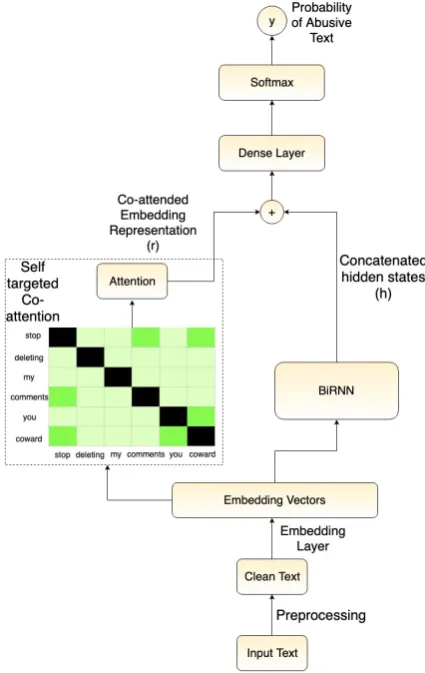
2018). However, we propose several modifica-tions. As shown in Figure 1, the model is com-posed of a co-attention module and a BiRNN. The idea behind co-attention is to learn the semantic relationship between each word pair in the sen-tence whereas the BiRNN learns the long-range dependencies in the sentence.
We apply the co-attention layer directly on the embedding vectors (we also tested it over the out-puts of the BiRNN but obtained worse accuracy). We generate a similarity matrix S ∈ R(n×n) to learn the relationships between words, where sij
denotes the score between words ei andej. Our
similarity matrix is as follows:
sij =W EWT
where E ∈ R(d×d) is a learnable weight matrix, and, as mentioned earlier, W ∈ R(n×d) is the word embedding matrix, where n and d denote the length of sentence and embedding dimension size, respectively. We also mask the values inS where i == j, so the similarity of a word with respect to itself is not considered. Next, we ap-ply a row-wise average pooling operation toS(as
[image:4.595.308.521.66.403.2]deeper than the one we propose and may have led to overfit-ting.
Figure 1: Structure of the Co-Attn model. (Best viewed in color)
compared to max pooling that was originally pro-posed), which is followed by a Softmax to learn the attention vectora:
a=Softmax(avgrow(S))
where a ∈ R(n) represents the learned attention weights. Then the attention vector is used to learn the weighted representationr ∈R(d) of W, given by the equation below.
r = n
X
i=1 wiai
Now, instead of learning only from the output of the final hidden state of the BiRNN, the classifica-tion layer learns from the joint representaclassifica-tion of the co-attended embedding representation (r) and the BiRNN last hidden state vector (hn), as shown
below:
whereWf ∈R((d+2m)×m)andbf ∈Rm. The
em-bedding representation captures relationships be-tween words while the BiRNN captures the se-quential information within the sentence.
5 Experiments
For consistency with previous work, our ex-periments are based on the recently released Wikipedia datasets: Toxicity (W-Tox), Personal Attack (W-At) and Aggression (W-Ag) (Wulczyn et al., 2017). W-Tox contains 159,686 records, while W-At and W-Ag both contain 115,864 records each. These datasets were created by hav-ing annotators from the Crowdflower platform la-bel Wikipedia Talk Page comments as toxic or not, personal attack or not, and aggressive or not, re-spectively. Each comment was judged by multi-ple annotators, and, in this work, we take the ma-jority vote as the class label. This gives us a bi-nary classification problem. Roughly 10 percent of the comments in each dataset are labelled as toxic, personal attacks or aggressive. For a fair comparison toMishra et al.(2018), we use a 60:40 training-testing split.
Following Mishra et al. (2018), we use 300-dimensional Glove (Pennington et al.,2014) em-bedding vectors and we further tune them during training via back-propagation. We create embed-ding vectors for OOV words with random values in the range±0.25. We use 175 as the length of the sequence and we use cross-entropy loss with the Adam optimizer (Kinga and Adam,2015), with an initial learning rate of 0.001 and L2 regularization of10−6. Each GRU cell has a hidden dimension size of 150. We experimented with batch sizes of 128, 200 and 256. We implemented all the mod-els in Pytorch (Paszke et al.,2017) and we use the sigmoid output layer in all the models. Our source code is available at https://github.com/ ddhruvkr/Online_Abuse_Detection
We first evaluate the two methods of pre-processing from Section3, std-approach and adv-approach. We then evaluate the models from Sec-tion4. To measure the accuracy of the models, we report macro (i.e., average) F1 scores over both classes (labelled “Overall” below) as well as the (micro) F1 scores for just the toxic classes (defined in the standard way, as a harmonic mean of preci-sion and recall). In some experiments, we also re-port precision (P) and recall (R) individually. For each method, we repeat the experiments five times
Method W-Tox W-At / W-Ag
std-approach 13617 10703
[image:5.595.319.511.62.105.2]adv-approach 3418 2755
Table 1: OOV counts after applying standard and ad-vanced pre-processing techniques.
Method Overall Toxic
W-Tox
std-approach 88.76 79.58
std-approach + AT 89.05 80.19
std-approach + SW 88.95 80.04
std-approach + WS + SC 88.93 79.94
adv-approach 89.47 81.02
W-At
std-approach 87.08 77.09
std-approach + AT 87.53 77.89
std-approach + SW 87.71 78.27
std-approach + WS + SC 87.41 77.71
adv-approach 88.03 78.89
W-Ag
std-approach 86.45 76.15
std-approach + AT 86.71 76.63
std-approach + SW 86.86 77.01
std-approach + WS + SC 86.64 76.48
adv-approach 87.22 77.59
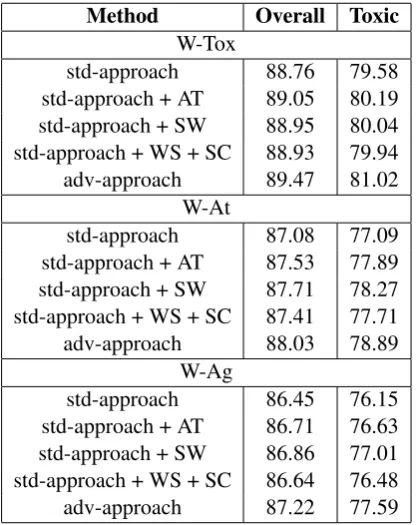
Table 2: Overall and toxic F1 score after applying var-ious preprocessing techniques using the BiRNN base-line model.
and report the average.
5.1 Impact of Pre-Processing
We first compare the OOV word count in the data after the simple preprocessing method (std-approach) to after applying additional preprocess-ing (adv-approach). Table 1 compares the OOV word count after applying the two preprocessing approaches on the three tested datasets. Our ad-vanced preprocessing method reduces the number of OOV words by a factor of 4.
[image:5.595.313.522.150.413.2]Method W-Tox W-At W-Ag
Context HS+CNG∗ 89.35 87.44
-BiRNN 89.47±0.18 88.03±0.20 87.22±0.23
Attn 89.65±0.15 88.18±0.11 87.49±0.22
[image:6.595.146.454.62.132.2]Co-Attn 89.76±0.14 88.34±0.08 87.35±0.16
Table 3: Overall Macro F1 scores in the three datasets.∗denotes results taken directly from the original papers.
and the advanced approach, which includes all of AT, SW, SC, and WS. In general, the adv-approach outperforms the std-approach on all three tested datasets. In particular, the inclusion of stopwords (SW), specifically pronouns, contributes the most to improving the performance on the At and W-Ag datasets. On the other hand, the advanced tok-ernizer (AT) is the most important preprocessing step for the W-Tox dataset. Word Segmentation (WS) and spelling correction (SC) also improve the scores for all three datasets.
5.2 Impact of Attention Models
The remainder of our experiments examine the value of neural attention models, Attn and Co-Attn, compared to 1) the baseline BiRNN 2) and a variation of the baseline that also uses character n-gram features in addition to a RNN, abbreviated Context-HS+CNG. (Mishra et al.,2018). We in-clude Context-HS+CNG because it is the previous state-of-the-art model on our datasets.
First, to compare overall performance, Table 3 shows the overall macro F1 scores of each tested method on the three datasets. We take the scores of Context HS+CNG directly from the original pa-pers (they did not test it on W-Ag, so we omit this number). Overall, we observe that the base-line model BiRNN with text pre-processing al-ready performs better than the previous state-of-the-art. Applying the attention mechanism (Attn) improves the scores, and the Co-Attn model is even better than Attn on W-Tox and W-At.
In addition to reporting the average macro F1 scores, Table 3 also includes the standard devia-tion over the five experimental runs. In addidevia-tion to having the highest scores on W-Tox and W-At, Co-Attn also has the lowest standard deviation.
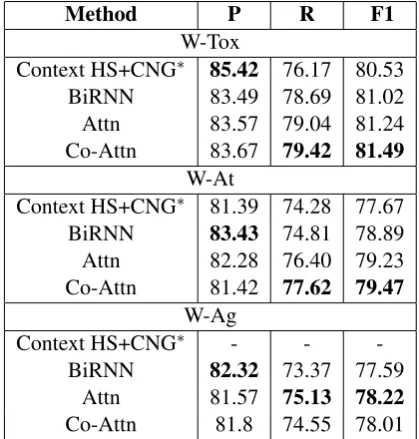
To obtain further insight into the performance on the minority (toxic, personal attack or aggres-sion) class, we show the micro precision (P), recall (R) and F1 scores for the minority class in Table 4. The attention models outperform the baselines in terms of recall and F1, but not precision. The
Co-Method P R F1
W-Tox
Context HS+CNG∗ 85.42 76.17 80.53
BiRNN 83.49 78.69 81.02
Attn 83.57 79.04 81.24
Co-Attn 83.67 79.42 81.49
W-At
Context HS+CNG∗ 81.39 74.28 77.67
BiRNN 83.43 74.81 78.89
Attn 82.28 76.40 79.23
Co-Attn 81.42 77.62 79.47
W-Ag
Context HS+CNG∗ - -
-BiRNN 82.32 73.37 77.59
Attn 81.57 75.13 78.22
[image:6.595.311.521.178.398.2]Co-Attn 81.8 74.55 78.01
Table 4: Micro precision, recall and F1 scores for toxic/personal attack/aggression classes.
attn model gives the best F1 score for the W-Tox dataset, improving it by close to one point over the previous state-of-the-art (Context-HS+CNG). For the W-At dataset, Co-Attn also has the high-est F1 score, improving the baseline by 1.8 points. For the W-Ag dataset, the Attn model improves the BiRNN baseline by about 0.6 points. Using a paired t-test, we found that the differences be-tween BiRNN and Co-Attn for the Tox and W-At datasets and between BiRNN and W-Attn for the W-Ag dataset are statistically significant using ap value of 0.05.
5.3 Interpretability
Model Prediction Confidence (in%) Sentence
Attn Attack 85.13 stop deleting my comments you coward Co-Attn Attack 92.42 stop deleting my comments you coward Attn Attack 59.04 you queer boy stop messing with my edits Co-Attn Attack 82.87 you queer boy stop messing with my edits Attn Non-Attack 71.41 hey queer boy stop messing with my edits Co-Attn Attack 64.39 hey queer boy stop messing with my edits
[image:7.595.80.516.59.177.2]Attn Attack 77.41 thanks for testing my resolution not to refer to anyone as douchebag Co-Attn Attack 74.87 thanks for testing my resolution not to refer to anyone as douchebag Attn Attack 65.11 thanks for testing my resolution not to refer to anyone as douche bag Co-Attn Non-Attack 50.25 thanks for testing my resolution not to refer to anyone as douche bag
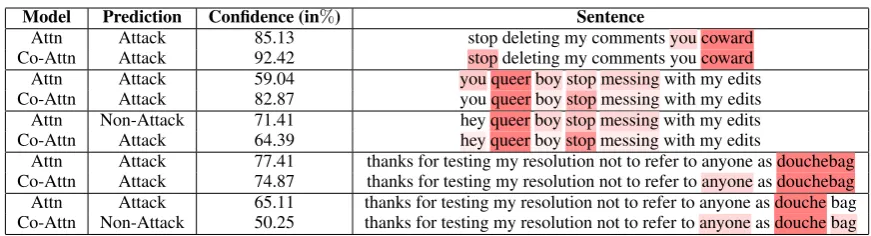
Table 5: Visualization of attention maps, predicted class, and the confidence percentage of the two attention models on personal attack (W-At) comments.
was incorrect. We highlight words found to be im-portant (darker shading means the word was more important), and we show the confidence percent-age scores, which represent the probability of the class predicted by the models.
For the first sentence, both models give an ac-curate prediction. The Attn model captures the re-lationship between “you” and “coward” whereas the Co-Attn model focuses on the word “stop” in addition to “coward”. In general, we observed that the Attn model relied heavily on pronouns. We see an example of this in the next two sentences.
For the second sentence, both models correctly predicted the class. The Attn model relies on “you” and “queer”. In the third sentence, we re-place the word “you” with “hey”, and we see that the Attn model incorrectly labels the sentence as not a personal attack. On the other hand, the Co-Attn model is still able to predict the label cor-rectly.
The next two sentences demonstrate where the Co-Attn model breaks. In the fourth sen-tence, both models are correct in their predic-tions. However, the Attn model mainly attends to the word “douchebag” whereas Co-attn observes the interaction between the words “anyone” and “douchebag”. However, when we modified the sentence by splitting the word “douchebag” into two (last sentence), the Co-Attn model attends to both “anyone” and “bag” along with the word “douche”. This results in the model being indeci-sive and incorrectly predicting that the label is not a personal attack. The confidence score of 50.25%
further confirms that the model is uncertain of its prediction. On the other hand, the Attn model still correctly predicts the class as it only focuses on the word “douche”. In general, we found that the Co-attn model was able to capture more interactions between words as compared to the Attn model.
6 Conclusions and Future Work
In this paper, we demonstrated the utility of at-tention models in detecting online abusive speech. We also showed the importance of reducing the number of out-of-vocabulary words through pre-processing techniques. Our experimental results showed that combining text processing with atten-tion mechanisms, both of which aim to filter out as much noise as possible, is more effective than the previous state of the art, especially at predicting the minority (toxic) class.
In future work, we will investigate alternative spell checkers. In the context of hate speech detection, a problem with standard spell check-ers is with their handling of profanity. For ex-ample, “sh*t” is corrected to “shot” and “b*tch” to “batch”. Recent work on context-sensitive spelling correction may be a good starting point for this extension (Gong et al., 2019), although it is not clear if intentional obfuscation should be corrected since it can be a strong indicator of hate speech.
We also plan to investigate the performance of our preprocessing and attention methods on other datasets such as Twitter and Facebook (Waseem and Hovy, 2016; Waseem, 2016; Kumar et al.,
2018). As mentioned byMishra et al.(2018), the Wikipedia datasets that we used in this paper have more standard language and less obfuscation than Twitter datasets. Thus, we expect preprocessing to be important for those datasets as well. We will also study the importance of different prepro-cessing steps when combined with contextualized character embeddings such as ELMo (Peters et al.,
2018).
of computer vision, and refers to the practice of adding noise to training data so as to make the model resistant to noise in test data (Goodfellow et al.,2015). For example, in computer vision, it was observed that when some calculated noise was added to the training data of an image classifica-tion model, the model made an incorrect classifi-cation decision even though there was no change to a human eye. It can be argued that intentional obfuscation of hate comments affects hate speech classifiers in a similar way. Recent work found that adversarial training does not completely miti-gate these issues in hate speech detection and that character level features are more robust than word level features (Gr¨ondahl et al., 2018). However, more work can be done to explore the potential of this idea.
Finally,Schmidt and Wiegand(2017) point out that little research has been done in the field of hate speech detection in languages other than En-glish. They mention that hate speech could have strong cultural implications and therefore advanc-ing the area of multi-ladvanc-ingual hate speech detection is important. They further state that it remains to be seen that how successful techniques in detect-ing hate speech in English perform when applied to different languages.
Acknowledgements
We thank Michael Cormier, Mount Allison Uni-versity, for his input on this paper. We also thank the anonymous reviewers for their valuable com-ments and suggestions.
References
Pinkesh Badjatiya, Shashank Gupta, Manish Gupta, and Vasudeva Varma. 2017. Deep learning for hate speech detection in tweets. In Proceedings of the 26th International Conference on World Wide Web Companion, pages 759–760. International World Wide Web Conferences Steering Committee.
Christos Baziotis, Nikos Pelekis, and Christos Doulk-eridis. 2017. Datastories at semeval-2017 task 4: Deep lstm with attention for message-level and topic-based sentiment analysis. In Proceedings of the 11th International Workshop on Semantic Eval-uation (SemEval-2017), pages 747–754, Vancouver, Canada. Association for Computational Linguistics.
Junyoung Chung, Caglar Gulcehre, KyungHyun Cho, and Yoshua Bengio. 2014. Empirical evaluation of gated recurrent neural networks on sequence model-ing. arXiv preprint arXiv:1412.3555.
Ronan Collobert and Jason Weston. 2008. A unified architecture for natural language processing: Deep neural networks with multitask learning. In Pro-ceedings of the 25th international conference on Machine learning, pages 160–167. ACM.
Nemanja Djuric, Jing Zhou, Robin Morris, Mihajlo Gr-bovic, Vladan Radosavljevic, and Narayan Bhamidi-pati. 2015. Hate speech detection with comment embeddings. In Proceedings of the 24th interna-tional conference on world wide web, pages 29–30. ACM.
Antigoni Maria Founta, Constantinos Djouvas, De-spoina Chatzakou, Ilias Leontiadis, Jeremy Black-burn, Gianluca Stringhini, Athena Vakali, Michael Sirivianos, and Nicolas Kourtellis. 2018. Large scale crowdsourcing and characterization of twit-ter abusive behavior. InTwelfth International AAAI Conference on Web and Social Media.
Bj¨orn Gamb¨ack and Utpal Kumar Sikdar. 2017. Us-ing convolutional neural networks to classify hate-speech. In Proceedings of the First Workshop on Abusive Language Online, pages 85–90.
Hongyu Gong, Yuchen Li, Suma Bhat, and Pramod Viswanath. 2019. Context-sensitive mali-cious spelling error correction. arXiv preprint arXiv:1901.07688.
Ian J Goodfellow, Jonathon Shlens, and Christian Szegedy. 2015. Explaining and harnessing adver-sarial examples. corr (2015).
Edel Greevy and Alan F Smeaton. 2004. Classifying racist texts using a support vector machine. In Pro-ceedings of the 27th annual international ACM SI-GIR conference on Research and development in in-formation retrieval, pages 468–469. ACM.
Tommi Gr¨ondahl, Luca Pajola, Mika Juuti, Mauro Conti, and N Asokan. 2018. All you need is” love”: Evading hate-speech detection. arXiv preprint arXiv:1808.09115.
D Kinga and J Ba Adam. 2015. A method for stochas-tic optimization. In International Conference on Learning Representations (ICLR), volume 5.
Ritesh Kumar, Aishwarya N Reganti, Akshit Bha-tia, and Tushar Maheshwari. 2018. Aggression-annotated corpus of hindi-english code-mixed data. In Proceedings of the Eleventh International Con-ference on Language Resources and Evaluation (LREC-2018).
Irene Kwok and Yuzhou Wang. 2013. Locate the hate: Detecting tweets against blacks. InTwenty-seventh AAAI conference on artificial intelligence.
Younghun Lee, Seunghyun Yoon, and Kyomin Jung. 2018. Comparative studies of detecting abusive lan-guage on twitter. arXiv preprint arXiv:1808.10245.
Minh-Thang Luong, Hieu Pham, and Christopher D Manning. 2015. Effective approaches to attention-based neural machine translation. arXiv preprint arXiv:1508.04025.
Yashar Mehdad and Joel Tetreault. 2016. Do charac-ters abuse more than words? InProceedings of the 17th Annual Meeting of the Special Interest Group on Discourse and Dialogue, pages 299–303.
Pushkar Mishra, Helen Yannakoudakis, and Ekaterina Shutova. 2018. Neural character-based composition models for abuse detection. In Proceedings of the 2nd Workshop on Abusive Language Online (ALW2), pages 1–10.
Chikashi Nobata, Joel Tetreault, Achint Thomas, Yashar Mehdad, and Yi Chang. 2016. Abusive lan-guage detection in online user content. In Proceed-ings of the 25th international conference on world wide web, pages 145–153. International World Wide Web Conferences Steering Committee.
Ji Ho Park and Pascale Fung. 2017. One-step and two-step classification for abusive language detection on twitter. In Proceedings of the First Workshop on Abusive Language Online, pages 41–45.
Adam Paszke, Sam Gross, Soumith Chintala, Gre-gory Chanan, Edward Yang, Zachary DeVito, Zem-ing Lin, Alban Desmaison, Luca Antiga, and Adam Lerer. 2017. Automatic differentiation in pytorch. InNIPS-W.
John Pavlopoulos, Prodromos Malakasiotis, and Ion Androutsopoulos. 2017. Deep learning for user comment moderation. In Proceedings of the First Workshop on Abusive Language Online, pages 25– 35.
Jeffrey Pennington, Richard Socher, and Christopher Manning. 2014. Glove: Global vectors for word representation. InProceedings of the 2014 confer-ence on empirical methods in natural language pro-cessing (EMNLP), pages 1532–1543.
Matthew E Peters, Mark Neumann, Mohit Iyyer, Matt Gardner, Christopher Clark, Kenton Lee, and Luke Zettlemoyer. 2018. Deep contextualized word rep-resentations. arXiv preprint arXiv:1802.05365.
Georgios K Pitsilis, Heri Ramampiaro, and Helge Langseth. 2018. Detecting offensive language in tweets using deep learning. arXiv preprint arXiv:1801.04433.
Tim Rockt¨aschel, Edward Grefenstette, Karl Moritz Hermann, Tom´aˇs Koˇcisk`y, and Phil Blunsom. 2015. Reasoning about entailment with neural attention. arXiv preprint arXiv:1509.06664.
Anna Schmidt and Michael Wiegand. 2017. A survey on hate speech detection using natural language pro-cessing. In Proceedings of the Fifth International Workshop on Natural Language Processing for So-cial Media, pages 1–10.
Minjoon Seo, Aniruddha Kembhavi, Ali Farhadi, and Hannaneh Hajishirzi. 2016. Bidirectional attention flow for machine comprehension. arXiv preprint arXiv:1611.01603.
Yi Tay, Anh Tuan Luu, Siu Cheung Hui, and Jian Su. 2018. Reasoning with sarcasm by reading in-between. InProceedings of the 56th Annual Meet-ing of the Association for Computational LMeet-inguistics (Volume 1: Long Papers), volume 1, pages 1010– 1020.
Zeerak Waseem. 2016. Are you a racist or am i seeing things? annotator influence on hate speech detection on twitter. InProceedings of the first workshop on NLP and computational social science, pages 138– 142.
Zeerak Waseem and Dirk Hovy. 2016. Hateful sym-bols or hateful people? predictive features for hate speech detection on twitter. In Proceedings of the NAACL student research workshop, pages 88–93.
Ellery Wulczyn, Nithum Thain, and Lucas Dixon. 2017. Ex machina: Personal attacks seen at scale. InProceedings of the 26th International Conference on World Wide Web, pages 1391–1399. International World Wide Web Conferences Steering Committee.
Caiming Xiong, Victor Zhong, and Richard Socher. 2016. Dynamic coattention networks for question answering. arXiv preprint arXiv:1611.01604.
Zichao Yang, Diyi Yang, Chris Dyer, Xiaodong He, Alex Smola, and Eduard Hovy. 2016. Hierarchi-cal attention networks for document classification. InProceedings of the 2016 Conference of the North American Chapter of the Association for Computa-tional Linguistics: Human Language Technologies, pages 1480–1489.
Dawei Yin, Zhenzhen Xue, Liangjie Hong, Brian D Davison, April Kontostathis, and Lynne Edwards. 2009. Detection of harassment on web 2.0. Pro-ceedings of the Content Analysis in the WEB, 2:1–7.