54
FLAIR: An Easy-to-Use Framework for State-of-the-Art NLP
Alan Akbik† Tanja Bergmann†∗ Duncan Blythe†?
Kashif Rasul† Stefan Schweter‡
†
ZalandoResearch,Mühlenstraße25,10243Berlin ‡
BayerischeStaatsbibliothekMünchen,DigitalLibrary/MunichDigitizationCenter,80539Munich ?Aleph-OneGmbH,RigaerStraße8,12047Berlin∗
RASAAI,Berlin
Roland Vollgraf†
Abstract
We present FLAIR, an NLP framework de-signed to facilitate training and distribution of state-of-the-art sequence labeling, text classi-fication and language models. The core idea of the framework is to present a simple, uni-fied interface for conceptually very different types of word and document embeddings. This effectively hides all embedding-specific engi-neering complexity and allows researchers to “mix and match” various embeddings with lit-tle effort. The framework also implements standard model training and hyperparameter selection routines, as well as a data fetching module that can download publicly available NLP datasets and convert them into data struc-tures for quick set up of experiments. Fi-nally, FLAIR also ships with a “model zoo” of pre-trained models to allow researchers to use state-of-the-art NLP models in their appli-cations. This paper gives an overview of the framework and its functionality.
The framework is available on GitHub at
https://github.com/zalandoresearch/flair.
1 Introduction
Classic pre-trained word embeddings have been shown to be of great use for downstream NLP tasks, both due to their ability to assist learning and generalization with information learned from unlabeled data, as well as the relative ease of in-cluding them into any learning approach (Mikolov et al., 2013;Pennington et al., 2014). Many re-cently proposed approaches go beyond the ini-tial “one word, one embedding” paradigm to better model additional features such as sub-word structures (Ma and Hovy,2016;Bojanowski et al.,2017) and meaning ambiguity (Peters et al., 2018a). Though shown to be extremely power-ful, such embeddings have the drawback that they cannot be used to simply initialize the embedding
layer of a neural network and thus require specific reworkings of the overall model architecture.
Hierarchical architectures. A common exam-ple is that many current approaches combine clas-sic word embeddings with character-level features trained on task data (Ma and Hovy,2016;Lample et al.,2016). To accomplish this, they use a hier-archical learning architecture in which the output states of a character-level CNN or RNN are con-catenated with the output of the embedding layer. While modern deep learning frameworks such as PYTORCH (Paszke et al., 2017) make the con-struction of such architectures relatively straight-forward, architectural changes are nevertheless re-quired for something that is fundamentally just an-other method for embedding words.
Contextualized embeddings. Similarly, recent works—including our own—have proposed meth-ods that produce different embeddings for the same word depending on its contextual usage (Pe-ters et al., 2018a; Akbik et al., 2018; Devlin et al., 2018). The string “Washington” for in-stance would be embedded differently depending on whether the context indicates this string to be a last name or a location. While shown to be highly powerful, especially in combination with classic word embeddings, such methods require an archi-tecture in which the output states of a trained lan-guage model (LM) are concatenated with the out-put of the embedding layer, thus adding architec-tural complexity.
These examples illustrate that word embeddings typically cannot simply be mixed and matched with minimal effort, but rather require specific re-workings of the model architecture.
raise. We created a simple, unified interface for all word embeddings as well as arbitrary combi-nations of embeddings. This interface, we argue, allows researchers to build a single model archi-tecture that can then make use of any type of word embedding with no additional engineering effort.
To further simplify the process of setting up and executing experiments, FLAIR includes con-venience methods for downloading standard NLP research datasets and reading them into data struc-tures for the framework. It also includes model training and hyperparameter selection routines to facilitate typical training and testing workflows. In addition, FLAIRalso ships with a growing list of pre-trained models allowing users to apply already trained models to their text. This paper gives an overview of the framework.
2 Framework Overview
2.1 Setup
FLAIR only requires a current version of Python (at least version 3.6) to be available on a system or a virtual environment. Then, the simplest way to install the library is viapip, by issuing the com-mand: pip install flair. This downloads the latest release of FLAIRand sets up all required li-braries, such as PYTORCH.
Alternatively, users can clone or fork the cur-rent master branch of FLAIR from the GitHub repository. This allows users to work on the lat-est version of the code and create pull requlat-ests. The GitHub page1has extensive documentation on training and applying models and embedding.
2.2 Base Classes
With code readability and ease-of-use in mind, we represent NLP concepts such as tokens, sen-tences and corpora with simple base (non-tensor) classes that we use throughout the library. For in-stance, the following code instantiates an example Sentenceobject:
# init sentence
sentence = Sentence ('I love Berlin ')
Each Sentence is instantiated as a list ofToken objects, each of which represents a word and has fields for tags (such as part-of-speech or named entity tags) and embeddings (embeddings of this word in different embedding spaces).
1https://github.com/zalandoresearch/flair
2.3 Embeddings
Embeddings are the core concept of FLAIR. Each embedding class implements either the TokenEmbeddingor the DocumentEmbedding in-terface for word and document embeddings re-spectively. Both interfaces define the .embed() method to embed aSentenceor a list ofSentence objects into a specific embedding space.
2.3.1 Classic Word Embeddings
The simplest examples are classic word embed-dings, such as GLOVEor FASTTEXT. Simply in-stantiate one of the supported word embeddings and call.embed()to embed a sentence:
# init GloVe embeddings
glove = WordEmbeddings ('glove ')
# embed sentence
glove . embed ( sentence )
Here, the framework checks if the requested GLOVE embeddings are already available on lo-cal disk. If not, the embeddings are first down-loaded. Then, GLOVE embeddings are added to eachTokenin theSentence.
Note that all logic is handled by the embedding class, i.e. it is not necessary to run common pre-processing steps such as constructing a vocabulary of words in the dataset or encoding words as one-hot vectors. Rather, each embedding is immedi-ately applicable to any text wrapped in aSentence object.
2.3.2 Other Word Embeddings
As noted in the introduction, FLAIR supports a growing list of embeddings such as hierarchical character features (Lample et al., 2016), ELMo embeddings (Peters et al., 2018a), ELMo trans-former embeddings (Peters et al., 2018b), BERT embeddings (Devlin et al.,2018), byte pair embed-dings (Heinzerling and Strube, 2018), Flair em-beddings (Akbik et al., 2018) and Pooled Flair embeddings. See Table1for an overview.
Importantly, all embeddings implement the same interface and may be called and applied just like in theWordEmbeddingexample above. For in-stance, to use BERT embeddings to embed a sen-tence, simply call:
# init BERT embeddings
bert = BertEmbeddings ()
# embed sentence
Class Type Pretrained?
WordEmbeddings classic word embeddings (Pennington et al.,2014) yes
CharacterEmbeddings character features (Lample et al.,2016) no
BytePairEmbeddings byte-pair embeddings (Heinzerling and Strube,2018) yes
FlairEmbeddings character-level LM embeddings (Akbik et al.,2018) yes
PooledFlairEmbeddings pooled version of FLAIRembeddings (Akbik et al.,2019b) yes
ELMoEmbeddings word-level LM embeddings (Peters et al.,2018a) yes
ELMoTransformerEmbeddings word-level transformer LM embeddings (Peters et al.,2018b) yes
BertEmbeddings byte-pair masked LM embeddings (Devlin et al.,2018) yes
DocumentPoolEmbeddings document embeddings from pooled word embeddings (Joulin et al.,2017) yes
DocumentLSTMEmbeddings document embeddings from LSTM over word embeddings no
Table 1: Summary of word and document embeddings currently supported by FLAIR. Note that some embedding types are not pre-trained; these embeddings are automatically trained or fine-tuned when training a model for a downstream task.
2.3.3 Stacked Embeddings
In many cases, we wish to mix and match sev-eral different types of embeddings. For instance, Lample et al.(2016) combine classic word embed-dings with character features. To achieve this in FLAIR, we need to combine the embedding classes WordEmbeddingsandCharacterEmbeddings. To enable such combinations, e.g. the “stacking” of embeddings, we include theStackedEmbeddings class. It is instantiated by passing a list of em-beddings to stack, but then behaves like any other embedding class. This means that by calling the .embed() method, a StackedEmbeddings class instance embeds a sentence like any other embed-ding class instance.
Our recommended setup is to stack WordEmbeddings with FlairEmbeddings, which gives state-of-the-art accuracies across many sequence labeling tasks. See Akbik et al. (2018) for a comparative evaluation.
2.3.4 Document Embeddings
FLAIR also supports methods for producing vec-tor representations not of words, but of entire doc-uments. There are two main embedding classes for this, namely DocumentPoolEmbeddings and DocumentLSTMEmbeddings. The former applies a pooling operation, such asmean pooling, to all word embeddings in a document to derive a docu-ment representation. The latter applies an LSTM over the word embeddings in a document to output a document representation.
2.4 NLP Dataset Downloader
To facilitate setting up experiments, we include convenience methods to download publicly avail-able benchmark datasets for a variety of NLP tasks and read them into data structures for training. For instance, to download the universal dependency
Dataset Task Language(s)
CoNLL 2000 NP Chunking en
CoNLL 2003 NER dt, es
EIEC NER basque
IMDB Classification en
TREC-6 Classification en
TREC-50 Classification en
Universal Dependencies PoS, Parsing 30 languages
WikiNER NER 9 languages
[image:3.595.73.520.65.184.2]WNUT-17 NER en
Table 2:Summary of NLP datasets in the downloader. References: CoNLL 2000 (Sang and Buchholz, 2000), CoNLL 2003 (Sang and De Meulder,2003), EIEC (Alegria et al.), IMDB (Maas et al.,2011), TREC-6 (Voorhees and Harman,2000), TREC-50 (Li and Roth,2002), Universal De-pendencies (Zeman et al.,2018), WikiNER (Nothman et al., 2012) and WNUT-17 (Derczynski et al.,2017).
treebank for English, simply execute these lines:
# define dataset
task = NLPTask . UD_English
# load dataset
corpus = NLPTaskDataFetcher . load_corpus ( task)
Internally, the data fetcher checks if the requested dataset is already present on local disk and if not, downloads it. The dataset is then read into an ob-ject of typeTaggedCorpuswhich defines training, testing and development splits.
Table2gives an overview of all datasets that are currently downloadable. Other datasets, such as the CoNLL-03 datasets for English and German, require licences and thus cannot be automatically downloaded.
2.5 Model Training
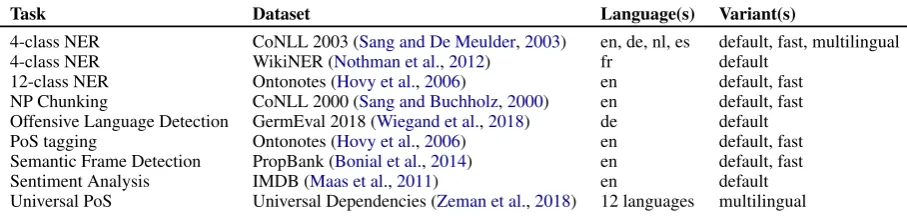
[image:3.595.307.527.231.338.2]Task Dataset Language(s) Variant(s)
4-class NER CoNLL 2003 (Sang and De Meulder,2003) en, de, nl, es default, fast, multilingual
4-class NER WikiNER (Nothman et al.,2012) fr default
12-class NER Ontonotes (Hovy et al.,2006) en default, fast NP Chunking CoNLL 2000 (Sang and Buchholz,2000) en default, fast Offensive Language Detection GermEval 2018 (Wiegand et al.,2018) de default PoS tagging Ontonotes (Hovy et al.,2006) en default, fast Semantic Frame Detection PropBank (Bonial et al.,2014) en default, fast
Sentiment Analysis IMDB (Maas et al.,2011) en default
[image:4.595.73.527.61.169.2]Universal PoS Universal Dependencies (Zeman et al.,2018) 12 languages multilingual
Table 3: Summary of pre-trained sequence labeling and text classification models currently available. The “default” variant are single-language models optimized for GPU-systems. The “fast” variant are smaller models optimized for CPU-systems. The “multilingual” variants are single models that can label text in different languages.
facilitate experimentation with standard learning parameters.
The ModelTrainer can be applied to any FLAIR model that implements the flair.nn.Model interface, such as our se-quence tagging and text classification classes. Refer to the online tutorials for examples on how to train different types of downstream task models.
2.6 Hyperparameter Selection
To further facilitate training models, FLAIR in-cludes native support for the HYPEROPT library which implements a Tree of Parzen Estima-tors (TPE) approach to hyperparameter optimiza-tion (Bergstra et al., 2013). Hyperparameter se-lection is performed against the development data split by default. This allows users to first run hy-perparameter selection using the training and de-velopment data splits, and then evaluate the final parameters with the held-out testing data.
3 Model Zoo
In addition to providing a framework for embed-ding text and training models, FLAIRalso includes a model zoo of pre-trained sequence labeling, text classification and language models. They allow users to apply pre-trained models to their own text, or to fine-tune them for their use cases. A list of currently shipped models is provided in Table3.
For example, to load and apply the default named entity recognizer for English, simply ex-ecute the following lines of code:
# make a sentence
sentence = Sentence ('I love Berlin .')
# load the NER tagger
tagger = SequenceTagger .load('ner ')
# run NER over sentence
tagger . predict ( sentence )
This first checks if the corresponding model is al-ready available on local disk and if not, downloads it. Entity tags are then added to theTokenobjects in theSentence. In this specific example, this will mark up “Berlin” as an entity of typelocation.
3.1 Model Variants
We distribute different variants of models with FLAIR (see Table 3). The default variant are single-language models intended to be run on GPU, typically using embeddings from language models with 2048 hidden states. Thefastvariant models use computationally less demanding em-beddings, typically from LMs with 1024 hidden states, and are suited to be run on CPU setups.
We also include multilingual models for some tasks. These are “one model, many languages” models that can predict tags for text in multiple languages. For instance, Flair includes multilin-gual part-of-speech tagging models that predict universal PoS tags for text in 12 languages. See Akbik et al.(2019a) for an overview of multilin-gual models and preliminary evaluation numbers.
4 Conclusion and Outlook
We presented FLAIRas a framework designed to facilitate experimentation with different embed-ding types, as well as training and distributing se-quence labeling and text classification models.
Together with the open source community, we are working to extend the framework along mul-tiple directions. This includes supporting more embedding approaches such as transformer em-beddings (Radford et al.,2018;Dai et al.,2019), InferSent representations (Conneau et al., 2017) and LASER embeddings (Artetxe and Schwenk, 2018), and expanding our coverage of NLP datasetsand formats for automatic data fetching.
down-stream tasks and extending the framework to facil-itate multi-task learning approaches.
Acknowledgements
We would like to thank the anonymous reviewers for their helpful comments. This project has received funding from the European Union’s Horizon 2020 research and
innova-tion programme under grant agreement no 732328 (“Fash-ionBrain”).
The development of FLAIR has benefited enormously from the open source community. We wish to thank the many individuals who contributed (see https://github.
com/zalandoresearch/flair/graphs/contributors) since without a doubt the usability and features of FLAIR have only gotten better due to their work or feedback. Thank you also to Zalando’s Open Source team (see
https://opensource.zalando.com).
References
Alan Akbik, Tanja Bergmann, and Roland Vollgraf. 2019a. Multilingual sequence labeling with one
model. In NLDL 2019, Northern Lights Deep
Learning Workshop.
Alan Akbik, Tanja Bergmann, and Roland Vollgraf. 2019b. Pooled contextualized embeddings for
named entity recognition. InNAACL, 2019 Annual
Conference of the North American Chapter of the Association for Computational Linguistics, page to appear.
Alan Akbik, Duncan Blythe, and Roland Vollgraf. 2018. Contextual string embeddings for sequence
labeling. InCOLING 2018, 27th International
Con-ference on Computational Linguistics, pages 1638– 1649.
Inaki Alegria, Olatz Arregi, Irene Balza, Nerea Ezeiza, Izaskun Fernandez, and Ruben Urizar. Design and development of a named entity recognizer for an ag-glutinative language.
Mikel Artetxe and Holger Schwenk. 2018. Mas-sively multilingual sentence embeddings for zero-shot cross-lingual transfer and beyond. arXiv preprint arXiv:1812.10464.
James Bergstra, Daniel Yamins, and David Daniel Cox. 2013. Making a science of model search: Hyperpa-rameter optimization in hundreds of dimensions for vision architectures.
Piotr Bojanowski, Edouard Grave, Armand Joulin, and Tomas Mikolov. 2017. Enriching word vectors with subword information. Transactions of the Associa-tion for ComputaAssocia-tional Linguistics, 5:135–146.
Claire Bonial, Julia Bonn, Kathryn Conger, Jena D. Hwang, and Martha Palmer. 2014. Propbank:
Se-mantics of new predicate types. In Proceedings
of the Ninth International Conference on Language Resources and Evaluation (LREC-2014). European Language Resources Association (ELRA).
Alexis Conneau, Douwe Kiela, Holger Schwenk, Loïc Barrault, and Antoine Bordes. 2017. Supervised learning of universal sentence representations from natural language inference data. InProceedings of the 2017 Conference on Empirical Methods in Nat-ural Language Processing, pages 670–680, Copen-hagen, Denmark. Association for Computational Linguistics.
Zihang Dai, Zhilin Yang, Yiming Yang, Jaime G. Carbonell, Quoc V. Le, and Ruslan Salakhutdi-nov. 2019. Transformer-xl: Attentive language models beyond a fixed-length context. CoRR, abs/1901.02860.
Leon Derczynski, Eric Nichols, Marieke van Erp, and Nut Limsopatham. 2017. Results of the wnut2017 shared task on novel and emerging entity recogni-tion. InProceedings of the 3rd Workshop on Noisy User-generated Text, pages 140–147.
Jacob Devlin, Ming-Wei Chang, Kenton Lee, and Kristina Toutanova. 2018. Bert: Pre-training of deep bidirectional transformers for language understand-ing.arXiv preprint arXiv:1810.04805.
Benjamin Heinzerling and Michael Strube. 2018. BPEmb: Tokenization-free Pre-trained Subword Embeddings in 275 Languages. In Proceedings of the Eleventh International Conference on Language Resources and Evaluation (LREC 2018), Miyazaki, Japan. European Language Resources Association (ELRA).
Eduard Hovy, Mitchell Marcus, Martha Palmer, Lance Ramshaw, and Ralph Weischedel. 2006. Ontonotes: the 90% solution. InProceedings of the human lan-guage technology conference of the NAACL, Com-panion Volume: Short Papers, pages 57–60. Associ-ation for ComputAssoci-ational Linguistics.
Armand Joulin, Edouard Grave, Piotr Bojanowski, and Tomas Mikolov. 2017. Bag of tricks for efficient text classification. InProceedings of the 15th Con-ference of the European Chapter of the Association for Computational Linguistics: Volume 2, Short Pa-pers, volume 2, pages 427–431.
Guillaume Lample, Miguel Ballesteros, Sandeep Sub-ramanian, Kazuya Kawakami, and Chris Dyer. 2016. Neural architectures for named entity recognition. arXiv preprint arXiv:1603.01360.
Xuezhe Ma and Eduard Hovy. 2016. End-to-end se-quence labeling via bi-directional LSTMs-CNNs-CRF. arXiv preprint arXiv:1603.01354.
Andrew L. Maas, Raymond E. Daly, Peter T. Pham, Dan Huang, Andrew Y. Ng, and Christopher Potts. 2011. Learning word vectors for sentiment analy-sis. InProceedings of the 49th Annual Meeting of the Association for Computational Linguistics: Hu-man Language Technologies, pages 142–150, Port-land, Oregon, USA. Association for Computational Linguistics.
Tomas Mikolov, Ilya Sutskever, Kai Chen, Greg S Cor-rado, and Jeff Dean. 2013. Distributed representa-tions of words and phrases and their compositional-ity. InAdvances in neural information processing systems, pages 3111–3119.
Joel Nothman, Nicky Ringland, Will Radford, Tara Murphy, and James R. Curran. 2012. Learning mul-tilingual named entity recognition from Wikipedia. Artificial Intelligence, 194:151–175.
Adam Paszke, Sam Gross, Soumith Chintala, Gre-gory Chanan, Edward Yang, Zachary DeVito, Zem-ing Lin, Alban Desmaison, Luca Antiga, and Adam Lerer. 2017. Automatic differentiation in pytorch.
Jeffrey Pennington, Richard Socher, and Christopher Manning. 2014. Glove: Global vectors for word representation. InProceedings of the 2014 confer-ence on empirical methods in natural language pro-cessing (EMNLP), pages 1532–1543.
Matthew Peters, Mark Neumann, and Christopher Clark Kenton Lee Luke Zettlemoyer Mohit Iyyer, Matt Gardner. 2018a. Deep contextualized word representations. 6th International Conference on Learning Representations.
Matthew Peters, Mark Neumann, Luke Zettlemoyer, and Wen-tau Yih. 2018b. Dissecting contextual word embeddings: Architecture and representation. In Proceedings of the 2018 Conference on Empiri-cal Methods in Natural Language Processing, pages 1499–1509.
Alec Radford, Karthik Narasimhan, Time Salimans, and Ilya Sutskever. 2018. Improving language un-derstanding with unsupervised learning. Technical report, Technical report, OpenAI.
Erik F Tjong Kim Sang and Sabine Buchholz. 2000. Introduction to the CoNLL-2000 shared task: Chunking. In Proceedings of the 2nd workshop on Learning language in logic and the 4th confer-ence on Computational natural language learning-Volume 7, pages 127–132. Association for Compu-tational Linguistics.
Erik F Tjong Kim Sang and Fien De Meulder. 2003. Introduction to the CoNLL-2003 shared task: Language-independent named entity recognition. In Proceedings of the seventh conference on Natural language learning at HLT-NAACL 2003-Volume 4,
pages 142–147. Association for Computational Lin-guistics.
Ellen M Voorhees and Donna Harman. 2000. Overview of the sixth text retrieval conference (trec-6). Information Processing & Management, 36(1):3–35.
Michael Wiegand, Melanie Siegel, and Josef Ruppen-hofer. 2018. Overview of the germeval 2018 shared task on the identification of offensive language. Aus-trian Academy of Sciences, Vienna September 21, 2018.