Original Article
Association between plasma mitochondrial DNA and
sterile systemic inflammatory response syndrome
in patients with acute blunt traumatic injury
Jianzheng Zhang, Xiaobin Chen, Zhi Liu, Xiaowei Wang, Jixin Ren, Tiansheng Sun Department of Orthopedic, PLA Army General Hospital, Beijing 100700, P. R. China
Received October 23, 2016; Accepted December 13, 2016; Epub February 15, 2017; Published February 28, 2017
Abstract: Background: Plasma mitochondrial DNA (mtDNA) has been associated with the occurrence of systemic
inflammatory response syndrome (SIRS), but its relationship to sterile SIRS is unknown. This study was to assess
the relationship between plasma mtDNA and sterile SIRS in patients with acute blunt traumatic injury. Methods: This was a prospective study of 65 patients with acute blunt traumatic injury admitted at the Trauma Center of the Army General Hospital (Bejing, China) between April 2010 and April 2013. Demographic and clinical characteristics and injury severity score (ISS) were recorded at admission. Plasma mtDNA, interleukin-6 (IL-6), C-reactive protein
(CRP), fibrinogen and white blood cells were measured. Patients were examined regularly for the occurrence of
sterile SIRS. Results: Patients who developed sterile SIRS had higher plasma mtDNA levels compared with those who did not develop sterile SIRS (317.6 [97.8-582.3] vs. 238.7 [86.8-591.3] pg/mL, P = 0.005). Pearson correlation analysis showed that plasma mtDNA levels correlated with the ISS score (r = 0.656, P < 0.001). Of the factors, sex (P = 0.005), plasma mtDNA (P = 0.005), CRP (P = 0.003) and fibrinogen (P = 0.012) were the significant predictors
for sterile SIRS in univariate analyses. In multivariate analysis showed that plasma mtDNA levels (odds ratio: 1.005, 95% CI: 1.001-1.009, P = 0.011), CRP (odds ratio: 1.089, 95% CI: 1.023-1.107, P = 0.003) and fibrinogen (odds
ratio: 1.003, 95% CI: 1.001-1.007, P = 0.046) were independently associated with the occurrence of sterile SIRS. Receiver operating characteristic analysis revealed that using the best cut-off value of 290.0 pg/mL, mtDNA had
an AUC of 0.709, specificity of 65% and sensitivity of 80%. Conclusions: Plasma mtDNA levels might be associated
with the occurrence of sterile SIRS in patients with acute blunt traumatic injury.
Keywords: Mitochondrial DNA, SIRS, CRP, WBC, injury
Introduction
Traumatic injuries are the most common rea-sons for hospitalization, with about 50 million injuries each year in the United States, of which 150,000 will be fatal [1]. Traumatic injuries can
be classified as penetrating or blunt trauma.
The cause of complications and death in pene-trating wounds is often obvious (hemorrhage, damaged organ), but blunt traumas are more pernicious since even important damages to organs may not be readily apparent. Main causes of blunt traumas are motor vehicle crash, fall, being struck by a blunt object and pedestrian being hit by a motor vehicle [1]. The
systemic inflammatory response syndrome
(SIRS) is a catastrophic syndrome that may lead to severe complications and death after
trauma. Both extrinsic and intrinsic factors can induce SIRS and contribute to the development of acute respiratory distress syndrome (ARDS) or multiple organ dysfunction syndrome (MODS) [2]. SIRS induced by severe trauma is
tradition-ally defined as a sepsis with an identifiable
focus of infection [3, 4]. However, SIRS in the absence of infection, termed sterile SIRS, has also been observed following trauma. Dying
cells can release molecules that induce inflam -mation and tissue damage [5, 6].
Some biochemical markers such as interleukin
(IL)-6, C-reactive protein (CRP) and fibrinogen
ele-vated as the result of chronic inflammation,
providing false information about the status of the patient [7]. Recently, mitochondrial DNA
(mtDNA) has been identified as an important
damage-associated molecular pattern (DAMP) [8, 9]. Gu et al. demonstrated that plasma mtDNA was an independent predictor of the risk of posttraumatic SIRS, as the median
plas-ma mtDNA concentration was significantly
higher in trauma patients who experienced posttraumatic complications than those with-out complications [10]. Generally, mtDNA is released into the circulation from apoptotic and necrotic cells, although the exact mechanism is unclear. It is likely that mechanical trauma dis-rupts the cells directly or indirectly via homody-namic compromise as a result of blood loss, activating immunity and initiating SIRS. Mechanical cell rupture, shock or autophagy of cell could lead to sudden expulsion of intracel-lular contents into circulation.
However, whether the extent of release of mtDNA into the circulation correlates with, or
contributes significantly to, the development of
sterile SIRS in trauma patients is unknown. Whilst the plasma concentration of the patho-gen-associated molecular pattern (PAMP)
bac-terial 16S DNA (bDNA) reflects ongoing infec -tion in SIRS, circulating mtDNA might be used
to reflect cellular injury in sterile SIRS. Zhang et al. recently reported that mitochondrial debris including mtDNA from shock-injured tissues activate neutrophils, causing degranulation in vitro and in vivo, and the accumulation of
proin-flammatory cytokines in the liver and the lung
[8, 9]. Plasma mtDNA content has been found to be a useful predictor of posttraumatic prog-nosis [9, 11-13]. However, the relationship between plasma mtDNA levels and sterile SIRS in trauma patients has not been established. The aim of the present study was to analyze plasma mtDNA levels after trauma and assess the value of plasma mtDNA levels to predict injury severity and clinical outcome.
Materials and methods
Patients
This was a prospective study performed in 65 consecutive patients admitted to the resuscita-tion room at the Trauma Center of the Army General Hospital (Bejing, China) as a result of
acute blunt traumatic injury between April 2010 and April 2013. This study was approved by the Human Studies Committee of the institutional review board of the Army General Hospital, and informed consent was obtained from the rela-tives of each patient (ethics approval number: EC-KS-2013-026).
The inclusion criteria were: 1) aged between 18 and 60 years; 2) sustained an acute blunt trau-matic injury; 3) no open wounds or gastrointes-tinal injuries; 4) no acute infectious diseases;
5) no administration of anti-inflammatory drugs, either conventional non-steroidal anti-inflam -matory drugs or selective cyclooxygenase-2 inhibitors; 6) no immunosuppressive agents less than 4 weeks prior to the blood sampling. The exclusion criteria were: 1) pathological
fractures; 2) infection, chronic inflammatory conditions or anti-inflammatory drug regimens;
3) hospitalization delayed for more than 10 h post-injury; 4) pregnancy, malignant disease, acute ischemic stroke, sepsis, drug overdose, chronic renal failure, liver cirrhosis, or history of surgery within the preceding three months.
Data collection at admission
Demographic and clinical data including age, gender, body mass index (BMI), chronic medical conditions (hypertension, heart diseases and diabetes), white blood cells (WBC), IL-6, CRP,
fibrinogen, and injury severity assessed using
the injury severity score (ISS) [14] were record-ed at admission.
Daily patient assessment
All eligible patients were screened daily for SIRS, sepsis, ARDS and MODS according to the guidelines of the American College of Chest Physicians/Society of Critical Care Medicine Consensus Conference [14-16]. Patients were diagnosed with SIRS if they had two or more of the following concurrent conditions: 1) a body temperature < 36°C or > 38°C; 2) heart rate > 90 bpm; 3) respiratory rate > 20/min or ventila-tor at PCO2 < 32 mmHg; and 4) WBC < 4000/ mm3 or > 12,000/mm3. According to the SIRS
scores, patients with post-trauma SIRS were further divided into low SIRS subgroup (SIRS score = 2) and high SIRS subgroup (SIRS score
≥ 3). A diagnosis of sepsis required suspected or confirmed infection and the presence of two
diagnosed in the presence of SIRS and in the
absence of any identifiable pathological agent
[18].
Grouping
Patients with acute blunt traumatic injury were grouped based on the occurrence of sterile SIRS during hospitalization.
Blood sampling
IL-6, CRP, fibrinogen and WBC were measured
at a median time of 6.7 h (2.6-8.9 h) after trau-ma. IL-6 serum levels were measured using the ABC ELISA system (R&D Systems, Minneapolis, MN) according to the manufacturer’s instruc-tions and as previously described [19]. CRP,
fibrinogen and WBC counts were determined
according to routine laboratory methods.
Specifically, CRP was measured using a nephe -lometric assay on an Array 360 Protein System (Beckman Coulter, Brea, CA, USA) and expre- ssed in mg/L. Fibrinogen was determined by
the fibrinogen clause method on Cobas Fibro
(Roche Diagnostics, Basel, Switzerland) and expressed in g/L.
Assessment of plasma mtDNA
Plasma mtDNA levels were measured at admis-sion. Blood samples for mtDNA extraction were collected into EDTA-containing tubes. To obtain cell-free plasma, EDTA-blood samples were ini-tially centrifuged at 3000 rpm (900×g) for 10 min, and the plasma was transferred into a clear polypropylene tube. The plasma was cen-trifuged at 10,000 rpm (9600×g) for another 10 min, and the upper portion of the plasma was transferred into another clear tube and stored at -80°C.
MtDNA and nuclear DNA (nDNA) were extracted from the isolated mitochondrial pellets or nuclear fractions using DNeasy Blood & Tissue
kits (Qiagen, Venlo, Netherlands), according to the manufacturer’s protocol. The mtDNA and nDNA levels were determined by spectropho-tometry and the mtDNA purity was determined by real-time PCR. Mitochondrial genes such as cytochrome B (Cyt B), cytochrome C oxidase subunit III (COX III), and NADH dehydrogenase (NADH) and the nDNA marker, GAPDH (glyceral-dehyde 3-phosphate dehydrogenase), were
detected using the primer sequences previous -ly described by Zhang et al. under the same conditions [9]. In DNA prepared from mitochon-dria, GAPDH was at the limit of detection, and nDNA was less than 0.1%. In addition, the A260/280 ratio of the mtDNA samples was 1.8
to 2.0, indicating the absence of significant pro -tein contamination.
Real-time PCR
MtDNA and nDNA were prepared from 200 µL of plasma using the QIAamp DNA Blood Mini Kit (Qiagen, Venlo, Netherlands), according to the manufacturer’s instructions. The same amount of DNA was used for each real-time PCR reac-tion using the SYBR Green Master Mix (Applied Biosystems, Foster City, California, USA) on a Mastercycler EP realplex (Eppendorf, Hamburg, Germany). Primers targeting the bacterial 16S ribosomal subunit were used, and primers for the mtDNA markers Cyt B, COX III, NADH, and the nDNA marker GAPDH by Invitrogen (Carlsbad, CA, USA) (Table 1). The cycling condi-tions were 95°C for 10 s, followed by 40 cycles at 95°C for 5 s, 60°C for 25 s and 72°C for 10
s. A standard curve was created to quantify mtDNA concentration using purified mtDNA
with CytB as the target, according to the manu-facturer’s protocol.
Statistical analysis
[image:3.612.92.522.83.166.2]Data of age and BMI are expressed as means ± standard deviations (SD) and were compared
Table 1. Primer sequences for real-time PCR
Gene Forward Reverse
using independent samples t tests, however, mtDNA, WBC, IL-6 and CRP are expressed as median (min, max), and were compared using the Mann-Whitney U test for independent sam-ples. Demographic or clinical characteristics that may have affected outcomes including gender, hypertension, heart diseases, diabe-tes, ISS score were analyzed using the Fisher’s exact test. Pearson correlation analysis was used to assess the relationships between plas-ma mtDNA and ISS in patients with acute blunt traumatic injury. Independent predictors of
post-traumatic SIRS were identified by forward
logistic regression, and age, hypertension, heart diseases, diabetes, WBC, IL6, mtDNA, and ISS were tried as independent variables.
Because CRP, fibrinogen and mtDNA are covari
-ates, CRP and fibrinogen were not included in
the model. To determine the predictive power
of mtDNA, CRP and fibrinogen, the receiver
operator characteristics (ROC) curve method
was used and areas under the curve (AUCs) were calculated. Optimal cut-off values were
selected to maximize specificity and sensitivity.
Statistical analyses were undertaken using SPSS 17.0 (IBM, Armonk, NY, USA). Two-tailed
P-values < 0.05 were considered significant.
Results
Characteristics of trauma patients
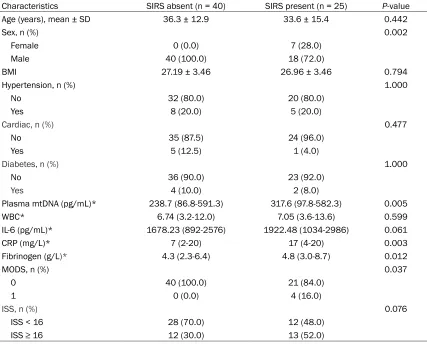
[image:4.612.91.518.86.430.2]Between April 2010 and April 2013, 114 patients with acute blunt traumatic injury received treatment at our trauma center. Twenty-two patients were excluded due to open injury or suspect infection and 13 patients were excluded due to systemic conditions or ethical concerns. Thus 79 patients were enrolled in this cohort study, of which 14 were lost during follow-up. There were 6 patients who were unconscious or unable to communicate at admission included this study was obtained
Table 2. Baseline characteristics of the patients
Characteristics SIRS absent (n = 40) SIRS present (n = 25) P-value
Age (years), mean ± SD 36.3 ± 12.9 33.6 ± 15.4 0.442
Sex, n (%) 0.002
Female 0 (0.0) 7 (28.0)
Male 40 (100.0) 18 (72.0)
BMI 27.19 ± 3.46 26.96 ± 3.46 0.794
Hypertension, n (%) 1.000
No 32 (80.0) 20 (80.0)
Yes 8 (20.0) 5 (20.0)
Cardiac, n (%) 0.477
No 35 (87.5) 24 (96.0)
Yes 5 (12.5) 1 (4.0)
Diabetes, n (%) 1.000
No 36 (90.0) 23 (92.0)
Yes 4 (10.0) 2 (8.0)
Plasma mtDNA (pg/mL)* 238.7 (86.8-591.3) 317.6 (97.8-582.3) 0.005
WBC* 6.74 (3.2-12.0) 7.05 (3.6-13.6) 0.599
IL-6 (pg/mL)* 1678.23 (892-2576) 1922.48 (1034-2986) 0.061
CRP (mg/L)* 7 (2-20) 17 (4-20) 0.003
Fibrinogen (g/L)* 4.3 (2.3-6.4) 4.8 (3.0-8.7) 0.012
MODS, n (%) 0.037
0 40 (100.0) 21 (84.0)
1 0 (0.0) 4 (16.0)
ISS, n (%) 0.076
ISS < 16 28 (70.0) 12 (48.0)
ISS ≥ 16 12 (30.0) 13 (52.0)
from the family of each patient. A total of 65 patients were admitted with acute blunt trau-matic injury and met the inclusion/exclusion criteria. Mean age was 35.2 ± 13.7 years, and 89% (n = 58) were male. Major trauma was caused (Supplementary Date) by motor bike accidents in 25 patients (38%), car accidents in 26 patients (40%), and by fall from a height in 11 patients (17%). All patients were directly admitted from the site of the accident with an average ISS of 13.9 ± 8.6 (range 4-36). The mean time between trauma and admission and sampling was 5.8 ± 1.3 and 6.7 ± 2.8 hours, respectively. The mean length of stay in the ICU was 2.5 ± 4.2 days, and the mean length of
those who did not develop sterile SIRS (317.6 [97.8-582.3] vs. 238.7 [86.8-591.3] pg/mL, P
= 0.005) (Table 2). The results of statistical analyses demonstrated that the mean concen-tration of plasma mtDNA in the high SIRS
sub-group was significantly higher than that in the
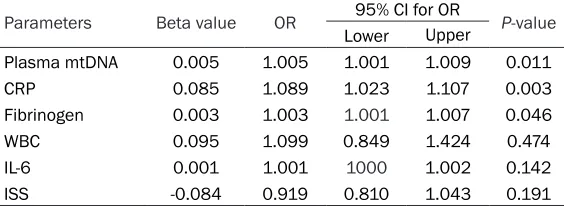
low SIRS subgroup (460.8 [311.1-591.3] vs. 320.6 [97.8-498.5] pg/mL, P = 0.017). Pearson correlation analysis showed that plasma mtDNA levels correlated with the ISS score (r = 0.656, P < 0.001) (Figure 1). Multivariate analy-sis showed that three indicators, plasma
[image:5.612.92.370.74.252.2]mtDNA, CRP and fibrinogen were independent -ly associated with the occurrence of sterile SIRS in patients with blunt trauma (Table 3).
Figure 1. Correlation between plasma mtDNA concentration and trauma severity. Plasma mtDNA concentration was measured on admission in 65 patients with acute blunt traumatic injury, Injury Severity Score (ISS) was assessed at the time of discharge or death, or at 28 days if the patient was still hospitalized.
Table 3. Multivariate logistic regression analysis to determine vari-ables independently associated with sterile SIRS in patients with acute blunt traumatic injury
Parameters Beta value OR 95% CI for OR P-value
Lower Upper
Plasma mtDNA 0.005 1.005 1.001 1.009 0.011
CRP 0.085 1.089 1.023 1.107 0.003
Fibrinogen 0.003 1.003 1.001 1.007 0.046
WBC 0.095 1.099 0.849 1.424 0.474
IL-6 0.001 1.001 1000 1.002 0.142
ISS -0.084 0.919 0.810 1.043 0.191
MtDNA: mitochondrial DNA; CRP: C-reactive protein; WBC: white blood cells; IL-6:
interleukin-6; ISS: Injury Severity Score; OR: odds ratio; 95% CI: 95% confidence
interval.
hospitalization was 12.3 ± 4.8 days.
Patients were grouped accord-ing to the occurrence of sterile SIRS (Table 2). Twenty-five
patients (38%) were diag-nosed with post-traumatic sterile SIRS during the course of treatment. 8 cases (32%) of 25 patients who had 2 or more SIRS criteria were divid-ed into high SIRS subgroup and 17 cases (68%) were low SIRS subgroup. The mean time to diagnosis was 48.0 ± 17.4 hours after trauma. There were differences in male gen-der distribution (SIRS: 72.0%
vs. no SIRS: 100.0%, P = 0.002), in CRP levels (SIRS: 17
vs. no SIRS: 7 mg/L, P =
0.003), in fibrinogen levels
(SIRS: 4.8 vs. no SIRS: 4.3, P = 0.012) and in the occurrence of MODS (SIRS: 16.0% vs. no SIRS: 0%, P = 0.037). There was no difference in age, BMI, hypertension, heart diseases, diabetes, WBC, IL-6 levels and ISS score. No bacterial DNA was detectable in any of plas-ma samples.
Plasma mtDNA
[image:5.612.91.373.373.476.2]Predictive factors for sterile SIRS
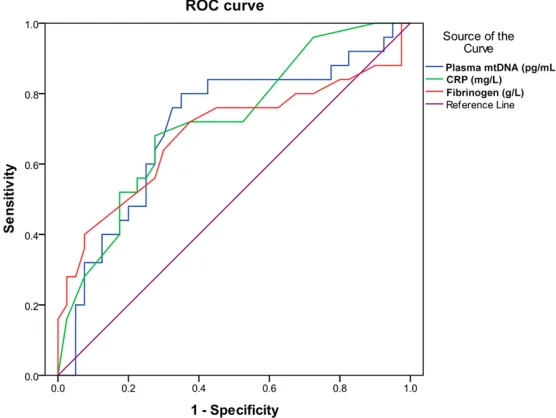
Table 4 and Figure 2 showed the ROC analysis of the predictive values of mtDNA, CRP and
fibrinogen levels for sterile SIRS. Using the best
cut-off value of 290.0 pg/mL, mtDNA had an
AUC of 0.709, specificity of 65% and sensitivity
of 80%. Using the best cut-off value of 8.5
mg/L, CRP had an AUC of 0.719, specificity of
73% and sensitivity of 68%. Using the best
cut-off value of 4.6 g/L, fibrinogen had an AUC of 0.687, specificity of 63% and sensitivity of 72%.
Discussion
The aim of the present study was to assess the relationship between plasma mtDNA and ster-ile SIRS in patients with acute blunt traumatic injury. Results showed that patients who devel-oped sterile SIRS had higher plasma mtDNA levels compared with those who did not devel-op sterile SIRS. Moreover, the plasma mtDNA level on admission in high SIRS subgroup was
istic analysis revealed that using the best cut-off value of 290.0 pg/mL, and mtDNA had an
AUC of 0.709, specificity of 65% and sensitivity
of 80%. These results might provide the basis for eventually using mtDNA as a predictor of sterile SIRS.
A marked elevation in plasma mtDNA concen-tration had been observed in rats subjected to trauma and hemorrhagic shock [19-23] as well as in trauma patients [9] and those with femur fracture reamings [8]. The mechanisms by which mtDNA was liberated into the circulation were poorly understood [26, 27]. It was likely that mechanical trauma disrupted the cells directly or indirectly via homodynamic compro-mise as a result of blood loss, activating immu-nity and initiating SIRS [28]. Maeda et al.
recently demonstrated that mitochondria DNA
were released from cells undergoing TNF-α
induced, receptor-interacting protein (RIP) 1-dependent necroptosis, a form of pro-grammed necrosis. MtDNA might represent a
Table 4. Receiver-operator characteristic (ROC) analysis for the prediction of sterile SIRS in patients with acute blunt traumatic injury
Variables AUC Specificity (%) Sensitivity (%) Cut-off value Youden index P-value
Plasma mtDNA (pg/mL) 0.709 65 80 290.0 0.45 0.005
CRP (mg/L) 0.719 73 68 8.5 0.41 0.003
Fibrinogen (g/L) 0.687 63 72 4.6 0.35 0.012
[image:6.612.93.371.190.399.2]AUC: area under the curve; mtDNA: mitochondrial DNA; CRP: C-reactive protein.
Figure 2. ROC curve indicating sensitivity and specificity of plasma mtDNA
and ISS prediction of SIRS.
significantly higher than that
in low SIRS, which indicated that the plasma levels of mtDNA on admission were associated with the severity of post-trauma SIRS. Pearson correlation analysis showed that plasma mtDNA levels cor-related with the ISS score. Of the factors, sex (P = 0.005), plasma mtDNA (P = 0.005), CRP (P = 0.003) and fibrino -gen (P = 0.012) were the
sig-nificant predictors for sterile
SIRS in univariate analyses. Multivariate analysis showed that plasma mtDNA, CRP and
fibrinogen were independently
character-DAMP that contributed to the initiation of sterile SIRS through the activation of both the TLR9/
NF-κB and the p38 MAPK pathways and the induction of pro-inflammatory cytokine produc -tion [9, 19].
Significant increases in circulating DNA in trau -ma patients had previously been reported to be useful in posttraumatic prognosis [10, 29]. Yamanouchi et al. found that plasma mtDNA levels were elevated during traumatic injury
and were significantly higher in non-survivors
than survivors of trauma [30]. Moreover, plas-ma mtDNA levels correlated with ISS, indicating that mtDNA might serve as a potential marker of the severity of injuries and contribute to pre-diction of outcome in patients with trauma [30]. In the present study, plasma mtDNA levels in patients with trauma were higher in patients who developed sterile SIRS compared with those who did not. Further multivariate analysis revealed that mtDNA levels were an indepen-dent predictor of sterile SIRS occurrence. Previous studies have demonstrated that a few
predictors were increased significantly after
trauma [20-22] and that the plasma levels of these markers positively correlated with injury severity [23, 24]. Gouel-Chéron et al. reported that circulating IL-6 levels contributed to assessment of severity and prediction of out-come in patients with SIRS [25]. Gu et al. have shown that plasma mtDNA, WBC and CRP were independently predictive of posttraumatic SIRS [10]. In multivariate analysis, the present study
showed plasma mtDNA levels, CRP and fibrino -gen were independently associated with the occurrence of sterile SIRS. We did not verify that WBC on admission had a discriminative power to predict the risk of post-traumatic SIRS. Although WBC and IL-6 levels were all higher in SIRS present group than the SIRS absent group, these differences were not
sta-tistically significant. The possible causes
included WBC and CRP were the more dynamic change and response to changes in the patient’s clinical state, and low blood pressure
and fluid resuscitation were important factors.
Another important characteristic was the pre-dictive power of CRP was more favorable and the AUCs in the prediction of post-traumatic SIRS were slightly higher for CRP than mtDNA, which was similar with precious report [10]. The increased change in the plasma mtDNA was
observed earlier and the half-life of was shorter than changes of CRP. It previous reported that a marked elevation in plasma mtDNA levels in 3 hours and reached a peak at 1 day after
trauma [9]. This quality might enable the
mtDNA level to be used to make an earlier diagnosis of SIRS and may also aid in decision-making. The evidence suggested that plasma mtDNA concentration might be a more precise and early way of estimating sterile SIRS than traditional CRP in patients with blunt traumatic injury and hence a better predictor
of exaggerated inflammation.
The present study was not without limitations. The sample size was small and from a single center. The extent of injury varied between patients, potentially leading to different levels of markers and inevitable balance bias. Finally, it was currently unknown if mtDNA levels were affected by treatments, and it was possible that the treatments received by the patients
influenced the outcomes. Although the present
study strongly suggested a clear relationship between mtDNA at admission and the occur-rence of sterile SIRS, large scale prospective studies were warranted to evaluate the prog-nostic contribution of plasma mtDNA to a wider range of clinical outcomes.
In conclusion, the present study suggested that plasma mtDNA levels might be associated with the occurrence of sterile SIRS after acute blunt traumatic injury. Plasma mtDNA levels in patients with acute blunt trauma were indepen-dently associated with sterile SIRS.
Acknowledgements
This study was supported by grants from the international S&T Cooperation Program of China (no. 2010DFA31250) and Beijing S&T Program (no. Z14100002114030).
Disclosure of conflict of interest
None.
References
[1] Newgard CD, Kuppermann N, Holmes JF, Haukoos JS, Wetzel B, Hsia RY, Wang NE, Bulger EM, Staudenmayer K, Mann NC, Barton ED, Wintemute G; WESTRN Investigators. Gunshot injuries in children served by emer-gency services. Pediatrics 2013; 132: 862-870.
[2] Tsukamoto T, Chanthaphavong RS, Pape HC. Current theories on the pathophysiology of multiple organ failure after trauma. Injury 2010; 41: 21-26.
[3] Kitajima I, Niimi H. [Establishment of the rapid, hypersensitive testing systems for sepsis/ SIRS]. Rinsho Byori 2012; 60: 46-51.
[4] Bone LB, Giannoudis P. Femoral shaft fracture
fixation and chest injury after polytrauma. J
Bone Joint Surg Am 2011; 93: 311-317. [5] Tarlowe MH, Kannan KB, Itagaki K, Adams JM,
Livingston DH, Hauser CJ. Inflammatory che -moreceptor cross-talk suppresses leukotriene B4 receptor 1-mediated neutrophil calcium mobilization and chemotaxis after trauma. J Immunol 2003; 171: 2066-2073.
[6] Pugin J. How tissue injury alarms the immune
system and causes a systemic inflammatory
response syndrome. Ann Intensive Care 2012; 2: 27.
[7] Pape HC, Tsukamoto T, Kobbe P, Tarkin I, Katsoulis S, Peitzman A. Assessment of the
clinical course with inflammatory parameters.
Injury 2007; 38: 1358-1364.
[8] Hauser CJ, Sursal T, Rodriguez EK, Appleton PT, Zhang Q, Itagaki K. Mitochondrial damage associated molecular patterns from femoral reamings activate neutrophils through formyl peptide receptors and P44/42 MAP kinase. J Orthop Trauma 2010; 24: 534-538.
[9] Zhang Q, Itagaki K, Hauser CJ. Mitochondrial DNA is released by shock and activates neutro-phils via p38 map kinase. Shock 2010; 34: 55-59.
[10] Gu X, Yao Y, Wu G, Lv T, Luo L, Song Y. The plas-ma mitochondrial DNA is an independent
pre-dictor for post-traumatic systemic inflammato -ry response syndrome. PLoS One 2013; 8: e72834.
[11] MacKenzie EJ. Epidemiology of injuries: cur-rent trends and future challenges. Epidemiol Rev 2000; 22: 112-119.
[12] Aller MA, Arias JI, Alonso-Poza A, Arias J. A re-view of metabolic staging in severely injured patients. Scand J Trauma Resusc Emerg Med 2010; 18: 27.
[13] Klune JR, Tsung A. Molecular biology of liver ischemia/reperfusion injury: established me- chanisms and recent advancements. Surg Clin North Am 2010; 90: 665-677.
[14] American college of chest physicians/society of critical care medicine consensus
confer-ence: definitions for sepsis and organ failure
and guidelines for the use of innovative thera-pies in sepsis. Crit Care Med 1992; 20: 864-874.
[15] Bone RC, Balk RA, Cerra FB, Dellinger RP, Fein AM, Knaus WA, Schein RM, Sibbald WJ.
Definitions for sepsis and organ failure and
guidelines for the use of innovative therapies in sepsis. The ACCP/SCCM consensus confer-ence committee. American college of chest physicians/society of critical care medicine. Chest 1992; 101: 1644-1655.
[16] Levy MM, Fink MP, Marshall JC, Abraham E, Angus D, Cook D, Cohen J, Opal SM, Vincent JL,
Ramsay G; International Sepsis Definitions
Conference. 2001 SCCM/ESICM/ACCP/ATS/
SIS international sepsis definitions confer -ence. Intensive Care Med 2003; 29: 530-538. [17] Kaczorowski DJ, Mollen KP, Edmonds R, Billiar
TR. Early events in the recognition of danger signals after tissue injury. J Leukoc Biol 2008; 83: 546-552.
[18] Vincent JL. Clinical sepsis and septic
shock--definition, diagnosis and management princi -ples. Langenbecks Arch Surg 2008; 393: 817-824.
[19] Zhang JZ, Liu Z, Liu J, Ren JX, Sun TS.
Mitochondrial DNA induces inflammation and
increases TLR9/NF-kappaB expression in lung tissue. Int J Mol Med 2014; 33: 817-824. [20] Kapetanovic R, Cavaillon JM. Early events in
in-nate immunity in the recognition of microbial pathogens. Expert Opin Biol Ther 2007; 7: 907-918.
[21] Dewar D, Moore FA, Moore EE, Balogh Z. Postinjury multiple organ failure. Injury 2009; 40: 912-918.
[22] Pfeifer R, Tarkin IS, Rocos B, Pape HC. Patterns of mortality and causes of death in polytrauma patients--has anything changed? Injury 2009; 40: 907-911.
[23] Rodriguez-Gaspar M, Santolaria F,
Jarque-Lopez A, Gonzalez-Reimers E, Milena A, de la Vega MJ, Rodriguez-Rodriguez E, Gomez-Sirvent JL. Prognostic value of cytokines in SIRS general medical patients. Cytokine 2001; 15: 232-236.
[24] Jaffer U, Wade RG, Gourlay T. Cytokines in the
systemic inflammatory response syndrome: a
review. HSR Proc Intensive Care Cardiovasc Anesth 2010; 2: 161-175.
[26] Puskarich MA, Shapiro NI, Trzeciak S, Kline JA, Jones AE. Plasma levels of mitochondrial DNA in patients presenting to the emergency de-partment with sepsis. Shock 2012; 38: 337-340.
[27] Kung CT, Hsiao SY, Tsai TC, Su CM, Chang WN, Huang CR, Wang HC, Lin WC, Chang HW, Lin YJ, Cheng BC, Su BY, Tsai NW, Lu CH. Plasma nuclear and mitochondrial DNA levels as pre-dictors of outcome in severe sepsis patients in the emergency room. J Transl Med 2012; 10: 130.
[28] Oka T, Hikoso S, Yamaguchi O, Taneike M, Takeda T, Tamai T, Oyabu J, Murakawa T, Nakayama H, Nishida K, Akira S, Yamamoto A, Komuro I, Otsu K. Mitochondrial DNA that
es-capes from autophagy causes inflammation
and heart failure. Nature 2012; 485: 251-255.
[29] Sun S, Sursal T, Adibnia Y, Zhao C, Zheng Y, Li H, Otterbein LE, Hauser CJ, Itagaki K. Mitochondrial DAMPs increase endothelial permeability through neutrophil dependent and independent pathways. PLoS One 2013; 8: e59989.