Magnesium Matrix Composite: Problems and Possibility
Hemendra Kumar Srivastva
1*Prashant kr Bhardwaj
2Rahul Prasad Gond
2Vikash Tiwari
2Rahul
Saroj
21Associate Professor, Department of Mechanical Engineering, Naraina group of institutionsKanpur 208020, INDIA 2graduate student, Department of Mechanical Engineering, Naraina group of institutionsKanpur 208020, INDIA Email :1[email protected]
ABSTRACT
This kind of paper opinions the states of art work concerning powdered metallurgy (P/M) magnesium matrix composites. Of all t he metallic matrix composite (MMCs) Magnesium could be the most in-demand metal because due to the low density high strength to weight ratio in addition to high specific stiffness on both room and higher temperature . There are actually different development methods that can be applied for this unique composite. By these, P/M could be stated as a successful and fiscal method in contrast toOther solutions
1. INTRODUCTION
Since so far magnesium casting generation has encountered an annual regarding between twelve to twenty percent over prior decades and also expected to proceed at this leve
l
[1-3] due to magnesium alloy and magnesium matrix composites have been progressively used in auto industry reason becoming their light-weight, superior mechanical properties and also better mach inability. Nevertheless magnesium alloys/ composites possess a relatively lower absolute strength compared to some other structural alloys, especially in elevated temperatures hence to keep expanding their own application hence to maintain their strength at high temperature greater than 120ᵒC (currently application of Al-Mg system is limited to 120ᵒC) Mg matrixComposites unidirectionaly reinforced with continuous carbon fiber those have superior mechanical properties at elevated temperature of up to 350-400ᵒC [4-6-].
thus to maintain strength at extreme temperature greater than 120ᵒC (currently you receive Al-Mg product is limited to 120ᵒC)
Mg matrix composites unidirectionaly reinforced along with continuous carbon fibre those possess superior mechanical
properties in elevated heat range of up to 350-400ᵒC [4-6-].
On the other hand fiber/particulate a strong composite demonstrates excellent mechanized properties nevertheless
Costly manufactured technique restrict their applying it areas. Therefore cost effective processing of metallic materials can be, therefore an important element pertaining to expanding their own application. Due to the fact composite’s qualities depends upon characteristics of it is constituents, geometry and architecture of issues, properties in the boundaries (interface) between diverse constituents as well as the manufacture route. For this reason study of factors is very important for the achieving success of magnesium matrix metal. This report reviews research on varieties of reinforcement, producing and microstructure of magnesium-matrix composite
.
MMCs can be categorized into following types based on the types of reinforcement.
1. Particulate-reinforced MMCs
2. Whisker- or short fiber-reinforced MMCs 3. Continuous fiber-reinforced MMCs 4. Mono filament reinforced MMCs 5. Hybrid MMCs
A few of the prominent function of these types of MMCs are comprehensive below
2.1. PARTICLE REINFORCED MMCs (PMMCs)
The powder metallurgy (P/M) method with regard to production of metal matrix composites (MMCs) provides several
advantages weighed against ingot metallurgy the primary of which may be the reduced temperature that eliminates sturdy interfacial reaction reducing the undesired reactions between matrix and the reinforcement. In additional, P/M allows components to be obtained which can't be obtained by any alternative route. (i.e. SiC reinforcing Al alloys) On the list of various particulate reinforced ceramic particles will be the broadly studied reinforcement for magnesium matrix composites since they have desirable degree of hardness, strength, elastic modulus and thermal stability but involve some restriction such as lower ductility Out of varied ceramics reinforcement SiC may be the most preferred due to the relatively higher wettability and its own stableness in magnesium melt when compared with other ceramics
.
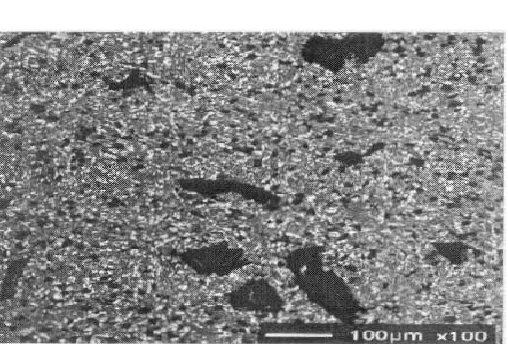
Figure- 1. Microstructures of magnesium matrix composite having high volume fraction of Si particle reinforcement (40 vol%)
2.2 WHISKER-REINFORCED AND SHORT FIBER MMCs (WMMCs) Whisker-reinforced composites could be manufactured by powder metallurgy or infiltration path and shows excellent mechanical properties in comparison to short fiber or particulate reinforced but usage of whisker reinforced composite has been disregarded because of recognized health hazards therefore short fiber reinforced composite are increasingly being developed increasingly those screen charatereristic between continuous fiber and particle reinforced MMCs
Figure-2. Microstructures of short fibre-reinforced magnesium matrix composite
2.3 CONTINOUS FIBER-REINFORCE MMCs (CFMMCs)
These kind of composites includes reinforcement by means of continuous fiber (of SiC or carbon) with diameter significantly less than 20µm {Fibre arrangement and orientation,} fiber concentratation and the distribution , all have substantial Influence about the strength along with other properties of fiber - reinforced composites
2.4 MONO FILAMENT REINFORCED MMCs (MFMMCs)
These monofilament fibers usually made by Chemical substance vapour deposition of either SiC right into a core of carbon fiber or wire of diameter range 100 to 150µm those possess low bending flexibility in comparison to multi –filaments. Monofilament reinforced composite generally made by diffusion bonding method and is bound to super plastic material forming magnesium alloy matrix.
2.5 HYBRID MMCs
Hybrid MMCs essentially consist of more than one type of reinforcement. For example, combination of particle and whisker, or mixture of fibre and particle or mixture of hard and soft reinforcements. Magnesium matrix composite containing mixture of carbon fibre and magnesium particles used in cylindrical liner applications is an example of hybrid composite. Figure 4 shows microstructure of hybrid MMC having both hard SiC and soft graphite particles as reinforcement.
3. PROCESSING TECHNIQUES OF MMCs
Selecting processing methods depends upon several aspects for example type, degree of reinforcement and amount of microstructure integrity needed
1. Liquid state processes 2. Solid state processes
Figure-4. Microstructures of hybrid composite containing 10% SiC and 4% graphite particles.
Liquid state processes consists of stir casting, in-situ(reactive) processing ,spray deposition whereas solid state process are powder metallurgy, Diffusion bonding .
3.1a STIR CASTING
Stir casting would work for production of composites upto 30% volume fraction. In a stir casting procedure reinforcement phases (generally in powder form ) are usually distributed into molten matrix phase by mechanical /ultrasonic or electromagnetic /centrifugal force stirring to conquer the indegent wettability between matrix and reinforcement phase In conventional stir casting method two-stage mixing process have already been adapted. In this technique the matrix material will be heated to above its liquidus temperature so the metal is completely melted. The melt will be then cooled off to a temperature between the liquidus and solidus stage and held in semi solid state and then pre heated particle are usually added and stirred which outcomes slurry that once again heated to create a completely liquid combination of matrix and reinforcement.
3.1b IN-SITU PROCESSING (REACTIVE PROCESSING)
This process could be categories as liquid-gas, liquid-solid, liquid-liquid and mixed salt reactions. In-situ synthesis is really a procedure wherein the refractory reinforcements are usually produced in the matrix by managed metallurgical reactions. In this technique the alloy of Al-Mg is positioned at the top of ceramic perform in a crucible. The complete assembly will be heated to the right temperature in the atmosphere of totally free flowing nitrogen bearing gas mixture..Al-Mg alloy right after melting infiltrates in to the perform and composite is certainly formed soon.
3.1c SPRAY FORMING
but show in homogeneous distribution of ceramic particles. Porosity in the as sprayed condition is normally about 5-10%.For continuous reinforcement, fibres are covered around a mandrel with controlled inter fiber spacing, and the matrix metal is sprayed onto the fibres. A composite monotype is formed; bulk composites are produced by hot pres sing of composite monotypes.
3.2 a CONVENTIONAL POWDER METALLURGY
In powder metallurgy constituents of composites, both in powder type are blended, pressed, degassed and sintered at specific heat range under a controlled environment or in a vacuum. sintered and degassed at particular temperature under a managed atmosphere or in the vacuum. Blending can be executed dried out or in liquid suspension. Blending is normally accompanied by cold compaction canning, degassing and temperature consolidation phase such as very hot isostatic pressing (HIP) or extrusion. PM processed MMCs, contain oxide particles by means of plate-like particles of several tens of nm thick and in volume fractions {which range from 0.05 to 0.5 based on powder history and processing conditions . These fine oxide particles will become a dispersion-strengthening agent and frequently has strong impact on the matrix attributes particularly during heat treatment.
3.2b DIFFUSION BONDING
Diffusion bonding involves zero liquid fusion and the components withstand no, or hardly, any plastic deformation; hardly any residual stress is presented; and there's absolutely no contamination from the bonding procedure. the procedure is more used to create Ti based fibre reinforced composites commonly .
.IN table 1 some manufacturing strategies for obtaining
composites are compared in terms of some characteristics
.IN table 2 different processes and reinforcement are compared
in terms of cost.
RELATIVE CHARACTERISTIC OF DIFFERENT
MANUFACTURING PROCESSES
Table1.
characteristics Processes
PM
Co-spray
Rheo casting
Liquid Infiltration Microstructural
versatility
1 2 2 2
Semi continuous Process
3 1 1 4
Low potential cost 4 2 1 2
1=best
5. GENRAL TRENDS OF COST FOR DISTINCT FORMING METHODS AND REINFORCEM ENT
Table2.
Processes Cost Reinforcement
Diffusion joining Monofilament
PM Whisker
Spray method Short fiber
Melting process Particles
6. PROBLEM S AND POSSIBILITY
Many obstacles should be conquer to be able to improve the engineering usage of MMCs. Design, research and product development initiatives and business development abilities must overcome these challenges. In this quest there's an vital need to have address the next issues.
1. Science of primary processing of MMCs need thoroughly to be understood more specifically aspects influencing the micro-structural integrity which includes segregation and agglomeration in MMCs 2. Right now there is a demand to enhance the destruction
tolerant attributes fracture ductility and toughness in MMCs particularly.
3. Work need to be accomplished to develop good quality and low cost reinforcements from commercial by-products and wastes
4. Attempts should be produced on the development of MMCs predicated on non-nonstandard magnesium alloys as matrices.
5. There is certainly a higher demand to categorize distinct grades of MMCs primarily based on property report and production cost.
6. There is certainly a higher demand to categorize distinct grades of MMCs primarily based on property report and production cost.
7. Secondary processing can be an essential concern in AMCs. Efforts should be initiated to develop cost-effective and basic joining techniques for AMCs. Advancement of less costly equipment for machining and cutting AMCs is necessity
8. Efforts should be carried out to build up re-cycling technologies for composites.
Possibility of MMCs should be viewed as a components for environment safety and Energy saving these two issues should
be sorted at authorities levels plus marketplace acceptance should be enhanced by publicizing information regarding the possible of MMCs
7. SUMMARY
Substantial periods of time and efforts have been dedicated to the research and development of magnesium matrix composites recently. Numerous strategies had been employed and
developed to the processing of magnesium matrix composites like stir casting, pressure, powder metallurgy and in-situ formation of reinforcement in the matrix. Crucial aspects influencing the overall performance of the magnesium composites will be the matrix composition; the chemistry; the form, dimension, and distribution of the reinforcements; and the bonding strength at the reinforcement/matrix user interface
High strength in the composites will be attained at the expense of compromised ductility normally Nonetheless grain
refinement is an efficient approach of enhancing strength and ductility at ambient temperatures Nevertheless extreme care needs to be taken in using fine-grained components at elevated temperatures since creep resistance could be influenced by the fine grain {size badly The recognition of the magnesium matrix composites as engineering components relies not merely on the overall performance of the materials,but additionally on the advancement of least expensive processing technologies for these materials.
.REFERENCES:
1. Edward B. Warda Ii , Light Metals Age Feb. (1989) 34. 2. Alan Luo, Jean Renaud, Isao Nakatsugawa
And Jacques Plourde, Jom July (1995) 28.
3. Byron B. Clow, Adv. Mater. Proc. Feb./Oct. (1996) 33. 4. Pekguleryuz, Mihriban Ozden And Luo Aihua
Alan, Patent Wo 96/25529.
5. Polmer I.J., “Light Alloys,” 2nd Edn. Published Byedward Arnold (1989) P. 169.
6. F . Von Buch, J. Lietzau, B. L. Mordike, A. Pisch And R. Schmid-Fetzer, Mater. Sci. Engg. A 263
(1999) 1.
7. Commercial Processing Of Metal Matrix Composites
William C. Harrigan Jr. * Alyn Corporation, Irvine, Ca 92606, Usa 8. X.Zhang, M.L.Tan ,”Selection Of Particulate Reinforcement In P/M Metal Matrix Composites “ (School Ofmechanical And Production Engineering, Nanyang Technological University, Nanyang Avenue, Singapore 639798)
9. Jain M.K. Et Al, The International Journal Of Powder Metallurgy , 29(1993), 267.