Enriching Basque Coreference Resolution System using Semantic
Knowledge sources
Ander Soraluze and Olatz Arregi and Xabier Arregi and Arantza D´ıaz de Ilarraza University of the Basque Country
Donostia - San Sebasti´an, Spain
{ander.soraluze,olatz.arregi, xabier.arregi,a.diazdeilarraza}@ehu.eus
Abstract
In this paper we present a Basque coref-erence resolution system enriched with se-mantic knowledge. An error analysis car-ried out revealed the deficiencies that the system had in resolving coreference cases in which semantic or world knowledge is needed. We attempt to improve the de-ficiencies using two semantic knowledge sources, specifically Wikipedia and Word-Net.
1 Introduction
Coreference resolution consists of identifying tex-tual expressions (mentions) that refer to real-world objects (entities) and determining which of these mentions refer to the same entity. While differ-ent string-matching techniques are useful to deter-mine which of these mentions refer to the same entity, there are cases in which more knowledge is needed, that is the case of the Example in 1.
(1) [Osasunak] lehenengo mailara igotzeko lehian azken astean bizi duen giroa oso polita da. [Taldea] lasaitzeko asmoz Oronozera eraman zituen Lotinak atzo guztiak. Oronozko kontzentrazioa behar-rezkoa dute [gorritxoek].
“[Osasuna] is going through a beautiful moment in the last week in the race to as-cend to the Premier League. In order to reassure [the team] Lotina has decided to give all of them to Oronoz. [The reds] need to concentrate in Oronoz.”
Having the world knowledge thatOsasunais a
football teamand its nickname isthe reds would be helpful for establishing the coreference rela-tions between the menrela-tions [Osasuna], [Taldea] and [gorritxoek] in the example presented above.
Evaluation scores used in coreference resolu-tion tasks can show how effective a system is; however, they neither identify deficiencies of the system, nor give any indication of how those er-rors might be corrected. Error analyses are a good option that can help to clear the deficiencies of a coreference resolver. Bearing this in mind, we have carried out an error analysis of the extended version of the coreference resolution system pre-sented in Soraluze et al. (2015). In this paper we present an improvement of this Basque corefer-ence resolution system by using semantic knowl-edge sources in order to correctly resolve cases like in Example 1.
This paper is structured as follows. After pre-senting an error analysis of the coreference resolu-tion system in Secresolu-tion 2, we analyse similar works to ours in which semantic knowledge sources have been used to improve coreference resolution in Section 3. Section 4 presents how we integrated the semantic knowledge in our system. The main experimental results are outlined in Section 5 and discussed in Section 6. Finally, we review the main conclusions and preview future work.
2 Error Analysis
A deep error-analysis can reveal the weak points of the coreference resolution system and help to decide future directions in the improvement of the system. The system we have evaluated is an adap-tation of the Stanford Coreference resolution sys-tem (Lee et al., 2013) to the Basque language. The Stanford coreference resolution module is a deter-ministic rule-based system which is based on ten independent coreference models or sieves that are precision-oriented, i.e., they are applied sequen-tially from highest to lowest precision. All the sieves of the system have been modified taking into account the characteristics of the Basque
guage and, one new sieve has been added, obtain-ing an end-to-end coreference resolution system.
The corpus used to carry out the error analysis is a part of EPEC (the Reference Corpus for the Pro-cessing of Basque) (Aduriz et al., 2006). EPEC is a 300,000 word sample collection of news pub-lished in Euskaldunon Egunkaria, a Basque lan-guage newspaper. The part of the corpus we have used has about 45,000 words and it has been man-ually tagged at coreference level by two linguists (Ceberio et al., 2016). First of all, automatically tagged mentions obtained by a mention detector (Soraluze et al., 2016) have been corrected; then, coreferent mentions have been linked in clusters.
More detailed information about the EPEC cor-pus can be found in Table 1.
Words Mentions Clusters Singletons
Devel 30434 8432 1313 4383
[image:2.595.314.518.61.183.2]Test 15949 4360 621 2445
Table 1: EPEC corpus division information
2.1 Error types
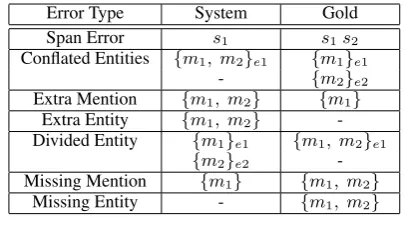
The errors have been classified following the cat-egorization presented in Kummerfeld and Klein (2013). The tool1 presented in the paper has been used to help in identifying and quantifying the er-rors produced by the coreference resolution sys-tem:
• Span Error (SE):A mention span has been identified incorrectly.
• Conflated Entities (CE):Two entities have been unified creating a new incorrect one.
• Extra Mention (EM):An entity includes an incorrectly identified mention.
• Extra Entity (EE):An entity which consists of incorrectly identified mentions is outputted by the system.
• Divided Entity (DE):An entity has been di-vided in two entities.
• Missing Mention (MM): A not identified mention is missing in an entity.
• Missing Entity (ME):The system misses an entity which is present in the gold standard. The error types are summarised in Table 2.
1code.google.com/p/berkeley-coreference-analyser/
Error Type System Gold
Span Error s1 s1s2
Conflated Entities {m1, m2}e1 {m1}e1 - {m2}e2 Extra Mention {m1, m2} {m1}
Extra Entity {m1, m2} -Divided Entity {m1}e1 {m1, m2}e1
{m2}e2 -Missing Mention {m1} {m1, m2}
Missing Entity - {m1, m2}
Table 2: Error types. s=string, m=mention, e=entity
2.2 Error causes
Apart from classifying the errors committed by the coreference resolution system, it is important to observe the causes of these error types. These are the causes of errors we found:
• Preprocessing (PP): Errors in the prepro-cessing step (lemmatization, PoS tagging, etc.) provoke incorrect or missing links in coreference resolution.
• Mention Detection (MD): These errors are provoked due to incorrectly identified (not a mention, incorrect boundaries..) or missed mentions during mention detection step. Missed mentions directly affect the recall of the system, and incorrectly identified men-tions affect precision.
• Pronominal Resolution (PR): The system often generates incorrect links between the pronoun and its antecedent.
• Ellipsis Resolution (ER): Elliptical men-tions do not provide much information as they omit the noun, as a consequence it is dif-ficult to correctly link these types of mentions with their correct antecedent.
For example, it is complicated to link the elliptical mention [Yosi Beilin Israelgo Jus-tizia ministroak Jeruralemi buruz esandako-Ø2-ak] “what Yosi Beilin Israel Justice Min-ister said” with its antecedent [Beilin Jus-tizia ministroaren hitzak] “Beilin Justice min-ister’s words”.
• Semantic Knowledge (SK):Errors related to a semantic relation (synonymy, hyperonymy, metonymy) between the heads of two men-tions.
For example, in mentions [Libanoko Par-lamentuak] “Lebanon parliament” and [Libanoko Legebiltzarrak] “Lebanon par-liament”, parlamentua is a synomyn of
legebiltzarra.
• World Knowledge (WK):In some cases the system is not able to link mentions as a con-sequence of the lack of world knowledge re-quired to resolve them correctly.
For example, to link the mention [Reala] “Re-ala” with the mention [talde txuri-urdinak] “white-blue team”, it is necessary to know thatRealais a team and the nickname of the football team istxuri-urdinak“white-blue”.
• Miscellaneous (MISC):In this category we classify the errors that are not contained in the above categories.
An example of a miscellaneous error could be the following. The mention [Kelme, Eu-skaltel eta Lampre] should be linked with the mention [Hiru taldeak] “The three teams”. In this specific example it is necessary to know that Kelme, Euskaltel and Lampre are teams and the enumerated mention has three ele-ments.
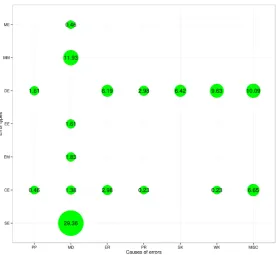
After defining the error types and the error causes, we analysed how the error causes affect the error types in EPEC corpus. The distribution of errors is shown in Figure 1.
As we observe in Figure 1, the most com-mon errors types of the system fail in Span Error (29.36%), Conflated Entities (11.92%), Divided Entities (42.88%) and Missing Mention (11.92%) categories.
Observing the error causes, we can conclude that mention detection is crucial for coreference resolution, 52.52% of errors. Improving men-tion detecmen-tion would likely improve the scores ob-tained in coreference resolution. Nevertheless, in order to identify deficiencies of a coreference res-olution system, Pronominal Resres-olution (9.17%), Ellipsis Resolution (3.21%), Semantics (6.42%) and World Knowledge (9.86%) categories can re-veal how the errors might be corrected. Due to the variety of errors classified in miscellaneous cat-egory, little improvement would be achieved de-spite making a big effort to solve them.
Among all the error causes, in this paper we are going to focus on errors provoked by the lack of
semantic and world knowledge.
3 Related Work
Lexical and encyclopedic information sources, such as WordNet, Wikipedia, Yago or DBPedia have been widely used to improve coreference res-olution.
WordNet (Fellbaum, 1998) is the one of old-est resources for lexical knowledge. It consists of synsets, which link synonymous word senses together. Using WordNet’s structure, it is possi-ble to find synonyms and hyperonymic relations. Wikipedia is a collaborative open source encyclo-pedia edited by volunteers and provides a very large domain-independent encyclopedic reposi-tory. Yago (Suchanek et al., 2007) is a knowl-edge base, linking Wikipedia entries to the Word-Net ontology. And finally, DBPedia (Mendes et al., 2012) contains useful ontological information extracted from the data in Wikipedia.
Regarding works in which lexical and ency-clopedic information sources have been exploited, Ponzetto and Strube (2006) were the earliest to use WordNet and Wikipedia.
Uryupina et al. (2011) extracted semantic com-patibility and aliasing information from Wikipedia and Yago and incorporated it in coreference res-olution system. They showed that using such knowledge with no disambiguation and filtering does not bring any improvement over the baseline, whereas a few very simple disambiguation and fil-tering techniques lead to better results. In the end, they improve their system’s performance by 2-3 percentage points.
Rahman and Ng (2011) used Yago to inject knowledge attributes in mentions, but noticed that knowledge injection could be noisy.
Durrett and Klein (2013) observed that the se-mantic information contained even in a corefer-ence corpus of thousands of documents is insuf-ficient to generalize to unseen data, so system de-signers have turned to external resources. Using specialised features, as well as WordNet-based hy-pernymy and synonymy and other resources, they obtained a gain from 60.06 in CoNLL score to 61.58 using automatic mentions, and from 75.08 to 76.68 with gold mentions.
Figure 1: Distribution of error causes into error types.
In Hajishirzi et al. (2013) NECo, a new model for named entity linking and coreference resolu-tion, which solves both problems jointly, reduc-ing the errors of each is introduced. NECo ex-tends the Stanford deterministic coreference reso-lution system by automatically linking mentions to Wikipedia and introducing new sieves which profit from information obtained by named entity link-ing.
As pointed out in Recasens et al. (2013), opaque mentions (mentions with very different words like
Google and the search giant) account for 65% of the errors made by state-of-the-art systems, so to improve coreference scores beyond 60-70% it is necessary to make better use of semantic and world knowledge to deal with non-identical-string coreference. They use a corpus of comparable documents to extract aliases and they report that their method not only finds synonymy and in-stance relations, but also metonymic cases. They obtain a gain of 0.7% F1 score for the CoNLL met-ric using gold mentions.
Lee et al. (2013) mention that the biggest chal-lenge in coreference resolution, accounting for 42% of errors in the state-of-the art Stanford sys-tem, is the inability to reason effectively about background semantic knowledge.
The intuition behind the work presented in
Dur-rett and Klein (2014) is that named entity recogni-tion on ambiguous instances can obtain benefit us-ing coreference resolution, and similarly can ben-efit from Wikipedia knowledge. At the same time, coreference can profit from better named entity in-formation.
4 Improving Coreference Resolution with Semantic Knowledge sources This section explains the improvement process of the coreference resolution system with semantic knowledge sources. In order to treat cases where knowledge is needed, two new specialised sieves have been added to the coreference resolution sys-tem: One to extract knowledge from Wikipedia and the other to obtain semantic information from WordNet.
4.1 Enriching mentions with Named Entity Linking
Named Entity Linking is the task of matching mentions to corresponding entities in a knowledge base, such as Wikipedia.
As pointed out in Versley et al. (2016), named entity linking, or disambiguation of entity men-tions, is beneficial to make full use of the infor-mation in Wikipedia.
about 258,000 articles in September 2016, which is much smaller in size when compared with En-glish Wikipedia, which contained about 5,250,837 pages on the same date.
In order to disambiguate and link mentions to Basque Wikipedia pages, the following formula has been applied to all the named entity mentions in a document:
P(s, c, e) =P(e|s)P(e|c)
P(e|s) is the probability of being entity e
given s string, i.e., the normalised probability of being entity e linked with string s in Wikipedia.
P(e|c) is the probability of being entityegiven the context c. The context c is a window of size [−50,+50] of the string s. To calculate
P(e|c) probability, UKB3 software has been utilised. UKB software uses Personalized Page Rank algorithm presented in (Agirre and Soroa, 2009) and (Agirre et al., 2014) to estimate the probabilities.
If a named-entity mention is linked with any page from Wikipedia, the page that UKB says it is the most probable is used to enrich the mention. From the Wikipedia page the following informa-tion is obtained:
• The title of the page. The title some-times gives useful information. For exam-ple, for the named-entity mentionAEK, the title of its Wikipedia page is Alfabetatze Euskalduntze Koordinakundea“Literacy and Euskaldunization Coordinator”, where the extent of the acronym is obtained. Further-more it gives the information that AEK is a coordinator,koordinakundea.
• The first sentence. The first paragraph of each Wikipedia article provides a very brief sum-mary of the entity. Usually the most use-ful information is in the first sentence, this is where the entity is defined.
• If the Wikipedia page has an Infobox, we ex-tract information from it. Infoboxes contain structured information in which the attributes of many entities are listed in a standardized way.
After the information is obtained from the Wikipedia page, this information is processed and the NPs are extracted.
3http://ixa2.si.ehu.es/ukb/
These NPs and their sub-phrases are used to en-rich the mentions with world knowledge. To fur-ther reduce the noise, the NPs that are location named-entities in a Wikipedia page about a loca-tion are discarded.
Taking Example 1, the mentionOsasunais en-riched as follows: The most probable Wikipedia page proposed by UKB for the mention Os-asuna is Osasuna futbol kluba “Osasuna foot-ball club”. Therefore, we obtain from this page the title, the first sentence and Infobox infor-mation. The NPs obtained after the informa-tion is processed are gorritxoak “the reds”, Os-asuna futbol kluba “Osasuna football club” and
Nafarroako futbol taldea “football team from Navarre”. So the mention Osasuna is enriched with the set of lemmas of the NPs and the lemmas of their sub-phrases: {gorritxo, Os-asuna futbol klub, futbol klub, klub, Nafarroa fut-bol talde, futfut-bol talde, talde} “{the reds, Os-asuna football club, football club, club, foot-ball team from Navarre, footfoot-ball team, team}”.
4.2 Wiki-alias sieve
The new Wiki-alias sieve uses the mentions en-riched by information obtained from Wikipedia pages.
Using this information, the Wiki-alias sieve as-sumes that two mentions are coreferent if one of the two following conditions is fulfilled:
i) the set of enriched word lemmas in the po-tential antecedent has all the mention candidate’s span lemmas. To better understand this constraint, suppose that the mentionRealak is enriched with
{talde, futbol talde, txuri-urdin} “{team, foot-ball team, white and blue}”, as the potential an-tecedentRealakhas all the lemmas in the mention candidate’s span, i.e., talde “{team}” and txuri-urdin“{white and blue}”, the mentiontalde txuri-urdinak “{white and blue team}” is considered coreferent ofRealak.
presidentea. AfterJacques Chiracekmention has been enriched with lemmas {presidente, Frantzia presidente} “{president, France president}”, the head word lemma of the mention candidate pres-idente is equal to a lemma in the set of enriched lemmas of the potential antecedentpresidenteand all the enriched lemmas of the potential antecedent appear in the cluster lemmas of the mention can-didate, so the second constraint is fulfilled. This constraint aims to link coreferent mentions where a mention with novel information appears later in text than the less informative one. As pointed out in Fox (1993), it is not common to introduce novel information in later mentions but it some-times happens.
4.3 Synonymy sieve
To create this new sieve, we have extracted from Basque WordNet (Pociello et al., 2011) all the words that are considered synonyms in this on-tology. The Basque WordNet contains 32,456 synsets and 26,565 lemmas, and is complemented by a hand-tagged corpus comprising 59,968 anno-tations (Pociello et al., 2011).
From all synsets, a static list of 16,771 sets of synonyms has been created and integrated in the coreference resolution system. Using the syn-onyms’ static list, the Synonymy sieve considers two mentions as coreferent if the following con-straints are fulfilled: i) the head word of the po-tential antecedent and the head word of the men-tion candidate are synonyms and ii) all the lemmas in the mention candidate’s span are in the poten-tial antecedent cluster word lemmas orvice versa. For example, the mention candidateLibanoko leg-ebiltzarra“Lebanon parliament” and theLibanoko parlametua“Lebanon parliament” are considered coreferent as the head wordslegebiltzarraand par-lamentua are synonyms and the lemma Libano
“Lebanon” of the wordLibanokois present in the cluster word lemmas of the potential antecedent.
5 System evaluation
In order to quantify the impact of using seman-tic knowledge sources in coreference resolution, we have tested the enriched coreference resolu-tion system using the EPEC corpus and compared the results with the baseline system. The exper-imentation has been carried out using automatic mentions and gold mentions. In both cases named entity disambiguation and entity linking has been
performed automatically.
5.1 Metrics
The metrics used to evaluate the systems’ perfor-mances are MUC (Vilain et al., 1995),B3(Bagga and Baldwin, 1998), CEAFe(Luo, 2005), CEAFm
(Luo, 2005), BLANC (Recasens and Hovy, 2011) and LEA (Moosavi and Strube, 2016). The CoNLL metrics is the arithmetic mean of MUC,
B3and CEAFemetrics. The scores have been cal-culated using the reference implementation of the CoNLL scorer (Pradhan et al., 2014).
5.2 Experimental results
As pointed out in Rahman and Ng (2011), while different knowledge sources have been shown to be useful when applied in isolation to a corefer-ence system, it is also interesting to observe if they offer complementary benefits and can there-fore further improve a resolver when applied in combination. In order to quantify the individual improvement of each new sieve, we compared the baseline system (1) with the system in which the wiki-alias sieve has been added (2), with the one where the synonymy sieve has been added (3), and with the final system combining both sieves (4).
Table 3 shows the results obtained by the base-line system compared with those obtained by the coreference resolution system, which uses semantic knowledge sources. These scores are obtained with automatically detected mentions (F1 =77.57).
The scores obtained by systems using the gold mentions (F1 =100), i.e., when providing all the correct mentions to the coreference resolution sys-tems, are shown in Table 4.
6 Discussion
Observing the results presented in Table 3, we can see that the baseline system’s F1 scores are out-performed in all the metrics by the semantically enriched system. In CoNLL metric, the improved system has a score of 55.81, which is slightly higher than the baseline system, to be precise, 0.24 higher.
As shown in Table 4, the baselineF1scores are also outperformed in all the metrics, except inB3 when gold mentions are used. The official CoNLL metric is improved by 0.39 points.
Automatic Mentions
MUC B3 CEAFm CEAFe BLANC LEA CoNLL
R P F1 R P F1 R P F1 R P F1 R P F1 R P F1 F1
1 34.1 55.76 42.32 57.98 68.83 62.94 60.78 62.31 61.54 66.02 58.41 61.98 38.41 53.57 43.18 46.71 51.78 49.12 55.74 2 34.41 55.70 42.54 58.09 68.64 62.93 60.73 62.26 61.49 65.94 58.49 61.99 38.65 53.27 43.35 46.82 51.64 49.11 55.82 3 34.57 56.03 42.76 58.08 68.80 62.98 60.85 62.38 61.61 65.99 58.51 62.03 38.53 53.65 43.31 46.83 51.97 49.27 55.92 4 34.88 55.90 42.95* 58.19 68.60 62.97 60.80 62.33 61.56 65.92 58.60 62.04 38.77 53.33 43.48* 46.94 51.83 49.26 55.98*
Table 3: Results obtained when automatic mentions are used. 1=Baseline, 2=1+Wiki sieve, 3=2+Synonymy sieve, 4=1+Wiki sieve+Synonymy sieve.
Gold Mentions
MUC B3 CEAFm CEAFe BLANC LEA CoNLL
R P F1 R P F1 R P F1 R P F1 R P F1 R P F1 F1
[image:7.595.74.527.64.125.2]1 48.76 71.94 58.12 81.35 93.47 86.99 80.57 80.57 80.57 89.00 78.24 83.27 67.09 84.65 72.77 66.36 71.11 68.66 76.12 2 49.84 70.81 58.50 81.71 92.83 86.92 80.57 80.57 80.57 88.69 78.77 83.44 67.51 83.27 72.84 66.60 71.01 68.73 76.28 3 50.00 71.50 58.85 81.69 93.19 87.06 80.80 80.80 80.80 88.90 78.82 83.56 67.39 84.23 72.95 66.68 71.52 69.02 76.49 4 50.46 70.99 58.99* 81.86 92.81 86.99 80.71 80.71 80.71 88.71 79.00 83.57* 67.68 83.34 73.00 66.79 71.29 68.97 76.51*
Table 4: Results obtained when gold mentions are used. 1=Baseline, 2=1+Wiki sieve, 3=2+Synonymy sieve, 4=1+Wiki sieve+Synonymy sieve.
except CEAFeshow an improvement in recall and
decrease in precision when two new sieves are ap-plied. The reason why the CEAFemetric is
behav-ing differently could be that, as mentioned by De-nis and Baldridge (2009), CEAF ignores all cor-rect decisions of unaligned response entities. Con-sequently, the CEAF metric may lead to unreliable results.
It is interesting to compare the improvements obtained by the system which uses semantic knowledge sources in CoNLL scores. The im-provement when automatic mentions are used is lower than when gold mentions are provided, 0.24 and 0.39 respectively. In both cases, even the im-provements obtained are modest, they are statisti-cally significant using Paired Student’s t-test with p-value<0.05.
As pointed out in Versley et al. (2016), in real-istic settings, where the loss in precision would be amplified by the additional non-gold mentions, it is substantially harder to achieve gains by incorpo-rate lexical and encyclopedic knowledge, but pos-sible and necessary. A similar idea is concluded by Durrett and Klein (2013). They mention that de-spite the fact that absolute performance numbers are much higher on gold mentions and there is less room for improvement, the semantic features help much more than they do in system mentions.
To conclude the analysis of the results, it is also interesting to observe the difference between the results obtained by both systems when automatic mentions and when gold mentions are used. It is clear that having accurate preprocessing tools and a good mention detector are crucial to obtain good results in coreference resolution. In both
sys-tems the difference in CoNLL score is about 20.00 points higher when gold mentions are used.
The results obtained have enabled us to carry out a new error analysis in the development set. After applying the new two sieves, the error anal-ysis has revealed four major issues that directly affect not obtaining bigger improvement when knowledge resources are used:
1. Some mentions do not have Wikipedia en-try, as the coverage of Basque Wikipedia (257,546 pages) has less coverage than other languages, for example English (5,250,837 pages), i.e., Basque version is 21 times smaller.
2. Due to incorrect mention disambiguation, some mentions are linked to incorrect Wikipedia pages. The precision obtained in disambiguation is 87,84%.
3. Precision errors, provoked by cases where many proper noun mentions were potential antecedent for a common noun. For exam-ple,Oslois linked byhiriburu“capital”, nev-ertheless the correct antecedent forhiriburu
is another capital that appears in text, in this specific case,Jerusalem.
4. Some indefinite mentions which do not have antecedent are linked incorrectly. For exam-ple,estaturik“state” is linked withFrantziak
“France”.
[image:7.595.74.525.171.234.2]are synonyms depending on the context in which they appear. As a consequence of missing synonyms, some mentions with syn-onymy relations between them are not linked. The presence of very generic synonyms pro-vokes to incorrectly link mentions that are not coreferent, so that precision decreases. Iden-tifying the particular sense that a word has in context would likely help to improve the pre-cision.
Regarding the issues that affect improvement of the systems when knowledge bases are used, Uryupina et al. (2011) suggest that in their partic-ular case the errors introduced are not caused by any deficiencies in web knowledge bases, but re-flect the complex nature of the coreference resolu-tion task.
7 Conclusions and future work
We have enriched the Basque coreference resolu-tion adding new two sieves, Wiki-alias and Syn-onymy sieve, respectively. The first sieve uses the enriched information of named-entity mentions af-ter they have been linked to their correspondent Wikipedia page, using Entity Linking techniques. The second sieve uses a static list of synonyms ex-tracted from Basque WordNet to consider whether two mentions are coreferent.
Applying the two new sieves, the system ob-tains an improvement of 0.24 points in CoNLLF1 when automatic mentions are used and the CoNLL score is outperformed by 0.39 points when the gold mentions are provided. The error analysis of the enriched system has revealed that the knowl-edge bases used, Basque Wikipedia and Basque WordNet, have deficiencies in their coverage com-pared with knowledge bases in major languages, for example, English. We suggest that there is margin of improvement, as Basque Wikipedia and Basque WordNet coverage increase, bearing in mind that coreference resolution is a complex task. As future work, we intend to improve the Pro-noun resolution and Ellipsis Resolution, as we ob-served in the error analysis presented in Section 2 they are the cause of considerable coreference res-olution errors, around % 12 of total errors.
Acknowledgments
This work has been supported by first author’s PhD grant from Euskara Errektoreordetza, the
University of the Basque Country (UPV/EHU) and by the EXTRECM project, Spanish Govern-ment (TIN2013-46616-C2-1-R).
References
Itziar Aduriz, Mar´ıa Jes´us Aranzabe, Jose Mari Ar-riola, Maite Atutxa, Arantza D´ıaz de Ilarraza, Nerea Ezeiza, Koldo Gojenola, Maite Oronoz, Aitor Soroa, and Ruben Urizar. 2006. Methodology and Steps towards the Construction of EPEC, a Corpus of Written Basque Tagged at Morphological and Syn-tactic Levels for the Automatic Processing. In
Language and Computers, volume 56, pages 1–15.
Rodopi, Amsterdam, Netherlands.
Eneko Agirre and Aitor Soroa. 2009. Personalizing PageRank for Word Sense Disambiguation. In Pro-ceedings of the 12th Conference of the European Chapter of the Association for Computational
Lin-guistics, EACL ’09, pages 33–41, Athens, Greece.
Association for Computational Linguistics.
Eneko Agirre, Oier L´opez de Lacalle, and Aitor Soroa. 2014. Random Walks for Knowledge-based Word Sense Disambiguation. Comput. Linguist., 40(1):57–84.
Amit Bagga and Breck Baldwin. 1998. Algorithms for Scoring Coreference Chains. In The First Interna-tional Conference on Language Resources and
Eval-uation Workshop on Linguistics Coreference, pages
563–566, Granada, Spain.
Klara Ceberio, Itziar Aduriz, Arantza D´ıaz de Ilarraza, and Ines Garcia-Azkoaga. 2016. Coreferential re-lations in Basque: the annotation process. In The-oretical Developments in Hispanic Linguistics. The Ohio State University.
Pascal Denis and Jason Baldridge. 2009. Global Joint Models for Coreference Resolution and Named Entity Classification. Procesamiento del Lenguaje Natural, 43:87–96.
Greg Durrett and Dan Klein. 2013. Easy Victories and Uphill Battles in Coreference Resolution. In Pro-ceedings of the 2013 Conference on Empirical
Meth-ods in Natural Language Processing, pages 1971–
1982, Seattle, Washington, USA. Association for Computational Linguistics.
Greg Durrett and Dan Klein. 2014. A Joint Model for Entity Analysis: Coreference, Typing, and Linking.
TACL, 2:477–490.
Christiane Fellbaum, editor. 1998. WordNet: an elec-tronic lexical database. MIT Press.
Barbara A. Fox. 1993. Discourse structure and
anaphora: written and conversational English.
Hannaneh Hajishirzi, Leila Zilles, Daniel S. Weld, and Luke Zettlemoyer. 2013. Joint Coreference Res-olution and Named-Entity Linking with Multi-Pass Sieves. InProceedings of the 2013 Conference on Empirical Methods in Natural Language Process-ing, pages 289–299, Seattle, Washington, USA. As-sociation for Computational Linguistics.
Jonathan K. Kummerfeld and Dan Klein. 2013. Error-Driven Analysis of Challenges in Coreference Res-olution. InProceedings of the 2013 Conference on Empirical Methods in Natural Language Process-ing, pages 265–277, Seattle, Washington, USA.
Heeyoung Lee, Angel Chang, Yves Peirsman, Nathanael Chambers, Mihai Surdeanu, and Dan Ju-rafsky. 2013. Deterministic Coreference Resolution Based on Entity-centric, Precision-ranked Rules.
Computational Linguistics, 39(4):885–916.
Xiaoqiang Luo. 2005. On Coreference Resolution Per-formance Metrics. In Proceedings of the Confer-ence on Human Language Technology and
Empir-ical Methods in Natural Language Processing, HLT
’05, pages 25–32, Vancouver, British Columbia, Canada. Association for Computational Linguistics.
Pablo Mendes, Max Jakob, and Christian Bizer. 2012. DBpedia: A Multilingual Cross-domain Knowledge Base. In Proceedings of the Eight International Conference on Language Resources and Evaluation
(LREC’12), Istanbul, Turkey. European Language
Resources Association (ELRA).
Nafise Sadat Moosavi and Michael Strube. 2016. Which Coreference Evaluation Metric Do You Trust? A Proposal for a Link-based Entity Aware Metric. In Proceedings of the 54th Annual Meet-ing of the Association for Computational LMeet-inguis- Linguis-tics, pages 632–642, Berlin, Germany. Association for Computational Linguistics.
Elisabete Pociello, Eneko Agirre, and Izaskun Aldez-abal. 2011. Methodology and construction of the Basque WordNet. Language Resources and Evalu-ation, 45(2):121–142.
Simone Paolo Ponzetto and Michael Strube. 2006. Exploiting Semantic Role Labeling, WordNet and Wikipedia for Coreference Resolution. In Pro-ceedings of the Main Conference on Human Lan-guage Technology Conference of the North Amer-ican Chapter of the Association of Computational
Linguistics, HLT-NAACL ’06, pages 192–199.
As-sociation for Computational Linguistics.
Sameer Pradhan, Xiaoqiang Luo, Marta Recasens, Ed-uard Hovy, Vincent Ng, and Michael Strube. 2014. Scoring Coreference Partitions of Predicted Men-tions: A Reference Implementation. InProceedings of the 52nd Annual Meeting of the Association for Computational Linguistics, pages 30–35, Baltimore, Maryland. Association for Computational Linguis-tics.
Altaf Rahman and Vincent Ng. 2011. Coreference Resolution with World Knowledge. InProceedings of the 49th Annual Meeting of the Association for Computational Linguistics: Human Language
Tech-nologies, HLT ’11, pages 814–824, Portland,
Ore-gon. Association for Computational Linguistics. Lev Ratinov and Dan Roth. 2012. Learning-based
Multi-sieve Co-reference Resolution with Knowl-edge. In Proceedings of the 2012 Joint Confer-ence on Empirical Methods in Natural Language Processing and Computational Natural Language
Learning, EMNLP-CoNLL ’12, pages 1234–1244,
Jeju Island, Korea. Association for Computational Linguistics.
Marta Recasens and Eduard Hovy. 2011. BLANC: Implementing the Rand index for coreference eval-uation. Natural Language Engineering, 17(4):485– 510.
Marta Recasens, Matthew Can, and Daniel Jurafsky. 2013. Same Referent, Different Words: Unsuper-vised Mining of Opaque Coreferent Mentions. In
Proceedings of the 2013 Conference of the North American Chapter of the Association for
Computa-tional Linguistics: Human Language Technologies,
pages 897–906, Atlanta, Georgia. Association for Computational Linguistics.
Ander Soraluze, Olatz Arregi, Xabier Arregi, and Arantza D´ıaz de Ilarraza. 2015. Coreference Res-olution for Morphologically Rich Languages. Adap-tation of the Stanford System to Basque. Proce-samiento del Lenguaje Natural, 55:23–30.
Ander Soraluze, Olatz Arregi, Xabier Arregi, and Arantza D´ıaz De Ilarraza. 2016. Improving mention detection for Basque based on a deep error analysis.
Natural Language Engineering, pages 1–34, 007.
Fabian M. Suchanek, Gjergji Kasneci, and Gerhard Weikum. 2007. YAGO: a core of semantic knowl-edge unifying WordNet and Wikipedia. In Proceed-ings of the 16th International World Wide Web
Con-ference (WWW 2007), pages 697–706.
Olga Uryupina, Massimo Poesio, Claudio Giuliano, and Kateryna Tymoshenko. 2011. Disambigua-tion and Filtering Methods in Using Web Knowl-edge for Coreference Resolution. InFLAIRS
Con-ference, pages 317–322. AAAI Press.
Yannick Versley, Massimo Poesio, and Simone Ponzetto. 2016. Using Lexical and Encyclo-pedic Knowledge. In Massimo Poesio, Roland Stuckardt, and Yannick Versley, editors, Anaphora Resolution: Algorithms, Resources, and
Applica-tions, pages 393–429. Springer Berlin Heidelberg,
Berlin, Heidelberg.