Compositional Semantics using Feature-Based Models from WordNet
Pablo Gamallo
Centro Singular de Investigaci´on en Tecnolox´ıas da Informaci´on (CiTIUS) Universidade de Santiago de Compostela
Galiza, Spain
Mart´ın Pereira-Fari˜na Centre for Argument Technology (ARG-tech)
University of Dundee Dundee, DD1 4HN, Scotland (UK) [email protected]
Departamento de Filosof´ıa e Antropolox´ıa Universidade de Santiago de Compostela
Pz. de Mazarelos, 15782, Galiza, Spain [email protected]
Abstract
This article describes a method to build semantic representations of composite ex-pressions in a compositional way by using WordNet relations to represent the mean-ing of words. The meanmean-ing of a target word is modelled as a vector in which its semantically related words are assigned weights according to both the type of the relationship and the distance to the tar-get word. Word vectors are composi-tionally combined by syntactic dependen-cies. Each syntactic dependency triggers two complementary compositional func-tions: the namedhead functionand depen-dent function. The experiments show that the proposed compositional method per-forms as the state-of-the-art for subject-verb expressions, and clearly outperforms the best system for transitive subject-verb-object constructions.
1 Introduction
The principle of compositionality (Partee, 1984) states that the meaning of a complex expression is a function of the meaning of its constituent parts and of the mode of their combination. In the recent years, different distributional semantic models endowed with a compositional component have been proposed. Most of them define words as high-dimensional vectors where dimensions rep-resent co-occurring context words. This distribu-tional semantic representation makes it possible to combine vectors using simple arithmetic opera-tions such as addition and multiplication, or more advanced compositional methods such as learning functional words as tensors and composing con-stituents through inner product operations.
Notwithstanding, these models are usually qual-ified as black box systems because they are usually not interpretable by humans. Currently, the field of interpretable computational models is gaining rel-evance1 and, therefore, the development of more explainable and understandable models in compo-sitional semantics is also an open challenge. in this field. On the other hand, distributional semantic models, given the size of the vectors, needs signif-icant resources and they are dependent on particu-lar corpus, which can generate some biases in their application to different languages.
Thus, in this paper, we will pay attention to compositional approaches which employ other kind of word semantic models, such as those based on the WordNet relationships; i.e., synsets, hyper-nyms, hypohyper-nyms, etc. Only in (Faruqui and Dyer, 2015) we can find a proposal for word vector rep-resentation using hand-crafted linguistic resources (WordNet, FrameNet, etc.), although a composi-tional frame is not explicitly adopted. Therefore, to the best of our knowledge, this is the first work using WordNet to build compositional semantic interpretations. Thus, in this article, we propose a method to compositionally build the semantic representation of composite expressions using a feature-based approach (Hadj Taieb et al., 2014): constituent elements are induced by WordNet re-lationships.
However, this proposal raises a serious prob-lem: the semantic representation of two syntacti-cally related words (e.g. the verbrunand the noun
computerin“the computer runs”) encodes incom-patible information and there is no direct way of combining the features used to represent the mean-ing of the two words. On the one hand, the verb
1
http://www.darpa.mil/program/explainable-artificial-intelligence
runis related by synonymy, hypernym, hyponym and entailment to other verbs and, on the other, the nouncomputeris put in relation with other nouns by synonymy, hypernym, hyponym, and so on.
In order to solve this drawback, on the basis of previous work on dependency-based distribu-tional composidistribu-tionality (Thater et al., 2010; Erk and Pad´o, 2008), we distinguish between direct denotation and selectional preferences within a dependency relation. More precisely, when two words are syntactically related, for instance com-puterand the verbrunby the subject relation, we build two contextualized senses: the contextual-ized sense ofcomputergiven the requirements of
runand the contextualized sense ofrungiven com-puter.
The sense of computer is built by combining the semantic features of the noun (its direct de-notation) with the selectional preferences imposed by the verb. The features of the noun are built from the set of words linked tocomputerin Word-Net, while the selectional preferences of run in the subject position are obtained by combining the features of all the nouns that can be the nominal subject of the verb (i.e. the features ofrunners). Then, the two sets of features are combined and the resulting new set represents the specific sense of the nouncomputer as nominal subject of run. The sense of the verb given the noun is built in a analogous way: the semantic features of the verb are combined with the (inverse) selectional pref-erences imposed by the noun, resulting in a new compositional representation of the verbrunwhen it is combined with computer at the subject po-sition. The two new compositional feature sets represent the contextualized senses of the two re-lated words. During the contextualization process, ambiguous or polysemous words may be disam-biguated in order to obtain the right representation. For dealing with any sequence with N (lexi-cal) words (e.g., “the coach runs the team”), the semantic process can be applied in two different ways: from left-to-right and from right-to-left. In the first case, it is appliedN−1times dependency-by-dependency in order to obtain N contextual-ized senses, one per lexical word. Thus, firstly, the subject dependency builds two contextualized senses: that ofrungiven the nouncoachand that of the noun given the verb. Then, the direct object dependency is applied on the already contextual-ized sense of the verb in order to contextualize it
again giventeamat the direct object position. This dependency also yields the contextualized sense of the object given the verb and its nominal subject (coach+run). At the end of the interpretation pro-cess, we obtain three fully contextualized senses. In the second case, from right-to-left, the semantic process process is applied in a similar way, being contextualized (and disambiguated) using the re-strictions imposed by the verb and its nominal ob-ject (run+team). As in the first case, three slightly different word senses are also obtained.
Lastly, word sense disambiguation is out of the aim of this paper. Here, we only use WordNet for extracting semantic information from words, but not to identify word senses.
The article is organized as follow: In the next section (2), different approaches on ontological feature-based representations and compositional semantics are introduced and discussed. Then, sections 3 and 4 respectively describe our feature-based semantic representation and compositional strategy. In Section 5, some experiments are per-formed to evaluate the quality of the word models and compositional word vectors. Finally, relevant conclusions are reported in Section 6.
2 Related Work
Our approach relies on two tasks: to build feature-based representations using WordNet relations, and to build compositional vectors using the WordNet representations. In this section, we will examine work related to these two tasks.
2.1 Feature-Based Approaches
Tversky (1977), in order to define a similarity measure, assumes that any object can be repre-sented as a collection (set) of features or proper-ties. Therefore, a similarity metric is a feature-matching process between two objects. This con-sists of a linear combination of the measures of their common and distinctive features. It is worth noting that this is a non-symmetric measure.
main objective of this approach is to capture the semantic knowledge induced by ontological rela-tionships.
Our model is partly inspired by that defined in (Rodr´ıguez and Egenhofer, 2003). It proposes that the set of properties that characterizes a word may be stratified into three groups: i) synsets; ii)features(e.g., meronyms, attributes, hyponym, etc.), and, iii)neighbor concepts(those linked via semantic pointers). Each one of these strata is weighted according to its contribution to the rep-resentation of the concept. The measure analyzes the overlapping among the three strata between the two terms under comparison.
2.2 Compositional Strategies
Several models for compositionality in vector spaces have been proposed in recent years, and most of them use bag-of-words as basic distribu-tional representations of word contexts. The ba-sic approach to composition, explored by Mitchell and Lapata (2008; 2009; 2010), is to combine vec-tors of two syntactically related words with arith-metic operations: addition and component-wise multiplication. The additive model produces a sort of union of word contexts, whereas multiplication has an intersective effect. According to Mitchell and Lapata (2008), component-wise multiplica-tion performs better than the additive model. How-ever, in (Mitchell and Lapata, 2009; Mitchell and Lapata, 2010), these authors explore weighted ad-ditive models giving more weight to some con-stituents in specific word combinations. For in-stance, in a noun-subject-verb combination, the verb is provided with higher weight because the whole construction is closer to the verb than to the noun. Other weighted additive models are de-scribed in (Guevara, 2010) and (Zanzotto et al., 2010). All these models have in common the fact of defining composition operations for just word pairs. Their main drawback is that they do not pro-pose a more systematic model accounting for all types of semantic composition. They do not focus on the logical aspects of the functional approach underlying compositionality.
Other distributional approaches develop sound compositional models of meaning inspired by Montagovian semantics, which induce the compo-sitional meaning of the functional words from ex-amples adopting regression techniques commonly used in machine learning (Krishnamurthy and
Mitchell, 2013; Baroni and Zamparelli, 2010; Ba-roni, 2013; Baroni et al., 2014). In our approach, by contrast, compositional functions, which are driven by dependencies and not by functional words, are just basic arithmetic operations on vec-tors as in (Mitchell and Lapata, 2008). Arithmetic approaches are easy to implement and produce high-quality compositional vectors, which makes them a good choice for practical applications (Ba-roni et al., 2014).
Other compositional approaches based on Cat-egorial Grammar use tensor products for com-position (Grefenstette et al., 2011; Coecke et al., 2010). A neural network-based method with tensor factorization for learning the embed-dings of transitive clauses has been introduced in (Hashimoto and Tsuruoka, 2015). Two prob-lems arise with tensor products. First, they re-sult in an information scalability problem, since tensor representations grow exponentially as the phrases grow longer (Turney, 2013). And sec-ond, tensor products did not perform as well as component-wise multiplication in Mitchell and Lapata’s (2010) experiments.
There are also works focused on the notion of sense contextualization, e.g., Dinu and Lapata (2010) work on context-sensitive representations for lexical substitution. Reddy et al. (2011) work on dynamic prototypes for composing the seman-tics of noun-noun compounds and evaluate their approach on a compositionality-based similarity task.
So far, all the cited works are based on bag-of-words to represent vector contexts and, then, word senses. However, there are a few works us-ing vector spaces structured with syntactic infor-mation. Thater et al. (2010) distinguish between
first-orderandsecond-ordervectors in order to al-low two syntactically incompatible vectors to be combined. This work is inspired by that described in (Erk and Pad´o, 2008). Erk and Pad´o (2008) pro-pose a method in which the combination of two words, a and b, returns two vectors: a vector a’
combi-nation) in order to apply them to WordNet-based word representations.
3 Semantic Features from WordNet A word meaning is described as a feature-value structure. Thefeatures are the words with which the target word is related to in the ontology (e.g., in WordNet, hypernym, hyponym, etc.) and the val-ues correspond to weights computed taking into account two parameters: the relation type and the edge-counting distance between the target word and each word feature (i.e. the number of rela-tions required to achieve the feature from the tar-get word) (Rada et al., 1989).
The algorithm to set the feature values is the fol-lowing. Given a target wordw1and the feature set
F, wherewi ∈F ifwi is a word semantically
re-lated tow1in WordNet, the weight for the relation
betweenw1 andwiis computed by equation 1:
weight(w1, wi) = R X
j=1
1
length(w1, wi, rj) (1)
where R is the number of different semantic re-lations (e.g. synonymy/synset, hyperonymy, hy-ponymy, etc) that WordNet defines for the part-of-speech of the target word. For instance, nouns have five different relations, verbs four and ad-jectives just two. length(w1, wi, rj is the length
of the path from the target word w1 to its
fea-ture wi in relation rj. length(w1, wi, rj) = 1
when rj stands for the synonymy relationship, i.e. whenw1 andwi belong to the same synset; length(w1, wi, rj) = 2 if wi is at the first level
within the hierarchy associated to relationrj. For instance, the length value of a direct hyper-nym is 2 because there is a distance of two arcs with regard to the target word: the first arc goes from the target word to a synset and the second one is the hyperonymy relation between the direct hy-pernym and the synset. The length value increases in one unit as the hierarchy level goes up, so at level 4, the length score is 5 and then the partial weight is1/5 = 0.2. For some non-taxonomic re-lations, namely meronymy, holonymy and coordi-nates, there is only one level in WordNet, but the distance is 3 since the target word and the word feature (part, whole or coordinate term) are sepa-rated by a synset and a hypernym.
As a feature word wi may be related to the target w1 via different semantic relations
(with-out distinguishing between different word senses), the final weight is the addition of all partial weights. For instance, take the noun car. It is related to automobile through two different re-lationships: they belong to the same synset and the latter is a direct hypernym of the former, so
weight(car, automobile) = 1/1 + 1/2 = 1.5. To compute compositional operations on words, the feature-value structure associated to each word is modeled as a vector, where features are dimen-sions, words are objects, and weights the values for each object/dimension position.
4 Compositional Semantics 4.1 Syntactic Dependencies As Compositional Functions
Our approach is also inspired in (Erk and Pad´o, 2008). Here, semantic composition is modeled in terms of function application driven by binary de-pendencies. A dependency is associated in the se-mantic space with two compositional functions on word vectors: the head and the dependent func-tions. To explain how they work, let us take the direct object relation (dobj) between the verbrun
and the nounteamin the expression“run a team”. The head function,dobj↑, combines the vector of the head verbrun~ with the selectional preferences imposed by the noun, which is also a vector of WordNet features, and notedteam~ ◦. This
combi-nation is performed by component-wise multipli-cation and results in a new vectorrun~ dobj↑, which
represents the contextualized sense of run given
teamin thedobjrelation:
dobj↑(run, ~~ team◦) = run~ team~ ◦ = run~ dobj↑
To build the (inverse) selectional preferences im-posed by the dependent wordteamas direct ob-ject on the verb, we require a reference corpus to extract all those verbs of which team is the di-rect object. The selectional preferences of team
as direct object of a verb, and noted team~ ◦, is a
new vector obtained by component-wise addition of the vectors of all those verbs (e.g. create, sup-port, help, etc) that are indobj relation with the nounteam:
~
team◦ = X
~v∈T ~v
subspace of verb vectors. Component-wise addi-tion has an union effect.
Similarly, the dependent function, dobj↓,
com-bines the noun vector team~ with the selectional preferences imposed by the verb, notedrun~ ◦, by
component-wise multiplication. Such a combina-tions builds the new vector of team~ dobj↓, which
stands for the contextualized sense ofteamgiven
runin thedobjrelation:
dobj↓(run~ ◦, ~team) = team~ run~ ◦ = team~ dobj↓
The selectional preferences imposed by the head wordrunto its direct object are represented by the vectorrun~ ◦, which is obtained by adding
the vectors of all those nouns (e.g. company,
project,marathon, etc) which are in relationdobj
with the verbrun:
~
run◦ = X
~v∈R ~v
whereRis the vector set of nouns playing the di-rect object role ofrun(exceptteam).Ris included in the subspace of nominal vectors.
Each multiplicative operation results in a compositional vector of a contextualized word. Component-wise multiplication has an intersec-tive effect. The vector standing for the selectional preferences restricts the vector of the target word by assigning weight 0 to those WordNet features that are not shared by both vectors. The new com-positional vector as well as the two constituents all belong to the same vector subspace (the subspace of nouns, verbs, or adjectives).
Notice that, in approaches to computational semantics inspired by Combinatory Categorial Grammar (Steedman, 1996) and Montagovian se-mantics (Montague, 1970), the interpretation pro-cess for composite expressions such as “run a team”or“electric coach”relies on rigid function-argument structures: relational expressions, like verbs and adjectives, are used as predicates while nouns and nominals are their arguments. In the composition process, each word is supposed to play a rigid and fixed role: the relational word is semantically represented as a selective func-tion imposing constraints on the denotafunc-tions of the words it combines with, while non-relational words are in turn seen as arguments filling the con-straints imposed by the function. For instance,run
and electric would denote functions while team
andcoachwould be their arguments.
By contrast, we deny the rigid “predicate-argument” structure. In our compositional ap-proach, dependencies are the active functions that control and rule the selectional requirements im-posed by the two related words. Thus, each con-stituent word imposes its selectional preferences on the other within a dependency-based construc-tion. This is in accordance with non-standard lguistic research which assumes that the words in-volved in a composite expression impose seman-tic restrictions on each other (Pustejovsky, 1995; Gamallo et al., 2005; Gamallo, 2008).
4.2 Recursive Compositional Application In our approach, the consecutive application of the syntactic dependencies found in a sentence is ac-tually the process of building the contextualized sense of all the lexical words which constitute it. Thus, the whole sentence is not assigned to an unique meaning (which could be the contextual-ized sense of the root word), but one sense per lemma, being the sense of the root just one of them.
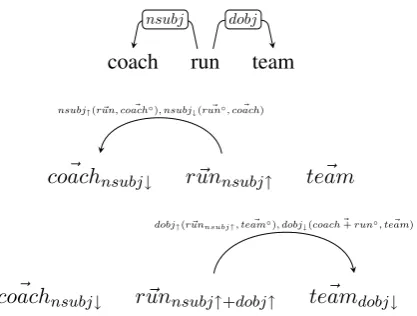
This incremental process may have two di-rections: from left-to-right and vice versa (i.e., from right-to-left). Figure 1 illustrates the incremental process of building the sense of words dependency-by-dependency from left-to-right. Thus, given the composite expression “the coach runs the team” and its dependency analysis depicted in the first row of the figure, two com-positional processes are driven by the two depen-dencies involved in the analysis (nsubjanddobj). Each dependency is decomposed into two func-tions: head (nsubj↑ and dobj↑) and dependent
(nsubj↓ anddobj↓) functions.2 The first
compo-sitional process applies, on the one hand, the head functionnsubj↑on the denotation of the head verb
(run~ ) and on the selectional preferences required by coach (coach~ ◦), in order to build a
contex-tualized sense of the verb: run~ nsubj↑ . On the
other hand, the dependent functionnsubj↓ builds
the sense of coach as nominal subject of run:
~
coachnsubj↓. Then, the contextualized head
vec-tor is involved in the compositional process driven bydobj. At this level of semantic composition, the selectional preferences imposed on the nounteam 2We do not consider the meaning of determiners, auxiliary
stand for the semantic features of all those nouns which may be the direct object ofcoach+run. At the end of the process, we have not obtained one single sense for the whole expression, but one con-textualized sense per lexical word: coach~ nsubj↓,
~
runnsubj↑+dobj↑ andteam~ dobj↓.
In other case, from right-to-left, the verbrunis first restricted byteamat the direct object position, and then by its subject coach. In addition, this noun is now restricted by the selectional prefer-ences imposed byrunandteam, that is, it is com-bined with the semantic features of all those nouns that may be the nominal subject ofrun+team.
5 Experiments
We have performed several similarity-based ex-periments using the semantic word model defined in Section 3 and the compositional algorithm de-scribed in 4.3 First, in Subsection 5.1, we evaluate just word similarity without composition. Then, in Subsection 5.2, we evaluate the simple compo-sitional approach by making use of a dataset with similar noun-verb pairs (NV constructions). Fi-nally, the recursive application of compositional functions is evaluated in Subsection 5.3, by mak-ing use of a dataset with similar noun-verb-noun pairs (NVN constructions).
In all experiments, we made use of datasets suited for the task at hand, and compare our results with those obtained by the best systems for the corresponding dataset. Moreover, in order to build the selectional preferences of the syntactically re-lated words, we used the British National Corpus (BNC). Syntactic analysis on BNC was performed with the dependency parser DepPattern (Gamallo and Gonz´alez, 2011; Gamallo, 2015), previously PoS tagged with Tree-Tagger (Schmid, 1994).
5.1 Word Similarity
Recently, the use of word similarity methods has been criticised as a reliable technique for evalu-ating distributional semantic models (Batchkarov et al., 2016), given the small size of the datasets and the limitation of context information as well. However, given this procedure still is widely ac-cepted, we have performed two different kinds of experiments: rating by similarity and synonym de-tection with multiple-choice questions.
3Both the software and the semantic word model
are freely available at http://fegalaz.usc.es/ ˜gamallo/resources/CompWordNet.tar.gz.
5.1.1 Rating by Similarity
In the first experiment, we use the WordSim353 dataset (Finkelstein et al., 2002), which was con-structed by asking humans to rate the degree of se-mantic similarity between two words on a numer-ical scale. This is a small dataset with 353 word pairs. The performance of a computational system is measured in terms of correlation (Spearman) be-tween the scores assigned by humans to the word pairs and the similarity Dice coefficient assigned by our system (WN) built with the WordNet-based model space.
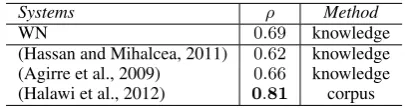
Table 1 compares the Spearman correlation ob-tained by our model, WN, with that obtained by the corpus-based system described in (Halawi et al., 2012), which is the highest score reached so far on that dataset. Even if our results were clearly outperformed by that corpus-based method, WN
seems to behave well if compared with the state-of-the-art knowledge-based (unsupervised) strat-egy reported in (Agirre et al., 2009).
Systems ρ Method
WN 0.69 knowledge
[image:6.595.313.516.361.415.2](Hassan and Mihalcea, 2011) 0.62 knowledge (Agirre et al., 2009) 0.66 knowledge (Halawi et al., 2012) 0.81 corpus
Table 1: Spearman correlation between the Word-Sim353 dataset and the rating obtained by our knowledge-based systemWNand the state-of-the-art for both knowledge and corpus-based strate-gies.
5.1.2 Synonym Detection with Multiple-Choice Questions
In this evaluation task, a target word is presented with four synonym candidates, one of them being the correct synonym of the target. For instance, for the targetdeserve, the system must choose be-tween merit (the correct one), need, want, and
expect. Accuracy is the number of correct an-swers divided by the total number of words in the
Systems Noun Adj Verb All
WN 0.85 0.85 0.75 0.80
(Freitag et al., 2005) 0.76 0.76 0.64 0.72
(Zhu, 2015) 0.71 0.71 0.63 0.69
[image:6.595.312.520.658.712.2](Kiela et al., 2015) - - - 0.88
coach run team nsubj dobj
~
coachnsubj↓ run~ nsubj↑ team~
nsubj↑(run,~ coach~ ◦), nsubj↓(run~◦, ~coach)
~
coachnsubj↓ run~ nsubj↑+dobj↑ team~ dobj↓
[image:7.595.198.407.58.216.2]dobj↑(run~ nsubj↑,team~ ◦), dobj↓(coach~+run◦, ~team)
Figure 1: Syntactic analysis of the expression“the coach runs the team”and left-to-right construction of the word senses.
dataset.
The dataset is an extended TOEFL test, called the WordNet-based Synonymy Test (WBST) posed in (Freitag et al., 2005). WBST was pro-duced by generating automatically a large set of TOEFL-like questions from the synonyms in WordNet. In total, this procedure yields 9,887 noun, 7,398 verb, and 5,824 adjective questions, a total of 23,509 questions, which is a very large dataset. Table 2 shows the results. In this case, the accuracy obtained by WN for the three syntactic categories is close to state-of-the-art corpus-based method for this task (Kiela et al., 2015), which is a neural network trained with a huge corpus contain-ing 8 billion words from English Wikipedia and newswire texts.
5.2 Noun-Verb Composition
The first experiment aimed at evaluating our com-positional strategy uses the test dataset by Mitchell and Lapata (2008), which comprises a total of 3,600 human similarity judgments. Each item consists of an intransitive verb and a subject noun, which are compared to another noun-verb pair (NV) combining the same noun with a synonym of the verb that is chosen to be either similar o dissimilar to the verb in the context of the given subject. For instance, “child stray” is related to
“child roam”, being roam a synonym of stray. The dataset was constructed by extracting NV composite expressions from the British National Corpus (BNC) and verb synonyms from WordNet. In order to evaluate the results of the tested sys-tems, Spearman correlation is computed between individual human similarity scores and the sys-tems’ predictions.
In this experiment, we compute the similarity between the contextualized heads of two NV com-posites and between their contextualized depen-dent expressions. For instance, we compute the similarity between “eye flare” vs “eye flame”by comparing first the verbs flare and flame when combined with eye in the subject position (head function), and by comparing how (dis)similar is the nouneyewhen combined with both the verbs
flareandflame (dependent function). In addition, as we are provided with two similarities (head and dep) for each pair of compared expressions, it is possible to compute a new similarity score by av-eraging the results of head and dependent func-tions (head+dep).
Table 3 shows the Spearman’s correlation val-ues (ρ) obtained by the three versions of WN: only head function (head), only dependent func-tion (dep) and average of both (head+dep). The latter score value is comparable to the state-of-the-art system for this dataset, reported in (Erk and Pad´o, 2008). It is also very similar to the most re-cent results described in (Dinu et al., 2013), where the authors made use of the compositional strategy defined in (Baroni and Zamparelli, 2010).
Systems ρ
WN (head+dep) 0.29 WN (head) 0.26
WN (dep) 0.14
(Erk and Pad´o, 2008) 0.27
[image:7.595.354.476.631.699.2](Dinu et al., 2013) 0.26
5.3 Noun-Verb-Noun Composition
The last experiment consists in evaluating the quality of compositional vectors built by means of the consecutive application of head and de-pendency functions associated with nominal sub-ject and direct obsub-ject. The experiment is per-formed on the dataset developed in (Grefenstette and Sadrzadeh, 2011a). The dataset was built us-ing the same guidelines as Mitchell and Lapata (2008), using transitive verbs paired with subjects and direct objects: NVN composites.
Given our compositional strategy, we are able to compositional build several vectors that somehow represent the meaning of the whole NVN com-posite expression. In order to known which is the best compositional strategy and be exhaustive and complete, we evaluate all of them; i.e., both left-to-right and right-to-left strategies. Thus, take again the expression“the coach runs the team”. If we follow the left-to-right strategy (noted nv-n), at the end of the compositional process, we obtain two fully contextualized senses:
nv-n head The sense of the headrun, as a result of being contextualized first by the prefer-ences imposed by the subject and then by the preferences required by the direct object. We note nv-n head) the final sense of the head in a NVN composite expression following the left-to-right strategy.
nv-n dep The sense of the object team, as a re-sult of being contextualized by the prefer-ences imposed by run previously combined with the subjectcoach. We note nv-n dep the final sense of the direct object in a NVN com-posite expression following the left-to-right strategy.
If we follow the right-to-left strategy (noted n-vn), at the end of the compositional process, we obtain two fully contextualized senses:
n-nv head The sense of the headrunas a result of being contextualized first by the preferences imposed by the object and then by the sub-ject.
n-nv dep The sense of the subject coach, as a result of being contextualized by the prefer-ences imposed by run previously combined with the objectteam.
Systems ρ
WN (nv-n head+dep) 0.35
WN (nv-n head) 0.34
WN (nv-n dep) 0.13
WN (n-vn head+dep) 0.50
WN (n-vn head) 0.35
WN (n-vn dep) 0.44
WN (n-vn+nv-n) 0.47
(Grefenstette and Sadrzadeh, 2011b)* 0.28
(Van De Cruys et al., 2013)* 0.37
(Tsubaki et al., 2013)* 0.44
(Milajevs et al., 2014) 0.46
(Polajnar et al., 2015) 0.35
(Hashimoto et al., 2014) 0.48
(Hashimoto and Tsuruoka, 2015) 0.48
[image:8.595.324.506.57.224.2]Human agreement 0.75
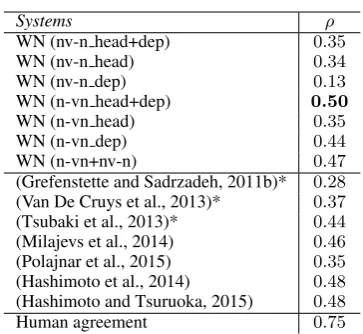
Table 4: Spearman correlation for transitive ex-pressions using the benchmark by Grefenstette and Sadrzadeh (2011)
Table 4 shows the Spearman’s correlation val-ues (ρ) obtained by all the different versions built from our modelWN. The best score was achieved by averaging the head and dependent similarity values derived from the n-vn (right-to-left) strat-egy. Let us note that, for NVN composite ex-pressions, the left-to-right strategy seems to build less reliable compositional vectors than the right-to-left counterpart. Besides, the combination of the two strategies (n-vn+nv-n) does not improve the results of the best one (n-vn).4. The score val-ues obtained by the different versions of the right-to-left strategy outperform other systems for this dataset (see results reported below in the table). Our best strategy (ρ= 0.50) also outperforms the neural network strategy described in (Hashimoto and Tsuruoka, 2015), which achieved0.48 with-out considering extra linguistic information not in-cluded in the dataset. The (ρ) scores for this task are reported for averaged human ratings. This is due to a disagreement in previous work regard-ing which metric to use when reportregard-ing results. We mark with asterisk those systems reporting (ρ) scores based on non-averaged human ratings.
6 Conclusions
In this paper, we described a compositional model based on WordNet features and dependency-based functions on those features. It is a recursive pro-posal since it can be repeated from left-to-right or from right-to-left and the sense of each constituent word is performed in a recursive way.
4n-vn+nv-nis computed by averaging the similarities of
Our compositional model tackles the problem of information scalability. This problem states that the size of semantic representations should not grow exponentially, but proportionally; and, infor-mation must not be loss using fixed size of compo-sitional vectors. In our approach, however, even if the size of the compositional vectors is fixed, there is no information loss since each word of the com-posite expression is associated to a compositional vector representing its context-sensitive sense. In addition, the compositional vectors do not grow exponentially since their size is fixed by the vector space: they are all first-order (or direct) vectors. Finally, the number of vectors increases in propor-tion to the number of constituent words found in the composite expression. So, both points are suc-cessfully solved.
In future work, we will try to design a compo-sitional model based on word semantic represen-tations combining WordNet-based features with syntactic-based distributional contexts as well as extend our model to full sentences instead of the simple ones described in this paper.
Acknowledgements
We would like to thank the anonymous review-ers for helpful comments and suggestions. This work was supported by a 2016 BBVA Founda-tion Grant for Researchers and Cultural Creators, and by project TELPARES (FFI2014-51978-C2-1-R) and grant TIN2014-56633-C3-1-R, Ministry of Economy and Competitiveness. It has received financial support from the Conseller´ıa de Cultura, Educaci´on e Ordenaci´on Universitaria (Postdoc-toral Training Grants 2016 and Centro Singular de Investigaci´on de Galicia accreditation 2016-2019, ED431G/08) and the European Regional Develop-ment Fund (ERDF).
References
Eneko Agirre, Enrique Alfonseca, Keith Hall, Jana Kravalova, Marius Pas¸ca, and Aitor Soroa. 2009. A study on similarity and relatedness using
distribu-tional and wordnet-based approaches. In
Proceed-ings of Human Language Technologies: The 2009 Annual Conference of the North American Chap-ter of the Association for Computational Linguistics, NAACL ’09, pages 19–27, Stroudsburg, PA, USA. Association for Computational Linguistics.
Marco Baroni and Roberto Zamparelli. 2010. Nouns are vectors, adjectives are matrices: Represent-ing adjective-noun constructions in semantic space.
In Proceedings of the 2010 Conference on Em-pirical Methods in Natural Language Processing, EMNLP’10, pages 1183–1193, Stroudsburg, PA, USA.
Marco Baroni, Raffaella Bernardi, and Roberto Zam-parelli. 2014. Frege in space: A program for
com-positional distributional semantics. LiLT, 9:241–
346.
Marco Baroni. 2013. Composition in distributional
semantics. Language and Linguistics Compass,
7:511–522.
Miroslav Batchkarov, Thomas Kober, Jeremy Reffin, Julie Weeds, and David Weir. 2016. A critique of word similarity as a method for evaluating
distribu-tional semantic models. InProceedings of the ACL
Workshop on Evaluating Vector Space Representa-tions for NLP, Berlin, Germany.
B. Coecke, M. Sadrzadeh, and S. Clark. 2010. Math-ematical foundations for a compositional distribu-tional model of meaning. Linguistic Analysis, 36(1-4):345–384.
Georgiana Dinu and Mirella Lapata. 2010. Measur-ing distributional similarity in context. In Proceed-ings of the 2010 Conference on Empirical Methods in Natural Language Processing, pages 1162–1172, Cambridge, MA, October. Association for Compu-tational Linguistics.
G. Dinu, N. Pham, and M. Baroni. 2013. General estimation and evaluation of compositional
distribu-tional semantic models. InACL 2013 Workshop on
Continuous Vector Space Models and their Compo-sitionality (CVSC 2013), pages 50–58, East Strouds-burg PA.
Katrin Erk and Sebastian Pad´o. 2008. A structured vector space model for word meaning in context. In Proceedings of EMNLP, Honolulu, HI.
Manaal Faruqui and Chris Dyer. 2015.
Non-distributional word vector representations. In Pro-ceedings of ACL.
Lev Finkelstein, Evgeniy Gabrilovich, Yossi Matias, Ehud Rivlin, Zach Solan, Gadi Wolfman, and Ey-tan Ruppin. 2002. Placing search in context: the concept revisited. ACM Trans. Inf. Syst., 20(1):116– 131.
Dayne Freitag, Matthias Blume, John Byrnes, Ed-mond Chow, Sadik Kapadia, Richard Rohwer, and Zhiqiang Wang. 2005. New experiments in
distribu-tional representations of synonymy. InProceedings
of the Ninth Conference on Computational Natural Language Learning, pages 25–32.
Pablo Gamallo and Isaac Gonz´alez. 2011. A grammat-ical formalism based on patterns of part-of-speech
tags. International Journal of Corpus Linguistics,
Pablo Gamallo, Alexandre Agustini, and Gabriel Lopes. 2005. Clustering Syntactic Positions with
Similar Semantic Requirements. Computational
Linguistics, 31(1):107–146.
Pablo Gamallo. 2008. The meaning of syntactic
de-pendencies. Linguistik OnLine, 35(3):33–53.
Pablo Gamallo. 2015. Dependency parsing with
com-pression rules. InInternational Workshop on
Pars-ing Technology (IWPT 2015), Bilbao, Spain. Pablo Gamallo. 2017. The role of syntactic
dependen-cies in compositional distributional semantics. Cor-pus Linguistics and Linguistic Theory.
Edward Grefenstette and Mehrnoosh Sadrzadeh. 2011a. Experimental support for a categorical com-positional distributional model of meaning. In Con-ference on Empirical Methods in Natural Language Processing.
Edward Grefenstette and Mehrnoosh Sadrzadeh. 2011b. Experimenting with transitive verbs in a
dis-cocat. InWorkshop on Geometrical Models of
Nat-ural Language Semantics (EMNLP-2011).
Edward Grefenstette, Mehrnoosh Sadrzadeh, Stephen Clark, Bob Coecke, and Stephen Pulman. 2011. Concrete sentence spaces for compositional
distri-butional models of meaning. InProceedings of the
Ninth International Conference on Computational Semantics, IWCS ’11, pages 125–134.
Emiliano Guevara. 2010. A regression model of adjective-noun compositionality in distributional
se-mantics. In Proceedings of the 2010 Workshop on
GEometrical Models of Natural Language Seman-tics, GEMS ’10.
M. A. Hadj Taieb, M. Ben Aouicha, and A. Ben Hamadou. 2014. Ontology-based approach
for measuring semantic similarity. Engineering
Applications of Artificial Intelligence, 36:238–261. Guy Halawi, Gideon Dror, Evgeniy Gabrilovich, and
Yehuda Koren. 2012. Large-scale learning of word relatedness with constraints. InProceedings of the 18th ACM SIGKDD International Conference on Knowledge Discovery and Data Mining, KDD ’12, pages 1406–1414.
Kazuma Hashimoto and Yoshimasa Tsuruoka. 2015. Learning embeddings for transitive verb disam-biguation by implicit tensor factorization. In Pro-ceedings of the 3rd Workshop on Continuous Vector Space Models and their Compositionality, pages 1– 11, Beijing, China, July. Association for Computa-tional Linguistics.
Kazuma Hashimoto, Pontus Stenetorp, Makoto Miwa, and Yoshimasa Tsuruoka. 2014. Jointly learn-ing word representations and composition functions
using predicate-argument structures. In
Proceed-ings of the 2014 Conference on Empirical Methods in Natural Language Processing (EMNLP), pages
1544–1555, Doha, Qatar, October. Association for Computational Linguistics.
S. Hassan and R. Mihalcea. 2011. Semantic related-ness using salient semantic analysis. InProceedings of AAAI Conference on Artificial Intelligence.
Douwe Kiela, Felix Hill, and Stephen Clark. 2015. Specializing word embeddings for similarity or re-latedness. In Llu´ıs M`arquez, Chris Callison-Burch, Jian Su, Daniele Pighin, and Yuval Marton,
edi-tors, EMNLP, pages 2044–2048. The Association
for Computational Linguistics.
Jayant Krishnamurthy and Tom Mitchell, 2013.
Pro-ceedings of the Workshop on Continuous Vector Space Models and their Compositionality, chapter Vector Space Semantic Parsing: A Framework for Compositional Vector Space Models, pages 1–10. Association for Computational Linguistics.
Lingling Meng, Runquing Huang, and Junzhong Gu. 2013. A review of semantic similarity measures in
wordnet. International Journal of Hybrid
Informa-tion Technology, 6(1).
Dmitrijs Milajevs, Dimitri Kartsaklis, Mehrnoosh Sadrzadeh, and Matthew Purver. 2014. Evaluating neural word representations in tensor-based compo-sitional settings. In Alessandro Moschitti, Bo Pang,
and Walter Daelemans, editors,EMNLP, pages 708–
719. ACL.
Jeff Mitchell and Mirella Lapata. 2008. Vector-based
models of semantic composition. InProceedings of
ACL-08: HLT, pages 236–244.
Jeff Mitchell and Mirella Lapata. 2009. Language
models based on semantic composition. In
Proceed-ings of EMNLP, pages 430–439.
Jeff Mitchell and Mirella Lapata. 2010. Composition in distributional models of semantics. Cognitive Sci-ence, 34(8):1388–1439.
Richard Montague. 1970. Universal grammar. theoria. Theoria, 36:373–398.
Barbara Partee. 1984. Compositionality. In Frank
Landman and Frank Veltman, editors, Varieties
of Formal Semantics, pages 281–312. Dordrecht: Foris.
Tamara Polajnar, Laura Rimell, and Stephen Clark. 2015. An exploration of discourse-based sentence spaces for compositional distributional semantics. In Proceedings of the First Workshop on Linking Computational Models of Lexical, Sentential and Discourse-level Semantics, pages 1–11, Lisbon, Por-tugal, September. Association for Computational Linguistics.
James Pustejovsky. 1995. The Generative Lexicon.
R. Rada, H. Mili, E. Bicknell, and M. Blettner. 1989. Development and application of a metric on
se-mantic nets. Systems, Man and Cybernetics, IEEE
Transactions on, 19(1):17–30.
Siva Reddy, Ioannis P. Klapaftis, Diana McCarthy, and Suresh Manandhar. 2011. Dynamic and static pro-totype vectors for semantic composition. InFifth In-ternational Joint Conference on Natural Language Processing, IJCNLP 2011, Chiang Mai, Thailand, November 8-13, 2011, pages 705–713.
M. Andrea Rodr´ıguez and Max J. Egenhofer. 2003. Determining semantic similarity among entity
classes from different ontologies. IEEE Trans.
Knowl. Data Eng., 15(2):442–456.
H. Schmid. 1994. Probabilistic part-of-speech tagging using decision trees. InInternational Conference on New Methods in Language Processing.
Thabet Slimani. 2013. Description and evaluation of
semantic similarity measures approaches.
Interna-tional Journal of Computer Applications, 80(1):25– 33.
Mark Steedman. 1996. Surface Structure and
Inter-pretation. The MIT Press.
Stefan Thater, Hagen F¨urstenau, and Manfred Pinkal. 2010. Contextualizing semantic representations
us-ing syntactically enriched vector models. In
Pro-ceedings of the 48th Annual Meeting of the Associa-tion for ComputaAssocia-tional Linguistics, pages 948–957, Stroudsburg, PA, USA.
Masashi Tsubaki, Kevin Duh, Masashi Shimbo, and Yuji Matsumoto. 2013. Modeling and learning se-mantic co-compositionality through prototype
pro-jections and neural networks. In EMNLP, pages
130–140. ACL.
Peter D. Turney. 2013. Domain and function: A dual-space model of semantic relations and compositions. Journal of Artificial Intelligence Research (JAIR), 44:533–585.
A. Tversky. 1977. Features of similarity.
Psichologi-cal Review, 84(4).
Tim Van De Cruys, Thierry Poibeau, and Anna Ko-rhonen. 2013. A Tensor-based Factorization Model
of Semantic Compositionality. InConference of the
North American Chapter of the Association of Com-putational Linguistics (HTL-NAACL), pages 1142– 1151, Atlanta, United States, June.
Fabio Massimo Zanzotto, Ioannis Korkontzelos, Francesca Fallucchi, and Suresh Manandhar. 2010. Estimating linear models for compositional distribu-tional semantics. InProceedings of the 23rd Inter-national Conference on Computational Linguistics, COLING ’10, pages 1263–1271.
Peng Zhu. 2015. N-grams based linguistic search
en-gine. International Journal of Computational