/
/
/
|
/
/
/
/
/
L
/
A L e x i c a l l y - I n t e n s i v e A l g o r i t h m
for D o m a i n - S p e c i f i c K n o w l e g d e A c q u i s i t i o n
Rend Schneider *
Text Understanding Systems
Daimler-Benz Research and Technology
Ulm, Germany
r e n e . s c h n e i d e r @ d b a g , u l m . D a i m l e r B e n z . C O M
Abstract
This paper is an outline of a statistical learn- ing algorithm for information extraction sys- tems. It is based on a lexicaUy intensive anal- ysis of a small number of texts that belong to one domain and provides a robust lemma- tisation of the word forms and the collection of the most important syntagmatic dependen- cies in weighted regular expressions. The lexi- cal and syntactical knowledge is collected in a very compact knowledge base that enables the analysis of correct and partly incorrect texts or messages, which due to transmission er- rors, spelling or grammatical mistakes other- wise would have been rejected by conventional systems.
1
Introduction
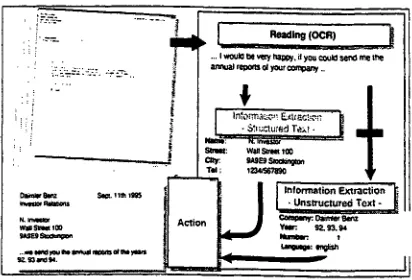
The major tasks of information extraction systems (IE-Systems) are the unsupervised selection, fast analysis and efficient storage of relevant text pat- terns a person or a group of persons is interested in. It accomplishes this through the use of learned or handcrafted patterns. In the ideal case the re- sults lead to an appropriate reaction, executed by the computer itself (see Figure 1). The extracted information is stored in a template that usually is based on a slot-and-filler model. Whenever the tex- tual information does not fit automatically into the fillers, it has to be changed adequately to the form and content requirements of the template, otherwise the text is rejected. Thus, the templates architecture depends very much on the domain the IE--system was built for, i.e. before processing a text or a mes- sage and starting the linguistic analysis, the cate- gory that the text or message belong to is already
This study is part of the project READ. The project READ is funded by the German Ministry for Ed- ucation and Research (BMBF) under grant 01IN503C. The author is responsible for the contents of the publi- cation.
known or has been labeled automatically with the aid of a categorizer. In our investigation the system was built to process requests for business reports, ex- tracting the number, years and language of business reports a certain sender asked for.
• . i~.~:._5:~:.~::..:,:~_..
WIISWl Im
... I v ~ $ k l 1~ ~ l y h a ~ / . il ycea cot jId . ~ a n ~ iI*,e
annt~ r e ~ s ~ y~Jr com~iny ..
~ : wan sew too I
!
Tel : 1234~6"~0 d k
| [,nfon'nationExwacUon--
~ I ~ . Unsm~ctumci Text - •
• cammn~ ~
Action Y ~ . ~.. 93, 94
t
Figure 1: Overview of an Information Extraction System
[image:1.612.317.523.277.417.2]noisy information adequately.
The work presented in this paper reflects a sta- tistical approach for the automatic acquisition of a linguistic knowledge base, that allows the essential analysis for texts of a certain domain, independent of their transmission quality or pre-processing.
2 C h a l l e n g e s i n I n f o r m a t i o n E x t r a c t i o n
2.1 T h e Acquisition Bottleneck
Generally, I_E-Systems are built for a rather re- stricted task and work on a more or less limited domain. This keeps their knowledge bases and the rules that are needed to process the texts, e.g. the syntactic rules, quite compact. But nevertheless, the changes that have to be done whenever a working system is applied to another domain are remarkably high, in some cases leading to the construction of a almost completely new knowledge base.
Both, t h e construction of a new knowledge base and their maintenance need a certain time and lots of efforts have to be done by highly-skilled staff know- ing the system and the domain it is built for. On the other hand, texts or messages that are written for a very specific purpose show the phenomena of Sub- languages (Harris, 1982), with less ambiguities and varieties than unrestricted language but still more freedom in expression than Controlled Languages. This fact strengthens the need for the automatic ac- quisition of linguistic knowledge, esp. the construc- tion of a lemmatisation and a shallow parsing com- ponent.
Statistical learning algorithms are usually applied to processing large corpora, but in real life, huge samples are hard to find for commercial and indus- trial applications. In our case, the corpora usually consist of small samples of fewer than 150 very short texts and the whole sample must be split into a training and a test corpora. This disadvantages are compensated by the use of a domain-specific sublan- guage. Any sublanguage shows some use of typical vocabulary, styles, and grammatical constructions, and it can be said that the more specific the domain is, the stronger are the restrictions of the sublan- guage. But even in categories where these restric- tions are weak, the essential and relevant informa- tion is carried by some typical words and located in a few kernel phrases, so that even simple statistics like frequency lists, distance measures and weighted collocation patterns may overcome parts of the ac- quisition problem (see section 4).
2.2 The Noisy-Channel-Problem
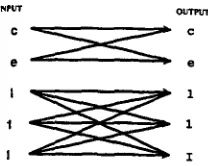
The second major problem is concerned with the fact that still a remarkably high number of paper- bound texts have to be pre-processed by an OCR- System in order to convert them into machine- readable code. This problem can be compared to the well known problem of a noisy channel, as indi- cated in Figure 2.
INPUT OUTPUT
• e
1 1
I I
Figure 2: An Example of a Noisy Channel in OCR
Therefore, the development of OCR systems and the improvement of their efficiency is still a ma- jor task in the area of document processing. But even with high quality scanners, the promised 99.9% recognition rate is difficult to achieve (Taghva et al., 1994) and remains the ideal case due to e.g. the use of different fonts, low quality print or paper, a low resolution etc.
Besides the mistakes caused by OCR, a consid- erable number of documents include typographical or grammatical mistakes (misspellings, wrong inflec- tion or word order), unusal expressions etc., which shows that natural language processing (NLP) needs more than just a grammar for grammatical expres- sions but indeed has to be fault-tolerant to process ~real-world" utterances. Though natural language itsdf has a lot to do with exceptions and irregular- ities, all these nuisances amplify the problems NLP is occupied with, but - - as a glance at text samples shows - - IE,-systems are faced with a considerable number of these additional irregularities that occur
• as a result of low grammatical competence, e.g. whenever a non-native speaker is obliged to write a document or message in a second lan- guage;
• as careless slips, e.g. misspellings, missing punc- tuations etc.
However, the most of all occurring errors are pro- duced by OCR 1 and can be classified as follows:
ZA brief example of an OCR-text: I/e would be vBry pleasd ifyou could send two 1992 annuai reports and a product brochure to: -..
Schneider 20 Lexically-lntensive Algorithm
II
!1
II
II
II
II
II
Ii
[image:2.612.359.463.177.260.2]II
II
II
II
I!
II
II
II
• Incorrect character recognition:
- Merging or Splitting: Two or more charac- ters are represented as one and vice versa. - Replacement: Characters are confused, e.g.
1 and 1.
- Deletion: Characters are dropped (e.g. due to low print quality).
- I n s e r t i o n : Non-existing characters are added.
• Incorrect word boundary recognition:
- Agglutination: Two or more word bound- aries are not recognized, and distinct words are linked with each other.
- Separation: A single word is split into two or more fragments.
Therefore, in this study one of the principle goals was to find a new methodology that enables the com- puter to learn automatically from a very small data set with examples of both grammatically incorrect and orthographically ill-formed text.
3
Machine Learning in Information
Extraction
3.1 Statistical L a n g u a g e Learning
Machine learning techniques have been developed to acquire factual and conceptual knowledge automat- ically and all of them have been applied to natural language processing. The different techniques were derived from the fields of symbolic, connectionist, statistical and evolutionary computing and their ap- plication depends on the specific problem. Recent developments show that the consecutive or simulta- neous combination of different learning approaches, i.e. hybrid strategies, often leads to better results than the single use of one. The methodology most frequently used to support other learning strategies are statistics, but in several occasion they are also used exclusively, esp. when the a priori knowledge about the content and the structure of the data is very low (Vapnik, 1995).
In such cases, all that is needed to start with, is the knowledge about some functional properties of the data to deduce their dependencies. Simply speaking, an unordered or hidden structure is transformed into a systematic structure revealing the properties, re- lations and processes of the data. In the ideal case the discovery of these dependencies leads to the for-
MIROMIR, an independant financial and economic research society, is making a study about Leasing in Europe. In order to make a prvsentation of your company, we would like to recieve your commorcial documents and your last snnual roports (from 1988 to 1991) in er~9~£sh. If you have a mailing ~st would you kindly include our name for future issues of annual repords and information on your company. With our grateful thanks, yours faithfully.
Figure 3: D o m a i n - S p e c i f i c and Tezt-Relevant In- formation (OCR-text)
or variation (Abney, 1996) using the methods of information- and probability theory (Charniak, 1993). Thus, the starting point of every investiga- tion discovering these processes in order to "learn" a language or acquire knowledge about some language with statistical techniques is the hkelihood of words and their derivable distributions and functions.
3.2 Domain-Specific and T e x t - R e l e v a n t Knowledge
Besides that, the formulation of what has to be learned needs to be formulated and described pre- cisely, esp. in IE where the different elements of the whole data set are not regarded with the same degree-of-interest and only a very small part of the whole information is extracted. Hence, the system has to learn to divide between the important or in- teresting and the unimportant or less interesting in- formation. In case of OCR-errors, it has to be able to clean the text from noisy parts and restore those parts appropriately.
[image:3.612.316.524.59.202.2]tion is represented by the words r e c i e v e , annual r o p o r t s and i n c l u d e , m a i l i n g l i s t . The t e x t - relevant information MIROFIIR, we, from 1988 t o 1991, e n g l i s h , o u r name specifies the numbers, years and language of the annual reports requested and of course the sender (which in the case of we and o u r name has to be unriddled by anapher resolution) t h a t should be included into the mailing list.
To illustrate the relationship between domain- specific and text-relevant information, their func- tions m a y be compared to those of constants and variables in a mathematical equation with the domain-specific words (representin.g the unvariable and basic components of the equation) and the text- relevant information representing the variables (as unstable and characteristic elements of the equa- tion). Thinking in categories of natural language, the domain-specific information represents the prag- matic meaning and uses verbs and specific nouns to describe specific events while the text-relevant in- formation is represented through names, numbers, dates etc. In any case it has to be considered that this distinction depends very much on the sharpness of the domain the IF_c-System is built for. Generally speaking, the more specific a domain is, the better does this distinction work and thus facilitates both the construction of the output structure (templates) and the extraction of the relevant text features.
Unfortunately - - as will be seen in the next sec- tion - - text-relevant information is very difficult to learn automatically, particularly when the texts t h a t are analyzed have been damaged by OCR: e.g. the differences of r e p o r t and r o p o r t can easily be detected and resolved, whereas names of persons, streets etc. themselves have several spelling variants and the change of a single letter changes the whole meaning, as it happens for numbers, too.
Therefore the main focus is on the the detection of domain-specific information with statistical meth- ods that leads in a following step to the text-relevant information, i.e. the major task of the algorithm is to build automatically a knowledge base for the cru- cial words and the kernel phrases that represent the salient information of a given text.
4 L e x i c a l l y - I n t e n s i v e K n o w l e d g e A c q u i s i t i o n
4.1 A n Outline of the Algorithm
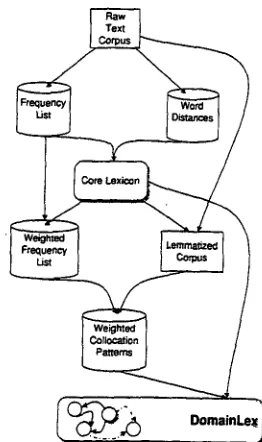
The algorithm as illustrated in Figure 4 is divided into the following major steps: First, a frequency list is computed from the training data, i.e. the raw text of a limited number of texts belonging to the same domain. Then, all word forms are compared with
each other and the word forms with a low distance are grouped together. The results from these two procedures are combined and lead to the construc- tion of a very compact core lexicon that consists of a limited number of entries with lexical prototypes and automatically assigned variants of the corpus' word forms. Afterwards the training data is trans-
Figure 4: Building a Domain-Specific Lexicon
formed so that it only consists of the automatically derived lexical prototypes. Then the most frequent syntagmatic patterns from a length of two to five l e m m a t a are collected and weighted. In the last but one step similar patterns having at least one domain- specific lexeme in Common are collected to reveal the neighbourhoods of the most important words. The degree-of-interest of a word is computed from its frequency and the number of variants the word has. Finally the entries of the core lexicon are connected with one another and compressed into weighted reg- ular expressions. The result is a domain-specific lex- icon that is represented as a net of lexical entries cov- ering the correct word and their variants and some of the possible incorrect variants and the syntacti- cal relations that are commonly used in texts of a certain domain.
4.2 Acquisition o f Lexical Knowledge
The construction of the core lexicon is based on the combination of a frequency list and a comparision of the distances of all word forms given in a corpus of
Schneider
22Lexically-lntensive Algorithm
II
II
II
II
II
Ii
Iii
[image:4.612.352.483.164.385.2]II
II
II
/
II
II
II
II
II
II
!1
II
ca. one hundred texts. 2
A computation of the relative size of unknown and already known word (see Figure 5) shows that after a very low number of texts generally 80 % of the information is confirmed, i.e. it appeared already in one of the former texts. These 80 % cover generally the functional words such as articles, conjunctions etc. and of course the domain-specific information. The residual 20 % consist of text-relevant informa- tion, unimportant and less interesting information, misspellings, and - - in O C R - t e x t s - - noisy informa- tion.
~ ' . , . ~
:!
Quota of i n c o m i ~ and already imovm worcts ~,mple: ~ $ 1 s for anra~al r e p ~ -
A A A A
• ^ A A 4 4 ~a ~ A ~ ta 4
, : 4 . . , 4 , : : .
444:: 4)
A A A 4 A
A a A ~
e ' 4 T~e,
, 4 • .
. . . l . . . 1 . . . 1 . . . ~ . . .
TeXlS (1-100)
Figure 5: Incoming and Known Words in a Sequen- tially Ordered Training Corpus
A closer look at the frequency lists strengthens this impression and allows the postulation of the fol- lowing hypothesis:
H y p o t h e s i s 1 The more frequent a word appears in a number of consecutively ordered texts or mes- sages of a limited domain, the more probable will it represent the "lezical prototype" for a wordform and in OCR-texts the correct form of a prototype (or a lemma).
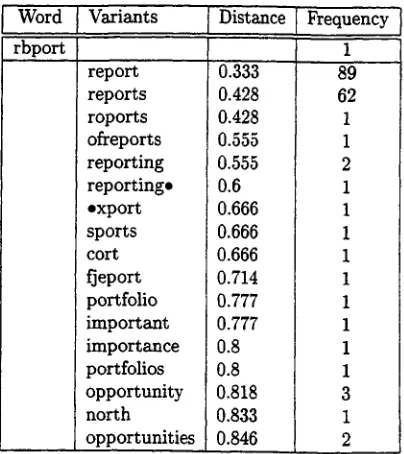
To find out which possible variants exist for the whole number of word forms, the similarities (or dis- tances) of the word forms are computed. An effec- tive method for the measurement of word distances is the Levenshtein distance in combination with an adequate threshold value (Nerbonne et al., 1996),
2In this paper we focus on the results of a training corpus of business letter requests in english with a total number of only 7,078 word forms distributed over 100 texts. Notice that the average size cannot be regarded as statistical significant due to the standard deviation of 42.32 and the text sizes ranging between 15 and 256 tokens.
Word
rbport
I Variants Distance Frequency
1 report
reports roports ofreports reporting reporting* *xport sports cort i~eport portfolio important importance portfolios opportunity north opportunities
0.333 0.428 0.428 0.555 0.555 0.6 0.666 0.666 0.666 0.714 0.777
0.777
0.8 0.8 0.818 0.833 0.846
89 62 1 1 2 1 1 1 1 1 1 1 1 1 3 1 2
Table 1: Unordered Lexicon Entry: r b p o r t
since the operations that are done to calculate this distance cover most of the phenomena (see 2.2) that occur through OCR. Any two words are compared with each other in a distance matrix, which mea- sures the least effort of transforming one word into the other. Least effort means the lowest number of insertions, deletions, or replacements (as a combi- nation of deletion and insertion). The effort is nor- realized to the length of the longest word in order to obtain a ratio-scaled value. Table 1 gives the ex- ample of an unordered lexicon entry for the word form rbport with all similar words that were found in the corpus, having a Levenshtein distance lower than 0.9 3. As already postulated in Hypothesis 1, the number of correct and "deflected" forms is al- ways higher than those of typical OCR-mistakes. In fact it must be asked, whether typical OCR mistakes exist at all due to the different types of reasons for these mistakes and the multitude of effects they may have.
For every word with one or more similar words as determined by a threshold value of 0.9, a pre- liminary entry was created as illustrated in Table 1, covering the most important morphological deriva-
STo facilitate and shorten the work of the algorithm, the alphabet was divided into interpretable signs ( a - Z , 0-9, punctuation) and non-interpretable signs (like *, - , ^ etc.) which were converted into a middle point (,) . A
[image:5.612.323.525.57.284.2] [image:5.612.92.298.213.370.2]tions and graphemic alternations, whereas in none of the entries a distinction between l e m m a and vari- ants is m a d e so that the unordered lexicon bears a huge burden of redundant information. To diminish this redundancy, it is necessary
• to drop those words having a high distance and showing no linguistic relation to the other words in the entries and
• to make a clear distinction between a lemma and its variants.
Therefore the multitude of preliminary lexical en- tries was reduced to a very compact core lexicon as exampled in Table 2 and described as follows.
The algorithm processes successively through the frequency list, starting with the most frequent word and finishing with the last hapax legomenon. Each word that can be found in the frequency list is con- sidered as the top of a new lexicon entry or lemma. Afterwards, the algorithm looks for the word forms in the preliminary lexicon, that are similar to this word (having a distance smaller than 0.4), assigns them as variants in the new entry and recursively looks for all variants of the previously assigned vari- ants (having a distance smaller than 0.7). Each one of these variants can no longer be regarded as top of another entry and consequently is taken out of the frequency lists, t h a t simultaneously shrinks more and more. The variants' frequency is added to that of the lemma.
The results of the algorithm depend a lot on an
a priori specified treshold value for the Levenshtein
distances. In our tests, good results are achieved with a value of 0.4 for direct similarity and 0.7 for indirect similarity, meaning the newly computed dis- tance of variants of a variant to a given lemma. The threshold value may depend on the language and the domains that are used. This aspect will be further investigated.
The result of this process is a core lexicon that consists of
• high frequent synsemantica or function words having no variants,
• high frequent, domain specific autosemantica or content words and most of their occuring vari- ants,
• middle and low frequency words and their vari- ants, and
• one single entry for all the remaining hapax legomena having no similarity to one of the pre- ceding words lower than 0.4,
Stem
report
E
Variants
reports 0.142 reprt 0.166
repo 0.333
repOrt 0.333 rbport 0.333 ofreports 0.333 reporting 0.333 reporting• 0.4 roports 0.428 fjeport 0.428 repoii 0.666 sports 0.666 repods 0.666 13
D.istanc.e [ f req
88 61 2 1
1
1
1
2
1
1
1
1
1 1
163
Table 2: Core Lexicon Entry: report
in order of their summarized frequencies. Hence, the number of entries in the core lexicon is at about one third of t h e total number of types 4. Table 2 shows the entry for r e p o r t and the assigned variants.
As follows, many of the wrongly analyzed combi- nations of e.g. your annual report that formerly lead to a rejection of the text, now can be transformed into their correct forms. This increases the number of documents that can be analyzed by the IE-system considerably. The wrong assignment of s p o r t s as a variant of r e p o r t shows the domain dependency of the algorithm, but it has to be considered that the frequency of such wrong assignments generally is 1 and can be compensated by the extraction of syn- tactical patterns.
4.3 A c q u i s i t i o n o f S y n t a c t i c a l K n o w l e d g e
T h e core lexicon bears the basic lexical knowledge t h a t is needed for a morphological text analysis and furthermore can be used to "clean" documents from noisy sequences but it does not store any informa- tion about the syntagmatic relations or dependencies t h a t exist in texts of a given domain. To reveal these dependencies, the original corpus was transformed into a lemmatized version, consisting only of the ear- lier derived prototypes and "Weighted Ranks" for words with the frequency 1 having no similarity to other words. Figure 6 shows the example text (see Figure 3) after the transformation into lemmata and "jokers". As can be seen in Figure 6, the algorithm
4In the case of the english requests for annual reports the core lexicon comprised 537 entries with a total num- ber of 1758 types and 7078 tokens in the training corpus.
Schneider 24 Lexically-lntensive Algorithm
I
|
I
m
m
m
m
m
m
m
[image:6.612.333.503.60.264.2]m
m
m
m
m
m
m
m
m
m
m
|
- , an independant f i n a n c i a l and
economic r e s e a r c h - , is m a k i n g a study about l e a s i n g in e u r o p e a n . in order to make a - of your company , we would like to r e c e i v e your c o m m o r c i a l documents and your latest ~ u a l report from - to 1991 in e n g l i s h . if you have a m a i l i n g list w o u l d you k i n d include our name for future issues of ~nnual report and i n f o r m a t i o n on your company . with our g r a t e f u l thank , y o u r - .
Figure 6: A Lemmatized Text
• suppresses (in t h i s format) the H a p a x - L e g o m e n a like Miromir, society, prvsentation, 1988 and faithfully;
• corrects the OCR-errors of the most impor- tant words, like r o p o r t s --+ r e p o r t , r e p o d s --+ report, i n f o r m a t i o n -+ information; • corrects misspelled words, like recieve -+
receive;
• lemmatizes several less frequent words to their more frequent prototypes, like ropods and r e p o d s as plural forms of r e p o r t , l a s t -+ l a t e s t , k i n d l y -+ kind, t b ~ k s -+ thank, yours --4 your 5.
T o enhance the importance of the lexical pro- toypes or lemmata, their frequencies were multipli- cared with the n u m b e r of their assigned variants as a result of the following hypothesis:
H y p o t h e s i s 2 The more often a word appears in texts of a restricted category and the more morpho- logical and graphemic variants it has, the more prob- able the word will represent some domain-specific in- formation.
The multiplication of frequencies and the number of variants of a word (freqz varx) leads to a weighted frequency list (see Table 3) whose first ranks com- prise the most relevant lemmata that are needed for the extraction of the salient syntactic patterns. Therefore, the texts are transformed parallely into a corpus of indices implying the ranks that are given to the lemmata after they have been weighted.
Scommorcial is head of an entry including commercial as the single variant, both having the frequency 1. Thus, the distinction between stem and variant can not be done clearly by the algorithm (the same holds true for independant and independent). Nevertheless, the two forms and all newly occuring forms having a small distance value will be clustered together.
Word
report annual your would thank company other mailing information please financial grateful the to
statements international of
latest list you and receive
I Sreq, I varx I
Table 3: Weighted Frequency List (first 20 Ranks)
The concluding analysis follows the Firthian notion of "knowing a word by the company it keeps" (Firth, 1957), a postulate which emphasizes the fact that certain words have a strong tendency to be used together. Thus, the algorithm retrieves all collocation patterns of different length (2 - 5) and matches them with one another. Repetitively the most frequent patterns are matched with the colloca- tion patterns of a greater length (patterns of length 2 with patterns of length 3; patterns of length 3 with patterns of length 4 etc.) looking both left and right for high frequent lemmata in the neighbourhood of the already composed patterns. That means that the words from the top of the weighted frequency list are connected with the most common words that precede and succeed them. The result is a two--way finite-state automaton that may be analyzed using light parsing strategies (Grefenstette, 1996) with the salient words of the weighted frequency lists as start- ing points (see Figure 7).
[image:7.612.339.502.59.333.2] [image:7.612.91.304.68.383.2]the real ambitions of IE-Systems (Grishman, 1996) and flat finite-state analyses are getting more and more popular and efficient (Bayer et al., 1997). Yet,
6)
Figure 7: Generation of a bi-directional regular ex- pression
the statistical information that is represented in the ranks of the lexical stems should not be omitted, though they show evidence of the degree-of-interest that is needed for the parsing strategy. The neigh- bourhood of low indices, such as 3 +- 2 <-- 1 (repre- senting your annual report should be regarded as more representative for the corpus' syntax than e.g.
15 <--- 3 -r6 representing of your company or even
95 e- 45 --+ 381 representing am currently doing. The weighted ranks represent the degree-of-interest that the words have for the IE-System. With the help of the weighted ranks, it is possible to compute a probabilistic value similar to transition likelihoods. Looking at a pattern or window of several words wi of a given pattern length n, we add up the ranks of
the weighted frequency lists fw~ to ~ , and compute
the average rank. This value is divided by the overall
frequency
freq
of the whole pattern(wl ..wn):
i=1 re( 2 ~%t~i
n".' = i = 1
C(~1..~.) = f r e q ( w l . . w n ) n ]req(wl..Wn)
The resulting value represents the weighted like- lihood for the c(>-occurrence C(wa..w.) of two (or more) words indicating how probable a word pre- cedes or succeeds another word. To give an example the word pattern of two words like m a i l i n g l i s t the equation is solved a follows:
rmailing + rlist C ( m a i l i n g list) = 2 freq(mailin# list)
8 + 1 9
= 0.385 2- 35
or for longer patterns of a lower degree-of-interest, such as as any interim:
ras -Jr rany -t- rinterim C ( as any interim) = 3 f r eq( as any interim)
53 + 87 + 28
- = 56.0
3-1
As already pointed out, the values for the co-- occurrences of the different lemmata were only com- puted up to a length of 5 lemmata. Compared to other collocation measures, this value does not only take account of the words frequencies and the collocations frequencies (as e.g. Mutual Informa- tion (Church and P., 1990)) or their transition like- lihood (as e.g. Markov chains (Thomason, 1986)) but combines these two properties with a third one: the word's different modalities as indicated by their number of variants, i.e. their weighted ranks. This last value weakens the influence of both less frequent and fimctional words and supports the degree-of- interest of domain-specific and correct words as de- termined in Hypothesis 1 and 2.
The c(>-occurrence values may be labeled to the arcs of the regular expressions that are generated during this acquisition process to make the parsing process more effective since a low transition value reflects a high significance or degree--of-interest in texts of a certain domain.
5 Using the Domain-Specific Lexicon
The connections that exist between the different lex- ical entries are also used to link the entries of the core lexicon, providing it with the syntactical information that is typical for a certain domain. The contents of the entries and their relations, i.e. the arcs connect- ing them, cover the essential statistical properties of lexemes and their syntactical relationship, enabling a robust lexical and syntactical analysis of new texts. First results show that word forms are deflected
• -. in the past your companys report has
[image:8.612.320.499.93.142.2]been among those we collect . however , our records indicate we do not have a copy of your 1992 annual rbport . please help us complete our collection by sendhig a copy of your 1992 annual report to the followhig adess . .-.
Figure 8: Example of an U n k n o w n Text ( O C R )
and corrected (as shown in Figure 6 and 9); kernel phrases are isolated by extracting the islands of the domain-specific words and their surroundings (as
Schneider 26 Lexically-lntensive Algorithm
m
m
m
m
m
m
m
m
m
m
m
m
[image:8.612.75.296.119.259.2]B
|
B
B
B
B
|
B
B
B
B
m
|
• -. i n t h e - y o u r c o m p a n y ~ e p o ~ h a s b e e n
a m o n g t h e s e w e c o l l e c t i o n . h o w e v e r ,
our records indicating w e d o not have a copy of your 1992 ~ n u a l ~epor~
p l e a s e help us complete our collection
by sending a copy of your 1992 annual ~eport to the following address ..-
Figure 9: Lemmatizing an Unknown Text
shown in Figure 7 and 10). Although some words are lemmatized in a quite strange way, as e.g. c o l l e c t -+ collection or indicate -~ indicating due to their low frequence, the relevant patterns are con- verted to analyzable and weU formed strings.
Given a new text with several occurences of a highly-ranked words, (see Figure 8), the text is lem- matized (see Figure 9 and browsed for the word with the highest degree--of-interest as indicated by the words' weighted ranks (in our example r e p o r t ) .
Afterwards the transition values for the three neighbourhoods of r e p o r t are compared and or- dered after the values of the weighted transition likelihood (see Figure 10 with immediate transition values i.e. a window length 2). In our case, the second phrase has the lowest transition values and would consequently extract and parse succesfully the most relevant phrase a copy of your 1992 annual report to the following a d d r e s s .
$9.16.
0 . , 6 0 . 7 -
Figure 10: Parsing the Most Likely Neighbourhood
The lexicon's dynamic structure enables the anal- ysis of unknown texts and consequently updates the entries and the relations among them, i.e. whenever an unknown word or a new syntactical pattern ap-
created. Similar to the lexical updating process the weights of the tokens that connect the lexical entries are either affirmed and strengthened with the repeti- tion of every pattern that was already known to the system or the new pattern is added to the network.
6 C o n c l u s i o n
In this paper we discussed the construction of a sta- tistical learning algorithm based on restricted do- mains and their underlying sublanguages in order to build automatically a linguistic knowledge base for information extraction tasks with the aid of very simple arithmetic procedures. The method is based on weighted frequency lists of word forms and syn- tactical patterns. Although very small information about the texts and the domain is known a priori
and only two functional dependencies (see Hypothe- ses 1 and 2) have been postulated, the algorithm learns automatically to build a very compact knowl- edge base from small and noisy text corpora. The method was tested empirically on several english, german and spanish corpora and shows the same re- sults for noisy as well as for correct domain-specific corpora.
A comparison of the core lexicon with common frequency analyses (Francis and Ku~era, 1982) for correct texts shows that even with a very small text sample the resulting information for linguistically al- lowed alterations of a lexical base form is acquired automatically. Additional information is achieved with the subsumption of linguistically incorrect vari- ants. The acquired knowledge is stored in a com- pact and dynamic knowledge base whose structure is modified with every significant change of the lex- eme's probabilistic properties and relations. The knowledge base is quite compact and allows a very quick analysis of unknown texts.
First tests with different corpora and different lan- guages (German and Spanish) show that this algo- rithm can be applied to different domains and other languages and thus is a useful tool for the expansion of IE-systems that work with OCR--data. Although the results of the algorithm depend very much on the data, i.e. the limits or sharpness of the domain which is used, the underlying ideas may be used for any information extraction purpose and other appli- cations such as lexicography, information retrieval or terminology extraction.
[image:9.612.94.290.423.564.2]R e f e r e n c e s
Steven Abney. 1996. Statistical methods and lin- guistics. In Klavans, J.L. and Resnik, P., editors,
The Balancing Act: Combining Symbolic and Sta-
tistical Approaches to Language, pages 1-26. MIT
Press, Cambridge, MA.
Thomas Bayer, Uli Bohnacker and Ingrid Renz. 1997. Information extraction from paper docu- ments. In Bunke, H. and Wang, P.S.P., editors,
Handbook on Optical Character Recognition and
Document Image Analysis, pages 653-677. World
Scientific Publishing Company, Singapore. Eugene Charniak. 1993. Statistical Language Learn-
ing. MIT Press, Cambridge, MA.
Kenneth W. Church and Patrick Hanks. 1990. Word association norms, mutual information and lex- icography. Computational Linguistics, 16(3):22- 29.
John R. Firth. 1957. Modes of meaning. In J.R.
Firth: Papers in Linguistics, pages 190--215, Lon-
don. Oxford University Press.
W. Nelson Francis and Henry Ku~era. 1982. Fre-
quency Analysis of English Usage. Houghton Mif-
flin, Boston, MA.
Gregory Grefenstette. 1996. Light parsing as finite- state filtering. In Proceedings of the Workshop on Extended Finite State Models of Language,
ECAI'96, Budapest, Hungary.
Ralph Grishman. 1996. The NYU system for MUC- 6 or where's the syntax? In Proceedings of the Sixth Message Understanding Conference (MUC- 6), Columbia, MD. Morgan Kaufraann.
Zellig S. Harris. 1 9 8 2 . Discourse and sublan- guage. In Kittredge, R. and Lehrberger, J., ed- itors, Sublanguage: Studies of Language in Re-
stricted Semantic Domains, pages 231-236. de
Gruyter, Berlin.
John Nerbonne, Wilbert Heeringa, Erik van den Hout, Peter van der Kooi, Simone Otten and Willem van de Vis. 1996. Phonetic distance be- tween dutch dialects. In Durieux, G., Daelemans, W., and GiUis, S.,-editors, Proceedings of Com-
putational Linguistics in the Netherlands, pages
185--202, Antwerp, Centre for Dutch Language and Speech (UIA).
Maria Teresa Pazienza. 1997. Information Extrac- tion - A Multidisciplinary Approach to an Emerg-
ing Information Technology. Springer, Berlin.
Ellen Riloff. 1993. Automatically constructing a dictionary for information extraction tasks. In
Proceedings of the 11th National Conference on
Artificial Intelligence, AAAI-93, pages 811-816.
Kazem Taghva, Julie Borsack, Allen Condit and Srinivas Erva. 1994. The effects of noisy data on text retrieval. Journal of the American Soci-
ety for Information Science, 45(1):50--58.
Michael G. Thomason. 1986. Syntactic pattern recognition: Stochastic languages. In Fu, K.S. and Young, T.Y., editors, Handbook of Pattern
Recognition and Image Processing, pages 119-142.
Academic Press, Orlando, FL.
Vladimir N. Vapnik. 1995. The Nature of Statistical
Learning Theory. Springer, New York.
Roman Yangarber and Ralph Grishman. 1997. Customization of information extraction system.
In Proceedings of the International Workshop on
Lexically Driven Information Extraction. Univer-
sit~ di Roma "La Sapienza'.
Schneider 28 Lexically-lntensive Algorithm