A Long Short-Term Memory Framework for Predicting Humor in Dialogues
Dario Bertero and Pascale Fung Human Language Technology Center
Department of Electronic and Computer Engineering The Hong Kong University of Science and Technology
Clear Water Bay, Hong Kong
[email protected], [email protected]
Abstract
We propose a first-ever attempt to employ a Long Short-Term memory based framework to predict humor in dialogues. We analyze data from a popular TV-sitcom, whose canned laughters give an indication of when the au-dience would react. We model the setup-punchline relation of conversational humor with a Long Short-Term Memory, with utter-ance encodings obtained from a Convolutional Neural Network. Out neural network frame-work is able to improve the F-score of8%over a Conditional Random Field baseline. We show how the LSTM effectively models the setup-punchline relation reducing the number of false positives and increasing the recall. We aim to employ our humor prediction model to build effective empathetic machine able to un-derstand jokes.
1 Introduction
There has been many recent attempts to detect and understand humor, irony and sarcasm from sen-tences, usually taken from Twitter (Reyes et al., 2013; Barbieri and Saggion, 2014; Riloff et al., 2013; Joshi et al., 2015), customer reviews (Reyes and Rosso, 2012) or generic canned jokes (Yang et al., 2015). Bamman and Smith (2015) and Karoui et al. (2015) included the surrounding context.
Our work has a different focus from the above. We analyze transcripts of funny dialogues, a genre somehow neglected but important for human-robot interaction. Laughter is the natural reaction of peo-ple to a verbal or textual humorous stimulus. We want to predict when the audience would laugh.
Compared to a typical canned joke or a sarcastic Tweet, a dialog utterance is perceived as funny only in relation to the dialog context and the past history. In a spontaneous setting a funny dialog is usually built through a setup which prepares the audience to receive the humorous discourse stimuli, followed by a punchline which releases the tension and triggers the laughter reaction (Attardo, 1997; Taylor and Ma-zlack, 2005). Automatic understanding of a humor-ous dialog is a first step to build an effective empa-thetic machine fully able to react to the user’s humor and to other discourse stimuli. We are ultimately in-terested in developing robots that can bond with hu-mans better (Devillers et al., 2015).
As a source of situational humor we study a popu-lar TV sitcom: “The Big Bang Theory”. The domain of sitcoms is of interest as it provides a full dialog setting, together with an indication of when the au-dience is expected to laugh, given by the background canned laughters. An example of dialog from this sitcom, as well as of the setup-punchline schema, is shown below (punchlines in bold):
PENNY: Okay, Sheldon, what can I get you?
SHELDON:Alcohol.
PENNY:Could you be a little more spe-cific?
SHELDON: Ethyl alcohol. LAUGH Forty milliliters.LAUGH
PENNY: I’m sorry, honey, I don’t know milliliters.
SHELDON:Ah. Blame President James Jimmy Carter. LAUGH He started America on a path to the metric system
but then just gave up.LAUGH
The utterances before the punchline are the setup. Without them, the punchlines may not be perceived as humorous (the last utterance, out of context, may be a political complaint), only with proper setup a laughter would be triggered. The humorous intent is also strengthen by the fact the dialog takes place in a bar (evident from the previous and following utter-ances), where a request of40ml of “Ethyl Alcohol” is unusual and weird.
Our previous attempts on the same corpus (Bert-ero and Fung, 2016b; Bert(Bert-ero and Fung, 2016a) showed that using a bag-of-ngram representation over a sliding window or a simple RNN to cap-ture the contextual information of the setup was not ideal. For this reason we propose a method based on a Long Short-Term Memory network (Hochre-iter and Schmidhuber, 1997), where we encode each sentence through a Convolutional Neural Network (Collobert et al., 2011). LSTM is successfully used in context-dependent sequential classification tasks such as speech recognition (Graves et al., 2013), de-pendency parsing (Dyer et al., 2015) and conversa-tion modelling (Shang et al., 2015). This is also to our knowledge the first-ever attempt that a LSTM is applied to humor response prediction or general hu-mor detection tasks.
2 Methodology
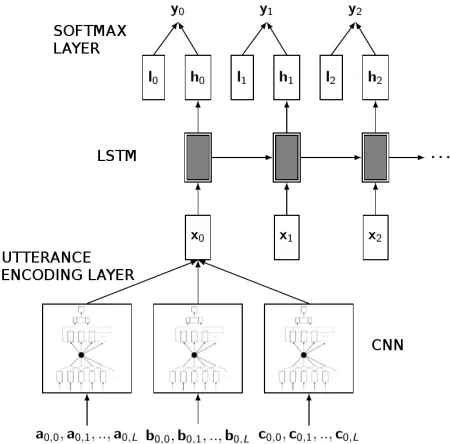
We employ a supervised classification method to detect when punchlines occur. The bulk of our classifier is made of a concatenation of a Convo-lutional Neural Network (Collobert et al., 2011) to encode each utterance, followed by a Long Short-Term Memory (Hochreiter and Schmidhuber, 1997) to model the sequential context of the dialog. Before the output softmax layer we add a vector of higher level syntactic, structural and sentiment features. A framework diagram is shown in Figure 1.
2.1 Convolutional Neural Network for each utterance
[image:2.612.316.541.61.283.2]The first stage of our classifier is represented by a Convolutional Neural Network (Collobert et al., 2011). Low-level, high-dimensional input feature vectors are fed into a first embedding layer to obtain a low dimensional dense vector. A sliding window is
Figure 1: Framework diagram. at, bt and ct are the CNN
three input features (words, word2vec and character trigrams). ltare the high level feature vectors, andytthe outputs for each
utterance.
then moved on these vectors and another layer is ap-plied to each group of token vectors, in order to cap-ture the local context of each token. A max-pooling operation is then applied to extract the most salient features of all the tokens into a single vector for the whole utterance. An additional layer is used to gen-eralize and distribute each feature to its full range before obtaining the final utterance vector.
In our task we use three input features:
1. Word tokens: each utterance token is repre-sented as a one-hot vector. This feature models how much each word is likely to trigger humor in the specific corpus.
2. Character trigrams: each token is represented as a bag-of-character-trigrams vector. The fea-ture models the role of the word signifier and removes the influence of the word stems.
3. Word2Vec: we extract for each token a word vector from word2vec (Mikolov et al., 2013), trained on the text9 Wikipedia corpus1. This representation models the general semantic
1Extension of the text8 corpus, obtained from
meanings, and matches words that do not ap-pear to others similar in meaning.
The convolution and max-pooling operation is ap-plied individually to each feature, and the three vec-tors obtained are then concatenated together and fed to the final sentence encoding layer, which combines all the contributions.
2.2 Long/Short Term Memory for the utterance sequence
The LSTM is an improvement over the Recurrent Neural Network aimed to improve its memory ca-pabilities. In a standard RNN the hidden memory layer is updated through a function of the input and the hidden layer at the previous time instant:
ht= tanh(Wxxt+Whht−1+b) (1)
where xis the network input and b the bias term. This kind of connection is not very effective to main-tain the information stored for long time instants, as well as it does not allow to forget unneeded informa-tion between two time steps. The LSTM enhances the RNN with a series of three multiplicative gates. The structure is the following:
it=σ(Wixxt+Wihht−1+bi) (2)
ft=σ(Wfxxt+Wfhht−1+bf) (3)
ot=σ(Woxxt+Wohht−1+bo) (4)
st= tanh(Wsxxt+Wshht−1+bh) (5)
ct=ftct−1+itst (6)
ht= tanh(ct)ot (7)
whereis the element-wise product. Each gate fac-tor is able to let through or suppress a specific update contribution, thus allowing a selective information retaining. The input gateiis applied to the cell input
s, the forget gatef to the cell value at the previous time stepct−1, and the output gateoto the cell out-put for the current time instantht. In this way a cell value can be retained for multiple time steps when
i = 0, ignored in the output wheno = 0, and for-gotten whenf = 0.
As dialog utterances are sequential, we feed all ut-terance vectors of a sitcom scene in sequence into a Long Short-Term Memory block to incorporate con-textual information. The memory unit of the LSTM
keeps track of the context in each scene, and mim-ics human memory to accumulate the setup that may trigger a punchline.
Before the output we incorporate a set of high level features from our previous work (Bertero and Fung, 2016b) and past literature (Reyes et al., 2013; Barbieri and Saggion, 2014). They include:
• Structural features: average word length, sen-tence length, difference in sensen-tence length with the five previous utterances.
• Part of speech proportion: noun, verbs, adjec-tives and adverbs.
• Antonyms: proportion of antonym words with the previous utterance (from WordNet (Miller, 1995)).
• Sentiment: positive, negative and average sen-timent score among all words (from Senti-WordNet (Esuli and Sebastiani, 2006)).
• Speaker and turn: speaker character identity and utterance position in the turn (beginning, middle, end, isolated).
• Speaking rate: time duration of the utterance from the subtitle files, divided by the sentence length.
All these features are concatenated to the LSTM out-put, and a softmax layer is applied to get the final output probabilities.
3 Experiments 3.1 Corpus
We built a corpus from the popular TV-sitcom “The Big Bang Theory”, seasons 1 to 6. We downloaded the subtitle files (annotated with the timestamps of each utterance) and the scripts2, used to segment all the episodes into scenes and get the speaker identity of each utterance. We extracted the audio track of each episode in order to retrieve the canned laugh-ters timestamps, with a vocal removal tool followed by a silence/sound detector. We then annotated each utterance as a punchline in case it was followed by a laughter within 1s, assuming that utterances not
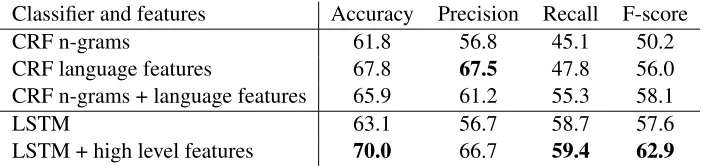
Classifier and features Accuracy Precision Recall F-score
CRF n-grams 61.8 56.8 45.1 50.2
CRF language features 67.8 67.5 47.8 56.0 CRF n-grams + language features 65.9 61.2 55.3 58.1
LSTM 63.1 56.7 58.7 57.6
LSTM + high level features 70.0 66.7 59.4 62.9
Table 1:Results, percentage.
[image:4.612.131.483.57.141.2]Encoding stage A P R F1 CNN 70.0 66.7 59.4 62.9 LSTM 68.4 66.2 53.4 59.1
Table 2: Comparison between a CNN and a LSTM sentence encoding input.
followed by a laughter would be the setup for the punchline.
We obtained a total of 135 episodes, 1589 overall scenes,42.8%of punchlines, and an average inter-val between two punchlines of 2.2 utterances. We built a training set of80% of the overall episodes, and a development and test set of 10% each. The episodes were drawn from all the seasons with the same proportion. The total number of utterances is 35865 for the training set, 3904 for the development set and 3903 for the test set.
3.2 Experimental setup and baseline
In the neural network we set the size to 100 for all the hidden layers of the CNN and the LSTM, and 5 to the convolutional window. We applied a dropout regularization layer (Srivastava et al., 2014) after the output of the LSTM, and L2 regularization on the softmax output layer. The network was trained with standard backpropagation, using each scene as a training unit. The development set was used to tune the hyperparameters, and to determine the early stopping condition. When the error on the devel-opment set began to increase for the first time we kept training only the final softmax layer, this im-proved the overall results. The neural network was implemented with THEANO toolkit (Bergstra et al., 2010). We ran experiments with and without the ex-tra high-level feature vector.
As a baseline for comparison we used an imple-mentation of the Conditional Random Field (Laf-ferty et al., 2001) from CRFSuite (Okazaki, 2007), with L2 regularization. We ran experiments using
the same high level feature vector added at the end of the neural network, 1-2-3gram features of a win-dow made by the utterance and the four previous, and the two feature sets combined. We also com-pared the overall system where we replace the CNN with an LSTM sentence encoder (Li et al., 2015), where we kept the same input features.
3.3 Results and discussion
Results of our system and our baselines are shown in table 1. The LSTM with the aid of the high level feature vector generally outperformed all the CRF baselines with the highest accuracy of 70.0% and the highest F-score of62.9%. The biggest improve-ment of the LSTM is the improveimprove-ment of the recall without affecting too much the precision. Lexical features given by n-gram from a context window are very useful to recognize more punchlines in our baseline experiment, but they also yield many false positives, when the same n-gram is used in differ-ent contexts. A CNN-LSTM network seems to over-come this issue as the CNN stage is better in model-ing the lexical and semantic content of the utterance, as the LSTM allows to put each utterance in relation with the past context, filtering out many false posi-tives from wrong contexts.
The choice of the CNN is further justified by the results obtained from the comparison between the CNN and the LSTM sentence encoding input, shown in table 2. The CNN is more effective, ob-taining a recall of10% higher and 6% more in F-score. The CNN is a simpler model that might ben-efit more of a small-size corpus. It also required a much shorter training time compared to the LSTM. We may consider in the future to use more data, and try other sentence input encoders, including deeper or bi-directional LSTMs, to find the most effective one.
laughters is a particularly challenging task. In some cases canned laughters are inserted by the show pro-ducers with the purpose of solicit response to weak jokes, where otherwise people would not laugh. The audience must also be kept constantly amused, extra canned laughters may help in scenes where fewer jokes are used.
4 Conclusion and future work
We proposed a Long Short-Term Memory based framework to predict punchlines in a humorous di-alog. We showed that our neural network is partic-ularly effective in increasing the F-score to62.9%
over a Conditional Random Field baseline of58.1%. We furthermore showed that the LSTM is more ef-fective in obtaining an higher recall with fewer false positives compared to simple n-gram shifting con-text window features.
As future work we plan to use a virtual agent sys-tem to collect a set of human-robot humorous inter-actions, and adapt our model to predict humor from them.
Acknowledgments
This work was partially funded by the Hong Kong Phd Fellowship Scheme, and partially by grant #16214415 of the Hong Kong Research Grants Council.
References
Salvatore Attardo. 1997. The semantic foundations of cognitive theories of humor. Humor-International Journal of Humor Research, (10):395–420.
David Bamman and Noah A Smith. 2015. Contextual-ized sarcasm detection on twitter. InNinth Interna-tional AAAI Conference on Web and Social Media. Francesco Barbieri and Horacio Saggion. 2014.
Mod-elling irony in twitter. In Proceedings of the Student Research Workshop at the 14th Conference of the Eu-ropean Chapter of the Association for Computational Linguistics, pages 56–64.
James Bergstra, Olivier Breuleux, Fr´ed´eric Bastien, Pas-cal Lamblin, Razvan Pascanu, Guillaume Desjardins, Joseph Turian, David Warde-Farley, and Yoshua Ben-gio. 2010. Theano: a CPU and GPU math expression compiler. InProceedings of the Python for Scientific Computing Conference (SciPy), June. Oral Presenta-tion.
Dario Bertero and Pascale Fung. 2016a. Deep learning of audio and language features for humor prediction.
International Conference on Language Resources and Evaluation (LREC) 2016.
Dario Bertero and Pascale Fung. 2016b. Predicting hu-mor response in dialogues from TV sitcoms. In Acous-tics, Speech and Signal Processing (ICASSP), 2016 IEEE International Conference on.
Ronan Collobert, Jason Weston, L´eon Bottou, Michael Karlen, Koray Kavukcuoglu, and Pavel Kuksa. 2011. Natural language processing (almost) from scratch.
The Journal of Machine Learning Research, 12:2493– 2537.
Laurence Devillers, Sophie Rosset, Guillaume Dubuis-son Duplessis, Mohamed A Sehili, Lucile B´echade, Agnes Delaborde, Cl´ement Gossart, Vincent Letard, Fan Yang, Yucel Yemez, et al. 2015. Multimodal data collection of human-robot humorous interactions in the joker project. InAffective Computing and Intel-ligent Interaction (ACII), 2015 International Confer-ence on, pages 348–354. IEEE.
Chris Dyer, Miguel Ballesteros, Wang Ling, Austin Matthews, and Noah A. Smith. 2015. Transition-based dependency parsing with stack long short-term memory. In Proceedings of the 53rd Annual Meet-ing of the Association for Computational LMeet-inguistics and the 7th International Joint Conference on Natural Language Processing (Volume 1: Long Papers), pages 334–343, Beijing, China, July. Association for Com-putational Linguistics.
Andrea Esuli and Fabrizio Sebastiani. 2006. Sentiword-net: A publicly available lexical resource for opinion mining. In Proceedings of LREC, volume 6, pages 417–422.
Alan Graves, Abdel-rahman Mohamed, and Geoffrey Hinton. 2013. Speech recognition with deep recur-rent neural networks. InAcoustics, Speech and Signal Processing (ICASSP), 2013 IEEE International Con-ference on, pages 6645–6649. IEEE.
Sepp Hochreiter and J¨urgen Schmidhuber. 1997. Long short-term memory. Neural computation, 9(8):1735– 1780.
Conference on Natural Language Processing (Volume 2: Short Papers), pages 644–650, Beijing, China, July. Association for Computational Linguistics. John D. Lafferty, Andrew McCallum, and Fernando C. N.
Pereira. 2001. Conditional random fields: Proba-bilistic models for segmenting and labeling sequence data. InProceedings of the Eighteenth International Conference on Machine Learning, ICML ’01, pages 282–289, San Francisco, CA, USA. Morgan Kauf-mann Publishers Inc.
Jiwei Li, Minh-Thang Luong, and Dan Jurafsky. 2015. A hierarchical neural autoencoder for paragraphs and documents. arXiv preprint arXiv:1506.01057. Tomas Mikolov, Kai Chen, Greg Corrado, and Jeffrey
Dean. 2013. Efficient estimation of word represen-tations in vector space.CoRR, abs/1301.3781. George A Miller. 1995. Wordnet: a lexical database for
english. Communications of the ACM, 38(11):39–41. Naoaki Okazaki. 2007. Crfsuite: a fast
implemen-tation of conditional random fields (crfs). URL http://www.chokkan.org/software/crfsuite.
Antonio Reyes and Paolo Rosso. 2012. Making objec-tive decisions from subjecobjec-tive data: Detecting irony in customer reviews. Decision Support Systems, 53(4):754–760.
Antonio Reyes, Paolo Rosso, and Tony Veale. 2013. A multidimensional approach for detecting irony in twit-ter. Language Resources and Evaluation, 47(1):239– 268.
Ellen Riloff, Ashequl Qadir, Prafulla Surve, Lalindra De Silva, Nathan Gilbert, and Ruihong Huang. 2013. Sarcasm as contrast between a positive sentiment and negative situation. InEMNLP, pages 704–714. Lifeng Shang, Zhengdong Lu, and Hang Li. 2015.
Neu-ral responding machine for short-text conversation.
arXiv preprint arXiv:1503.02364.
Nitish Srivastava, Geoffrey Hinton, Alex Krizhevsky, Ilya Sutskever, and Ruslan Salakhutdinov. 2014. Dropout: A simple way to prevent neural networks from overfitting. The Journal of Machine Learning Research, 15(1):1929–1958.
Julia Taylor and Lawrence Mazlack. 2005. Toward computational recognition of humorous intent. In
Proceedings of Cognitive Science Conference, pages 2166–2171.