Original Article
Preoperative anxiety decrease the postoperative
satisfaction in anterior dental implant surgery
Yunfei Liu1,2,3, Bo Li4, Li Wang1,2,3*, Chuansong Li5*
1Stomatological Hospital of Chongqing Medical University, Chongqing 401147, P. R. China; 2Chongqing Key Laboratory of Oral Diseases and Biomedical Sciences, Chongqing 401147, P. R. China; 3Chongqing Municipal Key Laboratory of Oral Biomedical Engineering of Higher Education, Chongqing 401147, P. R. China; 4Chengdu University of Traditional Chinese Medicine, Chengdu 610072, P. R. China; 5Medical Scientific Academy in Sichuan People’s Hospital, Chengdu 610072, P. R. China. *Equal contributors.
Received March 16, 2016; Accepted August 11, 2016; Epub October 15, 2016; Published October 30, 2016
Abstract: Background: Anterior dental implant surgery has a deep impact on aesthetic zone, and preoperative anxiety as a common clinical presentation effect the evaluation of patients in postoperative satisfaction. It is necessary tostudy the preoperative anxiety association with the postoperative satisfaction in anterior dental implant surgery. Methods: A total of 92 patients with anterior tooth missing were included and all were over 18 years old. Symptom Checklist 90 (SCL90) and State-Trait Anxiety Inventory (STAI), as well as pain Visual Analogue Scale (VAS) and Self-satisfaction evaluation, were used to test the psychological status of each subject. Results: There were no significant difference. between age, relationship status or health behaviors and pain or satisfaction (all P values >0.05). Most scores of SCL90-R did not show a significant difference between national norm of Chinese and participants. Concerning to the scores of VAS of pain and self-satisfaction, significant differences in trait and state anxiety were found. Moreover, correlation analysis showed that there are correlations between SAI, TAI and anxious (SCL90R) and the VAS of pain and self-satisfaction. Conclusion: These findings indicate that there is an explicitly relevance between preoperative psychological factors and postoperative outcomes in anterior dental implant surgery. In addition, preoperative anxiety contribute to the increase of pain in anterior tooth implantation surgery rather than age and gender.
Keywords: Anterior tooth missing, oralimplantology, symptom checklist, state-trait anxiety inventory
Introduction
Anxiety is an emotional reaction defined as
chronic stress, apprehension, nervousness and concern caused , accompanied by activa-tion of the autonomous nervous system [1] and often observed in dental procedures [2]. Dental anxiety is widespread among the patient
popu-lation and shows a significant problem in the
management [3]. Dental anxiety can result in a barrier for the patients to seek dental treat-ment and consequently compromise oral health [4]. Additionally, patients with anxiety are less cooperative during procedures and dis-play lower degree of satisfaction with surgical treatments [5, 6]. Anxious patients are uncoop-erative during dental surgery, such as dental implantation, and complicate the procedure [7]. In dental implant surgery, local anesthesia
can be insufficient to perform an adequate
operation and patients fear to face the pain in the procedures [8]. Dental anxiety, by contrast, relates to the psychological and physiological variations of a non-pathological fear response to a dentist’s appointment or treatment [9]. The cancellation, avoidance, or postponement of dental visits is a common observation among anxious and vulnerable individuals [10]. Considering dental anxiety before the dental implant, more than 70% of patients present moderate to high levels of anxiety. The more anxious patients were, the less patients
satis-fied with the procedure [11].
con-trols” to “disordered ones” [12]. It consists of
90 questions defined in 9 symptoms dimen -sions (depression, anxiety, phobic anxiety, hos-tility, obsessive-compulsive, interpersonal sen-sitivity, somatization, paranoid ideation and psychoticism dimensions). A good level of con-sistency and test-retest reliability has been reported for SCL90-R [13]. The State-Trait Anxiety Inventory (STAI) has been used to evalu-ate anxiety in patients who undergo dental and buccomaxillofacial treatments, and young pat- ients and women presented the highest levels of anxiety [16]. So we choose the SCL90R and STAIscales to measure the mental factors and anxiety in patients who undergo dental and maxillofacial treatments.
The loss of an anterior tooth influences the
patient’s aesthetics and has major detrimental
implications for the subject, since it significant -ly affects the social integration and quality of life [14]. Dental implant surgery is a valid treat-ment procedure, to restore aesthetics in the anterior maxilla, However, patients with dental anxiety are less cooperative and more pain dur-ing procedures and display lower degree of sat-isfaction with surgical treatment in clinical experiences.
Because of the importance of this topic, inves-tigating trait anxiety, state anxiety, and anxiety
specifically associated with dental procedures
of tooth implants for loss of anterior tooth is important. Given the growing demand for con-scious intravenous sedation for dental implant surgery, it is interesting to know the grade of patient anxiety in dental implant surgery under conscious intravenous sedation. The aim is to study whether preoperative anxiety of the
patient is influenced by age and sex and to
compare the preoperative anxiety of the patient with the postoperative patient and surgeon satisfaction in dental implant surgery with local anesthesia and conscious intravenous sedation.
Materials and methods
Objectives
This was a randomized and prospective study evaluating general and dental anxiety in patients, and ethics approval for this study was granted by the Ethics Committee of Chongqing Medical University.
The subjects consisted of 92 patients with loss of anterior tooth (55 male and 37 female). All patients were over 18 years old with loss of anterior tooth and choosed dental implant as valid treatment procedure voluntarily. Patients with metastatic lesions, systemic diseases, a history of alcohol abuse or the use of drugs altering the immune response such as system-ic cortsystem-icosteroids and beta blockers within the last 6 months were excluded. Psychosocial questionnaires were completed during the preoperative appointment about two to four hours before their surgery.
Behavioral, demographic, and medical assessments
Demographic, health behavior, clinical informa-tion and histopathological data were obtained from medical records. Detailed information on hours of sleep, smoking, alcohol and caffeine intake during the 7 days immediately preceding surgery was also collected.
All subjects received theSCL90R, a compre-hensive self-assessment survey of 90 ques-tions, which rates a broad range of psychiatric symptoms over the previous 7 days on a 5 point scale, and a demographic questionnaire. In the
SCL90R subjects responded on a five point
scale of distress ranging from “not at all” (0) at one pole to “a little bit” (1), “moderately” (2), “quite a bit” (3) and “extremely” (4) at the other pole. The 90 items of the SCL90R are grouped
along ten symptom dimensions reflecting broad
psychological symptom status in a spectrum of individuals. The dimension “psychoticism” (10 items) includes items indicative of a withdrawn, isolated, schizoid lifestyle as well as items rep-resenting symptoms of psychosis and schizo-phrenia such as hallucinations and thought broadcasting [12].
All subjects received the STAI, which comprises two scales (state anxiety and trait anxiety),
each with 20 affirmatives for which 1 to 4
numbered responses all of the time [6, 15]. The scores for each scale varied from 20 to 80, in which higher scores indicated higher anxiety.
Individuals with scores <33 were classified as
low anxiety. Individuals with scores between 34
and 44 were classified as moderate anxiety. Individuals with scores >45 were classified as high anxiety. The classifications for trait anxiety are relatively stable, whereas the classifica -tions for state anxiety can vary rapidly as a function of anxiogenic stimuli [6, 15].
All subjects received the Visual Analogue Scale (VAS) card, which is supervised by Chinese medical association. The VAS card is about 10 cm long and ranges from “no pain” (0) at one pole to “unbearable pain” (10) at the other pole.
The card is finished immediately after the
implant surgery.
All subjects received the self-satisfaction card, which is supervised by ourselves. The self-sat-isfaction card is about 10cm long and ranges from “most dissatisfaction” (0) at one pole to “most satisfaction” (10) at the other pole. The
card is finished after the upper restoration is finished.
Statistical analyses
SPSS version 19.0 (SPSS, Inc., Chicago, IL) was used for data analysis. The scores in each com-partment were examined using Pearson’s
cor-relation co-efficient. Categorical variables were
tested using either Chi Squared tests or analy-ses of variance (ANOVA). A p value of <0.05 was
considered statistically significant.
Results
Participant characteristics
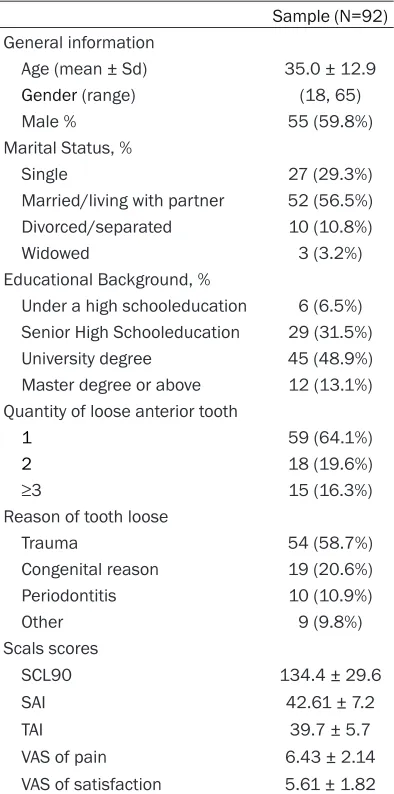
Table 1 presents demographic characteristics by compartment. Among the 92 patients, 59.8% (n=55) were men. The main reasons for losing of anterior tooth of the patients reported are a traumatizing experience (58.7%, n=54), congenital reason (20.6%, n=19), periodontitis
(0.9%, n=10). There were no significant associ -ations between age or health behaviors and pain or satisfaction (all P values >0.05). There
were no significant associations of relationship
status (single vs. divorced/separated/widowed vs. married) with pain or satisfaction in any compartment (all P values >0.05).
[image:3.612.91.288.84.481.2]sometimes it indicated a low anxiety level to avoid the patient responding with the same
Table 1. General information
Sample (N=92) General information
Age (mean ± Sd) 35.0 ± 12.9
Gender (range) (18, 65)
Male % 55 (59.8%)
Marital Status, %
Single 27 (29.3%)
Married/living with partner 52 (56.5%) Divorced/separated 10 (10.8%)
Widowed 3 (3.2%)
Educational Background, %
Under a high schooleducation 6 (6.5%) Senior High Schooleducation 29 (31.5%) University degree 45 (48.9%) Master degree or above 12 (13.1%) Quantity of loose anterior tooth
1 59 (64.1%)
2 18 (19.6%)
≥3 15 (16.3%)
Reason of tooth loose
Trauma 54 (58.7%)
Congenital reason 19 (20.6%)
Periodontitis 10 (10.9%)
Other 9 (9.8%)
Scals scores
SCL90 134.4 ± 29.6
SAI 42.61 ± 7.2
TAI 39.7 ± 5.7
VAS of pain 6.43 ± 2.14
[image:3.612.90.288.542.687.2]VAS of satisfaction 5.61 ± 1.82
Table 2. Comparison of scores of SCL90 between patients with anterior tooth missing and national norm
Norm
(N=1388) Sample (N=92) Somatization 1.37 ± 0.48 1.40 ± 0.27
Obsessive-compulsion 1.62 ± 0.58 1.58 ± 0.54
Sensitive 1.65 ± 0.61 1.66 ± 0.42
Depression 1.50 ± 0.59 1.52 ± 0.43
Anxiety 1.39 ± 0.43 1.57 ± 0.41
Hostility 1.46 ± 0.55 1.49 ± 0.31
Phobic anxiety 1.23 ± 0.41 1.20 ± 0.25
Paranoid ideation 1.43 ± 0.57 1.39 ± 0.24
Factor analysis identifying SCL90-R symptom dimensions
Most dimension scores of SCL90-R did not
show a significant difference between norm of
chinese and sample. The scores of somati- zation (1.40 ± 0.27), sensitive (1.66 ± 0.42), depression (1.52 ± 0.43), anxiety (1.57 ± 0.41), hostility (1.49 ± 0.31) and psychosis (1.32 ± 0.27) of patients with anterior tooth lost are higher than norm of Chinese respectively [16] (Table 2).
Factor analysis identifying STAI symptom dimensions
For anxiety levels, we devide the patients into three group by scores of State Anxiety Inventory (SAI) and Trait Anxiety Inventory (TAI) (Table 3). Concerning to the scores of VAS of pain and
self-satisfaction, significant differences in
trait and state anxiety were found. For state anxiety, the scores of VAS of pain dif-fered substantially, with group SAIlow show-ing comparatively lower scores (5.53 ± 2.18), the scores of group SAImed (6.41 ± 1.93) and group SAIhigh are higher, and there
are significant differences using pairwise
comparison methods (P<0.05). For state anxiety, the scores of self-satisfaction dif-fered substantially. It is clear that the result of scores was SAIlow>SAImed>SAIhigh, and
there are significant differences using pair -wise comparison methods (P<0.05). The same trend could be observed in TAI group (Table 4). Moreover, correlation analysis sho-wed that there are correlations between SAI, TAI and anxious (SCL90R) and the VAS of pain and self-satisfaction (Table 5). Discussion
In the present study, placement of dental implants is one of the most anxiety-provok-ing oral surgery procedures [17], and the
finding shows that patients always avoide
dental treatments especially procedures that involve surgery, such as dental implants [18]. However, the loss of an anterior tooth
influences the patient’s aesthetics, social
integration and quality of life, so that a den-tal implant surgery is always one of the most reasonable choice.
The present study have showed that the lev-els of anxiety are associated with the expec-Table 3. Scores of classified by State Anxiety Inven
-tory (SAI) and Trait Anxiety Inven-tory (TAI)
SAI group TAI group
samples scores samples scores
Low 17 32.6 ± 6.5 26 31.9 ± 5.2
Medium 42 41.5 ± 3.1 36 40.1 ± 3.0
[image:4.612.90.318.95.164.2]High 33 49.2 ± 4.7 30 46.1 ± 3.4
Table 4. Postoperative pain and self-satisfy scores in
patients with different anxiety levels classified using
SAI and TAI
VAS of Pain VAS of Sat-isfaction
SAI Low 5.53 ± 2.18 P<0.05 7.29 ± 1.32 P<0.05 Medium 6.41 ± 1.93 5.77 ± 1.36
High 7.01 ± 2.26 4.48 ± 1.89
TAI Low 5.73 ± 2.03 P<0.05 6.96 ± 1.50 P<0.05 Medium 6.41 ± 2.00 5.47 ± 1.53
High 7.06 ± 2.31 4.60 ± 1.73
Table 5. Correlation analysis between the postopera-tive pain and self-satisfy scores with stage and SAI or TAI
R* P
VAS of Pain SAI 0.471 0.024
TAI 0.528 0.041
Anxious (SCL90) 0.512 0.043
VAS of Satisfaction SAI 0.492 0.031
TAI 0.573 0.047
Anxious (SCL90) 0.494 0.039
*: P<0.05.
tancy of pain [19]. Oral surgeries, despite not being life-threatening and associated with rapid recovery, cause physical and psychologi-cal effects in individuals who have high expec-tations, thus determining an unpleasant experi-ence [17].
Anxiety feelings associated with treatment results were determined in this study, which was an expected result. With regard to dental anxiety, Elter et al reported that mild levels of dental anxiety is consistent with the results [20]. We also found no association with gender,
in agreement with previous authors, a finding
[image:4.612.91.318.222.326.2] [image:4.612.89.320.384.478.2]studies (72.2%) [22]. Considering that dental anxiety is related to prior dentistry experience, we observed that the patients who had higher dental anxiety were the ones who had reason-able or traumatizing dental experiences. We used three validated scales in the present study: STAI-trait, STAI-state, and SCL90R-anxious. The STAI appeared to be more
sensi-tive than SCL90R for measuring fluctuations in
anxiety levels, although SCL90R assess the psychological symptom status of individuals from “healthy controls” to “disordered ones” [12]. Therefore, we suggest using both scales in the evaluation of anxiety in dentistry.
The key findings of this study are that the trait
and state anxious levels in patients are linked to dental implant treatment results. In our study, a higher anxious level was associated with increased pain and decreased satisfac-tion. Indeed, our data and those of others sug-gest that patients needed dental implant have more emotional distress. This is essential to provide the adequate support to the patient and a patient’s quality of life.
Acknowledgements
Project Supported by Chongqing Municipal Key Laboratory of Oral Biomedical Engineering of Higher Education and Program for Innovation Team Building at Institutions of Higher Education in Chongqing in 2016.
Disclosure of conflict of interest
None.
Address correspondence to: Li Wang, Stomato- logical Hospital of Chongqing Medical University, Chongqing 401147, P. R. China. E-mail: 16012877@ qq.com; Chuansong Li, Medical Scientific Academy in Sichuan People’s Hospital, Chengdu 610072, P. R. China. E-mail: [email protected]
References
[1] Miller AA. Psychological considerations in den-tistry. J Am Dent Assoc 1970; 81: 941-948. [2] Humphris G, Crawford JR, Hill K, Gilbert A,
Freeman R. UK population norms for the modi-fied dental anxiety scale with percentile calcu -lator: adult dental health survey 2009 results. BMC Oral Health 2013; 24: 29.
[3] Armfield JM. How do we measure dental fear and what are we measuring anyway? Oral Health Prev Dent 2010; 8: 107-115.
[4] Crofts-Barnes NP, Brough E, Wilson KE, Beddis AJ, Girdler NM. Anxiety and quality of life in phobic dental patients. J Dent Res 2010; 89: 302-306.
[5] González-Lemonnier S, Bovaira-Forner M, Pe-ñarrocha-Diago M, Peñarrocha-Oltra D. Rela-tionship between preoperative anxiety and postoperative satisfaction in dental implant surgery with intravenous conscious sedation. Med Oral Patol Oral Cir Bucal 2010; 15: 379-382.
[6] Candido MC, Andreatini R, Zielak JC, de Souza JF, Losso EM. Assessment of anxiety in pa-tients who undergo surgical procedures for tooth implants: a prospective study. Oral Maxil-lofac Surg 2015; 19: 253-8.
[7] Smyth JS. Some problems of dental treatment. Part 1. Patient anxiety: some correlates and sex differences. Aust Dent J 1993; 38: 354-359.
[8] Manani G, Facco E, Cordioli A, Guarda-Nardini L, Berengo M, Mazzuchin M, Da Corte Zanda-tina S, Fontana G, Tonello S, Malimpensa B, Zanette G. Bispectral Index in the sedation with intranasal midazolam and intravenous di-azepam in dental practice. Minerva Stomatol 2007; 56: 85-104.
[9] Bhola R, Malhotra R. Dental Procedures, Oral Practices, and Associated Anxiety: A Study on Late-teenagers. Osong Public Health Res Per-spect 2014; 5: 219-232.
[10] Skaret E, Berg E, Kvale G, Raadal M. Psycho-logical characteristics of Norwegian adoles-cents reporting no likelihood of visiting a den-tist in a situation with toothache. Int J Paediatr Dent 2007; 17: 430-438.
[11] González-Lemonnier S, Bovaira-Forner M, Pe-ñarrocha-Diago D, PePe-ñarrocha-Diago MA. He-modynamic and ventilatory changes during implant surgery with intravenous conscious sedation. Med Oral Patol Oral Cir Bucal 2011; 16: 541-545.
[12] Derogatis LR, Cleary PA. Factorial invariance across gender for the primary symptom dimen-sions of the SCL-90. Br J Soc Clin Psychol 1977; 16: 347-356.
[13] Bakhshaie J, Sharifi V, Amini J. Exploratory Fac -tor Analysis of SCL90-R Symptoms Relevant to Psychosis. Iran J Psychiatry 2011; 6: 128-132. [14] Censi R, Vavassori V, Borgonovo AE, Re D. Es-thetic rehabilitation of a severely compromised anterior area: combined periodontal and re-storative approach. Case Rep Dent 2014; 658790.
[15] Mavrovouniotis FH, Argiriadou EA, Papaioan-nou CS. Greek traditional dances and quality of old people’s life. J Bodyw Mov Ther 2010; 14: 209-218.
Chinese Mental Health Journal 1995; 1: 38-39.
[17] Eli I, Schwartz-Arad D, Baht R, Ben-Tuvim H. Ef-fect of anxiety on the experience of pain in im-plant insertion. Clin Oral Imim-plants Res 2003; 14: 115-118.
[18] Sohn W, Ismail AI. Regular dental visits and dental anxiety in an adult dentate population. J Am Dent Assoc 2005; 136: 58-66.
[19] Kim S, Lee YJ, Lee S, Moon HS, Chung MK. As-sessment of pain and anxiety following surgi-cal placement of dental implants. Int J Oral Maxillofac Implants 2013; 28: 531-535. [20] Elter JR, Strauss RP, Beck JD. Assessing dental
anxiety, dental care use and oral status in old-er adults. J Am Dent Assoc 1997; 128: 591-597.
[21] Kanegane K, Penha SS, Borsatti MA and Ro-cha RG. Dental anxiety in an emergency dental service. Rev Saude Publica 2003; 37: 786-792.