Leveraging Preposition Ambiguity to Assess Compositional Distributional
Models of Semantics
Samuel Ritter∗
Princeton University Indiana UniversityCotie Long University of TrentoDenis Paperno
Marco Baroni
University of Trento Princeton UniversityMatthew Botvinick Princeton UniversityAdele Goldberg
Abstract
Complex interactions among the meanings of words are important factors in the function that maps word meanings to phrase meanings. Recently, compositional distributional seman-tics models (CDSM) have been designed with the goal of emulating these complex interac-tions; however, experimental results on the ef-fectiveness of CDSM have been difficult to in-terpret because the current metrics for assess-ing them do not control for the confound of lexical information. We present a new method for assessing the degree to which CDSM cap-ture semantic interactions that dissociates the influences of lexical and compositional infor-mation. We then provide a dataset for per-forming this type of assessment and use it to evaluate six compositional models using both co-occurrence based and neural language model input vectors. Results show that neural language input vectors are consistently supe-rior to co-occurrence based vectors, that sev-eral CDSM capture substantial compositional information, and that, surprisingly, vector ad-dition matches and is in many cases superior to purpose-built paramaterized models.
1 Introduction
Consider the meanings of the following phrases: “red apple,” “red hair,” and “red state.” The meaning of the word “red” in each of these examples interacts with the meaning of the noun it modifies, applying
∗
Please address correspondence to the first author at [email protected]
a different color to the first two and a political af-filiation to the third. This is an example of a com-mon phenomenon in natural language in which the meaning of a whole expression is not derived from a simple concatenation of its parts, but is composed by interactions among their meanings.
Cognitive and computer scientists have pointed out this complexity and proposed various models for accommodating it (Kintsch, 2001; Mitchell and La-pata, 2010; Socher et al., 2013). A dominant model-ing approach seeks to learn functions that combine word representations derived from the distributional structure of large natural language corpora (Deer-wester et al., 1990; Landauer and Dumais, 1997). Because the word representations to be combined and the compositional functions are generated based on the distributions of words in corpora, these mod-els have been dubbed compositional distributional semantic models, or CDSM (Marelli et al., 2014). CDSM produce fixed-dimensional vector represen-tations of arbitrary sentences and phrases, and the foundational principle of these models is, stated sim-ply, that semantically similar phrases should have vector representations that are close together in the vector space.
1.1 CDSM Assessment
Past studies have tested how well CDSM adhere to this principle by comparing the vector similarity of pairs of sentences with similarity ratings given by humans. Many of these studies used datasets in which the amount of lexical overlap between the sentence pairs is not carefully controlled, e.g., the datasets of Dolan and Brockett (2005) and Agirre
et al. (2014). One such study obtained the influen-tial result that on such a dataset, simple composition models such as vector addition perform compara-bly to a state-of-the-art composition model (Blacoe and Lapata, 2012). The success of these simplis-tic models led to the conjecture that these data sets fail to assess critical aspects of language (Baroni et al., 2014a) and leaves open the question of whether CDSM would outperform simplistic models in a set-ting in which lexical cues are uninformative.
In the present study, we develop a method for re-moving the confound of lexical cues from CDSM as-sessment. The method is to create a set of sentences where each sentence fits into a semantic category and where a sentence’s semantic category cannot be determined based on any individual word in the sen-tence. CDSM are then challenged to create a vector space in which the representations for sentences in a given category cluster together, even though the in-dividual word vectors do not cluster together. This clustering can be tested by training a simple linear classifier on the CDSM representations, then testing it on representations for held out sentences.
Here, we build a suitable test set by leveraging the lexical ambiguity inherent in locative expres-sions. Locative expressions are phrases that describe a spatial relationship between two objects using two nouns joined by a preposition; for example, “The magnet is on the refrigerator”, which describes the relationship of adhesion to a vertical surface. Cru-cially, the spatial relationship between the two nouns in a locative expression is undetermined by the spa-tial preposition, and can only be determined based on semantic interactions among the prepositions and the two nouns (Herskovits, 1985).
For example, while “The magnet is on the refrig-erator” describes the spatial relationship of adhesion to a vertical surface, “The apple is on the refrigera-tor” describes support by a horizontal surface. In or-der to classify a new sentence, e.g., “The magnet is on the papers”, into the correct category of support by a horizontal surface, the CDSM vectors for the three sentences must encode the fact that “The mag-net is on the papers” shares a common spatial rela-tionship with “The apple is on the refrigerator” and not with “The magnet is on the refrigerator”, even though the latter pair of sentences share more words than the former.
Given this dissociation between lexical overlap and spatial relationship, we were able to construct a dataset wherein lexical information is uninforma-tive, and models must rely on compositionality to score well in classification.
1.2 Relation to Past Work
This approach to CDSM assessment is similar to a previous method wherein polysemous verbs are paired with disambiguating nouns in transitive or intransitive verb phrases. These phrases are then matched with “landmark” verbs that are either sim-ilar or not simsim-ilar in meaning to the full phrase. CDSM are then challenged to create representa-tions of the phrases from which classifiers can de-termine whether or not a phrase is similar to its landmark verb (Kintsch, 2001; Mitchell and Lapata, 2008; Mitchell and Lapata, 2010; Grefenstette and Sadrzadeh, 2011). Another notable CDSM assess-ment task involves matching a phrase with a word with a similar meaning, for example, matching a short dictionary definition with the word it defines (Kartsaklis et al., 2012; Turney, 2014).
While these methods are applicable only to simple phrases that can be mapped reasonably to a single word, the present method can, in principle, be ap-plied to any type of phrase. This allowed us to build a dataset that extends the current landmark word and word matching datasets in at least two important ways. First, it includes function words, specifically prepositions. Second, it requires the characterization of interactions among three words in each expres-sion, whereas previous datasets had two words per expression, or subsets of the words did not interact in complex ways.
Category Example
Adhesion to Vertical Surface “There is a magnet on the refrigerator.” Support by Horizontal Surface “There is an apple on the refrigerator.” Support from Above “There is an apple on the branch.” Full Containment “There is an apple in the refrigerator.” Partial Containment “There is an apple in the water.”
Table 1: Categories and Example Sentences
2 The Dataset
A list of all of the spatial categories with examples is given in Table 1. The authors chose the set of cat-egories to produce the desired dissociation between lexical meaning and phrase category, taking inspi-ration from the observations of Herskovits (1985). To produce a dataset of expressions fitting these cat-egories, the first and second authors - both native English speakers - generated a large set of locative expressions, intending each expression for a specific category. Then all of the expressions were indepen-dently rated by the first two authors, and any expres-sion for which the ratings disagreed were excluded from the dataset. In order to achieve a balanced cat-egory size, the second author then created additional sentences intended for underrepresented categories. All additional sentences were stripped of labels and rated independently by the first author. If the first and second authors’ categorizations did not match, the sentence was not added to the dataset.
The dataset contains 500 sentences in total with 100 sentences per category. There is a large amount of lexical variety in the set, with 242 distinct words occurring in noun position one and 213 occurring in noun position two. The dataset is publicly available for download at www.princeton.edu/∼swritter.
3 Evaluation Setup
Classification among the five categories was per-formed using a naive Bayes classifier. Two of the categories contained “in” as the preposition in all sentences while the other three contained “on” in all sentences. To be certain that the held out sentences on which the classifier was tested did not contain even a single category-informative noun, we oper-ationally defined informativeness and relegated all
sentences with an informative noun to the training set. A noun was deemed informative if it both oc-curred more than once in the entire data set and it occurred more frequently in one category than in any other. This criterion yielded a set of 80 sen-tences with no informative nouns, and a set of 420 sentences with at least one informative noun. By this method, we ensured that no component of the mod-els’ classification accuracy on the test set is due to the recognition of individual nouns.
In addition to the CDSM, we included two non-distributional models for comparison. The first, re-ferred to as word overlap, consists of a binary feature vector containing one feature per vocabulary item. This model’s performance provides an upper-bound on the performance that a model can achieve given only the distribution of word tokens in the train-ing set. The second model, inspired by Srikumar and Roth (2013), contains binary features for Word-net hypernyms (up to 4 levels) of each sense of the noun and a binary feature for each preposition. This model’s score provides an indication of the amount of task-relevant information contained in the taxo-nomic features of individual words.
We compared CDSM to a further control that con-sisted of the concatenation of the word vectors. The concatenated vectors contain a complete representa-tion of all of the individual word informarepresenta-tion, so that any performance the CDSM can achieve above the concatenation score can be attributed to semantic in-teraction information contained in the parameters of the CDSM.1
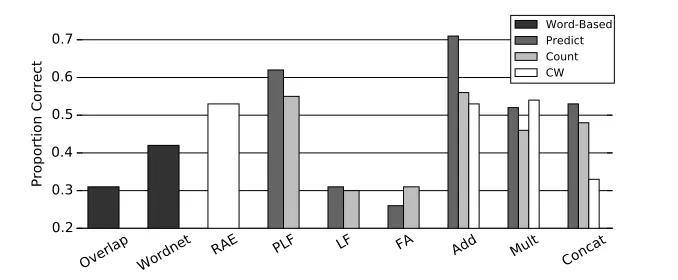
Overlap Wordnet RAE PLF LF FA Add Mult Concat 0.2
0.3 0.4 0.5 0.6 0.7
Proportion Correct
[image:4.612.138.477.65.205.2]Word-Based Predict Count CW
Figure 1: Naive Bayes accuracy scores for count and predict variants of several CDSM. Chance performance on this task was 0.2. Overlap refers to the word overlap baseline. CW refers to the vectors from Collobert and Weston (2008)
.
3.1 Compositional Distributional Models
We compared six models that are currently promi-nent in the CDSM literature: addition, multiplica-tion (Mitchell and Lapata, 2008), lexical funcmultiplica-tion (LF) (Coecke et al., 2010), practical lexical func-tion (PLF) (Paperno et al., 2014), full additive (FA) (Guevara, 2010; Zanzotto et al., 2010), and the re-cursive auto-encoder (RAE) (Socher et al., 2011).
The training data for LF, PLF, and FA was the UKWAC+Wikipedia+BNC 2.8 billion word cor-pus. In training LF, we followed Grefenstette et al. (2013), employing a two-step training regime using corpus-extracted vectors for noun–preposition–noun combinations to estimate matrices of correspond-ing prepositional phrases, which were in turn used to estimate a three-way tensor of each preposition. For PLF and FA, we learned separate matrices for combining prepositions with each of the two nouns in the construction, using corpus-based vectors of prepositional phrases for training preposition–noun combination. For training composition of the head noun with the prepositional phrase, we used corpus-extracted noun+preposition (for lexical matrices in PLF) or attributive adjective+noun (for attributive construction in FA) vectors. Phrase vectors for train-ing were built as DISSECT ‘peripheral’ spaces from phrase cooccurrence data in the count models. In the predict models, phrase vectors were learned along with word vectors in one pass, feeding all phrases of the relevant type as single tokens.
The RAE vectors were computed using Socher et al.’s implementation which is trained on a 150K sen-tence subset of the NYT and AP sections of the Gi-gaword corpus.
For all compositional models, we used as in-put two varieties of word level representations: co-occurrence based (Turney et al., 2010) and neural language model (Mikolov et al., 2013). Following Baroni et al. (2014b), we will refer to these variants ascountandpredictmodels respectively. Both word models were trained on the same corpus as those used to train the compositional models. Count was based on a 5 word window weighted with positive PMI and was reduced to 300 dimensions via SVD, while predict was based on a 5 word window using Mikolov’s continuous bag of words approach with negative sampling (Mikolov et al., 2013). These pa-rameters were based on their strong performance in the systematic evaluation by Baroni et al. (2014b). Socher et al.’s RAE implementation composes neu-ral language model vectors described by Collobert and Weston (2008) and supplied by Turian et al. (2010). For comparison with the RAE, we report re-sults for addition, multiplication, and concatenation of these same embeddings.
4 Results
informa-tion about the semantic interacinforma-tions between phrase constituents. Addition scored higher than PLF, while the RAE achieved comparable performance to its additive counterpart. In all cases except FA in which predict and count vectors were compared, predict achieved a higher score. This last result shows that the superiority of predict vectors docu-mented by Baroni et al. (2014b) extends to their use in compositional models.
All of the models performed well above chance accuracy of 0.2. The Wordnet based model achieved accuracy substantially above word overlap using hypernym information, indicating that although each noun is uninformative, its membership in higher level semantic categories is informative. All of the distributional models outperform the non-distributional models, except for LF and FA, which also fail to outperform concatenations of their in-put vectors. One explanation for the poor perfor-mance of LF and FA is that the 2.8B word corpus used to train them did not have sufficient relevant information to specify their large sets of parameters. This explanation is supported by the fact that PLF, a model designed as a parameter-reduced version of LF, performs well.
5 Discussion
The most important finding of this study is that, even on a test painstakingly designed to exclusively as-sess composition, vector addition matches or out-performs sophisticated CDSM. This finding implies that the structure of distributional vector spaces admits the effective use of addition for modeling complex interactions between meanings. This sug-gests that future work should be concerned with un-derstanding the properties of distributional vector spaces that make this possible, as well as with un-derstanding how these properties can be leveraged by sophisticated models.
A further contribution of this work is that it serves as a proof-of-concept for a new method for dissoci-ating the influences of lexical and compositional in-fluences on CDSM performance. Future work can extend this approach by finding alternatives to loca-tive expressions in order to test a wider variety of constructions. More immediately, future work may improve the locative expressions dataset by using
crowdsourcing to obtain naive participant ratings to corroborate the expert ratings and to increase the size of the dataset.
Acknowledgments
Denis Paperno and Marco Baroni were sup-ported by ERC 2011 Starting Independent Re-search Grant n. 283554 (COMPOSES). Samuel Ritter and Matthew Botvinick were supported by Intelligence Advanced Research Projects Activity (IARPA) Grant n. 102-01.
References
Eneko Agirre, Carmen Baneab, Claire Cardiec, Daniel Cerd, Mona Diabe, Aitor Gonzalez-Agirre, Weiwei Guof, Rada Mihalceab, German Rigaua, and Janyce Wiebeg. 2014. Semeval-2014 task 10: Multilingual semantic textual similarity. SemEval 2014, page 81. Marco Baroni, Raffaela Bernardi, and Roberto
Zampar-elli. 2014a. Frege in space: A program of compo-sitional distributional semantics. Linguistic Issues in
Language Technology, 9.
Marco Baroni, Georgiana Dinu, and Germ´an Kruszewski. 2014b. Dont count, predict! a systematic compari-son of context-counting vs. context-predicting seman-tic vectors. InProceedings of the 52nd Annual Meet-ing of the Association for Computational LMeet-inguistics, volume 1.
William Blacoe and Mirella Lapata. 2012. A comparison of vector-based representations for semantic composi-tion. InEMNLP, pages 546–556.
Bob Coecke, Mehrnoosh Sadrzadeh, and Stephen Clark. 2010. Mathematical foundations for a compositional distributional model of meaning. arXiv preprint arXiv:1003.4394.
Ronan Collobert and Jason Weston. 2008. A unified ar-chitecture for natural language processing: Deep neu-ral networks with multitask learning. InProceedings of the 25th international conference on Machine learn-ing, pages 160–167. ACM.
Scott C. Deerwester, Susan T Dumais, Thomas K. Lan-dauer, George W. Furnas, and Richard A. Harshman. 1990. Indexing by latent semantic analysis. JASIS, 41(6):391–407.
William B Dolan and Chris Brockett. 2005. Automat-ically constructing a corpus of sentential paraphrases. InProc. of IWP.
Edward Grefenstette, Georgiana Dinu, Yao-Zhong Zhang, Mehrnoosh Sadrzadeh, and Marco Baroni. 2013. Multi-step regression learning for composi-tional distribucomposi-tional semantics. In Proceedings of IWCS, pages 131–142, Potsdam, Germany.
Emiliano Guevara. 2010. A regression model of adjective-noun compositionality in distributional se-mantics. In Proceedings of the 2010 Workshop on
Geometrical Models of Natural Language Semantics,
pages 33–37.
Iris Hendrickx, Su Nam Kim, Zornitsa Kozareva, Preslav Nakov, Diarmuid ´O S´eaghdha, Sebastian Pad´o, Marco Pennacchiotti, Lorenza Romano, and Stan Szpakow-icz. 2009. Semeval-2010 task 8: Multi-way classifica-tion of semantic relaclassifica-tions between pairs of nominals.
In Proceedings of the Workshop on Semantic
Evalu-ations: Recent Achievements and Future Directions,
pages 94–99. Association for Computational Linguis-tics.
Annette Herskovits. 1985. Semantics and pragmatics of locative expressions*. Cognitive Science, 9(3):341– 378.
Dimitri Kartsaklis, Mehrnoosh Sadrzadeh, and Stephen Pulman. 2012. A unified sentence space for cate-gorical distributional-compositional semantics: The-ory and experiments. InIn Proceedings of COLING: Posters. Citeseer.
Walter Kintsch. 2001. Predication. Cognitive Science, 25(2):173–202.
Thomas K Landauer and Susan T Dumais. 1997. A so-lution to plato’s problem: The latent semantic analysis theory of acquisition, induction, and representation of knowledge. Psychological review, 104(2):211. Marco Marelli, Luisa Bentivogli, Marco Baroni,
Raf-faella Bernardi, Stefano Menini, and Roberto Zampar-elli. 2014. Semeval-2014 task 1: Evaluation of com-positional distributional semantic models on full sen-tences through semantic relatedness and textual entail-ment.SemEval-2014.
Tomas Mikolov, Kai Chen, Greg Corrado, and Jeffrey Dean. 2013. Efficient estimation of word representa-tions in vector space. arXiv preprint arXiv:1301.3781. Jeff Mitchell and Mirella Lapata. 2008. Vector-based models of semantic composition. InACL, pages 236– 244. Citeseer.
Jeff Mitchell and Mirella Lapata. 2010. Composition in distributional models of semantics. Cognitive science, 34(8):1388–1429.
Denis Paperno, Nghia The Pham, and Marco Baroni. 2014. A practical and linguistically-motivated ap-proach to compositional distributional semantics. In
Proceedings of the 52nd Annual Meeting of the Associ-ation for ComputAssoci-ational Linguistics (Volume 1: Long Papers), pages 90–99, Baltimore, Maryland, June.
Richard Socher, Eric H. Huang, Jeffrey Pennington, An-drew Y. Ng, and Christopher D. Manning. 2011. Dy-namic Pooling and Unfolding Recursive Autoencoders for Paraphrase Detection. InAdvances in Neural In-formation Processing Systems 24.
Richard Socher, Alex Perelygin, Jean Y Wu, Jason Chuang, Christopher D Manning, Andrew Y Ng, and Christopher Potts. 2013. Recursive deep models for semantic compositionality over a sentiment treebank.
InEMNLP, pages 1631–1642. Citeseer.
V. Srikumar and D. Roth. 2013. Modeling semantic rela-tions expressed by preposirela-tions. InTransactions of the Association for Computational Linguistics, volume 1, pages 231–242.
Joseph Turian, Lev Ratinov, and Yoshua Bengio. 2010. Word representations: a simple and general method for semi-supervised learning. InProceedings of the 48th Annual Meeting of the Association for Computational Linguistics, pages 384–394. Association for Computa-tional Linguistics.
Peter D Turney, Patrick Pantel, et al. 2010. From fre-quency to meaning: Vector space models of semantics.
Journal of artificial intelligence research, 37(1):141– 188.
Peter D Turney. 2014. Semantic composition and de-composition: From recognition to generation. arXiv preprint arXiv:1405.7908.