MIT at SemEval-2017 Task 10:
Relation Extraction with Convolutional Neural Networks
Ji Young Lee∗ MIT
Franck Dernoncourt∗
MIT
Peter Szolovits MIT [email protected]
Abstract
Over 50 million scholarly articles have been published: they constitute a unique repository of knowledge. In particular, one may infer from them relations be-tween scientific concepts. Artificial neu-ral networks have recently been explored for relation extraction. In this work, we continue this line of work and present a system based on a convolutional neural network to extract relations. Our model ranked first in the SemEval-2017 task 10 (ScienceIE) for relation extraction in sci-entific articles (subtask C).
1 Introduction and related work
The number of articles published every year keeps increasing (Druss and Marcus, 2005; Larsen and Von Ins,2010), with well over 50 million schol-arly articles published so far (Jinha,2010). While this repository of human knowledge contains in-valuable information, it has become increasingly difficult to take advantage of all available infor-mation due to its sheer amount.
One challenge is that the knowledge present in scholarly articles is mostly unstructured. One approach to organize this knowledge is to clas-sify each sentence (Kim et al., 2011; Amini et al., 2012; Hassanzadeh et al., 2014; Dernon-court et al.,2016). Another approach is to extract entities and relations between them, which is the focus of the ScienceIE shared task at SemEval-2017 (Augenstein et al.,2017).
Relation extraction can be seen as a process comprising two steps that can be done jointly (Li and Ji, 2014) or separately: first, entities of in-terest need to be identified, and second, the rela-tion among the entities has to be determined. In
∗ These authors contributed equally to this work.
this work, we concentrate on the second step (of-ten referred to as relation extraction or classifica-tion) and on binary relations, i.e. relations be-tween two entities. Extracted relations can be used for a variety of tasks such as question-answering systems (Ravichandran and Hovy, 2002), ontol-ogy extension (Schutz and Buitelaar, 2005), and clinical trials (Frunza and Inkpen,2011).
In this paper, we describe the system that we submitted for the ScienceIE shared task. Our sys-tem is based on convolutional neural networks and ranked first for relation extraction (subtask C).
Existing systems for relation extraction can be classified into five categories (Zettlemoyer,2013): systems based on hand-built patterns ( Yangar-ber and Grishman, 1998), bootstrapping meth-ods (Brin,1998), unsupervised methods ( Gonza-lez and Turmo, 2009), distant supervision (Snow et al., 2004), and supervised methods. We focus on supervised methods, as the ScienceIE shared task provides a labeled training set.
Supervised methods for relation extrac-tion commonly employ support vector ma-chines (Uzuner et al., 2010, 2011;Minard et al., 2011; GuoDong et al., 2005), na¨ıve Bayes ( Za-yaraz and Kumara,2015), maximum entropy (Sun and Grishman, 2012), or conditional random fields (Sutton and McCallum, 2006). These methods require the practitioner to handcraft features, such as surface, lexical, syntactic fea-tures (Grouin et al., 2010) or features derived from existing ontologies (Rink et al.,2011). The use of kernels based on dependency trees has also been explored (Bunescu and Mooney,2005; Culotta and Sorensen,2004;Zhou et al.,2007).
More recently, a few studies have investigated the use of artificial neural networks for relation ex-traction (Socher et al.,2012;Nguyen and Grish-man,2015;Hashimoto et al.,2013). Our approach follows this line of work.
word relative position2
part of speech type of entity relative
position1 multivariate
VBZ
signal 0 EMD
-3
6 an
NN 2
JJ
decomposition
-4
5 0
I-Process
-5 JJ
NN B-Process
4 3
-2
algorithm
O
0 0
I-Process NN O
I-Process -1
O is
NN 1
DT effective
0
B-Process
convolutional (ReLU)
max pooling
fully connected
(softmax)
[image:2.595.78.527.66.210.2]embedding
Figure 1: CNN architecture for relation extraction. The left table shows an example of input to the model.
Examples Rule format Relations detected
transmission electron microscopy (TEM) A (B) If B is an abbreviation of A, then A and B are synonyms.
high purity standard metals (Sn, Pb, Zn, Al, Ag, Ni) A (B, C, ... , Z) If any of B, C, ... , Z is a hyponym of A, then all of them are hyponyms of A.
(TEMs), scanning electron microscopes (A) B A and B have no relation.
DOTMA/DOPE A/B A and B have no relation.
Table 1: Rules used for postprocessing. We considered B to be an abbreviation of A if the first letters of each token in A form B. The examples are from the training and development sets
2 Model
Our model for relation extraction comprises three parts: preprocessing, convolutional neural net-work (CNN), and postprocessing.
2.1 Preprocessing
The preprocessing step takes as input each raw text (i.e., a paragraph of a scientific article in Scien-ceIE) as well as the location of all entities present in the text, and output several examples. Each ex-ample is represented as a list of tokens, each with four features: the relative positions of the two en-tity mentions, and their enen-tity types and part-of-speech (POS) tags. Figure 1 shows an example from the ScienceIE corpus in the table on the left.
Sentence and token boundaries as well as POS tags are detected using the Stanford CoreNLP toolkit (Manning et al., 2014), and every pair of entity mentions of the same type within each sen-tence boundary are considered to be of a poten-tial relation. We also remove any references (e.g. [1, 2]), which are irrelevant to the task, and en-sure that the sentences are not too long by elimi-nating the tokens before the beginning of the first entity mention and after the end of the second en-tity mention.
2.2 CNN architecture
The CNN takes each preprocessed sentence as in-put, and predicts the relation between the two en-tities. The CNN architecture, illustrated in Fig-ure1, consists of four main layers, similar to the one used in text classification (Collobert et al., 2011; Kim, 2014; Lee and Dernoncourt, 2016; Gehrmann et al.,2017).
1. the embedding layer converts each feature (word, relative positions 1 and 2, type of en-tity, and POS tag) into an embedding vector via a lookup table and concatenates them.
2. theconvolutional layerwith ReLU activation transforms the embeddings into feature maps by sliding filters over the tokens.
3. themax pooling layerselects the highest fea-ture value in each feafea-ture map by applying the max operator.
4. thefully connected layerwith softmax activa-tion outputs the probability of each relaactiva-tion.
2.3 Rule-based postprocessing
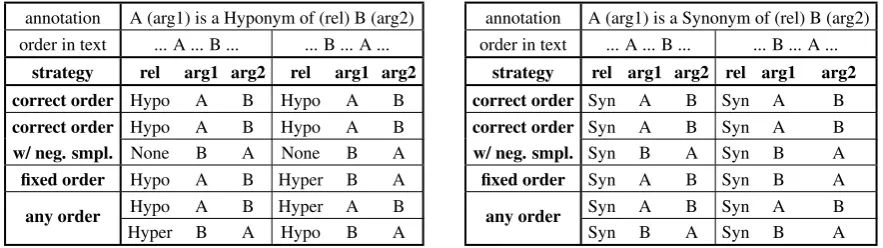
[image:2.595.75.523.254.342.2]annotation A (arg1) is a Hyponym of (rel) B (arg2) order in text ... A ... B ... ... B ... A ...
strategy rel arg1 arg2 rel arg1 arg2 correct order Hypo A B Hypo A B
correct order Hypo A B Hypo A B
w/ neg. smpl. None B A None B A
fixed order Hypo A B Hyper B A
any order Hypo A B Hyper A B
Hyper B A Hypo B A
annotation A (arg1) is a Synonym of (rel) B (arg2) order in text ... A ... B ... ... B ... A ...
strategy rel arg1 arg2 rel arg1 arg2 correct order Syn A B Syn A B
correct order Syn A B Syn A B
w/ neg. smpl. Syn B A Syn B A
fixed order Syn A B Syn B A
any order Syn A B Syn A B
[image:3.595.77.519.62.186.2]Syn B A Syn B A
Table 2: Argument ordering strategies. “w/ neg. smpl.”: with negative sampling (Xu et al., 2015), “rel”: relation, “arg”: argument. “Syn”, “Hypo”, “Hyper”, and “None” refers to the “Synonym-of”, “Hyponym-of”, “Hypernym-of”, and “None’ relations. Note that the “Hypernym-of” relation is the reverse of the “Hyponym-of” relation, introduced in addition to the relations annotated for the dataset.
2.4 Implementation
During training, the objective is to maximize the log probability of the correct relation type. The model is trained using stochastic gradient descent with minibatch of size 16, updating all parameters, i.e., token embeddings, feature embeddings, CNN filter weights, and fully connected layer weights, at each gradient descent step. For regularization, dropout is applied before the fully connected layer, and early stop with a patience of 10 epochs is used based on the development set.
The token embeddings are initialized using publicly available2pre-trained token embeddings, namely GloVe (Pennington et al.,2014) trained on Wikipedia and Gigaword 5 (Parker et al., 2011). The feature embeddings and the other parameters of the neural network are initialized randomly.
To deal with class imbalance, we upsampled the synonym and hyponym classes by duplicating the examples in the positive classes so that the upsam-pling ratio, i.e., the ratio of the number of positive examples in each class to that of the negative ex-amples, is at least 0.5. Without the upsampling, the trained model would have poor performances.
3 Experiments
3.1 Dataset
We evaluate our model on the ScienceIE dataset (Augenstein et al.,2017), which consists of 500 journal articles evenly distributed among the domains of computer science, material sciences and physics. Three types of entities are anno-tated: process, task, and material. The relation be-tween each pair of entities of the same type within a sentence are annotated as either “Synonym-of”,
2http://nlp.stanford.edu/projects/glove/
“Hyponym-of”, or “None”. Table 3 shows the number of examples for each relation class.
Relation Train Dev Test
Hyponym-of 420 123 95 Synonym-of 253 45 112 None 5355 1240 1503 Total 6028 1408 1710
Table 3: Number of examples for each relation class in ScienceIE. “Dev”: Development.
3.2 Hyperparameters
Table4details the experiment ranges and choices of hyperparameters. The results were quite robust to the choice of hyperparameters within the speci-fied ranges.
Hyperparameter Choice Experiment range
Token embedding dim. 100 50 – 300 Feature embedding dim. 10 5 – 50
CNN filter height 5 3 – 15
Number of CNN filters 200 50 – 500 Dropout probability 0.5 0 – 1
Upsampling ratio 3 0.5 – 5
Table 4: Experiment ranges and choices of hyper-parameters.3
3.3 Argument ordering strategies
One of the main challenges in relation extraction is the ordering of arguments in relations, as many re-lations areorder-sensitive. For example, consider the sentence “A dog is an animal.” If we set “dog” to be the first argument and “animal” the second,
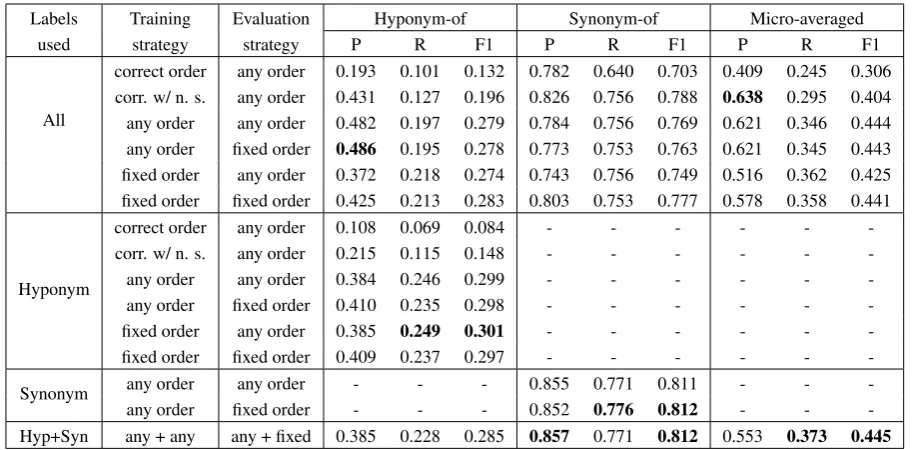
[image:3.595.349.483.297.364.2]Labels Training Evaluation Hyponym-of Synonym-of Micro-averaged
used strategy strategy P R F1 P R F1 P R F1
All
correct order any order 0.193 0.101 0.132 0.782 0.640 0.703 0.409 0.245 0.306 corr. w/ n. s. any order 0.431 0.127 0.196 0.826 0.756 0.788 0.638 0.295 0.404 any order any order 0.482 0.197 0.279 0.784 0.756 0.769 0.621 0.346 0.444 any order fixed order 0.486 0.195 0.278 0.773 0.753 0.763 0.621 0.345 0.443 fixed order any order 0.372 0.218 0.274 0.743 0.756 0.749 0.516 0.362 0.425 fixed order fixed order 0.425 0.213 0.283 0.803 0.753 0.777 0.578 0.358 0.441
Hyponym
correct order any order 0.108 0.069 0.084 - - -
-corr. w/ n. s. any order 0.215 0.115 0.148 - - -
-any order any order 0.384 0.246 0.299 - - -
-any order fixed order 0.410 0.235 0.298 - - -
-fixed order any order 0.385 0.249 0.301 - - -
-fixed order fixed order 0.409 0.237 0.297 - - -
-Synonym any order any order - - - 0.855 0.771 0.811 - -
-any order fixed order - - - 0.852 0.776 0.812 - -
[image:4.595.70.527.61.286.2]-Hyp+Syn any + any any + fixed 0.385 0.228 0.285 0.857 0.771 0.812 0.553 0.373 0.445 Table 5: Results for various ordering strategies on the development set of the ScienceIE dataset, averaged over 10 runs each.3 “corr. w/ n. s.”: correct order with negative sampling. Hyp+Syn is obtained by
merging the output of the best hyponym classifier and that of the best synonym classifier.
then the corresponding relation is “Hyponym-of”; however, if we reverse the argument order, then the “Hyponym-of” relation does not hold any more.
Therefore, it is crucial to ensure that 1) the CNN is provided with the information about the argu-ment order, and 2) it is able to utilize the given information efficiently. In our work, the former point is addressed by providing the CNN with the two relative position features compared to the first and the second argument of the relation respec-tively. In order to certify the latter point, we ex-perimented with four strategies for argument or-dering, outlined in Table2.
4 Results and Discussion
Table5shows the results from experimenting with various argument ordering strategies. The correct order strategy performed the worst, but the nega-tive sampling improved over it slightly, while the fixed order and any order strategies performed the best. The latter two strategies performed almost equally well in terms of micro-averaged F1-score. This implies that for relation extraction it may be advantageous to use both the original relation classes as well as their “reverse” relation classes for training, instead of using only the original rela-tion classes with the “correct” argument ordering (with or without the negative sampling). More-over, ordering the argument as the order of ap-pearance in the text and training once per relation
(i.e., fixed order) is as efficient as training each re-lation as two examples in two possible argument ordering, one with the original relation class and the other with the reverse relation class (i.e., any order), despite the small size of the dataset.
The difference in performance between the cor-rect order versus the fixed or any order strategies is more prominent for the “Hyponym-of” relation than for the “Synonym-of” relation. This is ex-pected, since the argument ordering strategy is different only for the order-sensitive “Hyponym-of” relation. It is somewhat surprising though, that the correct order strategy performs worse than the other strategies even for order-insensitive “Synonym-of” relation. This may be due to the fact that the model does not see any training exam-ples with the reversed argument ordering for the “Synonym-of” relation. In comparison, the nega-tive sampling strategy, which learns from both the original and reversed argument ordering for the “Synonym-of” relation, the performance is com-parable to the two best performing strategies.
be the reason why the model trained with the cor-rect order strategy does not perform as well, since it has to be evaluated with a different strategy from training, namely the any order strategy, as we do not know the correct ordering of arguments for ex-amples in the test set.
We have also tried training binary classifiers for the “Hyponym-of” and the “Synonym-of” rela-tions separately and then merging the outputs of the best classifiers for each relations. While the bi-nary classifiers individually performed better than the multi-way classifier for each corresponding re-lation class, the overall performance based on the micro-averaged F1-score did not improve over the multi-way classifier after merging the outputs of the hyponym and the synonym classifiers.
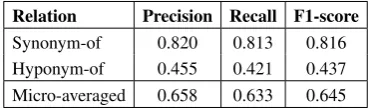
Based on the results from the argument or-dering strategy experiments, we submitted the model trained using the fixed order strategy, which ranked number one in the challenge. The result is shown in Table6.
Relation Precision Recall F1-score
Synonym-of 0.820 0.813 0.816 Hyponym-of 0.455 0.421 0.437 Micro-averaged 0.658 0.633 0.645
Table 6: Result on the test set of the ScienceIE dataset, using the official train/dev/test split.
To quantify the importance of various features of our model, we trained the model by gradually adding more features one by one, from word em-beddings, relative positions, and entity types to POS tags in order. The results on the importance of the features as well as postprocessing are shown in Figure2. Adding the relative position features improved the performance the most, while adding the entity type improved it the least. Note that even without the postprocessing, the F1-score is 0.63, which still outperforms the second-best sys-tem with the F1-score of 0.54.
Figure3quantifies the impact of the two prepro-cessing steps, deleting brackets and cutting sen-tences, introduced to compensate for the small dataset size. Cutting the sentence before the first entity and after the second entity resulted in a dra-matic impact on the performance, while deleting brackets (i.e., removing the reference marks) im-prove the performance modestly. This implies that the text between the two entities contains most of the information about the relation between them.
0.50 0.55 0.60 0.65
F1-score w+rp+et+pos+pp
[image:5.595.313.515.55.180.2]w+rp+et+pos w+rp+et w+rp w
Figure 2: Importance of features of CNN and post-processing rules. w: word embeddings, rp: rela-tive positions to the first and the second arguments, et: entity types, pos: POS tags.
0.50 0.55 0.60 0.65
F1-score - sentence cutting
[image:5.595.314.515.255.339.2]- bracket deletion w+rp+et+pos
Figure 3: Impact of bracket deletion and sen-tence cutting. “w+rp+et+pos” represents the CNN model trained using all features with both bracket deletion and sentence cutting during preprocess-ing. “-bracket deletion” is the same model trained only without bracket deletion, and “-sentence cut-ting” only without sentence cutting.
5 Conclusion
In this article we have presented an ANN-based approach to relation extraction, which ranked first in the SemEval-2017 task 10 (ScienceIE) for re-lation extraction in scientific articles (subtask C). We have experimented with various strategies to incorporate argument ordering for ordering-sensitive relations, showing that an efficient strat-egy is to fix the arguments ordering as appears on the text by introducing reverse relations. We have also demonstrated that cutting the sentence before the first entity and after the second entity is effec-tive for small datasets.
Acknowledgments
[image:5.595.87.275.362.417.2]References
Iman Amini, David Martinez, and Diego Molla. 2012. Overview of the ALTA 2012 Shared Task. In Aus-tralasian Language Technology Association Work-shop 2012. volume 7, page 124.
Isabelle Augenstein, Mrinal Kanti Das, Sebastian Riedel, Lakshmi Nair Vikraman, and Andrew McCallum. 2017. SemEval 2017 Task 10: ScienceIE -Extracting Keyphrases and Relations from Scientific Publications. In Proceedings of the International Workshop on Semantic Evaluation. Association for Computational Linguistics, Vancouver, Canada. Sergey Brin. 1998. Extracting patterns and
rela-tions from the world wide web. In International Workshop on The World Wide Web and Databases. Springer, pages 172–183.
Razvan C Bunescu and Raymond J Mooney. 2005. A shortest path dependency kernel for relation extrac-tion. In Proceedings of the conference on human language technology and empirical methods in nat-ural language processing. Association for Compu-tational Linguistics, pages 724–731.
Ronan Collobert, Jason Weston, L´eon Bottou, Michael Karlen, Koray Kavukcuoglu, and Pavel Kuksa. 2011. Natural language processing (almost) from scratch. The Journal of Machine Learning Research 12:2493–2537.
Aron Culotta and Jeffrey Sorensen. 2004. Dependency tree kernels for relation extraction. In Proceed-ings of the 42nd annual meeting on association for computational linguistics. Association for Compu-tational Linguistics, page 423.
Franck Dernoncourt, Ji Young Lee, and Peter Szolovits. 2016. Neural networks for joint sentence classification in medical paper abstracts. EACL 2017.
Benjamin G Druss and Steven C Marcus. 2005. Growth and decentralization of the medical liter-ature: implications for evidence-based medicine. Journal of the Medical Library Association 93(4):499.
Oana Frunza and Diana Inkpen. 2011. Extracting re-lations between diseases, treatments, and tests from clinical data. InCanadian Conference on Artificial Intelligence. Springer, pages 140–145.
Sebastian Gehrmann, Franck Dernoncourt, Yeran Li, Eric T. Carlson, Joy T. Wu, Jonathan Welt, David W. Grant, Patrick D. Tyler, and Leo A. Celi. 2017. Comparing rule-based and deep learning models for patient phenotyping. arXiv:1703.08705.
Edgar Gonzalez and Jordi Turmo. 2009. Unsupervised relation extraction by massive clustering. In Data Mining, 2009. ICDM’09. Ninth IEEE International Conference on. IEEE, pages 782–787.
Cyril Grouin, Asma Ben Abacha, Delphine Bernhard, Bruno Cartoni, Louise Deleger, Brigitte Grau, Anne-Laure Ligozat, Anne-Lyse Minard, Sophie Rosset, and Pierre Zweigenbaum. 2010. Caramba: concept, assertion, and relation annotation using machine-learning based approaches. Ini2b2 Medication Ex-traction Challenge Workshop.
Zhou GuoDong, Su Jian, Zhang Jie, and Zhang Min. 2005. Exploring various knowledge in relation ex-traction. InProceedings of the 43rd annual meeting on association for computational linguistics. Asso-ciation for Computational Linguistics, pages 427– 434.
Kazuma Hashimoto, Makoto Miwa, Yoshimasa Tsu-ruoka, and Takashi Chikayama. 2013. Simple cus-tomization of recursive neural networks for seman-tic relation classification. InEMNLP. pages 1372– 1376.
Hamed Hassanzadeh, Tudor Groza, and Jane Hunter. 2014. Identifying scientific artefacts in biomedical literature: The evidence based medicine use case. Journal of biomedical informatics49:159–170.
Arif E Jinha. 2010. Article 50 million: an estimate of the number of scholarly articles in existence. Learned Publishing23(3):258–263.
Su Nam Kim, David Martinez, Lawrence Cavedon, and Lars Yencken. 2011. Automatic classification of sentences to support evidence based medicine. BioMed Central (BMC) Bioinformatics12(2):1.
Yoon Kim. 2014. Convolutional neural networks for sentence classification. InProceedings of the 2014 Conference on Empirical Methods in Natural Lan-guage Processing (EMNLP). Association for Com-putational Linguistics (ACL), pages 1746–1751.
Peder Olesen Larsen and Markus Von Ins. 2010. The rate of growth in scientific publication and the de-cline in coverage provided by science citation index. Scientometrics84(3):575–603.
Ji Young Lee and Franck Dernoncourt. 2016. Sequen-tial short-text classification with recurrent and con-volutional neural networks. In Human Language Technologies 2016: The Conference of the North American Chapter of the Association for Computa-tional Linguistics, NAACL HLT.
Qi Li and Heng Ji. 2014. Incremental joint extraction of entity mentions and relations. InACL (1). pages 402–412.
Anne-Lyse Minard, Anne-Laure Ligozat, and Brigitte Grau. 2011. Multi-class svm for relation extraction from clinical reports. In Ranlp. volume 59, pages 604–609.
Thien Huu Nguyen and Ralph Grishman. 2015. Rela-tion extracRela-tion: Perspective from convoluRela-tional neu-ral networks. InProceedings of NAACL-HLT. pages 39–48.
Robert Parker, David Graff, Junbo Kong, Ke Chen, and Kazuaki Maeda. 2011. English Gigaword fifth edi-tion. Technical report, Linguistic Data Consortium, Philadelphia.
Jeffrey Pennington, Richard Socher, and Christopher D Manning. 2014. GloVe: global vectors for word representation. Proceedings of the Empiricial Meth-ods in Natural Language Processing (EMNLP 2014) 12:1532–1543.
Deepak Ravichandran and Eduard Hovy. 2002. Learn-ing surface text patterns for a question answerLearn-ing system. InProceedings of the 40th annual meeting on association for computational linguistics. Asso-ciation for Computational Linguistics, pages 41–47.
Bryan Rink, Sanda Harabagiu, and Kirk Roberts. 2011. Automatic extraction of relations between medical concepts in clinical texts. Journal of the American Medical Informatics Association18(5):594–600.
Alexander Schutz and Paul Buitelaar. 2005. Relext: A tool for relation extraction from text in ontology ex-tension. InInternational semantic web conference. Springer, volume 2005, pages 593–606.
Rion Snow, Daniel Jurafsky, Andrew Y Ng, et al. 2004. Learning syntactic patterns for automatic hypernym discovery. InNIPS. volume 17, pages 1297–1304.
Richard Socher, Brody Huval, Christopher D Manning, and Andrew Y Ng. 2012. Semantic compositional-ity through recursive matrix-vector spaces. In Pro-ceedings of the 2012 Joint Conference on Empirical Methods in Natural Language Processing and Com-putational Natural Language Learning. Association for Computational Linguistics, pages 1201–1211.
Ang Sun and Ralph Grishman. 2012. Active learn-ing for relation type extension with local and global data views. InProceedings of the 21st ACM inter-national conference on Information and knowledge management. ACM, pages 1105–1112.
Charles Sutton and Andrew McCallum. 2006. An in-troduction to conditional random fields for relational learning.Introduction to statistical relational learn-ingpages 93–128.
Ozlem Uzuner, Jonathan Mailoa, Russell Ryan, and Tawanda Sibanda. 2010. Semantic relations for problem-oriented medical records. Artificial intel-ligence in medicine50(2):63–73.
¨Ozlem Uzuner, Brett R South, Shuying Shen, and Scott L DuVall. 2011. 2010 i2b2/va challenge on concepts, assertions, and relations in clinical text. Journal of the American Medical Informatics Asso-ciation18(5):552–556.
Kun Xu, Yansong Feng, Songfang Huang, and Dongyan Zhao. 2015. Semantic relation classifi-cation via convolutional neural networks with sim-ple negative sampling. In Proceedings of the 2015 Conference on Empirical Methods in Natu-ral Language Processing. Association for Computa-tional Linguistics, Lisbon, Portugal, pages 536–540. https://aclweb.org/anthology/D/D15/D15-1062. Roman Yangarber and Ralph Grishman. 1998. Nyu:
Description of the proteus/pet system as used for muc-7. InIn Proceedings of the Seventh Message Understanding Conference (MUC-7). Citeseer. Godandapani Zayaraz and Suresh Kumara. 2015.
Con-cept relation extraction using na¨ıve bayes classi-fier for ontology-based question answering systems. Journal of King Saud University-Computer and In-formation Sciences27(1):13–24.
Luke Zettlemoyer. 2013. Relation extraction. CSE517: Natural Language Processing.