JOURNAL OF FOREST SCIENCE, 58, 2012 (11): 483–491
Analysis of price changes of selected roundwood
assortments in some Central Europe countries
J. Suchomel, M. Gejdoš, L. Ambrušová, R. Šulek
Faculty of Forestry, Department of Forest Harvesting and Mechanisation, Technical University in Zvolen, Zvolen, Slovak Republic
ABSTRACT: The paper deals with the analysis of price changes of roundwood (spruce, fir and beech sawlog, fuel-wood) and energy wood in Slovakia, Czech Republic and Austria during the period of 2008–+September 2011. At the beginning of the article, the authors identify the major factors influencing timber price trends such as legislation regarding technical standards for the quality grading of round wood, global economic recession, incidental felling and political influence. Consequently, detailed analysis of timber price changes in selected European counties is provided by means of line graphs. The results of the analysis revealed that demand for wood and wood products began to de-crease in mid-2008. The most critical situation was in 2009, primarily in the softwood market, when prices bottomed out. However, recent trends indicate a gradual rise in timber prices. In the future, a slight increase of timber prices is expected, however other factors (such as economic development, lobbyist pressure, incidental felling and many oth-ers) may influence prices, which makes it difficult to predict their trend.
Keywords: timber prices; timber market; timber trade; sawlog; fuelwood; energy wood
Timber trade and timber market are among the main areas of interest for wood producers and wood-processing industry. More than 90% of the sales revenue of forestry in Slovakia are from wood sales. European and global markets are closely linked and they influence each other. It means that if a significant factor affecting the timber market and trade (e.g. extensive incidental felling, global economic recession) arises in one or more coun-tries, it will have an impact on the whole timber market (European or global). Therefore, it is neces-sary to monitor price changes in this sphere, not only within one country, but also at least in Cen-tral Europe or globally. Only few wood producers in Slovakia are aware of these facts (Suchomel, Gejdoš 2009).
Prices of roundwood and wood products belong to the category of market prices. In a perfect mar-ket, prices are based on supply of and demand for the products. Upper-level price is limited by the
price of substitutes (e.g. steel, cement, plastic mate-rial, etc.) and by the border price of timber offered from other sources in the market studied. Lower-level price is usually determined by production costs. From the forest owners’ aspect, the produc-tion cost of roundwood includes cost of silviculture such as reforestation, tending of young stands, for-est protection as well cost of exploitation such as felling and extraction if wood is sold on the roadside or landing. In some cases, the roundwood price can be lower than the production costs (e.g. in the case of extensive incidental felling due to storm damage, for example).
Prices of roundwood, contrary to other products, are rarely derived from cost accounting. They are usually based on market price levels transacted in particular countries or regions (Bluďovský 2005).
Monitoring of timber price changes is one of the basic requirements of successful wood trade. As Slovakia joined the European Union, the country’s
timber markets became integrated with the region and even with global demand and supply. Therefore, it is important to continually monitor price changes at least in the Central-European region, for prepar-ing strategic plans, particularly to be prepared for abrupt changes in the market (negative or positive), to implement trade policy in accordance with ac-tual market situations (Suchomel, Gejdoš 2009). The recent global changes in economic conditions (globalisation, increasing oil prices, declining value of the US dollar, stagnation of the building industry and the 2009 global economic recession, climate change, etc.) have caused a decline in demand for roundwood and wood products (apart from wood for energy purposes and renewable energy resourc-es), which has brought problems for several wood processors in Europe and North America. Many of them had to significantly reduce their production or to shut down plants (Suchomel et al. 2010).
Moreover, this situation is complicated by the ris-ing intensity of incidental fellris-ing due to windthrow damage which is assumed to be associated with global climate change during the last 20 years. In-creasing global temperatures are assumed to fur-ther increase the intensity of incidental felling in the future. In view of the current critical situation in the timber market, it is necessary to adjust pro-duction strategies and be prepared for actions in the case of extensive incidental felling to minimise its negative impact on the timber market. Apart from windthrow, incidental felling may also in-crease due to harvesting of forest stands infested by bark beetle (Suchomel, Gejdoš 2009).
Timber prices are also influenced by technical standards used in timber trading. According to Slovakian Act No. 264/1999 on technical require-ments for products, on conformity assessment, and on amendment of some acts in the wording of Act No. 436/2001 and Act No. 254/2003, the use of technical standards is voluntary. Any techni-cal standards (including those expired standards or national standards of other countries) can be used in timber trade. They are typically defined by buyers when a sales contract is made. In Slovakia, there are two main standards for quality grading of roundwood, STN 48 0055 Qualitative Classifica-tion of Softwood Round Timber and STN 48 0056 Qualitative Classification of Hardwood Round Timber. STN 48 0055 and STN 48 0056 from 1984 were revised in 2004 and 2007: however, the 2004 version was barely recognised in practice. The lat-est revision of STN in 2007 was conceived strictly toward wood producers (in comparison with Eu-ropean standards). Because, due to these strict
technical requirements it is impossible to produce assortments of quality class I. There is also discor-dance between defined quality of roundwood and its prices. In Slovakia, the European standards STN EN for grading roundwood were accepted in 2004. STN EN 1316 and STN EN 1927 fall into the group called “Qualitative Assortment of Roundwood without Specified Utilization Purpose”. In practice, the European standards STN EN are barely used and they have not been promoted in the domes-tic market which absorbs the bulk of roundwood trade. As a result, the use of the technical standards in timber trade in Slovakia is somewhat complicat-ed. Therefore, many organizations use their own technical standards (including the largest supplier in the market – the state enterprise Lesy SR, š.p., Banská Bystrica). In addition, there is asymmetric information in this field and reluctance of forest operators to improve such situation (Suchomel, Gejdoš 2008).
MATERIAL AND METHODS
Price changes were analysed for the period from 2008 to September 2011 for spruce, fir and beech sawlogs, fuelwood and energy wood. Prices were analysed in Slovakia, in the Czech Republic and in selected federal states of Austria that are geograph-ically close to Slovakia. Austria and the Czech Re-public were chosen because they are the main trad-ing partners in trade in roundwood.
The Slovak prices in 2008 were converted to Euro using the average monthly exchange rates of Na-tional Bank of Slovakia (Exchange rate ... 2011). Czech prices were converted to Euro on the basis of the average monthly exchange rates of Czech Na-tional Bank (Exchange rate ... 2011). Prices in Aus-tria are quoted as road-side prices in Euro. Prices in Slovakia and in the Czech Republic are quoted in parity FCA (FCA means free carrier. It means that the seller fulfils his obligation to deliver when he has handed over the goods, cleared for export, into the charge of the carrier named by the buyer at the named place or point. If no precise point is indicated by the buyer, the seller may choose with-in the place or range stipulated where the carrier shall take the goods into its charge). Therefore, it is necessary to add transport cost (according to the Austrian state forests it is 6.08 EUR·m–3) to
Aus-trian prices in order to reach prices of assortment in comparable parity (Brezinová 2008).
Statistical Office (Price indice...2011) and the Slo-vak Forest Sector Information System (www.for-estportal.sk). In Austria, beech sawlog price data was available only for certain months of the year, when market transactions with this commodity were realised (roundwood must be harvested dur-ing dormancy).
Each country has different technical standards and legislation so it was not possible to compare the absolute levels of roundwood but this was not necessary as the focus of the study was to analyse changes in price levels over time.
RESULTS
Spruce and fir sawlog price changes in Austria and Slovakia
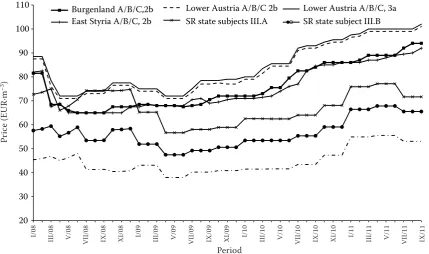
Fig. 1 shows spruce and fir sawlog price changes in Slovakia and in the selected states of Austria. The beginning of the year 2008 was characterized by a price decrease in Austria. In Burgenland, the most significant price decline was found for sawlogs (quality sub-classes A/B/C, diameter class 2b), from 81.5 EUR·m–3 in February 2008 to 68.5 EUR·m–3
in March 2008 (decrease by 16%). The main rea-sons for the decline in the prices were repeated windthrow disasters in Austria at the beginning of 2008, falling demand for wood, and unfavourable situation in the wood-processing industry.
The coniferous sawlog price change in Lower Austria and East Styria was similar to Burgen-land. In Burgenland and East Styria, spruce and fir sawlog prices bottomed out at 65 EUR·m–3 in
the second half of 2008. At the turn of the year 2008/2009, prices increased slightly. In the first half of 2009, the price change in Lower Aus-tria was influenced by economic recession, so sawlog prices went down again to 71 EUR·m–3.
In contrast, in Burgenland and East Styria the prices levelled off at 68 EUR·m–3. Since July 2009, there
has been a gradual price increase in each Austrian state. Sawlog prices reached their maximum in Sep-tember 2011 (Burgenland 94 EUR·m–3, East Styria
92 EUR·m–3, Lower Austria 101 EUR·m–3).
Spruce and fir sawlog prices in Slovakia increased slightly in the first quarter of 2008. In April 2008, the prices fell considerably, but in comparison with Aus-tria, this price decrease was less dramatic. The big-gest price drop was found in sawlogs of quality class III.A: the price of this assortment fell by 8.89 EUR·m–3
(12%). In the second half of 2008, the same price rose and reached 74.8 EUR·m–3. One explanation for these
[image:3.595.87.517.480.734.2]price changes may be the strengthening of the Slovak Crown against the Euroand subsequently, the adop-tion of the single European currency. Nevertheless, sawlog prices declined in the first half of 2009 (qual-ity class III.A decreased by 24%, qual(qual-ity class III.B decreased by 18.6%, quality class III.C decreased by 12%). Since the second half of 2009, there has been a small price increase. The biggest price rise was in
Fig. 1. Spruce and fir sawlog price changes in Austria and Slovakia (EUR·m–3)
20 30 40 50 60 70 80 90 100 110
Period
Burgenland A/B/C,2b Lower Austria A/B/C 2b Lower Austria A/B/C, 3a East Styria A/B/C, 2b SR state subjects III.A SR state subject III.B
Pri
ce
(EUR
∙m
–1)
I/08 III/08 V/08
V
II/08 IX/08 XI/08 I/09 III/09 V/09 VII/09 IX/09 XI/09 I/10 III/10 V/10 VII/10 IX/10 XI/10 I/11 III/11 V/11 VII/11 IX/11 Period
Pr
ic
e (EU
R·m
the first quarter of 2011, when spruce and fir saw-log prices rose by about 7.5 EUR·m–3. Prices reached
their peak in the second quarter of 2011 (III.A 77.14 EUR·m–3, III.B 67.86 EUR·m–3, III.C 54.79 EUR·m–3).
However, in the third quarter of 2011 sawlog prices went down. The biggest price decrease was found out for quality class III.A (drop by 5.48 EUR·m–3).
Spruce and fir sawlog price changes in the Czech Republic and Slovakia
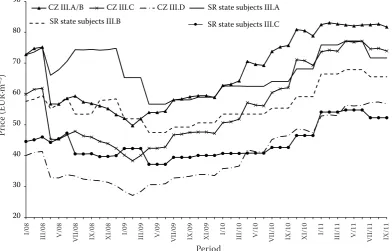
Fig. 2 shows spruce and fir sawlog price changes in the Czech Republic and Slovakia. Spruce and fir sawlog prices in the Czech Republic slightly rose in the first quarter of 2008, due to the strengthening Czech Crown against the Euro. But in April 2008 prices fell, and this price decrease was more sig-nificant in contrast to Slovakia. The sawlog price of quality class III.A/B went down by 18.4 EUR·m–3
(decrease by 24.5%), the price of quality class III.C went down by 16.6 EUR·m–3 (decrease by 26.8%).
The smallest decline was found for assortment of quality class III.D (decrease by 8.6 EUR·m–3, i.e.
20.8%). This declining price trend went on until February 2009, when spruce and fir sawlog prices reached their minimum (III.A/B 49.7 EUR·m–3,
III.C 38.3 EUR·m–3, III.D 27.1 EUR·m–3). Since
then, prices have gradually risen and reached their maximum in August 2011 (III.A/B 82.6 EUR·m–3,
III.C 74.8 EUR·m–3, III.D 56.7 EUR·m–3).
Beech sawlog price changes in Austria, Czech Republic and Slovakia
Fig. 3 presents beech sawlog price changes in Austria, in the Czech Republic and Slovakia. Beech sawlog prices of quality class A and B (diameter class 3 and 4) were listed in Austrian reviews just for the state of Salzburg. The beech sawlog mar-ket was stable in early 2008 and the price (quality class A) was 130 EUR·m–3, quality class B reached
85 EUR·m–3. However beech sawlog prices went
down due to economic recession at the end of 2008 and the price of quality class A ¾ dropped by 20 EUR·m–3 (15%) and levelled off at 110 EUR·m–3
afterwards. The beech sawlog price of quality class B ¾ dropped by 15 EUR·m–3 (18%) and remained
stable until February 2011. The sawlog price of this quality class rose by 7.5 EUR·m–3 in March 2011.
In the Czech Republic, there was a price increase caused by the strengthening Czech Crown against the Euro in the first quarter of 2008. Consequently, beech sawlog prices declined, but this drop was not so sharp in comparison with the spruce and fir sawlog. The price of quality class III.A/B rose slightly in the first quarter of 2009 and the subsequent price trend was characterised by fluctuations. The price of this assortment decreased considerably (by 9 EUR·m–3)
[image:4.595.105.498.482.733.2]in the third quarter of 2010. It was caused mainly by the large incidental felling due to windthrow di-saster, which affected especially beech stands in summer 2010. Sawlog prices of quality class III.A/B
Fig. 2. Spruce and fir sawlog price changes in the Czech Republic and Slovakia (EUR·m–3)
I/08 III/08 V/08
V
II/08 IX/08 XI/08 I/09 III/09 V/09 VII/09 IX/09 XI/09 I/10 III/10 V/10 VII/10 IX/10 XI/10 I/11 III/11 V/11 VII/11 IX/11 Period
20 30 40 50 60 70 80 90
Period
CZ III.A/B CZ III.C CZ III.D SR state subjects III.A
SR state subjects III.B SR state subjects III.C
Pri
ce
(EUR
∙m
–1)
Pr
ic
e (EU
R·m
decreased again (by 7 EUR·m–3) in July 2011.
Tim-ber prices of quality class III.C, III.D have increased slightly since March 2009. The biggest price increase was found for assortment of quality class III.D in the first quarter of 2011 (rise by 8.5 EUR·m–3). Beech
sawlog prices of quality class III.D for the third quar-ter of 2011were not listed in reviews.
Sawlog price changes in Slovakia were similar in comparison with the Czech Republic. In spite of a short-term price decrease in April – May 2008, the
timber price of quality class III.A rose during 2008 and reached a peak (77.08 EUR·m–3) in December.
Then the price went down during 2009 and lev-elled off at 62 EUR·m–3 in the third quarter of 2010.
The price of this assortment rose to 67 EUR·m–3 in
the first quarter of 2011. Timber prices of quality class III.B, III.C decreased during 2008–2009 and bottomed out in July 2009 (III.B 42.96 EUR·m–3,
III.C 40.95 EUR·m–3). Prices of these assortments
[image:5.595.102.493.58.289.2]remained stable until 2011, when they increased
Fig. 3 Beech sawlog price changes in Austria, Czech Republic and Slovakia (EUR·m–3)
Fig. 4. Coniferous fuelwood and energy wood price changes in Austria, Czech Republic and Slovakia (EUR·m–3)
I/08
II
I/08 V/08
V
II/08 IX/08 XI/08 I/09 III/09 V/09 VII/09 IX/09 XI/09 I/10 III/10 V/10 VII/10 IX/10 XI/10 I/11 III/11 V/11 VII/11 IX/11 Period
5 10 15 20 25 30 35 40 45
Period
Burgenland Lower Austria SR-state subjects
SR-non state subjects CZ SR energy wood
Pri
ce
(EUR
∙m
–1)
Pr
ic
e (EU
R·m
–3)
I/08
II
I/08 V/08
V
II/08 IX/08 XI/08 I/09 III/09 V/09 VII/09 IX/09 XI/09 I/10 III/10 V/10 VII/10 IX/10 XI/10 I/11 III/11 V/11 VII/11 IX/11 Period
30 40 50 60 70 80 90 100 110 120 130 140
Period
Salzburg A3/4 Salzburg B3/4 CZ II.A/B CZ III.C
CZ III.D SR III.A SR III.B SR III.C
Pri
ce
(EUR
∙m
–1)
Pr
ic
e (EU
R·m
[image:5.595.104.499.479.733.2]slightly. From January 2011 to September 2011, beech sawlog prices were maintained approximate-ly at the same level (III.A 66 EUR·m–3, III.B 50.1
EUR·m–3, III.C 46.3 EUR·m–3).
The situation in the beech sawlog market did not improve until the end of the study period and pric-es of thpric-ese assortments still stagnate.
Coniferous fuelwood price changes in Austria, Czech Republic and Slovakia
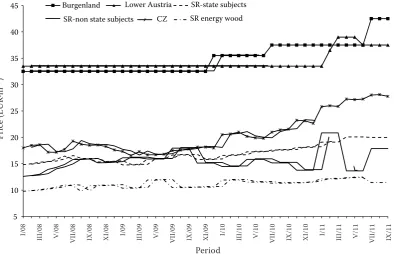
Fig. 4 documents spruce and fir fuelwood price changes in Austria, in the Czech Republic and Slovakia. Fuelwood prices in Austria were stable without any significant changes. In Lower Aus-tria, coniferous fuelwood prices held constant at 33.5 EUR·m–3 from 2008 to 2010 and then went up
to 39 EUR·m–3 in the second quarter of 2011.
Sub-sequently, the price of this assortment went down slightly, in the third quarter of 2011. In Burgenland, fuelwood prices were maintained at 32.5 EUR·m–3
during the period 2008–2009 and rose in December 2009 (by 3 EUR·m–3) and July 2010, when the price
reached 37.5 EUR·m–3. That was due to increased
demand for fuelwood caused by the coming winter season. Increasing demand for fuelwood caused a rise in prices of this assortment in the third quar-ter of 2011, when the prices reached 42.5 EUR·m–3.
Fuelwood prices in Austria were much higher than in the Czech Republic and Slovakia (prices lower by 18 EUR·m–3), because in Alpine states
fuel-wood prices depend on the charcoal price trend. It is caused also by providing tax relief and taking a comprehensive approach to this problem. It is due to Austrian trade policy. Alpine states receive subsidies not only for renewable energy resources but also for fossil fuels, which deforms the market and therefore the prices do not correspond to the real market prices. Thus, the softwood fuelwood price changes differed from the price changes of the other assortments and no considerable fluctua-tions were found in fuelwood prices due to previ-ously mentioned reasons. In the Czech Republic, a modest rise of fuelwood prices was recorded, char-acterised by minor fluctuations associated with the Czech Crown exchange rate trend. Fuelwood prices reached their maximum level at 28.1 EUR·m–3 in
August 2011.
Fuelwood prices in Slovakia (state forests) rose gradually during the study period and peaked at 20.1 EUR·m–3 in the second quarter of 2011. On the
contrary, in the non-state sector, fuelwood prices in-creased until the third quarter of 2009, after which there was a price decrease in 2010. A slight price in-crease (by 1.3 EUR·m–3) was recorded in April 2010.
In the non-state forestry sector, all fuelwood was bought by members of the forestry landowner as-sociations, which explains why the price was low in comparison with the market price. Fuelwood price in the non-state forestry sector went up consider-ably and peaked (20.85 EUR·m–3) in the first quarter
[image:6.595.99.501.491.731.2]of 2011, but subsequently it decreased sharply by 10.7 EUR·m–3 during the second quarter of 2011. In
Fig. 5. Non-coniferous fuelwood and energy wood price changes in Austria, Czech Republic and Slovakia (EUR·m–3)
I/08
II
I/08 V/08
V
II/08 IX/08 XI/08 I/09 III/09 V/09 VII/09 IX/09 XI/09 I/10 III/10 V/10 VII/10 IX/10 XI/10 I/11 III/11 V/11 VII/11 IX/11 Period
10 15 20 25 30 35 40 45 50 55 60 65 70
Period
Lower Austria Salzburg SR state subjects
SR non-state subjects CZ SR energy wood
Pri
ce
(EUR
∙m
–1)
Pr
ic
e (EU
R·m
July 2011, fuelwood price in the non-state forestry sector went up again and reached 17.87 EUR·m–3.
In Slovakia, we also analysed price changes of energy wood. It is an assortment intended for the industrial production of thermal energy (includ-ing logg(includ-ing waste, residues from thinn(includ-ing and pre-commercial thinnings used for chipping or crush-ing, wood from intensively managed forest stands and energy plantations). Energy wood prices were stable during the study period and peaked at 12.36 EUR·m–3 in June 2011. In the third quarter of
2011, there was a slight decrease in this assortment, when energy wood price reached 11.42 EUR·m–3.
The average prices of energy wood were about 4 EUR·m–3 lower than those of fuelwood.
Non-coniferous fuelwood price changes in Austria, Czech Republic and Slovakia
Fig. 5 shows beech fuelwood price changes in Austria, in the Czech Republic and Slovakia. Hard-wood fuelHard-wood prices in Austria exceeded prices of this assortment in the Czech Republic and Slo-vakia by about 22 EUR·m–3, as described above in
the case of softwood fuelwood prices. The over-all price trend of fuelwood in Lower Austria was stable. Fuelwood prices rose in October 2008 and remained constant at 52.5 EUR·m–3 until the end
of 2010. Prices reached their peak (60.5 EUR·m–3)
in September 2011. In Salzburg, fuelwood prices decreased by 3.5 EUR·m–3 in the second quarter of
2008. At the end of 2008, prices started to rise and levelled off at 56.5 EUR·m–3 until May 2010, when
they rose again to 58.5 EUR·m–3. Fuelwood prices
in Salzburg reached a peak (63.5 EUR·m–3) in
Au-gust 2011.
In the Czech Republic, fuelwood prices increased in the first quarter of 2008, but in April 2008 they fell by 3 EUR·m–3. In May 2008, prices rose
slight-ly, but in the third quarter of 2008 prices declined again due to economic recession and bottomed out at 25.2 EUR·m–3 in May 2009. Then prices
started to increase and reached their maximum (36.5 EUR·m–3) in the third quarter of 2011.
The overall price trend of fuelwood in Slova-kia (state forests) was steady. The price went up slightly during the analysed period and reached a peak (38.46 EUR·m–3) in the third quarter of 2011.
In the non-state sector, the price trend was char-acterised by significant fluctuations, particular-ly during the first half of 2009 and at the turn of 2010/2011. Fuelwood prices in the non-state sector went up to 35 EUR·m–3 (increase by 6.9 EUR·m–3)
in the first quarter of 2009. Subsequently, they fell by 5.8 EUR·m–3 in the second quarter 2009. During
the first half of 2011, fuelwood prices in the non-state sector increased sharply from 27.8 EUR·m–3
in January 2011 to 36.36 EUR·m–3 in June 2011. In
the third quarter of 2011, prices dropped slightly by 2.3 EUR·m–3.
Energy wood prices in Slovakia rose slightly until June 2009, but they dropped by 6.08 EUR·m–3 in July
2009. At the end of 2009, energy wood prices start-ed to grow and reachstart-ed their peak (20.86 EUR·m–3)
in the first quarter 2010. Subsequently they de-creased by 4.18 EUR·m–3. The prices of this
assort-ment increased slowly again during the second half of 2010. During the first half of 2011, the prices of energy wood levelled off at 20 EUR·m–3. However
in the third quarter of 2011, energy wood prices de-creased by 3.3 EUR·m–3.
The fuelwood market belongs to one of the most stable timber markets. It was not affected by eco-nomic recession as much as the other timber mar-kets were. That is due to increasing demand for re-newable energy resources.
Energy wood price changes in Austria
One possibility for roundwood producers and wood-processing manufacturers is the production of renewable energy based on wood, because de-mand for these resources is constantly on the rise owing to increasing prices of non-renewable ener-gy resources. Figs. 6–8 show price changes of wood pellets, sawdust and woodchips in Austria.
The pellet price in Austria (Fig. 6) was stable and varied in the range of 153 ‒ 155 EUR·t–1 in 2009. At
[image:7.595.304.532.569.720.2]the beginning of the year 2010, the price started to decrease and bottomed out at 148 EUR·t–1 in May
Fig. 6. Wood pellets price changes in Austria (EUR·t–1)
(Holzkurier 2011)
2010. Then the price began to rise rapidly and peaked (173,1 EUR·t–1) in February 2011. In April 2011, the
pellet price went down slightly to 170 EUR·t–1, which
was maintained until September 2011.
Fig. 7 shows sawdust price changes in Austria. The sawdust price began to decrease in April 2008 and the price maintained the downward trend to the end of 2008, when it bottomed out at 7 EUR·m–3.
Since then, the price had been rising continually and reached a peak (13.8 EUR·m–3) in May 2011.
Subsequently, there was a slight price decrease to 13 EUR·m–3 in June 2011 and the sawdust price
re-mained at this level until October 2011.
Fig. 8 shows woodchip price changes in Aus-tria. In the second quarter of 2008, the wood-chip price began to decrease and bottomed out at 10.5 EUR·bulk m–3 in September 2008.
How-ever, in the fourth quarter of 2008 the price be-gan to increase slightly and it maintained its up-ward trend till February 2010, when it reached 13.5 EUR·bulk m–3. In March 2010 the price declined
to 12.5 EUR·bulk m–3, but subsequently it began to
rise sharply and reached 16 EUR·bulk m–3 in
De-cember 2010 (i.e. an increase by 3.5 EUR·bulk m–3).
Since the second quarter of 2011, the woodchip price has levelled off at 16.5 EUR·bulk m–3.
Our study of fuel and energy wood market shows increasing prices of renewable energy sources. It is expected that this trend will continue in the future mainly due to the lack of fossil fuels and EU policies promoting RES energy.
DISCUSSION AND CONCLUSIONS
Timber market and timber price trend are influ-enced by many factors. Global economic recession, rising oil prices, climate change, stagnation of the building industry brought about a decrease in de-mand for wood products, which subsequently caused recession in the wood-processing industry and wood production. In addition, extensive incidental felling caused by natural hazards resulted in excess supply of roundwood which caused the timber price to drop. The most significant price decrease was found for co-niferous roundwood but less pronounced decreases were observed also in non-coniferous roundwood. In early 2008, softwood sawlog prices went down due to repeated windthrow disasters (in Austria) and subse-quent global economic recession. The crisis had its strongest impact in 2009, when timber prices bot-tomed out. Sawlog prices in Slovakia stagnated due to low demand for hardwood and rose slightly at the turn of the years of 2010/2011.
The energy wood market, one of the most stable markets because of increasing demand for renewable energy resources, is an exception. During the study period, a rise of energy and fuelwood prices was re-corded. It is assumed that rising demand for renew-able resources will cause a rise in energy wood pric-es, which is unfavourable for the wood-processing industry, especially if energy wood prices reach the price level of timber utilised in the wood-processing industry. In Slovakia, the difference between price levels of wood for energy purposes and wood suitable for industrial processing is around 10 EUR·m–3.
[image:8.595.63.290.54.211.2]According to Simanov (2009), the share of wood in energy production is increasing as a result of the EU policies for RES and the general rise of other energy prices. This may cause a keen competition between fuelwood and small-sized industrial wood used by fibreboard, particle board and pulp and paper indus-tries, eventually leading to structural changes in wood supply and enhanced demand for wood production. In Europe, the proportion of fuelwood in the total
Fig. 7. Sawdust price changes in Austria (EUR·m–3)
(Holzkurier 2011)
Fig. 8. Woodchips price changes in Austria (EUR·bulk m–3)
(Holzkurier 2011)
EUR·bulk m–3
[image:8.595.63.290.561.719.2]timber supply has risen since 1970, not only due to the reduced capacity of wood-processing industry to utilise lower-quality and small-sized wood, but also as a result of the rising interest in wood for energy purposes after the first energy crisis (late 1973 – early 1974). Obviously, part of wood suitable for industrial processing is now used for energy generation. Wood producers probably get paid equally for energy wood as for industrial wood. Utilisation of wood as an alter-native energy source as well as permanent rise of en-ergy consumption incites the faster growth of enen-ergy prices. Thus, the energy producers may be able to of-fer a higher price for energy wood than is the price offered for industrial wood.
Price development in Slovakia will be affected by the availability of wood. Terrain conditions and the present state of harvesting technology make it impos-sible to effectively utilise all the assortments of the en-tire wood supply. Almost 40% of the country’s forests are situated in areas with a certain degree of protec-tion and 32.5% of the forests belong to the categories of protection and special-purpose forests.
The supply of wood in Slovakia can not increase sig-nificantly in the future due to area constraints for pro-duction forests. There is presently an acute shortage of wood (mainly softwood) in Slovakia and this will prob-ably continue due to frequent wind damages, decreas-ing supply may result in reduction of wood-processdecreas-ing capacities. Wood shortage will probably become sig-nificant after the processing of wood from incidental felling has been completed after which a rise in timber prices can e expected. It is possible that timber prices will reach the levels of Austrian prices due to the geo-graphic proximity of the two markets. In addition, higher prices and shortages of fossil fuels will promote demand for renewable energy resources allowing pric-es of energy wood to rise gradually in the long term.
Forest owners and wood producers can be ex-pected to strengthen their position in the market. However, whether they will be able to make use of their stronger position is uncertain as forest own-ers are presently unable to sell wood effectively due to the several reasons such as asymmetric in-formation, lack of marketing analyses and lobby: management of the dominant subject in the market (state enterprise Lesy SR, š.p., Banská Bystrica) is influenced by political pressure, its main interests
are enforced by politicians. Moreover, its necessary to modify current legislation or to create new legis-lation in this area, however, in Slovakia there is still unwillingness to enhance present situation.
References
Bluďovský Z. (2005): Souvislosti vývoje cen surového dříví. [The Coherency of raw wood prices development.] Praha, VÚLHM: 44.
Brezinová M. (2011): Vývoj priemerných cien sortimentov a dodávok surového dreva za štvrťroky 2008, 2009, 2010, 2011. [The prices development of raw wood assortments for quar-ter 2008, 2009, 2010, 2011.] In: Informačný list Národného lesníckeho centra, Národné lesnícke centrum Zvolen, 4: 1–9. Simanov V. (2009): Palivo, nebo sortimenty užitkového dříví? Available at http://biom.cz/cz/odborne-clanky/palivo-nebo-sortimenty-uzitkoveho-drivi?sel_ids=1&ids[x63eb9e 2d85f315a7d7faeed949f0fd0a]=1 (accessed 20 June, 2011) Suchomel J., Gejdoš M. (2008): Analýza vývoja technických
podmienok a cien sortimentov surového dreva. [Analysis of technical conditions and raw wood assortments prices development.] Zvolen, Technical University Zvolen: 131. Suchomel J., Gejdoš M. (2009): Ťažbovo-dopravné
technológie: časť sortimentácia dreva a tovaroznalectvo v lesníctve. [Harvesting-transport technologies: part of wood sortimentation and wood merchandise in forestry.] Zvolen, Technical University Zvolen: 292.
Suchomel, J., Gejdoš, M., Šulek, R. (2010): Marketingová analýza obchodu s drevom na TU vo Zvolene, VŠLP. [Mar-keting analysis of trade with timber at Technical university Zvolen, school forest enterprise.] Zvolen, Technical Uni-versity Zvolen: 112.
Exchange rate of the Czech National Bank (2011): Avail-able at http://www.cnb.cz/cs/financni_trhy/devizovy_trh/ kurzy_devizoveho_trhu/prumerne_mena.jsp?mena=EUR (accessed November, 22 2011).
Exchange rate of the Slovak national bank (2011) available at: http://www.nbs.sk/sk/statisticke-udaje/kurzovy-listok/ kurzovy-listok/priemerne-mesacne-kurzy-usd-a-eur-v-skk-kumulativne (acessed November, 30 2011).
Price indice in forestry (2011) available at: http://www.czso. cz/csu/2011edicniplan.nsf/publ/7007-11-q4_2011 (ac-cessed November, 30 2011).
Received for publication November 30, 2011 Accepted after corrections October 23, 2012
Corresponding author:
Ing. Miloš Gejdoš, PhD., Technical University in Zvolen, Faculty of Forestry, Department of Forest Harvesting and Mechanisation, T.G. Masaryka 24, 960 53 Zvolen, Slovak Republic