II.
CENTRAL EUROPE
Eamonn ButlerEnergy is considered by the countries of Central Europe to be one of the region’s most pressing security concerns. The countries of the region – Austria, the Czech Republic, Slovakia, Hungary, Croatia and Slovenia – all recognise that they share common energy challenges. These include safeguarding supply security and lower consumer prices, the need to support continued integration of the market, and ensuring compliance with climate change commitments. However, they also recognise that despite developing extensive policy responses over the past 10-15 years, they still have much more to do. Furthermore, although collaboration is actively encouraged as a way to address these common challenges, bespoke national responses which take into account the histori-cal, societal, political and economic circumstances of each state are also needed. These national positions can create intra-regional challenges, as the region’s states pursue diverse approaches to addressing energy insecurity. As the EU, via the Energy Union, strives to speed up integration and better coordinate European responses to common energy challenges, the diversity of the Central European region could potentially place limitations on its success.
State of play
The diversity of Central European energy systems is quite pronounced due to histori-cal legacies. Issues to be taken into account include differing energy mixes; historihistori-cal and economic challenges to infrastructure development; continued asymmetrical im-port dependence; political and societal attitudes towards nuclear power and renewable energy sources (RES); varied levels of trust in third party actors such as Russia; and the extent to which national champions remain dominant, often with state support. Bal-ancing these differences will be key to ensuring that the region plays an effective role in developing the wider European energy landscape.
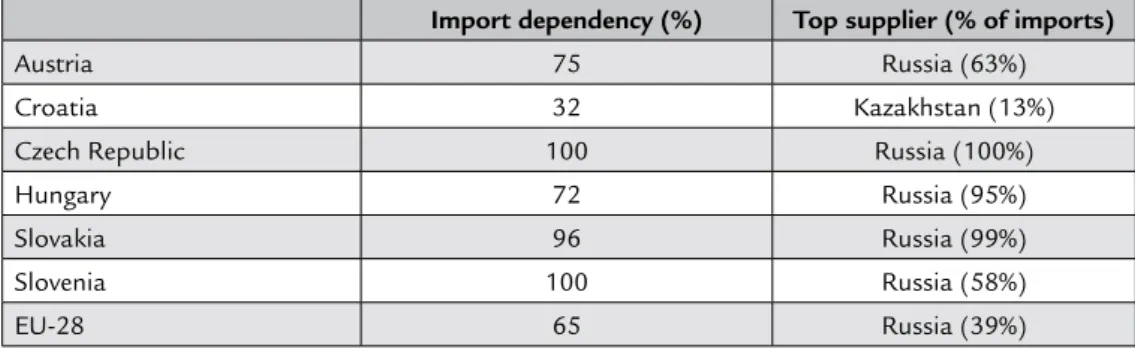
With the exception of lignite or brown coal in the Czech Republic and Slovenia, the region has limited indigenous energy sources and is therefore heavily dependent on the importation of fossil fuels such as oil and natural gas. This is particularly the case for natural gas, where Central European countries import upwards of 100% of their requirement need, with Russia often providing 50%-100% of that gas.
TABLE 1: NATURAL GAS IMPORTS (2013)
Import dependency (%) Top supplier (% of imports)
Austria 75 Russia (63%)
Croatia 32 Kazakhstan (13%)
Czech Republic 100 Russia (100%)
Hungary 72 Russia (95%)
Slovakia 96 Russia (99%)
Slovenia 100 Russia (58%)
EU-28 65 Russia (39%)
Source: EU Commission Staff Working Documents, Country Factsheets – ‘State of the Energy Union’, 2015.
TABLE 2: GROSS INLAND CONSUMPTION (2014)
Austria Croatia Czech
Republic Hungary Slovakia Slovenia EU
Solid Fuels 9% 8% 38% 10% 21% 16% 17% Petroleum & Products 36% 39% 22% 28% 20% 35% 34% Gases 20% 25% 15% 31% 23% 9% 21% Nuclear 0% 0% 19% 18% 25% 25% 14% Renewables 30% 24% 9% 8% 9% 18% 13%
Source: EU Commission, DG ENER, Unit A4, ‘Energy datasheets : EU-28 countries’, update of 6 July 2016. (NB Figures may not add up to 100 due to electricity imports and exports and rounding differences.)
Gas
The majority of natural gas imports to the Central European states are Russian and transit through Ukraine, although Austria, the Czech Republic and Croatia have other supply routes enabling gas procurement from western Europe, specifically Norway. In the case of the Czech Republic, it was acknowledged that Norwegian gas would be more expensive than Russian, but it was felt that the cost was justified. This proved pre-scient as it enabled the country, unlike Slovakia, to weather the 2006 and 2009 Ukrai-nian gas crises comfortably. Ironically, despite the introduction of an additional sup-plier, a system of gas trade swapping means that much of the purchased Norwegian gas is substituted with Russian gas. Austria imports the majority of its gas from Russia, but
also buys from Norway. Slovenia is 100% dependent on imports, with 61% purchased from Austria (mostly of Russian origin) and a further 37% procured directly from Rus-sia. Regardless of the location of purchase, Russian gas remains dominant within the Slovenian market. Croatia has significant indigenous production capacity and until recently additional imports have come from Italy, although its long-term supply con-tract with ENI was not renewed in preference for concentrating on domestic production and purchases on the spot market. The development of a liquefied natural gas (LNG) terminal on Croatia’s Adriatic coast at Krk is key to enabling Croatia, and potentially Slovenia and Hungary, to buy gas via the spot market. This would be a significant de-velopment for Hungary which imports around 70% of its supply needs from Russia. Although Hungary signed a 4-year extension to its long-term gas supply contract with Russia taking it to 2019, the planned completion of the Croatian LNG terminal by 2020 would coincide with the end of this extended contact allowing it to look for alternative suppliers should it so desire. It is clear that LNG is considered an essential strategic development for the region’s gas market, but its value will be contingent on successful delivery of the North-South corridor as a transmission route across the region.
Geopolitical uncertainties stemming from Russian-Ukrainian relations have reinforced concerns first raised during the 2006 and 2009 Russia-Ukraine gas crises about the poten-tial for conflict to impact supply and the continued lack of alternative suppliers for the region. In response, diversification projects which focus on infrastructure thus allowing new suppliers to enter the market continue to be promoted. These include the promotion of new spurs and extensions to Southern Corridor pipeline ventures such as the Trans Adriatic Pipeline (TAP) which would bring gas from Azerbaijan’s Shah Deniz field to Eu-rope, and the aforementioned North-South energy corridor. This corridor will eventually connect the Baltic with the Adriatic seas via a series of existing and new pipelines and cross-border interconnectors, thus allowing LNG to be imported and distributed as an al-ternative to Russian gas. These projects have become even more important for the Central European states in light of the collapse of the large-scale EU-backed Nabucco and Russia-backed South Stream pipeline projects. Significantly, the failure of large static pipeline projects has forced the Central European countries to focus attention on smaller, more manageable projects such as the North-South corridor interconnectors, which in turn ac-tually promotes greater cooperation in line with the vision of the Energy Union to join up the region’s transmission system. Looking forward, the Energy Union has the potential to help Central Europe complete the North-South corridor by facilitating improved ac-cess to European funding, helping to better identify and coordinate projects of common interest, and managing appropriate regulatory activity.
Storage is one of the other infrastructure challenges that each of the countries has sought to improve in response to supply insecurities. All countries successfully coped with the 2014 stress test carried out by the European Commission and have storage to cover a minimum of 30 days disruption as required under the 2010 EU Security of Gas Supply Regulation (SGSR). Austria, the Czech Republic and Hungary’s depleted gas fields provide them with some of the largest underground gas storage facilities in the region. Austria has already capitalised on this by transforming its Baumgarten
facility into the Central European Gas Hub, which includes a modern trading plat-form. Baumgarten also plays a key role for Slovenia which has no storage facilities of its own. However, despite not having the extensive storage capacity of other states it is Slovakia that remains the primary virtual gas trading hub for the region due to its location, capitalising on the fact that east-west routes for 50% of Europe’s Russian gas imports traverse its territory. This position is threatened by the development of Nord Stream 2 and a possible new Austro-Czech interconnection which could see Russian gas bypass Ukraine and subsequently Slovakia. Moves to alleviate Slovak concerns and use its transmission network have been suggested, but the possibility of a more direct pipeline being built remains a reality and limits levels of mutual trust between regional actors.
Despite the region’s existing storage and trading hub structures, the wider regional gas market remains underdeveloped. This offers opportunities for alternative gas hub loca-tions to be promoted as infrastructure improves. Hungary, for example, has touted its potential to maximise its storage capacity, which at 6 bcm is the fifth-largest in the EU, and host an alternative storage and trading hub. Alternative and competing hubs do raise questions about joined-up approaches to the region’s market and reinforce nation-al rather than regionnation-al priorities; however, they need not be overly problematic for the market and indeed could benefit it in terms of pricing. In order to fulfil this, improved enhancement to regional infrastructure development will be essential over the coming 10-20 years if the region is to capitalise on the benefits of being part of a comprehensive and functional gas market.
Electricity
Like the gas market, the electricity market also faces a number of challenges, notably the need for new investment. Austria is differentiated from the other countries in the region due to its non-communist legacy and long ties with Germany in the field of energy; a common power market is well established between the two. This has been beneficial for Austria in terms of lowering wholesale and consumer prices and allowing it to benefit from the growth of renewable energy sources in Germany, specifically wind power. A key challenge for this coupled market is the dated grid infrastructure and lack of con-nector capacity to deal with fluctuating volumes of electricity and subsequent electricity loop-flows via neighbouring country grid systems. The Czech Republic, Slovakia and Hungary have all complained about German loop-flows which overload their grids and can result in ‘brown-outs’ and lost revenue.
Suggested solutions have included splitting the Austro-German coupled market but this is opposed by Austria as it would reduce access to cheap German green electricity and at the European level would be in direct contradiction to the promotion of ‘ever closer union’ in energy markets. An alternative but temporary solution to loop-flows
al-ready enacted is the installation of phase-shift transformers on the grid-border between Germany and the Czech Republic. Planned new connections to improve capacity on the German-Austrian north-south grid route are not due to be delivered until 2020 at the earliest.
Improving infrastructure development and facilitating enhanced coupling of markets will go some way towards addressing cross-border problems. The signing in 2014 of a Memorandum of Understanding between transmission system operators, power ex-changes and national regulators in Austria, Germany, Croatia, Hungary, Czech Repub-lic, Slovakia, Hungary and Slovenia was a first step towards this; however, there is still some way to go before the region fulfils such levels of transmission and market integra-tion allowing for efficiency gains, a higher standard of service and more competitive and possible even single pricing. There is a potential role for the Energy Union to play here by helping to further coordinate and encourage such cooperation.
One of the big problems standing in the way of commonly traded electricity, once a regional market is in place, is the source of power. For Austria, electricity generated via nuclear power is not acceptable. Austria’s position stands in stark contrast to that of its neighbours to the east, all of whom promote nuclear power within their long-term en-ergy strategies. The Czech Republic recognises nuclear as a key alternative to continued burning of low grade lignite. It sees future investment at its existing nuclear facilities in Temelin and Dukovany as essential, with nuclear energy potentially providing upwards of 50% of the country’s future electricity needs in comparison with the current 33%. Nuclear is also seen as a cornerstone development in Hungary, where the government recently agreed a contract where Russia would finance a loan worth 80% of the €12 bil-lion cost to extend the Paks facility with 2 new reactors. Slovakia has also committed itself to extending operations and expanding capacity at both its Bohunice and Mocho-vce sites, with 2 new reactors currently under construction. Slovenia’s Krško nuclear power station, providing Slovenia with 38% and Croatia 20% of their electricity needs, is also earmarked for expansion and recently saw its lifespan extended by 20 years to 2043. Croatia has no nuclear facility of its own but has also been floating the idea of develop-ing nuclear capacity in the east near the Serbian border and with Albania to the south. The biggest challenge for the development of new nuclear facilities is finance. In the Hungarian case, accessing a Russian loan has raised significant questions regarding po-litical transparency. In Slovakia, a lack of financing has delayed new builds at Mochovce and refusal to pay a long-term set fee for electricity produced by Bohunice prevented investment by Russia’s Rosatom. The region has also seen investment interest from China. China National Nuclear Corporation (CNNC), which has also been developing investments in the UK and France, has expressed interest in Slovakia, and in 2015 a nuclear cooperation agreement was signed. Although no major investment was agreed, public perceptions of foreign interest were cautionary with concern that Slovakian stra-tegic infrastructure could end up under the control of China and, by proxy, Russia.
This raises questions of trust in foreign ownership and reflects moves by the governments of the region, including Hungary and Slovakia, to support national ownership (private and public) of strategic energy infrastructure and operators. In Hungary, this was witnessed through the purchase in 2011 of 21.2% MOL shares from Russia’s Surgutneftegaz and its continued 100% ownership of electricity company MVM. This places them in a similar situ-ation to Austria and the Czech Republic, where nsitu-ational companies OMV and CEZ have sizeable government shareholdings. The Czech Republic has a stated policy position not to reduce state control in strategic energy companies and to reduce the influence of countries or companies on which the Czech Republic is already heavily dependent (i.e. Russia).
Renewables
Social attitudes towards nuclear power are quite different across the region, with the Austrian public and government very much against the expansion of nuclear power. Instead, renewable energy is seen as a preferable alternative. Renewable technologies, while improving and becoming more efficient, are also viewed in different ways by the region’s governments. Austria has a long heritage of hydroelectric and biomass which plays an important role in district heating markets and it has a policy of increasing re-newables within its energy mix. It also recognises the importance of research for driving improvements in the renewable energy industry. The other countries all recognise the importance of renewables vis-à-vis diversification and climate change decarbonisation initiatives, but appear less committed to invest, as nuclear and fossil fuel sources remain more cost effective in the immediate to longer term. In Hungary, biomass remains the primary renewable energy source, as wind and solar are considered to have less viability, while geothermal energy, despite having great potential, faces problems of high opera-tional costs and low investment in research and development.
For Slovakia, renewables are not prioritised in the same way as nuclear and gas, with the government viewing then as unstable and unpredictable. In the Czech Republic, de-mands to address EU decarbonisation targets have furthered debate over the country’s reliance on lignite, which the Czechs use far more than their Central European neigh-bours. Even though the long-term financial sustainability of the renewables industry is challenged by the lack of investment and possible loss of regular subsidies, there is a recognition that certain forms of renewables, such as energy from waste and biomass, could replace lost capacity from the decommissioned lignite power stations. The key goal for the Czech Republic is to maximise diversification while keeping import depen-dency at or below current levels. Along with Croatia, the Czech Republic already meets its 2020 renewable energy use target of 13% of Total Primary Energy Supply (TPES). This does raise questions about incentives for revising that target towards 2030 and beyond, and how this may be managed and financed.
Future challenges and the Energy Union
Many of the future energy challenges for the Central European region will likely be simi-lar to those these countries face today. Questions about energy suppliers, infrastruc-tural development, geopolitical situations, financing and climate change targets require long-term planning. Capitalising on developments across these issues at a regional level will be necessary to ensure effective and operational delivery of a regional market with flexibility across wholesale, distribution and retail, which at present only partially exists. Taking into account sensitive positions on the future of nuclear power in the region will also be of immense importance, and finding technical ways to manage nuclear energy within a common regional energy mix will be necessary if Austria is ever to fully buy into being part of a wider Central European energy region.
The Energy Union has a valuable role to play, helping to coordinate and engage with member states and the various European, regional and national agencies and organisa-tions that oversee energy matters. The Union’s five aims (energy security and solidarity, a fully integrated market, energy efficiency, decarbonisation, and research and innova-tion) are all shared by the countries making up the Central European region. Reflecting on these aims by helping to create a sense of unity and regional identity beyond that currently expressed by Central European countries will also be essential. However, it is not the role of the Energy Union to create a homogenised market across the region, and to attempt to do so would merely reinforce mistrust of the Energy Union and potential-ly encourage the pursuit of national priority policy to the detriment of the development of an integrated market. Both the Czech Republic and Hungary, despite supporting the Energy Union’s development, have at different times publicly queried European strate-gies on issues such as financial aid and subsidy promotion, failure to account for state budgets, and rights of states to negotiate bilateral deals. Therefore, mutual trust could be said to remain weak.
The EU has played a major role in transforming the Central European energy landscape, particularly with respect to liberalisation of national markets. Connecting those na-tional markets, encouraging regional cooperation and preventing backsliding towards partial or even full renationalisation must be a priority for the EU and its members over the coming period. Key to this will be ensuring that integrated markets and policy goals account for national interests rather than compete with them. There is also an onus on the countries of the region to acknowledge the Energy Union, taking it and their neigh-bours into account when developing national policy so it feeds into regional strategies in the appropriate manner. There needs to be full and complete buy-in to the Energy Union from member states based on the principles of responsibility, solidarity, trust and transparency. Failure to do so will prevent the effective implementation of a truly functioning regional, and ultimately European, energy market.