research communications
Acta Cryst.(2019). E75, 1261–1264 https://doi.org/10.1107/S2056989019010363
1261
Received 18 July 2019 Accepted 20 July 2019
Edited by M. Zeller, Purdue University, USA
Keywords:crystal structure; ligand; dithiolene; metalloligand.
CCDC reference:1941888
Supporting information:this article has supporting information at journals.iucr.org/e
A molybdenum tris(dithiolene) complex coordinates
to three bound cobalt centers in three different
ways
Neilson Nguyen,aAlan J. Loughband Ulrich Fekla*
a
Department of Chemical and Physical Sciences, University of Toronto Mississauga, 3359 Mississauga Rd, Mississauga, Ontario, L5L 1C6, Canada, andbDepartment of Chemistry, University of Toronto, 80 St. George St., Toronto, Ontario, M5S 3H6, Canada. *Correspondence e-mail: [email protected]
The synthesis and structural characterization of the molecular compound (3
-benzene-1,2-dithiolato)hexacarbonylbis(3
-1,1,1,4,4,4-hexafluorobut-2-ene-2,3-dithiolato)tricobaltmolybdenum, [Co3Mo(C4F6S2)2(C6H4S2)(CO)6] or Mo(tfd)2
-(bdt)(Co(CO)2)3(tfd is 1,1,1,4,4,4-hexafluorobut-2-ene-2,3-dithiolate and bdt is
benzene-1,2-dithiolate), are reported. The structure of the molecule contains the molybdenum tris(dithiolene) complex Mo(tfd)2(bdt) coordinated as a
multi-dentate ligand to three cobalt dicarbonyl units. Each of the three cobalt centers is relatively close to molybdenum, with Co Mo distances of 2.7224 (7), 2.8058 (7), and 2.6320 (6) A˚ . Additionally, each of the cobalt centers is boundvia
main-group donor atoms, but each one in a different way: the first cobalt atom is coordinated by two sulfur atoms from different dithiolenes (bdt and tfd). The second cobalt atom is coordinated by one sulfur from one tfd and two olefinic carbons from another tfd. The third cobalt is coordinated by one sulfur from bdt and two sulfurs from tfd. This is, to the best of our knowledge, the first structurally characterized example of a molybdenum (tris)dithiolene complex that coordinates to cobalt. The F atoms of two of the –CF3groups were refined as
disordered over two sets of sites with ratios of refined occupancies of 0.703 (7):0.297 (7) and 0.72 (2):0.28 (2).
1. Chemical context
Sulfur removal from crude petroleum is performed on a large industrial scale through a process called hydrodesulfurization. This involves use of hydrogen gas (the sulfur is removed as H2S) and addition of a catalyst, typically cobalt-doped MoS2
(Hinnemannet al., 2008). MoS2is not a molecular compound
but rather possesses an extended structure, consisting of close-packed sulfur layers between which molybdenum is sand-wiched (Dickinson & Pauling, 1923). The coordination geometry around molybdenum is trigonal prismatic. Several
attempts to model MoS2 using molecular compounds have
been made, often using dithiolene (S2C2R2) ligands, where
some examples also contain the hydrodesulfurization-relevant addition of cobalt. Complexes containing molybdenum, cobalt, and one or two (but not three) dithiolenes are known. A molybdenum bis(dithiolene) that coordinates to two cobalt centers has been characterized crystallographically (Nihei et al., 1999; Murataet al., 2006). The study reports [Mo(bdt)2
(-CO)2(CpCo)2], where bdt =o-C6H4S2and Cp = cyclo-C5H5.
The methylated analog [Mo(bdt)2(CO)2(Cp*Co)2], where Cp*
=cyclo-C5Me5was also structurally characterized (Muratsugu
et al., 2011). An analogous [Mo(ddds)2(CO)2(CpCo)2] was
thiolene 1,2-dicarba-closo-dodecaborane-1,2-disulfide (Chen
et al., 2007). The above contribution also reported a molyb-denum mono(dithiolene) complex coordinated to a cobalt fragment, namely [Mo(ddds)(CO)2(py)2(Cp*Co)], where py =
pyridine. Coordinating to cobalt a molybdenum tris (dithio-ene), that is a compound where three dithiolenes are bound to molybdenum, would be interesting, because molybdenum tris(dithiolene)s mimic MoS2 particularly well. Similar to
MoS2, they contain molybdenum coordinated to six sulfur
atoms, and, also, depending on the oxidation state of the compound, the environment of molybdenum can sometimes be trigonal prismatic (Beswicket al., 2004). However, we could not find any structurally characterized example for how a molybdenum tris(dithiolene) complex can act as ligand for cobalt. Such an example is provided here. In 2007, the mixed dithiolene complex Mo(tfd)2(bdt) [tfd = S2C2(CF3)2], an
unsymmetrical tris(dithiolene), was reported for the first time (Harrisonet al., 2007). Later, this complex, which contains two different dithiolenes, was used to create structural models for the active sites of MoS2hydrodesulfurization catalysts, albeit
cobalt-free ones (Nguyenet al., 2010). In this current work, we
have successfully linked three cobalt centers to one
Mo(tfd)2(bdt) molecule. Surprisingly, each of the three
cobalt-containing units [each one is a Co(CO)2fragment] is bound to
the molybdenum tris(dithiolene) center in a different way.
2. Structural commentary
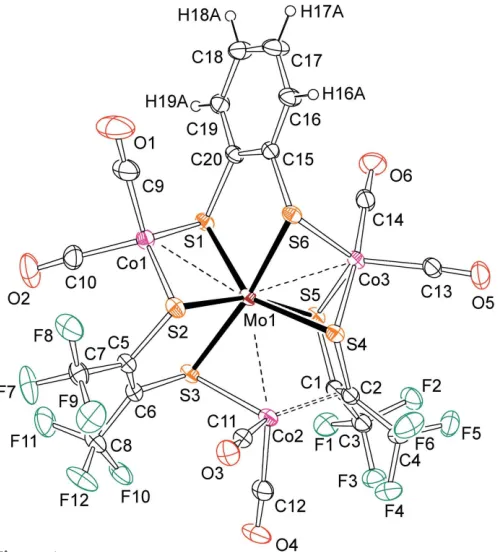
An anisotropic displacement plot showing the structure of the Mo(tfd)2(bdt)(Co(CO)2)3molecule is shown in Fig. 1. A good
starting point for the structural description is considering the core Mo(tfd)2(bdt) substructure first. Molybdenum is
coordi-nated by six sulfur atoms, four from the two tfd ligands, two from the one bdt ligand. The Mo—S distances are fairly normal, ranging from 2.413 (1) A˚ (Mo1—S5) to 2.457 (1) A˚ (Mo1—S4). The appearance of the structure is ‘approximately octahedral’. A more quantitative measure is obtained using theX—M—Xtranscriterion (Beswicket al., 2004; Nguyenet al., 2010), which indicates that the geometry around molybdenum is 71% octahedral (29% trigonal prismatic). The intra-ring C—C distance in the tfd ligand that is not -coordinated to cobalt (C5—C6) is 1.335 (6) A˚ , indicating that description as an ene-dithiolate is appropriate (Hosking et al., 2009). The intra-ring C-C distance in the tfd ligand that is-coordinated to cobalt (C1—C2) is much longer, at 1.439 (6) A˚ , but this elongation is expected as an effect of-coordination to cobalt
(Co2). At this point it makes sense to discuss the way in which the Mo(tfd)2(bdt) substructure coordinates to the three cobalt
dicarbonyl fragments. Co1 is coordinated by two sulfurs from different dithiolenes (bdt and tfd) at bond lengths of 2.225 (1) A˚ (Co1—S1) and 2.241 (1) A˚ (Co1—S2), respect-ively. The C2S2environment of Co1 is nearly tetrahedral, with
very slight distortions. The S1—Co1—S2 angle is slightly wide, at 115.44 (5), the C9—Co1—C10 angle is slightly narrow, at 98.4 (3). Co2, in contrast, is coordinated by one sulfur from one tfd and two olefinic carbons from another tfd, where bond lengths are 2.256 (1) A˚ (Co2—S3), 2.010 (4) A˚ (Co2—C1), and 1.970 (4) (Co2—C2). The coordination geometry of Co2 (not including Mo1 here) is, again, approximately tetrahedral, where the largest deviation from tetrahedral geometry are C11—Co2—C12, at 96.3 (2) and the comparably wide ‘bite’ of the chelating substructure, with Ct1—Co2—S3 measuring 119.7, where Ct1 is the mid-point between C11 and C12. Another sulfur atom, S4, is relatively close to Co2, but the interatomic distance, at 2.767 (1) A˚ , is considerably longer than the Co2—S3 bond, such that S4 is almost certainly not bonded. Finally, Co3 is coordinated by one sulfur from bdt and two sulfurs from tfd, at distances of 2.234 (1) A˚ (Co3—S4), 2.239 (1) A˚ (Co3—S5), and 2.275 (1) A˚ (Co3—S6). Co3 is surrounded by these three sulfurs and two carbons in an approximately trigonal–bipyramidal fashion. C14 and S4 occupy axial positions, with the C14-Co3-S4 angle being
174.3 (2). The three angles in the trigonal plane are
115.38 (4) (S5—Co3—S6), 118.6 (2) (S5—Co3—C13), and
1262
Nguyenet al. [Co3Mo(C4F6S2)2(C6H4S2)(CO)6] Acta Cryst.(2019). E75, 1261–1264
[image:2.610.317.566.70.346.2]research communications
Figure 1
A view of the molecular structure of Mo(tfd)2(bdt)(Co(CO)2)3.
Anisotropic displacement ellipsoids in this plot, generated with
124.0 (2) (S6—Co3—C13). While there is no doubt that the three cobalt atoms are bound by the heteroatoms (sulfur, carbon) of the Mo(tfd)2(bdt) structure, each of the three
cobalt atoms is also close to the central molybdenum, and these metal–metal contacts could possibly be bonding as well.
The relevant distances are 2.7224 (7) A˚ (Co1—Mo1),
2.8058 (7) A˚ (Co2—Mo1), and 2.6320 (6) A˚ (Co3—Mo1).
Such Mo—Co distances are typically considered of a range compatible with Mo—Co bonds (Chenet al., 2007; Curtiset al., 1997; Murataet al., 2006; Muratsuguet al., 2011).
3. Supramolecular features
Molecules of Mo(tfd)2(bdt)(Co(CO)2)3 pack, without any
solvent in the crystal,via contacting van der Waals surfaces. The packing pattern is shown in Fig. 2. Hydrogen atom H17A
forms close intermolecular contacts to an oxygen atom from a neighboring carbonyl and to a fluorine atom of the major disorder component (F11), as well as to a fluorine atom of the minor disorder component (F10A). Details can be found in Table 1.
4. Database survey
The Cambridge Crystallographic Database (version 5.40, including updates up to May 2019; Groom et al., 2016) was searched. The search was performed as a substructure search containing the most general dithiolene S–C–C–S substructure
(with any kind of bond allowed in the chain), plus a molyb-denum and a cobalt atom. Since no specific requirement was imposed with regard to whether or in which way cobalt or molybdenum are bonded to the S–C–C–S structure, hits that do not contain a molybdenum dithiolene complex coordinated to cobalt where manually removed as follows. Seven hits were
retrieved: EYUHIQ, JOQWIV, JOQWIV01, SEVMIQ,
SEVMOW, TASDAT, OQAMEZ. Out of these, TASDAT and OQAMEZ are not relevant here, since they do not contain a molybdenum dithiolene unit that is directly bonded to cobalt. They contain, respectively, a cobalt-based counter-cation for an anionic molybdenum complex and a nickel bis(dithiolene) anion as a counter-anion for a molybdenum/cobalt sulfido cluster. The structures EYUHIQ, JOQWIV, JOQWIV01, SEVMIQ and SEVMOW are relevant, since they contain at least one molybdenum dithiolene unit that is directly bonded to cobalt. These structures are all discussed above in the
Chemical context (Nihei et al., 1999; Murata et al., 2006; Muratsuguet al., 2011; Chenet al., 2007).
5. Synthesis and crystallization
Mo(tfd)2(bdt)(Co(CO)2)3 was prepared from Mo(tfd)2(bdt)
(Harrison et al., 2007) and dicobaltoctacarbonyl (obtained from Sigma-Aldrich) as summarized in the Scheme, using air-free conditions and rigorously dried solvents. 48 mg of Mo(tfd)2(bdt) (0.0697 mmol) were dissolved in 18 mL of
hexane (dried over Na/benzophenone). 60 mg (0.175 mmol) of (Co)2(CO)8dissolved in 2 mL of hexane were added and the
mixture was shaken. The mixture was stored overnight at 243 K in the freezer of a nitrogen-filled glovebox. The
super-natant was decanted off, and the black crystals of
Mo(tfd)2(bdt)(Co(CO)2)3 were washed twice with 5 mL of
cold hexane. Total yield 27 mg (0.026 mmol, 37%). Analysis calculated for Mo1S6C20H4F12Co3O6: C, 23.25; H, 0.39; O, 9.29;
S, 18.62. Found: C, 23.70; H, 0.44; O, 9.70; S, 18.80.1H NMR (400 MHz, C6D6): 6.38 (m), 7.02 (m). The compound is
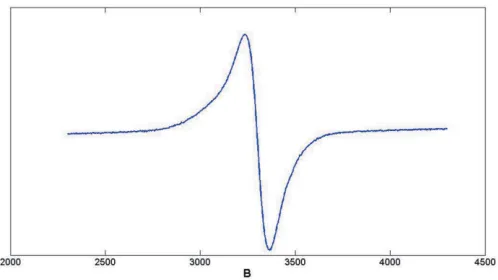
paramagnetic. An estimate of the magnetic moment in solu-tion (Evans method) yieldedca0.9 BM, consistent with one unpaired electron. An EPR spectrum was also obtained, shown in Fig. 3.
research communications
Acta Cryst.(2019). E75, 1261–1264 Nguyenet al. [Co
[image:3.610.42.297.90.143.2]3Mo(C4F6S2)2(C6H4S2)(CO)6]
1263
Table 1Hydrogen-bond geometry (A˚ ,).
D—H A D—H H A D A D—H A
C17—H17A O6i 0.95 2.57 3.353 (7) 140
C17—H17A F11ii 0.95 2.62 3.461 (9) 148
C17—H17A F10Aii 0.95 2.55 3.29 (2) 135
Symmetry codes: (i)xþ1;yþ2;z; (ii)xþ1 2;yþ
[image:3.610.47.294.533.718.2]1 2;z.
Figure 3
X-band EPR spectrum of Mo(tfd)2(bdt)(Co(CO)2)3in hexane at 298 K;g
[image:3.610.315.564.578.718.2]= 2.010.
Figure 2
Packing of molecules of Mo(tfd)2(bdt)(Co(CO)2)3, viewed along theb
6. Refinement
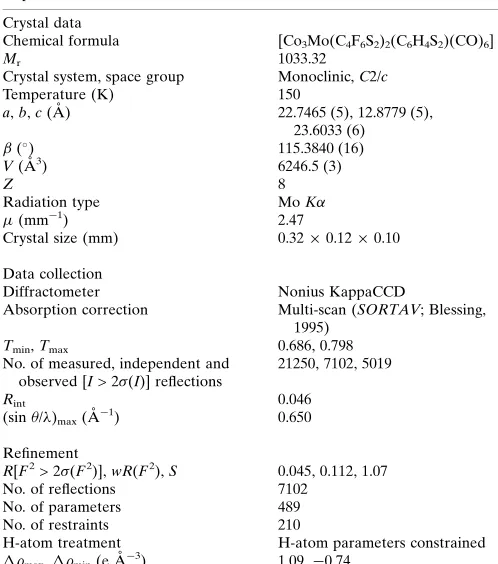
Crystal data, data collection and structure refinement details are summarized in Table 2. H atoms were placed in calculated positions and included in a riding-motion approximation with
Uiso(H) = 1.2Ueq(C). The F atoms of the –CF3 groups
containing C7 and C8 were refined as disordered over two sets of sites with ratios of refined occupancies of 0.703 (7):0.297 (7) and 0.72 (2):0.28 (2), respectively.
Acknowledgements
We thank Professors Wolfang Kaim and Biprajit Sarkar (University of Stuttgart) for the use of their EPR spectrometer for the spectrum shown in Fig. 3.
Funding information
Funding for this research was provided by: Natural Sciences and Engineering Research Council of Canada ; University of Toronto.
References
Altomare, A., Cascarano, G., Giacovazzo, C., Guagliardi, A., Burla, M. C., Polidori, G. & Camalli, M. (1994).J. Appl. Cryst.27, 435. Beswick, C. L., Schulman, J. M. & Stiefel, E. I. (2004).Prog. Inorg.
Chem.52, 55–110.
Blessing, R. H. (1995).Acta Cryst.A51, 33–38.
Chen, Y.-Q., Zhang, J., Cai, S., Hou, X.-F., Schumann, H. & Jin, G.-X. (2007).Dalton Trans.pp. 749–758.
Curtis, D. M., Druker, S. H., Goossen, L. & Kampf, J. W. (1997).
Organometallics,16, 231–235.
Dickinson, R. G. & Pauling, L. (1923).J. Am. Chem. Soc.45, 1466– 1471.
Farrugia, L. J. (2012).J. Appl. Cryst.45, 849–854.
Groom, C. R., Bruno, I. J., Lightfoot, M. P. & Ward, S. C. (2016).Acta Cryst.B72, 171–179.
Harrison, D. J., Lough, A. J., Nguyen, N. & Fekl, U. (2007).Angew. Chem. Int. Ed.46, 7644–7647.
Hinnemann, B., Moses, P. G. & Nørskov, J. K. (2008). J. Phys. Condens. Matter,20, 064236–064244.
Hosking, S., Lough, A. J. & Fekl, U. (2009).Acta Cryst.E65, m759– m760.
Murata, M., Habe, S., Araki, S., Namiki, K., Yamada, T., Nakagawa, N., Nankawa, T., Nihei, M., Mizutani, J., Kurihara, M. & Nishihara, H. (2006).Inorg. Chem.45, 1108–1116.
Muratsugu, S., Sodeyama, K., Kitamura, F., Tsukada, S., Tada, M., Tsuneyuki, S. & Nishihara, H. (2011).Chem. Sci.2, 1960–1968. Nguyen, N., Harrison, D. J., Lough, A. J., De Crisci, A. G. & Fekl, U.
(2010).Eur. J. Inorg. Chem.pp. 3577–3585.
Nihei, M., Nankawa, T., Kurihara, M. & Nishihara, H. (1999).Angew. Chem. Int. Ed.38, 1098–1100.
Nonius, B. (2002).COLLECT. Nonius BV, Delft, The Netherlands. Otwinowski, Z. & Minor, W. (1997).Methods in Enzymology, Vol.
276, Macromolecular Crystallography, Part A edited by C. W. Carter & R. M. Sweet pp. 307–326. London: Academic Press. Sheldrick, G. M. (2008).Acta Cryst.A64, 112–122.
Sheldrick, G. M. (2015).Acta Cryst.C71, 3–8. Spek, A. L. (2009).Acta Cryst.D65, 148–155.
1264
Nguyenet al. [Co3Mo(C4F6S2)2(C6H4S2)(CO)6] Acta Cryst.(2019). E75, 1261–1264
[image:4.610.313.562.89.371.2]research communications
Table 2
Experimental details.
Crystal data
Chemical formula [Co3Mo(C4F6S2)2(C6H4S2)(CO)6]
Mr 1033.32
Crystal system, space group Monoclinic,C2/c
Temperature (K) 150
a,b,c(A˚ ) 22.7465 (5), 12.8779 (5), 23.6033 (6)
(
) 115.3840 (16)
V(A˚3) 6246.5 (3)
Z 8
Radiation type MoK
(mm1) 2.47
Crystal size (mm) 0.320.120.10
Data collection
Diffractometer Nonius KappaCCD
Absorption correction Multi-scan (SORTAV; Blessing, 1995)
Tmin,Tmax 0.686, 0.798
No. of measured, independent and observed [I> 2(I)] reflections
21250, 7102, 5019
Rint 0.046
(sin/ )max(A˚ 1
) 0.650
Refinement
R[F2> 2(F2)],wR(F2),S 0.045, 0.112, 1.07
No. of reflections 7102
No. of parameters 489
No. of restraints 210
H-atom treatment H-atom parameters constrained
max,min(e A˚3) 1.09,0.74
supporting information
sup-1
Acta Cryst. (2019). E75, 1261-1264
supporting information
Acta Cryst. (2019). E75, 1261-1264 [https://doi.org/10.1107/S2056989019010363]
A molybdenum tris(dithiolene) complex coordinates to three bound cobalt
centers in three different ways
Neilson Nguyen, Alan J. Lough and Ulrich Fekl
Computing details
Data collection: COLLECT (Nonius, 2002); cell refinement: DENZO-SMN (Otwinowski & Minor, 1997); data reduction:
DENZO-SMN (Otwinowski & Minor, 1997); program(s) used to solve structure: SIR92 (Altomare et al., 1994);
program(s) used to refine structure: SHELXL2018 (Sheldrick, 2015); molecular graphics: PLATON (Spek, 2009);
software used to prepare material for publication: SHELXTL (Sheldrick, 2008).
(µ3-Benzene-1,2-dithiolato)hexacarbonylbis(µ3
-1,1,1,4,4,4-hexafluorobut-2-ene-2,3-dithiolato)tricobaltmolybdenum
Crystal data
[Co3Mo(C4F6S2)2(C6H4S2)(CO)6]
Mr = 1033.32 Monoclinic, C2/c a = 22.7465 (5) Å
b = 12.8779 (5) Å
c = 23.6033 (6) Å
β = 115.3840 (16)°
V = 6246.5 (3) Å3
Z = 8
F(000) = 3992
Dx = 2.198 Mg m−3
Mo Kα radiation, λ = 0.71073 Å Cell parameters from 21250 reflections
θ = 3.0–27.5°
µ = 2.47 mm−1
T = 150 K Needle, dark red 0.32 × 0.12 × 0.10 mm
Data collection
Nonius KappaCCD diffractometer
Radiation source: fine-focus sealed tube Detector resolution: 9 pixels mm-1
φ scans and ω scans with κ offsets Absorption correction: multi-scan
(SORTAV; Blessing, 1995)
Tmin = 0.686, Tmax = 0.798
21250 measured reflections 7102 independent reflections 5019 reflections with I > 2σ(I)
Rint = 0.046
θmax = 27.5°, θmin = 3.0°
h = −29→29
k = −16→16
l = −30→30
Refinement
Refinement on F2 Least-squares matrix: full
R[F2 > 2σ(F2)] = 0.045
wR(F2) = 0.112
S = 1.07 7102 reflections 489 parameters 210 restraints
Primary atom site location: structure-invariant direct methods
Secondary atom site location: difference Fourier map
Hydrogen site location: inferred from neighbouring sites
supporting information
sup-2
Acta Cryst. (2019). E75, 1261-1264
w = 1/[σ2(F
o2) + (0.054P)2 + 5.1797P] where P = (Fo2 + 2Fc2)/3
(Δ/σ)max = 0.001
Δρmax = 1.09 e Å−3 Δρmin = −0.74 e Å−3
Special details
Geometry. All esds (except the esd in the dihedral angle between two l.s. planes) are estimated using the full covariance
matrix. The cell esds are taken into account individually in the estimation of esds in distances, angles and torsion angles; correlations between esds in cell parameters are only used when they are defined by crystal symmetry. An approximate (isotropic) treatment of cell esds is used for estimating esds involving l.s. planes.
Fractional atomic coordinates and isotropic or equivalent isotropic displacement parameters (Å2)
x y z Uiso*/Ueq Occ. (<1)
Mo1 0.37011 (2) 0.67610 (3) 0.12477 (2) 0.02586 (11)
Co1 0.32882 (3) 0.85549 (5) 0.15702 (3) 0.03548 (16)
Co2 0.33267 (3) 0.47117 (5) 0.13309 (3) 0.03083 (16)
Co3 0.45749 (3) 0.63936 (5) 0.08184 (3) 0.02962 (15)
S1 0.32447 (5) 0.82941 (9) 0.06212 (5) 0.0297 (2)
S2 0.36985 (5) 0.72385 (9) 0.22479 (5) 0.0331 (3)
S3 0.26312 (5) 0.60667 (9) 0.10435 (5) 0.0296 (2)
S4 0.45637 (5) 0.54398 (9) 0.16042 (5) 0.0301 (2)
S5 0.35447 (5) 0.58534 (9) 0.02990 (5) 0.0295 (2)
S6 0.47364 (5) 0.76648 (9) 0.15395 (5) 0.0307 (3)
F1 0.26591 (12) 0.4072 (2) −0.02994 (12) 0.0493 (7)
F2 0.35969 (14) 0.3736 (2) −0.02658 (12) 0.0484 (7)
F3 0.32346 (13) 0.2830 (2) 0.02808 (12) 0.0456 (7)
F4 0.41197 (15) 0.2522 (2) 0.14259 (14) 0.0581 (8)
F5 0.46739 (15) 0.3033 (2) 0.09356 (15) 0.0588 (8)
F6 0.49947 (14) 0.3377 (2) 0.19160 (14) 0.0635 (9)
F7 0.2282 (2) 0.7313 (7) 0.2705 (2) 0.074 (2) 0.703 (7)
F8 0.3246 (3) 0.7860 (5) 0.3117 (3) 0.0698 (18) 0.703 (7)
F9 0.3064 (4) 0.6287 (4) 0.3225 (2) 0.0766 (19) 0.703 (7)
F7A 0.2573 (8) 0.7953 (11) 0.2754 (6) 0.072 (4) 0.297 (7)
F8A 0.3435 (5) 0.7165 (15) 0.3305 (4) 0.063 (3) 0.297 (7)
F9A 0.2537 (7) 0.6372 (10) 0.2967 (5) 0.063 (3) 0.297 (7)
F10 0.1632 (4) 0.5120 (8) 0.1246 (4) 0.055 (2) 0.72 (2)
F11 0.1431 (3) 0.6580 (6) 0.1565 (6) 0.066 (2) 0.72 (2)
F12 0.1944 (4) 0.5381 (9) 0.2222 (3) 0.068 (2) 0.72 (2)
F10A 0.1475 (9) 0.558 (2) 0.1103 (7) 0.057 (4) 0.28 (2)
F11A 0.1543 (10) 0.6471 (14) 0.1877 (12) 0.056 (4) 0.28 (2)
F12A 0.1972 (10) 0.4990 (14) 0.2037 (10) 0.057 (4) 0.28 (2)
O1 0.3951 (3) 1.0559 (4) 0.2075 (3) 0.112 (2)
O2 0.19536 (19) 0.9067 (4) 0.1404 (2) 0.0771 (13)
O3 0.37570 (16) 0.4528 (3) 0.26994 (14) 0.0486 (9)
O4 0.23791 (19) 0.2999 (3) 0.09880 (16) 0.0587 (11)
O5 0.56008 (17) 0.5074 (3) 0.07720 (17) 0.0586 (10)
O6 0.4473 (2) 0.7725 (3) −0.02293 (17) 0.0610 (10)
C1 0.35680 (19) 0.4568 (3) 0.06092 (19) 0.0304 (10)
supporting information
sup-3
Acta Cryst. (2019). E75, 1261-1264
C3 0.3269 (2) 0.3798 (4) 0.0090 (2) 0.0372 (11)
C4 0.4467 (2) 0.3306 (4) 0.1367 (2) 0.0423 (12)
C5 0.29505 (19) 0.6793 (4) 0.22259 (18) 0.0309 (10)
C6 0.25188 (19) 0.6280 (3) 0.17312 (19) 0.0304 (10)
C7 0.2880 (2) 0.7059 (4) 0.2817 (2) 0.0437 (12)
C8 0.1880 (2) 0.5842 (4) 0.1692 (2) 0.0435 (12)
C9 0.3691 (3) 0.9805 (5) 0.1880 (3) 0.0646 (17)
C10 0.2465 (3) 0.8898 (4) 0.1474 (2) 0.0495 (13)
C11 0.3593 (2) 0.4622 (4) 0.2178 (2) 0.0354 (10)
C12 0.2757 (2) 0.3625 (4) 0.1124 (2) 0.0409 (11)
C13 0.5214 (2) 0.5607 (4) 0.0791 (2) 0.0370 (11)
C14 0.4513 (2) 0.7229 (4) 0.0182 (2) 0.0410 (11)
C15 0.45531 (19) 0.8839 (3) 0.11004 (19) 0.0296 (9)
C16 0.5057 (2) 0.9503 (4) 0.1170 (2) 0.0398 (11)
H16A 0.549037 0.934569 0.146045 0.048*
C17 0.4928 (2) 1.0394 (4) 0.0814 (2) 0.0512 (14)
H17A 0.527525 1.083894 0.085070 0.061*
C18 0.4294 (2) 1.0649 (4) 0.0401 (2) 0.0442 (12)
H18A 0.420821 1.127055 0.016168 0.053*
C19 0.3788 (2) 0.9995 (4) 0.0339 (2) 0.0347 (10)
H19A 0.335466 1.016576 0.005600 0.042*
C20 0.39134 (19) 0.9089 (3) 0.06908 (19) 0.0291 (9)
Atomic displacement parameters (Å2)
U11 U22 U33 U12 U13 U23
Mo1 0.02129 (18) 0.0321 (2) 0.02433 (19) −0.00421 (15) 0.00990 (15) −0.00087 (15)
Co1 0.0354 (3) 0.0368 (4) 0.0387 (3) −0.0013 (3) 0.0202 (3) −0.0033 (3)
Co2 0.0325 (3) 0.0345 (4) 0.0287 (3) −0.0072 (3) 0.0162 (3) −0.0013 (2)
Co3 0.0259 (3) 0.0351 (4) 0.0308 (3) −0.0016 (3) 0.0149 (2) 0.0027 (3)
S1 0.0216 (5) 0.0358 (6) 0.0311 (5) −0.0030 (4) 0.0107 (4) 0.0019 (5)
S2 0.0278 (5) 0.0441 (7) 0.0269 (5) −0.0067 (5) 0.0112 (4) −0.0048 (5)
S3 0.0242 (5) 0.0394 (7) 0.0261 (5) −0.0077 (5) 0.0117 (4) −0.0025 (5)
S4 0.0286 (5) 0.0344 (6) 0.0283 (5) −0.0017 (5) 0.0130 (4) 0.0029 (5)
S5 0.0275 (5) 0.0357 (6) 0.0269 (5) −0.0036 (5) 0.0133 (4) −0.0001 (5)
S6 0.0229 (5) 0.0362 (7) 0.0304 (5) −0.0045 (4) 0.0088 (4) 0.0008 (5)
F1 0.0445 (15) 0.0509 (18) 0.0423 (15) −0.0106 (14) 0.0088 (13) −0.0117 (13)
F2 0.0626 (17) 0.0540 (19) 0.0453 (15) −0.0151 (15) 0.0391 (14) −0.0152 (13)
F3 0.0604 (17) 0.0358 (16) 0.0460 (15) −0.0124 (13) 0.0281 (13) −0.0079 (12)
F4 0.0690 (19) 0.0357 (17) 0.074 (2) −0.0050 (15) 0.0343 (17) 0.0094 (15)
F5 0.073 (2) 0.0481 (19) 0.072 (2) 0.0172 (16) 0.0474 (18) 0.0034 (15)
F6 0.0556 (19) 0.0473 (19) 0.0605 (19) 0.0085 (15) −0.0008 (16) 0.0074 (15)
F7 0.043 (3) 0.130 (6) 0.055 (3) 0.008 (3) 0.027 (2) −0.032 (4)
F8 0.092 (4) 0.085 (4) 0.054 (3) −0.038 (4) 0.051 (3) −0.038 (3)
F9 0.124 (5) 0.081 (4) 0.033 (3) 0.019 (4) 0.041 (3) 0.012 (3)
F7A 0.097 (8) 0.077 (8) 0.052 (6) 0.022 (7) 0.042 (6) −0.017 (6)
F8A 0.061 (6) 0.106 (9) 0.028 (5) −0.005 (7) 0.025 (5) −0.006 (6)
supporting information
sup-4
Acta Cryst. (2019). E75, 1261-1264
F10 0.045 (4) 0.069 (5) 0.063 (4) −0.029 (3) 0.035 (3) −0.024 (3)
F11 0.030 (3) 0.084 (4) 0.084 (5) 0.006 (2) 0.024 (3) −0.006 (4)
F12 0.062 (3) 0.099 (5) 0.053 (3) −0.032 (4) 0.035 (3) 0.005 (4)
F10A 0.031 (6) 0.087 (10) 0.052 (7) −0.023 (7) 0.017 (5) −0.012 (7)
F11A 0.044 (7) 0.067 (7) 0.072 (9) −0.008 (6) 0.039 (7) −0.017 (7)
F12A 0.055 (6) 0.065 (8) 0.063 (8) −0.014 (7) 0.036 (6) 0.005 (7)
O1 0.183 (5) 0.076 (4) 0.116 (4) −0.071 (4) 0.102 (4) −0.047 (3)
O2 0.058 (2) 0.107 (4) 0.082 (3) 0.038 (3) 0.045 (2) 0.027 (3)
O3 0.053 (2) 0.063 (3) 0.0311 (18) 0.0045 (18) 0.0197 (16) 0.0060 (16)
O4 0.078 (3) 0.063 (3) 0.051 (2) −0.042 (2) 0.043 (2) −0.0207 (19)
O5 0.052 (2) 0.068 (3) 0.069 (2) 0.020 (2) 0.0381 (19) 0.012 (2)
O6 0.091 (3) 0.053 (2) 0.054 (2) −0.002 (2) 0.045 (2) 0.0113 (19)
C1 0.031 (2) 0.030 (2) 0.034 (2) −0.0034 (19) 0.0177 (19) −0.0025 (19)
C2 0.033 (2) 0.034 (3) 0.035 (2) −0.0041 (19) 0.0195 (19) −0.0018 (19)
C3 0.039 (3) 0.041 (3) 0.037 (2) −0.007 (2) 0.022 (2) −0.003 (2)
C4 0.048 (3) 0.032 (3) 0.047 (3) −0.007 (2) 0.021 (2) 0.000 (2)
C5 0.027 (2) 0.039 (3) 0.028 (2) −0.0028 (19) 0.0126 (18) 0.0002 (19)
C6 0.027 (2) 0.036 (3) 0.031 (2) 0.0008 (19) 0.0146 (19) 0.0010 (19)
C7 0.044 (3) 0.061 (3) 0.032 (2) −0.001 (3) 0.022 (2) −0.006 (2)
C8 0.036 (2) 0.059 (3) 0.044 (3) −0.010 (2) 0.024 (2) −0.002 (2)
C9 0.098 (5) 0.056 (4) 0.065 (4) −0.029 (4) 0.059 (4) −0.022 (3)
C10 0.058 (3) 0.049 (3) 0.052 (3) 0.010 (3) 0.034 (3) 0.003 (3)
C11 0.036 (2) 0.034 (3) 0.039 (3) −0.001 (2) 0.019 (2) 0.000 (2)
C12 0.053 (3) 0.046 (3) 0.032 (2) −0.009 (3) 0.026 (2) −0.008 (2)
C13 0.034 (2) 0.042 (3) 0.040 (3) 0.003 (2) 0.020 (2) 0.009 (2)
C14 0.039 (3) 0.045 (3) 0.045 (3) −0.001 (2) 0.024 (2) −0.005 (2)
C15 0.029 (2) 0.032 (3) 0.030 (2) −0.0031 (18) 0.0144 (19) −0.0032 (18)
C16 0.026 (2) 0.040 (3) 0.048 (3) −0.008 (2) 0.011 (2) 0.003 (2)
C17 0.045 (3) 0.042 (3) 0.064 (3) −0.017 (2) 0.021 (3) 0.005 (3)
C18 0.043 (3) 0.035 (3) 0.050 (3) −0.004 (2) 0.016 (2) 0.009 (2)
C19 0.029 (2) 0.036 (3) 0.037 (2) −0.002 (2) 0.012 (2) −0.003 (2)
C20 0.026 (2) 0.034 (3) 0.029 (2) −0.0074 (18) 0.0129 (18) −0.0057 (19)
Geometric parameters (Å, º)
Mo1—S5 2.4134 (11) F6—C4 1.339 (5)
Mo1—S1 2.4179 (11) F7—C7 1.312 (6)
Mo1—S3 2.4391 (10) F8—C7 1.324 (6)
Mo1—S2 2.4420 (11) F9—C7 1.321 (6)
Mo1—S6 2.4461 (11) F7A—C7 1.322 (10)
Mo1—S4 2.4571 (11) F8A—C7 1.300 (10)
Mo1—Co3 2.6320 (6) F9A—C7 1.324 (9)
Mo1—Co1 2.7224 (7) F10—C8 1.333 (7)
Mo1—Co2 2.8058 (7) F11—C8 1.332 (7)
Co1—C10 1.840 (5) F12—C8 1.336 (7)
Co1—C9 1.842 (6) F10A—C8 1.341 (12)
Co1—S1 2.2247 (12) F11A—C8 1.312 (12)
supporting information
sup-5
Acta Cryst. (2019). E75, 1261-1264
Co2—C12 1.825 (5) O1—C9 1.127 (7)
Co2—C11 1.827 (5) O2—C10 1.125 (6)
Co2—C2 1.970 (4) O3—C11 1.130 (5)
Co2—C1 2.010 (4) O4—C12 1.122 (5)
Co2—S3 2.2556 (13) O5—C13 1.131 (5)
Co2—S4 2.7671 (11) O6—C14 1.133 (6)
Co3—C13 1.796 (5) C1—C2 1.439 (6)
Co3—C14 1.803 (5) C1—C3 1.494 (6)
Co3—S4 2.2338 (12) C2—C4 1.528 (7)
Co3—S5 2.2395 (11) C5—C6 1.335 (6)
Co3—S6 2.2749 (13) C5—C7 1.509 (6)
S1—C20 1.782 (4) C6—C8 1.524 (6)
S2—C5 1.775 (4) C15—C16 1.383 (6)
S3—C6 1.770 (4) C15—C20 1.396 (6)
S4—C2 1.777 (4) C16—C17 1.377 (7)
S5—C1 1.801 (4) C16—H16A 0.9500
S6—C15 1.779 (4) C17—C18 1.390 (7)
F1—C3 1.341 (5) C17—H17A 0.9500
F2—C3 1.344 (5) C18—C19 1.381 (6)
F3—C3 1.339 (5) C18—H18A 0.9500
F4—C4 1.324 (5) C19—C20 1.389 (6)
F5—C4 1.340 (6) C19—H19A 0.9500
S5—Mo1—S1 88.52 (4) C2—S4—Co3 102.26 (15)
S5—Mo1—S3 84.34 (4) C2—S4—Mo1 99.62 (14)
S1—Mo1—S3 92.75 (4) Co3—S4—Mo1 68.07 (3)
S5—Mo1—S2 163.43 (4) C2—S4—Co2 45.16 (13)
S1—Mo1—S2 101.96 (4) Co3—S4—Co2 111.42 (4)
S3—Mo1—S2 82.39 (4) Mo1—S4—Co2 64.65 (3)
S5—Mo1—S6 103.47 (4) C1—S5—Co3 102.78 (13)
S1—Mo1—S6 83.85 (4) C1—S5—Mo1 95.79 (14)
S3—Mo1—S6 171.36 (4) Co3—S5—Mo1 68.78 (3)
S2—Mo1—S6 90.52 (4) C15—S6—Co3 104.69 (14)
S5—Mo1—S4 76.17 (4) C15—S6—Mo1 106.48 (13)
S1—Mo1—S4 147.71 (4) Co3—S6—Mo1 67.65 (3)
S3—Mo1—S4 113.36 (4) C2—C1—C3 124.1 (4)
S2—Mo1—S4 100.13 (4) C2—C1—S5 116.8 (3)
S6—Mo1—S4 72.66 (4) C3—C1—S5 110.6 (3)
S5—Mo1—Co3 52.48 (3) C2—C1—Co2 67.3 (2)
S1—Mo1—Co3 96.23 (3) C3—C1—Co2 124.2 (3)
S3—Mo1—Co3 135.41 (3) S5—C1—Co2 106.8 (2)
S2—Mo1—Co3 137.11 (3) C1—C2—C4 124.4 (4)
S6—Mo1—Co3 53.08 (3) C1—C2—S4 114.4 (3)
S4—Mo1—Co3 51.93 (3) C4—C2—S4 115.3 (3)
S5—Mo1—Co1 137.65 (3) C1—C2—Co2 70.3 (2)
S1—Mo1—Co1 50.87 (3) C4—C2—Co2 126.8 (3)
S3—Mo1—Co1 86.08 (3) S4—C2—Co2 95.1 (2)
supporting information
sup-6
Acta Cryst. (2019). E75, 1261-1264
S6—Mo1—Co1 85.61 (3) F3—C3—F2 106.4 (4)
S4—Mo1—Co1 144.34 (3) F1—C3—F2 106.0 (3)
Co3—Mo1—Co1 131.93 (2) F3—C3—C1 114.4 (4)
S5—Mo1—Co2 71.40 (3) F1—C3—C1 111.2 (4)
S1—Mo1—Co2 138.35 (3) F2—C3—C1 111.9 (4)
S3—Mo1—Co2 50.35 (3) F4—C4—F6 106.2 (4)
S2—Mo1—Co2 92.44 (3) F4—C4—F5 107.4 (4)
S6—Mo1—Co2 135.42 (3) F6—C4—F5 107.0 (4)
S4—Mo1—Co2 63.03 (3) F4—C4—C2 113.9 (4)
Co3—Mo1—Co2 99.20 (2) F6—C4—C2 110.4 (4)
Co1—Mo1—Co2 128.84 (2) F5—C4—C2 111.5 (4)
C10—Co1—C9 98.4 (3) C6—C5—C7 126.2 (4)
C10—Co1—S1 107.95 (16) C6—C5—S2 121.5 (3)
C9—Co1—S1 109.32 (18) C7—C5—S2 112.3 (3)
C10—Co1—S2 111.11 (17) C5—C6—C8 124.2 (4)
C9—Co1—S2 113.2 (2) C5—C6—S3 122.6 (3)
S1—Co1—S2 115.44 (5) C8—C6—S3 113.3 (3)
C10—Co1—Mo1 128.61 (18) F7—C7—F9 108.1 (5)
C9—Co1—Mo1 132.8 (2) F8A—C7—F7A 105.8 (10)
S1—Co1—Mo1 57.46 (3) F7—C7—F8 105.8 (5)
S2—Co1—Mo1 57.97 (3) F9—C7—F8 105.4 (5)
C12—Co2—C11 96.3 (2) F8A—C7—F9A 107.0 (9)
C12—Co2—C2 110.5 (2) F7A—C7—F9A 105.6 (10)
C11—Co2—C2 104.60 (18) F8A—C7—C5 113.3 (6)
C12—Co2—C1 97.04 (18) F7—C7—C5 112.5 (4)
C11—Co2—C1 146.99 (18) F9—C7—C5 112.2 (4)
C2—Co2—C1 42.40 (16) F7A—C7—C5 110.7 (6)
C12—Co2—S3 100.76 (17) F8—C7—C5 112.3 (4)
C11—Co2—S3 103.81 (15) F9A—C7—C5 113.8 (6)
C2—Co2—S3 134.51 (14) F11A—C8—F12A 105.5 (11)
C1—Co2—S3 103.14 (13) F11—C8—F10 107.2 (5)
C12—Co2—S4 148.89 (16) F11—C8—F12 107.0 (6)
C11—Co2—S4 86.51 (14) F10—C8—F12 105.6 (6)
C2—Co2—S4 39.76 (13) F11A—C8—F10A 105.2 (11)
C1—Co2—S4 66.97 (12) F12A—C8—F10A 106.5 (11)
S3—Co2—S4 108.66 (4) F11A—C8—C6 115.3 (9)
C12—Co2—Mo1 154.70 (16) F12A—C8—C6 111.9 (9)
C11—Co2—Mo1 99.65 (15) F11—C8—C6 111.6 (5)
C2—Co2—Mo1 84.29 (13) F10—C8—C6 112.1 (5)
C1—Co2—Mo1 79.96 (12) F12—C8—C6 112.9 (5)
S3—Co2—Mo1 56.37 (3) F10A—C8—C6 111.8 (9)
S4—Co2—Mo1 52.32 (3) O1—C9—Co1 178.5 (8)
C13—Co3—C14 94.7 (2) O2—C10—Co1 177.0 (6)
C13—Co3—S4 91.03 (14) O3—C11—Co2 177.4 (4)
C14—Co3—S4 174.25 (15) O4—C12—Co2 176.0 (5)
C13—Co3—S5 118.60 (16) O5—C13—Co3 176.9 (4)
C14—Co3—S5 92.28 (15) O6—C14—Co3 177.6 (5)
supporting information
sup-7
Acta Cryst. (2019). E75, 1261-1264
C13—Co3—S6 124.00 (15) C16—C15—S6 118.8 (3)
C14—Co3—S6 97.07 (16) C20—C15—S6 120.9 (3)
S4—Co3—S6 80.22 (4) C17—C16—C15 119.5 (4)
S5—Co3—S6 115.38 (4) C17—C16—H16A 120.2
C13—Co3—Mo1 150.72 (14) C15—C16—H16A 120.2
C14—Co3—Mo1 114.26 (15) C16—C17—C18 120.8 (4)
S4—Co3—Mo1 60.00 (3) C16—C17—H17A 119.6
S5—Co3—Mo1 58.74 (3) C18—C17—H17A 119.6
S6—Co3—Mo1 59.27 (3) C19—C18—C17 119.7 (4)
C20—S1—Co1 98.78 (14) C19—C18—H18A 120.1
C20—S1—Mo1 106.69 (15) C17—C18—H18A 120.1
Co1—S1—Mo1 71.67 (4) C18—C19—C20 120.1 (4)
C5—S2—Co1 97.05 (15) C18—C19—H19A 120.0
C5—S2—Mo1 106.85 (14) C20—C19—H19A 120.0
Co1—S2—Mo1 70.94 (3) C19—C20—C15 119.6 (4)
C6—S3—Co2 101.70 (15) C19—C20—S1 118.7 (3)
C6—S3—Mo1 106.61 (14) C15—C20—S1 121.8 (3)
Co2—S3—Mo1 73.29 (3)
Co3—S5—C1—C2 20.2 (3) Co2—S3—C6—C5 79.7 (4)
Mo1—S5—C1—C2 −49.3 (3) Mo1—S3—C6—C5 3.9 (4)
Co3—S5—C1—C3 −129.4 (3) Co2—S3—C6—C8 −101.5 (3)
Mo1—S5—C1—C3 161.1 (3) Mo1—S3—C6—C8 −177.3 (3)
Co3—S5—C1—Co2 92.78 (16) C6—C5—C7—F8A 153.6 (10)
Mo1—S5—C1—Co2 23.27 (17) S2—C5—C7—F8A −26.0 (11)
C3—C1—C2—C4 4.9 (7) C6—C5—C7—F7 −37.8 (8)
S5—C1—C2—C4 −140.2 (4) S2—C5—C7—F7 142.6 (5)
Co2—C1—C2—C4 121.8 (4) C6—C5—C7—F9 84.4 (7)
C3—C1—C2—S4 156.5 (3) S2—C5—C7—F9 −95.2 (5)
S5—C1—C2—S4 11.4 (4) C6—C5—C7—F7A −87.7 (11)
Co2—C1—C2—S4 −86.6 (3) S2—C5—C7—F7A 92.7 (10)
C3—C1—C2—Co2 −116.9 (4) C6—C5—C7—F8 −157.0 (6)
S5—C1—C2—Co2 98.0 (3) S2—C5—C7—F8 23.4 (6)
Co3—S4—C2—C1 −37.5 (3) C6—C5—C7—F9A 31.1 (11)
Mo1—S4—C2—C1 32.0 (3) S2—C5—C7—F9A −148.5 (9)
Co2—S4—C2—C1 70.6 (3) C5—C6—C8—F11A 45.7 (14)
Co3—S4—C2—C4 116.8 (3) S3—C6—C8—F11A −133.1 (14)
Mo1—S4—C2—C4 −173.7 (3) C5—C6—C8—F12A −74.8 (13)
Co2—S4—C2—C4 −135.1 (4) S3—C6—C8—F12A 106.4 (13)
Co3—S4—C2—Co2 −108.11 (14) C5—C6—C8—F11 78.1 (8)
Mo1—S4—C2—Co2 −38.65 (16) S3—C6—C8—F11 −100.7 (7)
C2—C1—C3—F3 36.6 (6) C5—C6—C8—F10 −161.6 (7)
S5—C1—C3—F3 −176.6 (3) S3—C6—C8—F10 19.6 (8)
Co2—C1—C3—F3 −47.6 (5) C5—C6—C8—F12 −42.4 (9)
C2—C1—C3—F1 157.2 (4) S3—C6—C8—F12 138.8 (7)
S5—C1—C3—F1 −55.9 (4) C5—C6—C8—F10A 165.8 (14)
Co2—C1—C3—F1 73.1 (5) S3—C6—C8—F10A −13.0 (14)
supporting information
sup-8
Acta Cryst. (2019). E75, 1261-1264
S5—C1—C3—F2 62.4 (4) Mo1—S6—C15—C16 −179.2 (3)
Co2—C1—C3—F2 −168.6 (3) Co3—S6—C15—C20 71.1 (4)
C1—C2—C4—F4 −69.7 (6) Mo1—S6—C15—C20 0.5 (4)
S4—C2—C4—F4 138.9 (3) C20—C15—C16—C17 −2.5 (7)
Co2—C2—C4—F4 20.4 (6) S6—C15—C16—C17 177.3 (4)
C1—C2—C4—F6 170.9 (4) C15—C16—C17—C18 2.0 (8)
S4—C2—C4—F6 19.5 (5) C16—C17—C18—C19 −0.9 (8)
Co2—C2—C4—F6 −99.0 (4) C17—C18—C19—C20 0.3 (7)
C1—C2—C4—F5 52.1 (6) C18—C19—C20—C15 −0.8 (7)
S4—C2—C4—F5 −99.3 (4) C18—C19—C20—S1 177.5 (4)
Co2—C2—C4—F5 142.3 (3) C16—C15—C20—C19 1.9 (6)
Co1—S2—C5—C6 73.6 (4) S6—C15—C20—C19 −177.9 (3)
Mo1—S2—C5—C6 1.4 (4) C16—C15—C20—S1 −176.3 (3)
Co1—S2—C5—C7 −106.8 (3) S6—C15—C20—S1 3.9 (5)
Mo1—S2—C5—C7 −178.9 (3) Co1—S1—C20—C19 −111.0 (3)
C7—C5—C6—C8 −2.0 (7) Mo1—S1—C20—C19 175.6 (3)
S2—C5—C6—C8 177.6 (3) Co1—S1—C20—C15 67.2 (4)
C7—C5—C6—S3 176.7 (4) Mo1—S1—C20—C15 −6.2 (4)
S2—C5—C6—S3 −3.7 (6)
Hydrogen-bond geometry (Å, º)
D—H···A D—H H···A D···A D—H···A
C17—H17A···O6i 0.95 2.57 3.353 (7) 140
C17—H17A···F11ii 0.95 2.62 3.461 (9) 148
C17—H17A···F10Aii 0.95 2.55 3.29 (2) 135