The demand for early potato tubers in Poland increases in the mid-May when the tubers from the previous year’s harvest are already tasteless. Early potato tubers from Polish field production should be usually available on market from the end of May to the beginning of June. Potato production for an early crop is dependent on the climatic conditions in the first half of vegetation period, especially temperature (Sale 1979, Nishibe et al. 1989). In the climatic conditions of Poland, the profitable yield of early potato is usually obtained in the second half of June. The forceing of the harvest of early potato tubers and reducing the variability of the yield in the years are possible when using direct covers on the planted field. In Europe the covers that are most frequently applied in the cultivation of earlies are those with perforated polyethylene sheet (Dmitrieva and Zalenskij 1977, Friessleben 1984, Lang 1984, Le Corre 1988, Nelson and Jenkins 1990, Jenkins and Gillison 1995, Sawicka 1998). Widespread availability on the market of nonwo-ven polypropylene and extensive promotion of these covers have resulted in a frequently reduced perforated polyethylene sheet with nonwoven polypropylene in field cultivation (Lutomirska 1995, Kałużewicz and Knaflewski 1997, Prośba-Białczyk and Mydlarski 1998, Pszczółkowski and Sawicka 1999, Rekowska et al. 1999). The effect of covering, namely an increase in the tuber yield, to a high degree depends on the soil and climatic conditions. The change of conditions of the
ini-tial growth and development of potato plants by covering influences not only the yield level, but also tuber quality (Dmitrieva and Zalenskij 1977, Friessleben 1984, Lang 1984, Prośba-Białczyk and Mydlarski 1998, Lachman et al. 2003).
This paper presents the results of six-years of research on the effect of nonwoven polypropylene covering on the yield and quality of early potato tubers in the middle-eastern part of Poland.
MATERIAL AND METHODS
The effect of nonwoven polypropylene covering on the quantity and quality of early tuber yield of potato was investigated. The experiment was carried out in the years 1997–2002 in the middle-eastern part of Poland on cambisol, characterized by a mean to high content of available phosphorus and potassium and a low to medium content of magnesium, pH 5.5–6.0. The field experiment was established in the randomized complete blocks desing, in three replications. In the successive years the 6-week pre-sprouted seed potatoes of Aster cultivar were planted on the 26, 15, 9, 12, 11 and 9 April, within a row spacing of 30 cm and 62.5 cm between rows, and harvested after 60 and 75 days of planting. The plots were four rows wide and 6 m long. Farmyard manure was applied in autumn, at the rate of 30 t/ha. Mineral fertilizers were applied at the recommended rates of 60 kg N,
Effect of nonwoven polypropylene covers
on early tuber yield of potato crops
R. Jabłońska-Ceglarek, W. Wadas
University of Podlasie, Siedlce, Poland
ABSTRACT
In this six-year research study the effect of nonwoven polypropylene covering on the quantity and quality of early potato yield was estimated. The use of nonwoven polypropylene covers resulted in an increase in the tuber yield and smaller yield variability in the various years, when compared with the traditional cultivation, especially at a very early date of potato harvest. In the cultivation with nonwoven polypropylene covering, the marketable tuber yield 60 days a�er planting was higher by 23.34% on average and 75 days a�er planting by 10.92% in the six-year period of the study, compared with the cultivation with no plant covering. The higher profitable effect of covering was obtai-ned in the years with cold spring. The cultivation method of the potato did not affect the chemical composition of the tubers harvested a�er 60 days from planting. A�er 75 days from planting the tubers of potato cultivated under non-woven polypropylene covers contained, on average, more dry ma�er and starch by 0.81% and 0.85%, respectively.
60 kg P2O5 and 90 kg K2O for potatoes harvested 60 days after planting and 90 kg N, 90 kg P2O5 and 135 kg K2O per 1 ha in the case of potatoes harvested 75 days after planting. Immediately after planting and before covering the herbicide was applied (linuron – trade name Afalon 450 SC). The material used in the experiment was nonwoven polypropylene of 17 g/m2 weight (trade name Pegas Agro 17). The cover was removed 2 weeks after plant emergence. The total and marketable yield of tubers (diameter above 30 mm) was estimated. For laboratory studies, 50 tubers of different size, according to the proportional participation in the yield of each plot were sampled. The dry matter, starch (using the polarimetric method), total protein (using the Kjeldahl method) and vitamin C (using the Pijanowski method) contents in potato tubers were determined (Rutkowska 1981). Chemical analyses were made on fresh material just after the harvest.
The results of the experiment were analysed statistically by means of analysis of variance. The significance of differences was veryfied using the Tukey’s test at P = 0.05. The yield and the content of examined components in potato tubers were characterized by the mean, standard deviation and variability coefficient (%).
In the six-year period of the study, only in 1998 and 2002 were the climatic conditions favourable for potato cultivation for the early crop (Table 1). In 1997, a very cold April and a long-lasting snow cover made it impossible to plant the potatoes early. The considerable fall in temperature after potato planting retarded the date of germination in 1999, 2000 and 2001. The rainfall, with the exception of 2000 and 2001, was appropriate for the growth and development of potato plants, but its distribution in the vegetation period of potato was not favour-able, particularly in 1997 and 1999. In 2000 and 2001 shortages of rainfalls, particularly in May and June, were recorded.
RESULTS AND DISCUSSION
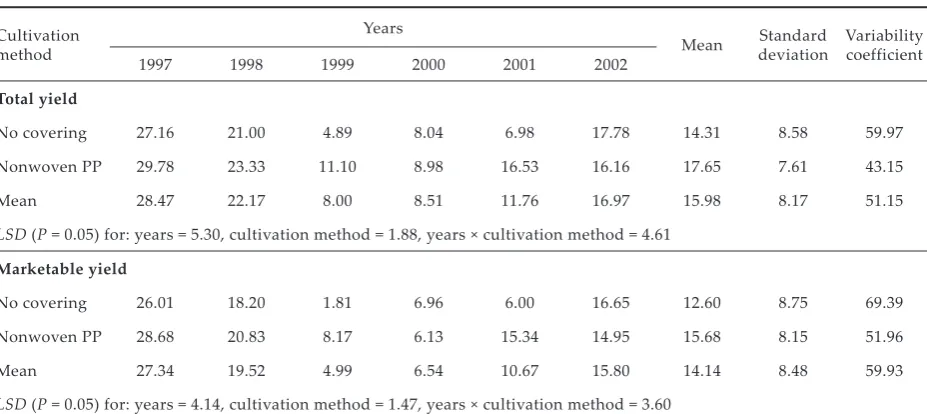
[image:2.595.69.533.597.762.2]Diverse climatic conditions during the potato vegetation period significantly affected the tuber yield. The yield variability after 60 days from plant-ing was higher than that obtained after 75 days from planting. The variability of marketable tuber yield was higher than that of total tuber yield, particularly at the earlier date of potato harvest (Tables 2 and 3). Higher yields were obtained in the moderately warm and humid years of 1997 and 1998 than in the following years of the study. The nonwoven polypropylene covering resulted in an increase in the early tuber yield of potato and a reduction in the yield variability, in comparison with the cultivation with no plant covering. A higher profitable effect of covering is usually obtained at a very early date of potato harvest (Friessleben 1984, Lang 1984, Le Core 1988, Nelson and Jenkins 1990, Lutomirska 1995, Sawicka 1998, Rekowska et al. 1999), what was confirmed in the present study. In the cultivation with covering, the total tuber yield after 60 days from planting was higher, in the six-year period of study, by 23.34% on average and the marketable tuber yield was higher by 24.44% on average, in comparison with the cultivation with no covering. A similar increase in the early tuber yield of potato was obtained in the central part of Poland (Lutomirska 1995), however, in the Poznań and Wrocław region the forceing of plant vegetation by nonwoven polypropylene covering increased the marketable tuber yield after 60 days from planting by 70% (Kałużewicz and Knaflewski 1997, Prośba-Białczyk and Mydlarski 1998). After 2-week delay of potato harvest an increase in the marketable tuber yield as a result of covering was 16–17% in the Poznań region and 30% in the Wrocław region. In the discussed study, after 75 days from planting the marketable tuber yield, in the potato cultiva-tion with polypropylene covering, was higher in the six-year period by 10.92% on average, than
Table 1. Mean air temperature and precipitation sums in the vegetation period of potato
Year Temperature (°C) Precipitation (mm)
April May June July April May June July
1997 5.1 14.9 17.7 19.9 21.5 24.5 51.5 191.3
1998 9.9 14.0 17.3 17.4 41.0 63.0 109.0 40.5
1999 9.9 12.9 20.5 21.8 87.3 26.4 121.7 21.9
2000 12.9 16.5 19.6 19.0 47.5 24.6 17.0 155.9
2001 8.7 15.5 17.1 23.8 69.8 28.0 36.0 55.4
2002 9.0 17.0 17.2 21.0 12.9 51.3 61.1 99.6
Mean
that on the control treatment with no covering. In Germany the perforated polyethylene sheet cover-ing of potato resulted in an incerase in the tuber yield by 54%, in comparison with the traditional cultivation (Friessleben 1984).
A higher increase in the tuber yield as a result of covering is obtained in the years with cold spring. In France and Wales, in the potato cultivation under polyethylene sheets, tuber yields higher by 4–24 t/ha and by 6–14 t/ha, respectivelywere obtained in com-parison with the traditional cultivation (Le Corre 1988, Jenkins and Gillison 1995), depending on the vegetation conditions. In the conditions of central part of Poland, the potato covering with nonwo-ven polypropylene resulted in a 20% increase of
tuber yield at the early date of potato harvest in the year with warm spring and a 30% increase in the year with cold spring (Lutomirska 1995). In the discussed study carried out in middle-east part of Poland, the highest favourable effect of nonwoven polypropylene covering was obtained in the years with the lowest air temperatures in the initial period of potato vegetation, namely 1999 and 2001 (Tables 2 and 3). The total tuber yield after 60 days from planting in the cultivation with nonwoven polypropylene covering was over twice as high and the marketable tuber yield was 4.5 times and 2.5 times as high, in 1999 and 2001, respectively, as that resulting from the cultivation without covering. At that method of potato culti-Table 2. Tuber yield after 60 days from planting (t/ha)
Cultivation method
Years
Mean deviationStandard Variabilitycoefficient 1997 1998 1999 2000 2001 2002
Total yield
No covering 27.16 21.00 4.89 8.04 6.98 17.78 14.31 8.58 59.97 Nonwoven PP 29.78 23.33 11.10 8.98 16.53 16.16 17.65 7.61 43.15 Mean 28.47 22.17 8.00 8.51 11.76 16.97 15.98 8.17 51.15
LSD (P = 0.05) for: years = 5.30, cultivation method = 1.88, years × cultivation method = 4.61
Marketable yield
No covering 26.01 18.20 1.81 6.96 6.00 16.65 12.60 8.75 69.39 Nonwoven PP 28.68 20.83 8.17 6.13 15.34 14.95 15.68 8.15 51.96 Mean 27.34 19.52 4.99 6.54 10.67 15.80 14.14 8.48 59.93
[image:3.595.66.530.82.289.2]LSD (P = 0.05) for: years = 4.14, cultivation method = 1.47, years × cultivation method = 3.60
Table 3. Tuber yield after 75 days from planting (t/ha)
Cultivation method
Years
Mean deviationStandard Variabilitycoefficient 1997 1998 1999 2000 2001 2002
Total yield
No covering 45.11 38.44 10.27 14.22 19.55 28.22 25.97 13.42 51.68 Nonwoven PP 47.16 35.56 19.42 15.78 33.11 23.78 28.80 11.31 39.26 Mean 46.13 37.00 14.84 15.00 25.33 26.00 27.38 12.31 44.97
LSD (P = 0.05) for: years = 7.41, cultivation method = 2.63, years × cultivation method = 6.45
Marketable yield
No covering 43.49 36.77 9.06 13.25 18.98 27.86 24.90 13.19 52.98 Nonwoven PP 46.61 32.63 18.59 14.87 29.69 23.36 27.62 11.22 40.63 Mean 45.05 34.70 13.82 14.06 24.33 25.61 26.26 12.15 46.26
LSD (P = 0.05) for: years = 8.02, cultivation method = n.s., years × cultivation method = 6.98
[image:3.595.61.534.532.731.2]vation, after a 2-week delay of potato harvest the tuber yield was on, twice and over 1.5 time higher, in 1999 and 2001 respectively, on average. In the favourable conditions to quick potato vegetation the nonwoven polypropylene covering of plants did not cause a significant increase in the tuber yield. The costs of the early potato production under covers are considerably higher compared with the traditional method. At relatively high costs relat-ing to the area unit, the production is profitable only when leading to obtaining sufficiently high yields (Prośba-Białczyk et al. 1997).
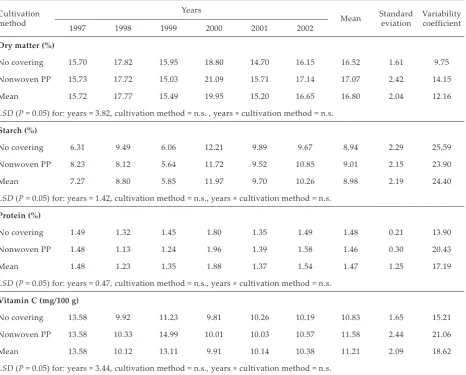
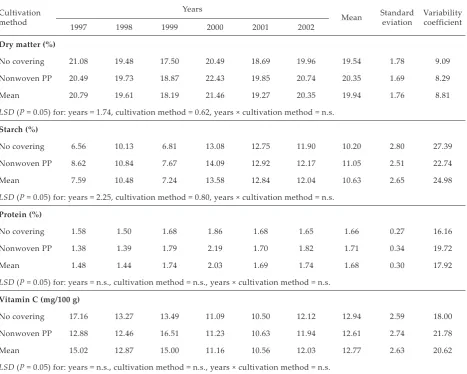
The use of nonwoven polypropylene cover in the potato cultivation for early crop has a favour-able effect on the yield level and share in the yield of marketable tubers and thus it does not reduce the tuber quality. The nonwoven polypropylene covering had no significant effect on the dry mat-ter and starch content in potato tubers harvested 60 days after planting but it increased the content of both in the older tubers, harvested 75 days after
[image:4.595.66.533.86.461.2]planting (Tables 4 and 5). At this method of po-tato cultivation, the dry matter content in tubers after 75 days from planting was higher by 0.81% on average in the six-year period and the starch content by 0.85% than that in the cultivation with no covering. Nelson and Jenkins (1990) determined that the dry matter content was higher in tubers of potato cultivated under perforated polyeth-ylene sheet, and Dmitrieva and Zalenskij (1977) and Friessleben (1984) found the same effect of covering in the case of the tuber starch content, too. In the potato cultivation including nonwoven polypropylene, the vitamin C content in tubers was smaller, than that in the cultivation with no plant covering (Prośba-Białczyk and Mydlarski 1998), which was not confirmed in the discussed study. The physiological age of the tubers during the potato harvest had no significant effect on the protein and vitamin C content (Tables 4 and 5). In a study carried out by Lachman et al. (2003), nonwoven polypropylene plant covering resulted Table 4. Content of selected components in tubers after 60 days from planting
Cultivation method
Years
Mean Standard eviation Variabilitycoefficient 1997 1998 1999 2000 2001 2002
Dry matter (%)
No covering 15.70 17.82 15.95 18.80 14.70 16.15 16.52 1.61 9.75 Nonwoven PP 15.73 17.72 15.03 21.09 15.71 17.14 17.07 2.42 14.15 Mean 15.72 17.77 15.49 19.95 15.20 16.65 16.80 2.04 12.16
LSD (P = 0.05) for: years = 3.82, cultivation method = n.s. , years × cultivation method = n.s.
Starch (%)
No covering 6.31 9.49 6.06 12.21 9.89 9.67 8.94 2.29 25.59 Nonwoven PP 8.23 8.12 5.64 11.72 9.52 10.85 9.01 2.15 23.90 Mean 7.27 8.80 5.85 11.97 9.70 10.26 8.98 2.19 24.40
LSD (P = 0.05) for: years = 1.42, cultivation method = n.s., years × cultivation method = n.s.
Protein (%)
No covering 1.49 1.32 1.45 1.80 1.35 1.49 1.48 0.21 13.90 Nonwoven PP 1.48 1.13 1.24 1.96 1.39 1.58 1.46 0.30 20.43
Mean 1.48 1.23 1.35 1.88 1.37 1.54 1.47 1.25 17.19
LSD (P = 0.05) for: years = 0.47, cultivation method = n.s., years × cultivation method = n.s.
Vitamin C (mg/100 g)
No covering 13.58 9.92 11.23 9.81 10.26 10.19 10.83 1.65 15.21 Nonwoven PP 13.58 10.33 14.99 10.01 10.03 10.57 11.58 2.44 21.06 Mean 13.58 10.12 13.11 9.91 10.14 10.38 11.21 2.09 18.62
LSD (P = 0.05) for: years = 3.44, cultivation method = n.s., years × cultivation method = n.s.
in a tendency to increase of the vitamin C content in potato tubers.
Chemical composition of the tubers to a higher degree depended on the weather conditions in the potato vegetation period than the potato cultiva-tion method. The variability of dry matter and protein content in potato tubers was lower than that of starch and vitamin C. In warm and dry years, the potato tubers contain more dry matter, starch and nitrogen compounds which is accompa-nied by a higher participation of protein nitrogen (Roztropowicz 1989, Leszczyński 1994, Sawicka and Mikos-Bielak 1995), which was confirmed in the discussed study. The largest amount of dry matter, starch and protein was accumulated by potato tubers in the year 2000, with the highest mean air temperatures and the lowest rainfall in the period May–June (Tables 4 and 5). The rainfall in the period May–June has no significant effect on the vitamin C content in potato tubers whereas higher air temperatures in this period favourably
stimulate the vitamin C accumulation in the tu-bers of very early potato cultivars (Sawicka and Mikos-Bielak 1995). In the six-year period of the study, more favourable conditions for vitamin C accumulation in potato tubers occurred in the year 1999, with the highest air temperatures in the second half of May and in June (Tables 4 and 5).
REFERENCES
Dmitrieva Z.A., Zalenskij V.A. (1977): Kartofel’ pod plenkoj. Kartofel’ i Ovošči, 3: 4–5.
Friessleben R. (1984): Untersuchungen zum Anbau von Speisefrühkartoffeln inter perforierter Polyäthylenfolie. Archiv für Acker- und Pflanzenbau und Bodenkunde, 28: 133–142.
[image:5.595.65.533.87.461.2]Jenkins P.D., Gillison T.C. (1995): Effects of plastic film covers on dry-matter production and early tuber yield in potato crops. Annals of Applied Biology, 127: 201–213.
Table 5. Content of selected components in tubers after 75 days from planting
Cultivation method
Years
Mean Standard eviation Variabilitycoefficient 1997 1998 1999 2000 2001 2002
Dry matter (%)
No covering 21.08 19.48 17.50 20.49 18.69 19.96 19.54 1.78 9.09 Nonwoven PP 20.49 19.73 18.87 22.43 19.85 20.74 20.35 1.69 8.29 Mean 20.79 19.61 18.19 21.46 19.27 20.35 19.94 1.76 8.81
LSD (P = 0.05) for: years = 1.74, cultivation method = 0.62, years × cultivation method = n.s.
Starch (%)
No covering 6.56 10.13 6.81 13.08 12.75 11.90 10.20 2.80 27.39 Nonwoven PP 8.62 10.84 7.67 14.09 12.92 12.17 11.05 2.51 22.74 Mean 7.59 10.48 7.24 13.58 12.84 12.04 10.63 2.65 24.98
LSD (P = 0.05) for: years = 2.25, cultivation method = 0.80, years × cultivation method = n.s.
Protein (%)
No covering 1.58 1.50 1.68 1.86 1.68 1.65 1.66 0.27 16.16 Nonwoven PP 1.38 1.39 1.79 2.19 1.70 1.82 1.71 0.34 19.72
Mean 1.48 1.44 1.74 2.03 1.69 1.74 1.68 0.30 17.92
LSD (P = 0.05) for: years = n.s., cultivation method = n.s., years × cultivation method = n.s.
Vitamin C (mg/100 g)
No covering 17.16 13.27 13.49 11.09 10.50 12.12 12.94 2.59 18.00 Nonwoven PP 12.88 12.46 16.51 11.23 10.63 11.94 12.61 2.74 21.78 Mean 15.02 12.87 15.00 11.16 10.56 12.03 12.77 2.63 20.62
LSD (P = 0.05) for: years = n.s., cultivation method = n.s., years × cultivation method = n.s.
Kałużewicz A., Knaflewski M. (1997): The effect of fibre covering on the yielding of early potato in the field and in a foil tunnel. In: Polish Science Conference Advancement of production technology of vegetable plants, ART Olsztyn: 123–126. (In Polish)
Lachman J., Hamouz K., Hejtmánková A., Dudjak J., Orsák M., Pivec V. (2003): Effect of white fleece on the selected quality parameters of early potato (Solanum tuberosum L.) tubers. Plant, Soil and Environment, 49: 370–377.
Lang H. (1984): Folieneinsatz im Frühkartoffelbau für Sicherheit, Ertrag und Qualität. Kartoffelbau, 35: 65–69.
Le Corre P. (1988): Deux techniques pour augmenter la précocité des pommes de terre primeurs: bâchage et paillage. La Pomme de Terre Francaise, 444: 9–14. Leszczyński W. (1994): Effect of factors working in
veg-etation period of potato on its quality. Postępy Nauk Rolnicznych, 6: 55–68. (In Polish)
Lutomirska B. (1995): Usage of agrotextile to forceing the yielding of potatoes. Ziemniak Polski, 3: 14–19. (In Polish)
Nelson D.G., Jenkins P.D. (1990): Effects of physiologi-cal age and floating plastic film on tuber dry-matter percentage of potatoes, cv. Record. Potato Research, 33: 159–169.
Nishibe S., Satoh M., Mori M., Isoda A., Nakaseko K., (1989): Effects of climatic conditions on intercepted radiation and some growth parameters in potato. Japanese Journal of Crop Science, 58: 171–179. Prośba-Białczyk U., Mydlarski M. (1998): Growth
potato on early harvest under cover with polypro-pylene sheets. Fragmenta Agronomica, 57: 74–84. (In Polish)
Prośba-Białczyk U., Paluch F., Mydlarski M. (1997): Eco-nomic effectiveness of early potato production under woven polypropylene sheets. Bibliography of Frag-menta Agronomica, 3: 181–188. (In Polish)
Pszczółkowski P., Sawicka B. (1999): The tubers yield of very early potato cultivars cultivated under agrofibre. In: Polish Science Conference Cultivation of horticul-tural plants at the threshold of 21st century, AR Lublin: 31–34. (In Polish)
Rekowska E., Orłowski M., Słodkowski P. (1999): Yield-ing of early potato as affected by coverYield-ing application and the terms of harvesting. Zeszyty Problemowe Po-stępów Nauk Rolniczych, 466: 181–189. (In Polish) Roztropowicz S. (1989): Variation in chemical
composi-tion of potato tubers, resulting from environmental, varietal and fertilization sources. Fragmenta Agro-nomica, 21: 33–75. (In Polish)
Rutkowska U. (1981): Selected methods of examining the composition and nutritional value of food. PZWL, Warszawa. (In Polish)
Sale P.J.M. (1979): Growth of potatoes (Solanum tuberosum L.) to the small tuber stage as related to soil temperature. Australian Journal of Agricultural Research, 30: 667–675.
Sawicka B. (1998): Technological and economical effects of cultivation of early potato varieties under polyeth-ylene sheeting. Roczniki AR Poznań, CCCVII, Rolnic-two, 52: 175–182. (In Polish)
Sawicka B., Mikos-Bielak M. (1995): An attempt to evaluate the fluctuation of chemical composition of potato tubers in changing conditions of arable field. Zeszyty Problemowe Postępów Nauk Rolniczych, 419: 95–102.
Received on June 7, 2004
ABSTRAKT
Vliv netkané polypropylenové textilie na výnos hlíz raných brambor
Během šestiletého pokusu byl hodnocen vliv zakrytí porostů raných brambor netkanou polypropylenovou textilií na výnos a kvalitu hlíz. Použití textilie se projevilo zvýšením výnosu hlíz a menší variabilitou výnosů ve srovnání s tradičním pěstováním, zvláště ve velmi časném termínu sklizně. Při pěstování pod textilií byl tržní výnos hlíz v průměru šesti let sledování za 60 dní po výsadbě o 23,34 % vyšší a za 75 dní po výsadbě o 10,92 % vyšší proti nezakrytým porostům. Vyššího ekonomického efektu pokrýváním textilií bylo dosaženo v letech s chladným jarem. Způsob pěstování brambor neovlivnil při sklizni za 60 dní po výsadbě chemické složení hlíz. Za 75 dní po výsadbě obsahovaly brambory vypěstované pod textilií v průměru o 0,81 % více sušiny a o 0,85 % více škrobu.
Klíčová slova: rané brambory; netkaná polypropylenová textilie; výnos; kvalita hlíz
Corresponding author: