Influence of Different Wheat and
Imperata cylindrica
Genetic Backgrounds on Haploid Induction Efficiency
in Wheat Doubled Haploid Breeding
Shoukat Ahmad RATHER, Harinder Kumar CHAUDHARY and Vineeta KAILA
Molecular Cytogenetics & Tissue Culture Lab, Department of Crop Improvement, CSK Himachal Pradesh Agricultural University, Palampur, India
Abstract
Rather S.A., Chaudhary H.K., Kaila V. (2014): Influence of different wheat and Imperata cylindricagenetic backgrounds on haploid induction efficiency in wheat doubled haploid breeding. Czech J. Genet. Plant Breed., 50: 195–200.
Four Indian and one Japanese accession of Imperata cylindrica were assessed for their influence upon haploid production in F1 generations of 21 wheat crosses (winter × spring, spring × spring and winter × winter) to find an efficient pollen source for haploid induction, which would enhance doubled haploid breeding in bread wheat. The frequency of haploid induction was influenced differently by the wheat and the I. cylindrica genotypes, indicating both maternal and paternal genetic influence on haploid induction. The gene actions controlling the inheritance of haploid induction appeared to be non-additive. Haploid formation efficiency was closely associated with other haploid induction parameters, i.e. pseudoseed formation, embryo formation and haploid regeneration. Amongst wheat F1 groups, spring × spring wheats exhibited the highest potential for haploid induction. General combining ability for haploid production was highest for the, I. cylindrica genotype Ic-Aru, native to the northeastern Himalayas, which appears as a potential pollen source for efficient haploid induction in bread wheat.
Keywords: general combining ability; haploid induction; Imperata cylindrica; interactive influence; wheat
Doubled haploid (DH) breeding offers unique ad-vantages for rapid genetic improvement of bread wheat in a single generation, reducing the time re-quired to achieve absolute homozygosity and en-hancing the selection efficiency. The remarkable discovery that haploid embryos and plants can be produced by culturing anthers of Datura (Guha & Maheshwari 1964, 1966) brought renewed inter-est in haploid breeding. This was quickly attempted in many species but the frequencies were very low, relative to the large number of pollen grains per flo-ret. Then, Kasha and Kao (1970) reported haploid production in barley following wide hybridization, and the subsequent preferential elimination of the wild species chromosomes during early embryogen-esis. Subsequently, this technique was initiated in wheat with the investigations of Barclay (1975),
doubled haploids in wheat and triticale. Further, this new approach was applied to recover haploids from triticale × wheat (Pratap et al. 2005) and wheat × rye derivatives (Kishore et al. 2011).
The frequency of production of wheat haploids is influenced by the genetic makeup of both wheat and the pollen parent in the wheat × maize-mediated sys-tem of doubled haploid breeding (Singh et al. 2004). The diversity, evident in I. cylindrica (Chou & Tsai 1999), has made it imperative to search for potential pollen sources for efficient polyhaploid induction in bread wheat, so that the efficiency of the system can be further enhanced by utilizing the more responding
I. cylindrica genotype for haploid induction. Thus, the present investigation was carried out to assess the in-teractive influence of diverse genotypes of I. cylindrica
and wheat on the haploid induction parameters, in order to find out and identify an efficient I. cylindrica
genotype as a pollen source for haploid induction in bread wheat and establish the gene action for various haploid induction parameters.
MATERIAL AND METHODS
Twenty-one wheat F1s (16 winter × spring, two each of winter × winter and spring × spring and one spring × winter wheat derivative) were generated out of eight elite and diverse genotypes of winter and spring wheat ecotypes (Table 1). Five diverse I. cylin-drica genotypes from different geographical locations
(Table 2)were used to pollinate the wheat F1s. The wheat F1s were raised in a completely randomized design, each sown individually in two rows, 1.5 m long with 25 cm row × row spacing. Three exotic collections of I. cylindrica genotypes, viz. Ic-Aru, Ic-Sri and Ic-Jp, were grown in pots (50 pots for each collection) filled with soil, sand and vermicompost at the ratio of 2:1:1, whereas the local genotypes, i.e. Ic-Pbr and Ic-Pye, were grown naturally.
Haploid induction was carried out as per the wheat ×
I. cylindrica mediated approach of doubled haploid breeding proposed by Chaudhary et al. (2005). Ten spikes of each wheat genotype (F1) were hybridized with each I. cylindrica genotype in a line (wheat hybrid) × tester (I. cylindrica genotype) fashion under natural con-ditions. After 24 h post-pollination of the emasculated wheat spikes with I. cylindrica pollen, a 2,4-D solution of 100 ppm concentration was injected at the base of the uppermost internode of each pollinated spike for three consecutive days in order to ensure pseudoseed and embryo formation in each cross. The crossed spikes were harvested from the tiller base after 18–20 days of pollination. The embryo carrying pseudoseeds were identified under a source of light (Bains et al. 1998). The embryo was seen floating in the fluid (aqueous solution) instead of the solid endosperm found in selfed seeds. The embryos were then excised from surface sterilized pseudoseeds. These excised embryos were transferred to test tubes containing Murashige and Skoog (MS) medium (Murashige & Skoog 1962) supplemented with essential amino acids. Cultured embryos were given a cold treatment at 4°C in the dark for 24 h immediately after embryo rescue followed by incubation in the dark at 20 ± 2°C till regeneration of roots and shoots. The regenerated plantlets were then shifted to a growth chamber at 20 ± 2°C with 10-h day length regime and 75% relative humidity (RH), until they developed properly into complete green plantlets. The green haploid plantlets developed through embryo culture were then subjected to rooting medium (liquid) for profuse rooting at the three- to four-leaf stage. The haploid plantlets at the four- to five-leaf stage were subsequently subjected to colchicine treatment (0.1% solution + 1.5% dimethyl sulfoxide) for five hours and transplanted into pots and maintained up to maturity.
Observations were recorded with respect to vari-ous haploid induction parameters, viz. pseudoseed formation, embryo formation, haploid regeneration and haploid formation in each cross. The information was used to generate data with respect to pseudo-seed formation frequency (number of pseudopseudo-seeds obtained per 100 wheat florets pollinated with
I. cy-Table 1. Parentage and source of different wheat genotypes used for generating F1s
No. Genotype Parentage Winter wheats
1 DH-100 WW 10/WW 24 2 DH-114 VWFW 452/WW 24
3 Saptdhara Selection from Atou (Cappelle/Garnet)
4 Tyari-1 (North West Himalayan regions)Landrace from Lahaul Spiti
Spring wheats
5 DH-40 Saptdhara/HW 3024 6 HPW-155 BT 2549/FATH
7 HS-295 CQT//IAS55//ALDML‘S’/3/ALDML‘S’/NAFN/4/PJN’S’/PEL1276.6
8 KWS-29 Amargas/Veery ‘S’
[image:2.595.63.291.516.730.2]lindrica), embryo formation frequency (number of embryo-carrying seeds per 100 pseudoseeds), haploid regeneration frequency (number of green haploid plantlets developed per 100 embryos cultured) and haploid formation efficiency (number of green haploid plantlets developed per 100 wheat florets pollinated with I. cylindrica). The data obtained from ten spikes/genotype/tester in each haploid induction parameter was computed as per the com-pletely randomized design (CRD), so as to work out the analysis of variance. The data on all the crosses with respect to various haploid induction parameters were subjected to line × tester analysis according to Kempthorne (1957) after arcsine transformations (Gomez & Gomez 1984). Correlation coefficients (r) between various haploid induction parameters were calculated and tested according to the formula sug-gested by Chandel (1965).
RESULTS
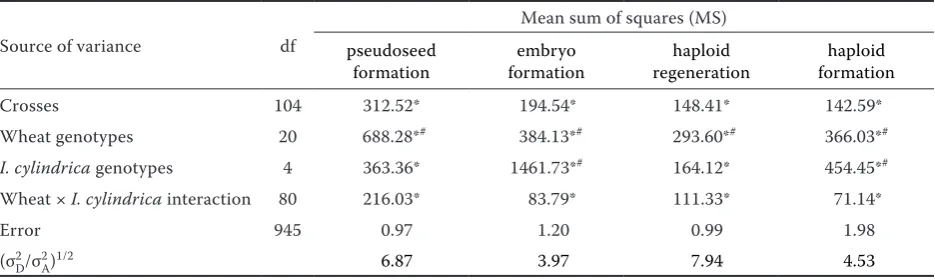
Analyses of variance of the data in respect of vari-ous haploid induction parameters revealed that mean squares due to crosses, wheat, Imperata cylindrica
genotypes and wheat × I. cylindrica interactionwere significantly different for all the haploid induction parameters when tested against error mean squares. The wheat genotypes also showed significant dif-ferences for all the haploid induction parameters when tested against mean squares due to wheat ×
I. cylindrica interaction. Whereas, the I. cylindrica
genotypes showed significant differences when tested against mean squares due to wheat × I. cylindrica
interactionfor two haploid induction parameters, viz.
embryo formation frequency and haploid formation efficiency (Table 3).
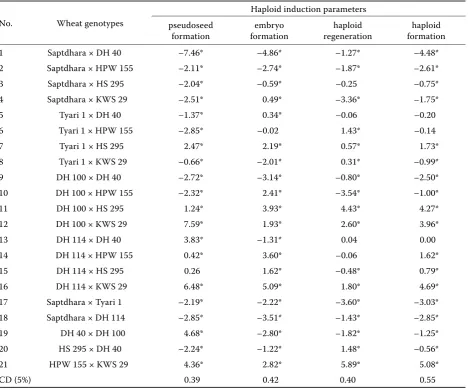
[image:3.595.65.533.100.196.2]Estimation of general combining ability (GCA) of lines and testers for various haploid induction parameters was worked out in order to determine the genetic control of haploid induction and identify the most efficient wheatand I. cylindrica genotypes. Among the wheat F1s, the highest positive GCA ef-fect for pseudoseed formation and embryo formation was exhibited by DH 100 × KWS 29 and DH 114 × KWS 29, respectively, whereas the highest positive GCA effect was revealed by HPW 155 × KWS 29 for haploid regeneration and haploid formation ef-ficiency (Table 4).
Table 2. Geographic location of different Imperata cylindrica genotypes used for haploid induction in bread wheat
No. I. cylindrica genotype* Geographic location Region Latitude and longitude
1 Ic-Pbr** Palampur, Himachal Pradesh, India North-west Himalayas 32.12°N and 76.53°E 2 Ic-Pye*** Palampur, Himachal Pradesh, India North-west Himalayas 32.12°N and 76.53°E 3 Ic-Sri Pulwama, Jammu & Kashmir, India North-west Himalayas 33.88°N and 74.92°E 4 Ic-Aru Pasighat, Arunachal Pardesh, India North-east Himalayas 28.07°N and 95.33°E 5 Ic-Jp Osaka Kyoiku Dai Mai, Osaka, Japan Eastern Asia 34.66°N and 135.52°E *Ic – Imperata cylindrica; Pbr – Palampur brown; Pye – Palampur yellow; Aru – Arunachal Pradesh; Sri – Srinagar; Jp – Japan; **I. cylindrica collection having spike with brown anthers; ***I. cylindrica collection having spike with yellow anthers
Table 3. ANOVA for various haploid induction parameters in wheat × Imperata cylindrica crosses
Source of variance df
Mean sum of squares (MS) pseudoseed
formation formationembryo regenerationhaploid formationhaploid Crosses 104 312.52* 194.54* 148.41* 142.59* Wheat genotypes 20 688.28*# 384.13*# 293.60*# 366.03*#
I. cylindrica genotypes 4 363.36* 1461.73*# 164.12* 454.45*#
Wheat × I. cylindrica interaction 80 216.03* 83.79* 111.33* 71.14*
Error 945 0.97 1.20 0.99 1.98
(σ2
D/σ2A)1/2 6.87 3.97 7.94 4.53
*Significant at P = 0.05 (tested against EMS); #significant at P = 0.05 (tested against MS (wheat × I. cylindrica));
σ2
[image:3.595.64.532.590.730.2]Among diverse pollen sources, the highest positive GCA effect for pseudoseed formation and haploid regeneration was exhibited by the genotypes Ic-Pye
[image:4.595.65.534.100.490.2]and Ic-Pbr. The genotype Ic-Aru possessed the high-est positive GCA effect for embryo formation as well as haploid formation efficiency (Table 5).
Table 4. General combining ability (GCA) effects of wheat genotypes with respect to various haploid induction parameters
No. Wheat genotypes
Haploid induction parameters pseudoseed
formation formationembryo regenerationhaploid formationhaploid
1 Saptdhara × DH 40 –7.46* –4.86* –1.27* –4.48*
2 Saptdhara × HPW 155 –2.11* –2.74* –1.87* –2.61*
3 Saptdhara × HS 295 –2.04* –0.59* –0.25 –0.75*
4 Saptdhara × KWS 29 –2.51* 0.49* –3.36* –1.75*
5 Tyari 1 × DH 40 –1.37* 0.34* –0.06 –0.20
6 Tyari 1 × HPW 155 –2.85* –0.02 1.43* –0.14
7 Tyari 1 × HS 295 2.47* 2.19* 0.57* 1.73*
8 Tyari 1 × KWS 29 –0.66* –2.01* 0.31* –0.99*
9 DH 100 × DH 40 –2.72* –3.14* –0.80* –2.50*
10 DH 100 × HPW 155 –2.32* 2.41* –3.54* –1.00*
11 DH 100 × HS 295 1.24* 3.93* 4.43* 4.27*
12 DH 100 × KWS 29 7.59* 1.93* 2.60* 3.96*
13 DH 114 × DH 40 3.83* –1.31* 0.04 0.00
14 DH 114 × HPW 155 0.42* 3.60* –0.06 1.62*
15 DH 114 × HS 295 0.26 1.62* –0.48* 0.79*
16 DH 114 × KWS 29 6.48* 5.09* 1.80* 4.69*
17 Saptdhara × Tyari 1 –2.19* –2.22* –3.60* –3.03*
18 Saptdhara × DH 114 –2.85* –3.51* –1.43* –2.85*
19 DH 40 × DH 100 4.68* –2.80* –1.82* –1.25*
20 HS 295 × DH 40 –2.24* –1.22* 1.48* –0.56*
21 HPW 155 × KWS 29 4.36* 2.82* 5.89* 5.08*
CD (5%) 0.39 0.42 0.40 0.55
*Significant at P = 0.05; CD – critical difference
Table 5. General combining ability (GCA) effects of Imperata cylindrica genotypes with respect to various haploid induction parameters
No. Imperata cylindrica genotypes
Haploid induction parameters pseudoseed
formation formationembryo regenerationhaploid formationhaploid
1 Ic-Pbr –2.20* –1.40* 1.47* –0.51*
2 Ic-Pye 1.17* 1.40* –0.05 0.95*
3 Ic-Aru 0.75* 3.97* –0.05 2.07*
4 Ic-Sri –0.07 –1.66* –0.66* –1.13*
5 Ic-Jp 0.35* –2.30* –0.70* –1.37*
CD (5%) 0.18 0.21 0.20 0.27
[image:4.595.68.533.611.744.2]The mean response of various wheat F1 groups over all the testers to pseudoseed formation, embryo for-mation, haploid regeneration and haploid formation ranged from 72.40 to 77.45%, 34.83 to 41%, 41.91 to 52.31% and 10.62 to 17.15%, respectively. The spring × spring wheats exhibited the highest mean response to all the haploid induction parameters (Table 6).
For all the haploid induction parameters, the magnitude of variance in respect of the dominance component (σ2
D) was higher than in the additive component (σ2
A) rendering the degree of dominance (σ2
[image:5.595.64.532.114.222.2]D/σ2A)1/2 greater than one (Table 3). Positive and significant correlations were found between all the haploid induction parameters. The correlation coef-ficient (r) was highest for embryo formation followed by haploid regeneration and pseudoseed formation when observed against haploid formation efficiency (Table 7).
DISCUSSION
The wheat × I. cylindrica-mediated approach of chromosome elimination has proved to be the most efficient alternative to the existing systems of doubled haploid production in bread wheat (Chaudhary et al. 2005). Keeping in view the diversity apparent in
I. cylindrica (Chou & Tsai 1999), and to further
enhance the efficiency of the system, it was impera-tive to search potential pollen sources for efficient polyhaploid induction in bread wheat. From the analyses of variance, all the wheat genotypes exhib-ited significant differences in response to various haploid induction parameters. These results are in accordance with the findings of Chaudhary et al.
(2005), who found significant effects of diverse wheat genotypes on different haploid induction parameters when crossed with I. cylindrica.
[image:5.595.63.534.284.376.2]GCA plays an important role in the selection of potential parents on the basis of their genetic value which can further be utilized for the production of desirable hybrids. Among the wheat F1s, DH 100 × KWS 29 and DH 114 × KWS 29 were identified as being the best general combiners for pseudoseed and embryo formation frequency, respectively, whereas, the genotype HPW 155 × KWS 29 was identified as the best general combiner for both haploid regen-eration frequency and haploid formation efficiency. Among the I. cylindrica genotypes, Pye and Ic-Pbr were recognized as the best general combiners for pseudoseed formation and haploid regeneration frequency, respectively. Genotype Ic-Aru was identi-fied as the best general combiner for both embryo formation frequency and haploid formation efficiency. The prevalence of non-additive (dominance) gene Table 6. Mean performance of various wheat F1 groups for response to various haploid induction parameters pooled over all the Imperata cylindrica genotypes
S. No. Wheat groups Haploid induction parameters
f sf ef r h
1 winter × spring wheat 24526 75.88 (18653) 40.51* (7644) 45.97 (3548) 14.36 2 winter × winter wheat 3187 72.40 (2299) 34.83 (803) 41.91 (337) 10.62 3 spring × spring wheat 3057 77.45* (2374) 41.00* (983) 52.31* (531) 17.15*
Mean 10256.67 75.24 38.78 46.73 14.04
CD (5%) 0.86 1.14 1.07 1.03
*Significant at P = 0.05; f – total number of florets pollinated; sf – pseudoseed formed; ef – embryo formation; r – em-bryo regeneration; h – haploids formed; figures in parenthesis represent the number obtained; CD – critical difference
Table 7. Estimates of correlation coefficients between various haploid induction parameters
Correlation coefficient Haploid induction parameters
pseudoseed formation embryo formation haploid regeneration haploid formation
Pseudoseed formation – 0.36* 0.30* 0.65*
Embryo formation – – 0.24* 0.78*
Haploid regeneration – – – 0.71*
Haploid formation – – – –
action governing the inheritance of all the haploid induction parameters infers that the haploid induc-tion frequency can be enhanced by using diverse maternal and paternal parents.
The parameter haploid formation efficiency gave the highest significant correlation with the remain-ing parameters, viz. pseudoseed formation, embryo formation and haploid regeneration. Based on haploid formation efficiency, spring × spring wheat F1s and HPW 155 × KWS 29 were identified as potential maternal parents, whereas the Ic-Aru (I. cylindrica
collection from Pasighat, Arunachal Pradesh, India, representing northeastern regions of the Himalayas) was identified as the potential pollen source for ef-ficient haploid induction.
In conclusion, the present investigation revealed that the genetic constitution of maternal and pa-ternal genotypes affects the induction of haploids through main and interactive effects. The promising genotypes involved in intergeneric hybridization mediated haploid induction must be identified on the basis of haploid formation efficiency as it is highly associated with other haploid induction parameters. Moreover, the work also revealed that I. cylindrica
predominant in other areas of the world is also capable of inducing haploids in wheat. A preponderance of non-additive gene action governing the inheritance of all the haploid induction parameters suggests that wheat and I. cylindrica genotypes utilized for haploid induction must be diverse in nature.
References
Bains N.S., Mangat G.S., Singh K., Nanda G.S. (1998): A simple technique for the identification of embryo carry-ing seeds from wheat × maize crosses prior to dissection. Plant Breeding, 117: 191–192.
Barclay I.R. (1975): High frequencies of haploid pro-duction in wheat (Triticum aestivum) by chromosome elimination. Nature, 256: 410–411.
Chandel S.R.S. (1965): Handbook of Agricultural Statis-tics. Achal Prakashan Mandir Parmat, Kanpur, 288–292. Chaudhary H.K., Sethi G.S., Singh S., Pratap A.,
Sharma S. (2005): Efficient haploid induction in wheat
by using pollen of Imperata cylindrica. Plant Breeding, 124: 96–98.
Chou C.H., Tsai C.C. (1999): Genetic variation in the inter-generic spacer of ribosomal DNA of Imperata cylindrica
(L.) Beauv. var. major (Cogongrass) populations in Tai-wan. Botanical Bulletin of Academia Scinica, 40: 319–327. Gomez K.A., Gomez A.A. (1984): Statistical Procedures for Agricultural Research. Wiley Interscience Publication, John Wiley & Sons, Singapore, 272–315.
Guha S., Maheshwari S.C. (1964): In vitro production of embryos from anthers of Datura. Nature,204: 497. Guha S., Maheshwari S.C. (1966): Cell division and
dif-ferentiation of embryos in the pollen grains of Datura in vitro. Nature, 212: 27–28.
Kasha K.J., Kao K.N. (1970): High frequency haploid pro-duction in barley (H. vulgare L.). Nature, 225: 874–876. Kempthorne O. (1957): An Introduction to Genetic
Sta-tistics. Iowa State University Press, Ames.
Kishore N., Chaudhary H.K., Chahota R.K., Kumar V., Sood S.P., Jeberson S., Tayeng T. (2011): Relative ef-ficiency of the maize and Imperatacylindrica-mediated chromosome elimination approaches for induction of haploids of wheat-rye derivatives. PlantBreeding, 130: 192–194.
Laurie D.A., Bennett M.D. (1987): Wide crosses involving maize (Zea mays). Annual Report of the Plant Breeding Institute, 66–68.
Murashige T., Skoog F. (1962): A revised medium for rapid growth and bioassays with tobacco tissue cultures. Phyosiology of Plants, 15: 473–497.
Pratap A., Sethi G.S., Chaudhary H.K. (2005): Relative ef-ficiency of different Gramineae genera for haploid induction in triticale and triticale × wheat hybrids through chromo-some elimination technique. Plant Breeding, 124: 147–153. Singh S., Sethi G.S., Chaudhary H.K. (2004): Differential
responsiveness of winter and spring wheat genotypes to maize-mediated production of haploids. Cereal Research Communications, 32: 201–207.
Zheng Y.L., Luo M.C., Yen C., Yang J.L. (1992): Chro-mosome location of a new crossability gene in common wheat. Wheat Information Service, 75: 36–40.
Received for publication May 22, 2013 Accepted after corrections February 13, 2014
Corresponding author: