Ensiling is the process of feed conservation with a minimal loss of nutritive value by anaerobic fer-mentation of soluble carbohydrates to organic acids, preferably lactic acid, which reduces the pH (Saa-risalo et al., 2007). Maize silage (MS) is a well
digestible and palatable high-quality forage crop mainly used as a high energy feed silage for dairy cows. Starch in the kernels optimizes the growth of the rumen microbial population and influences the rate of microbial protein synthesis, nitrogen
utiliza-Supported by Slovak Research and Development Agency of the Slovak Republic (Project APVV- No. 0043-07) and Grant Agency of Ministry of Education of the Slovak Republic and Slovak Academy of Sciences of the Slovak Republic (VEGA No. 2/0009/08).
Influence of inoculated maize silage and sunflower oil
on the in vitro fermentation, ciliate population
and fatty acid outputs in the rumen fluid collected
from sheep
Z. Váradyová, S. Kišidayová, A. Lauková, D. Jalč
Institute of Animal Physiology, Slovak Academy of Sciences, Košice, Slovak Republic
ABSTRACT:The effect of maize silage (MS) supplemented with sunflower oil (SO) on the rumen
fermen-tation parameters, growth of ciliate population and fatty acid outputswas investigated for 72 hours using a batch culture fermentation technique. The rumen fluid from ruminally fistulated sheep was mixed with McDougall’s buffer (1:1) and added (35 ml) to fermentation bottles containing 1.5 g (0.38 g of DM) of MS with or without SO (30 g/kg of DM). Four types of MS were used: uninoculated (MS) or inoculated with Lactobacillus plantarum CCM 4000 (MS+LP), Lactobacillus fermentum LF2 (MS+LF) or Enterococcus fae-cium CCM 4231 (MS+EF) in simultaneous incubations at 39 ± 0.5°C for 72 h in vitro. Total gas production was decreased by SO (by 16–17%) in MS and all inoculated MS. Methane production was not significantly influenced by SO. The concentration of total volatile fatty acids, molar proportions of acetate, propionate and n-butyrate were influenced by SO (P < 0.05; P < 0.01; P < 0.001). SO had no significant effect on the total ciliate number and growth of the examined ciliate species Entodinium spp., Dasytricha ruminantium, Polyplastron multivesiculatum, Enoploplastron triloricatum and Diplodinium denticulatum. The number of Dasytricha ruminantium with MS+LP was higher (P < 0.01) as compared to MS. Outputs of trans vac-cenic acid (TVA), linoleic acid, conjugated linoleic acid (CLA) and α-linolenic acid were influenced by SO (P < 0.05; P < 0.01; P < 0.001). However, the output of CLA was increased only in MS+LF (P < 0.001). It can be concluded that the supplementation of sunflower oil into maize silage is not effective as dietary anti-protozoal agents in a short-time interval, but it might positively affect the rumen bacterial population and activities. Sunflower oil with inoculated and uninoculated maize silage could be effective for an increase of TVA in the rumen fluid of sheep.
tion and production of volatile fatty acids (Elizalde et al., 1999). Mechanical processing of whole maize plants after harvesting improves the digestion and utilization of MS and enhances ruminal fermenta-tion because of more rapid attachment and more difficult colonization of rumen bacteria to the processed silage (Kozakai et al., 2007). Fresh whole maize dry matter containing 300–400 g/kg grains is rich in linoleic acid (LA; 550–620 g/kg of fatty acids; FA) and oleic acid (240–320 g/kg of FA) and poor in α-linolenic acid (< 20 g/kg of FA; Chilliard et al., 2007). Bacterial inoculants such as lactic acid producing bacteria are used as silage additives to potentiate the lactic acid production and to better preserve the ensiled material. Numerous studies dealt with the ensiling of maize without inocu-lants (Abdehadia et al., 2005; Kozakai et al., 2007) or with inoculants (e.g. Lactobacillus plantarum, Lactobacillus buechneri, Propionibacterium acidi-propionici) (Filya, 2003; Filya and Sucu, 2007) or with commercial inoculants containing lactoba-cilli, enterococci, pediococci(Weinberg et al., 2004) or with mixtures of inoculants (Sucu and Filya, 2006; Koc et al., 2008). In addition, in vitro experiments have shown that microorganisms suchas lactobacilli, lactococci, propionibacteriae, bifidobacteriae and enterococci are able to form conjugated linoleic acid (CLA) from linoleic acid in some growth media (Coakley et al., 2003; Sieber et al., 2004; Marciňáková, 2006). The survival and effect of three new probiotic inoculants (e.g. L. plantarum CCM 4000, L. fermentum LF2 and E. faecium CCM 4231) on the nutritive value and fermentation parameters of grass or maize silages was studied previously in our laboratory (Jalč et al., 2009a,b,c). A batch culture fermentation sys-tem showed the potential to appropriately simulate biohydrogenation of unsaturated fatty acids and production of C18:0 from unprotected FA sources (Fievez et al., 2007). Therefore, the possibilities to increase the concentration of polyunsaturated FA in MS using both microbial inoculants and plant oil were studied in the present work in batch cul-tures. Sunflower-seed oil was found to be an effec-tive dietary supplement that produces a massive reduction in the rumen protozoa population (Ivan et al., 2001). A reduction in the rumen protozoa population should increase the rumen microbial synthesis of protein and, proportionally, reduce the requirement for dietary protein. Rumen ciliates can decrease the intestinal flow of amino acids, mainly those of bacterial origin, by 23–30% (Ivan et al.,
2000). The aim of our study was to determine the influence of inoculated MS (i.e. L. plantarum CCM 4000, L. fermentum LF2, and E. faecium CCM 4231, those previously characterized in our laboratory) supplemented with sunflower oil on the fermenta-tion parameters, ciliate populafermenta-tion and FA outputs in batch culture fermentation.
MATERIAL AND METHODS
For the ensiling of whole maize plants (Zea mays L.) the following four treatments were used: un-treated maize silage (MS) without inoculants; treat-ed maize silage – inoculattreat-ed by the L. plantarum CCM 4000 strain (MS+LP); treated maize silage – inoculated by the L. fermentum LF2 strain (MS+LF) and treated maize silage – inoculated by the E. fae-cium CCM 4231 strain (MS+EF). The inoculants were applied in a concentration of 109 CFU/ml in
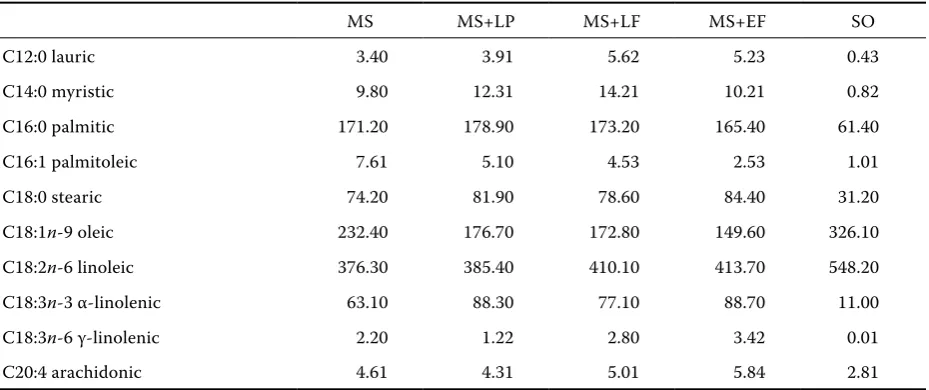
Ringer’s solution (10 ml/kg of fresh whole plant maize). The counts of inoculants decreased dur-ing the ensildur-ing of maize, and at the end of ensil-ing (105 days) the counts of inoculants were lower than 1.0 log10 CFU/g. The chemical composition of whole plant maize before ensiling was (g/kg DM): dry matter (DM): 288.3; crude protein (CP): 57.2; crude fibre (CF): 203.6; neutral detergent fibre (NDF): 515.5; acid detergent fibre (ADF): 216.4; lignin (sa) 30.1; fat: 22.8; ash: 53.6; organic mat-ter (OM): 272.9. The nutrient composition and fermentation characteristics of uninoculated and three inoculated MS after 105 days of ensiling are shown in Table 1. The fatty acid composition of MS (i.e. uninoculated and inoculated after 105 days of ensiling) is documented in Table 2.
Three rumen-fistulated Merino sheep (4 years of age; 43 ± 3.0 kg) were used. Sheep were housed separately in pens and fed a diet consisting of 700 g/kg meadow hay and 300 g/kg barley grain with free access to water. Rumen fluid (RF) was collected about three hours after the morning feed-ing, transferred to the laboratory in a water bath preheated to 39 ± 0.5°C, squeezed through four layers of gauze, combined among sheep and purged with CO2. The rumen ciliate population of sheep was A-type (Polyplastron and Ophryoscolex spp., Eadie, 1967).
Table 1. Nutrient composition and fermentation parameters in MS after 105 days of ensiling
MS MS+LP MS+LF MS+EF
DM (g/kg) 279.00 280.00 271.00 278.00
Ash (g/kg DM) 52.10 51.40 51.00 51.70
Crude protein (g/kg DM) 68.90 63.20 64.40 63.60
NDF (g/kg DM) 526.00 541.00 487.00 523.00
ADF (g/kg DM) 243.00 245.00 244.00 251.00
Fat (g/kg DM) 22.90 21.60 23.50 22.30
IVDMD (g/kg DM) 761.00 765.00 749.00 782.00
pH 3.44 3.48 3.50 3.54
Lactate (g/kg DM) 11.10 11.40 10.30 9.76
Acetate (g/kg DM) 1.68 1.85 4.60 1.82
Propionate (g/kg DM) 0.17 0.15 0.11 0.14
n-butyrate (g/kg DM) ND ND ND ND
Ammonia N (g/kg DM) 0.34 0.29 0.43 0.32
Inoculants (log10 CFU/g) NI < 1.00 < 1.00 < 1.00
ENT (log10 CFU/g) < 1.00 < 1.00 < 1.00 < 1.00
LAB (log10 CFU/g) 1.10 < 1.00 < 1.00 < 1.00
MS = maize silage; DM = dry matter; NDF = neutral detergent fibre; ADF = acid detergent fibre; IVDMD = in vitro dry mat-ter degradability; LP = Lactobacillus plantarum CCM 4000; LF = Lactobacillus fermentum LF2;EF = Enterococcus faecium CCM 4231; ENT = enterococci; LAB = lactic acid bacteria; NI = not isolated;ND = not determined
*P < 0.05; **P < 0.01; ***P < 0.001 express differences between control (MS) and inoculated MS
Table 2. Fatty acid composition of MS and sunflower oil (g/kg of FA) after 105 days of ensiling
MS MS+LP MS+LF MS+EF SO
C12:0 lauric 3.40 3.91 5.62 5.23 0.43
C14:0 myristic 9.80 12.31 14.21 10.21 0.82
C16:0 palmitic 171.20 178.90 173.20 165.40 61.40
C16:1 palmitoleic 7.61 5.10 4.53 2.53 1.01
C18:0 stearic 74.20 81.90 78.60 84.40 31.20
C18:1n-9 oleic 232.40 176.70 172.80 149.60 326.10
C18:2n-6 linoleic 376.30 385.40 410.10 413.70 548.20
C18:3n-3 α-linolenic 63.10 88.30 77.10 88.70 11.00
C18:3n-6 γ-linolenic 2.20 1.22 2.80 3.42 0.01
C20:4 arachidonic 4.61 4.31 5.01 5.84 2.81
[image:3.595.68.533.522.717.2]pumped with an automatic pump into the preheat-ed fermentation bottles containing 1.5 g (0.38 g of DM) of MS (uninoculated or inoculated). The fer-mentation bottles were filled up with CO2, closed with a butyl rubber stopper and aluminum-sealed. Eight replicate fermentation bottles of MS were used for experimental groups (MS; MS+LP; MS+LF; MS+EF). Eight replicate fermentation bottles of MS were used for experimental groups with sun-flower oil (SO; 30 g/kg of DM) additive (MS+SO; MS+LP+SO; MS+LF+SO; MS+EF+SO). ‘Blank’ fermentations (inoculum, no silage, no inoculants, and no additive) for the examination of fermenta-tion activity of media were run simultaneously. The fatty acid composition of SO is shown in Table 2. The in vitro fermentation procedure and measure-ments were performed according to Váradyová et al. (2005). Methane concentration (percentage per 1 ml of gas volume) and volatile fatty acids (VFA) in the medium at the end of the fermentation pe-riod were determined by gas chromatography us-ing a Perkin-Elmer Clarus 500 gas chromatograph (Perkin-Elmer, Inc., Shelton, CN, USA).
The samples for ciliate count were collected after 24 h. The strained rumen fluid from two replicate fermentation bottles of all treatment groups was fixed with an equal volume of 8% formaldehyde. The number of ciliate protozoa was counted mi-croscopically according to the procedure described by Coleman (1978). Protozoa were identified ac-cording to Dogiel (1927) and Ogimoto and Imai (1981). The following rumen ciliate genera and spe-cies were established: Entodinium spp., Dasytricha ruminantium, Isotricha spp., Ophryoscolex cauda-tus tricoronacauda-tus, Polyplastron multivesiculatum, Enoploplastron triloricatum, and Diplodinium denticulatum.
Chemical analyses of MS after 105 days of ensil-ing were in triplicate (Table 1). Dry matter of MS was determined by oven drying at 103°C for 16 h. Dried (60°C, 48 h) samples were analysed for NDF and ADF according to Van Soest et al. (1991) using Fibertec 2010 (Tecator Comp., Höganäs, Sweden). NDF was assayed without heat stable amylase and expressed inclusive of residual ash. ADF is expressed inclusive of residual ash (Mertens, 2002). Standard methods were used for determining ash (AOAC, 1990 No. 942 05),N (AOAC, 1990, No. 968 06) and fat (AOAC, 1990, No. 983 23). A water extract of MS was prepared by adding deionized water to 20 g of MS to achieve a total of 300 g. The water extract was measured for pH, organic acids and ammonia
N (AOAC, 1990 No. 920 03). Lactic acid and VFA (acetate, propionate, n-butyrate) were analysed by the Naumann and Bassler (1997) method.
Lipids from freeze-dried MS (after 105 days of ensiling) were extracted using the extraction-trans-esterification procedure of Sukhija and Palmquist (1988). The mixture of chloroform and methanol (2:1) was chosen as the extraction solvent. Extracted lipids were dissolved in 1 ml hexane with the inter-nal standard tridecanoic acid (C13:0) and esterifi-cation of lipids was done with 2 ml 1N methanolic sodium methoxide (30 min, 50°C) and 3 ml 3N methanolic HCl (60 min, 50°C). After centrifuga-tion at 200 × g for 5 min at laboratory temperature the samples as the upper hexane layers were used for the gas chromatographic analyses of methyl esters using a Hewlett-Packard 5890 gas chroma-tograph (Agilent Technologies, Inc., Santa Clara, CA, USA) equipped with a programmed 60 m HP-Innowa capillary column (180–240°C) and a flame ionization detector (FID).
FA outputs in uninoculated and inoculated MS with or without SO after 72 h of fermentation in RF were determined in lyophilized samples. The extraction and analysis of FA were performed as de-scribed by Váradyová et al. (2007). A Perkin-Elmer Clarus 500 gas chromatograph (Perkin-Elmer, Inc., Shelton, CN, USA) equipped with a DB-23 capillary column (60 m × 0.25 mm, film thickness 0.25 μm, Agilent Technologies, Inc., Santa Clara, CA, USA) and a FID (constant flow, hydrogen 40 ml/min, air 400 ml, 260°C) was used for the determination of FA methyl esters. Analyses of FA (0.5 μl methyl esters in hexane injected at a 30:1 split ratio) were carried out under a temperature gradient (130°C for 1 min; 130–170°C at program rate 6.5°C/1 min; 170–206°C at program rate 1°C/min; 206–240°C at program rate 34°C/min) with H2 as a carrier gas (flow 1.8 ml/min, velocity 44 cm/s, pressure 23.2 psi). The FA methyl ester peaks were identified with the commercial mixture (Supelco 37 compo-nent FAME MIX, Supelco, Bellefonte, PA, USA; trans11-vaccenic /TVA/ methyl ester, Supelco, Bellefonte, PA, USA; cis9, trans11 conjugated lino-leic acid /CLA/, Matreya, PA, USA) and quantified by the internal standard of tridecanoic acid (C13:0, Supelco, Bellefonte, PA, USA).
MS+LF, MS+LP) and two oil supplemental groups (without SO and with SO). Effects included silage (MS), oil (SO) and the interactions between MS and SO (MS × SO). Interactions between uninocu-lated and inocuuninocu-lated MS were analysed by two-way ANOVA with Bonferroni post-test. The differences between the treatment means were considered to be significant when P < 0.05.
RESULTS
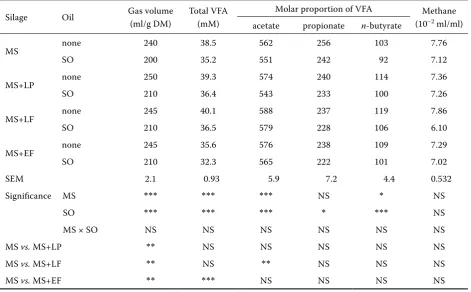
After 72 hours of fermentation in vitro the SO supplementation decreased gas production in both uninoculated and inoculated MS (Table 3). The gas production of inoculated MS with SO was higher (P < 0.01) as compared to uninoculated MS. The concentration of total VFA (P < 0.001) and mo-lar proportions of acetate (P < 0.001), propionate (P < 0.05) and n-butyrate (P < 0.001) were influ-enced by SO. The total VFA were lower (P < 0.001) with MS+EF versus MS. Compared to MS, higher
molar proportions of acetate and n-butyrate were determined for MS+LF. The methane production was not significantly influenced by SO.
SO had no significant effect on the total ciliate number and individual ciliate species (Table 4). Interactions of MS and SO (MS × SO) in the number of Isotricha spp. and Ophryoscolex caudatus tri-coronatus were detected (P < 0.05; P < 0.01). The number of Dasytricha ruminantium with MS+LP was higher (P < 0.01) as compared to MS.
[image:5.595.64.536.425.717.2]Outputs of TVA (P < 0.05) and linoleic acid (P < 0.001) were influenced by SO (Table 5). The con-centration of TVA of MS+EF was higher (P < 0.01) as compared to the MS. Outputs of CLA and α-linolenic acid were influenced by SO (P < 0.01; P < 0.001). However, interactions of MS and SO (MS × SO) in the outputs of CLA, α-linolenic and γ-linolenic were detected (P < 0.001; P < 0.05). Interactions of the MS and SO supplement (MS × SO) occurred also in the output of the majority of FA (i.e. myristic, palmitic, stearic, and oleic, respectively).
Table 3. Fermentation parameters of MS incubated in rumen fluid with either SO or without SO after 72 h of fer-mentation in vitro
Silage Oil Gas volume (ml/g DM)
Total VFA (mM)
Molar proportion of VFA Methane (10–2 ml/ml) acetate propionate n-butyrate
MS none 240 38.5 562 256 103 7.76
SO 200 35.2 551 242 92 7.12
MS+LP none 250 39.3 574 240 114 7.36
SO 210 36.4 543 233 100 7.26
MS+LF none 245 40.1 588 237 119 7.86
SO 210 36.5 579 228 106 6.10
MS+EF none 245 35.6 576 238 109 7.29
SO 210 32.3 565 222 101 7.02
SEM 2.1 0.93 5.9 7.2 4.4 0.532
Significance MS *** *** *** NS * NS
SO *** *** *** * *** NS
MS × SO NS NS NS NS NS NS
MS vs. MS+LP ** NS NS NS NS NS
MS vs. MS+LF ** NS ** NS NS NS
MS vs. MS+EF ** *** NS NS NS NS
DISCUSSION
In our previous experiments, the effect of inocu-lated grass and maize silages on rumen fermenta-tion and lipid metabolism in RUSITEC effluent was tested using the same inoculants (i.e. L. plantarum CCM 4000, L. fermentum LF2, and E. faecium CCM 4231). The inoculants used in grass silage were found to survive in higher counts contrary to low counts in maize silage (Jalč et al., 2009a,b). It is probably due to low pH in maize silage because the rumen pH has an important role in maintaining a viable environment suitable for microorganisms. It is known that the rumen pH near the neutral with a high amount of dietary linoleic acid modulates the reactions of biohydrogenation in a way that supports CLA and TVA contents in the rumen (Troegeler-Meynadier et al., 2003).
Starch in maize silage is a fermentable source of energy in contrast to grass silages where the main energy source is fermentable fibre. It is evident that the inoculants together with SO in the fermentation with MS could influence the fermentation of some products formed. In our experiment the in vitro gas production of MS (without SO) ranged from 240 to 250 ml/g DM. Chai et al. (2004) reported the gas production after 32 h of incubation with MS from 212 to 304 ml/g OM. SO decreased gas production (by 16–17%) in MS and all inoculated MS. Previous studies (Doreau et al., 1993; Jalč et al., 2006a) showed no effect or reduction of in vitro gas production in MS or forage diets with rapeseed, linseed, and fish oil. In our study, the molar propor-tion of VFA (i.e. acetate, propionate and n-butyrate) was influenced by SO. An increase of the molar proportion of propionate and a reduction of the molar proportion of acetate and n-butyrate with different oils, their blend and different diets were also reported previously (Doreau et al., 1993; Jalč et al., 2006b,c; Li and Meng, 2006). Recent studies showed that a blend of essential oils altered in vitro ruminal fermentation (Benchaar et al., 2007), how-ever, it did not affect the fermentation or aerobic stability of maize silage (Kung et al., 2008). The methane production in the present study was not affected by SO treatment. The inhibitory effect of fat on rumen methanogenesis is determined by the source and quantity of fat used (Machmüller et al., 1998; Zhang et al., 2008).
In addition, 6% of SO in the diets of sheep sub-stantially reduce protozoa in the rumen for over 84 days (Ivan et al., 2001). Unsaturated FA in plant
oils are toxic to some rumen ciliates (Ivan et al., 2004) and reductions of protozoa as a predator of bacteria in the rumen would lead to an increase in bacterial biomass. The present results showed that the number of total ciliate population and Entodinium spp. was not affected by SO after 24 h incubation in vitro. Surprisingly the growth of Dasytricha ruminantium was increased by SO in the case of MS+LF. However, Kišidayová et al. (2006) suggested that the rumen ciliates had no uniform response to oil supplements in studies in vitro. In addition, recent studies showed that rumen ciliates play an important role in causing the high CLA and TVA concentration in RF (Devillard et al., 2006; Or-Rashid et al., 2007, 2008a).
im-pacts on the levels of CLA and TVA in meat and dairy products.
It can be concluded that the supplementation of sunflower oil into inoculated and uninoculated maize silage affected in vitro gas production and VFA concentration in 72 h batch cultures, how-ever it did not affect the methane production and total ciliate number. The output of TVA was in-creased by SO supplementation especially in the case of MS+EF. The output of CLA was increased by SO only in MS+LF. Maize silage supplemented with sunflower oil seems not to be effective as di-etary antiprotozoal agents in a short-time interval, but it might positively affect the rumen bacterial population and activities. Our results show the possibilities of increasing the concentration of polyunsaturated fatty acids in rumen fluid using plant oils as a supplement to silages inoculated with some microorganisms.
Acknowledgements
The authors thank Dr. P. Siroka for the analysis of fatty acids.
REFERENCES
AOAC (1990): Official Methods of Analysis. In: Herlick K. (ed.): Association of Official Analytical Chemists.
15th ed., Arlington, USA, 1230 pp.
Abdehadia L.O., Santini F.J., Gagliostro G.A. (2005): Corn silage or high moisture corn supplements for beef heif-ers grazing temperate pastures: effects on performance,
ruminal fermentation and in situ pasture digestion.
Animal Feed Science and Technology, 118, 63–78. Beam T.M., Jenkins T.C., Moate P.J., Kohn R.A., Palmquist
D.L. (2000): Effects of amount and source of fat on the rates of lipolysis and biohydrogenation of fatty acids in ruminal contents. Journal of Dairy Science, 83, 2564–2573.
Benchaar C., Petit H.V., Berthiaume R., Ouellet D.R., Chiquette J., Chouinard P.Y. (2007): Effects of essential oils on digestion, ruminal fermentation, rumen micro-bial populations, milk production, and milk composi-tion in dairy cows fed alfalfa silage or corn silage. Journal of Dairy Science, 90, 886–897.
Chai W.Z., Van Gelder A.H., Cone J.W. (2004): Relation-ship between gas production and starch degradation in feed samples. Animal Feed Science and Technology, 114, 195–204.
Chilliard Y., Glasser F., Ferlay A., Bernard L., Rouel J., Doreau M. (2007): Diet, rumen biohydrogenation and nutritional quality of cow and goat milk fat. European Journal of Lipid Science and Technology, 109, 828–855.
Coakley M., Ross R.P., Nordgren M., Fitzgerald G., De-very R., Stanton C. (2003): Conjugated linoleic acid biosynthesis by human-derived Bifidobacterium spe-cies. Journal of Applied Microbiology, 94, 138–145. Coleman G.S. (1978): Rumen entodiniomorphid
proto-zoa. In: Taylor A.E.R., Baker J.R. (eds.): Methods of Cultivating Parasites in vitro. Academic Press, London, UK, 39–54.
Da Cruz C.R., Brouk M.J., Schingoethe D.J. (2005): Lac-tational response of cows fed condensed corn distillers solubles. Journal of Dairy Science, 88, 4000–4006. Devillard E., McIntosh F.M., Newbold C.J., Wallace R.J.
(2006): Rumen ciliate protozoa contain high concentra-tions of conjugated linoleic acid and vaccenic acid, yet do not hydrogenate linoleic acid or desaturate stearic acid. British Journal of Nutrition, 96, 697–704. Dogiel V.A. (1927): Monografie der Familie
Ophryoscol-ecidae. Archiv für Protistenkunde, 59, 1–280. Doreau M., Ferlay A., Elmeddah Y. (1993):
Organic-mat-ter and nitrogen digestion by dairy-cows fed calcium salts of rapeseed oil fatty-acids or rapeseed oil. Journal of Animal Science, 71, 499–504.
Eadie J.M. (1967): Studies on the ecology of certain rumen ciliate protozoa. Journal of General Microbiology, 49, 175–194.
Elizalde J.C., Merchen N.R., Faulkner D.B. (1999): Sup-plemental cracked corn for steers fed fresh alfalfa: I. Effects on digestion of organic matter, fiber, and starch. Journal of Animal Science, 77, 457–466.
Fievez V., Vlaeminck B., Jenkins T., Enjalbert F., Doreau M. (2007): Assessing rumen biohydrogenation and its
manipulation in vivo, in vitro and in situ. European
Jour-nal of Lipid Science and Technology, 109, 740–756. Filya I. (2003): The effect of Lactobacillus buchneri and
Lactobacillus plantarum on the fermentation, aerobic stability, and ruminal degradability of low dry matter corn and sorghum silages. Journal of Dairy Science, 86, 3575–3581.
Filya I., Sucu E. (2007): The effect of bacterial inoculants and a chemical preservative on the fermentation and aerobic stability of whole-crop cereal silages. Asian-Aus-tralasian Journal of Animal Sciences, 20, 378–384. Gulati S.K., Kitessa S. M., Ashes J.R., Fleck E., Byers E.
Ivan M., Neill L., Entz T. (2000): Ruminal fermentation and duodenal flow following progressive inoculations of fauna-free wethers with major individual species of ciliate protozoa or total fauna. Journal of Animal Sci-ence, 78, 750–759.
Ivan M., Mir P.S., Koenig K.M., Rode L.M., Neill L., Entz T., Mir Z. (2001): Effects of dietary sunflower seed oil on rumen protozoa population and tissue concentra-tion of conjugated linoleic acid in sheep. Small Rumi-nant Research, 41, 215–227.
Ivan M., Mir P.S., Mir Z., Entz T., He M.L., McAllister T.A. (2004): Effects of dietary sunflower seeds on ru-men protozoa and growth of lambs. British Journal of Nutrition, 92, 303–310.
Jalč D., Cieslak A., Szumacher-Strabel M., Potkanski A., Kowalczyk J. (2006a): The effect of different oils and di-ets on total gas production in an artificial rumen (Rusitec). Journal of Animal and Feed Sciences, 15, 145–148. Jalč D., Potkanski A., Szumacher-Strabel M., Kowalczyk
J., Cieslak A. (2006b): The effect of a forage diet and different fat sources on rumen fermentation in vitro. Journal of Animal and Feed Sciences, 15, 129–132. Jalč D., Potkanski A., Szumacher-Strabel M., Kowalczyk
J., Cieslak A. (2006c): The effect of a high forage diet and different oil blends on rumen fermentation in vitro. Journal of Animal and Feed Sciences, 15, 141–144. Jalč D., Lauková A., Váradyová Z., Homolka P., Koukolová
V. (2009a): Effect of inoculated grass silages on rumen fermentation and lipid metabolism in an artificial ru-men (RUSITEC). Animal Feed Science and Technology, 151, 55–64.
Jalč D., Váradyová Z., Lauková A., Homolka P., Jančík F. (2009b): Effect of inoculated corn silage on rumen fer-mentation and lipid metabolism in an artificial rumen (RUSITEC). Animal Feed Science and Technology, 152, 256–266.
Jalč D., Lauková A., Simonová M., Váradyová Z., Homolka P. (2009c): The use of bacterial inoculants for grass si-lage: their effect on nutrient composition and fermen-tation parameters in grass silages. Czech Journal of Animal Science, 54, 84–91.
Kišidayová S., Mihaliková K., Váradyová Z., Potkański A., Szumacher-Strabel M., Cieślak A., Čertík M., Jalč D. (2006): Effect of microbial oil, evening primrose oil, and borage oil on rumen ciliate population in artificial rumen (RUSITEC). Journal of Animal and Feed Sci-ences, 15, 153–156.
Koc F., Coskuntuna L., Ozduven L. (2008): The effect of bacteria + enzyme mixture silage inoculant on the fer-mentation characteristics, cell wall contents and aero-bic stabilities of maize silage. Pakistan Journal of Animal Science, 7, 222–226.
Kozakai K., Nakamura T., Kobayashi Y., Tanigawa T., Osaka I., Kawamoto S., Hara S. (2007): Effect of me-chanical processing of corn silage on in vitro ruminal fermentation, and in situ bacterial colonization and dry matter degradation. Canadian Journal of Animal Science, 87, 259–267.
Kung L., Williams P., Schmidt R.J., Hu W. (2008): A blend of essential plant oils used as an additive to alter silage fermentation or used as a feed additive for lactating dairy cows. Journal of Dairy Science, 91, 4793-4800. Li Y.L., Meng Q.X. (2006): Effect of different types of fibre
supplemented with sunflower oil on ruminal fermenta-tion and producfermenta-tion of conjugated linoleic acids in vitro. Archives of Animal Nutrition, 60, 402–411. Machmüller A., Ossowski D.A., Wanner M., Kreuzer M.
(1998): Potential of various fatty feeds to reduce
meth-ane release from rumen fermentation in vitro
(RUSITEC). Animal Feed Science and Technology, 71, 117–130.
Marciňáková M. (2006): Probiotic microorganisms in the feed and the digestive tract of animals and their role in prevention, [PhD. Thesis.] Košice, SR, 1–145. McDougall E.J. (1948): Studies on ruminant saliva. 1. The
composition and output of sheep’s saliva. Biochemical Journal, 43, 99–109.
Mertens D.R. (2002): Gravimetric determination of amy-lase-treated neutral detergent fibre in feeds with reflux-ing beakers or crucibles: collaborative study. Journal of the Association of Official Analytical Chemists In-ternational, 85, 1217–1240.
Mosley E.E., Powell G.L., Riley M.B., Jenkins T.C. (2002): Microbial biohydrogenation of oleic acid to trans isomers in vitro. Journal of Lipid Research, 43, 290–296.
Naumann C., Bassler R. (1997): Methodenbuch. Band III. Die chemische Untersuchung von Futtermitteln. VD-LUFA-Verlag, Darmstadt, Germany, 1–6.
Ogimoto K., Imai S. (1981): Atlas of Rumen Microbiology. Japan Scientific Societies Press, Tokyo, 231 pp. Or-Rashid M.M., Odongo N.E., McBride B.W. (2007):
Fatty acid composition of ruminal bacteria and proto-zoa, with emphasis on conjugated linoleic acid, vac-cenic acid, and odd-chain and branched-chain fatty acids. Journal of Animal Science, 85, 1228–1234. Or-Rashid M.M., AlZahal O., McBride B.W. (2008a):
Studies on the production of conjugated linoleic acid from linoleic and vaccenic acids by mixed rumen pro-tozoa. Applied Microbiology and Biotechnology, 81, 533–541.
composition in cattle. Journal of Animal Science, 86, 187–196.
Ribeiro C.V.D.M., Karnati S.K.R., Eastridge M.L. (2005): Biohydrogenation of fatty acids and digestibility of fresh alfalfa or alfalfa hay plus sucrose in continuous culture. Journal of Dairy Science, 88, 4007–4017. Saarisalo E., Skyttä E., Haikara A., Jalava T., Jaakkola S.
(2007): Screening and selection of lactic acid bacteria strains suitable for ensiling grass. Journal of Applied Microbiology, 102, 327–336.
Sieber R., Collomb M., Aeschliemann A., Jelen P., Eyer H. (2004): Impact of microbial cultures on conjugated linoleic acid in dairy products – a review. International Dairy Journal, 14, 1–15.
Sucu E., Filya I. (2006): Effects of homofermentative lac-tic acid bacterial inoculants on the fermentation and aerobic stability characteristics of low dry matter corn silages. Turkish Journal of Veterinary and Animal Sci-ences, 30, 83–88.
Sukhija P.S., Palmquist D.L. (1988): Rapid method for the determination of total fatty acid content and composi-tion of feedstuffs and faeces. Journal of Agricultural and Food Chemistry, 36, 1202–1206.
Troegeler-Meynadier A., Nicot M.C., Bayourthe C., Mon-coulon R., Enjalbert F. (2003): Effects of pH and con-centrations of linoleic and linolenic acids on extent and intermediates of ruminal biohydrogenation in vitro. Journal of Dairy Science, 86, 4054–4063.
Van Soest P.J., Robertson J.B., Lewis B.A. (1991): Methods for dietary fiber neutral detergent fiber, and non-starch polysaccharides in relation to animal nutrition. Journal of Dairy Science, 74, 3583–3597.
Váradyová Z., Baran M., Zeleňák I. (2005): Comparison of two in vitro fermentation gas production methods using both rumen fluid and faecal inoculum from sheep. Animal Feed Science and Technology, 123–124, 81–94.
Váradyová Z., Kišidayová S., Siroka P., Jalč D. (2007): Fatty acid profiles of rumen fluid from sheep fed diets supple-mented with various oils and effect on the rumen cili-ate population. Czech Journal of Animal Science, 52, 399–406.
Weinberg Z.G., Chen Y., Gamburg M. (2004): The passage of lactic acid bacteria from silage into rumen fluid, in vitro studies. Journal of Dairy Science, 87, 3386–3397. Zhang C.M., Guo Y.Q., Yuan Z.P., Wu Y.M., Wang J.K.,
Liu J.X., Zhu W.Y. (2008): Effect of octadeca carbon fatty acids on microbial fermentation, methanogenesis and microbial flora in vitro. Animal Feed Science and Technology, 146, 259–269.
Received: 2009–06–04 Accepted after corrections: 2009–09–26
Corresponding Author
Zora Váradyová, DVM, PhD., Institute of Animal Physiology, Slovak Academy of Sciences, Šoltésovej 4-6, 040 01 Košice, Slovak Republic